W. Joseph Campbell

Posts Tagged ‘Getting It Wrong’

The ‘Johnson White House reeled’? Not because of Cronkite

In Cronkite Moment, Debunking, Media myths on December 19, 2009 at 12:56 pm

The AOL Television online site today recalls as a “TV moment of 2009” the death five months ago of Walter Cronkite, the famous CBS News anchorman.

The AOL Television post recalls the so-called “Cronkite Moment” of 1968, when the anchorman’s downbeat assessment about the U.S. military effort in Vietnam was said to have had immediate and stunning effects on President Lyndon Johnson and his war policy.

The AOL post says of Cronkite: “In 1968, after extensive on-the-ground reporting, he advocated the withdrawal of American troops from Vietnam. The Johnson White House reeled.”

Reeled?

Hardly.

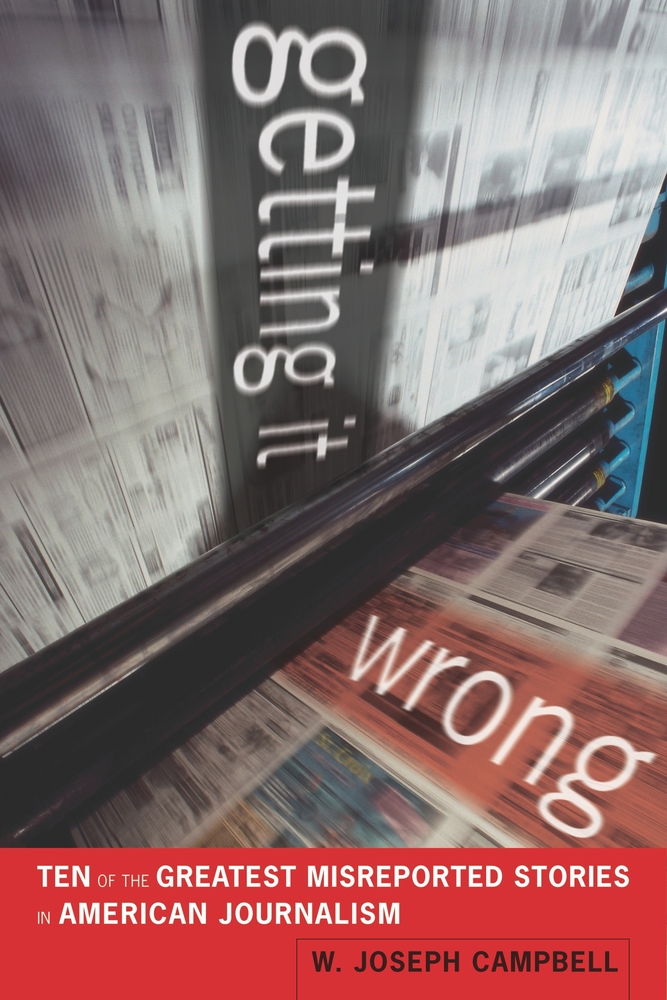
As I write in my forthcoming book, Getting It Wrong:

“Scrutiny of the evidence associated with the program reveals that Johnson did not have—could not have had—the abrupt yet resigned reaction that so often has been attributed to him. That’s because Johnson did not see the program when it was aired” on February 27, 1968.
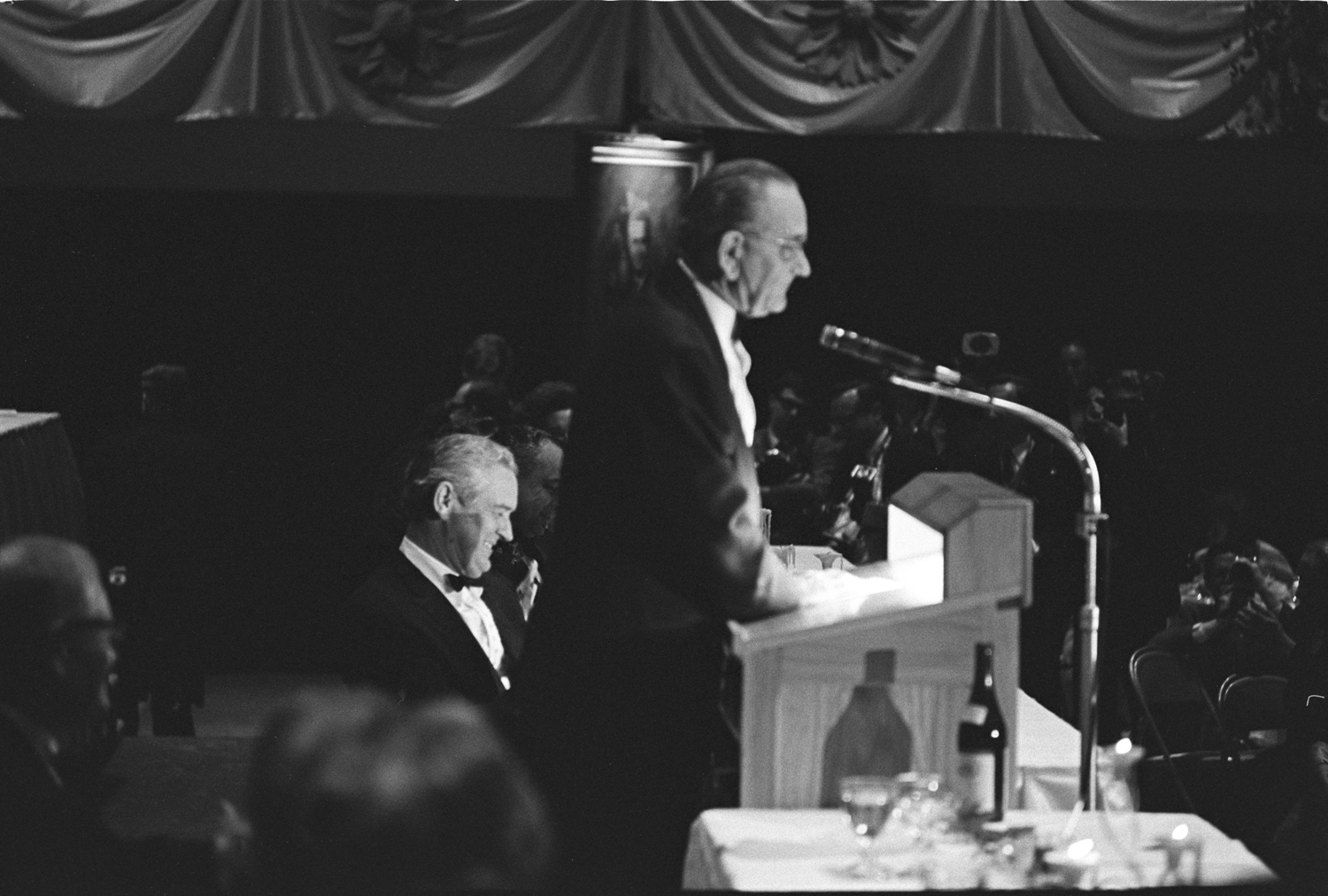
Lyndon Johnson at Connally's birthday party

Johnson then was in Austin, Texas, engaging in light-hearted banter at a black-tie party for Governor John Connally. “Today you are 51, John,” the president said in Austin, at about the time the Cronkite program was ending.

“That is the magic number that every man of politics prays for—a simple majority. Throughout the years we have worked long and hard—and I might say late—trying to maintain it, too.”

Even if he later heard—or heard about— Cronkite’s assessment, it represented no epiphany for Johnson. Indeed, soon after the Cronkite program, the president gave a rousing, lectern-pounding speech in which he urged a “total national effort” to win the war in Vietnam.

So Cronkite’s program scarcely was decisive to American war policy. It certainly did not send the Johnson White House reeling.

It is noteworthy to recall that Cronkite in his program on Vietnam did not urge the immediate withdrawal of U.S. forces.

He hedged, holding open the possibility that the U.S. military efforts might still force the North Vietnamese to the bargaining table. Cronkite suggested the U.S. forces be given a few months more to press the fight in Vietnam, in the wake of the communists’ surprise Tet offensive, stating:

“On the off chance that military and political analysts are right, in the next few months we must test the enemy’s intentions, in case this [Tet offensive] is indeed his last big gasp before negotiations. But it is increasingly clear to this reporter that the only rational way out then will be to negotiate, not as victors, but as an honorable people who lived up to their pledge to defend democracy, and did the best they could.”

What’s more, Cronkite’s assessment was scarcely exceptional or extraordinary.

In his year-study about 1968, Mark Kurlansky wrote that Cronkite’s view was “hardly a radical position” for the time.

Four days before the Cronkite program, the Wall Street Journal said in an editorial that the U.S. war effort in Vietnam “may be doomed” and that “everyone had better be prepared for the bitter taste of defeat beyond America’s power to prevent.” And nearly seven months before the Cronkite program, New York Times correspondent R.W. Apple Jr. cited “disinterested observers” in reporting that the war in Vietnam “is not going well.”

Victory, Apple wrote, “is not close at hand. It may be beyond reach.”

WJC

The ‘new yellow journalism’? Hardly

In Debunking, Media myths, Spanish-American War, Yellow Journalism on December 18, 2009 at 3:52 pm

The blog Secondhand Smoke yesterday likened coverage of the global warming debate to “a new yellow journalism,” arguing:

“When journalists so emotionally choose sides, they cease to be journalists.”

The blog author may be right about U.S. media coverage of the global warming phenomenon. It’s hardly been searching, or challenging, in any sustained way.

But he’s quite incorrect in saying the coverage represents “a new yellow journalism” (which he vaguely defines as “using all the tricks of the trade to panic the world into granting tremendous power to an unelected and unaccountable global warming scientocracy, that will ‘save the planet’ via anti human and economy  killing policies”).

Yellow journalism, he further writes, “helped push the USA into war back in the 1890s.”

Well, that’s a media myth. A delicious and enduring one, too.

As I wrote in my 2001 book, Yellow Journalism: Puncturing the Myths, Defining the Legacies:

William Randolph Hearst in 1896

“The yellow press is not to blame for the Spanish-American-War. It did not force—it could not have forced—the United States into hostilities with Spain over Cuba in 1898. The conflict was, rather, the result of a convergence of forces far beyond the control or direct influence of even the most aggressive of the yellow newspapers, William Randolph Hearst’s New York Journal.”

I also wrote that claims that the yellow press fomented the war “are exceedingly media-centric, often rest on the selective use of evidence, and tend to ignore more relevant and immediate factors that give rise to armed conflict.

“In the case of the Spanish-American War, the policy objectives between the United States and Spain ultimately proved irreconcilable. Months of intricate diplomatic efforts ultimately failed to resolve what had become an intolerable state of affairs in Cuba, dramatized by the destruction of the Maine in [February 1898] in a harbor under Spanish control and supervision. To indict the yellow press for causing the Spanish-American War is to misread the evidence and to ignore the intricacies of the diplomatic quandary that culminated in the spring of 1898 in an impasse that led to war.”

Yellow journalism has been equated (as Secondhand Smoke suggests) to lurid and sensational treatment of the news. It’s often the term of choice for egregious journalistic misconduct of almost any kind. And sometimes, yellow journalism is seen as synonymous with Hearst, himself.

None of those shorthand characterizations is adequate, revealing, or very accurate. None of them captures the genre’s complexity and vigor.

As practiced in the late 19th century, yellow journalism was defined by these features and charactersitics:

  • the frequent use of multicolumn headlines that sometimes stretched across the front page.
  • a variety of topics reported on the front page, including news of politics, war, international diplomacy, sports, and society.
  • the generous and imaginative use of illustrations, including photographs and other graphic representations such as locator maps.
  • bold and experimental layouts, including those in which one report and illustration would dominate the front page. Such layouts sometimes were enhanced by the use of color.
  • a tendency to rely on anonymous sources, particularly in dispatches of leading reporters.
  • a penchant for self-promotion, to call attention frequently to the newspaper’s accomplishments. This tendency was notably evident in crusades against monopolies and municipal corruption.

As so defined, yellow journalism certainly could not be called predictable, boring, or uninspired—complaints of the sort that are frequently raised about U.S. newspapers of the early twenty-first century.

Jack Shafer, the inestimable media critic at slate.com, put it well in a column early this year:

“I wish our better newspapers availed themselves of some of the techniques of yellow journalism and a little less of the solemnity we associate with the Committee of Concerned Journalists.” Well said.

WJC


Too bad it’s only in French: A neat little book of impressive debunking

In Debunking, Media myths on December 17, 2009 at 3:21 pm

Talk about heavy-duty debunking.

The Times of London not long ago posted an item at one of its blogs about a book published last month that challenges the veracity of well-known quotes attributed to French rulers and intellectuals.

The book, Le Petit inventaire des citations malmenées (or, roughly, the Small  inventory of abused quotations), calls into question such famous lines as Louis XIV’s  “L’état c’est moi,”  Louis XV’s “Après moi le déluge,” and Queen Marie Antoinette’s “Qu’ils mangent de la brioche” (let them eat cake).

As described by Charles Bremner, the Times‘ correspondent in Paris in a blog posting late last month, “Those famous royal remarks are among dozens of misattributed, misunderstood and outright false quotations in a fun little book just published by two academics,” Paul Desalmand and Yves Stallini.

Bremner writes that the authors “delight in knocking down famous lines that were outright invented or wrongly attributed to great figures of the past. They blame lazy journalists and historians for populari[z]ing dodgy quotes and making them up because they sound right.”

Lazy journalists: Seems right.

Journalists can be quite eager to invoke famous quotes that “sound right” or are simply too good to check out. Too delicious not to be true.

The long-lived but almost certainly apocryphal remark attributed to William Randolph Hearst, “You furnish the pictures, I’ll furnish the war,” comes readily to mind.

So does the comment attributed to President Lyndon Johnson, “If I’ve lost Cronkite, I’ve lost Middle America.” Johnson supposedly made the remark after watching Walter Cronkite’s special report on Vietnam in February 1968. As is discussed in my forthcoming book, Getting It Wrong, Johnson did not see the program when it aired.

And Hearst denied ever having vowed to “furnish the war” between the United States and Spain.

In its review, the Parisian daily Le Monde calls Le Petit inventaire des citations malmenées “clever” as well as “instructive and amusing. Also sad, sometimes.”

The book, Bremner further notes, challenges the quote attributed to King Henri IV, “Paris vaut bien une messe” [Paris is well worth a mass]. “No trace of this legendary quip by the ex-protestant king can be found in historical records,” Bremner writes, adding that authors Desalmand and Stallini “suggest that it may have been invented by enemies of the popular 16th century ruler who switched to Catholicism in order to have the crown.”

Le Petit inventaire des citations malmenées sounds like a neat little book of impressive debunking. It runs 188 pages, but hélas, is available only in French.

WJC

‘Most famous words in American journalism’? Probably not

In 1897, Cronkite Moment, Media myths, New York Sun on December 15, 2009 at 10:16 am

In a blog post today, Followthemedia.com says the “Yes, Virginia” passage in the  1897 editorial “Is There A Santa Claus?” are “the most famous words in American journalism.”

And it takes Macy’s to task for its Christmas season “Believe” campaign, a sappy promotion that capitalizes on the editorial and its inspiration, Viriginia O’Hanlon. She was the 8-year-old girl whose letter to the New York Sun asking about the exisitence of Santa Claus prompted the famous editorial.

Followthemedia.com says:

“We know this a is a tough retail year but Is nothing sacred – last week Macy’s, the giant US department store chain, enticed women named Virginia into its stores by offering $10 gift certificate as part of its ‘Believe’ campaign based on the most famous words in US journalism, ‘Yes, Virginia, there is a Santa Claus.'”

It adds:

“The company hasn’t said how many certificates it gave out, but it estimated there are more than 500,000 Virginias in the US, and it did try to expand the base by saying first, middle or last names would all be ok. And it really was all in a good cause – to bring people into the store to deliver letters to Santa Claus and for each letter delivered the store donated $1 to the Make-A-Wish charity.

“Of course it would never  enter the minds of store executives that once having enticed people into the store they might linger somewhat and actually do some shopping there? Ah, we just have to stop being so cynical at this time of good cheer!”

Cynicism aside, followthemedia.com raises an interesting point about “the most famous words in American journalism.” Are those words really, “Yes, Virginia, there is a Santa Claus?”

I’m not so sure.

The “Yes, Virginia,” passage is invoked so often, and in so many contexts, that no longer is it readily associated with American journalism. “Yes, Virginia,” long ago became unmoored from its original context, the third of three columns of editorials in the New York Sun on September 21, 1897.

Media-driven myths have propelled other phrases into what is arguably greater renown in American journalism.

Getting It Wrong: Forthcoming 2010

The quote attributed to William Randolph Hearst — “You furnish the pictures, I’ll furnish the war” — may even be more famous than “Yes, Virgina?” As I write in my forthcoming book, Getting It Wrong, the Hearst quote is almost certainly is apocryphal. But it lives on as a comment too rich and too delicious not to be true.

The same goes for the comment often attributed to President Lyndon Johnson, after watching a CBS News special in late February 1968 in which anchorman Walter Cronkite declared the U.S. war effort in Vietnam was mired in stalemate.

Johnson, supposedly, had the sudden revelation that the war was now hopeless and turned to an aide and said, “If I’ve lost Cronkite, I’ve lost middle America.” Or words to that effect. Words that may be more famous and more directly tied to journalism than “Yes, Virginia.”

But the Cronkite-Johnson anecdote is exaggerated, too, as Getting It Wrong discusses. Johnson did not see the program when it aired. And in the days and weeks immediately following the Cronkite program, Johnson continued hawkish calls for national sacrifice to win the war in Vietnam.

Even Cronkite, for many years, said he didn’t believe his comments had much effect on Johnson. Late in his life, though, Cronkite came to embrace the supposed power of the program on Vietnam.

He told Esquire magazine in 2006: “To be honest, I was rather amazed that my reporting from Vietnam had such an effect on history.”

But it didn’t, really.

WJC

The myths of ‘Yes, Virginia’

In Media myths, New York Sun on December 10, 2009 at 2:33 pm

The media relations folks at American University posted at the Newswise public relations site today a rundown about my research into myths surrounding American journalism’s best-known, most-reprinted editorial, “Is There A Santa Claus?”

Viriginia O'Hanlon

The editorial, an endearing if cerebral tribute to childhood and the Christmas spirit, was published in the New York Sun in September 1897, in reply to the query of an 8-year-old girl, Virginia O’Hanlon, who asked in a letter, “Is there a Santa Claus?”

The back story to the famous editorial is discussed in detail in my 2006 book, The Year That Defined American Journalism: 1897 and the Clash of Paradigms.

The post at Newswise notes the editorial’s enduring appeal and adds:

“This year, Macy’s and the CBS television network are cosponsoring an animated children’s program about Virginia O’Hanlon ….” The show is to air at 8 p.m. tomorrow.  I will discuss the program afterward at Media Myth Alert.

The Newswise item also points out:

“Most people assume the editorial was an immediate hit when first published in 1897 and that the Sun enthusiastically reprinted it every year at Christmastime until the newspaper folded in 1950. Not true, said W. Joseph Campbell, a journalism professor and an expert on media myths at American University.”

Indeed, my research shows that the famous editorial was reluctantly embraced by the Sun. A painstaking review of the newspaper’s year-end issues from 1897 to 1949, or just before the Sun went out of business in 1950, shows that  in the ten years from 1898–1907, “Is There A Santa Claus?” was reprinted in the Sun at Christmastime only twice.

The first time was in 1902 and on that occasion, the Sun did so with a hint of annoyance, stating:

“Since its original publication, the Sun has refrained from reprinting the article on Santa Claus which appeared several years ago, but this year requests for its reproduction have been so numerous that we yield.” The newspaper added a gratuitous swipe: “Scrap books seem to be wearing out.”

It next reprinted the editorial in 1906, eight months after the death of the editorial’s author, Francis P. Church.

The Sun then said it was reprinting the editorial “at the request of many friends of the Sun, of Santa Claus, of the little Virginias of yesterday and to-day, and of the author of the essay, the late F.P. Church.”

Not until the early 1920s did the editorial begin appearing without fail in the Sun at Christmastime.

WJC

Jessica Lynch: One of the ‘buzziest’?

In Jessica Lynch, Media myths, Washington Post on December 8, 2009 at 12:17 pm

NBC’s Today show yesterday featured Jessica Lynch, perhaps the best-known American soldier of the Iraq War, as central figure of one of the decade’s  “buzziest” news stories.

Buzziest.”

That’s how the Lynch segment was introduced.

It was a brief report (see transcript here), in which Lynch talked about her life since she was catapaulted to sudden, unsought fame in the first days of the war in Iraq.  Lynch then was a private, a supply clerk in the Army’s 507th Maintenance Company.

On March 23, 2003, elements of the 507th were ambushed by Iraqi irregulars in the southern city of Nasiriyah.  Lynch was badly injured in the crash of her Humvee and was taken prisoner.

Nine days later, she was rescued from a hospital in Nasiriyah by a U.S. special operations unit.

The Washington Post's front page report about Jessica Lynch

Two days after that, the Washington Post published a sensational account on its front page, reporting that Lynch had “fought fiercely” in Nasiriyah and had “shot several enemy soldiers after Iraqi forces ambushed” her unit, “firing her weapon until she ran out of ammunition.”

The Post‘s report cited “U.S. officials” who otherwise were unidentified as saying that Lynch had “continued firing at the Iraqis even after she sustained multiple gunshot wounds and watched several other soldiers in her unit die around her in fighting March 23.” One official was quoted anonymously as saying:

“‘She was fighting to the death. She did not want to be taken alive.'”

It was a great story, one picked up by news outlets across the United States and around the world.

Only it wasn’t true.

The Post‘s report not only was grievously in error;  it became the launchpad for a tenacious media-driven myth, one that the Today show yesterday helped promote.

Meredith Vieira, the Today show personality who interviewed Lynch, described her as “a pawn of the military that was trying to sell, some said, a war to the American public.”

In reality, though, the U.S. military did little to promote the hero-warrior story about Lynch, who then was 19-years-old. The Lynch case is discussed in a chapter in my forthcoming book, Getting It Wrong .

One of the authors of the Post‘s erroneous report, Vernon Loeb, told an NPR radio program in late 2003 that “the Pentagon … wouldn’t say anything about Jessica Lynch.”

Loeb also said: “I just didn’t see the Pentagon trying to create a hero where there was none.”

Even so, the notion that the military promoted a phony hero-warrior lives on, and has become a central element of the narrative about the Lynch case.

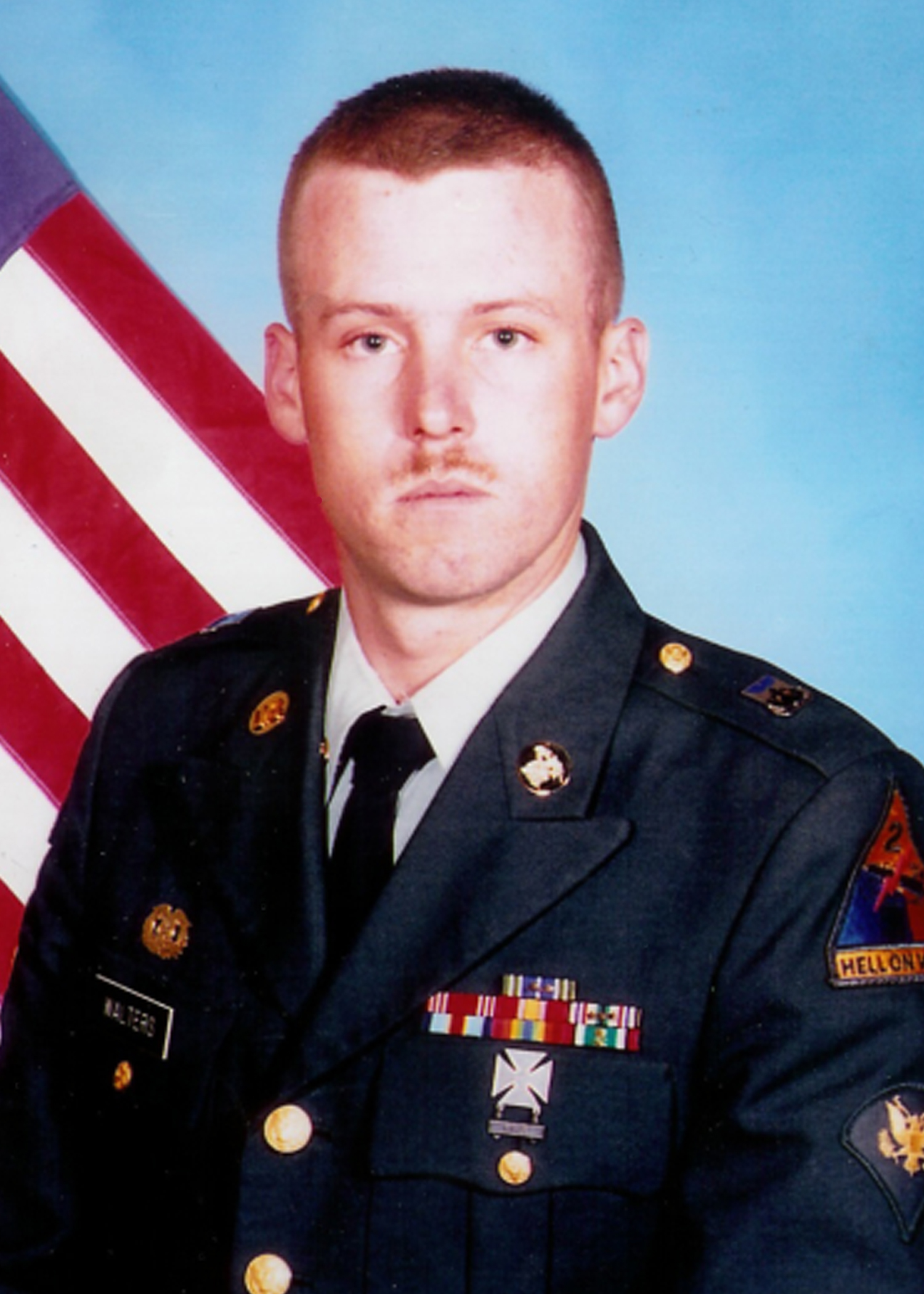
The hoopla over Jessica Lynch in the first days of the Iraq War had another, lasting effect: That of obscuring recognition of an Army sergeant named Donald Walters who did fight to the death at Nasiriyah.

Walters’ heroics were mistakenly attributed to Lynch, apparently because of faulty translation of Iraqi battlefield reports.

Sgt. Donald Walters

Walters stayed behind as the ambushed 507th tried to flee  Nasiriyah. He was captured when his ammunition ran out and was executed. His body was recovered the day Lynch was rescued from the hospital in Nasiriyah.

Walters’ actions, when they became known, attracted little more than passing interest from the American news media.

And not surprisingly, they were not mentioned yesterday on the Today show’s “buzziest” segment.

Nor did Today point out that the Lynch myth took hold because of over-the-top reporting in the Washington Post. The segment contained nary a word about that.

WJC

Related:

Cronkite Moment: What Johnson supposedly said

In Cronkite Moment, Media myths on December 6, 2009 at 12:35 pm

A guest columnist for the Lancaster Eagle Gazette in Ohio today offers a new version of President Lyndon Johnson’s famous comment,  supposedly made in response to Walter Cronkite’s dire assessment in 1968 about the war in Vietnam.

As the story goes, Johnson watched the special televsion program that Cronkite prepared in the aftermath of the North Vietnamese communists’ Tet offensive in February 1968. Cronkite said the U.S. war effort had become “mired in stalemate.” And he closed program by suggesting the time had come to consider opening negotiations to end the war.

For Johnson, Cronkite’s report supposedly was an epiphany. The president realized that the war was all but lost and uttered in dismay:

“If I’ve lost Cronkite, I’ve lost Middle America.”

Other versions have Johnson saying: “If I’ve lost Cronkite, I’ve lost the country.”

Or, “If I’ve lost Cronkite, I’ve lost the American people.”

Or, “If I’ve lost Cronkite, I’ve lost the war.”

The guest columnist in the Lancaster paper has Johnson as saying: “If we lose Cronkite, we lose America.”

What I call acute version variability dogs this anecdote — and it’s one of the indicators that the story is  a media-driven myth. Version variability of  such magnitude is a signal of implausibility. And it’s a marker of a media myth.

As I write in my forthcoming book, Getting It Wrong, the famous, often-cited Cronkite-Johnson anecdote is almost assuredly a media myth.

For starters, Johnson did not see the program when it was aired. He was in Austin, Texas, at the time, offering light-hearted comments at a birthday party for Governor John Connally.

Johnson at Connally's birthday party

Moreover, Johnson’s supposedly downbeat reaction to Cronkite’s on-air assessment about Vietnam clashes sharply with the president’s aggressive characterization about the war. Only hours before the Cronkite program aired, Johnson was in Dallas, Texas, where he delivered a little-recalled but rousing speech on Vietnam, a speech cast in Churchillian terms.

It seems inconceivable that Johnson’s views would have changed so swiftly, so  dramatically, upon hearing the opinions of a television news anchor.

Even if Johnson later heard—or heard about— Cronkite’s assessment, it represented no epiphany. Not long after the Cronkite program, Johnson gave a rousing, lectern-pounding speech in which he urged a “total national effort” to win the war in Vietnam.

No, the Cronkite program in late February 1968 prompted no great change. Nor did it prompt any famous presidential utterances.

WJC

Kennedy took responsibility?

In Bay of Pigs, Media myths on November 28, 2009 at 11:09 am

Leslie Gelb, a former columnist for the New York Times and president emeritus of the Council on Foreign Relations, says President Obama’s recent Asia trip was so thin on accomplishment that it revealed a “disturbing amateurishness in managing America’s power.”

Gelb, writing at the Daily Beast blog, also says Obama “should stare hard at the skills of his foreign-policy team and, more so, at his own dominant role in decision-making.” He further suggests that “Obama might take responsibility himself, as President Kennedy did after the Bay of Pigs fiasco in 1961.”

There’s no argument here with Gelb’s assessment about Obama’s foreign policy. It projects a decided whiff of amateurishness, indeed.

But on the point about Kennedy’s having taken responsibility for the Bay of Pigs debacle: Well, there’s a whiff of media myth in that claim.

As I write in my forthcoming book, Getting It Wrong, Kennedy in the aftermath of the failed Bay of Pigs invasion of Cuba, sought to spread the blame to the U.S. news media, particularly the New York Times. On separate occasions in 1961 and 1962, Kennedy told the Times publisher and its managing editor that had the newspaper printed all it knew about the pending invasion, the country and his administration would have been spared a major foreign policy embarrassment. That is, the pre-invasion publicity would have made an assault untenable.

But as James (Scotty) Reston, the veteran Times columnist and correspondent in Washington, correctly noted, Kennedy’s comments were “a cop-out.”

The decision to press ahead with the attempt to topple Fidel Castro rested squarely with the Kennedy administration.

Kennedy’s comments, made to Publisher Orvil E. Dryfoos and Managing Editor Turner Catledge, had the effect of solidifying the media-driven myth that the Times had censored itself in reporting about the run-up to the invasion.

The purported self-censorship took place in the days before the invasion, which failed utterly in its objective of toppling Castro.

But close reading of the newspaper in early April 1961 makes it clear that the Times did not spike it reports about the pending invasion of Cuba. The newspaper did not censor itself. The Times’ coverage about preparations for the assault was in fact fairly detailed and prominently displayed on front pages in the days before the invasion force of Cuban exiles hit the beaches.

The related notion that Kennedy asked or persuaded the Times to suppress, hold back, or dilute any of its reports about the pending Bay of Pigs invasion also is utter fancy.

But the anecdote about the Times’ self-censorship lives on as a timeless lesson about why the news media should not bow or defer to power. It’s a potent, durable, and compelling tale.

It’s also apocryphal.

WJC

Debunking the debunking

In Media myths, Yellow Journalism on November 20, 2009 at 3:04 pm

There’s undenial appeal in busting myths.

As I write in Getting It Wrong, my forthcoming book on media-driven myths, “Debunking can be an entertaining and even faintly mischievous pursuit.”

A hint of that appeal can be detected in a commentary posted recently at fairfieldweekly.com, the online site of a free weekly newspaper in Connecticut.

The author writes: “In recent weeks, while researching a publishing project on the myths of American history, I have combed through an unending supply of stories that, upon closer scrutiny, simply do not hold, or even add, up.”

He says “the swiftness with which Americans are willing to accept, believe and disseminate myths would be touching if it wasn’t so dangerous.”

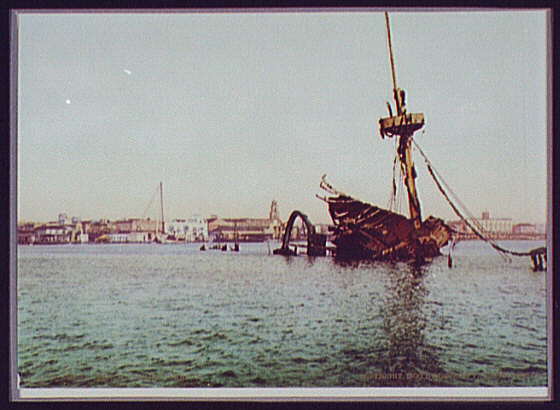
To illustrate that point, he cites “the sinking of the battleship Maine, the immediate cause of the Spanish-American War. The explosion was caused by a fire in the ammunition hold, not by Spanish sabotage. Doesn’t matter; we wanted the war, so [William Randolph] Hearst sold the sabotage myth to the American people, they quickly bought it hook, line and sinker, and we ended up an empire.”

Wreckage of the Maine, 1898 (Library of Congress)

In addressing a purported myth, the author indulges in and reiterates another, even more profound myth — that Hearst’s coverage of the Maine‘s destruction in Havana harbor in early 1898 was decisive to the U.S. declaration of war against Spain.

It’s a tempting and very tidy explanation about why the United States went to war. But it’s decidedly in error.

As I wrote in Yellow Journalism: Puncturing the Myths, Defining the Legacies (2001),  Hearst and his newspapers are “not to blame for the Spanish-American-War.” They did not force—they could not have forced—the United States into hostilities with Spain over Cuba in 1898.

The destruction of the Maine may have focused American public opinion on Cuba, but it was scarcely the principal reason in the decision to go to war.

Rather, the conflict was result of a convergence of forces that were far beyond the control or influence of Hearst and his papers.

The war with Spain was the consequence of a prolonged, three-sided impasse: Spain, for domestic political reasons, could not agree to grant independence for Cuba. The rebel movement in Cuba, which had been fighting Spanish forces for three years before the United States declared war, would accept nothing less than independence. And the United States, for political and economic reasons, could tolerate no longer the disruption and the human rights abuses caused by Spain’s harsh and ineffective efforts to put down the rebellion.

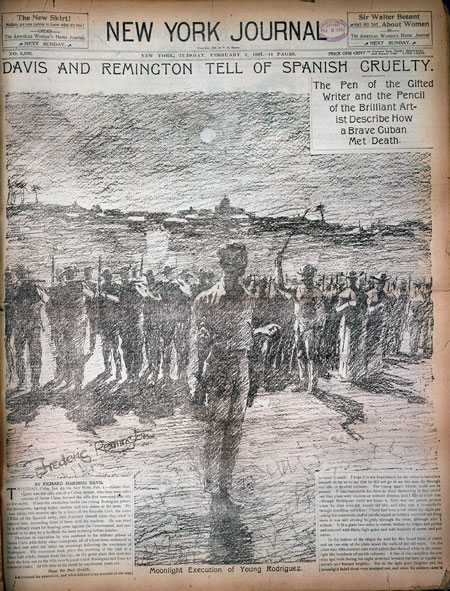
A Cuban rebel executed by Spanish firing squad, 1897

By early 1898, the Spanish had forced thousands and thousands of Cuban non-combatants — women, children, and old men — into garrison towns, in an attempt to deprive the rebels of support. Many thousands of these civilians died of disease and malnutrition, at what the Spanish called “reconcentration” centers.

This human rights disaster was well-known to, and often a topic of coverage by, U.S. newspapers, including Hearst’s. In many respects, the U.S. war with Spain was a humanitarian crusade, to end the abuses on Cuba.

In addition, there is no agreement among historians that the Maine blew up because of “a fire in the ammunition hold.” A study commissioned by the National Geographic Society and released in 1998 reports that chemical analysis pointed to an external source, such as an underwater mine, as the cause of the deadly explosion that destroyed the battleship.

WJC

Hat tip to the Observer

In Media myths on November 12, 2009 at 3:37 pm

A tip of the chapeau to the American University journalism graduate students and their fine online magazine, American Observer.

The Observer‘s staff this week posted a short article about “Media Myth Alert.”

My thanks. WJC