W. Joseph Campbell

Posts Tagged ‘Getting It Wrong’

Akin to the Lynch case?

In Jessica Lynch on November 12, 2009 at 3:16 pm

The New York Times says that initial reports of an Army sergeant’s heroism in the Fort Hood shootings appear “to be inaccurate.” Another sergeant, the Times reports, apparently “fired the shots that brought down the rampaging gunman,” an Army major named Nidal Malik Hasan.

“The confusion over what happened and the quickness of the military to label someone a hero” is reminiscent, the Times says, “of the case of Pfc. Jessica Lynch in 2003, when the Army initially reported Private Lynch had been captured in Iraq after a Rambo-like performance in which she emptied her weapon and was wounded in battle. It was later learned she had been badly hurt in a vehicle accident during an ambush and was being well cared for by the Iraqis.”

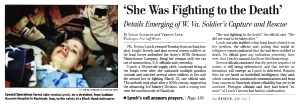
The erroneous report about Lynch’s heroics in fighting Iraqi irregulars was published by the Washington Post in early April 2003 and picked up by news organizations around the world. The Post‘s report was placed on its front page beneath the headline, “‘She was fighting to the death.'”

Lynch_Post_front_300_clean

The Washington Post and Jessica Lynch

The international hoopla over Lynch’s purported heroics effectively obscured the deeds of an Army cook, Sergeant Donald Walters, who apparently did fight Iraqi irregulars “to the death.” Walters was captured when his ammunition ran out, and executed. As is discussed in my forthcoming book Getting It Wrong, Walters’ story attracted nowhere near the attention of the erroneous reports about Lynch, who was then 19-years-old.

Getting It Wrong also challenges the view, which is widely held and was reiterated by the Times, that the U.S. military pushed the Lynch-heroics story. One of the authors of the Post‘s “Fighting to the death” article has said the military wasn’t the source for the story.

WJC

A ‘Cronkite Moment’ sighting

In Cronkite Moment, Media myths on November 12, 2009 at 8:25 am

A commentary posted recently at the American Thinker online site invokes the hardy myth of the “Cronkite Moment,” which stems from Walter Cronkite’s pronouncement in late February 1968 about the war in Vietnam.

At the close of a special televised report, Cronkite, the CBS News anchor, declared that the U.S. military was “mired in stalemate” in Vietnam and suggested that negotiations eventually would have to be opened with the North Vietnamese.

As the American Thinker item notes, Cronkite’s dire assessment supposedly prompted President Lyndon Johnson to declare, “If I’ve lost Cronkite, I’ve lost Middle America.” Or words to that effect. Johnson is said to have watched Cronkite’s program at the White House and is further said to have snapped off the television set in exasperation.

It all makes for a great story, a story of dramatic media influence, of telling truth to power.

But the “Cronkite Moment” is almost assuredly a media myth.

As I describe in my forthcoming book, Getting It Wrong, Johnson wasn’t even at the White House the night of Cronkite’s program on Vietnam. The president didn’t see the show when it aired. He was in Austin, Texas, attending the 51st birthday party of then-Governor John Connally. At about the time Cronkite was intoning his pessimistic assessment about Vietnam, Johnson was making light-hearted remarks about Connally’s age, saying:

“Today you are 51, John. That is the magic number that every man of politics prays for—a simple majority. Throughout the years we have worked long and hard—and I might say late—trying to maintain it, too.”

Johnson_Cronkite moment

WJC

‘Furnish the war’ lives on, and on

In Furnish the war, Media myths on November 9, 2009 at 10:22 am

The  media-driven myth of William Randolph Hearst’s purported vow to “furnish the war” with Spain is as delicious as it is tenacious.

The myth is cited in the “E-bits” column in the November 2009 issue of The Digital Journalist. The columnist writes: “The godfather of yellow journalism, Hearst purportedly said to an illustrator he sent to cover a revolution that wasn’t happening in 1898, ‘You furnish the pictures, I’ll furnish the war.'”

It’s a story almost too good not to be true, almost too delicious to be false.

But it’s almost certainly apocryphal. As I write in the forthcoming Getting It Wrong,  the story lives on despite a nearly complete absence of supporting documentation. It lives on even though the telegram that supposedly contained Hearst’s vow has never turned up. It lives on even though Hearst denied ever sending such a message.

It lives on despite an irreconcilable internal inconsistency: It would have been absurd for Hearst to vow to “furnish the war” because war—specifically, the Cuban rebellion against Spain’s colonial rule—was the very reason Hearst sent the illustrator, Frederic Remington, to Cuba in the first place. Remington was in Cuba in early 1897, at a time when anyone reading U.S. newspapers would have been well aware that Cuba was a theater of a nasty war. By then, Spain had sent nearly 200,000 soldiers in a failed attempt to put down the rebellion, which in 1898 gave rise to the Spanish-American War.

Hearst’s famous vow has achieved unique status as an all-purpose anecdote, useful in illustrating any number of media sins and shortcomings. It has been invoked to illustrate the media’s willingness to compromise impartiality, promote political agendas, and indulge in sensationalism. It has been used, more broadly, to suggest the media’s capacity to inject malign influence into international affairs.

And it’s as tenacious as any media-driven myth.

WJC

Media myths: FAQs, Part Two

In Media myths on November 8, 2009 at 1:35 pm

Q: Which media myths has been around the longest?

A: The anecdote of Hearst’s vowing to “furnish the war” with Spain dates back almost 120 years. It was first recounted in a book of reminiscences by James Creelman, a bluff, cigar-chomping journalist who admired Hearst’s style of aggressive, activist journalism. In his book, Creelman recounted the vow in an admiring way, saying it demonstrated how Hearst’s “yellow journalism” had an eye toward the future and was good at anticipating events. But over the years, the vow took on far more sinister overtones. And that’s how it’s usually told today—as an example of media power run amok. It’s also the statement most often attributed to Hearst. But he denied ever having made such a vow.

Q: So why is it important to take time and energy to debunk media-driven myths?

A: Because they aren’t trivial, and they aren’t innocuous. Media-driven myths can and do have adverse consequences. They tend to distort understanding about the role and function of journalism in American society. They often confer on the news media far more power and influence than they really possess. Media myths tend to minimize the complexity of historical events in favor of simplistic and misleading interpretations. And media myths can deflect blame away from the makers and sponsors of flawed public policy.

Media myths can feed stereotypes, too. The highly exaggerated news reports of nightmarish violence in New Orleans after Hurricane Katrina’s landfall in 2005 essentially defamed the battered city and impugned its residents at a time of their deep despair.

Media myths also invite indulgence in the “golden age fallacy”—a flawed but appealing belief that there really was a time when journalists were inspiring and respected heroic figures.

So media-driven myths can be deceiving and illusory. Trivial and innocuous, they aren’t.

Q: What fresh insights does this book offer?

A: There are many. The chapter in Getting It Wrong on the War of the Worlds radio dramatization of 1938 calls attention to how second- and third-hand accounts spread rapidly as the broadcast unfolded and became significant and but little-recognized sources of fright that October night. A false-alarm contagion took hold in many places in the country, sowing fear and confusion among many people who had heard not a single word of the program.

The chapter about the media-driven myth of the New York Times’ bowing to White House pressure and suppressing its reporting in the run-up to the Bay of Pigs invasion in 1961 offers new evidence, too. The chapter demonstrates how President John F. Kennedy had almost no opportunity to call the Times and bring pressure to bear when a crucial news report about the pending invasion was edited and prepared for publication.

Getting It Wrong also demonstrates how the erroneous media reports about the supposed heroism of Private Jessica Lynch during the first days of the Iraq War in 2003 obscured the truly heroic deeds of another U.S. soldier, Sergeant Donald Walters. It’s pretty clear that Lynch initially received credit in the media for the actions of Donald Walters, who was captured and executed by Iraqi irregulars. But Walters’ heroics have received only scant and passing attention from the news media.

Q: In short, what are this book’s most important contributions?

Getting It Wrong challenges media-centric interpretations of history, offers perspective about media power and influence, and endeavors to set the record straight on some of the most cherished stories American journalism tells about itself. It’s also offers a cautionary tale about the capacity of the news media to present misleading or distorted interpretations of important events.

It should be noted, too, that no other book has addressed and examined prominent media-driven myths the way Getting It Wrong does.

WJC
Media myths: FAQs, Part One

In Media myths on November 2, 2009 at 5:17 pm

Q: So what are media-driven myths?

A: They are well-known stories about and/or by the news media that are widely believed and often retold but which, on close inspection, prove to be apocryphal or wildly exaggerated. Media-driven myths are dubious tales that often promote misleading interpretations of media power and influence. They can be thought of as the “junk food of journalism.” Or as prominent cases of “fake news” that have masqueraded as factual, in some cases for decades.

Q: Give me an example of a media-driven myth.

A: There are many of them. Certainly well-known is the tale that two young, intrepid reporters for the Washington Post brought down the corrupt presidency of Richard Nixon. It’s an appealing story, evoking David vs. Goliath and all. But it’s a media myth. Nixon’s fall was the consequence of his criminal conduct, which was exposed in the convergence of many forces—newspapers being among the least decisive. Journalism’s contribution to Nixon’s fall was modest at best. But it’s far easier to focus on the exploits of the two heroic journalists than it is to grapple with the intricacies and baffling complexities of the Watergate scandal.

A similar dynamic helped propel the media myth of Edward R. Murrow’s television program in 1954, which supposedly unmasked Senator Joseph McCarthy and ended his virulent, communists-in-government witch-hunt. Many factors combined to bring about McCarthy’s downfall, not the least of which were his own excesses and miscalculations. But the notion that Murrow was the giant killer is very appealing, often taught, and easy to remember.

Q: And where do media-driven myths come from?

A: They arise from many sources—including the tendency to believe the news media are very powerful and sometimes even dangerous forces in society. Media myths also are appealing because they offer simplistic answers to complex issues.  Stories that are too good—too delicious—to be checked out also can become media myths. Those three factors—media power, simple answers to complex questions, and a sense of being too good not to be true—help explain the emergence and tenacity of one of the most famous media myths—the purported vow of William Randolph Hearst to “furnish the war” with Spain. That anecdote is rich, telling, and delicious—and fits well with the image of Hearst as war-monger. But it’s almost certainly apocryphal.

Sloppy reporting, and anecdote-driven reporting, can give rise to media myths, too. We see that in the myth of “crack babies” of the late 1980s and 1990s— that children born to women who took cocaine during pregnancy were fated to become what journalists called a “bio underclass.” Doing crack while pregnant is lunacy. But the much-feared social catastrophe, the “bio underclass,”  never materialized.

High-quality cinematic treatments can be powerful agents of media myth-making, too. Millions of Americans born after 1954 were introduced to the famous Murrow-McCarthy confrontation through Good Night, and Good Luck, a critically acclaimed motion picture released in 2005. Good Night, and Good Luck cleverly promoted the view that Murrow stood up to McCarthy when no one else would or could.

See more FAQs here.

WJC

A clever show it was

In Media myths, Media myths and radio on October 31, 2009 at 3:31 pm

The War of the Worlds dramatization  holds appeal to this day.

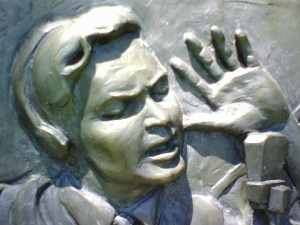
Orson Welles monument in Grovers Mill, N.J.

A monument in Grovers Mill, N.J., commemorates Welles and his adaptation of War of the Worlds

The show was work of Orson Welles and his Mercury Theatre on the Air troupe who cleverly used signature elements of radio of the 1930s to create a splendidly clever program. Most listeners recognized it for what it was: An ingenious radio play about a Martian invasion on the eve of Halloween.

The Mercury Theatre on the Air version was set in New Jersey and New York City. The vanguard of the invading Martians landed in Grovers Mill, N.J., still a rural community near Princeton. The War of the Worlds dramatization is commemorated in Grovers Mill by a monument that depicts scenes from the program — including young Orson Welles at the microphone.

Welles was 23 when he made the program. He went on to greater fame as director and star of 1941 motion picture Citizen Kane.

War of the Worlds

In Media myths, Media myths and radio on October 31, 2009 at 3:09 pm
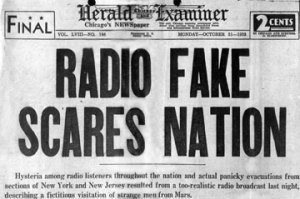
Chicago Herald Examiner about War of the Worlds broadcast

Front page of the Chicago Herald Examiner on Halloween, 1938

The famous radio dramatization of The War of Worlds in October 1938 supposedly set off panic and hysteria across the United States. Tens of thousands of panic-stricken Americans were said to have taken to the streets or headed for the hills during the radio show, which was a clever adaptation of H. G. Wells’ novel about an invasion by Martians wielding  deadly heat rays.

The supposed panic that night in 1938 is a delicious story, one almost too good to be false.

But it is. There is scant evidence to believe that The War of Worlds dramatization had such an effect.

Getting It Wrong describes how newspapers of the time got it badly wrong.

Listen to the broadcast here.

Greetings

In Debunking, Media myths on October 31, 2009 at 2:10 pm

Welcome to Media Myth Alert.

This blog, begun on Halloween in 2009, seeks to direct attention to the appearance of media-driven myths. These are stories about and/or by the news media that are widely believed and often retold but which, under scrutiny, prove to be apocryphal or wildly exaggerated.

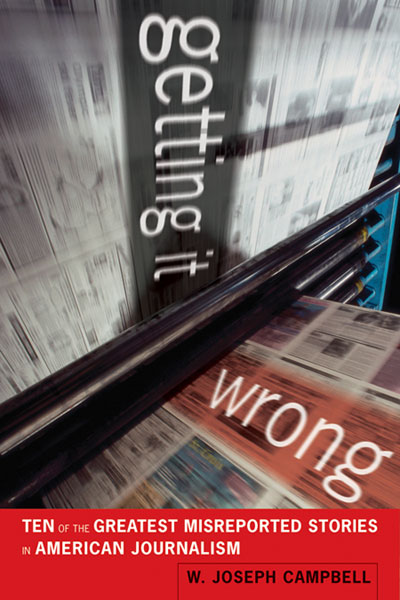
It also seeks to promote my forthcoming book, Getting It Wrong, which will be published in spring 2010 by University of California Press.

Getting It Wrong available in spring 2010

We’ll seek to be vigilant and on guard about media myths that appear online and in print. And we’ll call attention to them when we see them.