W. Joseph Campbell

Posts Tagged ‘Iraq War’

Lynch and mythical ‘Pentagon propaganda machine’

In Debunking, Jessica Lynch, Media myths, Washington Post on December 7, 2010 at 6:36 pm

I’ve frequently noted at Media Myth Alert that the dominant narrative in the case of Jessica Lynch, the single most famous American soldier of the Iraq War, is that the Pentagon concocted a story about her battlefield heroics in order to boost popular support for the conflict.

The Post's botched report

It is, however, a false narrative that utterly obscures the singular role of the Washington Post in thrusting the bogus hero-warrior story about Lynch into the public domain.

But the false narrative lives on. It’s a tenacious media-driven myth–one of 10 that I address and debunk in my latest book, Getting It Wrong. The false narrative popped up in a Michigan newspaper the other day, in a commentary that took a look back at the first decade of the 21st century.

The retrospective appeared in the Niles Daily Star and the author in writing about the Lynch case said “insult [was] added to her injuries by the Pentagon propaganda machine [by] exaggerating her heroics” in Iraq.

The reference was to Lynch’s supposed derring-do in an ambush in Nasiriyah, in the first days of the war.

Lynch then was a 19-year-old private, a supply clerk in the 507th Maintenance Company, elements of which were attacked March 23, 2003.

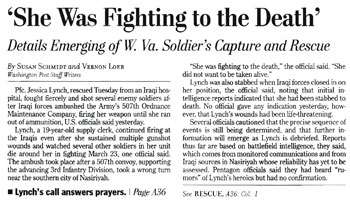
The Post reported 11 days later that Lynch had fought ferociously in the ambush, despite watching “several other soldiers in her unit die around her.”

Lynch was shot and stabbed, the Post said, but kept firing at the attacking Iraqis until she ran out of ammunition, and was taken prisoner.

The Post quoted a source identified only as a “U.S. official” as saying:

“She was fighting to the death. She did not want to be taken alive.”

It was an electrifying, front-page account which, as I note in Getting It Wrong, was picked up by news organizations around the world. The Times of London, for example, declared that “one thing is certain”–Lynch “has won a place in history as a gritty, all-American hero.”

But Lynch was no hero.

She never fired a shot in Iraq. It turned out that her gun had jammed during the ambush.

She was neither shot nor stabbed. She did suffer shattering injuries in the crash of Humvee while trying to flee the ambush.
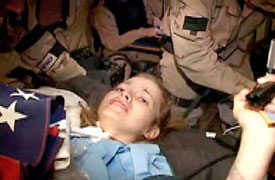
Rescuing Jessica Lynch

Lynch was hospitalized in Nasiriyah for nine days, until rescued by a commando team of U.S. special forces. The sensational article about her heroics appeared two days later, on April 3, 2003; it was a Post exclusive.

Ten weeks later, as Lynch slowly recovered from her injuries, the Post begrudgingly acknowledged that key elements of its hero-warrior story were wrong. (One critic said the embarrassing rollback was “the journalistic equivalent of Napoleon’s retreat from Moscow.”)

But over time, as American public opinion curdled and turned against the Iraq War, the role of the Post in propelling Lynch into unwarranted fame receded in favor of the false narrative that the Pentagon made up the hero-warrior tale.

However, as I discuss in Getting It Wrong, the Pentagon was not the source for the botched report in the Post about Lynch’s supposed heroics. The U.S. military was loath to discuss the sketchy reports from the battlefield that told of her derring-do.

I note in Getting It Wrong that Vernon Loeb, then the defense writer for the Post, went on the NPR program Fresh Air in late 2003 to say that he “could never get anybody from the Pentagon to talk about” the Lynch case.

“They wouldn’t say anything about Jessica Lynch,” Loeb said on the radio show.

“I just didn’t see the Pentagon trying to create a hero where there was none,” he added. “I mean …they never showed any interest in doing that, to me.”

Loeb declared:

“Our sources for that story were not Pentagon sources.”

Not surprisingly, news outlets that embrace the false narrative about the Pentagon and Jessica Lynch never explain how it worked–how the Post was so thoroughly duped into publishing the bogus report. No one ever addresses how the “Pentagon propaganda machine” accomplished its purported task.

And the Post, to its lasting discredit, has never disclosed the sources of its botched story about Lynch.

WJC

Recent and related:

Thoughts on why journalists can get it badly wrong

In Debunking, Hurricane Katrina, Jessica Lynch, Media myths, Washington Post on November 27, 2010 at 6:34 am

I mentioned in a blog post yesterday the Time magazine essay about journalists getting it wrong.

It’s a fine and thoughtful discussion, written by Kathryn Schulz, who maintains: “Reporters make serious mistakes routinely, and we do so not because we are immoral, but because of the nature of journalism, and of the human mind.”

Schulz, author of Being Wrong: Adventures in the Margin of Error, refers in the essay to what she says are “two rich sources of error”–the echo-chamber effect and “the double whammy of journalism’s shrinking profit margin and growing news hole.”

As an example of the first, she describes what in effect is the phenomenon of inter-media agenda-setting, which I discuss in my latest book, Getting It Wrong.

Inter-media agenda-setting typically occurs when large news organizations with resources to cover events far from home effectively set the news agenda for smaller outlets. “Journalists,” Schulz writes in the Time essay, “…often just replicate one another’s conclusions.

“That goes some way toward explaining how the massive myth of Pfc. Jessica Lynch’s Iraq heroics grew out of a single inaccurate story in the Washington Post.”

It’s refreshing to see such an acknowledgement.

As I’ve periodically noted at Media Myth Alert, the singular role of the Washington Post in propelling Lynch into unimagined and undeserved fame has receded in favor of the false narrative that accuses the Pentagon of having concocted the hero-warrior story about Lynch in Iraq to bolster Americans’ support for the war.

As I discuss in Getting It Wrong, the Pentagon wasn’t the source for the botched report in the Post about Lynch’s supposed heroics. The U.S. military was loath to discuss Lynch’s reputed derring-do. And yet, the false story line has since become entrenched as the dominant narrative about the Lynch case.

In writing about “the double whammy of journalism’s shrinking profit margin and growing news hole,” Schulz points out that thorough investigations cost news organizations a lot in time and money, but that reporters these days “increasingly resemble doctors in an understaffed emergency room, working under immense time pressure with inadequate resources.

“Those conditions,” she adds, “are not exactly conducive to the stodgy, time-consuming business of accuracy: verifying quotes, contacting additional sources, fact-checking claims.”

I’m not so sure about that: Why wouldn’t the reality of time pressures make fact-checking even more imperative in newsrooms? Blaming times pressures of course doesn’t exonerate journalists or excuse them from their errors.

The observation is reminiscent of excuses offered for the highly exaggerated, over-the-top reporting about mayhem and violence in New Orleans in the aftermath of Hurricane Katrina in 2005. Telecommunication networks were down. Telephone service was out. Cell phones didn’t function. Electricity was scarce.

But as I write in Getting It Wrong, those conditions do not let journalists off the hook for the inaccurate reporting about the horrific violence supposedly unleashed by the hurricane.

“It would not have been unreasonable for the collapse of communication networks to have given reporters pause, leaving them more cautious and more wary about what they heard and reported, and thus less likely to traffic in wild and dubious claims” of apocalyptic violence in Katrina’s immediate aftermath, I point out in the book.

Schulz mentions the flawed reporting of the hurricane, referring in her essay to “the quasi-hysterical coverage of Katrina: the uncritical regurgitation by reporters of claims of mass murder, children being raped, gang wars in the Superdome.”

And she notes the Katrina-related research I discuss in Getting It Wrong, writing:

“Those claims proved hyperbolic to the point of sheer invention: according to journalist W. Joseph Campbell in Getting It Wrong, only six people died in the Superdome (four of natural causes, one of a drug overdose, one an apparent suicide), and not a single claim of sexual assault was ever substantiated.”

Indeed.

To Schulz’s short list of the causes of major error in journalism, I would add, at a minimum, the fog of war.

I note in Getting It Wrong that it’s scarcely surprising that war and conflict can be breeding grounds for media-driven myth. After all, I write, “The stakes in war are quite high, and the shock of combat is alien and unfamiliar to most people.

“Given their limited first-hand experience with war, media audiences usually find themselves in no position to challenge reports from the battlefield. The confusion and intensity inherent in warfare can lead journalists to place fragmented information that emerges from conflict into recognizable if sometimes misleading frames.”

The Lynch case is one of a number of war-related myths addressed and debunked in Getting It Wrong.

WJC

Recent and related:

Jessica Lynch one of ‘Time’ magazine’s ‘faces of decade’

In Debunking, Jessica Lynch, Media myths, Washington Post on November 26, 2010 at 6:42 am

I’ve expressed astonishment at Media Myth Alert from time to time about how the national spotlight still finds Jessica Lynch, who became the most familiar face of the early Iraq War because of a botched, front page story in the Washington Post about her supposed battlefield heroics.

Lynch, before the war

That was a sensational account, picked up by news organizations across the country and around the world. The Times of London, for example, declared that “one thing is certain”–Lynch “has won a place in history as a gritty, all-American hero.”

But the Post story  was utterly in error: Lynch, then a 19-year-old Army private, never fired a shot in Iraq. She was neither shot nor stabbed, as the Post reported, but suffered shattering injuries in the crash of a Humvee as it tried to escape an Iraqi ambush in Nasiriyah on March 23, 2003.

She was no battlefield hero.

Over time, however, the singular role of the Washington Post in propelling Lynch into unmerited fame has receded in favor of a false narrative that says the Pentagon concocted the hero-warrior story about Lynch to bolster Americans’ support for the war.

Time magazine repeated the false narrative  the other day in a writeup about Lynch, whom it calls one of the “faces of the decade”–a handful of men and women the magazine says “became famous overnight not for glamour or riches or simply being famous but for the explosive public issues they represented.”

Time says flatly that Lynch “was a victim of the propaganda machine at the Pentagon, which exaggerated her heroics.”

Whether Lynch merits inclusion in the “faces of the debate” is highly debatable. What’s not debatable is the magazine’s inaccurate characterization of Lynch’s improbable emergence to unsought fame.

As I discuss in my latest book, Getting It Wrong, the Pentagon was not the source for the botched report in the Post about Lynch’s supposed heroics in Iraq. The U.S. military was loath to discuss the sketchy reports from the battlefield that told of her heroic deeds.

I note in Getting It Wrong that Vernon Loeb, then the defense writer for the Post, went on an NPR program in late 2003 to say that he “could never get anybody from the Pentagon to talk about” the Lynch case.

“They wouldn’t say anything about Jessica Lynch,” Loeb said in an interview on the Fresh Air show.

“I just didn’t see the Pentagon trying to create a hero where there was none,” Loeb added. “I mean …they never showed any interest in doing that, to me.”

Loeb declared: “Our sources for that story were not Pentagon sources.”

Not surprisingly, the Time writeup doesn’t say how the Pentagon (if it had been the source) so thoroughly duped the Post into publishing the bogus report: No one pushing the false narrative about the Pentagon’s having ginned up the Lynch story addresses that critical element.

The Post–to its discredit–has never disclosed the source of its botched story, which appeared April 3, 2003, beneath the headline:

“‘She was fighting to the death.'”

The botched story

Lynch told Time that she doesn’t know how the phony report about her battlefield derring-do took hold. In excerpts of an interview posted at the Time online site, Lynch says:

“Honestly, I have no idea where the stories were created.”

The interview excerpts make no reference to the Post or its erroneous report. (Interestingly, a separate article in Time that ruminates about errors by journalists does mention the Post, saying: “Lynch’s Iraq heroics grew out of a single inaccurate story in the Washington Post.”)

Like many media-driven myths, though, the notion that the Pentagon pushed the phony hero-warrior story is just too good, too delicious, to be disbelieved.

And so it lives on, a blight on the historical record.

WJC

Recent and related:

Lynch says she could’ve embraced Post’s phony hero story

In Debunking, Jessica Lynch, Media myths, Washington Post on November 15, 2010 at 6:55 am

Jessica Lynch was back on the air the other day, doing a television interview that brought more muddle than clarity to the erroneous reporting about her battlefield heroics early in the Iraq War.

Lynch said on CNN’s HLN show that she could have embraced the storyline that said she fought like a female Rambo–and no one would have been the wiser if she had. No one “would have known,” she asserted.

The notion Lynch was a wartime hero, that she had fought like Rambo, was thrust into the public domain by the Washington Post in a botched, front-page story published April 3, 2003. The Post described how Lynch supposedly was fighting to the death in the ambush of her unit in Nasiriyah, Iraq.

The Post also said in its sensational yet thinly sourced  report that Lynch had been shot and stabbed before being overwhelmed and taken prisoner.

The Post published the article beneath the headline: “‘She was fighting to the death.’”

But as I discuss in my latest book, Getting It Wrong, none of that was true: Lynch had not fired a shot in the ambush; her weapon had jammed. She was neither shot nor stabbed.

She did suffer shattering injuries in the crash of a Humvee as it tried to flee the ambush. But Lynch was no battlefield hero.

She was taken prisoner and kept in an Iraqi hospital where she lingered near death until a U.S. special forces team rescued her on April 1, 2003.

On HLN, Lynch said she agreed with interviewer Joy Behar’s suggestion that she could have claimed the hero’s mantle.

“Absolutely,” Lynch said, “because nobody would have known. I mean, everyone in my vehicle was killed that day. So I was the only survivor out of the five of us.

“I mean, so it would have been very easy to take credit for everything.”

However, as I’ve noted previously, embracing the false hero-warrior storyline would have been untenable for Lynch.

The colonel commanding the Army hospital at Landstuhl, Germany, where Lynch was treated after her rescue, told journalists the day after the Post published its hero-warrior story that Lynch had been neither shot nor stabbed.

He thus undercut a crucial element of the hero-warrior tale–that Lynch had been shot and stabbed, but had kept fighting. That central component of the narrative was quickly exposed as untrue.

Moreover, it became apparent in the weeks after the Post‘s story that there had been a real hero at Nasiriyah, that the battlefield derring-do initially attributed to Lynch probably were the deeds of Sergeant Donald Walters, a cook in Lynch’s unit.

Walters either was left behind or stayed behind during the confusion of the ambush. He laid down covering fire as he fellow soldiers sought to escape.

After running out of ammunition, Walters was captured by Iraqi irregulars, and executed. His body when exhumed bore stab and gunshot wounds.

It’s curious–indeed, in my view inexcusable–that Lynch almost never refers to Walters. She didn’t mention his name in the interview with HLN.

It’s curious, too, that interviews with Lynch never bring up the Washington Post and its singular role in propelling the Lynch case into the public domain. HLN’s Behar certainly didn’t mention the Post and its phony hero-warrior story.

WJC

Recent and related:

Helen Thomas and Iraq War: What’s she talking about?

In Debunking, Furnish the war, Media myths, Newspapers on June 11, 2010 at 8:12 am

Helen Thomas, the cranky, now-disgraced columnist for Hearst newspapers who resigned under fire this week, claims in an interview that White House press corps bears some responsibility for the Iraq War.

Thomas, who quit after saying Jews should “get the hell out of Palestine” and go to Germany and Poland, asserted in the interview posted yesterday by Vice magazine:

“Everyone rolled over and played dead at a time when they should have been really penetrating. … But in this case they bought all the propaganda. Or, whether they bought it or not, they took it and spouted it.”

Thomas, who is almost 90,  didn’t elaborate on her “rolled over and played dead” comment, which has the whiff of a gratuitous shot at her erstwhile colleagues.

She’s made similar comments before, claiming for example that the American news media were “comatose” in the run-up to the war. But seldom has she offered much in the way of specific, supporting detail. As in who “rolled over” when?

While her claims have hardened into something approaching conventional wisdom about pre-war coverage, Thomas’ views have been challenged, notably by David Gregory of NBC, who has asserted:

“I think the questions were asked [in the run-up to the war].  I think we pushed. I think we prodded. I think we challenged the president. I think not only those of us the White House press corps did that, but others in the rest of the landscape of the media did that.

“If there wasn’t a debate in this country,” Gregory has said, “then maybe the American people should think about, why not?  Where was Congress? Where was the House? Where was the Senate? Where was public opinion about the war?”

As to his last question, where was public opinion? It heavily favored the war in Iraq. And as I note in a chapter in my new book, Getting It Wrong, a Washington Post-ABC News poll, taken in the early days of the war found that 69 percent of Americans thought the invasion of Iraq was justified even if weapons of mass destruction were not found.

Reason magazine also has challenged the argument that the U.S. news media could have been more searching in the run-up to the war, asserting in a well-argued piece in 2007:

“The ‘we should have done more to head off this war’ argument assumes too much, exaggerates the media’s power to influence, removes the onus from politicians and infantilizes news consumers.”

Those are all good points. And blaming the news media does tend to deflect blame from Congress, which in 2002 authorized military force against Iraq.

What’s more, the content leading U.S. daily newspapers in the weeks before the Iraq War began included a sustained amount of searching coverage. A good deal of the coverage in February and March 2003 focused on diplomatic démarche at the United Nations, where the U.S. pro-war policy came under frequent attack by the French, Germans, Russians, and others.

Those challenges to U.S. policy were given prominence in U.S. newspapers, as were the massive anti-war demonstrations in Europe and in some American cities.

Thomas has never impressed me as a particularly incisive or even careful reporter. She notably indulged in media myth in her 2006 book, Watchdogs of Democracy?: The Waning Washington Press Corps and How It Has Failed the Public.

The book repeated the hoary anecdote about Hearst’s vowing to “furnish the war” with Spain in the late 19th century–one of the media-driven myths that I debunk in Getting It Wrong.

Thomas’ use of the “furnish the war” anecdote helped Watchdogs of Democracy? make the tail-end of my lineup of the dozen overrated books about journalism history–a roster I compiled in 2009 for the quarterly journal American Journalism.

Topping my “overrated” list was David Halberstam‘s The Powers That Be, followed by Carl Bernstein and Bob Woodward‘s All the President’s Men and Hadley Cantril’s The Invasion From Mars.

About Thomas’ Watchdogs of Democracy?, I wrote:

“The title of Thomas’ book promises far more than its disjointed and repetitive content delivers,” adding, “don’t turn to Watchdogs of Democracy? for searching analysis.”

WJC

Related: