W. Joseph Campbell

Posts Tagged ‘Journalism’

Knocking down the ‘Cronkite Moment’

In Cronkite Moment, Debunking, Media myths, New York Times on December 22, 2010 at 9:28 am

That’s more like it.

A blog sponsored by the Hollywood Reporter yesterday invoked–and parenthetically disputed–the so-called “Cronkite Moment” of 1968, when CBS news anchorman Walter Cronkite declared on-air that the U.S. war effort in Vietnam was “mired in stalemate.”

The media myth has it that President Lyndon Johnson watched the Cronkite report and, upon hearing the anchorman’s “mired in stalemate” assessment, snapped off the television set and told an aide or aides:

“If I’ve lost Cronkite, I’ve lost Middle America.” Or something to that effect.
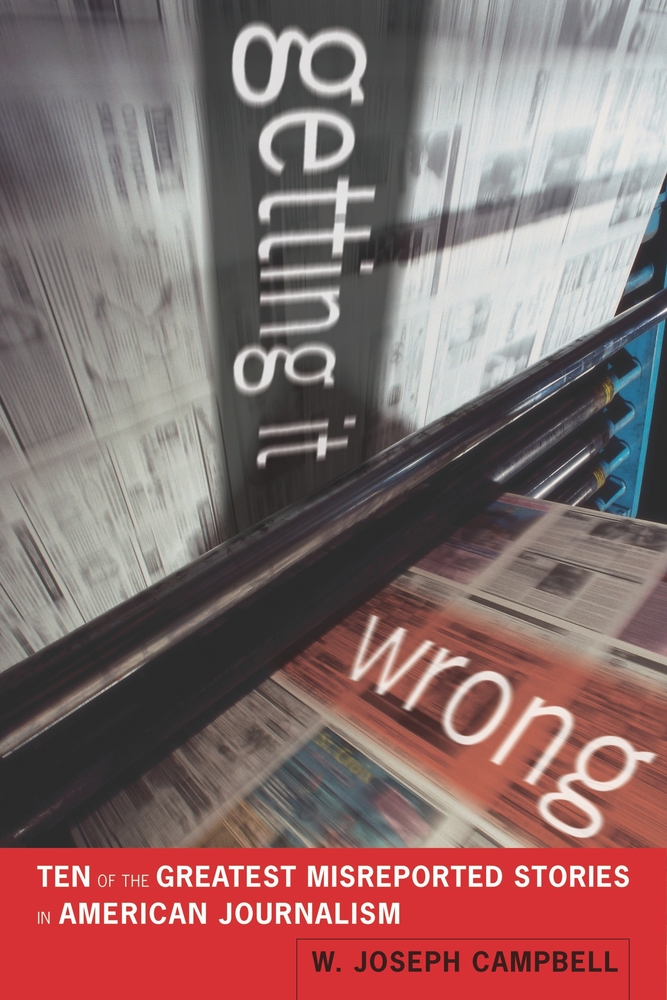
As I discuss in my latest book, Getting It Wrong, the tale almost certainly is a media myth.

Johnson didn’t see the Cronkite report when it aired on February 27, 1968. The president at the time was in Austin, Texas, attending the 51st birthday party of Governor John Connally, one of his longtime allies.

About the time Cronkite was intoning “mired in stalemate,” Johnson wasn’t lamenting the loss of the anchorman’s support. Johnson was making light-hearted comments about Connally’s age, saying:

“Today you are 51, John. That is the magic number that every man of politics prays for—a simple majority.”

Moreover, there is no compelling evidence that Johnson saw the Cronkite program later, on videotape.

And as I point out in Getting It Wrong, “The power of the ‘Cronkite moment’ resides in the sudden, unexpected, and decisive effect it supposedly had on the president: Such an effect would have been absent, or greatly diminished, had Johnson had seen the program on videotape at some later date.”

So here’s what the Hollywood Reporter blog said yesterday, in a column that discussed leading candidates for best motion picture of 2010:

“They say that when President LBJ saw newscaster Walter Cronkite editorialize against Vietnam, he said, ‘If I’ve lost Cronkite, I’ve lost the war.’ (Actually, this is an urban legend, but it’s a fine metaphor so it endures.)”

While it’s not entirely clear why the writer felt compelled to invoke the “Cronkite Moment,” that he promptly knocked it down is commendable.

Calling it out as dubious is necessary if the myth ever is to be unmade.

The “Cronkite Moment,” despite its wobbly and improbable elements, is a delicious story of a journalist telling truth to power–and producing a powerful effect. As such, it probably will live on.

It certainly will live on if efforts aren’t made repeatedly to call attention to its improbability: A news anchorman’s brief editorial statement was sufficient to alter a president’s thinking?

Come on.

It doesn’t work that way.

Besides, as I point out in Getting It Wrong, Cronkite’s assessment of the U.S. war effort was hardly original.

Nearly seven months before the “Cronkite Moment,” the New York Times had reported the war in Vietnam “is not going well.”

Victory, the Times said in August 1967, “is not close at hand. It may be beyond reach.”

This analysis was published on the Times’ front page beneath the headline:

Vietnam: The Signs of Stalemate.”

WJC

Recent and related:

Mythmaking on Blu-ray?

In Cinematic treatments, Debunking, Media myths, Washington Post, Watergate myth on December 20, 2010 at 11:11 am

All the President’s Men, the most-seen movie about the Watergate scandal, may be released on Blu-ray early next year, according to a post yesterday at a blog sponsored by a Canadian newspaper.

“Word is that Warner Bros. will release the Watergate movie … in a feature loaded  Blu-ray book in February,” said the item at the Leader-Post newspaper in Saskatchewan.

Now at best, the Blu-ray version of All the President’s Men is of mild interest to Media Myth Alert. What caught the  eye, though, was this characterization in the Leader-Post item:

“The 1976 movie is perhaps the greatest ever on newspaper journalism. It tells the true story of how Washington Post reporters Carl Bernstein and Bob Woodward exposed the real story behind the break-in at Democratic Party offices in the Watergate building by Republican political operatives. Their exposé, fed by a mysterious source called ‘Deep Throat,’ led to the resignation of President Richard Nixon.”

I placed the words in bold for emphasis.

As I note in my latest book, Getting It Wrong, Woodward and Bernstein didn’t expose the Watergate scandal. It was at first a police beat story that spiraled into an intricate and sprawling scandal that sent to jail nearly 20 men associated with Nixon’s presidency or his 1972 reelection campaign.

And the reporting of Woodward and Bernstein didn’t lead to Nixon’s resignation.

As I point out in Getting It Wrong:

“To roll up a scandal of such dimension [as Watergate] required the collective if not always the coordinated forces of special prosecutors, federal judges, both houses of Congress, the Supreme Court, as well as the Justice Department and the FBI.

“Even then, Nixon likely would have served out his term if not for the audiotape recordings he secretly made of most conversations in the Oval Office of the White House. Only when compelled by the Supreme Court [in 1974] did Nixon surrender those recordings, which captured him plotting the cover-up and authorizing payments of thousands of dollars in hush money.”

Against the tableau of subpoena-wielding investigative authorities, the work of Woodward and Bernstein for the Washington Post fades into relative insignificance.

Even so, as I write in Getting It Wrong, the heroic-journalist interpretation of Watergate–the endlessly appealing notion that the  reporting of Woodward and Bernstein did bring down Nixon’s  presidency–“has become the most familiar storyline of Watergate.”

The heroic-journalist interpretation is, I note, “a proxy for grasping the scandal’s essence while avoiding its forbidding complexity.”

Perhaps the factor most important in propelling and solidifying the heroic-journalist meme of Watergate was the movie All the President’s Men, an adaptation of Woodward and Bernstein’s 1974 book by the same title.

“The book in fact had been written with the cinema in mind,” I write in Getting It Wrong, noting that the actor Robert Redford “had taken keen interest in the Woodward-Bernstein collaboration in reporting the scandal and encouraged the reporters to structure the book around their experiences.”

Redford paid $450,000 for the rights to All the President’s Men, and he played Woodward in the movie.

The cinematic version of All the President’s Men focuses on the work of Woodward and Bernstein while mostly ignoring, and even denigrating, the efforts of investigative agencies like the FBI.

I further note that the movie All the President’s Men allows no interpretation other than it was the work Woodward and Bernstein that set in motion far-reaching effects that brought about the first-ever resignation of a U.S. president.

The movie, I write, helped ensure the heroic-journalist myth “would live on by offering a neat, tidy, and vastly simplified account the Watergate scandal, one that allowed viewers to sidestep the scandal’s complexity while engaging in an entertaining storyline.”

The myth is solidly entrenched in popular culture. It is one of the heartiest of media-driven myths, those dubious, media-centric tales that masquerade as factual.

The Blu-ray version of All the President’s Men may serve to introduce the myth of Watergate to yet another generation of movie-goers.

WJC

Recent and related: