W. Joseph Campbell

Posts Tagged ‘Scandal’

Carl Bernstein, at it again

In Debunking, Washington Post, Watergate myth on October 1, 2011 at 11:25 am

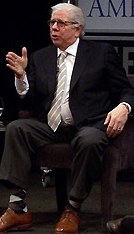
Carl Bernstein, he of Watergate fame, was in London the other day, waxing indignant about the phone-hacking scandal that shook Rupert Murdoch’s media operations in Britain over the summer and forced the closure of the raunchy News of the World tabloid.

Mentions reporters' ethical lapses

As he has in the past, Bernstein conveniently avoided reference to his own suspect conduct as a Washington Post reporter covering Watergate, the scandal that brought down Richard Nixon’s corrupt presidency in 1974.

Bernstein, who comes across as something of a sanctimonious windbag, sounded aghast in London, telling a panel convened by the Guardian newspaper that he was stunned by the notion of “criminals working for a newspaper, being a substitute for reporters” at the News of the World.

“Gathering news through criminal acts — it’s absolutely stunning,” Bernstein declared.

Bernstein, though, is an odd, curious choice to criticize such conduct, given his own ethical lapses in reporting Watergate.

It’s not often recalled these days, but Bernstein and his Washington Post colleague, Bob Woodward, sought out federal grand jurors in December 1972, inviting them to break their oaths of secrecy and discuss Watergate-related testimony that they had heard.

The reporters were that desperate for leads in what was a slowly unfolding scandal.

The private entreaties to grand jurors nearly landed Bernstein and Woodward in jail for contempt.

As recounted in All the President’s Men, Bernstein and Woodward’s book about their Watergate reporting, none of the grand jurors was cooperative and the overtures soon were made known to John J. Sirica, chief judge of U.S. District Court in the District of Columbia.

The judge was livid.

According to All the President’s Men, Edward Bennett Williams, the Post’s  lawyer and well-known Washington insider, went to lengths to persuade Sirica — known as “Maximum John” for the severe sentences he often imposed — not to punish Bernstein and Woodward.

“John Sirica is some kind of pissed at you fellas,” Williams was quoted as saying in the book. “We had to do a lot of convincing to keep your asses out of jail.”

The reporters wrote in All the President’s Men, which came out in 1974 just as Watergate was nearing its climax, that in seeking out grand jurors, they “had chosen expediency over principle and, caught in the act, their role had been covered up.” That is, they managed to dodge media scrutiny of their misconduct.

All the President’s Men also described how Bernstein sought, and obtained, information from private telephone records of Bernard Barker, one of the men who in June 1972 broke into headquarters of the Democratic National Committee, the signal crime of Watergate.

Seeking Barker’s records was another case of choosing “expediency over principle” — not to mention a bit of phone-hacking, 1970s style.

WJC

Recent and related:

A ‘certain American paper brought down a certain president’

In Debunking, Media myths, Newspapers, Washington Post, Watergate myth on September 29, 2011 at 4:14 am

It’s impressive how strictly American media myths can win such eager embrace in international contexts.

A certain American president leaves office

The heroic-journalist myth of Watergate is a telling example.

India’s leading English-language newspaper, the Hindu, invoked that myth the other day in a commentary that declared:

“More than 30 years ago, a certain American newspaper brought down a certain president by courageously exposing his wrongdoings entirely on the strength of information supplied by an anonymous source. It was not until some quarter of a century later that the real identity of Washington Post’s source for its expose of the Watergate scandal was revealed.”

Alright, let’s unbundle that myth-freighted paragraph:

  • Richard Nixon’s corrupt presidency was not brought down by the Washington Post, or by any other American newspaper — a topic I discuss in my media mythbusting book, Getting It Wrong.
  • Nixon’s fall in 1974 had nothing to do with “information supplied by an anonymous source” — a reference to the Post’s stealthy, high-level contact code-named “Deep Throat.” In 2005, a former senior FBI official named W. Mark Felt announced that he had been the Post’s Deep Throat.”

I note in Getting It Wrong that the heroic-journalist interpretation of Watergate — “the endlessly appealing notion that the dogged reporting of two young, hungry, and tireless Washington Post journalists, Bob Woodward and Carl Bernstein, brought down Nixon and his corrupt presidency” — has become the dominant narrative of the greatest scandal in American political history.

“But to explain Watergate through the lens of the heroic-journalist is,” I write, “to abridge and misunderstand the scandal and to indulge in a particularly beguiling media-driven myth.”

I point out that the heroic-journalist trope “minimizes the far more decisive forces that unraveled the scandal and forced Nixon from office.”

Those forces, I write, included “the collective if not always the coordinated forces of special prosecutors, federal judges, both houses of Congress, the Supreme Court, as well as the Justice Department and the FBI.”

But even then, Nixon likely would have served out his second term as president if not for the audiotape recordings he secretly made of most conversations in the Oval Office of the White House.

Only when compelled by the Supreme Court in July 1974 did Nixon surrender the recordings that captured him plotting to cover up his administration’s ties to the burglary at the headquarters of the Democratic National Committee in Washington.

I note that the heroic-journalist interpretation “has become the dominant popular narrative of the Watergate scandal for several reasons,” including:

Woodward and Bernstein’s book about their reporting of the unfolding Watergate scandal; the popular cinematic version of their book, All the President’s Men, and the years-long guessing game about the identity of “Deep Throat,” with whom Woodward (but never Bernstein) met periodically in 1972 and 1973, while investigating Watergate.

The role of “Deep Throat,” the reporters wrote in All the President’s Men, was to “confirm information that had been obtained elsewhere and to add some perspective.”

Those factors, I write, “combined to place Woodward and Bernstein at the center of Watergate in popular consciousness” while projecting and reinforcing the erroneous notion that the scandal’s outcome pivoted on disclosures reported by the news media.

WJC

Recent and related:

The ‘stories that brought down a president’: Sure, they did

In Debunking, Media myths, Washington Post, Watergate myth on September 26, 2011 at 3:31 am

The Guardian, one of London’s top newspapers, bought into Watergate’s dominant myth yesterday in a flattering article about Carl Bernstein, who teamed with Bob Woodward to report the scandal for the Washington Post.

Referring to the resignation of President Richard Nixon in 1974 at the height of Watergate, the Guardian asserted that Bernstein and Woodward produced “a string of stories that brought down a president.”

That claim may be the dominant narrative of Watergate. But it’s simplistic, a media-centric misreading of history.

As I discuss in my latest book, Getting It Wrong, the heroic-journalist interpretation of Watergate — the notion that Bernstein and Woodward’s dogged reporting forced Nixon from office in disgrace — “minimizes the far more decisive forces that unraveled the scandal and forced Nixon from office.”

Bernstein: Didn't bring down Nixon

Those forces included special Watergate prosecutors, federal judges, bipartisan panels of both houses of Congress, the U.S. Supreme Court, as well as the Justice Department and the FBI.

To explain Watergate through the lens of the heroic-journalist interpretation, I write in Getting It Wrong, is to short-change and “misunderstand the scandal and to indulge in a particularly beguiling media-driven myth.”

The myth, though, is endlessly appealing – as the Guardian article suggested.

Interestingly, though, not even the Washington Post embraces the heroic-journalist trope.

For example, Michael Getler, then the newspaper’s ombudsman wrote in 2005:

“Ultimately, it was not The Post, but the FBI, a Congress acting in bipartisan fashion and the courts that brought down the Nixon administration. They saw Watergate and the attempt to cover it up as a vast abuse of power and attempted corruption of U.S. institutions.”

And Ben Bradlee, the Post’s executive editor during and after Watergate, said on the Meet the Press interview show in 1997:

[I]t must be remembered that Nixon got Nixon. The Post didn’t get Nixon.”

Even Woodward has dismissed the heroic-journalist interpretation, stating in an interview with American Journalism Review:

To say the press brought down Nixon, that’s horse shit.”

What brought down Nixon’s presidency was evidence of his guilty role in the crimes of Watergate — evidence captured on audiotapes that he secretly made of his conversations at the White House.

The decisive evidence — known as the “Smoking Gun” tape — revealed that Nixon at a meeting with his top aide, H.R. Haldemann, on June 23, 1972, sought to deflect or derail the FBI investigation into the Watergate burglary.

Bernstein and Woodward didn’t reveal the contents of that tape, which Watergate prosecutors had subpoenaed and which Nixon refused to surrender until ordered by the U.S. Supreme Court to comply.

Nor did Bernstein and Woodward reveal the existence of Nixon’s taping system, which proved so crucial to Watergate’s outcome.

In All the President’s Men, their book about their Watergate reporting, Bernstein and Woodward said they had received a tip about the taping system a few days before its existence was made public in July 1973.

But according to the book, Bradlee, the executive editor, suggested not expending much energy pursuing the tip. And they didn’t.

WJC

Recent and related:

As if it were toxic: Media ignore exculpatory Jefferson-paternity study

In Debunking, Media myths on September 17, 2011 at 5:49 am

More than two weeks have passed since publication of a hefty scholarly study disputing that Thomas Jefferson sired children by one of his slaves, and America’s mainstream news media have shunned the work as if it were toxic.

The work, after all, does pose an acute threat to the dominant narrative that Jefferson had an intimate relationship with slave Sally Hemings.

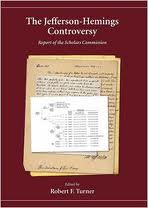
But rather than engage and scrutinize the study — the collective work of a dozen Jefferson scholars that’s titled The Jefferson-Hemings Controversy: Report of the Scholars Commission and was released September 1 — the mainstream media have resolutely ignored it.

When they have had opportunities recently to address the Jefferson-Hemings tale, news outlets have turned blithely to what amounts to defamation of the third president.

The day before the scholars commission study was released, for example, the Atlanta Journal-Constitution observed:

“The descendants of slavery-era unions were often consigned to a shadowy middle-ground, as the black descendants of Thomas Jefferson and Sally Hemings will attest.”

The Washington Post flatly asserted recently that Jefferson “fathered children with his slave Sally Hemings.”

And the Huffington Post the other day published a commentary that declared:

“It wasn’t until the late ’90s when new biographies of the founding fathers — like American Sphinx by Joseph Ellis, which revealed that Thomas Jefferson had a sexual relationship with his slave Sally Hemings that bore him six children — suddenly brought them to life in full color, foibles and all.”

There is, quite simply, no persuasive or compelling evidence — from Ellis or anyone else — that Jefferson fathered any of Hemings’ children, let alone six.

Indeed, the weight of available evidence favors the exculpatory interpretation offered by the new book, which states:

“Trying to prove a negative is usually difficult. But we have found most of the arguments used to point suspicion toward Thomas Jefferson to be unpersuasive and often factually erroneous. Not a single member of our group, after an investigation lasting roughly one year, finds the case against Thomas Jefferson to be highly compelling, and the overwhelming majority of us believe that it is very unlikely that he fathered any children by Sally Hemings.”

The scholars reported that had Jefferson carried on such a sexual relationship, it is “very difficult to believe that he would have selected as his companion the teenaged maid to his young daughters. … We … think it highly unlikely that Thomas Jefferson would have placed at risk the love and respect of his young children in this manner.”

The scholars’ work also notes that the DNA testing conducted in 1998 was widely misinterpreted as identifying Jefferson the father of Hemings’ children. (Ellis in American Sphinx incorrectly wrote that the testing “demonstrated a match between Jefferson” and the youngest son of Hemings.)

The DNA tests, the study points out, “were never designed to prove, and in fact could not have proven, that Thomas Jefferson was the father of any of Sally Hemings’ children.

“The tests merely establish a strong probability that Sally Hemings’ youngest son, Eston, was fathered by one of the more than two dozen Jefferson men in Virginia at the time, seven of whom there is documentary evidence to believe may well have been at Monticello when Eston was conceived.”

What’s more, the book says there’s no “clear evidence that Sally Hemings or any of her children ever alleged that Thomas Jefferson was her lover or their father, save for the statement attributed to an aging and clearly bitter Madison Hemings [another son] nearly five decades after Thomas Jefferson’s death.

“Surely, if they believed the famous President to be their father, they would have found it to their benefit to make this fact known to others before 1873.”

The Jefferson-Hemings Controversy is rich material and certainly worthy of thorough and frank consideration by the news media.

Instead they demur, fearful perhaps of what scrutiny of the evidence will reveal.

WJC

Recent and related:

Challenge the dominant narrative? Who, us?

In Debunking, Media myths on September 4, 2011 at 9:01 am

No surprise here.

The mainstream news media, as expected, have ignored the publication of an impressively researched and authoritative book challenging the narrative that Thomas Jefferson had children by one of his slaves, Sally Hemings.

The 400-page work, The Jefferson-Hemings Controversy: Report of the Scholars Commission, was released September 1 at a news conference at the National Press Club in Washington.

A search of the LexisNexis database reveals no major U.S. news organization has since reported on the book’s appearance or, more important, on its content.

That Jefferson sired children with Hemings has long been accepted and reported as fact by mainstream news media, even though DNA testing often cited to support the claim was misreported when released in Nature magazine in 1998.

News reports then often characterized the DNA tests as having verified Jefferson’s parentage of at least one of Hemings’ children.

The Philadelphia Inquirer, for example, declared:

“DNA evidence has confirmed that Thomas Jefferson, the revered third president of the United States, fathered at least one child by his slave-mistress, Sally Hemings.”

And the New York Times asserted:

“DNA tests on the descendants of Thomas Jefferson’s family and of Jefferson’s young slave, Sally Hemings, offer compelling evidence that the nation’s third President fathered at least one of her children, according to an article in the scientific journal Nature.”

That evidence, the Times declared, “is likely to send historians scurrying to re-evaluate Jefferson, particularly his role in the anti-slavery movement.”

But in fact the DNA tests identified Jefferson as one of about two dozen Jefferson males who could have fathered Hemings’ last child, Eston.

The new book  — which places between hard covers the report and essays issued 10 years ago by a commission of scholars that investigated the Jefferson-Hemings matter — declares that “much of the public has been misled about the significance of the DNA tests … first reported in the journal Nature in November 1998.

“While the tests were professionally done by distinguished experts, they were never designed to prove, and in fact could not have proven, that Thomas Jefferson was the father of any of Sally Hemings’ children.

“The tests merely establish a strong probability that Sally Hemings’ youngest son, Eston, was fathered by one of the more than two dozen Jefferson men in Virginia at the time ….”

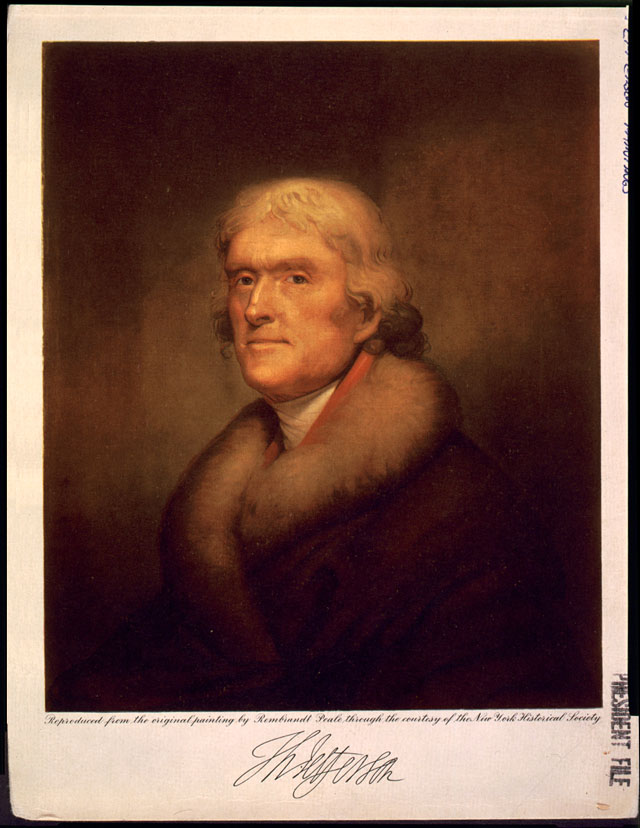
Thomas Jefferson: Library of Congress

The new book says circumstantial evidence points more powerfully to Jefferson’s younger brother, Randolph (or his sons), in the question of Eston Hemings’ paternity.

Randolph Jefferson, the book says, was known to have socialized with the slaves at Monticello, Thomas Jefferson’s home near Charlottesville, VA.

Randolph Jefferson was a dozen years younger than the president, and the available record offers no evidence that Thomas Jefferson “enjoyed socializing at night with Monticello slaves,” the book says.

Eston Hemings’ was conceived around August 1807, when Thomas Jefferson was 64 and in declining health — factors that further diminish the likelihood of his paternity.

Jefferson’s age and ailments always have represented crucial exculpatory evidence, in my view. That and the fact that Hemings had no children after Jefferson retired to Monticello from public life.

What’s more, the book says “Sally Hemings appears to have been a very minor figure in Thomas Jefferson’s life,” noting that Jefferson referred to her “in but four of his tens of thousands of letters.”

Of particular interest to Media Myth Alert is why the mainstream news media would ignore compelling evidence that exonerates Jefferson, or at least seriously complicates the paternity case against him.

Why wouldn’t the news media find appealing an opportunity to challenge the dominant narrative about Jefferson and his purported slave-mistress?

A number of reasons offer themselves.

One is that the new book essentially is a compilation of reports released in April 2001. In the new book’s acknowledgements, editor Robert F. Turner apologizes to members of the scholars commission “for the long delay in finally getting this volume in print.”

But the volume’s delayed publication doesn’t make the case against Jefferson’s paternity any less powerful or less compelling.

It is a complex case, and complexity seldom appeals to the news media. Simplistic tales are far more engaging, alluring, and easy to report.

As I point out in my latest book, Getting It Wrong (which does not discuss the Jefferson-Hemings controversy), media-driven myths “tend to minimize or negate complexity in historical events and offer simplistic and misleading interpretations instead.”

As does the dominant narrative of the Jefferson-Hemings matter.

That Thomas Jefferson sired offspring by a slave-mistress is an intriguing and perversely delicious story. But it is hardly settled history. It’s more likely a misreading of history — a misreading that the well-written and thoroughly researched new book, to its credit, seeks to correct.

WJC

Recent and related:

Woodward, Bernstein toppled Nixon? Think again

In Media myths, Washington Post, Watergate myth on August 27, 2011 at 9:58 am

'Nixon got Nixon'

The passing of time is making the heroic-journalist narrative of Watergate even more heroic.

A commentary yesterday at Huffington Post suggests as much, in extolling — and overstating — the accomplishments of Bob Woodward and Carl Bernstein, the Washington Post reporters who covered the scandal.

The commentary, which considers the state of investigative reporting, says Woodward and Bernstein “plugged away for two years at the Watergate story through thick and thin and false leads. They were determined to nail then President Richard Nixon for authori[z]ing a break in at the Democratic Party HQ during his re-election campaign and then organi[z]ing a cover up. They did, with his resignation in August 1974.”

Woah. A lot of overstatement there.

First, there’s no evidence that Nixon authorized or even knew in advance about the burglary in June 1972 at the headquarters of the Democratic National Committee, the signal crime of Watergate.

Nixon, however, certainly did seek to block the FBI’s investigation of the breakin — and for that obstruction of justice, he was compelled to resign the presidency in disgrace.

But more important is that Woodward and Bernstein didn’t “nail” Nixon on Watergate. As I discuss in my latest book, Getting It Wrong, their investigative reporting for the Post certainly didn’t bring down Nixon’s corrupt presidency.

The heroic-journalist interpretation of Watergate, I write in Getting It Wrong, is to “misunderstand the scandal and to indulge in a particularly beguiling media-driven myth.

“The heroic-journalist interpretation,” I add, “minimizes the far more decisive forces that unraveled the scandal and forced Nixon from office.” Those forces included bipartisan panels of both houses of Congress, special federal Watergate prosecutors, federal judges, the Justice Department, the FBI, and the U.S. Supreme Court.

If inelegantly, even Woodward has concurred, declaring in an interview in 2004:

To say the press brought down Nixon, that’s horse shit.”

What toppled Nixon, what brought down his presidency, was clear evidence of his culpability in the crimes of Watergate — evidence captured on audiotapes that he secretly made of his conversations at the White House.

The decisive evidence — known as the “Smoking Gun” tape — revealed that Nixon at a meeting with his top aide, H.R. Haldemann, on June 23, 1972, sought to deflect or derail the FBI investigation into the Watergate burglary.

Woodward and Bernstein didn’t reveal the contents of that tape, which Watergate prosecutors had subpoenaed and which Nixon had refused to surrender until ordered to do so by the U.S. Supreme Court.

Nor did Woodward and Bernstein disclose the existence of Nixon’s secret taping system. That was revealed in July 1973, during hearings of the Senate Select Committee on Watergate.

In All the President’s Men, their book about their reporting, Woodward and Bernstein said they had received a tip about the taping system a few days before its existence was made public.

According to All the President’s Men, Ben Bradlee, then the Post‘s executive editor, suggested not expending much energy pursuing the tip. And they didn’t.

Interestingly, Bradlee also insisted the Post did not nail Nixon.

Speaking on a Meet the Press interview program at the 25th anniversary of the Watergate break-in, Bradlee declared:

[I]t must be remembered that Nixon got Nixon. The Post didn’t get Nixon.”

WJC

Recent and related:

Misreporting Watergate

In Debunking, Media myths, Washington Post, Watergate myth on August 20, 2011 at 5:15 am

That new historical marker at the parking garage where Bob Woodward of the Washington Post occasionally met his stealthy “Deep Throat” source has stirred some cheery buzz among journalists — and some breathtaking exaggeration about the consequences of Woodward’ reporting on the Watergate scandal.

Credit: Odestreet.com

The marker titled “Watergate Investigation” went up late last week outside the garage in the Rosslyn section of Arlington, Virginia.

As I’ve noted at Media Myth Alert, the marker errs in stating that information Deep Throat” (who in 2005 was self-revealed to have been W. Mark Felt) provided Woodward “exposed the Nixon administration’s obstruction of the FBI’s Watergate investigation.”

For some news outlets commenting about the marker, it has been occasion to assert hyperbolic claims that the Post’s reporting on Watergate brought down Richard Nixon’s scandal-riddled presidency.

For example, the widely followed all-news radio station in Washington, WTOP,  said yesterday in its report about the marker:

“Mark ‘Deep Throat’ Felt, passed state secrets to Washington Post reporter Bob Woodward for a string of stories that would eventually take down a president — what would come to be known as the Watergate scandal.”

Quite simply not true.

Felt, formerly a top official at the FBI, offered Woodward mostly incremental details about Watergate as the scandal unfolded in 1972 and 1973. And as Woodward noted in the book, All the President’s Men, the role of “Deep Throat” was “only to confirm information that had been obtained elsewhere, and to add some perspective.”

It was hardly the stuff of “state secrets.”

More important, the reporting of Woodward and his Post colleague Carl Bernstein assuredly did not “take down” Nixon’s presidency.

Embracing that interpretation of Watergate, I write my media-mythbusting book, Getting It Wrong, “is to abridge and misunderstand the scandal and to indulge in a particularly beguiling media-driven myth.”

It’s an interpretation that not even officials at the Post have endorsed.

For example, Kathryn Graham, the newspaper’s publisher during and after Watergate, said in 1997, at a Newseum program marking the scandal’s 25th anniversary:

“Sometimes people accuse us of bringing down a president, which of course we didn’t do. The processes that caused [Nixon’s] resignation were constitutional.”

And Woodward, in earthier terms, has concurred, telling American Journalism Review in 2004:

To say that the press brought down Nixon, that’s horseshit.

The popular Washington entertainment blog, DCist, offered an even stranger interpretation of “Deep Throat” and his meetings with Woodward in the garage.

DCist, in a brief report about the marker, said yesterday the garage was where  “the informant, the FBI’s Mark ‘Deep Throat’ Felt, fessed up to what would eventually become the Watergate scandal that brought down President Richard Nixon.”

Huh? The “Deep Throat” source “fessed up to what would eventually become the Watergate scandal”?

“Fessed up”?

Such wording suggests that Felt/”Deep Throat” was a culprit or a suspect in the Watergate scandal.

Which he wasn’t.

Felt in fact wasn’t even around the FBI when the scandal reached its climax with Nixon’s resignation in August 1974.

He had been passed over for the FBI directorship and left the agency in 1973. Felt last conferred with Woodward at the Arlington garage in November that year.

But that’s not to say Felt was beyond reproach.

He really wasn’t such a hero.

In his senior position at the FBI, Felt had authorized illegal burglaries in the early 1970s as part of the agency’s investigations into leftists associated with the radical Weather Underground.

Felt was convicted in 1980 on felony charges related to those break-ins, but pardoned by President Ronald Reagan.

So if it not Felt’s tips to Woodward, what then brought down Nixon?

As I point out in Getting It Wrong, rolling up a scandal of Watergate’s complexity and dimension demanded “the collective if not always the coordinated forces of special prosecutors, federal judges, both houses of Congress, the Supreme Court, as well as the Justice Department and the FBI.

“Even then,” I write, “Nixon likely would have served out his term if not for the audiotape recordings he secretly made of most conversations in the Oval Office of the White House.”

Only when compelled by the Supreme Court did Nixon surrender the recordings that captured him plotting to cover up the break-in in June 1972, the signal crime of Watergate.

WJC

Recent and related:

‘Deep Throat’ garage marker errs about Watergate source disclosures

In Debunking, Media myths, Washington Post, Watergate myth on August 18, 2011 at 10:16 am

An historical marker went up the other day outside the parking garage in Arlington, Virginia, where Washington Post reporter Bob Woodward periodically met during the Watergate scandal with a stealthy, high-level source code-named “Deep Throat.”

It’s a handsome marker, artfully scalloped at the top.

Felt: Cagey source

But it errs in describing the information Woodward received from “Deep Throat,” who in 2005 revealed himself as W. Mark Felt, formerly the FBI’s second in command.

The marker, which is titled “Watergate Investigation,” says:

“Felt provided Woodward information that exposed the Nixon administration’s obstruction of the FBI’s Watergate investigation.”

Not so.

Such evidence would have been so damaging and explosive that it surely would have forced Nixon to resign the presidency well before he did, in August 1974.

Felt didn’t have that sort of information — or (less likely) didn’t share it with Woodward.

As described in Woodward’s book about Felt, The Secret Man, the FBI official provided or confirmed a good deal of piecemeal evidence about the scandal as it unfolded.

And he could be cagey and evasive in doing so.

Here, for example, is a passage from Secret Man, in which Woodward discussed efforts he and his Post colleague Carl Bernstein had made to identify Nixon’s chief of staff, H.R. Haldemann, as one of five people controlling a secret slush fund:

“I told Felt that we were going to publish a story next week saying that Haldemann was the fifth and final person to control the secret fund.

“‘You’ve got to do it on your own,’ Felt said.

“I said I expected him to warn me if we were wrong.

“Felt said he would.

“So he was essentially confirming Haldemann?

“‘I’m not,’ he said. ‘You’ve got to do it on your own.’

“It was a distinction that didn’t make sense to me. I was tired of this dancing around.

“‘You cannot use me as a source [on that story],’ Felt said. ‘I won’t be a source on a Haldemann story.””

And so it went.

(All the President’s Men, Woodward and Bernstein’s book about their Watergate reporting, says Woodward’s conversations with “Deep Throat” were intended “only to confirm information that had been gathered elsewhere and to add some perspective.”)

Woodward met Felt at the garage six times from October 1972 to November 1973, the marker notes. The last meeting at the garage was a few months after Felt had been passed over for the FBI directorship and retired.

Not until late summer 1974 — months after Felt left the FBI — did unequivocal evidence emerge about Nixon’s attempt to thwart the agency’s investigation into Watergate.

That came when Nixon complied with a unanimous Supreme Court ruling and surrendered audiotape recordings he had secretly made of conversations at the White House.

A recording of Nixon’s meeting with Haldemann on June 23, 1972, revealed that the president had sought to deflect or derail the FBI investigation into the burglary six days before at the headquarters of the Democratic National Committee at the Watergate complex in Washington.

The recording was called the “Smoking Gun” tape — and that tape, not information Felt gave Woodward, exposed Nixon’s guilt and forced his resignation.

The tape offered stunning and incontrovertible evidence that Nixon “had participated in an obstruction of justice almost from the outset” of the scandal, Stanley I. Kutler, the leading historian of the scandal, wrote in The Wars of Watergate.

As I note in my latest book, Getting It Wrong, had Nixon not recorded his conversations, he likely would have survived the Watergate scandal and served out his second term.

The marker outside the “Deep Throat” garage contains another, smaller error, too.

It says it was “erected in 2008 by Arlington County, Virginia.” But the online news site arlnow .com pointed out that the marker went up late last week — “after a three year delay.”

WJC

Recent and related:

Fox News misremembers Watergate and ‘follow the money’

In Cinematic treatments, Debunking, Media myths, Washington Post, Watergate myth on August 16, 2011 at 9:20 am

I’ve referred to “follow the money” as Watergate’s best-known made-up line.

It also can be thought of as Watergate’s best-known misremembered line.

I say that because a Fox News commentary posted yesterday thoroughly misremembered the phrase as having been part of the “media circus” of Watergate in the months before the scandal reached its denouement with Richard Nixon’s resignation in August 1974.

The Fox commentary declared:

“America was transfixed for months by [Watergate-related] televised hearings presided over by the colorful Sen. Sam Ervin. … We learned about the mysterious insider, pornographically code-named ‘Deep Throat’ murmuring intriguing clues like ‘Follow the Money….’ It was a media circus.”

But as I’ve noted at Media Myth Alert, follow the money” was not part of the vernacular of Watergate. It was never offered as advice — murmured or otherwise — by the stealthy “Deep Throat” source, who met periodically with Bob Woodward of the Washington Post as the scandal unraveled.

(The identity of “Deep Throat” remained a secret for more than 30 years until W. Mark Felt, a former top FBI official, self-identified himself as having been Woodward’s secret source during Watergate.)

What’s more, “follow the money” appeared in no Watergate-related article or editorial in the Post until June 1981.

Nor is the line to be found in All the President’s Men, the book Woodward and his Post colleague, Carl Bernstein, wrote about their Watergate reporting.

The phrase exists only in the movies — in the cinematic version of All the President’s Men, which came out in April 1976.

Follow the money” was written into the screenplay of All the President’s Men and spoken by the actor Hal Holbrook, who turned in a memorable performance as “Deep Throat.”

Holbrook intoned “follow the money” with such steely assurance that it did indeed seemed to suggest a way — however simplistic — to unravel the scandal.

But even if “Deep Throat”/Felt had counseled Woodward to “follow the money,” the advice would have neither unraveled Watergate nor led the reporter to Nixon.

Nixon quit the presidency not because he misused campaign funds; he resigned in disgrace after it became clear he had sought to obstruct justice by covering up the signal crime of Watergate, the break-in at the headquarters of the Democratic National Committee in June 1972.

As I note in my latest book, Getting It Wrong, rolling up a scandal of the dimension and complexity of Watergate required “the collective if not always the coordinated forces of special prosecutors, federal judges, both houses of Congress, the Supreme Court, as well as the Justice Department and the FBI.

“Even then,” I write, “Nixon likely would have served out his term if not for the audiotape recordings he secretly made of most conversations in the Oval Office of the White House.

“Only when compelled by the Supreme Court did Nixon surrender those recordings, which captured him plotting the cover-up” — which cost him the presidency.

WJC

Recent and related:

Following the money on 37th anniversary of Nixon’s fall

In Anniversaries, Cinematic treatments, Debunking, Media myths, Washington Post on August 9, 2011 at 12:55 am

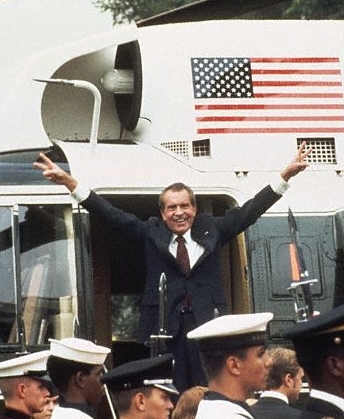
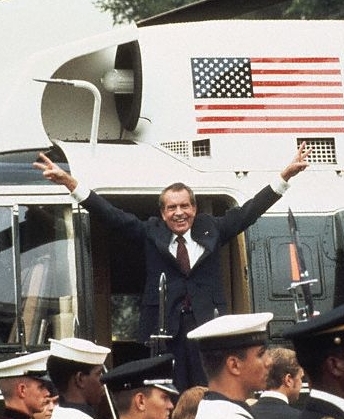
Nixon resigns, 1974

It’s somehow fitting on this, the 37th anniversary of President Richard Nixon’s resignation, to direct attention to the myth and hyperbole that embrace the best-known line of the Watergate scandal, the line that supposedly helped bring him down.

That line, of course, is “follow the money,” which purportedly was crucial advice given the Washington Post by a super-secret, high-level source code-named “Deep Throat.”

Follow the money” was said to have been so telling and effective that it’s still cited as exemplary guidance applicable in journalism, politics, and finance.

Just yesterday, for example, Barry Nolan, a journalist and contributor to Boston Magazine’sBoston Daily” blog, invoked the famous phrase, writing:

“Any time you really want to know why a vote happened the way it did, the single best piece of advice ever given came from ‘Deep Throat,’ the shadowy tipster in the Watergate scandal. ‘Follow the money,’ he told the Washington Post reporters.”

It may seem like stellar advice, but it’s guidance that the “Deep Throat” source offered only in the movies.

As I’ve discussed at Media Myth Alert, “follow the money” is Watergate’s most famous made-up line.

The phrase was written into the screenplay of All the President’s Men, the 1976 cinematic version of the book by Bob Woodward and Carl Bernstein of the Washington Post.

“Follow the money” appears nowhere in Woodward and Bernstein’s book about their Watergate reporting — reporting that did not, as I discuss in my latest work, Getting It Wrong, take down Nixon’s corrupt presidency.

Nor did “follow the money” appear in any Watergate-related news article or editorial in the Post until June 1981, nearly seven years after Nixon’s resignation.

Nor did “Deep Throat” — who was self-identified in 2005 as W. Mark Felt, formerly the FBI’s second-ranking official — utter the line in his periodic meetings with Woodward. (And Felt/”Deep Throat” didn’t meet Bernstein until 2008.)

Follow the money” was memorably intoned not by Mark Felt but by Hal Holbrook, the actor who played “Deep Throat” in All the President’s Men.

As I’ve noted, Holbrook turned in a marvelous performance as a tormented, conflicted, and stealthy “Deep Throat.”

Holbrook delivered the “follow the money” line with such conviction and steely assurance, that it seemed for all the world to offer a way through the labyrinth of the Watergate scandal.

But even if Woodward had been counseled to “follow the money,” the advice certainly neither would have unraveled Watergate nor led him to Nixon.

Nixon resigned 37 years ago today not because he misused campaign funds but because he sought to obstruct justice by covering up the signal crime of Watergate, the break-in at the headquarters of the Democratic National Committee in June 1972.

The simplified follow-the-money  interpretation of Watergate effectively deflects attention from the decisive forces that ultimately forced Nixon from office.

As I note in Getting It Wrong, rolling up a scandal of Watergate’s intricacy and dimension required “the collective if not always the coordinated forces of special prosecutors, federal judges, both houses of Congress, the Supreme Court, as well as the Justice Department and the FBI.

“Even then,” I write, “Nixon likely would have served out his term if not for the audiotape recordings he secretly made of most conversations in the Oval Office of the White House.

“Only when compelled by the Supreme Court did Nixon surrender those recordings, which captured him plotting the cover-up” that cost him the presidency.

WJC

Recent and related: