Oregon Public Broadcasting aired a segment today recalling the death seven years ago in Iraq of Sergeant Donald Walters, whose battlefield heroics were mistakenly attributed to Private Jessica Lynch.
“In later accounts,” the OPB report noted, “Don emerged as a hero who’d stayed behind to cover for his escaping comrades, before his capture and brutal death” at the hands of Iraqi irregulars, the Fedayeen.
The OPB report represents one of the few occasions when U.S. news media have called attention to Walters, a 33-year-old cook in the Army’s 507th Maintenance Company who either was left behind or stayed behind as his unit tried to escape an ambush in Nasiriyah in March 2003, during the first days of the Iraq War.
 Walters laid down covering fire as his comrades fled. When his ammunition ran out, Walters was captured and soon after executed.
Owing apparently to a mistaken translation of Iraqi battlefield reports, Walters’ heroics initially were attributed to Lynch, then a 19-year-old supply clerk in the 507th.
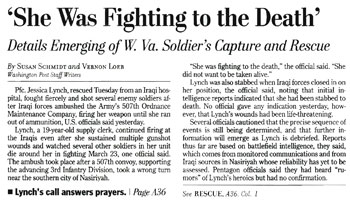
The Washington Post sent the erroneous account about Lynch into worldwide circulation on April 3, 2003, in a sensational report on its front page. The Post said Lynch had “fought fiercely” in Nasiriyah and had “shot several enemy soldiers after Iraqi forces ambushed” elements of the 507th, “firing her weapon until she ran out of ammunition.”
The Post cited “U.S. officials” who otherwise were unidentified as saying that Lynch had “continued firing at the Iraqis even after she sustained multiple gunshot wounds and watched several other soldiers in her unit die around her in fighting March 23.” One official was quoted anonymously as saying:
“‘She was fighting to the death. She did not want to be taken alive.’”
As I write in Getting It Wrong, my forthcoming book about media-driven myths, “the Post never fully acknowledged or explained its extraordinary error about Jessica Lynch.”
I also note: “The Post’s erroneous hero-warrior tale thrust Lynch into an international spotlight that has never fully receded.”
Indeed, the hoopla over her supposed derring-do in battle obscured the actions of Walters, whose conduct Nasiriyah probably saved lives of fellow soldiers. Walters posthumously was awarded the Silver Star, the U.S. military’s third-highest decoration for valor.
Walters’ parents live in Salem, Oregon. In the OPB report, Walters’ mother, Arlene, points to an imponderable about her son in his last hours. “Our big question,” she said, “is did he choose to stay or was he left out there” in Nasiriyah in the rush to escape the ambush.
Perhaps the best account of the ambush at Nasiriyah appears in Richard Lowry’s masterful book, Marines in the Garden of Eden.
Lowry wrote:
“We will never really know the details of Walters’ horrible ordeal. We do know that he risked his life to save his comrades and was separated from the rest of the convoy, deep in enemy territory. We know that he fought until he could no longer resist.”
As I note in Getting It Wrong:
“Walters’ actions, when they became known, attracted little more than passing interest from the American news media—certainly nothing akin to the intensity of the Lynch coverage after the Post’s ‘fighting to the death’ story appeared.”








 Media Myth Alert