W. Joseph Campbell

Archive for September, 2010|Monthly archive page

New ‘Nueva York’ exhibition and the Spanish-American War

In 1897, Media myths, Spanish-American War, Yellow Journalism on September 18, 2010 at 7:56 am

The Nueva York (1613-1945) exhibition that opened yesterday at El Museo del Barrio in New York City looks to be terrific.

It was jointly developed by Museo de Barrio and the New-York Historical Society, and is billed as “the first museum exhibition to explore … New York’s long and deep involvement with Spain and Latin America.

Descriptive material posted online about Nueva York describes the show’s thematic presentation across five galleries.

The descriptive material also  contains a passage of particular interest to Media Myth Alert.

It says the Spanish-American War–which was fought over Cuba in 1898–“was a conflict sold to the American public by New York newspaper publishers including Joseph Pulitzer and William Randolph Hearst,” the city’s leading practitioners of yellow journalism.

That’s a media-centric interpretation of a much-misunderstood war.
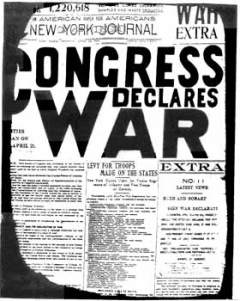
New York Evening Journal, April 1898

It’s a misleading characterization, too.

As I discussed in my 2001 book, Yellow Journalism: Puncturing the Myths, Defining the Legacies, such claims tend to rest on unsupported assumptions about the effects of newspaper content on readers in New York City and beyond, and on policymakers in Washington.

Critics who blame the yellow press for bringing on the war–or for selling the American public on the conflict–fail to explain precisely how the often-exaggerated content of the New York yellow journals was transformed into policy and military action.

As I state in Yellow Journalism:

“The yellow press is not to blame for the Spanish-American-War.

“It did not force—it could not have forced—the United States into hostilities with Spain over Cuba in 1898. The conflict was, rather, the result of a convergence of forces far beyond the control or direct influence of even the most aggressive of the yellow newspapers, William Randolph Hearst’s New York Journal.”

The Spanish-American War was the upshot of a prolonged, three-sided diplomatic impasse: Cubans who in 1895 launched what became an island-wide rebellion against Spanish rule would settle for nothing short of political independence. Spain, for reasons of political stability at home, could not agree to grant Cuba its independence. And the United States could tolerate no longer the disruptions caused by turmoil in Cuba.

Spain sent nearly 200,000 soldiers to the island in a mostly failed attempt to restore order. By early 1898, the Cuban rebellion had become a stalemate.

A particularly disastrous element of Spain’s strategy was to seek to deprive Cuban rebels of support in the hinterland by a policy called “reconcentration,” under which Cuban non-combatants–old men, women, and children–were forced into garrison towns. There, by the tens of thousands, the Cubans fell victim to disease and starvation.

A humanitarian disaster had taken hold in Cuba by early 1898, and the harsh effects of Spain’s “reconcentration” policy were often described in U.S. newspapers, yellow and otherwise.

In many ways, the U.S. entry in April 1898 into the rebellion on Cuba was a humanitarian crusade to end to abuses caused by Spain’s “reconcentration” policy. (A leading historian of the Spanish-American War, David F. Trask, has written that Americans in 1898 “went to war convinced that they had embarked upon an entirely selfless mission for humanity.”)

It was the human rights disaster on Cuba, not the press of New York City, that “sold” Americans on going war with Spain. Newspapers–including the yellow journals of Hearst and Pulitzer–were marginal in that equation.

WJC

Related:

‘Exquisitely researched and lively’

In Cronkite Moment, Debunking, Hurricane Katrina, Media myths, Reviews on September 16, 2010 at 9:40 am

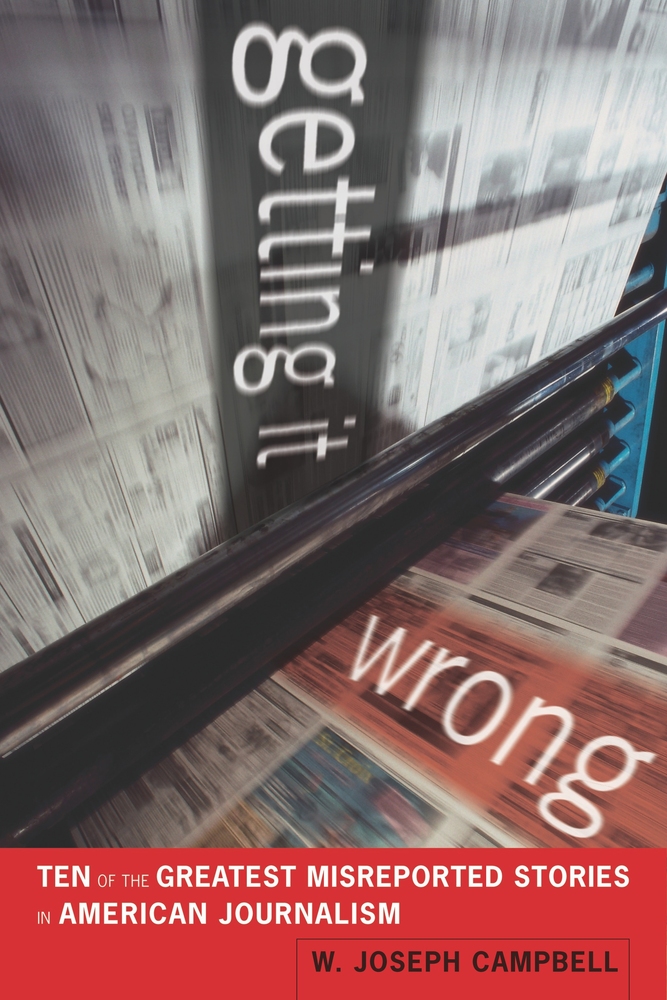
That’s the Denver Post‘s take on Getting It Wrong, my new book on media-driven myths which the newspaper recently reviewed.

The Post offers a discerning summary of the book, noting that it “takes a critical look at 10 stories that were either total fabrications or blown way out of proportion and yet became part of our popular culture.”

It also says Getting It Wrong offers “an exquisitely researched and lively look at an industry that too often shines the light on itself more than it does on events and public figures.”

And it notes, quite correctly:

“Much of the ‘wrong’ coverage through the years comes from the media’s self-congratulatory preening.”

The review points out that the sternest criticism in Getting It Wrong is reserved “for coverage, mainly by television, of the chaotic aftermath of Hurricane Katrina in New Orleans in 2005.

“Hyperactive reporters told tales of snipers roaming the streets, ‘hundreds’ of bodies stacked up in the Super Dome and babies being raped and murdered, none of which could be verified.

The upshot of the exaggerated coverage of the storm’s aftermath, the review notes, “was that rescue operations were hindered by fear, and prejudices of a watching public against poor people and minorities were confirmed.”

The review was written by Dick Kreck, a former reporter and columnist for the Post who has written three books. Kreck is an engaging storyteller and the go-to source for details about the lusty history of Denver journalism. (Full disclosure: Kreck spoke at a program at the Denver Post during last month’s convention of the Association for Education in Journalism and Mass Convention. I helped organize the program.)

Kreck opens the review of Getting It Wrong by declaring:

“Memo to media: Get over yourself. You’re not that important.”

He later cites a passage in Getting It Wrong quoting Robert Samuelson, a columnist who writes on economic issues for the Washington Post:

“Because the media are everywhere—and inspire much resentment—their influence is routinely exaggerated. The mistake is confusing visibility with power and the media are often complicit in the confusion. We [in the news media] embrace the mythology, because it flatters our self-importance.”

Getting It Wrong indeed offers a brief for modest media effects.

To bust media myths, I write in the book, “is to confront the reality that the news media are not the powerful agents they, and many others, assume them to be.

“It is exceedingly rare for any news report to trigger a powerful, immediate and decisive reaction akin to President Lyndon Johnson’s purported response to [Walter] Cronkite’s televised assessment about Vietnam: ‘If I’ve lost Cronkite ….’

“Researchers long ago dismissed the notion the news media can create such profound and immediate effects, as if absorbing media messages were akin to receiving potent drugs via a hypodermic needle,” I note, adding:

“Media power tends to be modest, nuanced, diffused, and situational.” And typically trumped by other, more powerful forces and factors.

WJC

Related:

New book on Tet invokes mythical ‘Cronkite Moment’

In Cronkite Moment, Debunking, Media myths on September 15, 2010 at 7:06 am

Cronkite in Vietnam, 1968

A provocative new book on the 1968 Tet offensive, titled This Time We Win, devotes a chapter to “The Walter Cronkite Moment,” that mythical occasion when the CBS anchorman’s on-air assessment that the war in Vietnam was “mired in stalemate” supposedly had decisive effect on the U.S. president.

The “Cronkite Moment” also is a chapter in my latest book, Getting It Wrong, which debunks 10 prominent media-driven myths–those dubious and improbable tales about the news media that masquerade as factual.

I note in Getting It Wrong that the “Cronkite Moment,” under scrutiny, “dissolves as illusory—a chimera, a media-driven myth.”

This Time We Win is the work of James S. Robbins, an editorial writer on defense issues for the Washington Times. Robbins doesn’t exactly embrace the “Cronkite Moment,” but offers it instead with qualification, writing:

“It is said that after watching Cronkite’s documentary President [Lyndon] Johnson said to his aides, ‘If I’ve lost Cronkite, I’ve lost Middle America.’ Five weeks later Johnson decided not to run for reelection based on this belief. So the legend goes. This is the Holy Grail for a reporter, that a documentary, newscast, article, picture, or other product shapes history on a grand scale.”

Robbins further writes:

“But did Johnson lose Middle America? Did sensationalistic or misleading press coverage turn the country against the President and against the war?”

His answer: “In a word, no.”

He’s quite right about that.

But Robbins might well have asked a more direct, searching, and relevant question:

“Was there really a ‘Cronkite Moment’ at all?”

The answer is, in a word, no. The anecdote’s pivotal, defining, and most delicious element is in error.

Cronkite certainly did take to the air on February 27, 1968, in a special report about Vietnam, where U.S. forces and South Vietnamese allies had repelled a broad offensive that the North Vietnamese and the Viet Cong launched a month before, at the Tet lunar new year.

Cronkite closed his report that night with an editorial comment that said the U.S. war effort was “mired in stalemate.” He suggested that a negotiated settlement might eventually be the way out.

Central to the anecdote’s power and enduring appeal is that Johnson, at the White House, was watching the program and, upon hearing Cronkite’s assessment, snapped off the television set and muttered to an aide or aides:

“If I’ve lost Cronkite, I’ve lost Middle America.”

It supposedly was an epiphany for the president, a burst of clarity and insight about an unwinnable war.

But as I write in Getting It Wrong, “Scrutiny of the evidence associated with the program reveals that Johnson did not have—could not have had—the abrupt yet resigned reaction that so often has been attributed to him.”

Johnson was not at the White House that night.

He wasn’t in front of a television set, either.

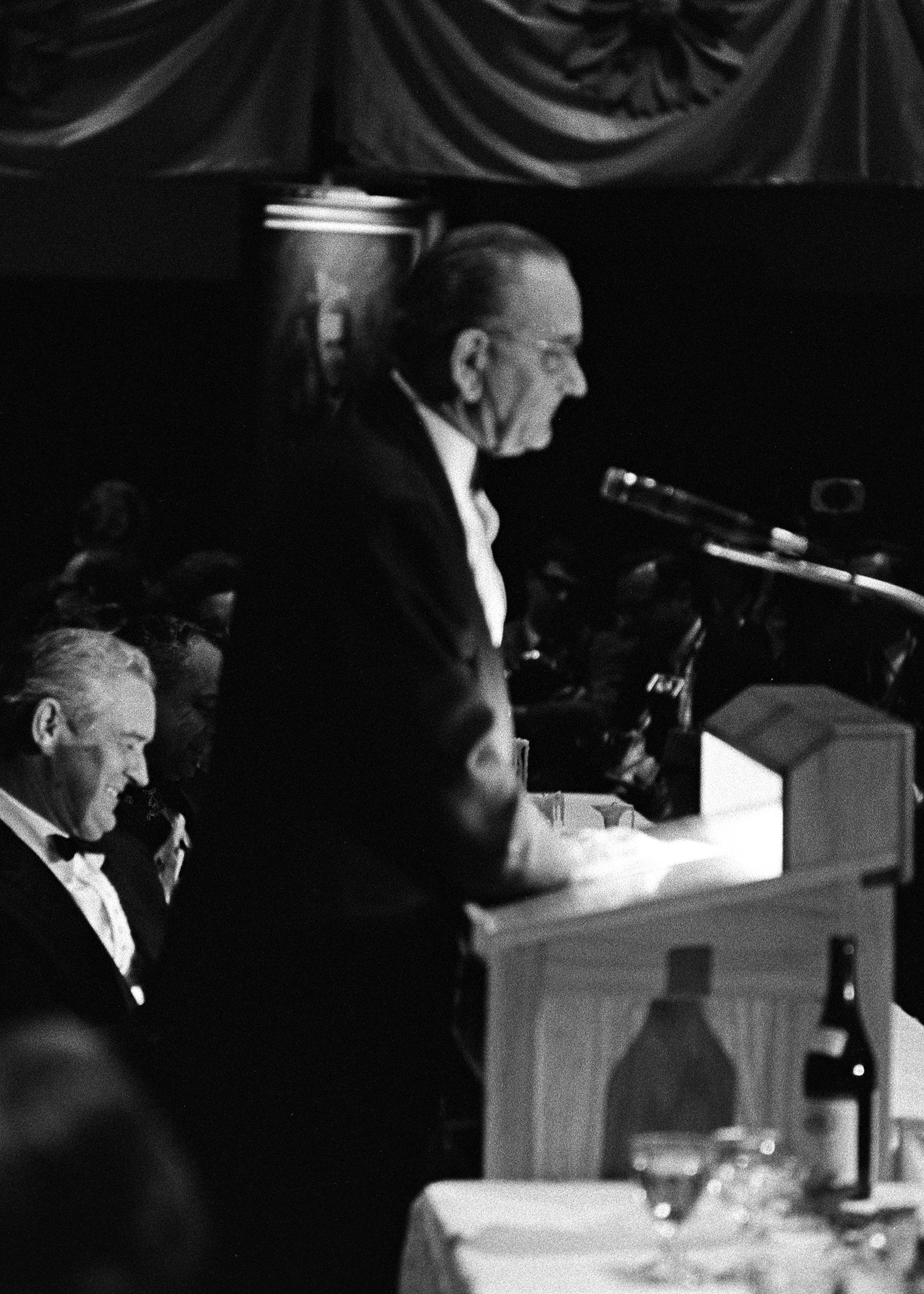
Johnson then was in Austin, Texas, at the 51st birthday party of Governor John Connally, one of his political allies.

About the time Cronkite declared the war “mired in stalemate,” Johnson was offering light-hearted banter, saying: “Today you are 51, John. That is the magic number that every man of politics prays for—a simple majority.”

Johnson’s memoir, The Vantage Point, is silent about the Cronkite program, offering no clue about whether the president ever saw it on videotape or, if he did, what he thought of it.

And as I note in Getting It Wrong, “The power of the ‘Cronkite moment’ resides in the sudden, unexpected, and decisive effect it supposedly had on the president.

“Such an effect would have been absent, or greatly diminished, had Johnson seen the program on videotape at some later date.”

Moreover, in the days and weeks immediately following Cronkite’s pessimistic assessment, Johnson remained outwardly hawkish about the war.

On March 18, 1968, for example, he delivered a rousing speech in Minneapolis in which he urged “a total national effort” to win the war in Vietnam. The president also declared:

“We love nothing more than peace, but we hate nothing worse than surrender and cowardice.”

He criticized critics as wanting the United States to “tuck our tail and violate our commitments” to South Vietnamese allies.

Johnson’s aggressive remarks are difficult to square with his supposedly downcast, self-pitying reaction to Cronkite’s assessment about Vietnam.

That the “Cronkite Moment” turns out to be a media myth is not so surprising, I write in Getting It Wrong.

“Seldom, if ever, do the news media exert truly decisive influences in decisions to go to war or to seek negotiated peace,” I note. “Such decisions typically are driven by forces and factors well beyond the news media’s ability to shape, alter, or significantly influence.”

So it was in Vietnam.

WJC

Related:

On sensationalism and yellow journalism: Not synonymous

In Debunking, Media myths, Newspapers, Yellow Journalism on September 14, 2010 at 6:06 am

The popular Politico blog yesterday invoked the yellow press period of the late 1890s, saying it was a time in American journalism when sensationalism ran wild.

In its commentary, Politco likened recent news coverage of the formerly obscure Rev. Terry Jones of Florida, who had threatened a Quran-burning spectacle on September 11, to the story line of Ace in the Hole, a terrific Billy Wilder movie released in 1951.

Ace in the Hole starred Kirk Douglas as a jaded newspaper reporter who sought to manipulate coverage of a mining cave-in in New Mexico in a cynical and ultimately failed attempt to restore a career in big-city journalism.

“What the media did last week with Jones is what Wilder’s reporter did a half-century ago,” the Politico post asserted. “Both amped a non-story by creating stakes.”

The Politico commentary further declared:

“Indeed, rampant sensationalism has been a news staple from the penny press of the 1830s, through the yellow journalism of the 1890s, through the tabloids of the 1920s, through the salivating cable shows of the last 20 years. The aberration was actually the ‘respectable’ press, like the New York Herald-Tribune or the old the New York Times or Edward R. Murrow’s CBS — which prided itself on its civic duty and lack of hyperventilation.”

But yellow journalism of the late 19th century was much more than merely sensational.

It was a lively, provocative, often-swaggering brand of journalism, a genre “well suited to an innovative and expansive time—a period when the United States first projected its military power beyond the Western Hemisphere in a sustained manner,” I wrote in my 2001 book, Yellow Journalism: Puncturing the Myths, Defining the Legacies.

Hearst in 1890s

Yellow journalism was “keen to adapt and eager to experiment,” I wrote. Its practitioners–notably William Randolph Hearst, owner of the New York Journal–took risks, spent lavishly on gathering the news, and generally shook up the field.

So it’s quite unfair, and inaccurate, to characterize “yellow journalism” as having been synonymous with the sensational treatment of news.

In its most developed form, I wrote in Yellow Journalism, the genre was characterized by these features:

  • the frequent use of multicolumn headlines that sometimes stretched across the front page.
  • a variety of topics reported on the front page, including news of politics, war, international diplomacy, sports, and society.
  • the generous and imaginative use of illustrations, including photographs and other graphic representations such as locator maps.
  • bold and experimental layouts, including those in which one report and illustration would dominate the front page. Such layouts sometimes were enhanced by the use of color.
  • a tendency to rely on anonymous sources, particularly in dispatches of leading reporters.
  • a penchant for self-promotion, to call attention eagerly to the paper’s accomplishments. This tendency was notably evident in crusades against monopolies and municipal corruption.

As defined above and as practiced more than a century ago, yellow journalism, I wrote in the book, “certainly could not be called predictable, boring, or uninspired”—complaints of the sort that are rather common about American newspapers of the early 21st century.

Related:


Going newsless, and its implications

In Debunking, Media myths on September 13, 2010 at 7:47 am

The biennial news consumption survey conducted by the Pew Research Center for the People and the Press invariably is full of intriguing data about how Americans use, or shun, the news media.

A particularly telling data point is the percentage of adults Americans who get no news on a typical day.

The 2010 Pew biennial news consumption survey, released yesterday, says that 17 percent of Americans go newsless: That is, they avoid getting news despite the wide variety of options offered by new media technologies.

This data point is not highlighted by Pew researchers; you have to dig a bit into the voluminous report to find a mention of Americans who go newsless.

“The vast majority of Americans (83 percent) get news in one form or another as part of their daily life,” Pew says in the report, adding:

“But even with the availability of news over a wide range of new technologies, 17% of Americans say they got no news yesterday, a figure that is virtually unchanged from previous years.”

Pew notes that in its news consumption survey conducted in 2008, 19 percent of adult Americans said they went newsless–and that survey “did not ask about getting news on a given day via cell phones or other digital technologies.”

Moreover, Pew says, 27 percent of American adults younger than 30 get no news on a typical day.

And among the 18-to-24-year-old cohort, 31 percent go newsless.

Pew offers neither commentary nor detailed tables about its “going newsless” data. And it presents no breakdown by age cohort, as it did in its 2008 report.

But the implications are fairly obvious: Choosing to go newsless suggests that a significant segment of the adult population has little interest, and probably little trust, in the U.S. news media and their content.

I mention the “going newsless” phenomenon in my latest book, Getting It Wrong, which debunks 10 prominent media-driven myths–dubious tales about the news media that masquerade as factual.

Referring to Pew’s 2008 news consumption study, I write:

“Large numbers of Americans are beyond media influence in any case. They choose to go newsless—they mostly ignore the news altogether. They are nonaudiences for news.”

Indeed, it is difficult to make a persuasive case for the sweeping influence of the news media if nearly one American adult in five chooses to eschew the news.

Moreover, the U.S. news media are far too splintered and diverse—print, broadcast, cable, satellite, online—to exert much in the way of collective and sustained influence on policymakers or media audiences, I write in Getting It Wrong. And  I quote the sociologist Herbert Gans who has pointed out:

“If news audiences had to respond to all the news to which they are exposed, they would not have time to live their own lives. In fact, people screen out many things, including news, that could interfere with their own lives.”

The 2010 news consumption study contained another surprising finding, that slightly less than half of young adult Americans get news on a typical day from a digital platform.

Pew notes that “Internet usage among those younger than 30 is nearly universal,” that four in five “have profiles on social networking sites and 58 percent go online using their cell phones.” And yet just 48 percent of that cohort “got news over any kind of digital platform yesterday.”

In fact, Pew says, “more of those younger than 30 (57 percent) got news from traditional sources” than from digital technology.

Americans in their 30s, Pew said, “are the most likely to use digital technologies to get news. Fully 57 percent of those in their 30s say they got news through a digital platform yesterday – either online or mobile – the highest percentage of any age group. And 21 percent of those 30 to 39 say they got news through social networking or Twitter.”

In conducting its 2010 news consumption study, Pew researchers interviewed 3,006 adults via cell phones or land line telephones from June 8 to June 28.

WJC

Related:

Many thanks to Jim Romenesko for linking to this post

‘Getting It Wrong’ goes on WTIC talk radio

In Anniversaries, Debunking, Hurricane Katrina, Media myths, Media myths and radio, Washington Post, Watergate myth on September 12, 2010 at 11:38 am

I was interviewed about Getting It Wrong the other day by Ray Dunaway on WTIC AM radio in Hartford, where years ago I was a reporter for the Hartford Courant newspaper.

The interview was live, brisk, and wide-ranging, covering a number of topics discussed in Getting It Wrong, my new book which debunks 10 prominent media-driven myths–those dubious and improbable stories about the media that masquerade as factual.

Topics that Dunaway and I discussed included the media myths associated with the Washington Post and the Watergate scandal, with Edward R. Murrow and his 1954 program on Senator Joseph McCarthy, and with coverage of Hurricane Katrina’s aftermath in 2005.

Dunaway, a veteran talk-shown host in Connecticut (with whom I had never previously spoken), said in introducing the segment:

“There are a lot of things we believe growing up and some of these are very near and dear to my heart. One would be–and I think this is absolutely true–when I was in graduate school, everybody, especially on the print side, everybody wanted to be the next Carl Bernstein and Bob Woodward [of Watergate fame] and, you know, bring down a president. That was kind of their dream.”

He added:

“Anyhow, there’s a great book out now. And what you believe ain’t necessarily so. W. Joseph Campbell has written a book … called Getting It Wrong

“First of all,” Dunaway said in launching into the interview, “I must tell you how much I enjoyed the book. It was a trip down memory lane, but maybe in a different direction than I originally thought.”

He asked whether I wrote the book to “set the record straight a bit.”

“That’s exactly right,” I replied. “The book is not really a media-bashing book but really aligns itself with a central objective of news-gathering, which is to try to get it right. And the book does seek to set the record straight by offering reappraisals of some of the best-known stories in American journalism.”

I added:

“I think these stories live on because they do offer simplistic explanations and simplistic answers to very complex historical events. So it’s a way of distilling what went on in the past [in] a very digestible and understandable way.

“In the process of simplification, though, there are exaggerations made–and myths are born. And I think that’s a recurring theme in this book. … These stories are appealing stories. They’re delicious stories. They’re almost too good to be checked out, and I think that’s another reason why these have lived on.”

We spent some time discussing the heroic-journalist interpretation of Watergate–that the investigative reporting of Woodward and Bernstein in the Washington Post brought about President Richard Nixon’s resignation in 1974.

“Woodward and Bernstein–the Watergate story–is another example of the David-and-Goliath encounter,” another thread that runs through Getting It Wrong, I said, adding that Nixon’s fall in the Watergate scandal “was the consequence of his own criminal conduct and that was exposed through the convergence of many forces and factors.

“And the Washington Post, although it did some good reporting in the aftermath of the Watergate breakin in 1972–it wasn’t the decisive factor.

“Its reporting did not bring down Richard Nixon.”

Dunaway, who described Getting It Wrong as “well worth reading,” turned the interview to Hurricane Katrina and what I call “the myth of superlative reporting.”

The coverage of Katrina’s aftermath was highly exaggerated and represented “no high heroic moment for American journalism,” I pointed out.

We spoke about exaggerated estimated death tolls in New Orleans in Katrina’s wake–estimates of 10,000 fatalities or more that were offered by public officials including the city’s then-mayor, Ray Nagin.

I noted:

“Nagin’s estimate is another example of why journalists and reporters have an obligation to themselves and to their audiences to question sources closely. ‘How did you find that information, Mr. Mayor? Could we talk to people who came up with that estimate?’ I mean, not being credulous but being searching, and a bit skeptical.

“I think skepticism was absent in the aftermath of Hurricane Katrina, and the apocalyptic horror that the hurricane supposedly unleashed was absolutely untrue.”

Dunaway wrapped up the interview by calling the book “more of a learning experience than a critique.”

That was an interesting characterization with which to close an engaging and thoughtful interview.

WJC

Related:

‘Cronkite Moment’ makes ‘Best of the Web’

In Cronkite Moment, Debunking, Media myths on September 11, 2010 at 8:41 am

The lead item yesterday of the Wall Street Journal‘s online “Best of the Web” roundup invoked the legendary “Cronkite Moment,” one of American journalism’s hardiest and best-known media-driven myths.

Cronkite in Vietnam, 1968

Only “Best of the Web” presented the anecdote as if it were factual, stating:

“‘If I’ve lost Cronkite,’ Lyndon B. Johnson is said to have lamented in 1968, ‘I’ve lost Middle America.'”

The passage set up an observation about President Barack Obama’s declining popularity:

“Obama has been losing Middle America, slowly but steadily, almost since the day he took office, in large part because he has taken his cues from a community of notions whose attitude toward Middle America ranges from indulgent condescension to outright hostility.”

Obama’s fallen popularity is of but passing and academic interest to Media Myth Alert. Far more intriguing is this latest affirmation of the casual yet confident use of the “Cronkite Moment.”

Its appearance in “Best of the Web” was the latest in a spate of recent sitings of the “Cronkite Moment.”

In the past few weeks, Al Neuharth, founder of USA Today; Cal Thomas, a conservative syndicated columnist, and  David Zurawik, veteran television writer for the Baltimore Sun, all have invoked the anecdote in commentaries as if it were true.

Such frequent use signals not only the irresistible allure of the “Cronkite Moment,” it suggests the anecdote’s appeal across the political spectrum. Neuharth, for example, typically writes from the left; Thomas and “Best of the Web” offer analyses from the right.

I examine the “Cronkite Moment” in my new book, Getting It Wrong, which addresses and debunks 10 prominent media-driven myths–apocryphal or improbable tales about the news media that masquerade as factual.

The “Cronkite Moment” refers to the special report about the Vietnam War that was presented by CBS anchorman Walter Cronkite and aired February 27, 1968.

Near the end of his report, Cronkite asserted that the U.S. war effort was “mired in stalemate” and suggested negotiations might offer a “rational” way out of Vietnam.

Supposedly, President Lyndon Johnson watched the Cronkite program at the White House and, upon hearing the anchorman’s assessment, experienced the flash of insight that his war policy had hit the rocks.

“If I’ve lost Cronkite,” Johnson reputedly said, “I’ve lost Middle America.”

As I point out in Getting It Wrong, accounts vary markedly as to what Johnson supposedly said in reacting to Cronkite’s commentary.

Some accounts have the president saying: “I’ve lost Cronkite, I’ve lost the country.”

Or: “If I’ve lost Cronkite, I’ve lost the American people.”

Or: “If I’ve lost Cronkite, I’ve lost the war.”

Or: “If we lose Cronkite, we lose America.”

Most common is: “If I lost Cronkite, I’ve lost Middle America,” the version used by “Best of the Web.”

But version variability of such magnitude, I write in Getting It Wrong, signals implausibility.

It’s a marker of a media-driven myth.

Moreover, Johnson was not at the White House the night Cronkite’s special report aired. Nor was the president in front of a television set.

He was on the campus of the University of Texas at Austin, attending the 51st birthday party of Governor John Connally, a long-time political ally.

As I note in Getting It Wrong, at about the time Cronkite offered his “mired in stalemate” editorial comment, Johnson was engaging in mildly humorous banter about Connally’s age.

“Today you are 51, John,” he said. “That is the magic number that every man of politics prays for—a simple majority. Throughout the years we have worked long and hard—and I might say late—trying to maintain it, too.”

Even if Johnson saw the Cronkite program later, on videotape, the president “gave no indication of having taken the anchorman’s message to heart,” I write in Getting It Wrong, noting:

“Just three days after the [Cronkite] program aired, Johnson vowed in remarks at a testimonial dinner in Texas that the United States would ‘not cut and run’ from Vietnam. ‘We’re not going to be Quislings,’ the president said, invoking the surname of a Norwegian politician who helped the Nazis take over his country. ‘And we’re not going to be appeasers….’”

So even if he later heard, or heard about, Cronkite’s assessment about Vietnam, it represented no epiphany for Johnson, no stunning revelation about policy gone awry.

Interestingly, the legend of the “Cronkite Moment” began to take hold and gain circulation several years after Johnson’s death in 1973. It was in 1968 neither an instant sensation nor a stunning assessment. “Mired in stalemate” was hardly a novel interpretation at the time.

Indeed, the New York Times had used “stalemate” in a front-page assessment of the war effort in early August 1967, nearly seven months before the “Cronkite Moment.”

WJC

Related:

Loving the ‘Cronkite Moment,’ and indulging in a media myth

In Cronkite Moment, Debunking, Media myths on September 10, 2010 at 10:52 am

The mythical “Cronkite Moment” of 1968–when CBS anchorman Walter Cronkite offered a supposedly withering assessment of the war in Vietnam–is cherished in American journalism.

Johnson and the 'Cronkite Moment'

The occasion supposedly was so exceptional and so memorably potent that it merits special reverence: The “Cronkite Moment.”

It’s not surprising that reverential bows are frequently made to the “Cronkite Moment.”

Such was the case just yesterday. Separate commentaries–one at a TV blog sponsored by the Baltimore Sun and the other in a column at MarketWatch–invoked the moment when Cronkite’s telling insight supposedly altered U.S. war policy.

But as I discuss in my new book, Getting It Wrong, the “Cronkite Moment” is an anecdote of two components–one part true, the other part false.

It’s true that Cronkite took to the air on February 27, 1968, in a special report about the war in Vietnam, where U.S. forces and South Vietnamese allies had just repelled a broad and surprising offensive by the North Vietnamese and the Viet Cong.

Cronkite closed his report that night by declaring the U.S. war effort was “mired in stalemate” and suggested a negotiated settlement might eventually be the way out.

At the White House, President Lyndon Johnson is said to have watched the Cronkite show and, upon hearing the anchorman’s closing “mired in stalemate” comment, snapped off the television set and muttered to an aide or aides:

“If I’ve lost Cronkite, I’ve lost Middle America.”

That’s the not-true component.

As I point out in Getting It Wrong, Johnson wasn’t at the White House that night. He wasn’t in front of a television set, either.

Johnson was in Austin, Texas, offering light-hearted comments at the 51st birthday party of Governor John Connally, one of his political allies.

About the time Cronkite was intoning “mired in stalemate,” Johnson was saying in jest: “Today you are 51, John. That is the magic number that every man of politics prays for—a simple majority.”

Johnson’s memoir, The Vantage Point, is silent about the Cronkite program, offering no clue about whether the president ever saw it or, if he did, what he thought of it. Indeed, there is no evidence that Johnson later saw the Cronkite program on videotape.

And as I note in Getting It Wrong, “The power of the ‘Cronkite moment’ resides in the sudden, unexpected, and decisive effect it supposedly had on the president.

“Such an effect would have been absent, or greatly diminished, had Johnson had seen the program on videotape at some later date.”

For many reasons, then, the “Cronkite Moment” is a dubious anecdote, a media-driven myth.

But that hasn’t much diminished its appeal.

As is the case with many media-driven myths, the “Cronkite Moment” is too delicious, too seemingly perfect to resist. It finds application in a striking variety of ways.

Take, for example, yesterday’s post at the Baltimore Sun-sponsored blog, “Z on TV.”

The writer, David Zurawik, invoked the “Cronkite Moment” in discussing the Fox News announcement that it would not to cover the Quran-burning spectacle proposed by the once-obscure Rev. Terry Jones in Gainesville, Florida. And Zurawik wondered whether the Fox decision was a reason Jones said yesterday he was canceling the planned Quran-burning.

“I am only half kidding,” Zurawik wrote, “when I reference Lyndon Johnson’s lament in 1968 after he watched CBS anchorman Walter Cronkite criticize the American war effort in Vietnam: ‘That’s it. If I’ve lost Cronkite, I’ve lost Middle America.’

“I wonder if Pastor Jones was thinking, ‘Without Fox News there to cover it, what’s the point?’ Or, ‘If I lost Fox News …'”

The column posted yesterday MarketWatch.com also signaled the hardy versatility of the “Cronkite Moment.”

The author, Andrew Leckey, discussed Chinese sensitivity to criticism in the U.S. news media. And he referred to a question once  posed to him “by the Chinese host on a special talk show” that focused on Cronkite.

The question, Leckey wrote, was why was there no journalist of Cronkite’s stature in the United States who was able to draw to an end the war in Iraq as Cronkite did in Vietnam?

Leckey didn’t say how he replied.

The best and accurate answer would have been that Cronkite did not bring about an end to the war in Vietnam. The last U.S. combat troops left Vietnam in 1973–nearly five years after the purported “Cronkite Moment.”

As I note in Getting It Wrong, the “Cronkite Moment,” under scrutiny “dissolves as illusory—a chimera, a media-driven myth.

“That it does is not so surprising. Seldom, if ever, do the news media exert truly decisive influences in decisions to go to war or to seek negotiated peace.”

WJC

Related:

WaPo ‘didn’t like Nixon’–and that’s how ‘we got Watergate’? Huh?

In Debunking, Media myths, New York Times, Newspapers, Washington Post, Watergate myth on September 9, 2010 at 7:06 am

Wolff

Michael Wolff, the media critic and biographer of Rupert Murdoch, has been sharply criticized for his column this week that presented a strange, Machiavellian assessment of the New York Times magazine article about how Murdoch’s Sunday tabloid News of the World apparently hacked the voicemail of Britain’s royals, and many others.

Murdoch

Wolff noted the Times is “locked in a ferocious battle with Murdoch. He’s trying to use the Wall Street Journal to undermine the Times—to lessen it as a competitor or, even, weaken it so much that he can buy it.”

OK, so far.

But Wolff also claimed that the article about the News of the World signaled that the Times “is striking back” at Murdoch, albeit “a little oddly (the Times can be brutal, but it likes to pretend it is much less brutal than it can be). Instead of using the paper to make its attack, it’s using the magazine—this is a clear choice for the Times.”

And in a passage holding relevance and particular interest to Media Myth Alert, Wolff (who surely ought to know better) wrote:

“Still, just because you have ulterior motives (and some worry and guilt about your motives), doesn’t mean the story won’t stick. The Washington Post didn’t like Nixon—and because of that bad blood we got Watergate.”

That’s how “we got Watergate”?

That’s just absurd.

The Watergate scandal was not the upshot of “bad blood” between the Nixon and the Post, even though neither was particularly fond of the other.

Nixon resigns, 1974

The scandal unfolded, deepened, and ultimately claimed Richard Nixon’s presidency because of broad criminal misconduct by Nixon, his close associates, some cabinet officers, as well as senior officials of his 1972 reelection campaign.

Likewise absurd is asserting that the Post‘s investigative reporting on Watergate was decisive in Nixon’s fall.

As I write in Getting It Wrong, my new book debunking prominent media-driven myths, to explain Watergate as a case of media revelation “is to abridge and misunderstand the scandal and to indulge in a particularly beguiling media-driven myth.”

It is an interpretation, I write, that minimizes and obscures “the far more decisive forces that unraveled the scandal and forced Nixon from office”–notably, special prosecutors, federal judges, both houses of Congress, the U.S. Supreme Court, as well as the Justice Department and the FBI.

Even then, I argue, “Nixon likely would have served out his term if not for the audiotape recordings he secretly made of most conversations in the Oval Office of the White House.

“Only when compelled by the Supreme Court did Nixon surrender those recordings, which captured him plotting the cover-up and authorizing payments of thousands of dollars in hush money.”

It’s understandable to seek to distill Watergate, as Wolff did, to something simple, manageable.

After all, the complexity of Watergate–the multiple lines of inquiry that slowly unwound the scandal, and the drama of an exceptional constitutional crisis—”are not routinely recalled these days,” I write in Getting It Wrong. “The epic scandal has grown so distant that few Americans can accurately describe what took place.”

I also write:

“What does stand out amid the scandal’s many tangles is the heroic-journalist version of Watergate—the endlessly appealing notion that the dogged reporting of two young, hungry, and tireless Washington Post journalists, Bob Woodward and Carl Bernstein, brought down Nixon and his corrupt presidency.”

In the years since Nixon resigned in 1974, the heroic-journalist meme has become embedded and solidified as the dominant narrative of Watergate–as a short-hand way of vaguely understanding the scandal and its outcome while sidestepping its forbidding complexity.

But it is an interpretation that rests upon a serious misreading of the historical record.

WJC

Related:

The editor and the protest: Bra-burning’s intriguing sidebar

In Anniversaries, Bra-burning, Debunking, Media myths, New York Times, Newspapers on September 8, 2010 at 7:27 am

The women’s liberation demonstration at Atlantic City in 1968–the event that gave rise to the legend of bra-burning–had a little-known sidebar that featured Charlotte Curtis, a prominent and pathbreaking editor for the New York Times.

Curtis, according to the Press of Atlantic City, was to have been a judge at the Miss America Pageant but backed out to cover the women’s liberation protest that took place September 7, 1968.

Curtis biography

The protest was on the boardwalk, near the Convention Center, where Miss America was crowned. The women’s liberation demonstrators denounced the pageant as a mindless spectacle demeaning to women.

And they carried placards bearing such slogans as:

“Up Against the Wall, Miss America,” “Miss America Sells It,” and “Miss America Goes Down.”

How the protest on the boardwalk gave rise to the “nuanced myth” of bra-burning–or bra-smoldering–is discussed in my new book, Getting It Wrong, which debunks 10 prominent media-driven myths.

The protest’s principal organizer, Robin Morgan, later discussed Curtis’ participatory role in covering the event–and described Curtis’ eagerness not to alert Times editors about how she helped demonstrators who had been arrested.

In her 2001 memoir, Saturday’s Child, Morgan recalled that Curtis rode with the demonstrators by bus from New York to Atlantic City.

Curtis, then the Times women’s editor, was “elegantly dressed in black (gloves, pearls, and heels) amid our colorful informality, gamely warbling ‘We Shall Overcome’ with us as we bounced along in the rattletrap buses.

“She stayed all day on the hot boardwalk with us, brought us cool drinks, laughed and applauded when we would recognize and respond to women journalists only,” Morgan wrote.

(The women’s liberation demonstrators would not speak to male reporters covering the event. Morgan later wrote that the protest’s “most enduring contribution” may have been the decision “to recognize only newswomen.”)

That night, a handful of demonstrators attended the Miss America pageant, briefly disrupted the event, and were arrested.

Morgan recalled how she went “from precinct to precinct in search of where our friends were being held. Finally, at 3 a.m., I learned they’d been released hours earlier on cash bail put up personally by ‘some older woman’ named Charlotte Curtis.

“When I phoned the next day to thank her, she asked me to keep it quiet, as ‘these dreary grey guys running the Times’ would not be amused.”

Her request “to keep it quiet” may well have been because Curtis had not only taken a role in the demonstration, but had written about it, too.

Her article for the Times appeared 42 years ago today and quoted Morgan as saying, “We told [the Atlantic City mayor] we wouldn’t do anything dangerous—just a symbolic bra-burning.”

Morgan has long insisted that the demonstrators set nothing afire that day. But her ambiguous comment to Curtis about “a symbolic bra-burning” no doubt helped propel the notion that bras were burned in a public spectacle on the boardwalk.

Curtis then was 39-years-old and well on her way to a memorable career. In all, she spent 25 years at the Times, including a stint as associate editor in charge of the daily op-ed page of opinion.

At her death in 1987, the Times eulogized Curtis as a “strong-willed, indefatigable Vassar graduate with an incisive wit.”

The anecdote about her role at the 1968 women’s liberation protest went unreported until 1999, when the Times published a letter by Morgan, who wrote to take issue with a characterization that Curtis had been “scornful of the feminist movement.”

“Actually, for a woman of her generation and prominence,” Morgan wrote in the letter to the Times, “Curtis was unusually supportive of women and feminist ideas and actions.”

Morgan proceeded to relate the anecdote about Curtis at the 1968 protest at Atlantic City.

“Charlotte Curtis had a style all her own,” Morgan wrote. “She was a lady. And she was a feminist. In her, this was no contradiction.”

WJC

Related: