W. Joseph Campbell

Archive for the ‘1897’ Category

What became of Virginia O’Hanlon?

In 1897, New York Sun, New York Times, Newspapers, Year studies on December 25, 2010 at 8:13 am

Virginia

Virginia O’Hanlon was 8-years-old when she gained a measure of fame that would last her lifetime.

Shortly after her birthday in July 1897, young Virginia wrote to the New York Sun, posing the timeless question: “Is there a Santa Claus?

It took several weeks, but her innocent letter gave rise to the most famous editorial in American journalism. The Sun answered Virginia’s query on September 21, 1897, in an essay destined to become a classic.

The essay was assigned an inconspicuous place in the Sun, appearing in the third of three columns of editorials beneath the headline, “Is There A Santa Claus?

Its most memorable passage sought to reassure Virginia–and, as it turned out, generations of youngsters since then.

“Yes, Virginia,” it declared, “there is a Santa Claus. He exists as certainly as love and generosity and devotion exist, and you know that they abound and give to your life its highest beauty and joy. Alas! how dreary would be the world if there were no Santa Claus. It would be as dreary as if there were no Virginias.”

The editorial closed with further reassurance:

“No Santa Claus! Thank God! he lives, and he lives forever. A thousand years from now, Virginia, nay, ten times ten thousand years from now, he will continue to make glad the heart of childhood.”

As I note in my 2006 book, a year-study titled The Year That Defined American Journalism: 1897 and the Clash of Paradigms, Virginia O’Hanlon as an adult embraced the recognition and modest fame that came with her part in inspiring “Is There A Santa Claus?” (She once said in jest that she was “anonymous from January to November.”)

The editorial, she told an interviewer in 1959, when she was 67, “gave me a special place in life I didn’t deserve. It also made me try to live up to the philosophy of the editorial and to try to make glad the heart of childhood.”

She occasionally read the editorial at Christmas programs, as she did in 1933 and 1937 at Hunter College, her alma mater. Virginia earned a bachelor’s degree there in 1910 and a master’s degree two years later at Columbia University.

She was a teacher in the New York City schools, and became a principal at a school for handicapped children after earning a doctorate from Fordham University in 1935.

At her retirement in 1959, the New York Times observed that Virginia was “one of those rare persons whose given name alone has instant meaning for millions.”

In December 1960, Virginia went on the Perry Como Show and said she had lived “a wonderfully full life.” She told Como in a brief interview that her letter to the Sun had been “answered for me thousands of times.”

She was married for a time to Edward Douglas by whom she had a daughter, Laura Temple. For two years in the 1930s, Temple worked in the advertising office of the Sun.

“They all knew who I was,” she was quoted years as saying about the Sun staff. “And we all had the same feeling about the editorial that my mother had—that it was a classic.”

Virginia O’Hanlon Douglas was 81 when she died at a nursing home in upstate New York.

Her death in May 1971 was reported on the front page of the New York Times beneath the headline:

Virginia O’Hanlon, Santa’s friend, dies.”

Virginia's gravesite (Photo by George Vollmuth, 2009)

She was buried in North Chatham, New York.

At the approach of Christmas in recent years, the North Chatham Historical Society has conducted a reading at Virginia’s gravesite of the letter that brought her fame and of the editorial that it inspired.

WJC

Recent and related:

At Christmas: The remarkable trajectory of an 1897 editorial

In 1897, Debunking, Media myths, New York Sun, Newspapers on December 24, 2010 at 7:52 am

WJC and pal: Merry Christmas

Christmas Eve is a fine occasion to consider how an obscure essay published more than 120 years ago in a combative New York City newspaper became the most memorable editorial in American journalism.

The editorial is the timeless tribute to childhood and the Christmas spirit, “Is There A Santa Claus?

Its trajectory from obscurity is remarkable.

The essay appeared in the New York Sun, in response to a letter from 8-year-old Virginia O’Hanlon, who implored:

“Please tell me the truth; is there a Santa Claus?”

The Sun in reply was reassuring.

“Yes, Virginia,” the editorial declared, “there is a Santa Claus. He exists as certainly as love and generosity and devotion exist, and you know that they abound and give to your life its highest beauty and joy. Alas! how dreary would be the world if there were no Santa Claus. It would be as dreary as if there were no Virginias.”

The editorial was published not at Christmas but in September 1897, in the third of three columns of editorials in the Sun–a newspaper that relished the rough and tumble of late 19th century American journalism.

As I noted in my 2006 book, The Year That Defined American Journalism: 1897 and the Clash of Paradigms, the Sun in its editorials in the late 19th century “was more inclined to vituperation and personal attack than to evoke the eloquence and lyricism” that distinguished “Is There A Santa Claus?”

Indeed, the trade journal Fourth Estate observed in 1897 that the Sun was never happy unless it was on the attack. Given such tendencies, I wrote, “the delicate charm of ‘Is There A Santa Claus?’ was decidedly out of place” in the columns of the Sun.

Moreover, the Sun was slow–reluctant, even–to embrace the editorial, usually rebuffing readers’ requests to reprint “Is There A Santa Claus?”

After its initial appearance on September 21, 1897, the essay was not published again in the Sun until December 1902.  The newspaper did so then with a trace of annoyance, declaring:

“Since its original publication, the Sun has refrained from reprinting the article on Santa Claus which appeared several years ago, but this year requests for its reproduction have been so numerous that we yield.

“Scrap books,” the Sun added in a gratuitous swipe, “seem to be wearing out.”

Over the years, though, readers persisted in their requests, asking the Sun every year at Christmastime to reprint “Is There A Santa Claus?”

And as I wrote in The Year That Defined American Journalism, the newspaper ultimately gave in, “tacitly acknowledging that editors are not always as perceptive as their readers in identifying journalism of significance and lasting value.”

In 1924, the newspaper’s then-owner, Frank Munsey, ordered “Is There A Santa Claus?” to appear as the lead editorial on Christmas Eve. In the years that followed, until the newspaper folded in 1950, “Is There A Santa Claus?” was the lead editorial in the Sun on December 23 or 24.

It remains a favorite, 113 years on.

Reasons for the editorial’s enduring popularity are several. Among them are:

  • The editorial is a cheering, reaffirming story, one without villains or sinister elements.
  • It represents a connection to distant time: It is reassuring, somehow, to know that what was appealing in 1897 remains appealing today.
  • It offers a reminder to adults about Christmases past, and the time when they, too, were believers.
  • It has been a way for generations of parents to address the skepticism of their children about Santa Claus. They can point to the editorial and its timeless answer to an inevitable question–and not have to fib much about Santa’s existence.

Interestingly, the essay was written by a veteran and childless journalist named Francis P. Church whose authorship wasn’t widely known until soon after his death in April 1906.

The Sun revealed that Church had written the editorial in what was an eloquent, posthumous tribute.

“At this time,” the newspaper said, “with the sense of personal loss strong upon us, we know of no better or briefer way to make the friends of the Sun feel that they too have lost a friend than to violate custom by indicating him as the author of the beautiful … editorial article affirming the existence of Santa Claus, in reply to the question of a little girl.”

WJC

Recent and related:

Recalling Mark Twain and the ‘calamity of calamities’

In 1897, Debunking, Media myths, Reviews, Year studies, Yellow Journalism on December 21, 2010 at 10:18 am

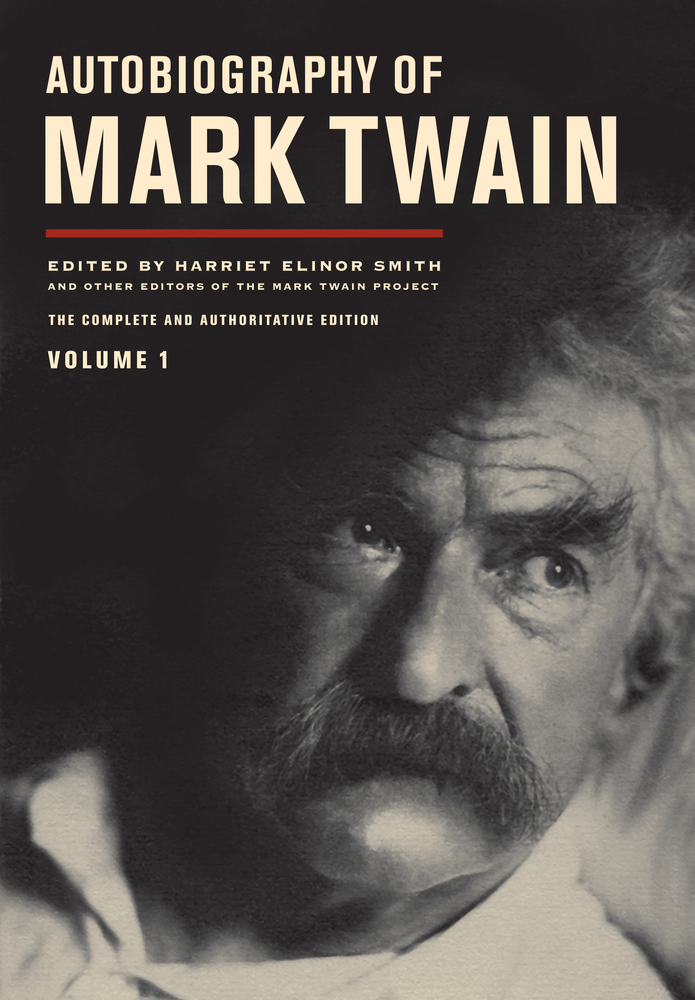
The first volume of Autobiography of Mark Twain–published 100 years after his death–has been a best-seller for the University of California Press, the publisher that brought out my latest book, Getting It Wrong.

The Twain volume has received largely favorable reviews, although the New York Times did say, in a critique the other day by the insufferable Garrison Keillor, that “there’s precious little frankness and freedom here and plenty of proof that Mark Twain, in the hands of academics, can be just as tedious as anybody else when he is under the burden of his own reputation.”

A more generous review, posted online yesterday by the North County Times in California, caught my eye–mostly for its reference to Twain (Samuel Clemens) and yellow journalism. The review quoted this passage from Twain’s autobiography:

“I was converted to a no-party independence by the wisdom of a rabid Republican. This was a man who was afterward a United States Senator, and upon whose character rests no blemish that I know of, except that he was the father of the William R. Hearst of to-day, and therefore grandfather of Yellow Journalism–that calamity of calamities.”

The reference was to George Hearst, an adventurer-miner who struck it rich in the silver fields of the 19th century American West. After securing his fortune, George Hearst became a U.S. senator from California, serving from 1886-1891.

Twain’s reference to “a rabid Republican” is puzzling, though, because George Hearst was a committed Democrat, as was his son, William Randolph Hearst.

More interesting was Twain’s characterization of yellow journalism as “that calamity of calamities.”

It’s an amusing line, but it ignores the generosity young Hearst extended to Twain in 1897, when the writer was down on his luck in London.

Hearst by then was running the provocative and activist-oriented New York Journal — the newspaper that helped give rise in 1897 to the sneer, “yellow journalism.”

The Journal preferred the term “journalism of action” and asserted that a newspaper had an obligation to inject itself routinely and conspicuously into civic life, to address the ills that government wouldn’t or couldn’t.

As I wrote in my 2006 year-study, The Year That Defined American Journalism: 1897 and the Clash of Paradigms, Hearst arranged for Twain, then 51, to report for the Journal on Queen Elizabeth’s Diamond Jubilee in June 1897.

Lining up Twain to cover the Jubilee was emblematic of Hearst’s willingness to spend money lavishly to recruit big-name talent, if only for spot assignments.

In Twain, though, Hearst must have been disappointed.

As I wrote in The Year That Defined American Journalism:

“Twain’s reporting about Victoria’s jubilee seemed half-hearted and hardly inspired. The spectacle was easily the most regal international story of 1897, and came at a time when the British empire at or near its height. But Twain found the celebration overwhelming—’a spectacle for the kodak [camera], not the pen,’” as he wrote in a dispatch published June 23, 1897.

Twain’s dispatch to the Journal included this odd observation:

“I was not dreaming of so stunning a show. All the nations seemed to be filing by. They all seemed to be represented. It was a sort of allegorical suggestion of the Last Day, and some who live to see that day will probably recall this one if they are not too much disturbed in mind at the time.”

Twain’s association with the Journal in 1897 did give rise to one of his most memorable lines–and allowed the newspaper to puncture rumors about the writer’s health.

In early June 1897, the New York Herald reported that Twain was “grievously ill and possibly dying. Worse still, we are told that his brilliant intellect is shattered and that he is sorely in need of money.”

The Journal promptly exposed the Herald report as erroneous, and published Twain famous, if often-misquoted, denial:

“The report of my death was an exaggeration,” Twain said.

He lived until 1910.

WJC

Recent and related:

‘Yes, Virginia,’ on CBS: No classic

In 1897, Anniversaries, Debunking, Media myths, New York Sun, Newspapers, Year studies on December 18, 2010 at 7:44 am

I wrote a year ago about the charmless CBS animated Christmas special, Yes, Virginia, a show based on Virginia O’Hanlon’s famous letter to the New York Sun in 1897 that prompted American journalism’s best-known editorial.

The show aired again last night; watching it was headache-inducing.

It utterly lacks the serendipity, anticipation, disappointment, and surprise that characterized the real back story to Virginia’s 1897 letter.

Her appeal to the Sun — “Please tell me the truth; is there a Santa Claus?”–gave rise to an editorial published beneath the headline, “Is There A Santa Claus?”

The editorial’s most memorable and most-quoted passage declared:

“Yes, Virginia, there is a Santa Claus. He exists as certainly as love and generosity and devotion exist, and you know that they abound and give to your life its highest beauty and joy. Alas! how dreary would be the world if there were no Santa Claus. It would be as dreary as if there were no Virginias.”

As I noted last year at Media Myth Alert, CBS took great liberties with the back story in offering up a tedious half-hour show that was neither accurate nor entertaining. It’s a distortion of a charming story.

Francis P. Church

The animated Virginia is waddling, round-headed, and unaccountably obsessed with the existence of Santa Claus. Francis P. Church, the retiring journalist who wrote the famous editorial, is depicted–no, misrepresented–as scowling, dismissive, and hard-hearted.

Neither character is convincing. Neither is realistic.

The animated Church is identified as the editor of the Sun, which is shown as a tabloid newspaper. Church was not the editor; he was an editorial writer. And the Sun was no tabloid.

The CBS show also had Virginia writing her letter, and the Sun publishing its reply, in December, as Christmas approached.

In fact, the letter was written in the summer of 1897, and the Sun published the editorial on September 21, 1897 — obscurely, in the third of three columns on editorials on an inside page (and not in big, sensation-stirring headlines across the front page, as the CBS show had it).

As I discuss in my 2006 book–a year-study titled The Year That Defined American Journalism: 1897 and the Clash of Paradigms–Virginia O’Hanlon said that she addressed her letter to the Sun’s question-and-answer column, and waited impatiently for the newspaper to publish a response.

She recalled that the Sun did not promptly take up her inquiry. Far from being obsessed, little Virginia stopped thinking about it after a while.

“After writing to the Sun,” she told an audience in Connecticut many years later, “I looked every day for the simple answer I expected. When it didn’t appear, I got disappointed and forgot about it.”

At the Sun, Virginia’s letter probably was overlooked, or misplaced, for an extended period.

That there was such a gap seems certain, given O’Hanlon’s recollections about waiting and waiting for a reply, and the accounts that say Church wrote the editorial in “a short time” or “hastily, in the course of the day’s work.”

Virginia O'Hanlon

What reconciles the two accounts—O’Hanlon’s prolonged wait and Church’s quickly written response—is that the Sun for a time had misplaced the letter that inspired a classic editorial, one that would recall the newspaper long after it folded in 1950.

The real back story to Virginia’s letter is far richer than the cheerless, vapid fare that CBS offered up.

Unlike the 1897 editorial, the wretched animated show is destined to be no classic.

WJC

Recent and related:

As inevitable as ‘Yes, Virginia,’ at the holidays

In 1897, Debunking, Furnish the war, Media myths, New York Sun, New York Times, Newspapers, Year studies, Yellow Journalism on December 15, 2010 at 8:59 am

The approach of the year-end holidays brings inevitable reference to American  journalism’s most famous editorial, “Is There A Santa Claus?”

Virginia O'Hanlon

The lyrical and timeless tribute to childhood and the Christmas spirit was first published in 1897 in the old New York Sun, in response to the inquiry of an 8-year-old girl, Virginia O’Hanlon.

“Please tell me the truth,” she implored, “is there a Santa Claus?”

The Sun in reply was reassuring:

“Yes, Virginia, there is a Santa Claus. He exists as certainly as love and generosity and devotion exist, and you know that they abound and give to your life its highest beauty and joy.”

Almost as inevitable as the editorial’s reappearance this time of year are sightings of myths and misconceptions associated with “Is There A Santa Claus?”

Today, for example, an online reference site for journalists, Followthemedia.com, says in an essay that “Is There a Santa Claus?” was published on the front page of the Sun, on September 21, 1897.

The date is correct. But the famous editorial was given obscure placement in its debut. As I wrote in my 2006 book, The Year That Defined American Journalism: 1897 and the Clash of Paradigms:

“‘Is There a Santa Claus?’ appeared inconspicuously in the third of three columns of editorials in the New York Sun on 21 September 1987. It was subordinate to seven other commentaries that day, on such matters as ‘British Ships in American Waters,’ the ambiguities in Connecticut’s election law, and the features of the chainless bicycle anticipated in 1898.”

“Is There A Santa Claus” appeared on page six, the editorial page of the Sun.

Interestingly, the oddly timed editorial about Santa Claus–appearing as it did more than three months before Christmas–prompted no comment from the many newspaper rivals to the Sun.

That’s somewhat curious because the New York City press of the late 19th century was prone–indeed, eager–to comment on, and disparage, the content of their rivals.  That’s how the enduring sneer “yellow journalism” was coined, in early 1897.

In its headline today, Followthemedia suggests the editorial’s most-quoted passage — “Yes, Virginia, there is a Santa Claus” — are the words most famous in American journalism.

Maybe.

But a stronger case can be made for  the New York Times logo, “All the News That’s Fit to Print,” which in 1897 took a permanent place in the upper left corner of the newspaper’s front page, a spot known in journalism as the “left ear.”

As I noted in a blog post nearly a year ago: “The ‘Yes, Virginia,’ passage is invoked so often, and in so many contexts, that no longer is it readily associated with American journalism. ‘Yes, Virginia,’ long ago became unmoored from its original context, the third of three columns of editorials in the New York Sun on September 21, 1897.”

I also suggested then that the famous vow attributed to William Randolph Hearst–“You furnish the pictures, I’ll furnish the war“–may be more famous in journalism than “Yes, Virginia.”

The Hearstian vow, as I write in my latest book, Getting It Wrong, is almost certainly apocryphal. But like many media-driven myths, it lives on as an anecdote too delicious not to be true.

What is striking and perhaps exceptional about “Is There A Santa Claus?” is its timeless appeal–how generations of readers have found solace, joy, and inspiration in its passages.

A letter-writer to the Sun in 1914 said, for example: “Though I am getting old,” the editorial’s “thoughts and expressions fill my heart with overflowing joy.”

In 1926, a letter-writer told the Sun that “Is There A Santa Claus?” offered “fine relief from the commercialism and unsentimental greed” of the Christmas season.

In 1940, a writer to the Sun likened the editorial to “a ray of hope on the path to human understanding in our troubled times.”

WJC

Recent and related:

Saturday at Newseum: Telling the back story to ‘Yes, Virginia’

In 1897, Media myths, New York Sun, Newspapers, Year studies on December 10, 2010 at 4:44 pm

I’ll be discussing American journalism’s best-known, most-reprinted editorial at a program tomorrow afternoon at the Newseum, the $450 million museum of news on Pennsylvania Avenue in Washington.

The editorial is, of course, the timeless tribute to childhood and the Christmas spirit that ran 113 years ago in the old New York Sun beneath the headline, “Is There A Santa Claus?”

I’ll be speaking about the back story to the classic editorial at 3:30 p.m. in the Newseum’s Knight studio, near the close of what is billed as “‘Yes, Virginia,’ Family Day.” The essay often is referred to as “Yes, Virginia,” owing to its most famous passage–“Yes, Virginia, there is a Santa Claus.”

As I note in my 2006 book, The Year That Defined American Journalism: 1897 and the Clash of Paradigms, the editorial was rather obscure and inconspicuous in its first appearance.  “Is There A Santa Claus?” was published in the third of three columns of tightly packed commentaries on topics that ranged from the ambiguities in Connecticut’s election law to the features of the chainless bicycle anticipated in 1898.

The editorial’s timing was odd and incongruous, too. “Is There A Santa Claus?” first appeared in the Sun on September 21, 1897–more than three months before Christmas.

As I write in The Year That Defined American Journalism, the best explanation for the puzzling timing “lies in the excited speculation of a little girl who, after celebrating her birthday in mid-summer, began to wonder about the gifts she would receive at Christmas.”

The little girl was Virginia O’Hanlon who, in her excited speculation, wrote to the Sun, saying:

“Some of my little friends say there is no Santa Claus. … Please tell me the truth; is there a Santa Claus?”

Virginia O'Hanlon

As she recalled years later, the letter was sent soon after her 8th birthday in July 1897. But the editorial reply in the Sun didn’t appear until more than two months had passed.

“After writing to the Sun,” she told an audience in 1959, “I looked every day for the simple answer I expected. When it didn’t appear, I got disappointed and forgot about it.”

Apparently, the Sun had misplaced or overlooked her letter. It eventually turned up on the desk of Edward P. Mitchell, the editorial page editor, who asked Francis P. Church to craft a reply.

Years later, Mitchell wrote that Church, a retiring, taciturn journalist, “bristled and pooh-poohed” at the request but finally “took the letter and turned with an air of resignation to his desk” to write.

It took Church less than a day to draft the editorial that would ensure him enduring posthumous fame. (His authorship wasn’t disclosed by the Sun until shortly after his death in 1906.)

“Virginia,” Church wrote in the editorial, “your little friends are wrong. They have been affected by the skepticism of a skeptical age. They do not believe except they see. They think that nothing can be which is not comprehensible by their little minds.”

After ruminating about the dimensions of human imagination, Church opened a new paragraph and wrote the editorial’s most memorable passages:

“Yes, Virginia, there is a Santa Claus. He exists as certainly as love and generosity and devotion exist, and you know that they abound and give to your life its highest beauty and joy. Alas! how dreary would be the world if there were no Santa Claus. It would be as dreary as if there were no Virginias.”

It sometimes is claimed that “Is There A Santa Claus?” was an instant sensation. In fact, it attracted no immediate attention. As I write in The Year That Defined American Journalism:

“Although it was published at a time when newspaper editors routinely commented on—and often disparaged—the work and content of their rivals, the oddly timed editorial prompted no comment from the Sun’s rivals in New York City.”

But “readers noted it and found it memorable,” I add. “In untold numbers over the years, readers asked the Sun to reprint the essay.” While it took years, the newspaper grudgingly acquiesced.

From 1924 until the newspaper’s last Christmas before folding in 1950, “Is There A Santa Claus?” was the lead editorial in the Sun on December 23 or 24.

“Ultimately,” I note, “the newspaper gave in—tacitly acknowledging that editors are not always as perceptive as their readers in identifying journalism of significance and lasting value.”

WJC

Recent and related:

‘Getting It Wrong’ among 90 titles at NPC Book Fair

In 1897, Cronkite Moment, Debunking, Hurricane Katrina, Media myths, Murrow-McCarthy myth, Newspapers, Washington Post, Watergate myth, Year studies on November 8, 2010 at 11:55 am

I will be among more than 90 authors signing and selling their recent books tomorrow evening at the annual National Press Club Book Fair and Authors’ Night.

My latest book, Getting It Wrong, will be among the titles at the Press Club event.

The book fair this year brings together a variety of authors, including one of my favorite journalism historians, Maurine Beasley of the University of Maryland; Jack Fuller, author of What Is Happening To News, and Chesley (“Sully”) Sullenberger, the pilot who safely landed a stricken passenger airliner on the Hudson River in January 2009.

The Book Fair is a fine occasion. I attended the event in 2006 and had a great time. My book at that event was The Year That Defined American Journalism: 1897 and the Clash of Paradigms.

Getting It Wrong, which came out during the summer, addresses and debunks 10 prominent media-driven myths. These are stories about and/or by the news media that widely believed and often retold but which, under scrutiny, dissolve as apocryphal or wildly exaggerated.

I liken them to the “junk food” of journalism–delicious and appealing, perhaps, but not terribly healthy or nutritious.

The myths debunked in Getting It Wrong include some of the most cherished stories American journalism tells about itself, including:

“Because it takes on some of the most treasured stories in American journalism,” I write in the introduction to Getting It Wrong, the book “is a work with a provocative edge. It could not be otherwise.”

I further write that Getting It Wrong “aligns itself with a central objective of newsgathering—that of seeking to get it right, of setting straight the record by offering searching reappraisals of some of the best-known stories journalism tells about itself.

“Given that truth-seeking is such a widely shared and animating value in American journalism,” I add, “it is a bit odd that so little effort has been made over the years to revisit, scrutinize, and verify these stories. But then, journalism seldom is seriously introspective, or very mindful of its history. It usually proceeds with little more than a nod to its past.”

I point out that media myths take hold for a variety of reasons: Because they delicious stories that are almost too good not to be true; because they are reductive in offering simplistic interpretations of complex historical events, and because they are self-flattering in that they place journalists at the decisive center of important developments.

The Book Fair opens at 5:30 p.m. Admission is free for members, and $5 for non-members.

WJC

Recent and related:

IBD invokes Hearst myth of ‘furnish the war’

In 1897, Debunking, Furnish the war, Media myths, Spanish-American War, Yellow Journalism on October 21, 2010 at 5:19 pm

Remington, Davis in Cuba

In Getting It Wrong, my new mythbusting book, I point out that the most resilient media-driven myths often are those that are distilled “to a catchy, pithy phrase.”

A telling case in point is the line often attributed to William Randolph Hearst: “You furnish the pictures, I’ll furnish the war.” He supposedly was referring to war with Spain in the late 19th century.

Testimony to the tenacity of Hearst’s reputed comment–which I address and debunk in Getting It Wrong–appeared the other day in a commentary in Investor’s Business Daily. The commentary asserted:

“The media have a history of offering more heat than light on many issues. Recall publisher William Randolph Hearst’s telegram to a photographer on assignment to document the supposed conflict in Cuba in 1897: ‘You furnish the pictures, and I’ll furnish the war.'”

Let’s unpack that error-fraught paragraph.

For starters, the story goes that Hearst purportedly sent the telegram to Frederic Remington, a prominent artist (not a photographer), who arrived in Cuba in January 1897 on assignment for Hearst’s New York Journal (see image, above).

Remington was sent there to illustrate the island-wide rebellion against Spanish colonial rule. The artist later recalled that at the time of his brief visit, the Cuban countryside “was a pall of smoke” from homes of Cubans that had been set afire.

Davis

Remington traveled to Cuba with Richard Harding Davis, a prominent writer and correspondent. Davis’ correspondence from that time stated flatly: “There is war here and no mistake.”

So a “supposed conflict” the rebellion was not. In fact, the Cuban rebellion gave rise in 1898 to the Spanish-American War.

As I also point out in Getting It Wrong, the “furnish the war” anecdote lives on despite a nearly complete absence of supporting documentation.

“It lives on,” I write, “even though telegrams supposedly exchanged by Remington and Hearst have never turned up.

“It lives on even though Hearst denied ever sending such a message.”

Moreover, I write, the myth “lives on despite an irreconcilable internal inconsistency: It would have been absurd for Hearst to vow to ‘furnish the war’ because war—specifically, the Cuban rebellion against Spain’s colonial rule—was the very reason Hearst sent Remington to Cuba in the first place.”

A further reason for doubting that Hearst sent such a message is that Spanish authorities closely controlled cable traffic into and out of Cuba. They surely would have intercepted–and would have called attention to–such an inflammatory message, had it been sent.

Despite those and other factors, the Remington-Hearst anecdote is a media myth that refuses to die. One reason for its tenacity, I point out in Getting It Wrong, is that the tale “has achieved unique status as an adaptable, hardy, all-purpose anecdote, useful in illustrating any number of media sins and shortcomings.

“It has been invoked to illustrate the media’s willingness to compromise impartiality, promote political agendas, and indulge in sensationalism. It has been used, more broadly, to suggest the media’s capacity to inject malign influence into international affairs.”

Like many media-driven myths, the “furnish the war” anecdote is succinct, savory, and easily remembered. It is indeed “a catchy, pithy phrase,” one almost too good not to be true.

WJC

Recent and related:

Was ‘jailbreaking journalism’ a hoax? Evidence points the other way

In 1897, Anniversaries, Debunking, Media myths, Spanish-American War, Yellow Journalism on October 15, 2010 at 6:42 am

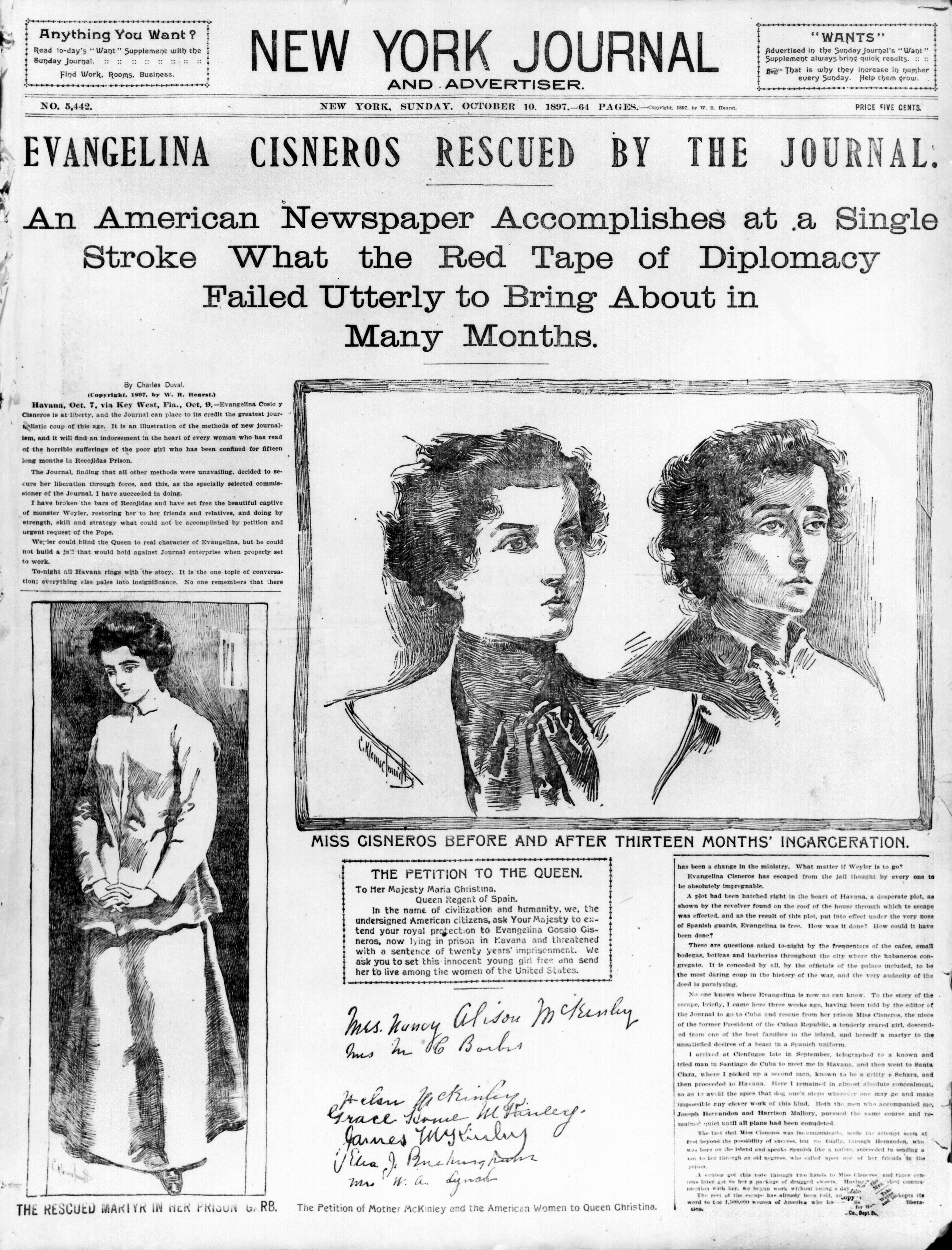
The sensational case of “jail-breaking journalism” reached a conclusion 113 years ago this week, when the passenger steamer Seneca reached in New York harbor, en route from Havana.

Among the passengers was 19-year-old Evangelina Cisneros, a petite Cuban woman who, a few days before, had been the world’s most famous political prisoner.

She had been broken out of jail in Havana in the early hours of October 7, 1897. Her rescuers included Karl Decker, a reporter for William Randolph Hearst‘s New York Journal who had been assigned to Havana to secure her freedom.

Once out of jail, Cisneros was hidden at the home of a bachelor Cuban banker for nearly three days. She was smuggled aboard the Seneca just before it left Havana.

The steamer reached New York on October 13, 1897, and the Journal lodged Cisneros in a palatial room at the Waldorf Hotel. Four days later, she and Decker were feted at Madison Square, at a thunderous outdoor reception organized by Hearst.

More than 75,000 people turned out at what was reported to have been the largest public gathering in New York since the Civil War.

I wrote about the case of “jail-breaking journalism” in my 2006 book, The Year That Defined American Journalism: 1897 and the Clash of Paradigms, noting:

“Cisneros was rapturously received [in New York] not because she was a daring and clever prison escapee, but because she was a frail and wily embodiment of the Cuban struggle for political independence from Spain.”

At the time, Cuba was in open rebellion against Spanish colonial rule, and Evangelina had been swept up in the tumult on the island. She was accused of plotting to kill a senior Spanish military officer; she said she was defending herself from the officer’s sexual advances.

To the Journal, her jailing stood as irrefutable evidence of Spain’s routine mistreatment of Cuban women. Cisneros, the Journal said, was guilty only of “having in her veins the best blood in Cuba.”

As that claim suggests, the Journal devoted impassioned and intensive coverage to Cisneros’ plight, turning her jailing into an international cause célèbre.

By the time of her escape, Cisneros had been in Spanish custody nearly 15 months without trial.

The jailbreak was breathtakingly illegal–and one of the most astonishing episodes in American journalism. The Journal declared it “epochal,” a stunning success of its activist brand of yellow journalism.

But the case long has been dogged by suspicions that the whole thing was a hoax, that Decker paid bribes to win Cisneros’ release and then concocted an elaborate tale about a jailbreak.

Such suspicions emerged almost as soon as Cisneros reached New York.  As I note in The Year That Defined American Journalism, Hearst’s leading rival newspaper, the New York World of Joseph Pulitzer, was particularly eager to denounce the Cisneros rescue as fraudulent.

“Gold did it,” the World declared. “The Spanish could not withstand its glitter. It oiled the palms of turnkeys and guards, of officers and civilians. Miss Cisneros’s friends had it a-plenty. And so she got out of her cell while her jailers looked the other way.”

But as I note in The Year That Defined American Journalism, such claims “have never been supported by any direct evidence. No one has identified to whom bribes were paid, how much, by what method, and how the purported payoffs secured the enduring silence of the authorities.”

Besides, a conspiracy of silence that included senior Spanish authorities in Cuba would have had to have been so improbably extensive—so many people would have known—that “concealment could not possibly have lasted for long, certainly not 100 years and more,” I wrote.

Allegations or suspicions of bribery, I noted, “rest more on assertion—and newspaper rivals’ contempt for the Journal—than on specific, persuasive documentation. They are supported more by argument than evidence.”

Decker–who denied that bribes had been paid–succeeded in the jailbreak because he tapped into a clandestine network in Havana, the operatives of which had become adept in smuggling arms, ammunition, and medicine into Cuba and, occasionally, people out.

Among those operatives was Carlos F. Carbonell, a bachelor banker in whose home Cisneros was hidden. They also included William B. MacDonald, an American national in Havana who was the agent for a steamship line. He was with Decker when the jailbreak took place.

It is simply implausible that Carbonell, MacDonald, and Decker’s other accomplices would have taken the risks they took had the Cisneros rescue been nothing more than hoax, farce, or sham.

WJC

Recent and related:

Doing more than casting ‘doubt’ on Hearst’s famous vow

In 1897, Cinematic treatments, Debunking, Furnish the war, Media myths, Newspapers, Spanish-American War, Yellow Journalism on October 9, 2010 at 7:15 am

In a thoughtful essay posted the other day about “Hollywood and the Power of Myth,” the director of new media at the Wharton School invoked my research into William Randolph Hearst’s purported vow to “furnish the war” with Spain, saying that I’ve cast “doubt” on the often-repeated anecdote.

I like to think that I’ve pretty much demolished that tale.

The Wharton new media director is Kendall Whitehouse, who referred in his essay to my 2000 article in Journalism and Mass Communication Quarterly that challenges the Hearstian vow as improbable. In that article, I wrote that the anecdote deserved “relegation to the closet of historical imprecision.”

I revisited the tale in my latest book, Getting It Wrong, which debunks 10 prominent media-driven myths–dubious and improbable stories about the news media that masquerade as factual.

Chapter One in Getting It Wrong is devoted to the Hearstian tale, which I flatly describe as a media-driven myth, calling it “perhaps the hardiest myth in American journalism.”

I note:

“Hearst’s famous vow to ‘furnish the war’ has achieved unique status as an adaptable, hardy, all-purpose anecdote, useful in illustrating any number of media sins and shortcomings. It has been invoked to illustrate the media’s willingness to compromise impartiality, promote political agendas, and indulge in sensationalism. It has been used, more broadly, to suggest the media’s capacity to inject malign influence into international affairs.”

Its versatility and its pithiness are two of the reasons the Hearstian myth has lived on.

The anecdote stems from Hearst’s assigning Frederic Remington, the famous artist of the American West, to Cuba, to draw illustrations for the New York Journal of the island-wide rebellion against Spanish colonial rule. Remington and the writer Richard Harding Davis, who also was on Hearst’s payroll, reached Cuba in January 1897. (Both are shown in the front-page image above.)

Remington was in Cuba six days before returning to New York. He suffered in the tropical heat and didn’t along with the self-important Davis, who called the rotund Remington “a large, blundering bear.”

Before returning, the media myth has it, Remington sent Hearst a telegram stating:

“Everything is quiet. There is no trouble here. There will be no war. I wish to return.”

Hearst supposedly cabled the artist reply: “Please remain. You furnish the pictures, and I’ll furnish the war.”

In most tellings of the anecdote, Hearst supposedly made good on his promise and brought on the war with Spain, which was declared 15 months later.

The Remington-Hearst anecdote is riven with flaw and incongruity. For starters, Hearst at least twice denied ever having sent such a message. And Remington apparently never discussed the anecdote.

Moreover, as I write in Getting It Wrong, “the anecdote lives on despite a nearly complete absence of supporting documentation. It lives on even though telegrams supposedly exchanged by Remington and Hearst have never turned up.”

And it lives on despite what I call “an irreconcilable internal inconsistency.” That is, it would have been absurd for Hearst to have vowed to “furnish the war” because war—specifically, the Cuban rebellion against Spain’s colonial rule—was the very reason Hearst sent Remington and Davis to Cuba in the first place.

“Anyone reading U.S. newspapers in early 1897 would have been well aware that Cuba was a theater of a nasty war,” I write in Getting It Wrong. “By then, the Cuban rebellion had reached islandwide proportions and not a single province had been pacified by Spain’s armed forces.”

Despite those and other flaws, the tale lives on as too good to check out, too good not to be true.

And as I note in Getting It Wrong:

“What firmly and finally pressed Hearst’s purported vow to ‘furnish the war’ into the public’s consciousness was Citizen Kane, the 1941 motion picture that was based loosely on Hearst’s life and times.”

In a scene early in the film, Orson Welles in the role of Charles Foster Kane, a newspaper tycoon who readily invites comparisons to Hearst, paraphrases the purported Remington-Hearst exchange.

Whitehouse noted in his essay: “Rightly or wrongly, Orson Welles’s … Citizen Kane has largely shaped our popular perception of William Randolph Hearst.” True enough.

Kane certainly helped solidify a robust media-driven myth.

WJC

Recent and related: