W. Joseph Campbell

Archive for the ‘Anniversaries’ Category

Check out new ‘War of Worlds’ mythbusting trailer

In Anniversaries, Media myths, Media myths and radio, War of the Worlds on October 21, 2010 at 9:17 am

No single program in American broadcasting has inspired more fear, controversy, and endless fascination than the radio dramatization of the War of The Worlds that aired on Halloween eve in 1938.

The program, which told of invading Martians wielding deadly heat rays, was the work of Orson Welles, a 23-year-old prodigy who directed and starred in the show.

As I write in my new mythbusting book, Getting It Wrong, Welles’ show supposedly was so alarming and made such effective use of simulated news bulletins that listeners by the tens of thousands—or even the hundreds of thousands—were convulsed in fear, panic, and mass hysteria, believing the Earth was under alien attack.

Fright beyond measure seized America that night more than 70 years ago.

Or so the media-driven myth has it.

Getting It Wrong offers compelling evidence that the fear, panic, and mass hysteria so readily associated with the War of The Worlds radio dramatization did not occur that night on anything approaching nationwide dimension.

I write that while some Americans may have been frightened by the program, the overwhelming number of listeners were not: They recognized it for what it was—an imaginative and entertaining radio show.

However, newspapers the day after Welles’ show suggested that mass panic had indeed swept the country.

Their reports were almost entirely anecdotal and based mostly on sketchy wire service roundups that emphasized breadth over depth. Newspapers, I write, “simply had no reliable way of ascertaining the validity of the sweeping claims” they made about the radio program.

“Inaccurate reporting,” I write, “gave rise to a misleading historical narrative and produced a savory and resilient media-driven myth.”

I further note in Getting It Wrong that the War of the Worlds show also offered American newspapers an “irresistible opportunity to rebuke radio—which in 1938 was an increasingly important rival source for news and advertising.”

Newspapers took delight in assailing radio as an unreliable, untrustworthy source of information. And this overwhelmingly negative commentary, I write, helped solidify the notion that the radio broadcast had sown mass panic and hysteria among Americans.

In short, the idea that the War of the Worlds program sent untold thousands of people into the streets in fear and panic, is a media-driven myth—one that offers a deceptive message about the influence of radio and about the media’s potential to cause panic and alarm.

I also note in Getting It Wrong that there can be “no disputing that the War of the Worlds dramatization was great entertainment”–worthy of distinction as perhaps the most famous radio show ever.

WJC

Recent and related:

Many thanks to Kathy Shaidle of fivefeetoffury for linking to this post.
Was ‘jailbreaking journalism’ a hoax? Evidence points the other way

In 1897, Anniversaries, Debunking, Media myths, Spanish-American War, Yellow Journalism on October 15, 2010 at 6:42 am

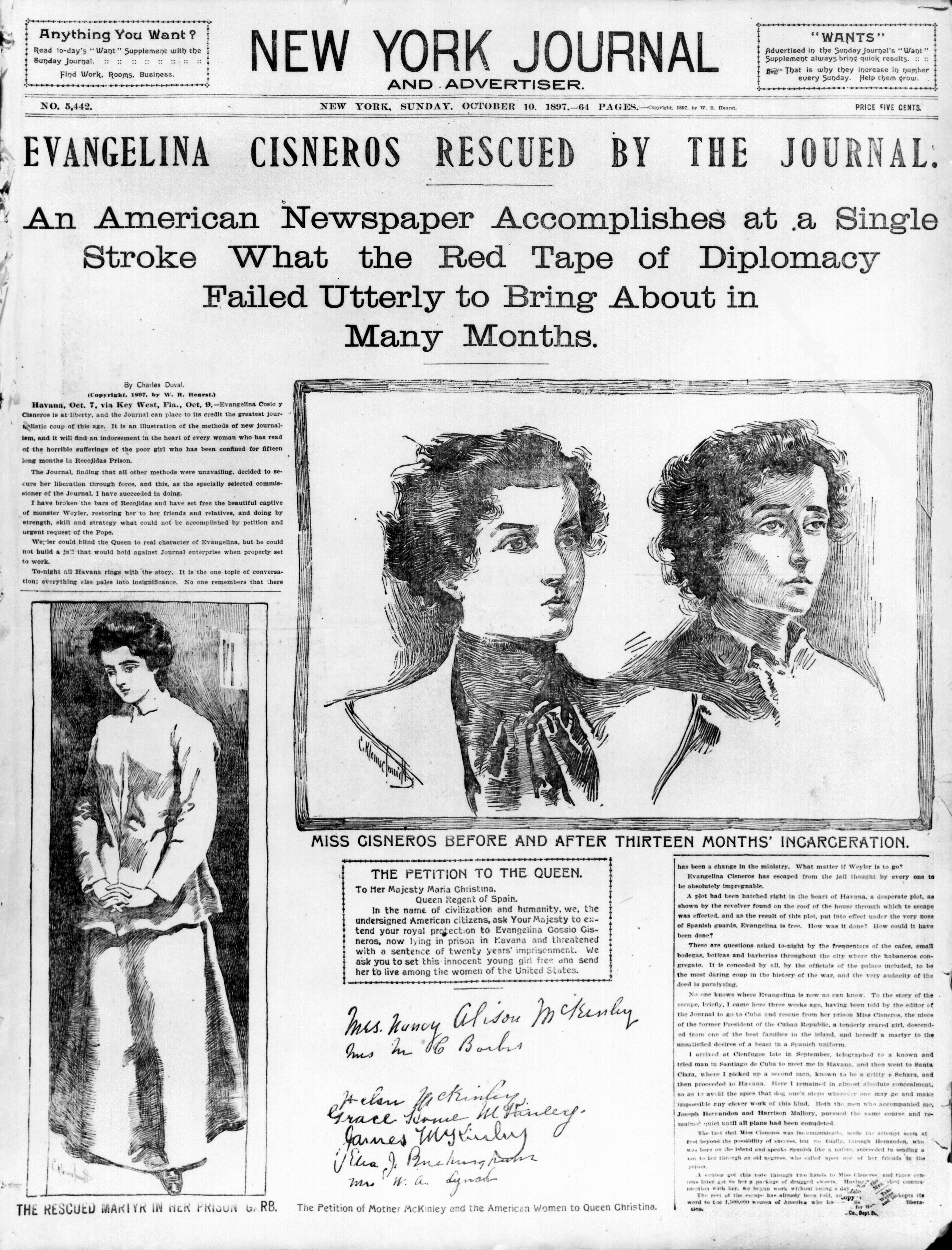
The sensational case of “jail-breaking journalism” reached a conclusion 113 years ago this week, when the passenger steamer Seneca reached in New York harbor, en route from Havana.

Among the passengers was 19-year-old Evangelina Cisneros, a petite Cuban woman who, a few days before, had been the world’s most famous political prisoner.

She had been broken out of jail in Havana in the early hours of October 7, 1897. Her rescuers included Karl Decker, a reporter for William Randolph Hearst‘s New York Journal who had been assigned to Havana to secure her freedom.

Once out of jail, Cisneros was hidden at the home of a bachelor Cuban banker for nearly three days. She was smuggled aboard the Seneca just before it left Havana.

The steamer reached New York on October 13, 1897, and the Journal lodged Cisneros in a palatial room at the Waldorf Hotel. Four days later, she and Decker were feted at Madison Square, at a thunderous outdoor reception organized by Hearst.

More than 75,000 people turned out at what was reported to have been the largest public gathering in New York since the Civil War.

I wrote about the case of “jail-breaking journalism” in my 2006 book, The Year That Defined American Journalism: 1897 and the Clash of Paradigms, noting:

“Cisneros was rapturously received [in New York] not because she was a daring and clever prison escapee, but because she was a frail and wily embodiment of the Cuban struggle for political independence from Spain.”

At the time, Cuba was in open rebellion against Spanish colonial rule, and Evangelina had been swept up in the tumult on the island. She was accused of plotting to kill a senior Spanish military officer; she said she was defending herself from the officer’s sexual advances.

To the Journal, her jailing stood as irrefutable evidence of Spain’s routine mistreatment of Cuban women. Cisneros, the Journal said, was guilty only of “having in her veins the best blood in Cuba.”

As that claim suggests, the Journal devoted impassioned and intensive coverage to Cisneros’ plight, turning her jailing into an international cause célèbre.

By the time of her escape, Cisneros had been in Spanish custody nearly 15 months without trial.

The jailbreak was breathtakingly illegal–and one of the most astonishing episodes in American journalism. The Journal declared it “epochal,” a stunning success of its activist brand of yellow journalism.

But the case long has been dogged by suspicions that the whole thing was a hoax, that Decker paid bribes to win Cisneros’ release and then concocted an elaborate tale about a jailbreak.

Such suspicions emerged almost as soon as Cisneros reached New York.  As I note in The Year That Defined American Journalism, Hearst’s leading rival newspaper, the New York World of Joseph Pulitzer, was particularly eager to denounce the Cisneros rescue as fraudulent.

“Gold did it,” the World declared. “The Spanish could not withstand its glitter. It oiled the palms of turnkeys and guards, of officers and civilians. Miss Cisneros’s friends had it a-plenty. And so she got out of her cell while her jailers looked the other way.”

But as I note in The Year That Defined American Journalism, such claims “have never been supported by any direct evidence. No one has identified to whom bribes were paid, how much, by what method, and how the purported payoffs secured the enduring silence of the authorities.”

Besides, a conspiracy of silence that included senior Spanish authorities in Cuba would have had to have been so improbably extensive—so many people would have known—that “concealment could not possibly have lasted for long, certainly not 100 years and more,” I wrote.

Allegations or suspicions of bribery, I noted, “rest more on assertion—and newspaper rivals’ contempt for the Journal—than on specific, persuasive documentation. They are supported more by argument than evidence.”

Decker–who denied that bribes had been paid–succeeded in the jailbreak because he tapped into a clandestine network in Havana, the operatives of which had become adept in smuggling arms, ammunition, and medicine into Cuba and, occasionally, people out.

Among those operatives was Carlos F. Carbonell, a bachelor banker in whose home Cisneros was hidden. They also included William B. MacDonald, an American national in Havana who was the agent for a steamship line. He was with Decker when the jailbreak took place.

It is simply implausible that Carbonell, MacDonald, and Decker’s other accomplices would have taken the risks they took had the Cisneros rescue been nothing more than hoax, farce, or sham.

WJC

Recent and related:

1897 flashback: Committing ‘jailbreaking journalism’

In 1897, Anniversaries, Newspapers, Spanish-American War, Yellow Journalism on October 4, 2010 at 7:08 am

William Randolph Hearst‘s New York Journal pulled off one of the greatest coups in participatory journalism 113 years ago this week, in what a rival newspaper called the case of “jail-breaking journalism.”

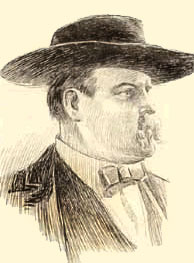
Decker

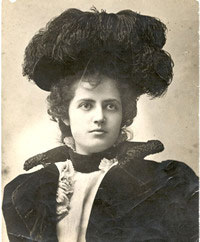
The episode centered around Karl Decker, a Journal reporter whom Hearst had sent to Cuba, and Evangelina Cisneros, a political prisoner jailed in Havana on suspicion of conspiring to kill a senior Spanish military officer.

Cisneros, who was 19, claimed the officer had made her the target of his unwelcome sexual advances.

She had been jailed more than a year, without trial, when Hearst’s Journal described her plight in a front-page article in August 1897.

The report claimed, incorrectly, that Cisneros already had been tried by a martial tribunal and was “in imminent danger” of being sentenced to 20 years’ imprisonment at Spain’s penal colony on Ceuta, off the north Africa coast.

As I wrote in my 2006 book, The Year That Defined American Journalism: 1897 and the Clash of Paradigms, the error mattered little to the Journal: “Far more important was that the prolonged imprisonment of Cisneros represented a brutish and unambiguous example of Spain’s cruel treatment of Cuban women—a topic of not infrequent attention in U.S. newspapers.”

In 1897, Spain still ruled Cuba, however tenuously. It had failed to put down an island-wide rebellion that began in 1895, despite having sent nearly 200,000 troops to Cuba. The Cuban rebellion was to give rise in 1898 to the Spanish-American War.

Following its disclosure about Cisneros’ jailing, the Journal organized a petition drive among American women, calling on the queen regent of Spain to release Cisneros. The newspaper claimed to have collected signatures from more than 10,000 women, but Spanish authorities were unmoved.

So in late summer 1897, Hearst sent Decker to Cuba, ostensibly as the Journal‘s correspondent in Havana. In reality, Decker was under orders to secure the release of Cisneros.

Evangelina Cisneros

With the quiet help of U.S. diplomatic personnel in Cuba–and with the crucial support of a clandestine smuggling network in Havana–Decker succeeded. In the early hours of October 7, 1897, Decker and two accomplices broke the bars of Cisneros’ cell and spirited her out of jail.

She was hidden for nearly three days at the home of one of the accomplices, Carlos F. Carbonell, an affluent, American-educated Cuban banker whom Cisneros later married.

Then, dressed as a boy, the diminutive Cisneros was smuggled aboard the Seneca, a passenger steamer bound for New York City, where Hearst organized a thunderous welcome for her.

Nearly 75,000 people turned out at New York’s Madison Square to welcome Cisneros and Decker, who had separately returned to the United States aboard a Spanish-flagged passenger vessel.

Cisneros “was rapturously received” in New York, I wrote in The Year That Defined American Journalism, “not because she was a daring and clever prison escapee, but because she was a frail and wily embodiment of the Cuban struggle for political independence from Spain.”

Some U.S. newspapers scoffed at the Journal‘s coup. “Jail-breaking journalism,” said the Chicago Times-Herald. But many other newspapers and trade journals cheered the exploit.

The Fourth Estate, for example, congratulated Decker and the Journal on an “international triumph” and saluted them for having “smashed journalistic records.”

For the Journal–which never was shy about self-promotion–the Cisneros jailbreak and rescue were “epochal,” the apogee of its brand of activist-oriented yellow journalism.

Interestingly, the Cisneros jailbreak fell quickly from the front pages of American newspapers–including those of the Journal. And the case was rarely mentioned in the American press, or by American political figures, as war loomed with Spain in the spring of 1898.

But “jail-breaking journalism” merits being recalled this week, as an episode unique in American journalism.

WJC

Recent and related:

<!–[if !mso]> the Journal, the Cisneros jailbreak and rescue was “epochal,”
/* Style Definitions */
table.MsoNormalTable
{mso-style-name:”Table Normal”;
mso-tstyle-rowband-size:0;
mso-tstyle-colband-size:0;
mso-style-noshow:yes;
mso-style-parent:””;
mso-padding-alt:0in 5.4pt 0in 5.4pt;
mso-para-margin:0in;
mso-para-margin-bottom:.0001pt;
mso-pagination:widow-orphan;
font-size:10.0pt;
font-family:”Times New Roman”;
mso-ansi-language:#0400;
mso-fareast-language:#0400;
mso-bidi-language:#0400;}
the Journal, the Cisneros jailbreak and rescue was “epochal,” the Journal, the Cisneros jailbreak and rescue was “epochal,”[i] a “supreme achievement of the journalism of action.”


[i]. Duval [Decker], “Evangelina Cisneros Rescued by the Journal,” New York Journal (10 October 1897).

‘War of the Worlds’ radio panic was overstated

In Anniversaries, Debunking, Media myths, Media myths and radio, War of the Worlds on October 3, 2010 at 8:02 am

Welles in bronze

October always brings frequent reminders about radio’s most memorable and myth-beclouded program–Orson Welles’ superb dramatization of the War of the Worlds that aired on Halloween eve 1938.

So realistic was Welles’ show, so alarming were its simulated news reports of invading Martians, that listeners by the tens of thousands—or more—were convulsed in panic and hysteria.

Fright beyond measure gripped the country that night; it was the night that panicked America.

Or so the media myth has it.

The delicious, ever-appealing tale of mass hysteria sown by the War of the Worlds program is one of the 10 prominent media-driven myths that I address and debunk in my new book, Getting It Wrong.

I note that some Americans were frightened by the program. But most listeners, in overwhelming numbers, were not. They recognized it for what it was—an imaginative and entertaining radio show that aired in its usual Sunday evening time slot.

Still, this media myth is just too well-known, too entrenched in the American consciousness, ever to fall into disuse.

That’s why October brings numerous references to the War of the Worlds show and the panic it supposedly caused. Indeed, just the other day, an item posted at examiner.com said the program fooled “over a million people into thinking the world was actually under attack by Martians.”

But there’s simply no data to support such claims.

Hadley Cantril, a psychologist at Princeton University who helped promote the notion that the Welles’ program caused widespread panic, drew on surveys to estimate that at least 6 million people listened to the hour-long program, which aired live over the CBS radio network.

Of those listeners, Cantril estimated, 1.2 million were “frightened,” “disturbed,” or “excited” by what they heard.

But as I note in Getting It Wrong, “Cantril left unclear the distinctions among ‘frightened,’ ‘disturbed,’ or ‘excited.’ Nor did Cantril not estimate how many listeners acted on their fears and excitement,” a critical element had there indeed been widespread panic that night.

I further note that “one can watch a horror movie and feel ‘frightened,’ ‘disturbed,’ or ‘excited,’ but such responses are hardly synonymous with panic or hysteria.” Far from it.

The notion that mass panic had accompanied the airing the War of the Worlds program spread quickly, mostly by U.S. newspapers which reported the day after the show that hysteria had swept the country.

Their reports, however, “were almost entirely anecdotal,” I note, “and largely based on sketchy wire service roundups that emphasized breadth over in-depth detail.”

Newspapers simply had no reliable way of testing or ascertaining the validity of the sweeping claims they made about the War of the Worlds program.

Here’s why.

The War of the Worlds dramatization aired from 8-9 on Sunday night in the East, a time when most newspaper newsrooms were thinly staffed.

Reporting on the reactions to The War of The Worlds broadcast represented no small challenge, especially for morning newspapers having late-night deadlines.

“Given the constraints of time and staffing,” I write in Getting It Wrong, “relying on wire services such as the Associated Press became essential. This dependency, in turn, had the effect of promoting and deepening the notion that panic was widespread that night: On a late-breaking story of uncertain dimension and severity, many newspapers took their lead from wire service dispatches.

“They had little choice.”

The AP’s reports about the program essentially were roundups of reactions culled from the agency’s bureaus across the country, I write. Typically, AP roundups emphasized sweep—pithy anecdotal reports from many places—over depth and detail.

The anecdotes about people frightened by the show tended to be sketchy, shallow, and small-bore. But their scope contributed to and confirmed the sense that widespread panic was afoot that night.

The reliance on wire service roundups helps explain the consensus among U.S. newspapers that the broadcast had created mass panic.

Interestingly, newspaper content also helps to undercut the notion that panic and hysteria  swept the country that night.  Had that happened, the resulting trauma and turmoil surely would have led to many deaths and serious injuries.

But newspaper reports were notably silent on extensive casualties.

No deaths were attributed to the War of the Worlds broadcast. And as Michael J. Socolow wrote in his fine essay about the program, no suicides could “be traced to the broadcast,” either.

WJC

Recent and related:

Indulging in myth on debate’s 50th anniversary

In Anniversaries, Debunking, Media myths, Washington Post, Watergate myth on September 27, 2010 at 7:12 am

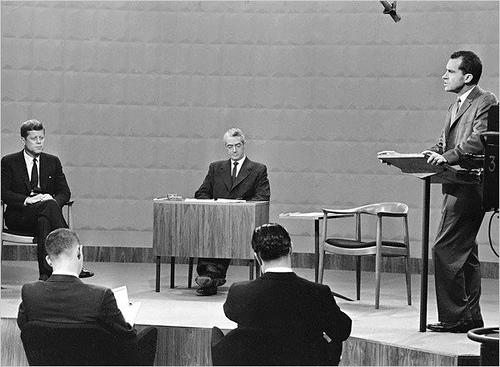
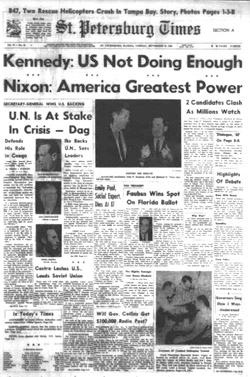
News outlets indulged in the myth of viewer-listener disagreement right through the 50th anniversary yesterday of the first Kennedy-Nixon debate.

The myth holds that people who watched the debate on television thought that Senator John F. Kennedy won; those who listened on radio thought Vice President Richard Nixon had the best of it.

The myth was long ago debunked by scholars David L. Vancil and Sue D. Pendell, in an article in Central States Speech Journal. They noted that reports of viewer-listener disagreement typically were anecdotal, and the few surveys that hinted at a viewer-listener disconnect were too small and unrepresentative by which to make confident judgments.

While it has been thoroughly dismantled, the myth lives on as irresistible testimony about the power of television and the importance of image in presidential politics.

An item posted yesterday at Andrew Breitbart’s Big Journalism online site said as much, declaring:

“The face of TV and politics changed forever on this date in history. …

“Those who watched the broadcast of the first ever televised presidential debate declared Kennedy the winner, those who listened on the radio gave the nod to Nixon. Thus, the political world changed forever.”

WLS-TV in Chicago, the city where the debate took place on September 26, 1960, said at its online site yesterday: “Most of the 70 million people who watched the event on television were convinced Kennedy won, and they voted for him in the presidential election of 1960.

“Surveys showed, though, that most of the people who listened on the radio thought Nixon won. It was the first time a nominee’s appearance may have affected voters.”

In addition, CBS Channel 2 in Chicago declared at its online site:

“Some listening on radio said it seemed like Nixon won. But as many as 74 million Americans were watching on television, and the medium became an overnight unexpected game-changer in our political system.”

As I’ve noted, specific evidence almost never is cited to support such claims about the debate. It’s as if the notion of viewer-listener disagreement is just too good, too delicious to check out–a factor that often characterizes the telling of media-driven myths. It’s a point I make in Getting it Wrong, my new book that debunks 10 prominent media myths. (While certainly prominent, the 1960 debate myth is not included in Getting It Wrong.)

There is evidence that a plurality of registered voters thought Kennedy fared better than Nixon in the debate 50 years ago.

But such impressions did not alter the campaign’s dynamic: The race remained a toss-up to Election Day.

Here’s what the evidence shows: A Gallup poll released in October 1960 reported that 43 percent of voters thought Kennedy “did the better job” in the first debate (of four debates during the campaign). Twenty-three percent thought Nixon was better; 29 percent said both candidates were about the same. Five percent offered no opinion.

The same survey reported Kennedy was narrowly ahead in the race, by 49 percent to 46 percent, with 5 percent undecided.

That result represented a slight change from Gallup’s survey taken just before the debate, which reported Nixon leading narrowly, by 47 percent to 46 percent.

Gallup called the post-debate shift too slight to be meaningful.

“The prudent reader can see,” George Gallup, head of the polling organization, wrote in reporting the results, “that polling accuracy has not reached the degree of accuracy required to say with certainty which candidate is ahead in a close race such as the present one.”

So, no: The debate 50 years ago didn’t change the “political world … forever.” Television wasn’t an “overnight … game-changer” in presidential campaigns. Nothing of the sort.

Media-driven myths are known to give rise to spin-off or subsidiary myths, a phenomenon I discuss in Getting It Wrong.

An example is the heroic-journalist myth of Watergate, which holds that the investigative reporting of Washington Post reporters Bob Woodward and Carl Bernstein brought down Nixon’s presidency in the 1970s. The spin-off or subsidiary myth is that Woodward and Bernstein’s work was so widely appealing that it prompted a surge in college students majoring in journalism.

But that wasn’t so: The surge in enrollments in journalism programs predated the Watergate scandal and was due in measure to young women entering the field.

A spin-off of the Kennedy-Nixon debate myth is that the widely watched televised encounter helped Kennedy become better known among Americans. Before then, the argument goes, Kennedy lacked much national recognition. Nixon, on the other hand, was well-known, having been vice president for almost eight years.

But in fact Kennedy had become nationally prominent long before the first debate.

So well-known that he ran well ahead of Nixon in many of the presidential trial heats that Gallup conducted nationally in late 1958 and 1959.

These matchups, while volatile, were seen by Gallup as early tests of a prospective candidate’s political strength.

The Gallup trial heat in December 1958 had Kennedy leading Nixon by 59 percent to 41 percent.

Kennedy was favored over Nixon by a larger margin, 61 percent to 39 percent, in the trial heat reported in July 1959.

To have polled as well as he did so long before the 1960 campaign, Kennedy simply could not have been an unknown in national politics.

WJC

Recent and related:

My many thanks to fivefeetoffury and Ed Driscoll for linking to this post.

Who won ’60 debate? Can’t say: Didn’t see it on TV

In Anniversaries, Debunking, Media myths on September 26, 2010 at 8:33 am

Sander Vanocur has been much in demand in the run-up to today’s 50th anniversary of the first Kennedy-Nixon televised presidential debate.

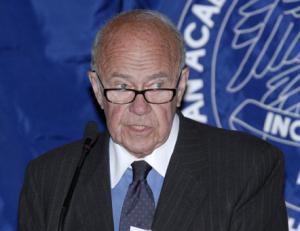
The 82-year-old Vanocur is sharp, witty, and droll–and the sole surviving member of the media panel that questioned the candidates during the debate on September 26, 1960.

Vanocur

Vanocur, a retired NBC newsman, has appeared on a number of panels in Washington that have examined the implications and legacies of the encounter between Senator John F. Kennedy and Vice President Richard Nixon. He’s also to participate on a panel today in Chicago, where the Kennedy-Nixon debate took place.

Among the comments that Vanocur has offered at these look-back events is:

“I don’t know who won the debate: I didn’t see it on television.”

He made such a remark yesterday, during a panel discussion at the Newseum, the $450 million museum of news in downtown Washington. (It’s where my new myth-busting book, Getting It Wrong, was launched in June.)

The comment “I didn’t see it on television” suggests the tube was decisive that night 50 years ago–and even was decisive to the outcome of the 1960 election.

Debate coverage, 1960

Which it wasn’t.

Nixon supposedly lost the debate among television viewers because he looked so poorly, what with sweaty brow, wan complexion, and ill-chosen gray suit. But among radio listeners, he is said to have bested Kennedy.

That, anyway, is the widely told media myth that has come to define the first presidential debate.

It is also an explanation for Vanocur’s comment: You had to see the debate on television to appreciate fully the importance that image made that night.

Time magazine was among the news organizations to have repeated the debate myth in the run-up to the 50th anniversary, stating:

“As the story goes, those who listened to the debate on the radio thought Nixon had won. .. Those that watched the debate on TV thought Kennedy was the clear winner. Many say Kennedy won the election that night.”

But television images were decisive neither in the debate (the first of four during the fall campaign), nor in the 1960 election.

David L. Vancil and Sue D. Pendell, in an article in the Central States Speech Journal in 1987, thoroughly dismantled the notion that disagreement among TV viewers and radio listeners characterized the debate 50 years ago.

They identified serious flaws in the anecdotal reports and the limited post-debate surveys that suggested there had been such a divergence of opinion in assessing the Kennedy- Nixon encounter.

Vancil and Pendell also challenged the notion that Nixon’s beleaguered appearance much contributed to views about the debate.

“Appearance problems, such as Nixon’s perspiring brow, could have had a negative impact on viewer perceptions,” Vancil and Pendell wrote, “but it is also possible for viewers to be sympathetic to such problems, or to interpret them as evidence of attractive or desirable qualities.”

They added: “Even if viewers disliked Nixon’s physical appearance, the relative importance of this factor is a matter of conjecture.”

Indeed. The Washington Post declared in its post-debate editorial:

“Of the two performances Mr. Nixon’s probably was the smoother.”

Vancil and Pendell also pointed out that “the inference that appearance problems caused Nixon’s loss is classic post hoc fallacy.”

Nixon’s supporters may have been dismayed by his appearance that night; but that factor was scarcely enough to prompt them to alter their opinions about the vice president’s candidacy and opt for Kennedy.

The debate 50 years ago only slightly nudged public opinion–and any effect it had on voters dissipated by election day in November.

On the eve of that debate, the U.S. electorate was split. According to the Gallup poll before the encounter in Chicago, 47 percent of registered voters favored Nixon, 46 percent favored Kennedy, and 7 percent were undecided.

The Gallup poll immediately after the first debate put Kennedy ahead by three percentage points, 49-46, among registered voters. (Gallup noted in reporting the post-debate results: “polling accuracy has not reached the degree of accuracy required to say with certainty which candidate is ahead in a close race such as the present one.”)

The popular vote for president was quite close: Kennedy won by about 113,000 votes–a margin of just 0.1 percent.

The first debate had at best a modest effect in shifting public opinion–and was a wash in the overall sweep of the 1960 presidential campaign.

WJC

Recent and related:

Kennedy-Nixon debate myth emerges–as predicted

In Anniversaries, Debunking, Media myths on September 24, 2010 at 6:40 am

As predicted, the run-up to the 50th anniversary of the historic Kennedy-Nixon presidential debate has sparked references to the hardy and enticing media myth of TV viewer-radio listener disagreement.

The myth has it that Senator John F. Kennedy won the debate among television viewers while Vice President Richard M. Nixon was thought to have prevailed by most radio listeners.

That’s essentially what Newton Minow said yesterday in an interview on radio station WBEZ in Chicago, the city where the first Kennedy-Nixon debate took place on September 26, 1960. (Minow in 1961 was appointed by Kennedy to chair the Federal Communications Commission. He’s best known for having called television programming a “vast wasteland.”)

Minow declared in the radio interview:

“People who listened to the debate on radio tended to believe that Nixon won the debate. People who watched the debate on television felt that Kennedy won the debate.”

Like many other media-driven myths, the notion of viewer-listener disagreement in the 1960 debate tends to minimize the complexity of a historical event in favor of a simplistic, misleading, yet easily remembered interpretation.

And that is that Nixon lost the debate–and perhaps the 1960 election–because he looked poorly on television, especially so in comparison to the telegenic Kennedy.

The debate myth was expertly dismantled in 1987, in a journal article by David L. Vancil and Sue D. Pendell.

But still, it lives on.

And it endures despite the paucity of supporting evidence. Seldom is any supporting evidence cited in references to the purported disagreement among viewers and listeners in the debate 50 years ago.

Minow, for example, offered none in his interview on WBEZ.

Nor did Phil Ponce, a prominent Chicago TV journalist who wrote in a blog post yesterday: “People who saw the debate on TV thought Kennedy won; those who heard it on the radio gave it to Nixon.”

Nor did the editorial posted the other day at the online site of the Observer-Reporter, a newspaper in western Pennsylvania.

The editorial stated:

“Although Nixon was perceived to have been the debate winner by radio listeners, he didn’t fare as well when filtered through the unblinking, unforgiving eye of the television camera. In their living rooms, viewers saw a wan, jittery candidate with darting eyes and a five o’clock shadow.”

It further stated:

“Given how close the final result was in the 1960 presidential election–Kennedy and Nixon were separated by only [113,000] votes–perhaps Nixon could have ended up with the keys to 1600 Pennsylvania Ave. if he’d only taken a nap that day, as Kennedy did, and put on some makeup beforehand.”

Of course, the narrow outcome of the 1960 election may be interpreted another way–as evidence that the first debate (there were four in all during the campaign) was insignificant to the Kennedy’s victory.

A Gallup survey showed U.S. voters were effectively split on the eve of that debate: 47 percent favored Nixon, 46 percent favored Kennedy, and 7 percent were undecided.

The Gallup poll immediately after the first debate put Kennedy ahead by three percentage points.

The popular vote for president was, as the editorial noted, razor-thin–which suggests that any advantage Kennedy gained in the first debate dissipated over the course of the campaign.

As the journalism professor James Baughman recently pointed out in an insightful essay about the debate, “relatively few [voters] said they had changed their minds about their Election Day intentions.”

And that was the sense newspaper reporters and columnists detected, if anecdotally, in the immediate aftermath of the first debate: The election dynamic had not much changed.

James Reston, then the Washington bureau chief for the New York Times, wrote in a post-debate column:

“Who took the first round is a matter of individual opinion. My own view is that Kennedy gained more than Nixon, but it was a fielder’s choice, settling nothing.

“The main thing,” Reston added, “is that the nation gained in a unique and promising experiment.”

But the first iteration of that experiment has become steeped in the intervening 50 years in a blithe, appealing yet terribly misleading media myth.

WJC

Related:

Kennedy-Nixon debate myth certain to circulate anew

In Anniversaries, Debunking, Media myths on September 20, 2010 at 7:50 am

With the 50th anniversary of the first Kennedy-Nixon presidential debate just days away, it’s a fair bet that a particularly hardy media myth will make frequent appearances in news reports recalling the 1960 encounter.

And that’s the myth of viewer-listener disconnect, which holds that the debate’s television viewers mostly thought Senator John F. Kennedy won the encounter; those who heard the debate only on radio thought Vice President Richard M. Nixon had prevailed.
The debate myth lives on because it suggests that television–and how candidates look on the air–can be decisive in presidential elections. Like many of the media-driven myths debunked in my new book, Getting It Wrong, the debate myth also is appealing in that it offers a simplistic explanation for a complex historical event.

The viewer-listener disconnect in the 1960 debate isn’t discussed in Getting It Wrong. But I do admire the surgical dismantling of the myth that David L. Vancil and Sue D. Pendell presented in 1987 in the Central States Speech Journal.

They found scant support for a viewer-listener disconnect in the debate, which took place September 26, 1960.

In their article, Vancil and Pendell pointed to serious flaws in the anecdotal reports and the limited surveys that suggested disagreement among viewers and listeners in assessing what was the first televised debate between U.S. presidential candidates.

Central to the notion that radio audiences thought Nixon won the debate was a survey conducted by Sindlinger & Company. The survey indicated that by a 2-to-1 margin, radio audiences thought Nixon had prevailed.

But Vancil and Pendell pointed out that the Sindlinger survey, conducted the day after the debate, included more than 2,100 respondents–of whom only 282 had listened on radio.

Of that number, 178 (or fewer than four people per state) “expressed an opinion about the debate winner,” they wrote.

Further, Vancil and Pendell noted, “the critical characteristics of the 282 listeners surveyed are unknown. …Crucial information, such as the relative numbers of Republicans and Democrats in the sample” was not captured, rendering meaningless any generalizations about the debate’s radio audience.

Vancil and Pendell also wrote that the survey’s finding that an overwhelming number of radio listeners thought Nixon won ran contrary to the tendency of debates to “reinforce pre-debate candidate preferences.” And a Gallup survey showed the electorate nearly split on the eve of the debate: 47 percent favored Nixon, 46 percent favored Kennedy, and 7 percent were undecided.

Kennedy during the debate committed no gaffes or blunders that would have swung radio listeners to Nixon. “The available evidence,” they wrote, “suggests … that Kennedy’s supporters and potential supporters were delighted with his arguments and responses to questions during the debate….”

Indeed, anecdotal evidence gathered immediately afterward–including an informal survey conducted by Associated Press correspondents of 100 people in 10 cities–indicated that the debate changed few minds.

And James Reston, then a leading Washington-based columnist for the New York Times, wrote the day after the debate:

“This TV program did not do any of the dramatic things predicted for it. It did not make or break either candidate.”

Vancil and Pendell also challenged the notion that Nixon’s haggard appearance and sweaty brow contributed greatly to viewer perceptions about the debate.

“Appearance problems, such as Nixon’s perspiring brow, could have had a negative impact on viewer perceptions,” Vancil and Pendell wrote, “but it is also possible for viewers to be sympathetic to such problems, or to interpret them as evidence of attractive or desirable qualities.”

They added: “Even if viewers disliked Nixon’s physical appearance, the relative importance of this factor is a matter of conjecture.”

Not all observers thought Nixon’s performance was especially dismaying. In its post-debate editorial, the Washington Post even said:

“Of the two performances Mr. Nixon’s probably was the smoother.”

It is interesting to show undergraduate students portions of the first 1960 debate, as I sometimes do in journalism history classes. For many students, it’s their initial exposure to the debate’s televised record.

Invariably, some of them say they were surprised that Nixon didn’t look worse, given the received wisdom about his appearance that night.

They’re right: Nixon was fatigued, but he didn’t look awful debating Kennedy in what was the first of four presidential debates that fall.

What stands out, though, is how often during the first debate Nixon said he agreed with Kennedy’s views.

Not necessarily the most effective debate strategy, that.

WJC

Related:

‘Getting It Wrong’ goes on WTIC talk radio

In Anniversaries, Debunking, Hurricane Katrina, Media myths, Media myths and radio, Washington Post, Watergate myth on September 12, 2010 at 11:38 am

I was interviewed about Getting It Wrong the other day by Ray Dunaway on WTIC AM radio in Hartford, where years ago I was a reporter for the Hartford Courant newspaper.

The interview was live, brisk, and wide-ranging, covering a number of topics discussed in Getting It Wrong, my new book which debunks 10 prominent media-driven myths–those dubious and improbable stories about the media that masquerade as factual.

Topics that Dunaway and I discussed included the media myths associated with the Washington Post and the Watergate scandal, with Edward R. Murrow and his 1954 program on Senator Joseph McCarthy, and with coverage of Hurricane Katrina’s aftermath in 2005.

Dunaway, a veteran talk-shown host in Connecticut (with whom I had never previously spoken), said in introducing the segment:

“There are a lot of things we believe growing up and some of these are very near and dear to my heart. One would be–and I think this is absolutely true–when I was in graduate school, everybody, especially on the print side, everybody wanted to be the next Carl Bernstein and Bob Woodward [of Watergate fame] and, you know, bring down a president. That was kind of their dream.”

He added:

“Anyhow, there’s a great book out now. And what you believe ain’t necessarily so. W. Joseph Campbell has written a book … called Getting It Wrong

“First of all,” Dunaway said in launching into the interview, “I must tell you how much I enjoyed the book. It was a trip down memory lane, but maybe in a different direction than I originally thought.”

He asked whether I wrote the book to “set the record straight a bit.”

“That’s exactly right,” I replied. “The book is not really a media-bashing book but really aligns itself with a central objective of news-gathering, which is to try to get it right. And the book does seek to set the record straight by offering reappraisals of some of the best-known stories in American journalism.”

I added:

“I think these stories live on because they do offer simplistic explanations and simplistic answers to very complex historical events. So it’s a way of distilling what went on in the past [in] a very digestible and understandable way.

“In the process of simplification, though, there are exaggerations made–and myths are born. And I think that’s a recurring theme in this book. … These stories are appealing stories. They’re delicious stories. They’re almost too good to be checked out, and I think that’s another reason why these have lived on.”

We spent some time discussing the heroic-journalist interpretation of Watergate–that the investigative reporting of Woodward and Bernstein in the Washington Post brought about President Richard Nixon’s resignation in 1974.

“Woodward and Bernstein–the Watergate story–is another example of the David-and-Goliath encounter,” another thread that runs through Getting It Wrong, I said, adding that Nixon’s fall in the Watergate scandal “was the consequence of his own criminal conduct and that was exposed through the convergence of many forces and factors.

“And the Washington Post, although it did some good reporting in the aftermath of the Watergate breakin in 1972–it wasn’t the decisive factor.

“Its reporting did not bring down Richard Nixon.”

Dunaway, who described Getting It Wrong as “well worth reading,” turned the interview to Hurricane Katrina and what I call “the myth of superlative reporting.”

The coverage of Katrina’s aftermath was highly exaggerated and represented “no high heroic moment for American journalism,” I pointed out.

We spoke about exaggerated estimated death tolls in New Orleans in Katrina’s wake–estimates of 10,000 fatalities or more that were offered by public officials including the city’s then-mayor, Ray Nagin.

I noted:

“Nagin’s estimate is another example of why journalists and reporters have an obligation to themselves and to their audiences to question sources closely. ‘How did you find that information, Mr. Mayor? Could we talk to people who came up with that estimate?’ I mean, not being credulous but being searching, and a bit skeptical.

“I think skepticism was absent in the aftermath of Hurricane Katrina, and the apocalyptic horror that the hurricane supposedly unleashed was absolutely untrue.”

Dunaway wrapped up the interview by calling the book “more of a learning experience than a critique.”

That was an interesting characterization with which to close an engaging and thoughtful interview.

WJC

Related:

The editor and the protest: Bra-burning’s intriguing sidebar

In Anniversaries, Bra-burning, Debunking, Media myths, New York Times, Newspapers on September 8, 2010 at 7:27 am

The women’s liberation demonstration at Atlantic City in 1968–the event that gave rise to the legend of bra-burning–had a little-known sidebar that featured Charlotte Curtis, a prominent and pathbreaking editor for the New York Times.

Curtis, according to the Press of Atlantic City, was to have been a judge at the Miss America Pageant but backed out to cover the women’s liberation protest that took place September 7, 1968.

Curtis biography

The protest was on the boardwalk, near the Convention Center, where Miss America was crowned. The women’s liberation demonstrators denounced the pageant as a mindless spectacle demeaning to women.

And they carried placards bearing such slogans as:

“Up Against the Wall, Miss America,” “Miss America Sells It,” and “Miss America Goes Down.”

How the protest on the boardwalk gave rise to the “nuanced myth” of bra-burning–or bra-smoldering–is discussed in my new book, Getting It Wrong, which debunks 10 prominent media-driven myths.

The protest’s principal organizer, Robin Morgan, later discussed Curtis’ participatory role in covering the event–and described Curtis’ eagerness not to alert Times editors about how she helped demonstrators who had been arrested.

In her 2001 memoir, Saturday’s Child, Morgan recalled that Curtis rode with the demonstrators by bus from New York to Atlantic City.

Curtis, then the Times women’s editor, was “elegantly dressed in black (gloves, pearls, and heels) amid our colorful informality, gamely warbling ‘We Shall Overcome’ with us as we bounced along in the rattletrap buses.

“She stayed all day on the hot boardwalk with us, brought us cool drinks, laughed and applauded when we would recognize and respond to women journalists only,” Morgan wrote.

(The women’s liberation demonstrators would not speak to male reporters covering the event. Morgan later wrote that the protest’s “most enduring contribution” may have been the decision “to recognize only newswomen.”)

That night, a handful of demonstrators attended the Miss America pageant, briefly disrupted the event, and were arrested.

Morgan recalled how she went “from precinct to precinct in search of where our friends were being held. Finally, at 3 a.m., I learned they’d been released hours earlier on cash bail put up personally by ‘some older woman’ named Charlotte Curtis.

“When I phoned the next day to thank her, she asked me to keep it quiet, as ‘these dreary grey guys running the Times’ would not be amused.”

Her request “to keep it quiet” may well have been because Curtis had not only taken a role in the demonstration, but had written about it, too.

Her article for the Times appeared 42 years ago today and quoted Morgan as saying, “We told [the Atlantic City mayor] we wouldn’t do anything dangerous—just a symbolic bra-burning.”

Morgan has long insisted that the demonstrators set nothing afire that day. But her ambiguous comment to Curtis about “a symbolic bra-burning” no doubt helped propel the notion that bras were burned in a public spectacle on the boardwalk.

Curtis then was 39-years-old and well on her way to a memorable career. In all, she spent 25 years at the Times, including a stint as associate editor in charge of the daily op-ed page of opinion.

At her death in 1987, the Times eulogized Curtis as a “strong-willed, indefatigable Vassar graduate with an incisive wit.”

The anecdote about her role at the 1968 women’s liberation protest went unreported until 1999, when the Times published a letter by Morgan, who wrote to take issue with a characterization that Curtis had been “scornful of the feminist movement.”

“Actually, for a woman of her generation and prominence,” Morgan wrote in the letter to the Times, “Curtis was unusually supportive of women and feminist ideas and actions.”

Morgan proceeded to relate the anecdote about Curtis at the 1968 protest at Atlantic City.

“Charlotte Curtis had a style all her own,” Morgan wrote. “She was a lady. And she was a feminist. In her, this was no contradiction.”

WJC

Related: