W. Joseph Campbell

Archive for the ‘Debunking’ Category

The editor and the protest: Bra-burning’s intriguing sidebar

In Anniversaries, Bra-burning, Debunking, Media myths, New York Times, Newspapers on September 8, 2010 at 7:27 am

The women’s liberation demonstration at Atlantic City in 1968–the event that gave rise to the legend of bra-burning–had a little-known sidebar that featured Charlotte Curtis, a prominent and pathbreaking editor for the New York Times.

Curtis, according to the Press of Atlantic City, was to have been a judge at the Miss America Pageant but backed out to cover the women’s liberation protest that took place September 7, 1968.

Curtis biography

The protest was on the boardwalk, near the Convention Center, where Miss America was crowned. The women’s liberation demonstrators denounced the pageant as a mindless spectacle demeaning to women.

And they carried placards bearing such slogans as:

“Up Against the Wall, Miss America,” “Miss America Sells It,” and “Miss America Goes Down.”

How the protest on the boardwalk gave rise to the “nuanced myth” of bra-burning–or bra-smoldering–is discussed in my new book, Getting It Wrong, which debunks 10 prominent media-driven myths.

The protest’s principal organizer, Robin Morgan, later discussed Curtis’ participatory role in covering the event–and described Curtis’ eagerness not to alert Times editors about how she helped demonstrators who had been arrested.

In her 2001 memoir, Saturday’s Child, Morgan recalled that Curtis rode with the demonstrators by bus from New York to Atlantic City.

Curtis, then the Times women’s editor, was “elegantly dressed in black (gloves, pearls, and heels) amid our colorful informality, gamely warbling ‘We Shall Overcome’ with us as we bounced along in the rattletrap buses.

“She stayed all day on the hot boardwalk with us, brought us cool drinks, laughed and applauded when we would recognize and respond to women journalists only,” Morgan wrote.

(The women’s liberation demonstrators would not speak to male reporters covering the event. Morgan later wrote that the protest’s “most enduring contribution” may have been the decision “to recognize only newswomen.”)

That night, a handful of demonstrators attended the Miss America pageant, briefly disrupted the event, and were arrested.

Morgan recalled how she went “from precinct to precinct in search of where our friends were being held. Finally, at 3 a.m., I learned they’d been released hours earlier on cash bail put up personally by ‘some older woman’ named Charlotte Curtis.

“When I phoned the next day to thank her, she asked me to keep it quiet, as ‘these dreary grey guys running the Times’ would not be amused.”

Her request “to keep it quiet” may well have been because Curtis had not only taken a role in the demonstration, but had written about it, too.

Her article for the Times appeared 42 years ago today and quoted Morgan as saying, “We told [the Atlantic City mayor] we wouldn’t do anything dangerous—just a symbolic bra-burning.”

Morgan has long insisted that the demonstrators set nothing afire that day. But her ambiguous comment to Curtis about “a symbolic bra-burning” no doubt helped propel the notion that bras were burned in a public spectacle on the boardwalk.

Curtis then was 39-years-old and well on her way to a memorable career. In all, she spent 25 years at the Times, including a stint as associate editor in charge of the daily op-ed page of opinion.

At her death in 1987, the Times eulogized Curtis as a “strong-willed, indefatigable Vassar graduate with an incisive wit.”

The anecdote about her role at the 1968 women’s liberation protest went unreported until 1999, when the Times published a letter by Morgan, who wrote to take issue with a characterization that Curtis had been “scornful of the feminist movement.”

“Actually, for a woman of her generation and prominence,” Morgan wrote in the letter to the Times, “Curtis was unusually supportive of women and feminist ideas and actions.”

Morgan proceeded to relate the anecdote about Curtis at the 1968 protest at Atlantic City.

“Charlotte Curtis had a style all her own,” Morgan wrote. “She was a lady. And she was a feminist. In her, this was no contradiction.”

WJC

Related:

Bra-burning: The morphing of a media myth

In Anniversaries, Bra-burning, Debunking, Media myths on September 7, 2010 at 9:01 am

Today is the 42d anniversary of the women’s liberation protest at Atlantic City, the event that gave rise to what I call the “nuanced myth” of bra-burning.

Atlantic City, September 7, 1968


Or “bra-smoldering.”

As I discuss in my new book, Getting It Wrong, “bra-burning” is a media myth that has morphed and taken on fresh significance in the years since 1968. “Bra-burning” the epithet has lost some of its sting.

The legend of bra-burning began to take hold in the days and weeks following the women’s liberation protest September 7, 1968, on the Atlantic City boardwalk.

Some 100 demonstrators gathered there, as one participant put it, “to protest the degrading image of women perpetuated by the Miss America pageant,” which took place that night inside the city’s Convention Center.

A centerpiece of the protest was the so-called “Freedom Trash Can” into which demonstrators placed such “instruments of torture” as brassieres, girdles, and high-heeled shoes.

Organizers of the protest have long insisted that nothing was burned during the demonstration.

But my research, as described in Getting It Wrong, found a long-overlooked contemporaneous account in the Press of Atlantic City that said bras and other items in the Freedom Trash Can were set afire that day.

Boucher (1949 photo)


That account was written by a veteran reporter named John Boucher and published September 8, 1968. The account was separately endorsed years later by Jon Katz, who in 1968 was a young reporter for the Press and who covered the women’s liberation demonstration.

“I quite clearly remember the ‘Freedom Trash Can,’ and also remember some protestors putting their bras into it along with other articles of clothing, and some Pageant brochures, and setting the can on fire,” Katz said in an interview with me in 2007. “I am quite certain of this.”

However, the witness accounts of Boucher and Katz don’t lend support to “the far more vivid and popular imagery that many bras went up in flames” in a fiery spectacle that September day, I write.

The legend of bra-burning has endured more than 40 years and, as media scholar Thomas Lieb has pointed out, it seems certain to survive the Baby Boomer generation that propelled it into the public domain.

For many years after 1968, “bra-burning” was a term of scorn and derision, a handy way to dismiss the feminist movement and its goals of gender equality.

As I write in Getting It Wrong:

“Invoking ‘bra-burning’ was a convenient means of brushing aside the issues and challenges raised by women’s liberation and discrediting the fledgling movement as shallow and without serious grievance.”

But as I further write in Getting It Wrong,  the term in recent years slowly “has become associated with female empowerment—a metaphor for assertiveness, audacity, and dedication to women’s rights.”

A recent example appeared in the Guardian of London, which referred to bra-burning as a “brilliant … piece of political theatre.”

Another and more puzzling example of bra-burning’s changing significance took place in February 2008 on the Tyra Banks afternoon television show.

I note in Getting It Wrong how “Banks took members of her studio audience into the chill of a winter’s afternoon in New York for a made-for-television stunt about what women could do with ill-fitting brassieres.

“Banks wore an unzipped gray sweatshirt that revealed a powder-blue sports bra. Most of the other women were clad above the waist only in brassieres. They clutched other bras as they stood before a burn barrel from which flames leapt hungrily. On Banks’ word, the women tossed the bras in their hands into the fire.”

More substantively, it is not that unusual to hear female college students these days describe bra-burning as a powerful metaphor for boldness and cheek.

“For many of them,” I write in Getting It Wrong, “‘bra-burning’ has few negative associations. They find little reason to cringe at the epithet.

“Rather, they view ‘bra-burning’ as bold symbolism that connotes a refusal to conform to standards and expectations set by others— sentiments that certainly echo the views of the women who tossed undergarments into the Freedom Trash Can” 42 years ago today.

WJC

Related:

Remembering bra-burning–er, make that bra-smoldering

In Anniversaries, Bra-burning, Debunking, Media myths, Newspapers on September 6, 2010 at 7:20 am

The legend of “bra-burning” emerged 42 years ago this week in the aftermath of a women’s liberation demonstration on the boardwalk at Atlantic City.

Atlantic City, September 7, 1968

As I discuss in Getting It Wrong, my new book debunking prominent media-driven myths, bra-burning is a “nuanced myth.”

Getting It Wrong offers evidence that bras and other items were burned–or at least smoldered–for a short time during the protest September 7, 1968, which was called to denounce the Miss America pageant at Atlantic City as a mindless spectacle that demeaned women.

The demonstration’s organizers have long insisted that nothing was set afire at the Atlantic City protest, which, as scholars such as  Thomas Lieb have noted, is regarded as decisive in the emergence of the women’s movement of the late 20th century.

Feminists have long claimed that “bra-burning” was an injurious turn of phrase, intended to denigrate the women’s movement and belittle its objectives of gender equality.

A centerpiece of the women’s liberation protest at Atlantic City was the so-called “Freedom Trash Can” (see photo, above), into which demonstrators placed what they called “instruments of torture,” such as brassieres, girdles, and high-heeled shoes, as well as copies of Playboy and Cosmopolitan magazines.

My research, as described in Getting It Wrong, found a long-overlooked contemporaneous account in the Press of Atlantic City that said bras and other items in the Freedom Trash Can were set afire that day.

That account was written by a veteran reporter named John Boucher and published September 8, 1968, beneath the headline:

Bra-burners blitz boardwalk.”

That account, which appeared on page 4, was separately endorsed years later by Jon Katz, who in 1968 was a young reporter for the Press. He also covered the women’s liberation protest.

“I quite clearly remember the ‘Freedom Trash Can,’ and also remember some protestors putting their bras into it along with other articles of clothing, and some Pageant brochures, and setting the can on fire,” Katz said in an interview with me while I was researching Getting It Wrong.

“I am quite certain of this.”

Katz also told me:

“I recall and remember noting at the time that the fire was small, and quickly was extinguished, and didn’t pose a credible threat to the Boardwalk.”

As I point out in Getting It Wrong, the witness accounts of Boucher and Katz “lend no support to the far more vivid and popular imagery that many bras went up in flames” in a fiery spectacle that September day.

Their accounts, I write, don’t corroborate the “widely held image of angry feminists demonstratively setting fire to their bras and tossing the flaming undergarments into a spectacular bonfire.”

Such imagery can be traced to imaginative and sardonic newspaper columns published shortly after the Miss America protest.

Harriet Van Horne, writing in the New York Post a few days after the demonstration, declared:

“My feeling about the liberation ladies is that they’ve been scarred by consorting with the wrong men. Men who do not understand the way to a woman’s heart, i.e., to make her feel utterly feminine, desirable and almost too delicate for this hard world. … No wonder she goes to Atlantic City and burns her bra.”

Van Horne, who was not at the protest, also wrote that the highlight of the demonstration “was a bonfire in a Freedom Trash Can. With screams of delight they consigned to the flames such shackling, demeaning items as girdles, bras, high-heeled slippers, hair curlers and false eyelashes.” (Emphasis added.)

The widely read humor columnist, Art Buchwald, took up the riff a few days later, writing in his nationally syndicated column that he had been “flabbergasted to read that about 100 women had picketed the Miss America pageant in Atlantic City against ‘ludicrous beauty standards that had enslaved’ the American woman.”

Buchwald added: “The final and most tragic part of the protest took place when several of the women publicly burned their brassieres.”

The columns by Van Horne and Buchwald introduced to national audiences the notion that bra-burning was flamboyant at Atlantic City. The columns conjured, I write in Getting It Wrong, “a powerful mental image of angry women setting fire to bras and twirling them, defiantly, for all on the boardwalk to see.”

Didn’t happen.

At most, bras smoldered in the Freedom Trash Can.

So what’s the significance of the Boucher and Katz accounts, as described in Getting It Wrong?

At very least, I write, they “offer fresh dimension to the bra-burning legend.

“They represent two witness accounts that bras and other items were burned, or at least smoldered, in the Freedom Trash Can. There is now evidence that bras and other items were set afire, if briefly, at the 1968 Miss America protest in Atlantic City.”

It’s evidence that cannot be taken lightly, dismissed, or ignored, as it signals that the narrative about bra-burning needs to be modified.

WJC

Related:

Investigative reporting’s ‘golden era’ lasted 25 years? Think again

In Debunking, Media myths, Newspapers, Washington Post, Watergate myth on September 5, 2010 at 6:43 am

In a lengthy, hand-wringing look at the state of investigative reporting, the September issue of American Journalism Review indulges in the “golden age” fallacy while hinting broadly at the heroic-journalist myth of Watergate.

The article, funded by a grant from the Open Society Institute and titled “Investigative Shortfall,” contains this passage:

“Elevated to hero status after two Washington Post reporters helped bring down a corrupt U.S. president and his cronies, investigative reporters enjoyed a golden era from the late 1970s into the 2000s.”

In other words, about 25 years.

However, the article presents scant corroboration for its 25-year “golden era” claim, beyond offering generalization such as:

“In cities blessed with activist media, reporters took aim at corruption, waste, incompetence and injustice in politics, government, charities and corporations. Cameras confronted culprits. An aroused populace demanded change. People went to jail; old laws were rewritten and new ones passed. Competition for investigative prizes swelled; others came into being.”

I think Carl Bernstein, he of Watergate fame, had it right when he said recently: “There’s a little too much nostalgia about maybe a golden age of ‘investigative journalism’ that never really existed.”

I address the “golden age” fallacy in Getting It Wrong, my new book that debunks 10 prominent media-driven myths–dubious tales about the news media that masquerade as factual.

I note in Getting It Wrong how  “media myths invite indulgence in the ‘golden age fallacy,’ the flawed but enticing belief that there really was a time when journalism and its practitioners were respected and inspiring—the time, say, of … [Bob] Woodward and Bernstein.”

They’re the “two Washington Post reporters” to whom American Journalism Review refers, claiming they “helped bring down a corrupt U.S. president and his cronies,” a reference to Richard Nixon and the Watergate scandal.

But as I write in Getting It Wrong, “the contributions of Woodward and Bernstein were modest, and certainly not decisive” to the outcome of Watergate.

I further write:

“… to explain Watergate through the lens of the heroic-journalist is to abridge and misunderstand the scandal and to indulge in a particularly beguiling media-driven myth. The heroic-journalist interpretation minimizes the far more decisive forces that unraveled the scandal and forced Nixon from office.”

Those forces included special prosecutors, federal judges, both houses of Congress, the Supreme Court, as well as the Justice Department and the FBI.

“Even then,” I write, “Nixon likely would have served out his term if not for the audiotape recordings he secretly made of most conversations in the Oval Office of the White House. Only when compelled by the Supreme Court did Nixon surrender those recordings, which captured him plotting the cover-up and authorizing payments of thousands of dollars in hush money.”

So against the tableau of federal prosecutors, judges, Congress, and the Supreme Court, the contributions of the Woodward and Bernstein were marginal. To say they “helped bring down” Nixon’s corrupt presidency is to indulge in overstatement.

The article’s woe-is-us tone about investigative reporting is hardly novel.

Brant Houston, formerly of the non-profit Investigation Reporters and Editors organization, noted this year in an article in Daedalus magazine:

“Each year that I served as executive director of IRE, from 1997 to 2007, journalists interviewed me (as they had my predecessors) about the pending death of investigative journalism.”

Those years would embrace a substantial portion of the supposed “golden era” of investigative reporting.

Undeniably, the decline of traditional, mainstream media-based investigative journalism has accelerated in recent years, given the layoffs and buyouts that have swept American newspapers.

But as Jack Shafer, media critic for slate.com pointed out a number of years ago, “newspapers aren’t the only organizations trolling for investigative news. The nonprofit Center for Public Integrity has broken as many stories as almost any big-city daily in the last couple of decades ….

“Activist organizations have similarly collected countless investigative scoops about human rights abuses, environmental crimes, consumer rip-offs, and more,” Shafer wrote, adding:

“Long before today’s newsroom budget crunch, newspapers were de facto outsourcing a good share of investigative reporting to the nonprofits, whose findings they trumpeted on their front pages.”

True enough.

It’s premature to write off investigative journalism in America, even given the deep cuts in newsroom staffs. That’d be as wrong as believing investigative reporting once enjoyed a 25-year golden age.

WJC

Related:

Washington Post ignores its singular role in Lynch hero-warrior story

In Cinematic treatments, Debunking, Jessica Lynch, Media myths, Washington Post on September 3, 2010 at 9:47 am

In its review today of the new movie about Pat Tillman, the Army Ranger killed by friendly fire in Afghanistan, the Washington Post invokes the Jessica Lynch case–but disingenuously shifts blame to the Pentagon for thrusting the former Army private into unsought and undeserved fame early in the Iraq War.

In fact it was the Post that gave the world the erroneous story about Lynch and her supposed battlefield heroics in 2003. The hero-warrior tale about Lynch was an embarrassment that the Post still seems eager to sidestep.

The Post's report on Lynch, April 3, 2003

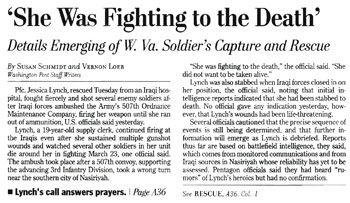
Not surprisingly, today’s review fails to mention the Post and its electrifying, but inaccurate, front-page report of April 3, 2003. The Post said Lynch had been shot and stabbed but yet “was fighting to the death” when captured by Iraqis.

Lynch then was a 19-year-old Army private, a supply clerk with the 507th Maintenance Company. Elements of her unit were ambushed in Nasiriyah, in southern Iraq, on March 23, 2003, a few days after the war began.

Lynch never fired a shot during the attack; her gun had jammed, she later said. She was neither shot nor stabbed; she suffered shattering injuries in the crash of a Humvee as it tried to flee the ambush.

Lynch was taken prisoner and hospitalized. She was rescued by a U.S. special forces team on April 1, 2003.

Two days later, the Post published its sensational account of Lynch’s supposed heroism, an account “unlike any to emerge from the war,” I write in Getting It Wrong, my new book debunking 10 prominent media-driven myths.

I note that the Post’s story about Lynch “quickly became a classic illustration of intermedia agenda-setting: News organizations around the world followed the Post’s lead by prominently reporting the supposed heroics of young Jessica Lynch and contemplating their significance.”

It was “all quite remarkable, fascinating, and irresistible,” I write in Getting It Wrong. “The petite, shy clerk who, in the Post’s telling, had fought her attackers with Rambo-like ferocity. But little of it proved true.”

Private Lynch

There’s no hint of any of that in the Post‘s review of the Tillman movie. Instead, the review serves up the dubious interpretation that the Pentagon concocted the hero-warrior story about Lynch.

“In a surreal coincidence,” the review says, “Tillman’s first Army tour was in Iraq, where he helped provide perimeter support for the stage-managed rescue of Pfc. Jessica Lynch. Lynch later debunked the Pentagon’s account of her own actions before being captured by Iraqi forces, accusing the military of using her in their propaganda efforts.” (Emphasis added.)

The Pentagon treated the hero-warrior story as if it were radioactive. And Vernon Loeb, who shared a byline on the Post‘s report about Lynch, later said the military was not the source.

I point out in Getting It Wrong that in “a little-noted interview on National Public Radio’s Fresh Air interview program in late 2003, Loeb made it clear the Post’s sources were not Pentagon officials.”

Loeb, then the Post‘s defense correspondent, said on the radio program:

“Our sources for that story were not Pentagon sources.

“And, in fact, I could never get anybody from the Pentagon to talk about those reports [about Lynch’s battlefield heroics] at all. I got indications that they had, in fact, received those intelligence reports, but the Pentagon was completely unwilling to comment on those reports at all. They wouldn’t say anything about Jessica Lynch.”

Loeb said in the interview that the Post had been “told by some really good intelligence sources here in Washington that, you know, there were indications that she had, you know, fired back and resisted her capture and actually been shot and possibly stabbed doing so.”

He added that the Post on April 3, 2003, “basically told our readers that day what the U.S. intelligence community was telling senior members of the U.S. government.”

Loeb dismissed at the interviewer’s suggestion that the Post‘s “fighting to the death” report was the upshot of clever manipulation by the Pentagon.

“I just didn’t see the Pentagon trying to create a hero where there was none,” Loeb said. “I mean …they never showed any interest in doing that, to me.”

The Post‘s movie review today refers to Lynch’s rescue as having been “stage-managed.”

That notion, I write in Getting It Wrong, represents a spinoff, or subsidiary, myth of the Lynch case.

The BBC was among the first to claim the rescue was a put-up job, calling it one  of the most stunning pieces of news management ever conceived.”

The Pentagon dismissed the BBC’s claims as “void of all facts and absolutely ridiculous.”

Later, at the request of three Democratic members of Congress, the Defense Department’s inspector general investigated the BBC’s allegations and found them baseless.

In testimony to Congress in April 2007, Thomas F. Gimble, then the acting inspector general, said no evidence had been uncovered to support claims that Lynch’s rescue “was a staged media event.”

Instead, Gimble said, the rescue operation was found to have been “a valid mission” to recover a prisoner of war “under combat conditions.”

More than 30 witnesses were interviewed in the inspector general’s inquiry, including members of the special operations team that had rescued Lynch, Gimble stated in written testimony.

Few if any of those witnesses, he noted, had been interviewed by news organizations.

WJC

Related:

Reported, but unconfirmed: The columnist and the ‘Cronkite Moment’

In Cronkite Moment, Debunking, Media myths on September 2, 2010 at 9:40 am

Sometimes, media-driven myths are just too juicy and delicious to shun, even if the narrator is unsure about their veracity.

Such was the case with Cal Thomas’ syndicated column this week, which invokes the purported “Cronkite Moment” of 1968. That was when CBS anchorman Walter Cronkite’s on-air assessment about the Vietnam War supposedly led President Lyndon Johnson to realize the war effort was hopeless.

Johnson at the hour of the 'Cronkite Moment'

Thomas wrote in his column:

“President Obama may have experienced his Walter Cronkite moment over the economy.

“Responding to Cronkite’s reporting from Vietnam four decades ago that the only way to end the war was by negotiating with the North Vietnamese, President Lyndon Johnson was reported (though never confirmed) to have said, ‘If I’ve lost Cronkite, I’ve lost Middle America.’

“Now President Obama appears to have ‘lost’ New York Times liberal economic columnist Paul Krugman. …”

Whether Obama has indeed “lost” the columnist Krugman is unimportant here.

What is relevant, and striking, is Thomas’ sly use of a well-known but dubious anecdote, one introduced by the ambiguous phrase, “reported (though never confirmed).” Such a preface leaves one to wonder: Why invoke the anecdote at all?

And there is ample good reason to avoid the anecdote of the “Cronkite Moment,” one of 10 prominent media myths addressed, and debunked, in my new book, Getting It Wrong.

For starters, President Johnson did not see Cronkite’s assessment about Vietnam, which aired the night of February 27, 1968.

As I point out in Getting It Wrong, Johnson at the time was in Austin, Texas, attending the 51st birthday party of a longtime political ally, Governor John Connally (see photo, above).

About the time Cronkite was wrapping up his report, asserting that the U.S. military was “mired in stalemate” in Vietnam, Johnson was offering light-hearted remarks about Connally’s age, saying:

“Today you are 51, John. That is the magic number that every man of politics prays for—a simple majority.”

Johnson said nothing about having “lost Cronkite.”

Moreover, there is no evidence Johnson watched Cronkite’s program on videotape.

As I write in Getting It Wrong:

“The power of the ‘Cronkite moment’ resides in the sudden, unexpected, and decisive effect it supposedly had on the president.

“Such an effect would have been absent, or greatly diminished, had Johnson had seen the program on videotape at some later date.”

It is interesting to note that Johnson struck a vigorously hawkish tone about Vietnam earlier in the day, telling an audience in Dallas:

“I do not believe that America will ever buckle” in pursuit of its objectives in Vietnam. “I believe that every American will answer now for his future and for his children’s future. I believe he will say, ‘I did not buckle when the going got tough.’”

The president also declared:

“Thousands of our courageous sons and millions of brave South Vietnamese have answered aggression’s onslaught and they have answered it with one strong and one united voice. ‘No retreat,’ they have said. Free men will never bow to force and abandon their future to tyranny. That must be our answer, too, here at home. Our answer here at home, in every home, must be: No retreat from the responsibilities of the hour of the day.”

I note in Getting It Wrong that the bravado of the president’s “no retreat” speech in Dallas is “hardly consistent with the crestfallen and resigned tenor of Johnson’s supposed reaction to the Cronkite program later that day.

“It is difficult indeed to imagine how the president’s mood could swing so abruptly, from vigorously defending the war to throwing up his hands in despair. But if the anecdote of the ‘Cronkite moment’ is to be believed, such a dramatic change in attitude is exactly what happened, within just hours of the hawkish speech in Dallas.”

The “Cronkite Moment” is a particularly delicious media myth, I’ll grant that. But as a framing device, as a way to set up a column or commentary, it’s  often not effective.

WJC

Related:

Katrina and the myth of superlative reporting

In Anniversaries, Debunking, Hurricane Katrina, Media myths, Newspapers on September 1, 2010 at 7:34 am

Five years ago this month, a few weeks after Hurricane Katrina battered the Gulf Coast and left much of New Orleans under water, former CBS anchorman Dan Rather went on Larry King Live to extol television’s coverage of the deadly storm.

Rather,  whose early career had been propelled by covering hurricanes, was extravagant in his praise, saying the Katrina coverage was “one of the quintessential great moments in television news,” ranking “right there with the Nixon/Kennedy debates, the Kennedy assassination, Watergate coverage, you name it.”

The coverage, Rather declared, was nothing short of “landmark.”

As I write in Getting It Wrong, my new book debunking prominent media-driven myths, Rather’s praise was “more than a little misleading.”

Rather’s comments also helped give rise to what I call the “myth of superlative reporting”–the notion that coverage of Katrina represented a memorable occasion of the news media’s finding their voice, of standing up to public officials and holding them accountable for an inept and muddled response,  especially in New Orleans.

But the notion the reporting was superlative is inexact and misleading. Katrina’s aftermath, as I write in Getting It Wrong, “was no high, heroic moment in American journalism.

“The coverage was in important respects flawed and exaggerated. On crucial details, journalists erred badly, and got it wrong. In the days following Katrina’s landfall, news reports described apocalyptic horror that the hurricane supposedly had unleashed.”

Five years on, it’s instructive to recall how extreme and over the top the reporting was from New Orleans in Katrina’s aftermath; it’s revealing to revisit what journalists said and wrote.

On CNN five years ago today, Paula Zahn spoke about “very discouraging reports out of New Orleans” about “bands of rapists going from block to block, people walking around in feces, dead bodies floating everywhere. And we know that sniper fire continues.”

She also said:

“We are getting reports that describe it as a nightmare of crime, human waste, rotten food, dead bodies everywhere. Other reports say sniper fire is hampering efforts to get people out.”

Also that day, John Burnett of National Public Radio said on the All Things Considered show: “We understand that there was a 10-year-old girl who was raped in the [New Orleans] Convention Center in the last two nights. People are absolutely desperate there. I’ve never seen anything like this.”

The Associated Press news service reported on September 1, 2005, that New Orleans had “descended into anarchy” as “corpses lay abandoned in street medians, fights and fires broke out, cops turned in their badges and the governor declared war on looters who have made the city a menacing landscape of disorder and fear.”

In her column published September 3, 2005, in the New York Times, Maureen Dowd referred to New Orleans as “a snake pit of anarchy, death, looting, raping, marauding thugs, suffering innocents, a shattered infrastructure, a gutted police force, insufficient troop levels and criminally negligent government planning.”

International news organizations, I note in Getting It Wrong, were quite “keen to report the horror stories from New Orleans, as if the hurricane had exposed pathologies in American society that otherwise would remain obscure.”

The British press landed with notable eagerness on the Katrina-unleashed-mayhem narrative.

The Sunday Observer of London reported on September 4, 2005, that New Orleans had become “a city … subsumed beneath waves of violence, rape and death.”

And a columnist for London’s Independent newspaper offered a colorful and highly imaginative account that was published five years ago today:

“Reports from New Orleans ring like prophecies of the apocalypse. Corpses float hopelessly in what used to be a thriving and distinctive downtown; coffins rise from the ground; alligators, sharks and snakes ply the poisonous waters ….”

Few if any of the nightmarish accounts of violence, anarchy, and mayhem proved true.

No shots were fired at rescue helicopters. There were no known child rape victims, no bodies stacked like cordwood, no “bands of rapists going from block to block,” no sharks plying the flood waters.

As I write in Getting It Wrong, “the erroneous and exaggerated reporting had the cumulative the effect of painting for America and the rest of the world a scene of surreal violence and terror, something straight out of Mad Max or Lord of the Flies.”

The coverage of Katrina’s aftermath was no “quintessential” great moment in journalism.

Far from it.

As a bipartisan congressional report on Katrina noted in 2006:

“If anyone rioted, it was the media.”

WJC

Related:

Many thanks to Instapundit Glenn Reynolds for linking to this post

Many thanks to the National Review Corner for linking to this post

Absent in looking back: Katrina’s lessons for the press

In Anniversaries, Debunking, Hurricane Katrina, Media myths, Watergate myth on August 31, 2010 at 6:06 am

The anniversary of Hurricane Katrina’s landfall has prompted a fair amount of hand-wringing and knitted-brow discussions about lessons still to be absorbed, five years after the storm’s onslaught on the Gulf Coast.

The Washington Post, for example, carried a lengthy and rather preachy commentary the other day about “Katrina’s unlearned lessons.” The commentary included this warning:

“Barring urgent action, if the gulf region is hit by another big hurricane this fall, its communities will be knocked down–and this time, many will not be able to get back up.”

Possibly. But it’s highly speculative.

Largely absent in the retrospective assessments about the hurricane are discussions about lessons the news media should take, or should have taken, from their often-exaggerated reporting about the nightmarish violence Katrina supposedly brought to New Orleans.

As I write in Getting It Wrong, my new book that debunks 10 prominent media-driven myths, the coverage of Katrina’s aftermath “was in important respects flawed and exaggerated.

“On crucial details, journalists erred badly, and got it wrong. In the days following Katrina’s landfall, news reports described apocalyptic horror that the hurricane supposedly had unleashed.”

Little of it was true.

What’s more, I write, the exaggerated, over-the-top reporting about mayhem and unspeakable violence “was neither benign nor without consequences.

“It had the very real and serious effects of delaying the arrival of aid to New Orleans, of diverting and distorting the deployment of resources and capabilities, of heightening the anxiety of evacuees at the [New Orleans] Superdome and Convention Center, and of broadly stigmatizing a city and its people.”

In the weeks following Katrina’s landfall, leading news organizations produced a brief flurry of reports revisiting, and criticizing, the accounts of mayhem and anarchy in New Orleans.

“The media joined in playing whisper-down-the-lane,” the Philadelphia Inquirer said in late September 2005 about post-Katrina coverage from New Orleans, “and stories that defied common sense were treated as news.”

But as I write in Getting It Wrong, “The news media’s contrition and introspection did not last for long, however. The self-critical articles tended to be one-off assessments that usually received little prominence. The Los Angeles Times, Philadelphia Inquirer, and Washington Post all placed their retrospective articles on inside pages, for example.

“After the flurry of post-Katrina assessments in late September and early October 2005,” I add, “the news media demonstrated little interest in sustaining or revisiting the self-critique.”

Five years on, Katrina’s lessons and reminders for the news media remain relevant. Among them is the near-certainty that erroneous reports will proliferate in the immediate aftermath of any major disaster.

As Kathleen Tierney of the Natural Hazards Center at the University of Colorado-Boulder told a congressional panel investigating Katrina’s consequences, “misleading or completely false media reports should have been among the most foreseeable elements of Katrina.”

As her comment suggested, the news media’s susceptibility to reporting disaster-related falsehoods and rumors has long been recognized. I cite in Getting It Wrong a prescient article titled “Coping With the Media in Disasters: Some Predictable Problems” that was published in the mid-1980s in Public Administration Review.

The authors–in an observation that anticipated Katrina’s aftermath–noted that news organizations “can spread rumors, and so alter the reality of disaster, at least to those well away from it, that they can bias the nature of the response. They can and do create myths about disasters, myths which will persist even among those with contrary disaster experience.”

The near-complete breakdown of communication networks in Katrina’s aftermath certainly complicated matters for reporters. Telephone service was out across New Orleans after Katrina roared through. Cell phones did not function. Electricity was scarce.

Amid such conditions, stories that at first may have had some factual underpinning became “exaggerated and distorted as they were passed orally—often the only mode of communication—through extraordinarily frustrated and stressed multitudes of people, including refugees, cops, soldiers, public officials and, ultimately, the press,” wrote Brian Thevenot in “Mythmaking in New Orleans,” a fine article published at the end of 2005 in American Journalism Review.

While the communications breakdown helps explain why exaggerated reporting was rampant in New Orleans in Katrina’s aftermath, it does not exonerate the flawed coverage or let journalists off the hook.

In varying degrees, communication disruptions are elements of all major disasters.

And as I write in Getting It Wrong, the collapse of communication networks should have given reporters pause, leaving them “more cautious and more wary about what they heard and reported, and thus less likely to traffic in wild and dubious claims.”

WJC

Related:

Unpacking errors in a ‘history lesson in media freedom’

In Debunking, Media myths, Murrow-McCarthy myth on August 29, 2010 at 11:11 am

Confirming anew that prominent myths of American journalism travel far and all too well, a columnist for a South African newspaper recently offered “a brief history lesson in media freedom” that thoroughly mangled the legendary encounter between Edward R. Murrow and Senator Joseph McCarthy.

In offering her “lesson,” the columnist for the online Mail & Guardian wrote:

McCarthy in 1954

“You’ll remember Senator Joseph McCarthy as the one who made America scared of those nasty Communists ….

“He was so scary that the media, although not legally required to do so, practiced extreme self-censorship, and did not criticise McCarthy in an attempt to avoid accusations of trying to bring down the government.

“Thankfully,” she added, “a radio presenter called Edward Murrow, who famously ended his broadcasts with ‘goodnight, and good luck’, came along and said: ‘We must not confuse dissent with disloyalty … We are not descended from men who feared to write, to speak, to associate, and to defend causes that were, for the moment, unpopular.’ At which point everyone realised just how unpopular McCarthy was, and he didn’t last long after that.”

There’s just an astonishing amount of error to unpack in those paragraphs.

Prominent among them is the discussion of Murrow, who was more than just a “radio presenter.” His searing assessment of McCarthy and his communists-in-government witch-hunt was shown on television, on the CBS show See It Now that aired March 9, 1954.

By then, as I write in Getting It Wrong, my new book debunking media-driven myths, McCarthy’s “favorability ratings had been sliding for three months,” from a high of 53 percent in December 1953.

So Americans were turning against McCarthy well before Murrow’s show.

I note in Getting It Wrong, that “it wasn’t as if Americans in early 1954 were hoping for someone to step up and expose McCarthy, or waiting for a white knight like Murrow to tell them about the toxic threat the senator posed. By then, McCarthy and his tactics were well-known and he had become a target of withering ridicule—a sign of diminished capacity to inspire dread.”

I further write:

“Long before the See It Now program, several prominent journalists—including the Washington-based syndicated columnist Drew Pearson—had become persistent and searching critics of McCarthy, his record, and his tactics.”

Hardly did Pearson (not to mention several other American journalists) practice “extreme self-censorship” as McCarthy pressed flimsy claims that communists had infiltrated high into the U.S. government, the military, and the Democratic party.

Pearson in the 1950s was Washington’s most-feared muckraking columnist and he challenged and criticized McCarthy years before Murrow’s program.

In February 1950, just after McCarthy began making extreme charges about communists in government, Pearson ridiculed McCarthy as the “harum-scarum” senator and wrote that his allegations were “way off base.”

Pearson also reported in 1950 about McCarthy’s tax troubles in Wisconsin, the senator’s questionable campaign contributions, and the suspicious payment he accepted from Lustron Corporation, a manufacturer of prefabricated housing that had received millions in federal  government support.

Pearson was unrelenting in his scrutiny of McCarthy, who in typical fashion took to the Senate floor in mid-December 1950 to denounce  the columnist as the “diabolically” clever “voice of international communism.”

A few days before the speech, McCarthy had physically assaulted Pearson in the cloakroom of the exclusive Sulgrave Club on DuPont Circle in Washington.

I write in Getting It Wrong that accounts differed as to what happened at the Sulgrave, noting:

“Pearson said McCarthy pinned his arms to one side and kneed him twice in the groin. McCarthy said he slapped Pearson, hard, with his open hand. A third account, offered by a radio broadcaster friendly to McCarthy, said the senator slugged Pearson, a blow so powerful that it lifted Pearson three feet into the air.”

Richard Nixon, then a U.S. senator, intervened to break up McCarthy’s attack.

So as I note in Getting It Wrong, “the legendary status that came to be associated with the [Murrow] program obscured and diminished the contributions of journalists who took on McCarthy years earlier, at a time when doing so was quite risky.”

And that is the real lesson here.

WJC

Related:

Give the press ‘D-minus’ on post-Katrina coverage

In Anniversaries, Debunking, Hurricane Katrina, Media myths on August 26, 2010 at 4:42 pm

Harry Shearer, director of The Big Uneasy, a new film about why levees failed in New Orleans following Hurricane Katrina’s onslaught, offered a searing critique the other night about the news media and their coverage of the deadly storm.

Shearer was quoted by AOL’s DailyFinance site as saying the New York Times “did okay” in its post-Katrina coverage five years ago.

“I think the rest of the press gets a D, and probably a D-minus for their efforts at patting themselves on the back about how well they did speaking truth to power,” Shearer said in an interview Tuesday night with Jeff Bercovici, the media columnist for DailyFinance.

Shearer cited the encounter September 1, 2005, between CNN’s Anderson Cooper and U.S. Senator Mary Landrieu.

Cooper on that occasion snapped at Landrieu, telling her: “And to listen to politicians thanking each other and complimenting each other, you know, I got to tell you, there are a lot of people here who are very upset, and very angry, and very frustrated.”

Shearer said of Cooper’s tongue-lashing the senator: “Like that’s the person you need to lecture.”

Shearer was further quoted as saying: “It was grandstanding and showboating in place of telling a story–partly because they left. They left. Water leaves, story over” in post-Katrina New Orleans.

He noted that the New Orleans Times-Picayune newspaper won two Pulitzer Prizes for its Katrina-related coverageTimes-Picayune reporters “couldn’t leave,” Shearer said. “They lived there. They had to stay.”

So, a “D” or “D-minus” overall for post-Katrina coverage? Harsh grades, those.

But certainly not undeserved.

News reporting in the immediate aftermath of Katrina’s landfall represented “no high, heroic aftermath in American journalism,” I write in Getting It Wrong, my new book debunking 10 prominent media-driven myths–among them the myth of superlative reporting in Katrina’s aftermath.

“The coverage,” I write, “was in important respects flawed and exaggerated. On crucial details, journalists erred badly, and got it wrong.”

I further write:

“They reported snipers firing at medical personnel. They reported that shots were fired at helicopters, halting evacuations from the Convention Center [in New Orleans].

“They told of bodies being stacked there like cordwood. They reported roving gangs were preying on tourists and terrorizing the occupants of the Superdome, raping and killing. They said children were victims of sexual assault, that one seven-year-old was raped and her throat was slit. They reported that sharks were plying the flooded streets of New Orleans.”

In the end, none of those reports was verified or substantiated, I note.

I point out in Getting It Wrong that no single news organization committed all those errors. And not all those lapses were committed at the same time, although they were largely concentrated during the first days of September 2005.

In any case, I write, the erroneous and over-the-top reporting “had the cumulative the effect of painting for America and the rest of the world a scene of surreal violence and terror, something straight out of Mad Max or Lord of the Flies.”

Estimates of Katrina’s death toll in New Orleans also were wildly exaggerated.

U.S. Senator David Vitter, a Louisiana Republican, said on September 2, 2005, that fatalities in the state could reach 10,000 or more.

Vitter described his estimate as “only a guess,” but it was nonetheless taken up by the then-New Orleans mayor, Ray Nagin, and reported widely.

In all, the death toll in Louisiana from Katrina was around 1,500.

About the inaccurate estimates of fatalities, the Times of London said it had become clear by in mid-September 2005 “that 10,000 people could have died only if more than 90 per cent of them had locked themselves into their homes, chained themselves to heavy furniture and chosen to drown instead of going upstairs as the waters rose.”

But the Times rationalized the flawed reporting, suggesting that it was inevitable: When “nature and the 24-hour news industry collide, hyperbole results.”

A weak excuse, that. Besides, post-Katrina reporting from New Orleans was more than hyperbolic: It described apocalyptic horrors that the hurricane supposedly unleashed.

“D-minus” is none too generous.

WJC

Related:

H/T Jim Romenesko

Many thanks to Instapundit Glenn Reynolds for linking to this post