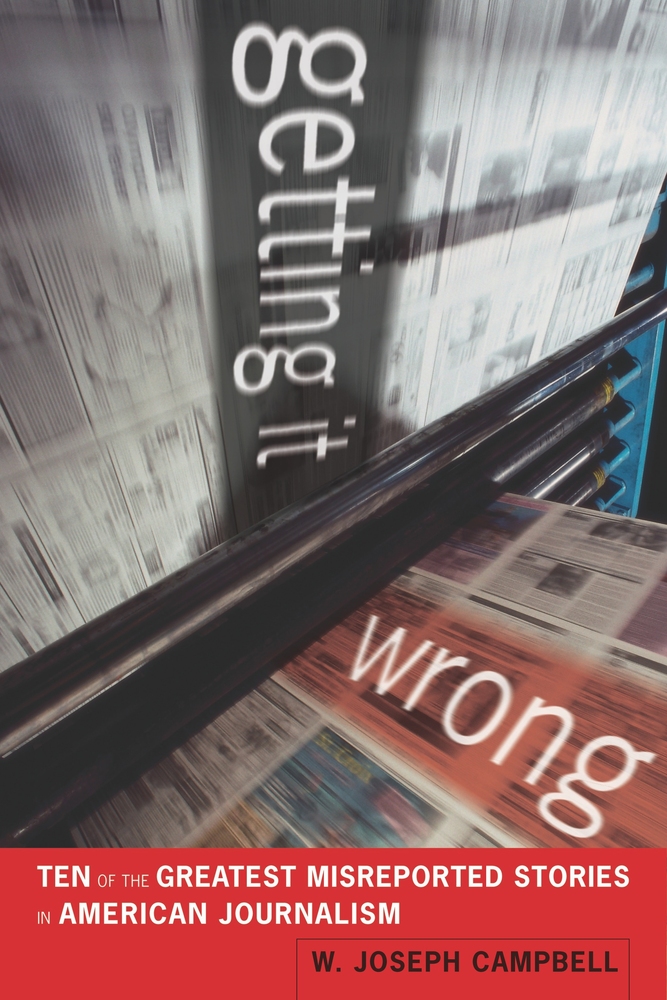
W. Joseph Campbell

Archive for the ‘Debunking’ Category

Just go, Rambo

In Debunking, New York Times on May 21, 2010 at 6:56 am

At least one Connecticut newspaper is having some fun with the dissembling of U.S. Senate candidate Richard Blumenthal about what he did during the Vietnam War.

The Republican American of Waterbury has taken to calling the brittle, strikingly thin Blumenthal “Rambo,” after the beefy fictional hero of cinematic treatments of the war.

And the newspaper has, with tongue undeniably in cheek, has taken to calling Rambogate” the furor that has erupted over Blumenthal’s periodic false claims to have served in Vietnam.

Blumenthal, the state’s attorney general, received at least five deferments that kept him out of the war before landing a coveted place in the Marine Reserve, which was not deployed to Vietnam.

As the New York Times first reported this week, Blumenthal from time to time  has dissembled about his wartime service. The Stamford Advocate in Connecticut added to the controversy yesterday, recalling that Blumenthal in 2008 falsely and publicly claimed:

“I wore the uniform in Vietnam and many came back to all kinds of disrespect. Whatever we think of war, we owe the men and women of the armed forces our unconditional support.”

The occasion was a Veterans Day parade in November 2008, the newspaper said.

It’s hard to envision how Blumenthal’s candidacy and credibility can survive the damage accompanying such disclosures. The attorney general has acknowledged that he inadvertently “misspoke” on a few occasions about his wartime service.

But these false claims clearly are more serious than an occasional slip of the tongue.

Although he probably won’t, it’s time for Blumenthal to pack it in.

Just go, Rambo.

I remain surprised that more attention hasn’t been devoted to Blumenthal’s  subsidiary fictional claims of having faced abuse and indignities upon his fictional “return” from Vietnam.

As I’ve noted, the news reports quoting Blumenthal as having said veterans were spat upon as they came back from Vietnam should prompt further questions about the senate candidate’s truthfulness.

Serious doubts have been raised over the years about such accounts. And yet, Blumenthal has invoked such claims more than a couple of times.

Perhaps the most thoughtful commentary about the Blumenthal mess appeared in yesterday’s Washington Post. It was written by veteran journalist Henry Allen, himself a former Marine.

Allen wrote:

“Blumenthal didn’t get in trouble for confessing he had ducked Vietnam but for lying that he hadn’t, for saying that he’d served there.

“What demon haunts him and others like him? What inconsolable regret provoked these desperate lies?

“He didn’t have to claim he’d been in Vietnam. He already had the résumé to be a shoo-in candidate. Rich kid, Harvard (editor of the Crimson), reporter at The Washington Post, Yale Law School (editor of the law journal), almost two decades as attorney general, the perfect knowledge-class candidate of the kind favored by modern Democrats. (In looks, however, he does bear an unsettling resemblance to disgraced former New York governor Eliot Spitzer.)”

Yes, more Spitzer than Rambo.

But Rambo ought to go.

WJC

Republican American

Blumenthal and his spat-upon claim: More myth?

In Debunking, Media myths, New York Times on May 19, 2010 at 4:43 pm

The New York Times articles this week about the Richard Blumenthal, the Connecticut attorney general who falsely stated he served in Vietnam, mentioned but didn’t explore Blumenthal’s reference to having been spat upon by antiwar protestors.

The Times report Tuesday quoted Jean Risley, chairwoman of the Connecticut Vietnam Veterans Memorial Inc., as saying Blumenthal, a Democrat running for the U.S. Senate, once described indignities he and other veterans faced upon returning from Vietnam.

“It was a sad moment,” the Times quoted Risley as saying. “He said, ‘When we came back, we were spat on; we couldn’t wear our uniforms.’ It looked like he was sad to me when he said it.”

In a follow-up report today, the Times indirectly quoted former Congressman Christopher H. Shays as saying that at a recent event in Bridgeport, Connecticut, Blumenthal “brought up the subject of his military service and lamented that when ‘we returned from Vietnam’ Americans had spit on soldiers.”

The separate reports of Blumenthal’s recollections about veterans having been spat upon should prompt additional questions about the Senate candidate’s truthfulness–questions that go beyond his false claim of having served in Vietnam during the war. (Blumenthal, the Times has reported, secured “at least five military deferments from 1965 to 1970 and took repeated steps that enabled him to avoid going to war, according to records” the newspaper reviewed.)

Doubts have been raised over the years about accounts of soldiers being spat upon as they returned from Vietnam. Jerry Lembcke notably challenged such claims in his 1998 study, The Spitting Image: Myth, Memory, and the Legacy of Vietnam.

Lembcke noted “that stories of veterans being abused by anti-war activists only surfaced years after the abuses were alleged to have happened.”

He also wrote that his “search through news stories and polls … revealed no basis for the widespread belief that the alleged spitting incidents actually occurred.”

Lembcke, a Vietnam veteran who became an opponent of the war, returned to the topic in 2005, writing in a commentary in the Boston Globe:

“Stories about spat-upon Vietnam veterans are like mercury: Smash one and six more appear. It’s hard to say where they come from. For a book I wrote in 1998 I looked back to the time when the spit was supposedly flying, the late 1960s and early 1970s. I found nothing. No news reports or even claims that someone was being spat on.”

He also noted:

“GIs [returning from Vietnam] landed at military airbases, not civilian airports, and protesters could not have gotten onto the bases and anywhere near deplaning troops. There may have been exceptions, of course, but in those cases how would protesters have known in advance that a plane was being diverted to a civilian site?”

Now, I haven’t studied the spat-upon claims to be in a position to embrace Lembcke’s findings, independently. It is a touchy and disputed topic. But I am impressed with the earnest quality of Lembcke’s research.

Moreover, I incorporate in Getting It Wrong, my forthcoming book about media-driven myths, a telling observation in Lembcke’s book about the tenacity of myths.

It appears as a chapter-opening quotation in the discussion in Getting It Wrong about the heroic-journalist myth of Watergate:

“Unlike a society with a strong oral tradition, American today remembers its history through visual imagery.”

True enough: The cinema can be a powerful force in pressing media-driven myths into the collective memory.

I also was impressed with Lembcke’s point that myths “help people come to terms with difficult periods of their past. They provide explanations for why things happened. Often, the explanations offered by myths help reconcile disparities between a group’s self-image and the historical record of a group’s behavior.”

Or, as might be paraphrased in the matter of Blumenthal’s dissembling, myths can help reconcile disparities between an individual’s self-image and the record of his behavior.

WJC

Mythologizing military service in Vietnam

In Debunking, New York Times on May 18, 2010 at 8:48 am

Today’s New York Times carries a potentially devastating piece about Connecticut Attorney General Richard Blumenthal’s dissembling about his military service during the Vietnam War.

Blumenthal, an odds-on favorite to win election this year to the U.S. Senate, told at least one audience in Connecticut, in 2008, that he had served in Vietnam.

“There was one problem,” the Times article says. “Mr. Blumenthal, a Democrat now running for the United States Senate, never served in Vietnam. He obtained at least five military deferments from 1965 to 1970 and took repeated steps that enabled him to avoid going to war, according to records.”

Blumenthal in Marine Reserve (NYTimes)

The Times has posted at its online site a video in which Blumenthal refers to “the days that I served in Vietnam.” Moreover, the Times reported, Blumenthal in 1970 “landed a coveted spot in the Marine Reserve, which virtually guaranteed that he would not be sent to Vietnam.”

Whether the disclosures are enough to ruin Blumenthal’s candidacy is uncertain.

But I wonder whether Blumenthal–who in nearly 20 years as attorney general seemed ever-eager to go before the television cameras to announce state-sponsored litigation–will be able to stand up to the scrutiny, which is sure to be intense over the next several days.

I knew Blumenthal, vaguely, during my time years ago in Connecticut, reporting for the Hartford Courant–which has to be keenly embarrassed that the Times scored this scoop, debunking Blumenthal’s claim.

Blumenthal always struck me in public as slick-haired, brittle, and ill at ease. Surprisingly so, given his frequent appearances on television.

My guess is that he’ll acknowledge a lamentable slip of the tongue and muddle on, a damaged and perhaps vulnerable candidate for a Senate seat that Democrats have held for 46 years. But I wouldn’t be surprised at all were Blumenthal to find the scrutiny too intense to bear, and step aside.

And with further disclosures about his mythologizing his wartime record, Blumenthal’s candidacy will be toast.

Many thanks to Jim Romenesko for linking to this post.

WJC

In myth, a truism: Hearst’s vow ‘will forever live on’

In 1897, Debunking, Furnish the war, Media myths, Spanish-American War, Yellow Journalism on May 17, 2010 at 8:34 am

William Randolph Hearst’s purported vow to “furnish the war” with Spain “has achieved unique status as an adaptable, hardy, all-purpose anecdote,” I write in my forthcoming book about media-driven myths, Getting It Wrong.

The anecdote, I point out, “has been invoked to illustrate the media’s willingness to compromise impartiality, promote political agendas, and indulge in sensationalism. It has been used, more broadly, to suggest the media’s capacity to inject malign influence into international affairs.”

It is for such reasons the Hearstian anecdote endures, despite having been thoroughly debunked. The tale is revisited, and debunked anew, in the first chapter of Getting It Wrong.

But it may well be that Hearst’s purported vow “will forever live on in journalism history,” as a columnist for the Times of Northwest Indiana newspaper wrote in a commentary published yesterday.

Far from challenging or disputing the tale, the columnist embraced it, repeating as if factual the supposed exchange between Hearst and the artist Frederic Remington, in which Hearst reputedly asserted:

“You furnish the pictures, and I’ll furnish the war.”

Remington was in Cuba in January 1897, on assignment for Hearst’s New York Journal to draw sketches of the rebellion against Spanish colonial rule. If the exchange did take place, it would have been then, in early 1897.

As I write in Getting It Wrong,  the anecdote lives on despite a nearly complete absence of supporting documentation. It lives on even though the telegram that supposedly contained Hearst’s vow has never turned up. It lives on even though Hearst denied ever sending such a message.

And it lives on despite an irreconcilable internal inconsistency: It would have been absurd for Hearst to vow to “furnish the war” because war—specifically, the Cuban rebellion—was the reason he sent Remington to Cuba in the first place. (The rebellion gave rise in 1898 to the Spanish-American War.)

The sole source for the anecdote was a self-important journalist named James Creelman. He was neither in Cuba nor in New York at the time the exchange would have occurred. Creelman then was in Europe, as a correspondent for Hearst’s Journal.

That means Creelman learned about the tale second-hand.

Or made it up.

The durability of media myths such as the “furnish the war” anecdote is discussed in Getting It Wrong. I acknowledge that “some myths addressed [in the book] may prove resistant to debunking. They may still be widely believed despite the contrary evidence marshaled against them.”

I note that the “most resilient myths may be those that can be distilled to a catchy, pithy phrase.”

Quotations such as “You furnish the pictures, and I’ll furnish the war” are indeed neat, tidy, catchy, and delicious. They are easy to remember, fun to repeat, and too good not to be true.

Almost certainly, they will live on.

WJC

Woodward’s reporting ‘changed course of American history’?

In Debunking, Media myths, Washington Post, Watergate myth on May 16, 2010 at 12:10 pm

Bob Woodward’s “investigative reporting of Watergate changed the course of American history.”

So asserted a column in yesterday’s St. Petersburg Times.

Woodward (Library of Congress)

The author didn’t elaborate, or offer supporting evidence for such an exuberant claim. Presumably, he meant that reporting by Woodward and his Washington Post colleague, Carl Bernstein, brought down Richard Nixon’s corrupt presidency in the Watergate scandal of the early 1970s.

That, of course, is among the most appealing and enduring of the many media-driven myths–stories about and or by the news media that are widely believed and often retold but which, under scrutiny, prove apocryphal or wildly exaggerated.

I address, and debunk, 10 prominent media-driven myths in my forthcoming book, Getting It Wrong. Among them is what I call the heroic-journalist myth of Watergate–a trope that knows few bounds.

As I note in Getting It Wrong, even Washington Post officials over the years have scoffed at such claims.

Notable among them was Katherine Graham, the publisher during the Watergate period.

“Sometimes people accuse us of bringing down a president, which of course we didn’t do,” Graham said in 1997, at a program marking the scandal’s twenty-fifth anniversary. “The processes that caused [Nixon’s] resignation were constitutional,” she insisted.

Indeed, I write in Getting It Wrong, “Nixon’s fall was the consequence of his criminal conduct, which was exposed in the convergence of many forces, newspaper reporting being among the least decisive.”

Still, the heroic-journalist myth endures.

An important reason why Woodward and Bernstein are given so much credit is the need for heroes in a business that is much derided and little trusted. As I note in Getting It Wrong, which will be out next month, “media myths can be self-flattering, offering heroes like Woodward and Bernstein to a profession more accustomed to criticism than applause.”

I further write:

“Similarly, media myths invite indulgence in the ‘golden age fallacy,’ the flawed but enticing belief that there really was a time when journalism and its practitioners were respected and inspiring—the time, say, of Murrow or Cronkite, or Woodward and Bernstein.”

Such misplaced nostalgia has helped embed these myths firmly and decisively in media history.

WJC

Myth resurfaces in Cronkite-collaborator report

In Cronkite Moment, Debunking, Media myths, Year studies on May 15, 2010 at 10:28 am

The Yahoo News report yesterday that venerable CBS anchorman Walter Cronkite may have quietly collaborated with antiwar activists in the late 1960s stirred a modest flurry of commentary in the blogosphere.

Cronkite in Vietnam, 1968

Few mainstream media outlets appear to have touched the story, which I find to be something of a stretch. An exception was Rupert Murdoch’s  New York Post, which carried a brief article, essentially a rewrite of the Yahoo report.

That report cited newly released FBI documents in saying that in late 1969, “Cronkite encouraged students at Rollins College in Winter Park, Fla., to invite Maine Sen. Edmund Muskie to address a protest [against the war] they were planning near Cape Kennedy (now known as Cape Canaveral). Cronkite told the group’s leader that Muskie would be nearby for a fundraiser on the day of the protest, and said that ‘CBS would rent [a] helicopter to take Muskie to and from site of rally.'”

Inevitably, the report recalled Cronkite’s famous on-air editorial comment delivered February 27, 1968, at the end of a special report on Vietnam. On that occasion, Cronkite declared the U.S. war effort in Vietnam was “mired in stalemate.”

A post yesterday at mediaite.com noted Cronkite’s 1968 commentary, saying it “is often credited with turning the tide of public opinion against the war.”

Cronkite’s commentary that night has become the stuff of legend. But it was scarcely so powerful or decisive as to much move public opinion.

As I discuss in Getting It Wrong, my forthcoming book about media-driven myths, public opinion had begun turning against the Vietnam War months before the Cronkite program.

In October 1967, a Gallup survey reported that the percentage of respondents saying that U.S. military presence in Vietnam was a mistake had reached a plurality—47 percent. That was 4½ months before Cronkite delivered his on-air commentary. (In August-September 1965, just 24 percent of Gallup poll respondents said sending troops to Vietnam was a mistake.)

In a Gallup poll completed in early February 1968, three weeks before the Cronkite program, the proportion saying the war was a mistake stood at 46 percent; 42 percent said it had not been a mistake.

Gallup asked the question again in a poll completed the day the Cronkite program aired, finding that 49 percent of the respondents said U.S. military intervention in Vietnam had been a mistake; 42 percent said it had not.

By late February 1968, Cronkite’s “mired in stalemate” assessment was, I write in Getting It Wrong, “neither notable nor extraordinary.”

I also note that Mark Kurlansky, author of a year-study about 1968, declared Cronkite’s view “hardly a radical position” for the time.

Cronkite’s remarks that night were fairly mild–certainly less emphatic than comments offered about two weeks later by Frank McGee of the rival NBC network.

“The war,” McGee declared on an NBC News program March 10, 1968, “is being lost by the administration’s definition.”

As I’ve noted previously, it is a bit surprising that McGee’s pointed editorial comments are not more often remembered.

WJC

Cronkite, secret antiwar collaborator? Seems a stretch

In Cronkite Moment, Debunking, Media myths on May 14, 2010 at 3:44 pm

Yahoo’s online news site has turned up FBI documents claiming that Walter Cronkite, the venerable CBS News anchorman often if mistakenly called America’s “most trusted” public figure, offered advice and suggestions in late 1969 to foes of the Vietnam War.

Redacted FBI document on Cronkite (Yahoo News)

The Yahoo report, posted this afternoon, says the documents indicate that Cronkite offered “advice on how to raise the public profile of protests and even pledging CBS News resources to help pull off events, according to FBI documents” obtained through the Freedom of Information Act.

Cronkite died 10 months ago.

He made clear his mild opposition to the war on February 27, 1968, in a famous editorial comment at the close of a special report on Vietnam.  Cronkite on that occasion declared:

To say that we are closer to victory today is to believe, in the face of the evidence, the optimists who have been wrong in the past. To suggest we are on the edge of defeat is to yield to unreasonable pessimism. To say that we are mired in stalemate seems the only realistic, yet unsatisfactory, conclusion.

Cronkite also suggested that negotiations eventually might prove to be America’s way out of the conflict.

The program that night became grist for a prominent media-driven myth, one of 10 that I discuss, and debunk, in my forthcoming book, Getting It Wrong.

Legend has it that at the White House, President Lyndon Johnson watched the Cronkite show and, upon hearing the anchorman’s dire assessment about Vietnam, snapped off the television set and exclaimed, “If I’ve lost Cronkite, I’ve lost Middle America.”

Or words to that effect. Versions vary.

But as I point out in Getting It Wrong, Johnson wasn’t at the White House that night. And he wasn’t in front of a television set to watch Cronkite’s special report.

The president was in Austin, Texas, offering light-hearted banter at the 51st birthday party of a longtime political ally, Governor John Connally.

Today’s Yahoo report, while certainly provocative, seem to stretch credulity in important respects.

Cronkite, the Yahoo report says, “encouraged students at Rollins College in Winter Park, Fla., to invite Maine Sen. Edmund Muskie to address a protest they were planning near Cape Kennedy (now known as Cape Canaveral). Cronkite told the group’s leader that Muskie would be nearby for a fundraiser on the day of the protest, and said that ‘CBS would rent [a] helicopter to take Muskie to and from site of rally,’ according to the [FBI] documents.”

That Cronkite would even contemplate going so far as to arrange for the network to pay for a helicopter to take Muskie to the rally seems improbable.

The Yahoo report further quotes the FBI documents as saying the leader of an antiwar group in Florida said he spent 45 minutes on the telephone with Cronkite, discussing activities related to antiwar demonstrations in November 1969.

That Cronkite would spent that much time on the phone, offering advice to an activist, also seems unlikely.

And a comment posted today at the popular Romenesko online media news site offers an important reminder:

“Many Yahoo readers may be unaware that [FBI] files were full of nonsense and falsehoods by people seeking to curry favor, damage enemies, collect money and who otherwise had no interest in the truth of matters.”

The Cronkite-as-secret-collaborator story is delicious in what it suggests. Given Cronkite’s public views about the war, it’s perhaps faintly plausible.

But by no means can it be considered authoritative.

WJC

CJR reviews ‘Getting It Wrong’

In Debunking, Media myths, Reviews on May 12, 2010 at 3:34 pm

The May/June number of Columbia Journalism Review contains a fine and insightful review of Getting It Wrong, my forthcoming book that addresses, and debunks, 10 prominent media-driven myths.

James Boylan, the reviewer, writes, perceptively:

“As W. Joseph Campbell shows, there are many ways to misreport. Sometimes it means getting the story wrong in the first place, sometimes misremembering the story, sometimes inflating it later for self-aggrandizement. The author’s ten case studies include examples of each.”

Boylan, who is founding editor of CJR, further writes:

“In each of these cases, the author debunks what is essentially historical hearsay. The value of these studies is less in the answers, which are telegraphed early on, than in the detailed and illuminating research Campbell has applied to each.”

WJC

Johnson was ‘panicked’ by Cronkite show on Vietnam?

In Cronkite Moment, Debunking, Media myths on May 11, 2010 at 1:28 pm

The flexibility and wide applicability of prominent media-driven myths is little short of astonishing sometimes.

Cronkite in Vietnam, 1968

Take, for example, the column in today’s Jerusalem Post, which invoked the often-told anecdote about the supposed effects of Walter Cronkite’s special report in 1968 about the Vietnam War.

As I discuss in Getting It Wrong, my forthcoming book about media-driven myths, it is widely believed that President Lyndon Johnson essentially threw up his hands in dismay upon hearing Cronkite’s pessimistic assessment about the war.

Cronkite, the CBS News anchorman, said the U.S. military was “mired in stalemate” in Vietnam and suggested that negotiations might be a way out.

Johnson supposedly realized the war effort was now hopeless, telling an aide or aides, “If I’ve lost Cronkite, I’ve lost Middle America.”

Or something along those lines. Versions of what the president supposedly said vary markedly.

Today’s Jerusalem Post column offered another variation, saying that Johnson “panicked when he lost Walter Cronkite over Vietnam….”

Panicked?

What? How so?

As I discuss in Getting It Wrong, Johnson didn’t even see the Cronkite report when it aired late in the evening of February 27, 1968.

Johnson then was in Austin, Texas, at the 51st birthday party of Governor John Connally, one of his long-time political allies.

About the time Cronkite was intoning his downbeat assessment on Vietnam, Johnson was offering light-hearted remarks about Connally’s age, saying:

“Today you are 51, John. That is the magic number that every man of politics prays for—a simple majority. Throughout the years we have worked long and hard—and I might say late—trying to maintain it, too.”

No panic there.

Nor was there any in the days that followed.

I note in Getting It Wrong that even if Johnson saw the Cronkite program on videotape, the anchorman’s assessment represented no epiphany for the president.

About three weeks after the Cronkite program, I write, “Johnson gave a rousing, lectern-pounding speech in which he urged a ‘total national effort’ to win the war in Vietnam.”

So no panic there, either.

And on the day of the Cronkite program, Johnson offered a forceful defense of his war policy, vowing in a midday speech in Dallas there would be “no retreat from the responsibilities of the hour of the day.”

Johnson declared: “We are living in a dangerous world and we must understand it. We must be prepared to stand up when we need to. There must be no failing our fighting sons” in Vietnam.

“It seems inconceivable,” I write in Getting It Wrong, “that Johnson’s views [on Vietnam] would have pivoted so swiftly and dramatically, upon hearing the opinion of a television news anchor, even one as esteemed as Cronkite.”

It’s quite improbable.

So, no, Johnson wasn’t “panicked” by Cronkite’s assessment on Vietnam.

Not at all.

WJC

<!–[if !mso]> <!– st1\:*{behavior:url(#ieooui) } –> Johnson’s speech, the newspaper said, was “perhaps his strongest public call yet for unity in pushing the Vietnam war.”[i]


[i] Sell, “No Viet Retreat,” Los Angeles Times, 1.

Check out new trailer for ‘Getting It Wrong’

In 1897, Debunking, Furnish the war, Media myths, Spanish-American War, War of the Worlds, Yellow Journalism on May 8, 2010 at 3:45 pm

Here’s the book trailer for Getting It Wrong, my forthcoming book that addresses, and debunks, 10 prominent media-driven myths.

Getting It Wrong will be published this summer by University of California Press.

WJC