W. Joseph Campbell

Archive for the ‘Media myths’ Category

CBS marks a Cronkite anniversary, invokes a tenacious media myth

In Anniversaries, Cronkite Moment, Debunking, Media myths on April 17, 2012 at 3:23 pm

CBS News yesterday marked what has to be among the more obscure anniversaries in broadcast journalism — the 50th anniversary of the debut of Walter Cronkite’s old evening news show.

Cronkite in Vietnam, 1968

And in a flattering writeup recalling the occasion, CBS invoked a prominent media-driven myth — the notion that Cronkite’s on-air assessment in 1968 about the war in Vietnam exerted enormous influence. Until late in his life, not even Cronkite believed that was the case.

Even so, the CBS article declared:

“Cronkite’s intense focus on objectivity gave his rare dose of opinion — especially his 1968 assessment of the war in Vietnam — an enormous weight.”

The writeup quoted an executive producer, Susan Zirinsky, as saying:

“Lyndon Johnson remarked, because he looked at that broadcast, and he said, ‘If I’ve lost Walter Cronkite, I’ve lost the country.'”

President Lyndon Johnson’s purported comment lies at the heart of this tenacious media myth — one of the 10 I address and debunk in my latest book, Getting It Wrong.

Interestingly, the comment so often attributed to Johnson has been described in so many ways. That is, there is no single version of what the president supposedly said in reacting to Cronkite’s assessment that the war was stalemated.

There’s the version Zirinsky invoked: “‘If I’ve lost Walter Cronkite, I’ve lost the country.”

More common is: “If I’ve lost Walter Cronkite, I’ve lost Middle America.”

Another variant has the president saying: “If I’ve lost Cronkite, I’ve lost the war.”

And so on.

As I point out in Getting It Wrong, “Version variability of that magnitude signals of implausibility. It is a marker of a media-driven myth.”

And it’s highly likely that Johnson said nothing of the sort.

He did not, after all, not see Cronkite’s report about Vietnam when it aired on CBS on February 27, 1968. The president that night was not in front of a television set when, near the close of the program, Cronkite declared that the U.S. military was “mired in stalemate” in Vietnam.
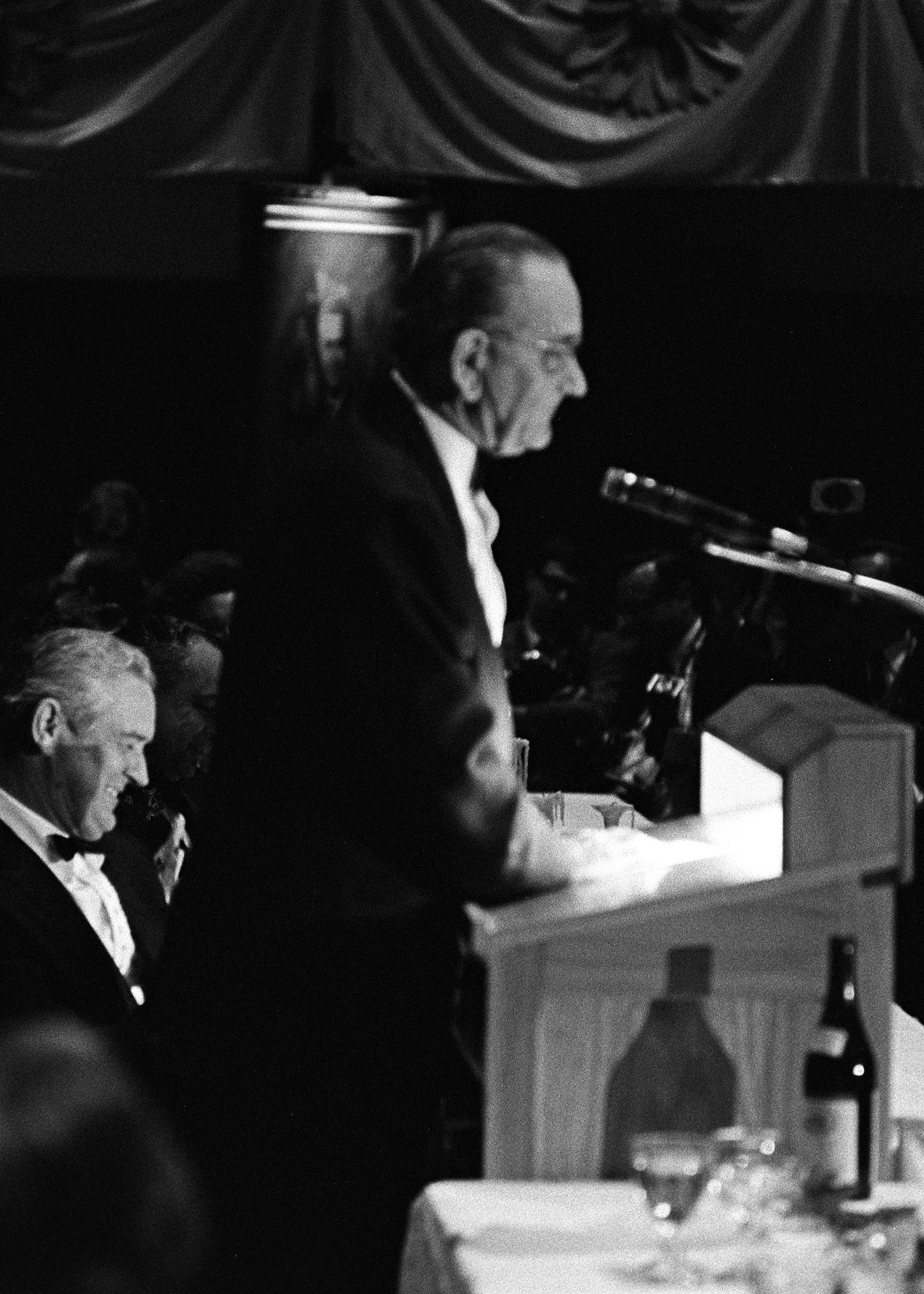
Johnson: Not in front of a TV

Johnson at that moment was at a black-tie birthday party for Texas Governor John Connally. The president poked fun at Connally, who was marking his 51st birthday.

“Today you are 51, John,” the president said. “That is the magic number that every man of politics prays for — a simple majority.”

It is difficult to fathom how Johnson could have been much moved by a program he did not see. And the power of what often is called the “Cronkite Moment” stems from the supposedly immediate and visceral effect the anchorman’s assessment had on the president.

But what Cronkite had to say on air that night was hardly earth-shaking, hardly stunning or novel.

If anything, Cronkite’s observation about “stalemate” was a rehash of what other news organizations, such as the New York Times, had been saying for months.

For example in August 1967, the Times inserted “stalemate” into the headline over a front-page news analysis about the war. The Times headline read:

Vietnam: The Signs of Stalemate.”

The newspaper’s analysis was filed from the South Vietnamese capital, Saigon, and noted:

“‘Stalemate’ is a fighting word in Washington. President Johnson rejects it as a description of the situation in Vietnam. But it is the word used by almost all Americans here, except the top officials, to characterize what is happening” in the war.

Before that, on July 4, 1967, the Times published a news analysis that said of the war effort:

“Many officers believe that despite the commitment of 466,000 United States troops now in South Vietnam … the military situation there has developed into a virtual stalemate.”

So in the context of the war in Vietnam, “stalemate” was hardly new by the time Cronkite turned to the word.

WJC

Recent and related:

Woodward and Bernstein: The ‘only superstars newspapers ever produced’?

In Cinematic treatments, Debunking, Media myths, Newspapers, Washington Post, Watergate myth on April 16, 2012 at 5:11 am

The 40th anniversary of the debut of the Watergate scandal falls in two months and we’re certain read many effusive tributes to the Washington Post’s reporters who often —  but wrongly — are said to have exposed the scandal and brought down Richard Nixon’s corrupt presidency.

It’s a safe bet that many of the tributes to the Post and its Watergate reporting team of Bob Woodward and Carl Bernstein will be exaggerated and erroneous.

Take, for example, this passage, which appeared over the weekend in a column in the Toronto Sun:

“The only superstars newspapers ever produced were Woodward and Bernstein, the Washington Post investigative team who broke the Watergate story that led to the downfall of U.S. president Richard Nixon.”

Maybe they were the only superstars of newspaperdom, although that claim might provoke an argument from the committee at New York University that recently selected 100 outstanding U.S. journalists of the past 100 years. (The list included several dubious entries, such as the self-important Christiane Amanpour of CNN; photojournalist and probable fraud Robert Capa; mythmaking writer David Halberstam, and broadcast journalism’s flawed saint, Edward R. Murrow.)

Woodward and Bernstein made NYU’s rather predictable list, too.

If they are newspapering’s lone superstars, their self-promotion had a lot to do with it.  Woodward and Bernstein’s book about their Watergate reporting, All the President’s Men, came out in June 1974, about two months before Nixon’s resignation.

The book, a months-long best-seller, had been written with the movies in mind; the cinematic version of All the President’s Men came out in April 1976 and starred Robert Redford as Woodward and Dustin Hoffman as Bernstein.

But more important than Woodward and Bernstein’s superstar status is the claim in the Sun’s column that they “broke the Watergate story.”

They did no such thing.

The signal crime of Watergate — the June 1972 burglary at Democratic National Committee headquarters — wasn’t broken by the Post. The break-in was interrupted by police and within hours, news was circulating of the arrest of five burglars at the Watergate complex.

The story in the Post about the break-in appeared beneath the byline of Alfred E. Lewis, a veteran police reporter, and its opening paragraph made quite clear that details were from investigators:

“Five men, one of whom said he is a former employee of the Central Intelligence Agency, were arrested at 2:30 a.m. yesterday in what authorities described as an elaborate plot to bug the offices of the Democratic National Committee here.”

Watergate reporting by the Post did not expose the cover-up of crimes linked to the break-in or the payment of hush money to the burglars, either.

As I note in my latest book, Getting It Wrong, which includes a chapter about the media myths of Watergate, Woodward was quoted in 1973 as saying that those crucial aspects of the scandal were “held too close. Too few people knew. We couldn’t get that high.”

Woodward: 'held too close'

Nor did Woodward and Bernstein uncover or disclose the existence of the White House audiotaping system, which was decisive to the outcome of Watergate.

The tapes secretly made by President Richard Nixon captured him approving a plan in June 1972 intended to thwart the FBI’s investigation of the Watergate break-in.

That contents of that tape — the so-called “smoking gun” of Watergate — sealed Nixon’s fate and directly led to his resignation in August 1974.

The White House taping system had been disclosed 11 months before, not by Woodward and Bernstein but by investigators of the Senate select committee on Watergate.

As I point out in Getting It Wrong, Woodward and Bernstein later claimed to have had a solid lead about the taping system.

In All the President’s Men, the book, Woodward recalled having spoken with Post Executive Editor Ben Bradlee about the lead.

Bradlee advised:

“I wouldn’t bust one” in checking it out.

Had they followed the lead, Woodward and Bernstein may well have broken a pivotal story about Watergate.

But they didn’t.

WJC

Recent and related:

Why WaPo should reveal sources on bogus Jessica Lynch tale

In Debunking, Jessica Lynch, Media myths, Washington Post on April 3, 2012 at 12:36 pm

On this date in 2003, the Washington Post published on its front page the electrifying but stunningly wrong hero-warrior tale about Pfc. Jessica Lynch, a botched report that carried the headline:

She was fighting to the death

Lynch, then a 19-year-old Army supply clerk, had fought fiercely in the attack of her unit in Nasiriyah, in southern Iraq, according to the Post, which cited anonymous “U.S. officials” as its sources.

One of them told the Post that Lynch had suffered gunshot and stab wounds “and watched several other soldiers in her unit die around her” in the ambush March 23, 2003.

It was exhilarating stuff and the Post’s report was picked up by news organizations around the world.

But it was wrong in almost all important details. Lynch was neither shot nor stabbed. She did not fire a shot in the ambush. She suffered crushing injuries in the crash of a Humvee as it attempted to flee the ambush.

She was taken prisoner and treated at an Iraqi hospital, from where she was rescued April 1, 2003, by a U.S. special operations team.

As Lynch herself insists, she was no hero (although she has said she could have embraced the hero-warrior tale and no one would’ve been the wiser).

Years later, it’s time for the Post to disclose just who it was that led it astray. It’s time to reveal the sources on the bogus story about Lynch.

It may be akin to sacrilege to argue that a newspaper should lift the veil of anonymity. But reasons  for making something of an exception in the Lynch case are several and compelling.

For one, news organizations owe little to anonymous sources that provide bad information. The grant of confidentiality isn’t meant to be a vehicle for diffusing falsehood.

In this case, the embarrassment quotient remains high enough for the Post to identify its Lynch sources — if not by name, then by affiliation.

Another compelling reason to lift the veil of anonymity is that the veil has been partly lifted already. One of the reporters on the botched story, Vernon Loeb, is on record as saying who the sources were not.

So it should be a small step to saying who they were.

Loeb, in an interview on NPR’s “Fresh Air” program in December 2003, stated unequivocally:

“Our sources for that story were not Pentagon sources.”

He also said he “could never get anybody from the Pentagon to talk about” the Lynch case.

“They wouldn’t say anything about Jessica Lynch,” Loeb said, adding:

“I just didn’t see the Pentagon trying to create a hero where there was none,” he added. “I mean …they never showed any interest in doing that, to me.”

Loeb also described them as “some really good intelligence sources” in Washington.

Despite Loeb’s insistence that the sources weren’t Pentagon sources, the narrative has taken hold that the military made up the story about Lynch’s heroics and somehow persuaded the Post to buy it.

This has become the dominant narrative of the Lynch case, as I point out in my book, Getting It Wrong.

By identifying its sources on the Lynch story, the Post could demolish the military-made-it-up narrative and, by doing so, strike a blow for accuracy and truth-telling.

There’s another compelling reason for the Post to lift anonymity in this case: The newspaper’s long silence on its sourcing has allowed twisted and erroneous claims to circulate as factual.

Notable in this regard are the claims Jon Krakauer made in his 2009 book Where Men Win Glory about Jim Wilkinson, an aide to the commander of U.S. forces in Iraq in 2003, General Tommy Franks.

Krakauer wrote that Wilkinson “duped reporters and editors at the Washington Post” by giving them exclusive access to the bogus tale about Lynch’s battlefield heroics.

Krakauer in the book also called Wilkinson a “master propagandist” and said he was “the guy who deserved top billing for creating the myth of Jessica Lynch.”

Wilkinson denied Krakauer’s allegations and met with the author to discuss a retraction.

Krakauer quietly retreated from his unattributed charges about Wilkinson, removing the unflattering passages from a recent paperback edition of Where Men Win Glory. That edition also contains a footnote, saying:

“Earlier editions of this book stated that it was Jim Wilkinson ‘who arranged to give the Washington Post exclusive access’ to this leaked intelligence [about Jessica Lynch]. This is incorrect. Wilkinson had nothing to do with the leak.”

Had the Post been transparent about the sourcing on its Lynch story,  Krakauer’s unsubstantiated allegations likely never would have been raised.

WJC

Many thanks to Instapundit
Glenn Reynolds for linking to this post.

Recent and related:

On bra-burning, Erica Jong is wrong

In Bra-burning, Debunking, Media myths, Photographs on March 28, 2012 at 4:25 pm

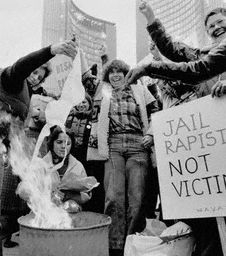
Bra-burning in Toronto, 1979 (Bettmann/Corbis)

The writer Erica Jong asserts in a rambling commentary posted yesterday at the Daily Beast that bra-burning “never actually occurred.”

The mischaracterization of bra-burning was an element of Jong’s defense of feminism and the sexual revolution of the 1960s and 1970s.

Jong wrote in the commentary:

“The fact that the so-called mainstream press reduced our valid struggles to sex, drugs, rock and roll, and bra burning (which, btw, never actually occurred) was their attempt to further disempower us. And they surely prevailed.”

It’s not an infrequent claim, that feminist bra-burning was a media trope, a media myth. That it “never actually occurred.”

But there were at least a couple of documented occasions when feminist protesters set fire to bras.

One occasion came 33 years ago this month, when members of Women Against Violence Against Women demonstrated outside Toronto City Hall. As the demonstration neared its end, a protester named Pat Murphy dropped a white bra into the hungry flames of a burn barrel (see photo, above).

The demonstration in Toronto on March 8, 1979, coincided with International Women’s Day and was aimed at denouncing a report on rape prepared by the Ontario Provincial Police.

The police report said “promiscuity” was a factor in many rapes.

The Women Against Violence Against Women group assailed the report as outrageous and “dazzling in its illogic.” Protesters carried signs saying: “Take a Rapist to Lunch — Charcoal Broiled” and “Hookers Who Wink Go to the Clink! Men Who Rape Escape.”

The Globe and Mail newspaper reported that the protesters lighted “a fire in a garbage can, to the obvious annoyance of about a dozen watchful constables, [and] shouted: ‘Burn the rapists, burn the city, burn the OPP,’” acronym for Ontario Provincial Police.

The newspaper’s account did not specifically mention bra-burning which, one participant has told me, “wasn’t a focal point” of the protest.

But bra-burning did happen there.

Another participant has recalled that “weighing in on the stereotype of ‘feminist bra-burners’ was actually an effective way [for protesters] to say: Women will control our own bodies, thank you!

“The bra burning,” she said, “was a way to entice the media as well as [offer] a critique of the police report.”

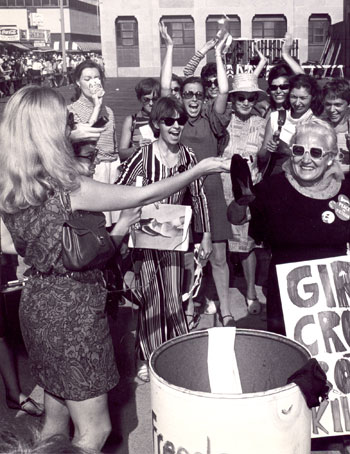
A little more than 10 years before the demonstration in Toronto, some 100 women gathered on the boardwalk at Atlantic City, New Jersey, to protest the 1968 Miss America pageant. The demonstration was organized by a small group called New York Radical Women and was an early manifestation of the women’s liberation movement.

In Getting It Wrong, my mythbusting book that came out in 2010, I offer evidence that bras were set afire, briefly, during the demonstration at Atlantic City.

The evidence is from two witness accounts, one of which was published in the local newspaper, the Press of Atlantic City, on September 8, 1968, the day after the protest.

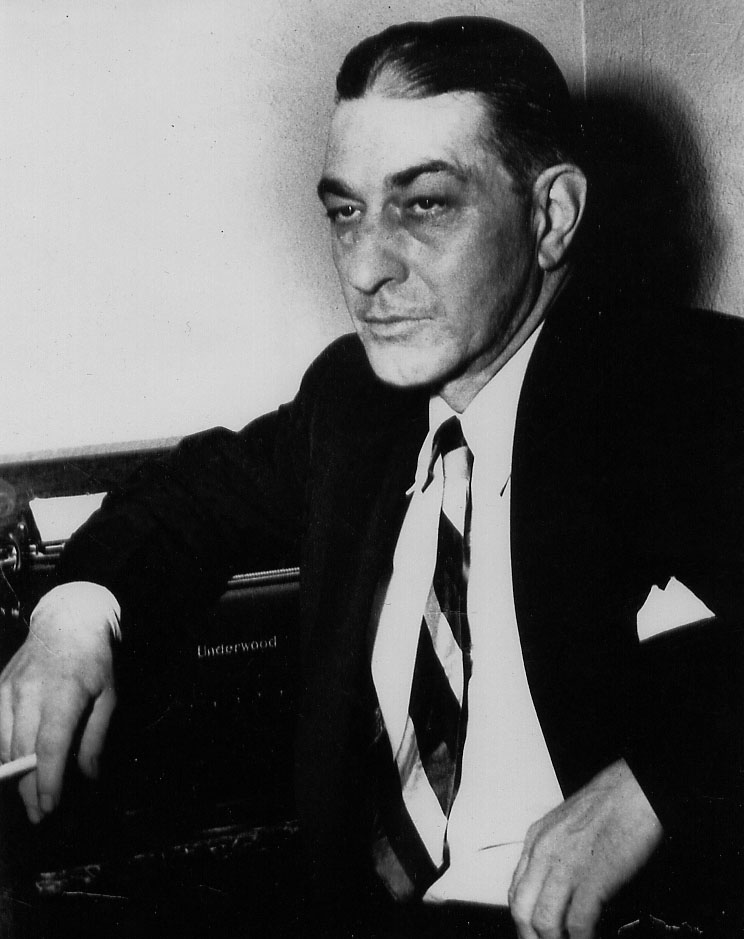
Boucher (1949 photo)

That account appeared beneath the byline of a veteran reporter named John L. Boucher and carried the headline:

“Bra-burners blitz boardwalk.”

Boucher’s article referred to the burn barrel that demonstrators dubbed the “Freedom Trash Can” and stated:

“As the bras, girdles, falsies, curlers, and copies of popular women’s magazines burned in the ‘Freedom Trash Can,’ the demonstration reached the pinnacle of ridicule when the participants paraded a small lamb wearing a gold banner worded ‘Miss America.’”

That published account was buttressed by recollections of the writer Jon Katz, who in 1968 was a young reporter for the Atlantic City newspaper. Katz was on the Atlantic City boardwalk the day of the protest, gathering material for a sidebar article about reactions to the demonstration.

Katz’s sidebar didn’t mention the fire in the “Freedom Trash Can.”

But in correspondence with me, Katz stated:

“I quite clearly remember the ‘Freedom Trash Can,’ and also remember some protestors putting their bras into it along with other articles of clothing, and some Pageant brochures, and setting the can on fire.

“I am quite certain of this.”

WJC

Many thanks to Instapundit
Glenn Reynolds for linking to this post.

Recent and related:

The ‘seismic cultural shifts’ of the 1960s: Protests, assassination — and bra-burning?

In Bra-burning, Debunking, Media myths, Washington Post on March 25, 2012 at 9:59 am

Feminist “bra-burning” of the late 1960s was more media myth than sustained reality.

But a commentary in today’s Washington Post places “bra-burning” among the “[s]eismic cultural shifts” of the late 1960s.

A column that promoted a media trope

Yes, “bra burning.”

This bizarre and baseless claim appears in a commentary that ruminates about the Mad Men television series.

The opening paragraph says:

“On ‘Mad Men,’ the AMC television show that returns for its fifth season Sunday night, booze, cigarettes, unprotected sex, cholesterol-rich foods and negligent parenting play starring roles in a surprisingly accurate and yet idealized picture of a New York ad agency in the mid-1960s. Seismic cultural shifts — Vietnam War protests, bra-burning and the assassination of Martin Luther King Jr. — are just over the horizon.”

The show, the Post’s commentary avers, “gives us a window into the mind-sets of our parents and grandparents.”

Oh, sure it does.

But even frivolous ruminations can bring opportunities for myth-busting, and bra-burning was hardly a “seismic” event of the late 1960s.

It hardly signaled “cultural shift.”

In fact, feminist “bra-burning” was mostly a non-event.

I call it a “nuanced myth” in my latest book, Getting It Wrong, which debunks 10 prominent media-driven myths.

The derivation of the nuanced myth can be traced to September 7, 1968, and the women’s liberation protest against the Miss America pageant at Atlantic City, N.J. The protest was organized by a small group called New York Radical Women.

The demonstrators included about 100 women who traveled to the Atlantic City boardwalk to denounce the pageant as a “degrading Mindless-Boob-Girlie symbol” that placed “women on a pedestal/auction block to compete for male approval” and promoted a “Madonna Whore image of womanhood.”

The harsh rhetoric notwithstanding, the daylong protest on the boardwalk wasn’t very raucous. A centerpiece was what the demonstrators called the “Freedom Trash Can,” into which they tossed “instruments of torture” such as brassieres, girdles, high-heeled shoes, and copies of Playboy and Cosmopolitan.”

One demonstrator held a girdle over the Freedom Trash Can, according to the New York Times, and chanted:

“No more girdles, no more pain. No more trying to hold the fat in vain.”

The protest’s organizers had let it be known in advance of the demonstration that they planned to set fire to bras and other items at Atlantic City. But once there, plans supposedly were abandoned in favor of what of was called a “symbolic bra-burning.”

And through the years, the demonstration’s organizers have been adamant that no bras were burned during the protest.

Nonetheless, newspaper columnists writing in the demonstration’s aftermath offered highly imaginative accounts of “bra-burning” at Atlantic City.

Notably, Harriet Van Horne wrote in the New York Post that a highlight of the demonstration “was a bonfire in a Freedom Trash Can.”

Van Horne, who was not at the Atlantic City protest, also wrote:

“With screams of delight they consigned to the flames such shackling, demeaning items as girdles, bras, high-heeled slippers, hair curlers and false eyelashes.”

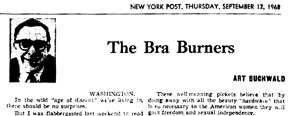
Nationally syndicated humor columnist Art Buchwald also picked up on the bra-burning meme, writing with tongue in cheek that he was “flabbergasted to read that about 100 women had picketed the Miss America pageant in Atlantic City against ‘ludicrous beauty standards’ that had enslaved the American woman.’”

Buchwald also wrote: “The final and most tragic part of the protest took place when several of the women publicly burned their brassieres.”

And a media myth took hold.

What nuances the myth are witness accounts, discussed in Getting It Wrong, that bras were set afire, if briefly, during the protest.

Boucher, 1949 photo

One witness account appeared in the Press of Atlantic City the day after the protest. The newspaper’s first-hand report, written by a veteran reporter named John L. Boucher, included this passage:

“As the bras, girdles, falsies, curlers, and copies of popular women’s magazines burned in the ‘Freedom Trash Can,’ the demonstration reached the pinnacle of ridicule when the participants paraded a small lamb wearing a gold banner worded ‘Miss America.’”

Also covering the demonstration was Jon Katz, then a young reporter for the Atlantic City Press. In my research into bra-burning, Katz told me:

“I quite clearly remember the ‘Freedom Trash Can,’ and also remember some protestors putting their bras into it along with other articles of clothing, and some Pageant brochures, and setting the can on fire. I am quite certain of this.”

As I point out in Getting It Wrong, these accounts that bras were burned in the “Freedom Trash Can” cannot be “taken lightly, dismissed or ignored.”

At the same time,  I write, the witness accounts “offer no evidence to corroborate a widely held image of angry feminists demonstratively setting fire to their bras and tossing the flaming undergarments into a spectacular bonfire.”

There was no mass bra-burning at Atlantic City, no feminists twirling flaming bras over the heads. Fire at most was a modest and fleeting aspect of the protest on that long ago September day.

It was, to be sure, no seismic event.

WJC

Recent and related:

How’s that? ‘Bra-burning’ influenced mid-1960s fashion?

In Bra-burning, Debunking, Media myths on March 22, 2012 at 4:50 am

The notion that “bra-burning” was a widespread element of feminist protest is a media myth that’s probably too engrained, and euphonic, ever to be thoroughly debunked.

Fashion statement? (Press of Atlantic City)

It’s a notion that’s given rise to much hyperbole since the late 1960s. An Associated Press report yesterday added to the overstatement reflex with this astounding and wrong-headed passage about “bra-burning“:

“Culturally, beatniks were becoming mods, rock ‘n’ roll was taking hold, and the move from stockings to pantyhose — and eventual bra-burning — all influenced mid-’60s fashion.”

The AP report was about how the Mad Men television series has reflected “the evolution of fashion” during the 1960s.

But it wasn’t such froth that caught the attention of Media Myth Alert: It was the absurd claim that “bra burning … influenced mid-1960s fashion.”

Left unsaid by the AP report was how — how “bra-burning,” even if it were a frequent manifestation (which it wasn’t), could have  influenced fashion of that time.

The AP claim was especially puzzling because the “bra burning” meme did not even emerge until the late 1960s, when it came to be associated with the Miss America protest at Atlantic City on September 7, 1968.

A centerpiece of the 1968 protest was the “Freedom Trash Can,” into which demonstrators deposited so-called “instruments of torture” — including brassieres, girdles, high-heeled shoes, false eyelashes, and copies of magazines such as Playboy and Cosmopolitan.

Organizers of the demonstration have long insisted that no bras were set afire that day — that there was only a “symbolic bra burning” at Atlantic City.

But “bra-burning” is a nuanced media myth — as I describe in my latest book, Getting It Wrong.

I discuss in the book two previously overlooked witness accounts that bras were burned, briefly, during the protest at Atlantic City, which often is credited with marking the rise of the feminist movement of the late 20th century.

One of the witness accounts was published the day after the protest in the Press of Atlantic City, beneath the headline:

Bra-burners Blitz Boardwalk.”

The newspaper report, written by a veteran reporter named John L. Boucher, included this passage:

“As the bras, girdles, falsies, curlers, and copies of popular women’s magazines burned in the ‘Freedom Trash Can,’ the demonstration reached the pinnacle of ridicule when the participants paraded a small lamb wearing a gold banner worded ‘Miss America.’”

The other witness account discussed in Getting It Wrong was that of Jon Katz, a writer who covered the 1968 protest as a young reporter for the Atlantic City newspaper.

“I recall and remember noting at the time that the fire was small, and quickly was extinguished, and didn’t pose a credible threat to the Boardwalk. I noted this as a reporter in case a fire did erupt,” Katz told me, adding:

“It is my recollection that this burning was planned, and that a number of demonstrators brought bras and other articles of clothing to burn, including, I believe some underwear.”

These witness accounts offer fresh dimension to the legend of bra-burning: They represent evidence that bras and other items were set afire, if briefly, at the 1968 protest in Atlantic City.

“This evidence,” I write in Getting It Wrong, “cannot be taken lightly, dismissed or ignored.”

I also point out, though, that neither witness account lends  “support to the far more vivid and popular imagery that many bras went up in flames in flamboyant protest that September day. [The] accounts offer no evidence to corroborate a widely held image of angry feminists demonstratively setting fire to their bras and tossing the flaming undergarments into a spectacular bonfire.”

The reference in the AP report to “bra burning” as a fashion-molder is not only wrong; it suggest the insidious nature of media myths — how they can be invoked so readily and casually, without reference to any supporting evidence or detail.

They’re often treated as if they’re common knowledge, widely accepted.

And “bra-burning” is a media myth with a sting. The term often has been employed casually, as derogatory epithet, to ridicule feminists and dismiss their objectives as trivial and insignificant. As such, “bra-burning” underscores the potential of media myths to feed and promote stereotypes.

Not to mention misleading impressions of fashion history of the 1960s.

WJC

Recent and related:

NYTimes blog embraces ‘March Madness’ myth, claims ‘Zero Productivity Zone’

In Debunking, Media myths, New York Times on March 15, 2012 at 2:22 pm

The productivity myth of March Madness has kicked around for years, apparently immune to the most thorough of debunkings.

As the NCAA men’s basketball tournament opened today, the New York Times college sports blog, “The Quad,” embraced the myth with a headline warning that U.S. workplaces were entering the “Zero Productivity Zone.”

“It is officially time to celebrate the two days a year when American productivity goes in the toilet and it’s a good thing,” a post at the blog declared, adding:

“Thursday and Friday are like a little escape hatch from the usual grind, with N.C.A.A. tournament games going non-stop and while the Puritans of the business world can wring their bony hands over paying people who are suddenly obsessed with the fate of Virginia Commonwealth, the proper response is: tough noogies.”

Sure, some of that’s meant tongue in cheek. Or faintly snarky.

But, still: Media Myth Alert is tempted to say “tough noogies” in calling out a blog post that so blithely repeats the dubious claim and contributes to perpetuating a hardy seasonal myth. And one that does so without data or documentation.

A quick LexisNexis search finds other media outlets indulging in the productivity myth, too.

The Christian Science Monitor, for example, reported the other day:

“According some employment specialists, the next two or three weeks often rank low for productivity, as employees either keep one eye on the scoreboard or just try to cope with less sleep. Even leading up to the second round, which starts Thursday, many employees spend a lot of company time ‘researching’ teams to compete in their office pools or in ‘bracketology’ showdowns online.”

To support such assertions the Monitor article turned to estimates by the Chicago outplacement firm, Challenger, Gray & Christmas, which over the years has propelled the myth with outlandish claims about productivity loss.

This year, the firm is a bit coy about projecting productivity losses. It claims in a news release that U.S. employers today and Friday may end up paying $175 million in wages to workers distracted by the games.

But Challenger proceeds to dismiss its own estimate, saying it’s not to be taken seriously.

On the second page of its news release, Challengers advises taking the estimate “with a grain of salt, as it is meant to be a tongue-in-cheek look at how technology continues to blur the line between our professional and personal lives.

“Ultimately,” the statement says, “March Madness will not even register a blip on the nation’s economic radar and even the smallest company will survive the month without any impact on their bottom line.”

Not even a blip.

Which makes one wonder why the company offers such outlandish estimates in the first place, given that they inject fresh life into a myth that deserves disposal on the slag heap of statistical imprecision. Is it so eager for free publicity?

And as Carl Bialik, the Wall Street Journal’s Numbers Guy, asked in a column seven years ago, “why does the press report studies whose authors don’t take them that seriously?”

Why, indeed?

No doubt because they’re simplistic and easily accessible. As I point out in my latest book, Getting It Wrong, among the most tenacious media myths are those that “minimize or negate complexity” and “offer simplistic and misleading interpretations instead.”

WJC

Recent and related:

James Fallows and ‘furnish the war’: Indulging in a media myth

In 1897, Debunking, Furnish the war, Media myths, Spanish-American War on March 3, 2012 at 11:00 am

Young Hearst

In deploring “carefree talk” about pre-emptively bombing Iran’s nuclear installations, Atlantic correspondent James Fallows invokes the mythical tale about William Randolph Hearst’s vow to “furnish the war” with Spain in the late 1890s.

The “furnish the war” anecdote can be just too delicious to resist, as Fallows demonstrates in a rambling commentary posted yesterday at the Atlantic online site.

In it, Fallows writes that “only twice before in my memory, and maybe thrice in American history, has there been as much carefree talk about war and unprovoked strikes as we’ve had concerning Iran in recent months ….

“The twice in my experience were: during the runup to the invasion of Iraq in 2002, and in the ‘bomb ’em back to the stone age’ moments of the early Vietnam era.

“The time that even I don’t remember was the ‘you furnish the pictures, I’ll furnish the war’ yellow journalism drumbeat before the war with Spain in 1898. This is not good company for today’s fevered discussion to join.”

The line, “you furnish the pictures, and I’ll furnish the war,” was attributed to Hearst more than 110 years ago. But as decades passed, no compelling evidence ever emerged to support or document the tale.

Indeed, it’s often overlooked that Hearst denied making such vow, which he purportedly included in a telegram to the artist Frederic Remington, who was on assignment to Spanish-ruled Cuba in early 1897 for Hearst’s New York Journal.

The telegram to Remington has never surfaced. And Remington apparently never discussed the anecdote, which was recounted first in 1901, in a brief passage in memoir by James Creelman, a blowhard journalist known for frequent exaggeration.

Creelman did not explain how he learned of the “furnish the war” tale which, as I describe in my latest book, Getting It Wrong, is almost surely apocryphal.

Not only does story live on despite the absence of supporting documentation; it lives on despite an irreconcilable internal inconsistency.

That is, it would have been absurd for Hearst to have vowed to “furnish the war” because war — specifically, the Cuban rebellion against Spain’s colonial rule — was the reason he sent Remington to Cuba in the first place.

Cuba in early 1897 was the theater of a nasty war. By then, Spain had dispatched nearly 200,000 troops in a failed attempt to put down the rebellion, which gave rise in 1898 to the Spanish-American War.

Spanish authorities controlled and censured international cable traffic to and from Cuba. They surely would have intercepted — and called attention to — Hearst’s bellicose message, had it been sent. There is little chance the cable would have moved unimpeded from Hearst in New York to Remington in Cuba.

But despite the compelling evidence arrayed against it, the vow attributed to Hearst lives on, and on.

That’s because it has, as I write in Getting It Wrong, “achieved unique status as an adaptable, hardy, all-purpose anecdote, useful in illustrating any number of media sins and shortcomings.

“It has been invoked to illustrate the media’s willingness to compromise impartiality, promote political agendas, and indulge in sensationalism. It has been used, more broadly, to suggest the media’s capacity to inject malign influence into international affairs.”

Which is what Fallows does.

WJC

Recent and related:

Wasn’t so special: Revisiting the ‘Cronkite Moment,’ 44 years on

In Anniversaries, Cronkite Moment, Debunking, Media myths on February 27, 2012 at 12:59 am

A legendary moment in network news came 44 years ago tonight, when CBS News anchorman Walter Cronkite pronounced at the close of special report that the U.S. military was “mired in stalemate” in Vietnam and said negotiations might offer a way out.

Johnson: Not in front of a TV

Cronkite’s report aired February 27, 1968, and examined the Tet offensive that communist forces had launched across South Vietnam four weeks earlier.

At the White House that night, President Lyndon B. Johnson supposedly watched the Cronkite report. Upon hearing the popular anchorman’s downbeat assessment, Johnson realized his war policy was a shambles. The report was, the story goes, an epiphany for the president.

Johnson snapped off the television set and said to an aide or aides:

“If I’ve lost Cronkite, I’ve lost Middle America.”

Or something to that effect.

The report was so singularly and unexpectedly decisive that it has come to be celebrated as the “Cronkite Moment,” a totem of courage and insight, a revered model for broadcast journalism.

Except the “Cronkite Moment” wasn’t so special. Cronkite’s assessment about the war wasn’t novel or particularly insightful.

It was, if anything, a rehash of what other news organizations had been saying for weeks and months. “Stalemate” was much in the news back then.

The New York Times, for example, wrote “stalemate” into the headline over a news analysis about the war that was published on its front page in August 1967 — nearly seven months before Cronkite’s televised report. The Times headline read:

Vietnam: The Signs of Stalemate.”

The Times analysis, which was filed from the South Vietnamese capital, Saigon, noted:

“‘Stalemate’ is a fighting word in Washington. President Johnson rejects it as a description of the situation in Vietnam. But it is the word used by almost all Americans here, except the top officials, to characterize what is happening” in the war.

So “stalemate” had been often invoked, and much-debated, by the time Cronkite turned to the word.

Even more damaging to the purported exceptionality of the “Cronkite Moment” was that Johnson did not see the Cronkite report when it aired.

As such, the president could not have had the abrupt, visceral reaction that endows the purported “Cronkite Moment” with special power and resonance.

As I discuss in my latest book, Getting It Wrong, Johnson wasn’t at the White House on February 27, 1968; he wasn’t in front of a television set, either, when Cronkite intoned his “mired in stalemate” assessment.

The president was in Austin, Texas, attending the 51st birthday party of a political ally, Governor John Connally. About the time Cronkite made his on-air editorial comment, Johnson was making light of Connally’s age, saying:

“Today you are 51, John. That is the magic number that every man of politics prays for— a simple majority.”

As I also discuss in Getting It Wrong, there is no persuasive evidence that Johnson later saw Cronkite’s report on videotape.

Even if he had, it would have made no difference to his thinking about Vietnam.

Not long after the Cronkite report, Johnson delivered a rousing speech in Minneapolis, urging “a total national effort” to win the war in Vietnam. The speech was given March 18, 1968, and in it, the president declared:

“We love nothing more than peace, but we hate nothing worse than surrender and cowardice.”

Johnson, who died in 1973, did not mention the purported “Cronkite Moment” in his memoir, The Vantage Point.

For his part, Cronkite often described the program in modest terms, likening its effect on U.S. policy to a straw on a camel’s back. He turned to that analogy in writing his memoir, for example.

But in the years immediately before his death in 2009, Cronkite began to interpret the program in a somewhat grander light. He came to embrace the presumptive power of the “Cronkite Moment.”

In an interview with Esquire in 2006, for example, he said:

“To be honest, I was rather amazed that my reporting from Vietnam had such an effect on history.”

Interestingly, Cronkite also said he had never discussed the program and his famous editorial comment with Johnson.

According to a report in the Austin American-Statesman, Cronkite said in a teleconference call with a journalism class at Southwest Texas State University in 1997 that Johnson “never brought it up and I certainly never did.”

WJC

Many thanks to Instapundit
Glenn Reynolds for linking to this post.

Recent and related:

Liz Trotta mangles Jessica Lynch ‘fairy tale’

In Debunking, Jessica Lynch, Media myths, Washington Post on February 20, 2012 at 10:12 am

Veteran broadcast journalist Liz Trotta went on Fox News yesterday to condemn plans to ease restrictions on women in Army combat positions.

In doing so, Trotta referred to — and mangled — key elements of the saga of Jessica Lynch, the Army private thrust into an international spotlight by a newspaper’s botched report about her battlefield heroics in Iraq in March 2003.

Trotta said in an appearance on the Fox program “America’s News HQ” that “the political correctness infecting the Pentagon has resulted in silly and dishonest fairy tales about female heroism. Has anyone forgotten the Jessica Lynch story?

“A PFC captured by the Iraqis and by all accounts, including her own, not mistreated. Yet the Pentagon saw fit to send in the SEALs to rescue her from a hospital in a videotaped operation that seemed headed straight to Hollywood.”

Whoa.

Let’s call out the errors there: Lynch was mistreated, and videotaping her rescue was routine practice in high-priority military operations —  not done with Hollywood in mind.

By Lynch’s own account — contained in a book by Rick Bragg and titled I Am a Soldier, Too — she was knocked out in the crash of a Humvee in attempting to escape an ambush in Nasiriyah, in southern Iraq. While unconscious, Lynch “was a victim of anal sexual assault,” the book says, adding:

“The records do not tell whether her captors assaulted her almost lifeless, broken body after she was lifted from the wreckage [of the Humvee], or if they assaulted her and then broke her bones into splinters until she was almost dead.”

She was rescued from an Iraqi hospital on April 1, 2003, in an operation that included not only Navy SEALS but Marines and Army Rangers as well.

It was the first rescue of a captured American solder from behind enemy lines since World War II.

I discuss the mythology of the Lynch case in my latest book, Getting It Wrong, noting that the Defense Department’s inspector general found no evidence to support the notion Lynch’s rescue “was a staged media event.”

The then-acting inspector general, Thomas F. Gimble, said in a report to Congress in 2007 that the rescue operation was determined to have been “a valid mission” to recover a prisoner of war “under combat conditions.”

That the rescue was videotaped was not unusual, Gimble said, noting that combat cameramen routinely filmed high-priority operations. In the Lynch case, he said, there was “no indication that any service member was acting for the camera during the rescue mission.”

Gimble also said the extrication team “fully expected to meet stiff resistance” in mounting the rescue.

Trotta’s mangled account was the latest in a succession of erroneous characterizations about the Lynch case, which burst into prominence April 3, 2003, in a sensational, front-page report in the Washington Post.

The newspaper cited otherwise unidentified “U.S. officials” and said Lynch, a supply clerk, had fought fiercely in the ambush at Nasiriyah, that she had “continued firing at the Iraqis even after she sustained multiple gunshot wounds and watched several other soldiers in her unit die around her ….”

The Post quoted one of the anonymous officials as saying: “She was fighting to the death. She did not want to be taken alive.”

But the report was bogus. Little of it was true.

Lynch, who was not in a combat unit, never fired a shot in the ambush; her weapon jammed.

Not was she shot, as the Post reported. She suffered shattering injuries in the crash of the Humvee.

The Post, moreover, has never adequately explained how it erred so utterly in its hero-warrior story about Lynch, a story that was picked up by news organizations around the world.

More recently, in an interview with Lynch last month, Fox News anchorman Shepard Smith claimed without providing evidence that “the government” had made up the tale about Lynch’s battlefield heroics in Iraq.

He ignored the singular role of the Washington Post in placing the hero-warrior tale about Lynch into the public domain.

WJC

Recent and related: