W. Joseph Campbell

Archive for the ‘Media myths’ Category

In Wikileaks, a hint of Watergate? Not so much

In Cinematic treatments, Debunking, Media myths, New York Times, Washington Post, Watergate myth on December 1, 2010 at 12:30 pm

It was just a matter of time before someone found a hint of Watergate in the recent, massive Wikileaks disclosures of sensitive U.S. diplomatic traffic.

Voilá. A commentary posted today at examiner.com invokes such a linkage in arguing that leaked cables describing Afghan President Hamid Karzai’s misconduct underscore the importance of turning him from office.

The commentary refers to Bob Woodward and Carl Bernstein, who reported on Watergate for the Washington Post, and asserts that Wikileaks disclosures “add to the well-documented trail of President Karzai’s abuse of Presidential power and his incessant attempts to exceed his constitutional authority.

Nixon quits, August 1974

“I have written before and shall point out again,” the commentary’s author stated, “that there is … the same amount of evidence derived from open source intelligence alone to impeach Karzai as Woodward and Bernstein had amassed to force Nixon to resign.”

Of keen interest to Media Myth Alert is not so much Karzai’s brazenness but the extravagant claim about the Watergate reporting of Woodward and Bernstein, that they “amassed” evidence to “force” Nixon’s resignation. He quit in 1974.

As I point out in my latest book, Getting It Wrong, their reporting had at best only a marginal effect on the outcome of the scandal, in which 19 men associated with Nixon’s presidency or his 1972 reelection campaign went to jail.

“To roll up a scandal of such dimension,” I write in Getting It Wrong, “required the collective if not always the coordinated forces of special prosecutors, federal judges, both houses of Congress, the Supreme Court, as well as the Justice Department and the FBI.”

Efforts of that dimension were required to uncover evidence implicating Nixon and his top aides in what was a sprawling scandal.

And even then, Nixon likely would have served out his second term if not for secret audiorecordings he made of many conversations in the Oval Office–conversations that captured his guilty role in authorizing a coverup of the Watergate scandal.

“Only when compelled by the Supreme Court,” I note, “did Nixon surrender those recordings, which captured him plotting the cover-up and authorizing payments of thousands of dollars in hush money.”

So against that tableau, the contributions of Woodward, Bernstein, and the Washington Post recede to minor significance: They were not decisive to the outcome of Watergate.

But because the scandal was so intricate, and because it is no longer a day-to-day preoccupation, the details have become blurred and what I call the “heroic-journalist” interpretation has taken hold as the dominant popular narrative of Watergate.

And that’s the endlessly appealing notion–propelled by the mediacentric motion picture All the President’s Men–that Woodward and Bernstein’s tireless and dogged reporting brought down Nixon.

The heroic-journalist interpretation, I write in Getting It Wrong, “has become the most familiar storyline of Watergate,” noting that it’s “ready short-hand for understanding Watergate and its denouement, a proxy for grasping the scandal’s essence while avoiding its forbidding complexity.”

It’s a view that’s widely held. Even the New York Times, the keenest rival of the Washington Post, has embraced the heroic-journalism interpretation of Watergate.

Interestingly, though, principals at the Post have over the years disputed the notion the newspaper was decisive in Nixon’s fall.

Katharine Graham, the newspaper’s publisher during and after the Watergate period, said in 1997, at the 25th anniversary of the foiled burglary at Democratic national headquarters that touched off the Watergate scandal:

“Sometimes people accuse us of bringing down a president, which of course we didn’t do. The processes that caused [Nixon’s] resignation were constitutional.”

And Woodward, himself, has concurred, if in earthier terms.  In an interview several years ago with American Journalism Review, Woodward declared:

To say that the press brought down Nixon, that’s horseshit.”

WJC

Recent and related:

He may be arrogant, but he’s right about presentism

In Debunking, Media myths, Spanish-American War, Watergate myth on November 29, 2010 at 6:57 am

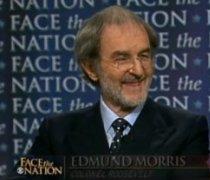
Edmund Morris, the Pulitzer Prize-winning biographer of Theodore Roosevelt, is a bit of an arrogant twit. But he was absolutely on-target in dismissing as “presentist” an inane question raised yesterday by host Bob Schieffer on the Face the Nation interview program.

Morris on 'Face the Nation'

Schieffer asked Morris, who recently completed the third of three volumes about Roosevelt’s life and times:

“What would Teddy Roosevelt think of today’s politics, Edmund?”

To which the Kenya-born Morris, who has lived in the United States since 1968, replied:

“You keep asking these presentist questions, Bob. As the immortal Marisa Tomei said in [the movie] My Cousin Vinny, that’s a bullshit question. Because you cannot pluck people out of the past and expect them to comment on what’s happening today.

“I can only say that what he represented in his time was that what we look for in our presidents now, what we hope for in our presidents now and we’re increasingly disappointed. He was somebody who understood foreign cultures. He represented the dignity of the United States. He was forceful but at the same time civilized.

“And what I really feel these days is we’ve become such an insular people … I see an insular people who are insensitive to foreign sensibilities, who are lazy, obese, complacent, and increasingly perplexed as to why we are losing our place in the world to people who are more dynamic than us and more disciplined.”

Morris’ comments–especially his profanity and his condescending swipes at Americans–quickly drew flak in the blogosphere.

And it’s true enough, as Matt Schneider of mediate.com observed with tongue in check, that “nothing compares to the thrilling unpredictability of an uninhibited guest like Morris who in one breath idolizes America’s ‘immortal’ movie stars, but in the next laments the rest of America as fat and lazy.”

Still, Morris was quite right to challenge Schieffer’s question. He was quite right to say that “you cannot pluck people out of the past and expect them to comment on what’s happening today.” It was a useful lesson.

Morris in effect was calling attention to the fallacy of presentism–that of applying contemporary standards and ideals to events and characters of the past. In other words, reading the present into the past.

Earlier in the show, Schieffer had asked Morris:

“What would T.R. have thought about what’s going on today? … Is there any correlation that you see between what he thought about and his vision for the country and, say, the rise of the Tea Party movement?”

To which Morris replied: “Well, I’m not going to pluck him out of the past because you can’t do that. He lived in his time. And he represented his time.”

Presentism is one of the fallacies David Hackett Fischer discussed 40 years ago in his superb study, Historians’ Fallacies.

Fischer noted: “The fallacy of presentism is a common failing in historical writing by men who have never been trained in the discipline of history.” He also wrote: “Academic historians are not exempt from the same error.”

Morris, whose Colonel Roosevelt has just been published, appeared on Face the Nation with three other authors of recent historical or political books. Among them was Bob Woodward, he of the Washington Post Watergate fame and author most recently of Obama’s Wars.

I’ve previously discussed at Media Myth Alert another, even more common fallacy of history–the “golden age” fallacy.The fallacy also is addressed in my latest book, Getting It Wrong, which debunks 10 prominent myths about the news media. Among them is the heroic-journalist myth of Watergate–the notion that the tireless reporting by Woodward and his colleague Carl Bernstein brought down Richard Nixon’s corrupt presidency.

I note in Getting It Wrong that the “golden age” fallacy is a “flawed but enticing belief that there really was a time when journalism and its practitioners were respected and inspiring”—the time, say, of Woodward and Bernstein.

WJC

Recent and related:

Thoughts on why journalists can get it badly wrong

In Debunking, Hurricane Katrina, Jessica Lynch, Media myths, Washington Post on November 27, 2010 at 6:34 am

I mentioned in a blog post yesterday the Time magazine essay about journalists getting it wrong.

It’s a fine and thoughtful discussion, written by Kathryn Schulz, who maintains: “Reporters make serious mistakes routinely, and we do so not because we are immoral, but because of the nature of journalism, and of the human mind.”

Schulz, author of Being Wrong: Adventures in the Margin of Error, refers in the essay to what she says are “two rich sources of error”–the echo-chamber effect and “the double whammy of journalism’s shrinking profit margin and growing news hole.”

As an example of the first, she describes what in effect is the phenomenon of inter-media agenda-setting, which I discuss in my latest book, Getting It Wrong.

Inter-media agenda-setting typically occurs when large news organizations with resources to cover events far from home effectively set the news agenda for smaller outlets. “Journalists,” Schulz writes in the Time essay, “…often just replicate one another’s conclusions.

“That goes some way toward explaining how the massive myth of Pfc. Jessica Lynch’s Iraq heroics grew out of a single inaccurate story in the Washington Post.”

It’s refreshing to see such an acknowledgement.

As I’ve periodically noted at Media Myth Alert, the singular role of the Washington Post in propelling Lynch into unimagined and undeserved fame has receded in favor of the false narrative that accuses the Pentagon of having concocted the hero-warrior story about Lynch in Iraq to bolster Americans’ support for the war.

As I discuss in Getting It Wrong, the Pentagon wasn’t the source for the botched report in the Post about Lynch’s supposed heroics. The U.S. military was loath to discuss Lynch’s reputed derring-do. And yet, the false story line has since become entrenched as the dominant narrative about the Lynch case.

In writing about “the double whammy of journalism’s shrinking profit margin and growing news hole,” Schulz points out that thorough investigations cost news organizations a lot in time and money, but that reporters these days “increasingly resemble doctors in an understaffed emergency room, working under immense time pressure with inadequate resources.

“Those conditions,” she adds, “are not exactly conducive to the stodgy, time-consuming business of accuracy: verifying quotes, contacting additional sources, fact-checking claims.”

I’m not so sure about that: Why wouldn’t the reality of time pressures make fact-checking even more imperative in newsrooms? Blaming times pressures of course doesn’t exonerate journalists or excuse them from their errors.

The observation is reminiscent of excuses offered for the highly exaggerated, over-the-top reporting about mayhem and violence in New Orleans in the aftermath of Hurricane Katrina in 2005. Telecommunication networks were down. Telephone service was out. Cell phones didn’t function. Electricity was scarce.

But as I write in Getting It Wrong, those conditions do not let journalists off the hook for the inaccurate reporting about the horrific violence supposedly unleashed by the hurricane.

“It would not have been unreasonable for the collapse of communication networks to have given reporters pause, leaving them more cautious and more wary about what they heard and reported, and thus less likely to traffic in wild and dubious claims” of apocalyptic violence in Katrina’s immediate aftermath, I point out in the book.

Schulz mentions the flawed reporting of the hurricane, referring in her essay to “the quasi-hysterical coverage of Katrina: the uncritical regurgitation by reporters of claims of mass murder, children being raped, gang wars in the Superdome.”

And she notes the Katrina-related research I discuss in Getting It Wrong, writing:

“Those claims proved hyperbolic to the point of sheer invention: according to journalist W. Joseph Campbell in Getting It Wrong, only six people died in the Superdome (four of natural causes, one of a drug overdose, one an apparent suicide), and not a single claim of sexual assault was ever substantiated.”

Indeed.

To Schulz’s short list of the causes of major error in journalism, I would add, at a minimum, the fog of war.

I note in Getting It Wrong that it’s scarcely surprising that war and conflict can be breeding grounds for media-driven myth. After all, I write, “The stakes in war are quite high, and the shock of combat is alien and unfamiliar to most people.

“Given their limited first-hand experience with war, media audiences usually find themselves in no position to challenge reports from the battlefield. The confusion and intensity inherent in warfare can lead journalists to place fragmented information that emerges from conflict into recognizable if sometimes misleading frames.”

The Lynch case is one of a number of war-related myths addressed and debunked in Getting It Wrong.

WJC

Recent and related:

Jessica Lynch one of ‘Time’ magazine’s ‘faces of decade’

In Debunking, Jessica Lynch, Media myths, Washington Post on November 26, 2010 at 6:42 am

I’ve expressed astonishment at Media Myth Alert from time to time about how the national spotlight still finds Jessica Lynch, who became the most familiar face of the early Iraq War because of a botched, front page story in the Washington Post about her supposed battlefield heroics.

Lynch, before the war

That was a sensational account, picked up by news organizations across the country and around the world. The Times of London, for example, declared that “one thing is certain”–Lynch “has won a place in history as a gritty, all-American hero.”

But the Post story  was utterly in error: Lynch, then a 19-year-old Army private, never fired a shot in Iraq. She was neither shot nor stabbed, as the Post reported, but suffered shattering injuries in the crash of a Humvee as it tried to escape an Iraqi ambush in Nasiriyah on March 23, 2003.

She was no battlefield hero.

Over time, however, the singular role of the Washington Post in propelling Lynch into unmerited fame has receded in favor of a false narrative that says the Pentagon concocted the hero-warrior story about Lynch to bolster Americans’ support for the war.

Time magazine repeated the false narrative  the other day in a writeup about Lynch, whom it calls one of the “faces of the decade”–a handful of men and women the magazine says “became famous overnight not for glamour or riches or simply being famous but for the explosive public issues they represented.”

Time says flatly that Lynch “was a victim of the propaganda machine at the Pentagon, which exaggerated her heroics.”

Whether Lynch merits inclusion in the “faces of the debate” is highly debatable. What’s not debatable is the magazine’s inaccurate characterization of Lynch’s improbable emergence to unsought fame.

As I discuss in my latest book, Getting It Wrong, the Pentagon was not the source for the botched report in the Post about Lynch’s supposed heroics in Iraq. The U.S. military was loath to discuss the sketchy reports from the battlefield that told of her heroic deeds.

I note in Getting It Wrong that Vernon Loeb, then the defense writer for the Post, went on an NPR program in late 2003 to say that he “could never get anybody from the Pentagon to talk about” the Lynch case.

“They wouldn’t say anything about Jessica Lynch,” Loeb said in an interview on the Fresh Air show.

“I just didn’t see the Pentagon trying to create a hero where there was none,” Loeb added. “I mean …they never showed any interest in doing that, to me.”

Loeb declared: “Our sources for that story were not Pentagon sources.”

Not surprisingly, the Time writeup doesn’t say how the Pentagon (if it had been the source) so thoroughly duped the Post into publishing the bogus report: No one pushing the false narrative about the Pentagon’s having ginned up the Lynch story addresses that critical element.

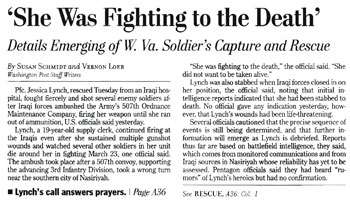
The Post–to its discredit–has never disclosed the source of its botched story, which appeared April 3, 2003, beneath the headline:

“‘She was fighting to the death.'”

The botched story

Lynch told Time that she doesn’t know how the phony report about her battlefield derring-do took hold. In excerpts of an interview posted at the Time online site, Lynch says:

“Honestly, I have no idea where the stories were created.”

The interview excerpts make no reference to the Post or its erroneous report. (Interestingly, a separate article in Time that ruminates about errors by journalists does mention the Post, saying: “Lynch’s Iraq heroics grew out of a single inaccurate story in the Washington Post.”)

Like many media-driven myths, though, the notion that the Pentagon pushed the phony hero-warrior story is just too good, too delicious, to be disbelieved.

And so it lives on, a blight on the historical record.

WJC

Recent and related:

Thanksgiving and its permissible myths

In Debunking, Media myths, Washington Post, Watergate myth on November 25, 2010 at 7:37 am

Thanksgiving can be a busy time for mild and amusing varieties of myth-busting.

There’s the notion, for example, that eating roast turkey makes you want to doze off after the feast.  Not entirely accurate, says Bon Appetit magazine. “The real reason you’re sleepy? It’s likely the stress of the holiday, the hours spent cooking, the wine and spirits–and all the fat and calories you just consumed,” the magazine says.

Then there’s disputed history about the holiday: Pilgrims may not have been the hosts of North America’s first Thanksgiving.  The editor of History News Network, Rick Shenkman, has pointed out: “Texans claim the first Thanksgiving in America actually took place in little San Elizario, a community near El Paso, in 1598 — twenty-three years before the Pilgrims’ festival” in 1621.

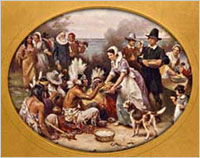
Thanksgiving 1621 (Library of Congress)

There’s also the matter of what the Pilgrims served at the feast in 1621. “No one knows if they had turkey, although they were used to eating turkey,” Shenkman says. “The only food we know they had for sure was deer.”

There’s the question, too, of Pilgrim garb. They didn’t dress in black, Shenkman writes, and “they did not wear those funny buckles, weird shoes, or black steeple hats.”

The myths of Thanksgiving, while undeniably engaging, tend to be on the innocuous side, rather of the genre of  Santa Claus and the Tooth Fairy.

They can be thought of, in a way, as permissible myths–misleading, perhaps, but quaint and mostly harmless.  They’re acceptable on a grander scale of things. (Of course, purists from time to time have campaigned against mythical characters like Santa Claus. As I discuss in my 2006 book, The Year That Defined American Journalism: 1897 and the Clash of Paradigms, efforts arose in the late 19th century to discourage children from believing in Santa Claus on grounds that it simply was “wrong to poison the minds of the young with untruths.”)

Permissible myths, like those of Thanksgiving, are welcome and amusing elements of the holiday that often comes with too many stresses and pressures.

Permissible myths, to be sure, are quite unlike media-driven myths, the subject of my latest book, Getting It Wrong. Media-driven myths are false, dubious, improbable stories about and/or by the news media that masquerade as factual. I like to think of them as the “junk food” of journalism–as tasty and appealing as pumpkin pie at Thanksgiving, but not terribly nutritious or healthy.

Media myths, I write in Getting It Wrong, “are neither trivial nor innocuous. They can and do have adverse consequences.

“Notably, they tend to distort understanding about the role and function of journalism in American society, conferring on the news media far more power and influence than they necessarily wield. Media myths often emerge from an eagerness to find influence and lasting significance in what journalists do and tend to extend credit where credit is not entirely due,” I note.

Indeed, media myths can serve to promote the notion of the central importance of the news media at decisive moments in history.

The heroic-journalist myth of Watergate is a telling example.

The heroic-journalist meme–the scandal’s dominant popular narrative–maintains that Washington Post reporters Bob Woodward and Carl Bernstein, through their dogged and fearless coverage, brought down the corrupt presidency of Richard Nixon.

As I point out in my latest book, Getting It Wrong, the work of Woodward and Bernstein was marginal to Watergate’s outcome–to the resignation of Nixon in 1974 and the jailing of some 20 of his top aides and reelection campaign officials.

Nixon’s fall, I write, “was the consequence of his criminal conduct, which was exposed in the convergence of many forces, newspaper reporting being among the least decisive.”

We can be thankful Nixon was forced from presidency because of his criminal misconduct. But it is of  little value to grant undeserved credit to the news media.

That’s hardly permissible.

WJC

Recent and related:

Palin’s new book invokes ‘bra-burning’ stereotype

In Bra-burning, Cronkite Moment, Debunking, Media myths, Watergate myth on November 24, 2010 at 8:57 am

Bra-burning,” I point out in my mythbusting book Getting It Wrong, was scarcely a common feature of feminist protests of the 1960s and 1970s, stereotypes and popular narratives notwithstanding.

The enduring and popular notion of numerous, demonstrative bra-burnings–that female protestors in those days set their bras afire and twirled them over their heads–“is fanciful and highly exaggerated,” I write.

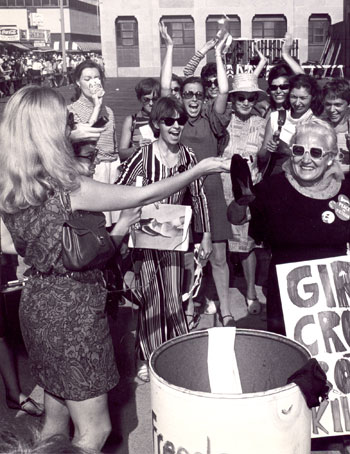
At most, women’s liberation demonstrators at Atlantic City in September 1968, briefly set bras and other items afire, an episode that may best be described as “bra-smoldering.”

At most, ‘bra-smoldering’

But there was no flamboyant bra-burning that day at Atlantic City, no fiery spectacle, no bonfire of bras. (See photo.) “Fire at most was a modest and fleeting aspect of the protest that day,” I write in Getting It Wrong.

Despite the thin evidentiary record, “bra-burning” lives on as a convenient if misleading shorthand phrase in “describing the upheaval of the 1960s and early 1970s,” as I note in Getting It Wrong. I  point out that “bra-burning” long has been “invoked as a defining phrase, or cliché, of those troubled times—as in ‘the era of bra-burning,’ ‘the hysteria of bra-burning,’ the time of ‘raucous bra burning,'” and the like.

To those misleading turns of phrase, Sarah Palin, the 2008 Republican vice presidential candidate and former governor of Alaska, adds “1960s-era bra-burning militancy.”

The phrase appears in America By Heart: Reflections on Family, Faith, and Flag, Palin’s second book, which came out yesterday.

Palin offers up “bra-burning militancy” in writing:

“Remember Hillary Clinton’s famous rant, when her husband was running for president, that she wasn’t, in her words, ‘some little woman standing by my man like Tammy Wynette’? Hillary … came across then as someone frozen in an attitude of 1960s-era bra-burning militancy. She told us in no uncertain terms that she ‘could have stayed and baked cookies and had teas’ but preferred to pursue a serious career.”

The passage has attracted some comment–for its jab at Clinton, not for its historically incorrect reference to “bra-burning militancy.”

It’s regrettable, and more than a little unfair, that a misnomer like flamboyant “bra-burning” is so casually invoked in characterizing the 1960s and 1970s.

It’s unfortunate, too: Those turbulent times are prone to mythical treatment as it is–the mythical “Cronkite Moment” of 1968 and the heroic-journalist meme of the Watergate scandal both figure in Getting It Wrong.

But there’s no denying the perverse appeal of the term. It trips off the tongue in a blithe, faintly sneering sort of way: “Bra-burning.”

Stereotyping can be a hazard of media-driven myths, and there’s also no denying that stereotype is embedded in the phrase.

“Bra burning,” I write in Getting It Wrong, “has long been an off-hand way of ridiculing feminists and mocking their sometimes-militant efforts to confront gender-based discrimination in the home and the work place. Characterizations such as ‘bra-burning feminists,’ ‘the bra-burning women’s movement,’ ‘loud-mouthed, bra-burning, men-hating feminists,’ and ‘a 1960s bra-burning feminist’ have had currency for years.”

In its passage mentioning “bra-burning,” Palin’s book casually, almost off-handedly, serves to reinforce the stereotype.

WJC

Recent and related:

“Bra burning” also has long been an off-hand way of ridiculing feminists and mocking their sometimes-militant efforts to confront gender-based discrimination in the home and the work place. Characterizations such as “bra-burning feminists,”[i] “the bra-burning women’s movement,” “loud-mouthed, bra-burning, men-hating feminists,” and “a 1960s bra-burning feminist” have had currency for years.


[i] Tony Chamberlain, “Berman’s A Women’s Movement Unto Herself with Three Official Wins,” Boston Globe (16 April 2006): C1.

Jimmy Carter fumbles Watergate history

In Debunking, Media myths, Washington Post, Watergate myth on November 23, 2010 at 6:28 am

Former President Jimmy Carter went on CNN’s Reliable Sources the other day to plug his new book and offered up the heroic-journalist myth of the Watergate scandal.

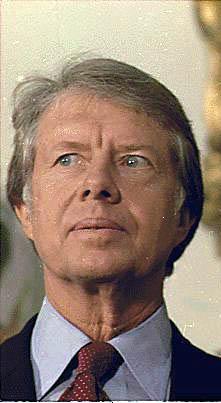
Carter (1980 photo)

The heroic-journalist meme, which has become the scandal’s dominant popular narrative, maintains Washington Post reporters Bob Woodward and Carl Bernstein, in their dogged coverage, brought down the corrupt presidency of Richard Nixon.

Carter invoked this media myth in response to a fairly pointed question from the show’s host, Howard Kurtz, about whether the former president felt “the press had it for you.”

Carter in reply referred to his term in office and said:

“I came in at a time when the press was in the post-Watergate period, and when two reporters in the Washington Post had become famous because they had revealed some secrets that had brought down the Nixon administration. And when I got there, shortly thereafter, I think a lot of the reporters were looking for something within my administration that might be scandalous or put them in the headlines as very notable investigative reporters.”

Hmm. “Brought down the Nixon administration.”

As notable as the reporting of Woodward and Bernstein may have been, it didn’t bring down the Nixon administration.

As I point out in my latest book, Getting It Wrong, the work of Woodward and Bernstein was at best marginal to Watergate’s outcome–the resignation of Nixon in 1974 and the eventual jailing of nearly 20 of his top aides and reelection campaign officials.

“To roll up a scandal of such dimension,” I note in Getting It Wrong, “required the collective if not always the coordinated forces of special prosecutors, federal judges, both houses of Congress, the Supreme Court, as well as the Justice Department and the FBI.”

Even then, I add:

“Nixon likely would have served out his term if not for the audiotape recordings he secretly made of most conversations in the Oval Office of the White House. Only when compelled by the Supreme Court did Nixon surrender those recordings, which captured him plotting the cover-up and authorizing payments of thousands of dollars in hush money.”

I further point out in Getting It Wrong that the heroic-journalist interpretation of Watergate “has become the most familiar storyline” of the scandal, because it is such an effective “proxy for grasping the scandal’s essence while avoiding its forbidding complexity.”

But to indulge in the heroic-journalist interpretation, I write, “is to abridge and misunderstand the scandal and to indulge in a particularly beguiling media-driven myth.

“The heroic-journalist interpretation minimizes the far more decisive forces that unraveled the scandal and forced Nixon from office.”

As Carter’s comment suggests, though, the heroic-journalist trope offers an accessible and simplistic explanation for a sprawling scandal that unfolded many years ago.

It’s interesting to note that Woodward and Bernstein’s reporting–for which they won the Pulitzer Prize for public service in 1973–never disclosed the key “secrets” of the scandal.

They did not disclose the hush-money payments made in an attempt to cover up the seminal crime of Watergate, the break-in at Democratic party offices in June 1972. Nor did they disclose the existence of the taping system that Nixon had installed to record most of his conversations in the Oval Office.

So it’s really not clear what Carter had in mind in asserting that the Post reporters “revealed some secrets that … brought down the Nixon administration.”

Interestingly, Kurtz did not challenge Carter on that point. Kurtz formerly was the media writer for the Post who, in 2005, pointedly disputed the heroic-journalism myth of Watergate.

He wrote in a column for the Post:

“Despite the mythology, The Post didn’t force Richard Nixon from office—there were also two special prosecutors, a determined judge, bipartisan House and Senate committees, the belated honesty of [White House counsel] John Dean and those infamous White House tapes.”

That’s a fine summary of the forces that truly did bring down Nixon’s presidency.

WJC

‘Mired in stalemate’? How unoriginal of Cronkite

In Cronkite Moment, Debunking, Media myths, New York Times on November 22, 2010 at 12:57 pm

So unoriginal.

Hardly exceptional.

Those are ways to characterize Walter Cronkite’s famous assessment–offered in a special televised report in February 1968–that the U.S. war effort in Vietnam was “mired in stalemate.”

Cronkite’s characterization supposedly represented a moment of such stunning clarity and insight that it forced President Lyndon Johnson to realize his war policy was a shambles.

“If I’ve lost Cronkite,” Johnson supposedly said to an aide or aides after seeing the special report, “I’ve lost Middle America.”

Or words to that effect.

And a month later, Johnson announced he was not running for election–a decision often linked, if erroneously, to Cronkite’s “mired in stalemate” analysis about Vietnam.

I dispute the power and impact of the so-called “Cronkite Moment” in my latest book, Getting It Wrong, which addresses and debunks 10 prominent media-driven myths. I point out that Johnson didn’t even see the Cronkite program when it aired on CBS on February 27, 1968.

I further note in Getting It Wrong that “stalemate” had been invoked  months before the “Cronkite Moment” to describe the war in Vietnam. Notably, the New York Times published a front-page analysis on August 7, 1967, that declared “the war is not going well. Victory is not close at hand.”

The Times report was published on its front page beneath the headline:

Vietnam: The Signs of Stalemate.

And that wasn’t only occasion in 1967 and early 1968 when the Times turned to “stalemate” to characterize the war.

A review of database articles reveals that “stalemate” was raised not infrequently, and that the Johnson administration disputed the characterization.

And all this was months before the supposed insight offered by Cronkite.

For example, in a news analysis published July 4, 1967, the Times said of the war effort:

“Many officers believe that despite the commitment of 466,000 United States troops now in South Vietnam … the military situation there has developed into a virtual stalemate.”

The Times report of August 7, 1967, which was filed from Saigon, elaborated on that view and included this observation:

“‘Stalemate’ is a fighting word in Washington. President Johnson rejects it as a description of the situation in Vietnam. But it is the word used by almost all Americans here, except the top officials, to characterize what is happening. They use the word for many reasons ….”

Johnson was confronted with that “fighting word” during a news conference August 18, 1967. He was asked whether “we have reached a stalemate in the Vietnam war.”

The president gave a rambling answer, but ended up rejecting the characterization of stalemate as “nothing more than propaganda.”

Johnson also said, apparently in reference to the communist North Vietnamese and their Viet Cong allies: “I think that our–there are those who are taking a pretty tough drubbing out there that would like for our folks to believe there’s a stalemate.”

Moreover, four months before Cronkite’s report, the Times said in an editorial that the Johnson administration should embrace stalemate in Vietnam as a way of enabling peace talks and a negotiated settlement of the war.

The logic was intriguing if not entirely persuasive. Here’s what the Times said in that editorial, published October 29, 1967:

“Instead of denying a stalemate in Vietnam, Washington should be boasting that it has imposed a stalemate, for that is the prerequisite–on both sides–to a negotiated settlement. That settlement, if it is to be achieved, will have to be pursued with the same ingenuity and determination that have been applied to fighting the war.”

Three months later, the Times anticipated Cronkite’s “mired in stalemate” commentary, stating in an editorial published February 8, 1968:

“Politically as well as militarily, stalemate increasingly appears as the unavoidable outcome of the Vietnam struggle.”

Cronkite said in wrapping up his special report on February 27, 1968:

“To say that we are mired in stalemate seems the only realistic, yet unsatisfactory, conclusion.”

So why does all this matter? Why is it important to trace the use of “stalemate” to describe a long-ago war?

Doing so demonstrates how unexceptional Cronkite’s commentary was. And how middling it was, too. It’s scarcely the stuff of dramatic insight, scarcely the sort of comments that would have decisive effect.

Tracing the use of “stalemate” also serves to underscore the inconsequential nature of the purported “Cronkite Moment, which nonetheless remains among the hardiest myths of American journalism.

WJC

Recent and related:

Newsman tells ‘a simple truth,’ changes history: Sure, he did

In Cronkite Moment, Debunking, Media myths on November 21, 2010 at 2:42 pm

Media-driven myths, I write in my latest book, Getting It Wrong,  “tend to minimize or negate complexity in historical events and offer simplistic and misleading interpretations instead.”

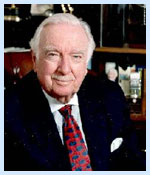
Cronkite

So it is with the mythical “Cronkite Moment,” one of the most tenacious myths of American journalism.

An important reason for the myth’s hardiness is that it presents a simplified version of a supposed turning point in the long political career of President Lyndon Johnson.

The “Cronkite Moment” has it that CBS News anchorman Walter Cronkite told truth to power in reporting that the U.S. military was “mired in stalemate” in Vietnam.

Supposedly, Johnson watched Cronkite’s special report on Vietnam, which aired February 27, 1968. Upon hearing the anchorman’s “mired in stalemate” assessment, the president switched off the television set and told an aide or aides:

“If I’ve lost Cronkite, I’ve lost Middle America.”

Or something to that effect.

A blogger at CapeCodToday.com recounted the familiar and delicious tale of the “Cronkite Moment” yesterday, writing:

“President Lyndon Johnson is reported to have said … after hearing Cronkite’s report, ‘If I’ve lost Cronkite, I’ve lost middle America.’ Not long after that, LBJ stepped down from office, refusing to run for a second term.

“A news person had told a simple truth, and it had helped change history.”

Of course Cronkite’s report on Vietnam had no such effect on history.

There is quite simply no link between the “Cronkite Moment” and Johnson’s decision–announced at the end of March 1968–not to stand for reelection that year.

None.

LBJ at moment of 'Cronkite Moment': Telling a joke

For starters, Johnson did not see the Cronkite report when it aired.

As I note in Getting It Wrong, the president at the time was in Austin, Texas, attending the 51st birthday party of Governor John Connally, a longtime political ally.

At about the moment Cronkite was intoning his “mired in stalemate” interpretation, Johnson was offering light-hearted banter about Connally’s age, saying:

“Today you are 51, John. That is the magic number that every man of politics prays for—a simple majority.”

So at the time of the purported “Cronkite Moment,” Johnson wasn’t agonizing about having lost Cronkite’s support; he wasn’t overcome with angst about the war effort in Vietnam.

Johnson was telling a joke.

And it’s hard to argue that the president could have been much moved by a television report that he didn’t see.

Not only that, but Johnson may have decided in 1967 or even earlier not to stand for reelection in 1968. He wrote in his memoir, The Vantage Point: “Long before I settled on the proper forum to make my announcement, I had told a number of people of my intention not to run again.”

Given those factors, Cronkite’s show at the end of February 1968 recedes into trivial insignificance as a reason for Johnson’s decision–announced a month later–not to stand for reelection.

It certainly is an appealing notion that a newsman such as Cronkite could tell “a simple truth” and, by doing so, help change history.

But such a notion is more often the recipe for a media-driven myth than it is the foundation of historical accuracy.

WJC

Recent and related:

‘When I lost Cronkite’–or ‘something to that effect’

In Cronkite Moment, Debunking, Media myths, Reviews on November 20, 2010 at 9:46 am

I discuss in my mythbusting book Getting It Wrong how accounts vary widely as to what President Lyndon Johnson purportedly said in reacting to Walter Cronkite’s on-air commentary in 1968 that the U.S. military effort in Vietnam was “mired in stalemate.”

Acute version variability has taken hold over the years and, as suggested by a theatrical review in yesterday’s Washington Times, fresh versions as to what Johnson said keep popping up.

Many published accounts have said Johnson’s reaction was: “If I’ve lost Cronkite, I’ve lost the country.”

Other accounts quote the president as saying: “If I’ve lost Cronkite, I’ve lost the American people.”

Or: “If I’ve lost Cronkite, I’ve lost the war.”

Or: “If we lose Cronkite, we lose America.”

The most common published version probably is: “If I lost Cronkite, I’ve lost Middle America.” It’s the version Cronkite included in his 1997 memoir, A Reporter’s Life.

In any case, version variability of such magnitude, I write in Getting It Wrong, signals more than laziness and reluctance to trace the derivation of a popular anecdote. The shifting versions of what Johnson supposedly said are an indicator the Cronkite-Johnson anecdote is bogus, a marker of a media-driven myth.

After all, the remarks and utterances of the president of the United States are among the most carefully chronicled. The many inconsistent accounts of Johnson’s remarks are akin to the effects of a tall tale that changes with frequent retelling.

The latest version of Johnson purported response appeared in the Washington Times review of a comedy titled Walter Cronkite Is Dead, which recently opened at the Signature Theatre in Arlington, Virginia, in suburban Washington, D.C.

The play isn’t much about Cronkite, the former CBS News anchorman who died 16 months ago. But the reviewer carries on about Cronkite at some length, and indulges in media myth in writing:

“Walter was regarded as the Gospel when it came to reporting the Vietnam War and his reports were instrumental in turning around the nation’s support for that war.

“Lyndon Johnson was reputed to have said of his own prospects, ‘When I lost Cronkite, I lost the election,’ or something to that effect. Not long after his observation, the beleaguered president dropped out of the 1968 electoral contest.”

Let’s consider the passages in bold: Both are dubious claims.

First, the notion that Cronkite’s views on the war in Vietnam “were instrumental” in altering public opinion.

As I discuss in Getting It Wrong, American public opinion had begun shifting against the war months before Cronkite offered his “mired in stalemate” assessment in special report that aired February 27, 1968.

By October 1967, 47 percent of Americans, a plurality, maintained that U.S. military presence in Vietnam was a mistake, according to Gallup surveys.

In a Gallup poll completed in early February 1968, three weeks before the Cronkite special report, the proportion saying the war was a mistake stood at 46 percent. Forty-two percent said it had not been a mistake.

As for the purported Johnson comment, “When I lost Cronkite, I lost the election”–it’s assuredly bogus. Johnson had stood in no election at the time of Cronkite’s commentary. The Democratic primary election in New Hampshire was a couple of weeks away, and Johnson would win as a write-in candidate.

More important, Johnson did not see the Cronkite program when it aired.

The president at the time was in Austin, Texas, attending the 51st birthday party of Governor John Connally, a longtime political ally.

Quite simply, Johnson could not have had “the abrupt yet resigned reaction that so often has been attributed to him,” as I write in Getting It Wrong. It’s illogical to argue he was much moved by a television report he hadn’t seen.

There is, moreover, no evidence Johnson later watched the Cronkite program on videotape.

And as I note in Getting It Wrong:

“The power of the ‘Cronkite moment’ resides in the sudden, unexpected, and decisive effect it supposedly had on the president. Such an effect would have been absent, or greatly diminished, had Johnson had seen the program on videotape at some later date.”

WJC

Recent and related: