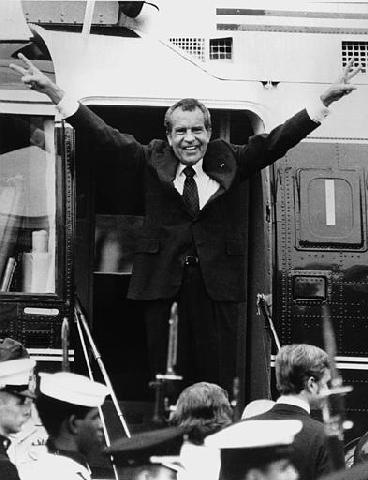
Nixon after his resignation, 1974
The Washington Post has tried from time to time over the years to distance itself from the media myth that its coverage of the Watergate scandal brought down Richard Nixon’s corrupt presidency.
The newspaper’s publisher at the time of Watergate, Katharine Graham, said at a program at the Newseum in 1997:
“Sometimes people accuse us of bringing down a president, which of course we didn’t do. The processes that caused [Nixon’s] resignation were constitutional.”
Michael Getler, then the newspaper’s ombudsman, wrote in a column in 2005:
“Ultimately, it was not The Post, but the FBI, a Congress acting in bipartisan fashion and the courts that brought down the Nixon administration. They saw Watergate and the attempt to cover it up as a vast abuse of power and attempted corruption of U.S. institutions.”
Still, the media myth that it was the Post — and, specifically, reporters Bob Woodward and Carl Bernstein — who exposed Nixon’s corrupt ways can be too tempting and too perfect to resist.
Such was the case in today’s edition of the Post, in a commentary by Dana Milbank, who declared that “in the mid-1970s,” the Post “took down a president.”
It was a passing reference in a commentary that challenged the dire assessment about the Post published in latest issue of New Republic.
Still, the “took down a president” passage hints at latent hubris and suggests how the Watergate meme can be used as a not-so-subtle reminder of greatness by Post loyalists and insiders.
But as I write in my forthcoming book, Getting It Wrong, to argue that the Post took down Nixon is to “misunderstand the scandal and to indulge in a particularly beguiling media-driven myth.”
It is, I further write, a misleading interpretation that “minimizes the far more decisive forces that unraveled the scandal and forced Nixon from office.”
What I call the “heroic-journalist myth of Watergate” took hold for a number of reasons, among them the sheer complexity of the scandal. Not only was Nixon turned from office but 19 men associated with his presidency or his 1972 reelection campaign went to jail.
The “heoric-journalist” myth has become, I also write in Getting It Wrong, “a proxy for grasping the scandal’s essence while avoiding its forbidding complexity.” That the Post and its reporters supposedly uncovered Watergate “is deeply ingrained in American journalism as one of the field’s most important and self-reverential stories.”
Despite, that is, the periodic protestations from the Post.


 Media Myth Alert