W. Joseph Campbell

Archive for the ‘Watergate myth’ Category

15 movies about journalists: At least 3 boosted myths

In Cinematic treatments, Debunking, Media myths, Murrow-McCarthy myth, Washington Post, Watergate myth on April 8, 2010 at 7:47 pm

It was the day of the journalist (“Dia do Jornalista”) in Brazil yesterday and to help mark the occasion, the RevistaMonet blog posted a lineup, with brief descriptions, of 15 movies about the work of journalists.

They included classics such as The Front Page and His Girl Friday, as well as surprises such as How to Lose a Guy in 10 Days and Superman Returns.

All 15 were English-language films. At least three of them have contributed to, or helped solidify, media-driven myths.

The three myth-builders: All the President’s Men; Good Night, and Good Luck, and my favorite, Citizen Kane.

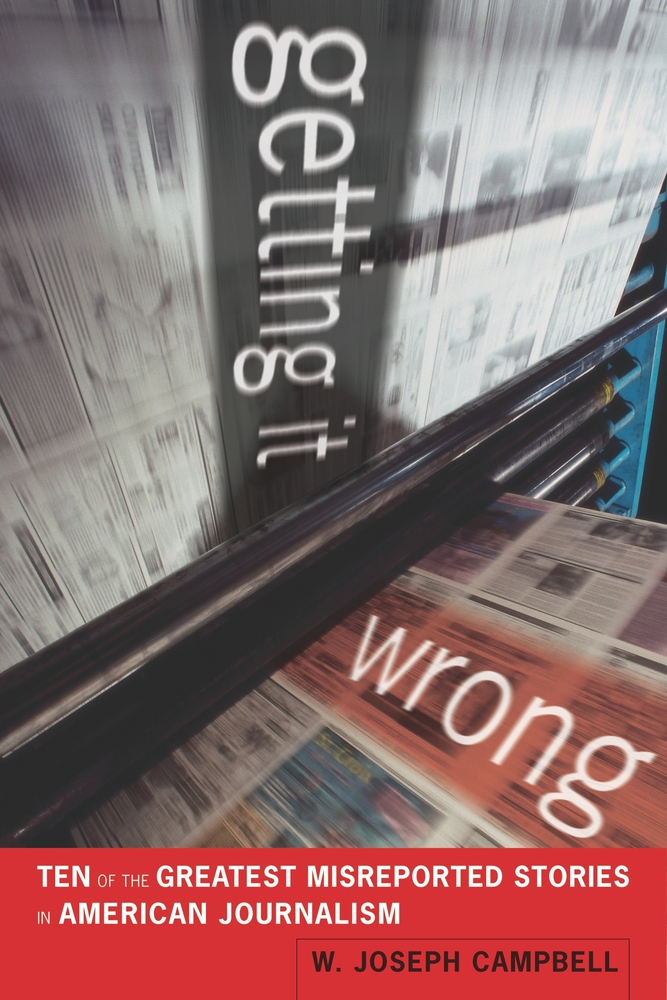
Cinema’s role in solidifying media-driven myths is discussed in Getting It Wrong, my next book, which will be out in the summer.

“Cinematic treatments,” I write, “influence how historical events are collectively remembered and can harden media-driven myths against debunking.”

That certainly was so with All the President’s Men, the 1976 screen adaptation of Carl Bernstein and Bob Woodward’s book by the same title.

The film characterized Bernstein and Woodward, both of the Washington Post, as central and essential to unraveling the Watergate scandal that toppled President Richard Nixon.

The upshot, I write in  Getting It Wrong, has been “to solidify and elevate the heroic-journalist myth” of Watergate and sustain it in the collective memory.

Indeed, it’s hard to think of Watergate without thinking of All the President’s Men.

Similarly, the 2005 motion picture Good Night, and Good Luck served to popularize and extend the media myth that broadcasting legend Edward R. Murrow exposed and abruptly ended the communists-in-government witch-hunt of Senator Joseph R. McCarthy.

Good Night, and Good Luck was a dramatic retelling of Murrow’s See It Now program on McCarthy, which aired on CBS on March 9, 1954, and often is credited with exposing McCarthy’s crude investigative tactics and bullying ways.

McCarthy in 1954

But as I point out in Getting It Wrong, Murrow’s program on McCarthy came very late–years after other journalists had confronted and challenged the red-baiting senator. By 1954, it wasn’t as if American audiences were waiting for a white knight like Murrow to tell them of the toxic threat McCarthy posed.

They already knew. And in the months immediately before Murrow’s program, the senator’s favorability ratings had begun to fall.

While it never explicitly said as much, Good Night, and Good Luck left the inescapable but erroneous impression that Murrow had courageously and single-handedly challenged and stopped McCarthy.

Citizen Kane, which was released in 1941, arguably is the finest motion picture ever made about journalism: It may have been the best movie, ever.

It certainly was Orson Welles’ towering and most memorable cinematic achievement. Kane was vaguely based on the life and times of media mogul William Randolph Hearst.

Kane‘s contribution to media mythmaking came in a scene that paraphrased Hearst’s purported vow to “furnish the war” with Spain at the end of the 19th century.

As I note in Getting It Wrong,  the Hearstian vow lives on despite a nearly complete absence of supporting documentation. It lives on even though the telegram that supposedly contained Hearst’s message has never turned up. It lives on even though Hearst denied ever making such a statement.

Like many media-driven myths, the story of Hearst’s purported vow is almost too good not to be true.

And given cinematic treatment, it may be impossible ever to inter.
WJC

Remembering big: Another April anniversary

In Anniversaries, Debunking, Jessica Lynch, Media myths, Washington Post, Watergate myth on April 4, 2010 at 5:56 pm

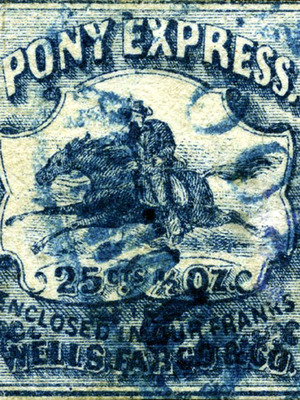
April 3 not only was the seventh anniversary of the Washington Post‘s botched report about the mythical battlefield heroics of Jessica Lynch. The date also marked the 150th anniversary of the first run of the legendary Pony Express–a short-lived institution that is impressively steeped in myth.

As Christopher Corbett wrote in an engaging commentary published Friday in the Wall Street Journal:

“We remember the Pony Express as one of the most enduring and endearing of American stories, a tale of the frontier, a story of bold entrepreneurs, daring young horsemen, true riders of the purple sage and all that.

“In truth, the venture hemorrhaged money from day one, was doomed by technology (another particularly American story), lasted a mere 78 weeks, ruined its backers and then disappeared into what historian Bernard DeVoto called ‘the border land of fable.'”

Corbett noted: “It was all over in 18 months. The service was shut down in the flash of a telegrapher’s key when the transcontinental telegraph was completed in October 1861.”

But for years afterward, “the West was aswarm with old men who claimed to be ‘the last of the Pony Express riders,'” Corbett wrote.

The tall tales and exaggerations that grew up around the Pony Express were in large part promoted by the cinema and the entertainment industry–factors akin to those that contribute to the rise and tenacity of media-driven myths, which are stories about and/or by the news media that are widely believed and often retold but which, on close inspection, prove to be apocryphal or wildly exaggerated.

The filmmaker John Ford incorporated the Pony Express into the 1948 Western, Fort Apache, where, Corbett noted, “the brave rider thunders into the fort to bring news of Custer’s Last Stand, which, alas, took place some 15 years after the Pony stopped running.”

It’s faintly reminiscent of the classic cinematic treatment of the Watergate scandal: Easily the best-known Watergate movie is All the President’s Men, a screen adaptation of the best-selling book by the same title.

The cinematic version of All the President‘s characterized the book’s authors, Carl Bernstein and Bob Woodward of the Washington Post, as central and essential to the scandal’s unraveling.

The upshot of that misrepresentation, I write in  Getting It Wrong, my forthcoming book about media-driven myths, has been “to solidify and elevate the heroic-journalist myth” of Watergate, to give it dramatic power, and sustain it in the collective memory.

I further note in Getting It Wrong that the film offers an unmistakable and unambiguous statement about “the power and centrality of the press in Nixon’s fall. All the President’s Men allows no other interpretation: It was the work Woodward and Bernstein that set in motion far-reaching effects that brought about the first-ever resignation of a U.S. president,” Richard Nixon.

What’s more, the heroic-journalist interpretation of Watergate minimizes or ignores the more decisive contributions in Nixon’s fall by agencies and organizations besides the Washington Post.

In his fine commentary, Corbett noted “the person who immortalized the Pony was William Frederick Cody, or Buffalo Bill. (He also claimed he had been a rider. Not true.)

“The [Pony Express] fast-mail service may have lasted only a year and a half, but it thrived for four decades in Cody’s Wild West show, seen by millions in the U.S. and Europe. To add drama to his re-enactment, Buffalo Bill might throw in a war party of savage Indians chasing a heroic rider who always managed to escape.

“It would become one of the most enduring images of the Pony Express, but it was not true; the actual riders rarely tangled with Indians,” Corbett wrote, adding:

“Why would a Paiute want a two-week-old copy of Horace Greeley’s New York Tribune?”

Corbett noted in closing:

“If the Pony Express continues to thrill and baffle us, consider the words of an old horseman in western Nebraska who advised me when I expressed some concerns about the pedigree of this yarn. ‘We don’t lie out here,’ he explained kindly. ‘We just remember big.'”

“Remember big.” A great line. And it’s certainly applicable in understanding why media-driven myths can be so tenacious and enduring.

WJC

Embedded myths of journalism history

In Cronkite Moment, Debunking, Media myths, Washington Post, Watergate myth on March 15, 2010 at 11:44 am

Popular media myths were in circulation over the weekend at the conference of journalism historians—signaling anew how embedded myths are in American media history and how difficult they can be to uproot.

One presentation at the conference in New York City discussed Walter Cronkite’s standing in collective American memory and in media history. The presentation inevitably invoked the notion that the Cronkite’s on-air commentary in 1968 dissuaded Lyndon Johnson from seeking reelection to the presidency.

Supposedly, Johnson watched Cronkite’s special report on CBS about Vietnam. Cronkite ended the program with by saying the U.S. war effort was “mired in stalemate” and that negotiations eventually might be considered as a way out of the conflict.

Upon hearing Cronkite’s downbeat editorial assessment, Johnson switched off the television and turned to an aide or aides, muttering something to the effect of:

“If I’ve lost Cronkite, I’ve lost Middle America.”

The program’s effect supposedly was so singularly powerful that it also turned public opinion against the war and came to be called the “Cronkite Moment.”

As I’ve noted several times at MediaMythAlert, and as I write in Getting It Wrong, my  forthcoming book about media-driven myths, Johnson did not watch Cronkite’s special report about Vietnam when it aired February 27, 1968.

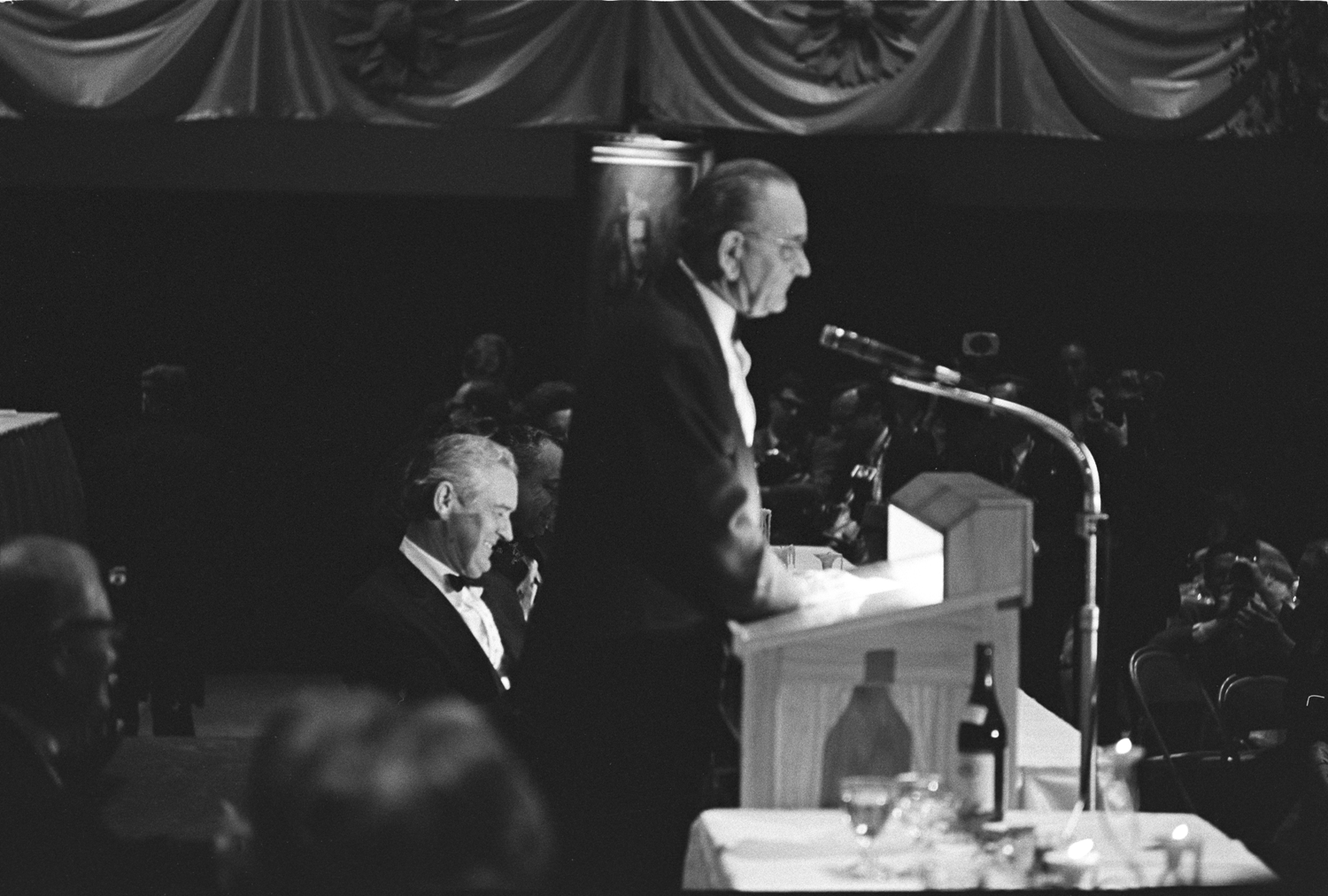
Johnson in Texas, February 27, 1968

Johnson at the time was not in front of a television set but on the campus of the University of Texas at Austin, at a party marking the 51st birthday of one of his political allies, Governor John Connally.

Nor is there evidence that Johnson later saw the Cronkite program on videotape.

Not only that, but as I discuss in Getting It Wrong, there is scant evidence to suggest that the “Cronkite Moment” had much influence at all on public opinion about the war.

Indeed, polling data “clearly show that American sentiment had begun shifting months before the Cronkite program,” I write in the book, which will be out this summer.

Also heard during conference presentations was what I call the heroic-journalist myth of Watergate–the notion that the reporting of two young reporters for the Washington Post brought down Richard Nixon’s corrupt presidency.

This is a trope that even Post officials have dismissed over the years.

In 2005, for example, the newspaper’s then-ombudsman, Michael Getler, wrote:

“Ultimately, it was not The Post, but the FBI, a Congress acting in bipartisan fashion and the courts that brought down the Nixon administration. They saw Watergate and the attempt to cover it up as a vast abuse of power and attempted corruption of U.S. institutions.”

The heroic-journalist myth is addressed, and debunked, in Getting It Wrong, which says that interpreting Watergate “through the lens of the heroic-journalist is to abridge and misunderstand the scandal and to indulge in a particularly beguiling media-driven myth.”

The conference in New York was Saturday, and was sponsored by the History Division of AEJMC and the American Journalism Historians Association. AEJMC is the acronym for the Association for Education in Journalism and Mass Communication.

WJC

If not for the Post’s digging …

In Debunking, Media myths, Washington Post, Watergate myth on March 7, 2010 at 1:26 pm

Then the Watergate scandal might never have come to light.

Right.

That, in any case, is a variation on the heroic-journalist meme of Watergate, which holds that the work of Bob Woodward and Carl Bernstein, two young reporters for the Washington Post, brought down Richard Nixon and his corrupt presidency.

It’s a claim too sweeping for many to embrace. As I write in my forthcoming book, Getting It Wrong, the heroic-journalist interpretation of Watergate is a media-driven myth–one that even officials at the Post tend to dismiss.

The variation on the heroic-journalist meme holds that the Post‘s persistent reporting during the summer and early fall of 1972–in the early weeks and months of the scandal–helped keep Watergate from fading completely from public view.

The variation theme was invoked yesterday in a column in the New Britain Herald in Connecticut.

The writer says about Watergate and Nixon’s eventual resignation:

“Sure, a federal judge and the members of Congress had something to do with it — Lowell Weicker made his name nationally at the [Senate] Watergate hearings. But without Woodward and Bernstein digging and writing in the Washington Post, it could all have been pushed under the rug.”

Alas, the writer offers no evidence for his speculative conclusion.

Even so, it’s not an uncommon interpretation.

Howard Simons, the Post‘s managing editor during the Watergate period, once said:

“For months we were out there alone on this story. What scared me was that the normal herd instincts of Washington journalism didn’t seem to be operating. … It was months of loneliness.”

Such characterizations are not entirely accurate, however. As I write in Getting It Wrong:

“The Post may well have led other newspapers on the Watergate story—principally was because Watergate at first was a local story, based in Washington, D.C. But rival news organizations such as Los Angeles Times and New York Times did not ignore Watergate as the scandal slowly took dimension during the summer and fall of 1972,” while Nixon’s reelection campaign gathered momentum.

In his classic essay on journalism and Watergate, Edward Jay Epstein noted that the Post and other newspapers were joined during the summer of 1972 by the General Accounting Office, the investigative arm of Congress, and Common Cause, a foundation that seeks accountability in government office, in calling attention to the scandal.

Nixon’s Democratic challenger for the presidency, George McGovern, often invoked Watergate in campaign appearances during the summer and fall of 1972. At one point, McGovern charged that Nixon was “at least indirectly responsible” for the Watergate scandal, which stemmed from a break-in at the headquarters of the Democratic National Committee.

McGovern also termed the break-in “the kind of thing you expect under a person like Hitler.”

So in its reporting on the emergent scandal, the Post in fact was one of several institutions seeking to delineate the reach and contours of Watergate.

Woodward and Bernstein were very much not alone in their digging. And the number of entities and institutions that were digging, even in the early days of the scandal, guaranteed that Watergate could not be “pushed under the rug.”

WJC

<!–[if !mso]> Edward Jay Epstein noted in his classic essay disputing the heroic-journalist myth of Watergate that the Post and other newspapers were joined during the summer of 1972 by the General Accounting Office, the investigative arm of Congress,[i] and Common Cause, a foundation that seeks accountability in government office, in calling attention to the scandal. Within a few days of the Watergate break-in, moreover, the Democratic National Committee filed a civil lawsuit against the Committee for the Reelection of the President, which ultimately compelled statements under oath. And Nixon’s Democratic challenger for the presidency, George McGovern, repeatedly invoked Watergate in his campaign appearances in the summer and fall of 1972. At one point, McGovern charged that Nixon was “at least indirectly responsible” for the Watergate burglary. McGovern also termed the break-in “the kind of thing you expect under a person like Hitler.”[ii] In its reporting on the emergent scandal in the summer and fall of 1972, the Post in fact was one of several institutions seeking to delineate the reach and contours of Watergate.[iii] The Post, that is, was very much not alone.


[i] See Bernard Gwertzman, “G.A.O. Report Asks Justice Inquiry Into G.O.P. Funds,” New York Times (27 August 1972): 1.

[ii] See James M. Naughton, “McGovern Bars Briefings By Kissinger as Unhelpful,” New York Times (16 August 1972): 1, 20.

[iii] Edward Jay Epstein, Between Fact and Fiction: The Problem of Journalism (New York: VintageBooks, 1975), 26. See also, Martin Schram, “Watergate in media legend,” Journal of Commerce (19 June 1997): 6A. Schram wrote: “Even in the early days [of the Watergate scandal], the Post was not always the Lone Ranger we now remember.

Yet again: Watergate and the Washington Post

In Debunking, Media myths, Newspapers, Washington Post, Watergate myth on March 4, 2010 at 7:00 am

Bob Woodward, he of the Washington Post and Watergate fame, is to give a talk today in Hartford, Connectict about “evolution of the media, politics, health care and the economy,” according to the city’s newspaper, the Courant.

In an article about the visit, the Courant (where I once worked) indulged in one of American journalism’s most persistent and delicious myths, declaring that Woodward’s “reporting of the Watergate scandal brought down a president and reshaped the journalism industry.”

Of course, the Courant article–which is mostly a Q-and-A with Woodward–leaves it at that. It never explains how the Post‘s reporting on Watergate accomplished either feat–bringing down Richard Nixon’s corrupt presidency let alone reshaping the journalism industry.

As I write in Getting It Wrong, my forthcoming book about media-driven myths, the Post‘s reporting on Watergate had only a marginal effect on the outcome of the Watergate scandal.

Indeed, Nixon likely would have completed his term if not for the secret recordings of many of his conversations in the Oval Office, conversations that captured his guilty role in authorizing a coverup of the Watergate scandal.

It was the Senate Select Committee on Watergate–not Woodward and his reporting partner Carl Bernstein–that uncovered and disclosed the existence of the White House tapes, the evidence most crucial in the scandal.

The special federal prosecutors on Watergate (one of whom Nixon ordered fired) pressed for the release of the tapes. And the U.S. Supreme Court unanimously ordered Nixon to turn over the recordings subpoenaed by the special prosecutor.

When Nixon complied, his presidency was all but over.

He resigned August 9, 1974.

As Stanley I. Kutler, a leading historian of Watergate, has written:

“The fact is, an incredible array of powerful actors all converged on Nixon at once—the FBI, prosecutors, congressional investigators, the judicial system.”

Amid this tableau of subpoena-wielding authorities, the contributions of Woodward and Bernstein were modest, and certainly not decisive, I write in Getting It Wrong, adding:

“Principals at the Post have acknowledged as much. Katharine Graham, the newspaper’s doughty publisher [during the Watergate period], often insisted the Post did not topple Nixon.

“‘Sometimes people accuse us of bringing down a president, which of course we didn’t do,’ Graham said in 1997, at a program marking the scandal’s twenty-fifth anniversary.

“’The processes that caused [Nixon’s] resignation were constitutional,’” she said.

Indeed.

WJC

Blithely invoking the Murrow-McCarthy myth

In Debunking, Media myths, Murrow-McCarthy myth, Watergate myth on March 3, 2010 at 11:15 am

It’s fairly remarkable how blithely and routinely media myths can be invoked.

A reminder of that appeared in a column posted today in the Times-News, a newspaper in Twin Falls, Idaho. The column, which ruminated about the use of middle initials, opened this way:

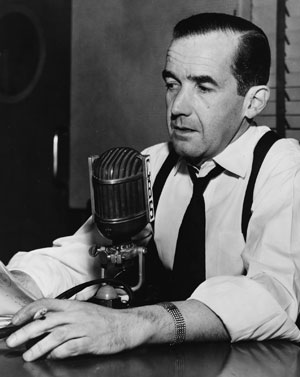
Murrow in 1954 (Library of Congress)

“When I was a young journalist, the most revered person in my profession was Edward R. Murrow, the CBS News reporter who brought down Sen. Joseph McCarthy.”

Brought down McCarthy.

It’s a story as famous and revered in American journalism as the notion that intrepid young reporters for the Washington Post brought down the corrupt presidency of Richard Nixon.

Both tales are exaggerated.

And both are media-driven myths that are examined in my forthcoming book, Getting It Wrong.

Murrow was a leading and ultimately a legendary figure in American broadcasting who in the 1950s  stood up to McCarthy, the Red-baiting junior senator from Wisconsin, when, supposedly, no one else would, or dared. In so doing, the story goes, Murrow brought an abrupt end to senator’s witchhunt for communists in the U.S. government.

The vehicle for Murrow’s brave exposé was his 30-minute television program, See It Now, which aired on CBS.

As I write in Getting It Wrong:

“Long before the See It Now program, several prominent journalists—including the Washington-based syndicated columnist Drew Pearson—had become persistent and searching critics of McCarthy, his record, and his tactics.”

Pearson, who wrote the widely published “Washington Merry-Go-Round” column, was the most assertive and, ultimately, acerbic of McCarthy’s media critics. He challenged McCarthy’s claims as early as 1950, soon after the senator began charging that communists had infiltrated the U.S. State Department.

McCarthy became so angered by Pearson’s searching columns that he threatened the columnist with physical harm–and followed through in December 1950 in the cloakroom of the exclusive Sulgrave Club on DuPont Circle in Washington. There, he slapped or tried to knee Pearson in the groin.

All that came long before Murrow confronted McCarthy on See It Now in 1954.

By 1954, I note in Getting It Wrong, “it wasn’t as if Americans … were hoping for someone to step up and expose McCarthy, or waiting for a white knight like Murrow to tell them about the toxic threat the senator posed.”

Pearson and others had been doing so for years.

WJC

Shoe leather, Watergate, and All the President’s Men

In Cinematic treatments, Debunking, Media myths, Washington Post, Watergate myth on February 28, 2010 at 2:36 pm

The heroic-journalist tale of Watergate–that two intrepid young reporters for the Washington Post brought down Richard Nixon’s corrupt presidency–is one of the most appealing and self-reverential stories in American media history.

It’s also a media-driven myth, one of 10 addressed in my forthcoming book, Getting It Wrong.

As I note in Getting It Wrong, an important factor for the tenacity of the heroic-journalist myth lies in its cinematic treatment. The media-centric storyline of Watergate was cemented by the film All the President’s Men, which came out to much acclaim in April 1976, 20 months after Nixon’s resignation.

An item posted the other day at the Politics Daily site fondly recalled All the President’s Men, saying the movie “about a bygone era” harkens to the “glory days of newspapers.”

The writer also indulged in the heroic-journalist myth, saying that the Post reporters “who brought down a sitting president” did so “with nothing more than shoe leather, determination, guts and a passion for the truth.”

It’s a wonderful story of journalists triumphant. But it’s exaggerated.

Even writers and officials at the Post have tried over the years to make clear that the newspaper and its reporters did not bring down Richard Nixon.

Howard Kurtz, the newspaper’s media writer, wrote in 2005, for example:

“Despite the mythology, The Post didn’t force Richard Nixon from office—there were also two special prosecutors, a determined judge, bipartisan House and Senate committees, the belated honesty of [former White House lawyer] John Dean and those infamous White House tapes.”

As I note in Getting It Wrong, “Nixon likely would have served out his term if not for the audiotape recordings he secretly made of most conversations in the Oval Office of the White House.

“Only when compelled by the Supreme Court [in 1974] did Nixon surrender those recordings, which captured him plotting the cover-up and authorizing payments of thousands of dollars in hush money.”

He resigned the presidency about two weeks later.

The cinematic version of All the President’s Men, however, placed Post reporters Bob Woodward and Carl Bernstein at the center of the unraveling of Watergate, while downplaying or dismissing the efforts of investigative agencies such as the FBI.

“The effect,” I write, “was to solidify and elevate the heroic-journalist myth, giving it dramatic power, and sustaining it in the collective memory.”

The movie helped make the heroic-journalist interpretation of Watergate vivid, memorable, accessible, and central.

After all, no other Watergate-related movie has retained such an appeal, or has likely been seen by as many people as All the President’s Men.

WJC

Haig, Deep Throat, and the Watergate myth

In Debunking, Media myths, Washington Post, Watergate myth on February 23, 2010 at 12:03 am

The recent death of Alexander M. Haig, the combative general who became U.S. secretary of state in the early 1980s, brought reminders about how Haig had figured improbably in the years-long guessing game about the identity of “Deep Throat.”

Deep Throat was the well-placed, anonymous source to whom the Washington Post periodically turned in reporting the Watergate scandal that toppled Richard Nixon’s presidency. Haig was chief of staff in the Nixon White House as the Watergate scandal intensified and reached its culmination in 1973-74.

Haig was not implicated in the scandal and has been credited with helping to navigate Nixon’s resignation after it became clear the president had conspired to obstruct justice.

And Haig’s name surfaced periodically in the guessing game about Deep Throat’s identity, which began soon after publication in 1974 of All the President’s Men, Carl Bernstein and Bob Woodward’s book about their reporting on Watergate.

The identity of Deep Throat was the subject of a “parlor game that would not die,” as the Philadelphia Inquirer once put it. The prolonged guessing game, I write in my forthcoming book, Getting It Wrong, helped promote the notion that the Post and its reporting were central to unraveling the Watergate scandal.

That is, the speculation about Deep Throat’s identity “provided periodic and powerful reminders about the Post and its Watergate coverage,” I write, “serving to keep Woodward and Bernstein in the public eye far longer than they otherwise would have been.”

I saw Haig at news conference in Geneva, Switzerland, in the early 1980s and recall being struck by what a swaggering, cocky, arrogant guy he was: An unlikely candidate to have been the secret source whom Woodward would meet in an underground parking garage in suburban Washington in the wee hours of the morning.

But, then, so were many of the other Deep Throat candidates, who included Henry Kissinger, former secretary of state; John Dean, a former White House lawyer; Patrick Buchanan, a former Nixon aide, and Diane Sawyer, another former White House aide and now a TV news anchor.

It’s striking how improbable the Deep Throat candidates really were.

Haig, like most of the others, denied having been the Post’s source. And the guessing game finally came to an end in 2005, when W. Mark Felt, formerly a senior FBI official, confirmed he had been Deep Throat. Despite his denials, Felt had always been a leading suspect.

It’s important to note just how dramatically overstated Deep Throat’s role in the Watergate scandal has been. An obituary about Haig published in the Scotsman offers an example.

“For many years,” the Scotsman said, “Haig’s name was linked with that of ‘Deep Throat’, the code-name Washington Post reporters used for the informant who provided them with leaked information that brought down Nixon.”

Brought down Nixon.

Neither Felt’s “leaked information,” nor the Washington Post‘s reporting, brought down Nixon.

As I note in Getting It Wrong, “Nixon likely would have served out his term if not for the audiotape recordings he secretly made of most conversations in the Oval Office of the White House.

“Only when compelled by the Supreme Court did Nixon surrender those recordings, which captured him plotting the cover-up and authorizing payments of thousands of dollars in hush money.”

And against the intricate tableau of Watergate investigators–the federal prosecutors, the FBI, the bipartisan congressional panels–the contributions of the Post and the U.S. news media were modest, and certainly not decisive to the scandal’s denouement.

WJC

Journalists changing history: A double dose of media myth

In Debunking, Media myths, Murrow-McCarthy myth, Washington Post, Watergate myth on February 19, 2010 at 9:06 am

The Buffalo News today offers readers a double dose of media myth, in a column ruminating about the journalism of Diane Sawyer, the anchor of “ABC World News Tonight.”

The myths invoked have nothing to do with Sawyer (who used to work at the Nixon White House and was mentioned a few times as perhaps the elusive “Deep Throat” source who figured in the Washington Post‘s Watergate reporting; “Deep Throat” turned out to be Mark Felt of the FBI).

A double dose of myth in a single column is striking in that it’s fairly uncommon. In this case, the myths invoked are about Watergate and about Edward R. Murrow, the legendary CBS News journalist.

Both are myths addressed, and dismantled, in my forthcoming book, Getting It Wrong.

About Watergate, the column says “it was, to use the current expression, a total ‘game-changer’ in newsrooms, journalism schools, etc., and not entirely to the good. It established journalism as an effective force in—essentially— removing a sitting president.”

And about Murrow, the column declares: “he helped change history by denouncing Sen. Joseph McCarthy.”

Watergate, first: That the press, and specifically the Washington Post, unraveled the intricate scandal that ended Richard Nixon’s corrupt presidency is one of the most self-reverential stories American journalism tells about itself.

But it is a dubious and misleading claim.

As I write in Getting It Wrong:

“To roll up a scandal of such dimension required the collective if not always the coordinated forces of special prosecutors, federal judges, both houses of Congress, the Supreme Court, as well as the Justice Department and the FBI.

“Even then, Nixon likely would have served out his term if not for the audiotape recordings he secretly made of most conversations in the Oval Office of the White House. Only when compelled by the Supreme Court did Nixon surrender those recordings, which captured him plotting the cover-up and authorizing payments of thousands of dollars in hush money.”

Amid the tableau of prosecutors, courts, federal investigations, and bipartisan congressional panels, the contributions of the American press were modest, and certainly not decisive to Watergate’s outcome.

The Murrow-McCarthy myth is another self-reverential tale of the power of journalism to alter history through reportorial exposé, in this case through the steady eye of television.

As I further write in Getting It Wrong, Murrow supposedly “confronted and took down the most feared and loathsome American political figure of the Cold War, Joseph R. McCarthy, the Red-baiting Republican senator from Wisconsin,” when no one else dared to take him on.

The myth revolves around Murrow’s See It Now television program about McCarthy, which aired March 9, 1954. Interestingly Murrow and his co-producer, Fred Friendly, were resisted claims that the show was pivotal.

Jay Nelson Tuck, the television critic for the New York Post, wrote not long after the program aired that Murrow felt “almost a little shame faced at being saluted for his courage in the McCarthy matter.

“He said he had said nothing that … anyone might not have said without a raised eyebrow only a few years ago,” Tuck wrote.

And Friendly wrote in his memoir, published in 1967:

“To say that the Murrow broadcast of March 9, 1954, was the decisive blow against Senator McCarthy’s power is as inaccurate as it is to say that Joseph R. McCarthy … single-handedly gave birth to McCarthyism.”

I note in Getting It Wrong that the legendary status associated with the See It Now program has “obscured and diminished the contributions of journalists who took on McCarthy years earlier, at a time when doing so was quite risky.”

Notable among them was Drew Pearson who wrote the muckraking “Washington Merry Go Round” column.

Pearson’s columns began addressing, dissecting, and dismissing McCarthy’s claims as early as February 1950–more than four years before Murrow’s famous program.

WJC

A trope that knows few bounds: The hero-journalist myth

In Debunking, Media myths, Washington Post, Watergate myth on February 12, 2010 at 2:09 pm

The heroic-journalist myth of Watergate — the notion that intrepid news reporters for the Washington Post brought down Richard Nixon’s corrupt presidency — is a trope that knows few bounds.

It’s one of the favorite stories American journalism tells about itself, and it turns up often, even in such unexpected places as online celebrity gossip sites.

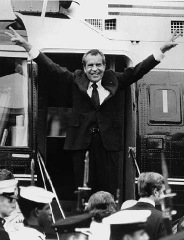
Nixon resigns, 1974

The well-known gossip columnist Liz Smith casually invoked the myth the other day, in an item at wowowow.com about Carl Bernstein. He is the former Washington Post reporter who figured prominently in the newspaper’s coverage of the unfolding Watergate scandal in 1972-73.

Smith referred to Bernstein as the “Watergate partner of Bob Woodward whose work for the Washington Post brought down the Nixon presidency.”

The heroic-journalist myth of Watergate is a hardy one: It lives on in textbooks, it’s taught in schools, and it rattles around in newsrooms.

It’s quite unrestrained in its reach, and over time has become the dominant popular narrative of the Watergate scandal.

But as I write in my forthcoming book about media-driven myths, Getting It Wrong, it’s also “a misleading interpretation, one that minimizes the more powerful and decisive forces that unraveled the scandal and ended Nixon’s corrupt presidency in the summer of 1974.”

As “earnest and revealing as their reporting was,” I further write, “Woodward and Bernstein did not uncover defining and decisive elements of the Watergate scandal—the cover-up and the payment of hush money” to the burglars who broke into the national headquarters of the Democratic Party at the Watergate complex in Washington, D.C.

The Senate Select Committee on Watergate–not Woodward and Bernstein–learned about, and disclosed the existence of, the White House tape recordings that captured Nixon’s complicity in the coverup. The special federal prosecutors on Watergate pressed for the release of the tapes. And the U.S. Supreme Court unanimously ordered Nixon to turn over the  tapes subpoenaed by the special prosecutor.

Those were pivotal events that led to Nixon’s resignation.

As I’ve mentioned in earlier blog postings, it’s intriguing that the Post from time to time has tried to make clear its reporting was not decisive to Nixon’s resignation.

For example, in 2005, Michael Getler, then the newspaper’s ombudsman, wrote in a column:

“Ultimately, it was not The Post, but the FBI, a Congress acting in bipartisan fashion and the courts that brought down the Nixon administration. They saw Watergate and the attempt to cover it up as a vast abuse of power and attempted corruption of U.S. institutions.”

This is not to say the Post’s Watergate reporting was without distinction.

As I write in Getting It Wrong, as “the scandal slowly unfolded in the summer and fall of 1972, Woodward and Bernstein progressively linked White House officials to a secret fund used to finance the burglary. The Post was the first news organization to establish a connection between the burglars and the White House, the first to demonstrate that campaign funds to reelect Nixon were used to fund the break-in, the first to implicate former Attorney General John Mitchell in the scandal….”

Those reports were published in the four months following the Watergate break-in.

Meanwhile, Nixon was on his way to reelection in a forty-nine state landslide.

WJC