W. Joseph Campbell

In essay about fake news, ‘Vox’ offers up media myth of the ‘Napalm Girl’

In 'Napalm girl', Debunking, Error, Media myths, Newspapers, Photographs on July 6, 2017 at 9:15 pm

In a lengthy essay posted yesterday about “fake news,” the online site Vox summoned a persistent media myth — that of the evocative “Napalm Girl” photograph, taken in Vietnam 45 years ago.

The essay invoked the photograph in discussing how remedies for “fake news” can be worse than the malady.

It ruminated about “potential unintended consequences of cracking down on fake news” and noted the controversy last year over “Facebook’s mishandling of the iconic photo of a naked 9-year-old Vietnamese girl running from the United States’ napalm bombing of her village during the Vietnam War. After a Norwegian author published the photo as part of a commentary on the evils of war, Facebook took the photo down, saying it violated standards regarding nudity on the site.”

Indeed, Facebook goofed up thoroughly in that episode.

But what most interests Media Myth Alert is the essay’s passage about “the United States’ napalm bombing of her village during the Vietnam War.”

That’s an erroneous reference to a misguided aerial bombing on June 8, 1972, during which napalm was dropped near the village of Trang Bang, in what then was South Vietnam.
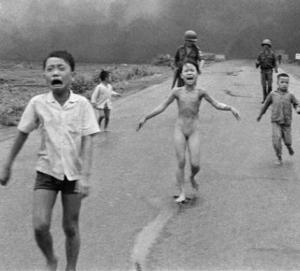
‘Napalm Girl,’ 1972 (Nick Ut/AP)

Nick Ut of the Associated Press took the memorable photograph of 9-year-old Kim Phuc and other terror-stricken children fleeing the attack. Kim’s arms were outstretched and her face was contorted in agony. Her clothing had been burned away.

The napalm attack was carried out not by the United States but by Skyraider warplanes of the South Vietnamese Air Force, attempting to roust communist forces dug in near the village.

Contemporaneous news accounts were quite clear about who dropped the napalm.

Christopher Wain, a veteran British journalist, wrote in a dispatch for the United Press International wire service, “These were South Vietnamese planes dropping napalm on South Vietnamese peasants and troops.” Donald Kirk of the Chicago Tribune reported the “napalm [was] dropped by a Vietnamese air force Skyraider diving onto the wrong target.”

The headline on the New York Times dispatch from Trang Bang said: “South Vietnamese Drop Napalm on Own Troops.” And the Boston Globe declared: “”S. Viet error kills 20 in napalm inferno.”

The fight at Trang Bang was — as I point out in the new edition of my media-mythbusting book, Getting It Wrong — “an all-Vietnamese encounter.” The notion that U.S. warplanes dropped the napalm that burned Kim Phuc and others is false, but enduring.

It is one of a number of myths attached to the “Napalm Girl” photograph.

Other myths are that the photograph was so raw and compelling that it hastened an end to the war (in fact it went on until April 1975) and that the image galvanized American public opinion against the conflict (Americans’ views about the war had turned negative in early 1968).

Another myth is that the “Napalm Girl” image appeared on the front pages of newspapers everywhere in the United States.

Many leading U.S. daily newspapers did publish the photograph soon after it was distributed by Associated Press. But many newspapers abstained, perhaps because it showed frontal nudity.

Of 40 leading daily U.S. newspapers included in a review I conducted with a research assistant (all 40 were Associated Press subscribers), 21 titles placed “Napalm Girl” on the front page.

But 14 newspapers examined — more than one-third the sample — did not publish the photograph at all. These titles included the Arizona Republic, Dallas Morning News, Denver Post, Des Moines Register, Detroit Free Press, Newark Star-Ledger, and Pittsburgh Post-Gazette.

Just three of the newspapers examined — the Boston Globe, New York Post, and New York Timesprinted editorials specifically addressing the photograph and its significance.

The editorial in the New York Post asked: “When will this bloodiest and most bestial of wars also be recognized as the monstrous mistake that it is? The picture of the children [fleeing the napalm attack] will never leave anyone who saw it….”

WJC

More from Media Myth Alert:

Murrow ‘risked his career to confront demagogic Joe McCarthy’? Hardly

In Debunking, Error, Media myths, Murrow-McCarthy myth, Washington Post on July 1, 2017 at 3:01 pm

The sentiments may be noble but the claims — one of them, at least — are dubious.

‘Demagogic’ Joe McCarthy

So it is with a Washington Post commentary this weekend that makes mention of “men and women who defended this country and its values in other ways [than taking up arms]: people like Edward R. Murrow, the broadcaster who risked his career to confront the demagogic Sen. Joe McCarthy; Harvey Milk, who helped pass gay rights legislation in San Francisco before he was assassinated; and Rosa Parks, whose courageous defiance was a spark for the civil rights movement, in which many were killed.”

What most interests Media Myth Alert is the reference to Murrow’s having risked his career in taking on McCarthy — a reference to the broadcaster’s half-hour television program, “See It Now,” in March 1954 that critically examined the senator’s communists-in-government witchhunt.

The show has long since become encrusted with media myth — namely that Murrow’s report exposed McCarthy’s demagoguery and abruptly ended his red-baiting ways.

The notion that Murrow’s career hung in the balance in taking on the bullying senator from Wisconsin was promoted in Good Night, and Good Luck, an overwrought cinematic account of the Murrow-McCarthy confrontation. But in reality, the risks to Murrow were scant by time he took on McCarthy in 1954.

By then, as I discuss in my media-mythbusting book, Getting It Wrong (a second edition of which is out now), Murrow was quite safe.

Murrow

That’s because, as I write, Murrow “was very late in confronting McCarthy” and “did so only after other journalists had challenged the senator and his tactics for months, even years.”

These journalists included the syndicated columnist Drew Pearson, who called out McCarthy’s exaggerations almost as soon as the senator began hurling accusations of communists infiltration of the State Department. That was in February 1950 — years before Murrow’s program on McCarthy.

Pearson certainly wasn’t a much-liked journalist; he was an aggressive, self-important muckraker whom media critic Jack Shafer once described as one of the skuzziest journalists to ever write a story. Pearson, I note, was always “eager to inject himself as a participant in Washington’s political scene.”

But he caught on quickly to McCarthy’s excesses.

Pearson: McCarthy nemesis

I note in Getting It Wrong that “Pearson first wrote about McCarthy’s wild allegations on February 18, 1950, just days after McCarthy had begun raising them. Pearson called McCarthy the ‘harum-scarum’ senator,” and described how the allegations had been discredited years earlier, after having been raised by a Republican congressman from Michigan.

Pearson wrote that “knowing something about State Department personnel, it is my opinion that Senator McCarthy is way off base.”

Pearson also went after McCarthy for his tax troubles in Wisconsin and for a suspicious $10,000 payment from a government contractor. And he likened McCarthy and his tactics to 17th century witchcraft trials in Massachusetts.

All of this angered the headstrong McCarthy who, at a Gridiron Club dinner in Washington in May 1950, approached Pearson, placed a hand on the columnist’s arm and muttered:

“Someday I’m going to get a hold of you and really break your arm.”

The thuggish threat, I write, was a prelude to a brief but violent encounter at the fashionable Sulgrave Club in Washington, D.C.

The Sulgrave, which occupies a late Gilded Age, Beaux-Arts mansion at DuPont Circle, was in the 1950s a hush-hush meeting place for Washington socialites and powerbrokers. “The club prided itself on insuring privacy and permitted no photographers to enter,” I note.

In December 1950, a young socialite named Louise Tinsley (“Tinnie”) Steinman invited both Pearson and McCarthy to join her guests at a dinner-dance at the Sulgrave.

She seated the men at the same table and they traded insults throughout the evening. Pearson and McCarthy “are the two biggest billygoats in the onion patch, and when they began butting, all present knew history was being made,” Time magazine said about their encounter.

“As the evening ended,” I write, “McCarthy confronted Pearson in the Sulgrave’s coat check room. Accounts differ about what happened. Pearson said McCarthy pinned his arms to one side and kneed him twice in the groin. McCarthy said he slapped Pearson, hard, with his open hand. A third account, offered by a radio broadcaster friendly to McCarthy, said the senator slugged Pearson, a blow so powerful that it lifted Pearson three feet into the air.

“Senator Richard Nixon, who also was a guest at Tinnie Steinman’s party, intervened to break up the encounter.”

In his memoir RN, Nixon quoted McCarthy as saying:

“You shouldn’t have stopped me, Dick.”

McCarthy took to the floor of the Senate not long afterward to assail Pearson in speeches that were unalloyed McCarthyism.

He denounced the columnist as the “diabolically” clever “voice of international communism,” a “prostitute of journalism,” and a “Moscow-directed character assassin.”

McCarthy also aimed a threat at Adam Hat Stores Inc., the principal sponsor of Pearson’s Sunday night radio program on NBC. McCarthy declared that “anyone who buys from a store that stocks an Adams [sic] hat is unknowingly contributing at least something to the cause of international communism by keeping this communist spokesman on the air.”

Adam Hat subsequently said it would not renew its sponsorship of Pearson’s radio show, citing “a planned change in advertising media for 1951.”

Pearson later claimed that losing the Adam Hat sponsorship cut his gross radio income to $100,000 from $250,000. “I suppose no one newspaperman suffered more economically than I did from Joe McCarthy,” he mused.

It’s tempting to suggest that the Post’s commentary would have been more apropos had it replaced Pearson for Murrow in saluting “men and women who defended this country and its values.” But, then, the memory of Drew Pearson projects none of the luster of the legendary Ed Murrow.

Also, it’s worth speculating that a keener risk to Murrow’s career and his reputation came in 1956, when he privately advised Adlai Stevenson, the Democratic presidential candidate, on what Murrow’s biographer, A.M. Sperber, called “the finer points of speaking to the camera.”

Sperber wrote in Murrow: His Life and Times that even though the Republican incumbent, Dwight D. Eisenhower, seemed sure to win to reelection,  Murrow agreed “to help the Democrats.”

The Murrow-Stevenson “connection was kept under wraps,” Sperber noted, adding that the “understanding” between the broadcaster and Stevenson’s advisers was that Murrow “was acting as a private citizen,” that his coaching was to be “kept quiet.”

WJC

More from Media Myth Alert:

Cronkite’s view on Vietnam had ‘tremendous impact,’ new book says: But how?

In Cronkite Moment, Debunking, Error, Media myths on June 9, 2017 at 7:20 am

A new book by prominent non-fiction writer Mark Bowden both treats skeptically and embraces key elements of the “Cronkite Moment,” a tenacious myth about media influence and the war in Vietnam.

Bowden is best known for Black Hawk Down, a well-regarded book about a bungled U.S. military mission in Somalia in 1993. Bowden devotes passing reference to the mythical “Cronkite Moment” in his latest work, Hue 1968, a detailed account of the weeks-long battle for the Vietnamese provincial capital Hue during the Tet offensive, launched by communist forces at the end of January 1968.

Cronkite in Vietnam

The offensive swept across much of what then was South Vietnam and deeply surprised the American public. The scope and shock of the assaults prompted Walter Cronkite, the anchorman at CBS News, to travel to Vietnam and gather first-hand details about the U.S. war effort.

Cronkite reported in his findings in an hour-long special report that aired at the end of February 1968. At the close of the broadcast, Cronkite offered his assessment that the U.S. military was “mired in stalemate” in Vietnam and that negotiations might eventually offer a way out.

It was a tepid appraisal; his “stalemate” observation mirrored what other American journalists had been saying for months.

But as I discuss in my media-mythbusting book, Getting it Wrong, Cronkite’s assessment has gained the luster of decisiveness, and is often recalled as an occasion when a prominent journalist spoke truth and influenced the powerful.

As the myth has it, President Lyndon Johnson watched Cronkite’s report and, upon hearing the “mired in stalemate” assessment, said something to the effect of, “If I’ve lost Cronkite, I’ve lost Middle America.”

So powerful and timely was Cronkite’s opinion that it also swung public opinion against the war.

From Google Books

Supposedly.

In Hue 1968, Bowden dismisses elements of the “Cronkite Moment,” writing that Johnson “probably never said the line that has been widely attributed to him after the broadcast — ‘If I’ve lost Cronkite, I’ve lost middle America.’

“Nor,” Bowden adds, “is it true, as David Halberstam would later write, that ‘it was the first time in American history a war had been declared over by an anchorman.'”

Indeed, the Vietnam War dragged on seven years for after the presumptive “Cronkite Moment.”

But Bowden also writes that Cronkite’s assessment “had tremendous impact and made it much harder to dismiss those who opposed the was as ‘hippies’ or un-American.”

He provides no evidence to support the claim of “tremendous impact,” however.

In fact, popular support for the war had begun declining months before the Cronkite report. The shift became evident by Fall 1967.

A Gallup poll in October 1967 found, for the first time, that a plurality of Americans — 47 percent — believed sending troops to fight in Vietnam had been a mistake.

A little more than two years earlier, just 24 percent of respondents said they thought it was a mistake to have deployed U.S. forces to Vietnam.

Gallup asked the question again in a poll completed hours before Cronkite’s program was aired: Forty-nine percent of the respondents said “yes,” U.S. military intervention in Vietnam had been a mistake; 42 percent said “no.”

In April 1968, Gallup found that 48 percent of respondents said U.S. military intervention in Vietnam had been a mistake; 42 percent said it had not been.

Moreover, print journalists had detected softening support for the war well before Cronkite’s report.

In December 1967, for example, journalist Don Oberdorfer, wrote that the previous summer and fall had “been a time of switching, when millions of American voters — along with many religious leaders, editorial writers and elected officials — appeared to be changing their views about the war.”

So a persuasive case can be made that rather than having had “tremendous impact,” Cronkite followed rather than led U.S. public opinion on the war.

And until late in his life, Cronkite downplayed the effects of his report from Vietnam, saying in an interview in 1999 that its impact on the Johnson administration was akin to that of a “straw on the back of a crippled camel.”

Only in the years before his death in 2009 did Cronkite embrace the mistaken notion his report in February 1967 had exerted powerful effects.

A closing note about Bowden’s book: It lacks an index and bibliography, which likely curbs its value to scholars.

WJC

More from Media Myth Alert: