W. Joseph Campbell

Posts Tagged ‘Crack babies’

‘A debunker’s work is never done’

In Bay of Pigs, Bra-burning, Cronkite Moment, Debunking, Furnish the war, Media myths, Murrow-McCarthy myth, New York Times, Reviews, War of the Worlds, Washington Post, Watergate myth, Yellow Journalism on May 21, 2010 at 6:14 pm

So notes the inestimable media critic Jack Shafer in his review of my forthcoming book, Getting It Wrong, posted today at slate.com.
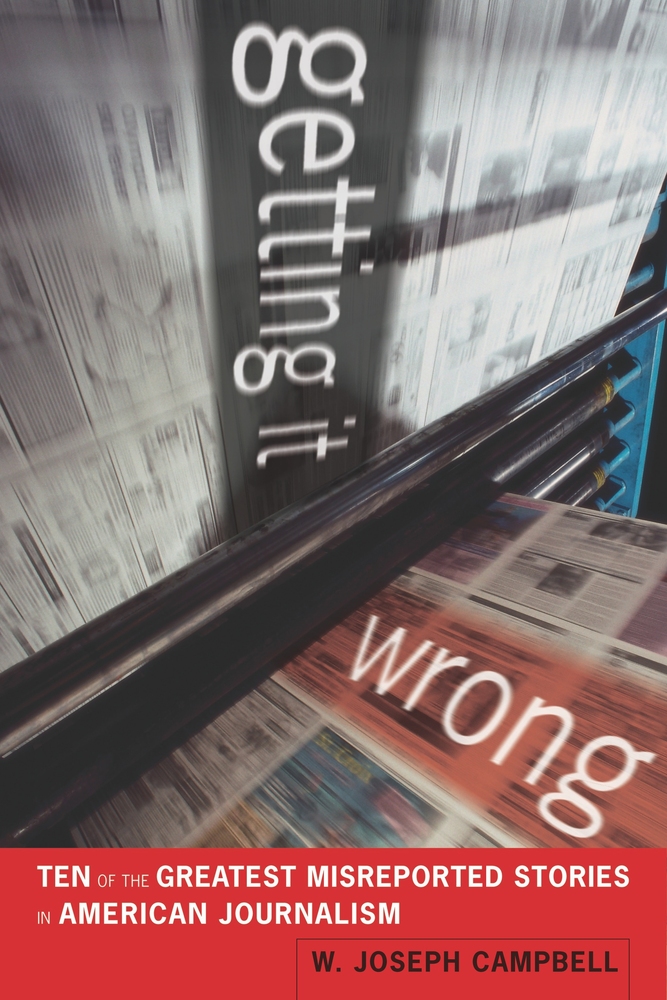
And what a generous, engaging, and insightful review it is.

Under the headline “The Master of Debunk,” Shafer notes that “the only way to debunk an enshrined falsehood is with maximum reportorial firepower.

“Toting big guns and an itchy trigger-finger is American University professor W. Joseph Campbell, whose new book Getting It Wrong: Ten of the Greatest Misreported Stories in American Journalism flattens established myths that you were brought up to believe were true.”

Shafer’s review specifically discusses a variety of media-driven myths, including William Randolph Hearst’s purported vow to “furnish the war” with Spain; the so-called “Cronkite moment” that supposedly altered President Lyndon Johnson’s Vietnam policy; the Bay of Pigs suppression myth that erroneously says President John F. Kennedy persuaded the New York Times to spike a story about the pending U.S.-backed invasion of Cuba, and the heroic-journalist myth of Watergate.

Shafer rightly points out that “a debunker’s work is never done” and to that end notes my recent post at Media Myth Alert about Evan Thomas’ new book, The War Lovers. The book embraces myths of the yellow press period in American journalism, including the Hearst vow.

Shafer thoughtfully considers the tenacity of media-driven myths, writing:

“Some myths endure because the stories are so compelling, like the Hearst tale and the alleged mayhem caused by Orson Welles’ [War of the Worlds] broadcast. Others survive because our prejudices nourish them (“crack babies,” bra burners) or because pure repetition has drummed them into our heads, smothering the truth in the process.

“The best tonic for the brain fever caused by media myths is an open mind and a free inquiry,” he writes.

Shafer wraps up the review by invoking this observation, by Jonathan Rauch:

“It is the error we punish, not the errant.”

Shafers adds:

“Of course when you do such a good job punishing the error, as Campbell does, you don’t need to bother with the errant.”

WJC

Related:

NPR revisits ‘crack baby’ panic, ignores media role

In Debunking, Media myths, Media myths and radio, Washington Post on May 4, 2010 at 1:21 pm

NPR’s “Tell Me More” program yesterday became the latest national news outlet to revisit the “crack baby” scare of the late 1980s and 1990s, and pronounce it all had been overblown.

As in the recent Washington Post retrospective about “crack babies,” NPR failed to confront the news media’s central role in promoting and spreading what one leading researcher has called a “fantasy panic.”

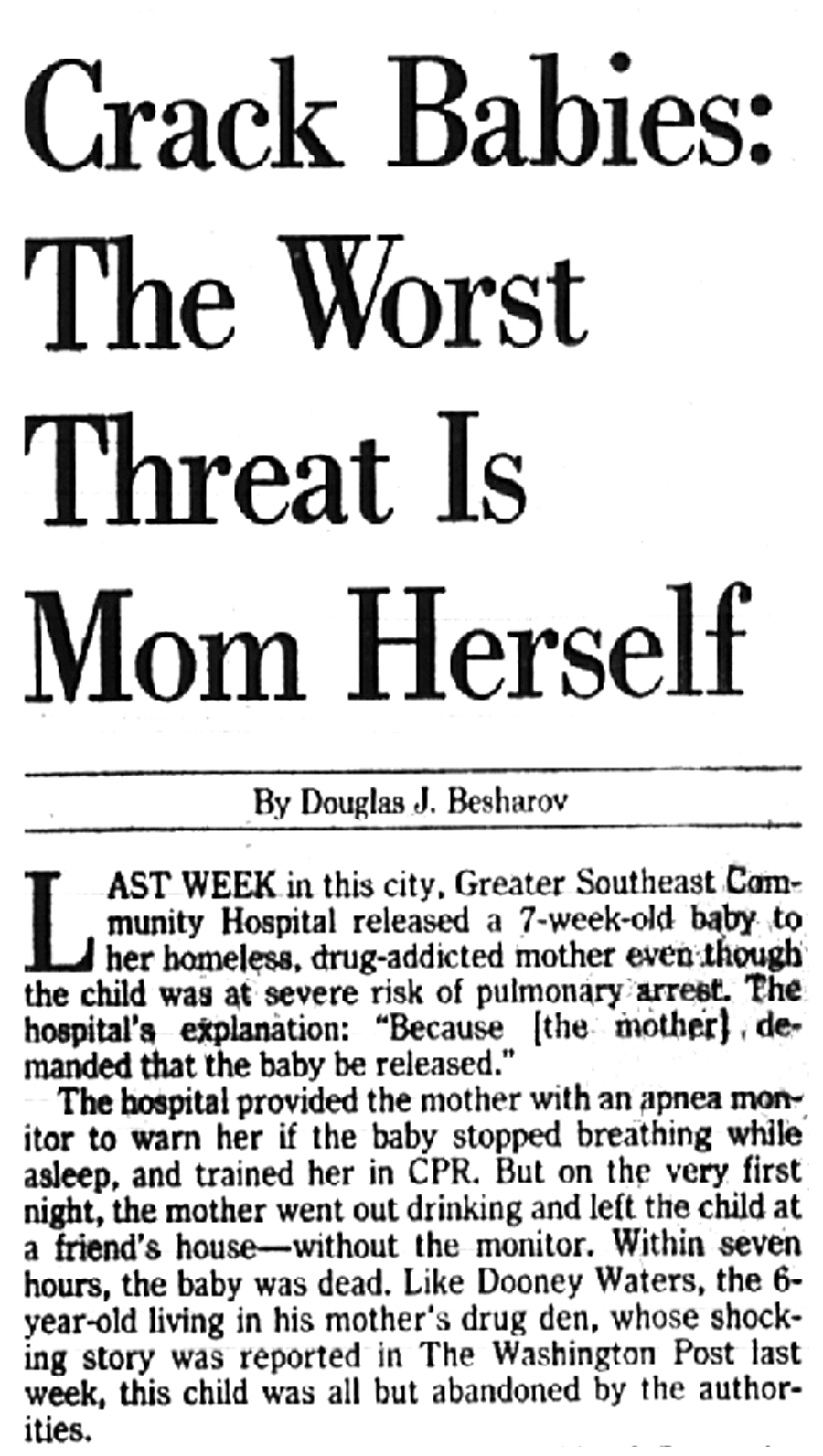
Washington Post, 1989

That turn of phrase inspired the title of the chapter about “crack babies” in Getting It Wrong, my forthcoming book that confronts and debunks 10 media-driven myths.

Getting It Wrong is being published this summer by University of California Press.

The crack-baby myth centers around the notion that women who took cocaine during pregnancy would give birth to children so mentally and physically deficient that they would constitute a helpless, dependent “bio-underclass,” as syndicated columnist Charles Krauthammer put it in 1989.

In Getting It Wrong,  I call attention “to the risks of anecdote-driven reporting, which characterized news coverage of the crack baby phenomenon.

“Disturbing images and heart-wrenching descriptions of helpless newborns supposedly damaged by their mothers’ toxic indulgence were,” I write, “frequent and irresistible elements of the coverage. Anecdotes were fuel for a powerful but misleading storyline.”

Yesterday’s “Tell Me More” segment on “crack babies” overlooked all that, referring vaguely to “all manner of pronouncements about how children who were exposed to crack in utero were destined to a life of physical and mental disability.”

The program’s description at the “Tell Me More” online site ignored the news coverage, saying instead that “the nation’s health specialists panicked over the growing number of so-called ‘crack babies’—children exposed to crack cocaine in utero. These children were said to be doomed to lives of physical and mental disability.”

The panic, though, was largely media-driven, as I discuss in Getting It Wrong.

The “Tell Me More” segment–which noted that “children who [had been] exposed to crack cocaine before birth are proving these worst case scenarios were all wrong”–did include an intriguing, media-related passage.

That came late in the show, when Dr. Carl Bell, a clinical professor of psychiatry and public health at the University of Illinois-Chicago, spoke of “media epidemiology.”

He said:

“I think it’s important for society to move away from what I refer to as media epidemiology and media hypotheses and making all these generalizations about things because frequently they’re flat out wrong, as it shows.”

I asked Bell by email to elaborate on “media epidemiology.”

He replied, stating:

“‘Media epidemiology’ is a term I began using about two years ago to describe how the public gets its understanding about epidemiology of various public health issues from the media, which of course is the absolutely wrong place to get such information as the media does not report on the common but on the uncommon which is defined as news.

“For example, ten years ago the homicide rates in Chicago were 1,000 but because of a lot of work done in public health in the city the homicide rates are down to 500, but the media keeps referring to the ‘homicide epidemic’ in Chicago; thereby misleading the public with their ‘media epidemiology.'”

It, too, is’ an interesting turn-of-phrase–and may help explain why the news media sometimes get it wrong in reporting on issues of science and public health.

WJC

Skirting the media’s role in the ‘crack baby’ scare

In Debunking, Media myths, Newspapers, Washington Post on April 18, 2010 at 3:40 pm

The Washington Post today revisits the “crack baby” scare of the late 1980s and 1990s and reports that “in the two decades that have passed since … these babies have grown into young adults who can tell their stories–and for the most part, they are tales of success.”

The Post notes that “a lot of misinformation surfaced” about the “crack baby” phenomenon, and cites an often-quoted column by Charles Krauthammer who in 1989 wrote:

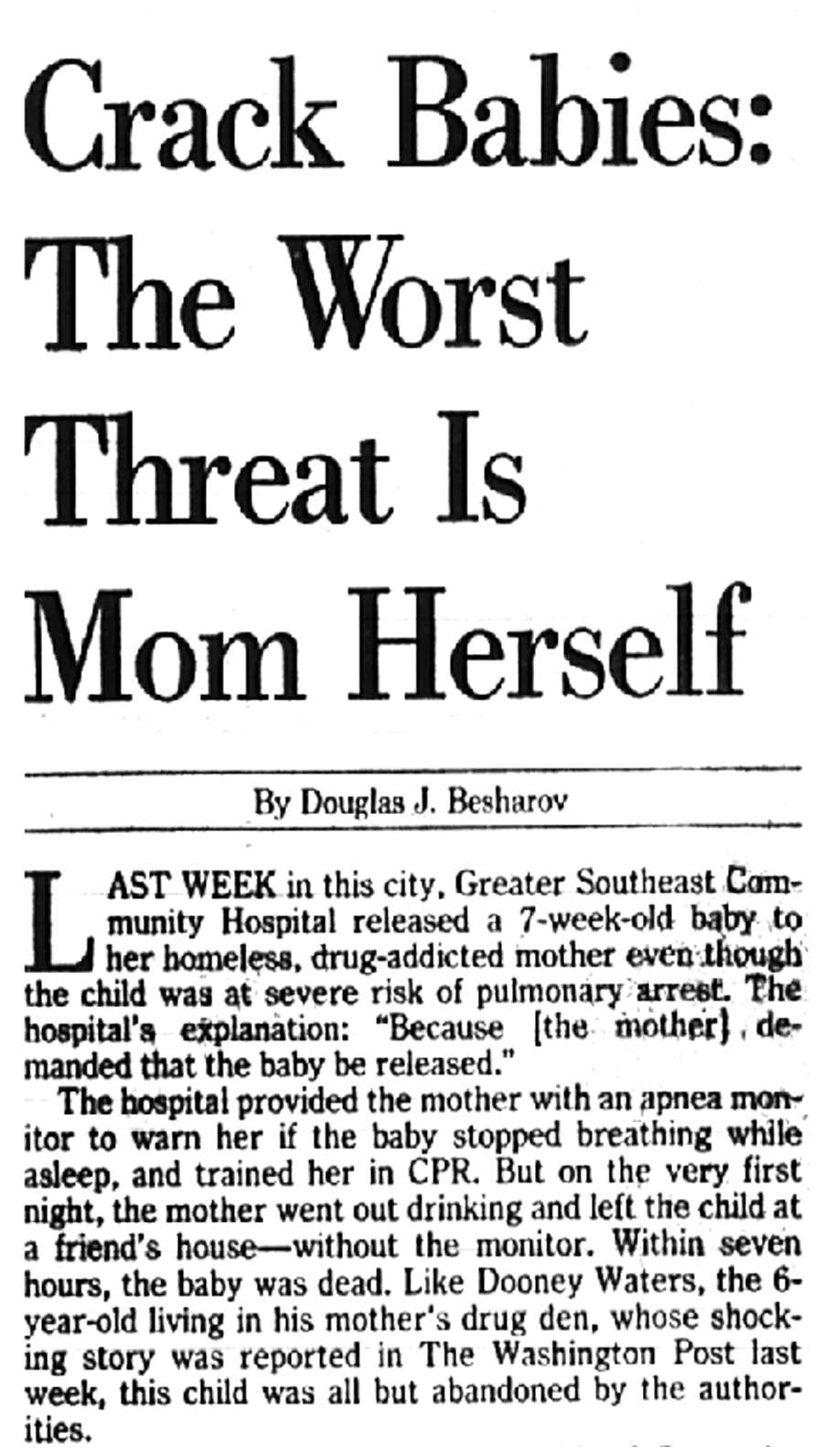
Washington Post, August 1989

“Theirs will be a life of certain suffering, of probable deviance, of permanent inferiority.”

(Although the Post article doesn’t mention it, Krauthammer also wrote in that column: “The inner-city crack epidemic is now giving birth to the newest horror: a bio-underclass, a generation of physically damaged cocaine babies whose biological inferiority is stamped at birth.”)

Otherwise, the Post‘s report steered well clear of considering the news media’s central role in spreading “misinformation” about “crack babies,” a topic is explored in Getting It Wrong, my forthcoming book about media-driven myths.

The scare, I write, “was a media-driven myth based more on anecdote than solid, sustained research, a myth that had the effect of stigmatizing underprivileged children presumed to have been born damaged and despised as ‘crack babies.’”

I further note:

“To be sure, smoking crack during pregnancy is hardly risk-free, and certainly neither prudent nor sensible.”

However, I add, “the effects of prenatal cocaine exposure have proved more subtle than sweeping: Newborns exposed to crack during pregnancy tend to be smaller in birth weight, in length, and in head circumference. Some research suggested that mild cognitive deficiencies, such as difficulties in concentrating on tasks at hand, might be attributable to prenatal cocaine exposure, especially as cognitive demands on children intensify as they grow older.

“But biomedical research has found nothing akin to a ‘bio-underclass,’” that Krauthammer and others warned about some 20 years ago.

Revisiting the media-driven myth of the crack baby is important, I write in Getting It Wrong, because doing so “allows insights into a tendency among journalists to neglect or disregard the tentativeness that characterizes serious scientific and biomedical research, and to reach for certainty and definitiveness that are not often found in preliminary findings.

“The tendency of journalists to push hard on tentative data has been apparent in coverage of more recent drug scares, notably that of methamphetamine in 2004 and 2005.”

The Post‘s report today was the latest in what, in effect, has been an intermittent series in leading newspapers to revisit the “crack baby” scare and find it to have been exaggerated.

In a lengthy article published 15 months ago, the New York Times called the scare “the epidemic that wasn’t.” A columnist for the New York Daily News acknowledged in 2004 that “we probably overreacted with forecasts of harm to so-called ‘crack babies.’”

And more than 12 years ago, the Post carried a story similar to today’s. That article appeared on page Z10, beneath the headline: “‘Crack Baby’ Fears May Have Been Overstated.”

As I note in Getting It Wrong, “The news media’s retreat or rollback on crack babies was neither as extensive nor as prominent as the dramatic and ominous reports about the scourge in the late 1980s and early 1990s.”

I quote the alternative magazine, Mother Jones, which pointed out in 1995:

“The publicity blitz that spread the crack-baby myth has not been matched by an attempt to unmake the myth—and many, many people still believe in it.”

The term “crack babies” remains firmly in circulation; it is invoked casually and idiomatically, as something of a cliché.

WJC

‘Pharm parties’ and the tenacity of media myths

In Debunking, Furnish the war, Media myths on January 26, 2010 at 6:25 am

Jack Shafer, editor-at-large at slate.com, recently revisited and re-debunked the media-driven myth of “pharm parties,” those purported gatherings at “which young people … dump the pills they’ve stolen from their parents’ medicine cabinets into a big bowl and then scoop out and swallow random handfuls.”

It’s a phenomenon, he says, that the news media “pretend [is] both real and ubiquitous.”

Shafer begins his take-down with a half-serious lament, writing:

“I regret to inform you that this column has failed to eradicate the ‘pharm party’ meme,” noting that he has written about this fanciful pastime on five other occasions.

Shafer appeals to common sense in deflating the myth, writing:

“There are at least two basic problems with the pharm-party scenario reported in the press. To begin with, if you were a young drug fiend and stole potent drugs, why would you deposit them in a communal bowl if there was a good chance that when your turn came to draw a drug at random, you might get an antihistamine? And second, I’ve yet to read a story in which a journalist actually attends such a gathering, interviews a participant, or cites a police report alleging such behavior.”

It’s an impressive debunking, but Shafer is under no illusions that his efforts will kill off the fantasy.

After all, he says, reports of “pharm parties” or their equivalent can be traced to the mid-1960s. “Any myth hearty enough to survive and thrive for 40-plus years in the media is probably unkillable,” Shafer writes.

And he’s probably right.

As I note in my forthcoming book, Getting It Wrong, some media-driven myths are so tenacious, so debunking-resistant, because they seem too good, too delicious, not to be true.

That’s certainly the case with the hoary tale of William Randolph Hearst’s purported vow to “furnish the war” with Spain at the end of the nineteenth century. What story better captures Hearst the warmonger than that? What tale better signals the potential malignant effects of the news media, writ large?

The anecdote of the Hearstian vow lives on, shrugging off repeated efforts to uproot it.

Likewise, the notion of “pharm parties,” is too enticing, too delicious in a perverse way, not to be true.

Another factor explaining tenacity of media-driven myths is that they readily feed stereotypes. “Pharm parties” certainly do so, offering supposed evidence of the mindless, reckless ways of a younger generation.

One of the cases of stereotyping explored in Getting It Wrong is that of “crack babies,” a frightening and overstated phenomenon of the late 1970s and 1980s. Women who smoked crack cocaine during pregnancy were, it was feared, giving birth to a neurologically damaged “bio-underclass” that would forever be dependent on the state.

The “crack baby” phenomenon turned out to be a widely misreported pandemic. Even so, it seemed to confirm the worst pathologies associated with inner-city poor people. That stereotype was one reason the “crack baby” meme lived on.

And lives on still.

WJC