W. Joseph Campbell

Posts Tagged ‘Getting It Wrong’

Recalling, and doubting, television’s ‘finest half hour’

In Debunking, Media myths, Murrow-McCarthy myth on March 8, 2010 at 12:18 am

It’ll be 56 years tomorrow since Edward R. Murrow, the “patron saint” of broadcast journalism, took to the small screen to confront Joseph R. McCarthy and decisively end the senator’s witch-hunt for communists in government.

Or so the story goes.
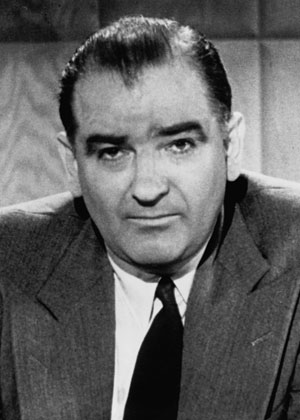
McCarthy in 1954 (Library of Congress)

The occasion was Murrow’s 30-minute See It Now program that aired March 9, 1954, on CBS.

It was a hallowed moment in American journalism, one that supposedly defined the power of television and reaffirmed the courage of Murrow. Among other accolades, the See It Now show on McCarthy has been called television’s “finest half-hour.”

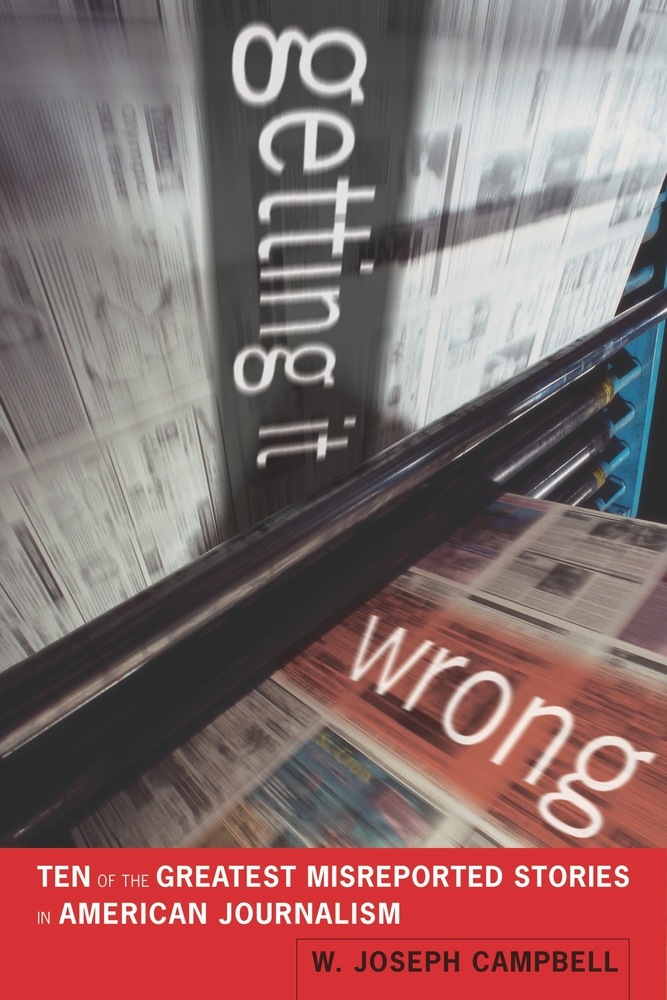
But as I write in my forthcoming book, Getting It Wrong, the notion that Murrow brought down McCarthy is a tenacious though delicious media-driven myth.

Murrow “was very late in confronting McCarthy,” I write in Getting It Wrong and “did so only after other journalists had challenged the senator and his tactics for months, even years.”

I note in the book–which addresses and debunks nine other media-driven myths–that Eric Sevareid, Murrow’s friend and CBS colleague, chafed at the misleading interpretation, pointing out in an interview in 1978 that Murrow’s program “came very late in the day.”

Sevareid was correct.

“Long before the See It Now program, several prominent journalists—including the Washington-based syndicated columnist Drew Pearson—had become persistent and searching critics of McCarthy, his record, and his tactics,” I note in Getting It Wrong.

Pearson wrote the widely read “Washington Merry-Go-Round” column and was the most assertive and persistent of McCarthy’s media critics. He challenged McCarthy’s claims as early as 1950–days after the senator began raising charges that scores of communists and fellow travelers had infiltrated the U.S. State Department.

McCarthy became so angered by Pearson’s searching columns that he threatened the columnist with physical harm–and followed through in December 1950, in a bizarre encounter in the cloakroom of the Sulgrave Club in Washington.

There, McCarthy slapped Pearson, or tried to knee the columnist in the groin. Accounts vary. (Then-Vice President Richard Nixon reportedly broke up the encounter.)

All that came long before Murrow confronted McCarthy on See It Now in 1954.

It’s sometimes argued that Murrow’s most effective contribution was “in mobilizing public opinion against Senator Joe McCarthy.” Such a claim was raised the other day in a post at the online site of the New American magazine.

But in fact, McCarthy’s favorability ratings had been falling for three months before the Murrow program: Factors other than Murrow’s reporting had turned public opinion against McCarthy.

Gallup Poll data show that McCarthy’s appeal crested in December 1953, when 53 percent of Americans said they had a favorable view of him. McCarthy’s favorable rating fell to 40 percent by early January 1954, and to 39 percent in February 1954.

As I write in Getting It Wrong, “it wasn’t as if Americans in early 1954 were hoping for someone to step up and expose McCarthy, or waiting for a white knight like Murrow to tell them about the toxic threat the senator posed.”

Thanks to the work of Pearson and other journalists, they already knew.
WJC

If not for the Post’s digging …

In Debunking, Media myths, Washington Post, Watergate myth on March 7, 2010 at 1:26 pm

Then the Watergate scandal might never have come to light.

Right.

That, in any case, is a variation on the heroic-journalist meme of Watergate, which holds that the work of Bob Woodward and Carl Bernstein, two young reporters for the Washington Post, brought down Richard Nixon and his corrupt presidency.

It’s a claim too sweeping for many to embrace. As I write in my forthcoming book, Getting It Wrong, the heroic-journalist interpretation of Watergate is a media-driven myth–one that even officials at the Post tend to dismiss.

The variation on the heroic-journalist meme holds that the Post‘s persistent reporting during the summer and early fall of 1972–in the early weeks and months of the scandal–helped keep Watergate from fading completely from public view.

The variation theme was invoked yesterday in a column in the New Britain Herald in Connecticut.

The writer says about Watergate and Nixon’s eventual resignation:

“Sure, a federal judge and the members of Congress had something to do with it — Lowell Weicker made his name nationally at the [Senate] Watergate hearings. But without Woodward and Bernstein digging and writing in the Washington Post, it could all have been pushed under the rug.”

Alas, the writer offers no evidence for his speculative conclusion.

Even so, it’s not an uncommon interpretation.

Howard Simons, the Post‘s managing editor during the Watergate period, once said:

“For months we were out there alone on this story. What scared me was that the normal herd instincts of Washington journalism didn’t seem to be operating. … It was months of loneliness.”

Such characterizations are not entirely accurate, however. As I write in Getting It Wrong:

“The Post may well have led other newspapers on the Watergate story—principally was because Watergate at first was a local story, based in Washington, D.C. But rival news organizations such as Los Angeles Times and New York Times did not ignore Watergate as the scandal slowly took dimension during the summer and fall of 1972,” while Nixon’s reelection campaign gathered momentum.

In his classic essay on journalism and Watergate, Edward Jay Epstein noted that the Post and other newspapers were joined during the summer of 1972 by the General Accounting Office, the investigative arm of Congress, and Common Cause, a foundation that seeks accountability in government office, in calling attention to the scandal.

Nixon’s Democratic challenger for the presidency, George McGovern, often invoked Watergate in campaign appearances during the summer and fall of 1972. At one point, McGovern charged that Nixon was “at least indirectly responsible” for the Watergate scandal, which stemmed from a break-in at the headquarters of the Democratic National Committee.

McGovern also termed the break-in “the kind of thing you expect under a person like Hitler.”

So in its reporting on the emergent scandal, the Post in fact was one of several institutions seeking to delineate the reach and contours of Watergate.

Woodward and Bernstein were very much not alone in their digging. And the number of entities and institutions that were digging, even in the early days of the scandal, guaranteed that Watergate could not be “pushed under the rug.”

WJC

<!–[if !mso]> Edward Jay Epstein noted in his classic essay disputing the heroic-journalist myth of Watergate that the Post and other newspapers were joined during the summer of 1972 by the General Accounting Office, the investigative arm of Congress,[i] and Common Cause, a foundation that seeks accountability in government office, in calling attention to the scandal. Within a few days of the Watergate break-in, moreover, the Democratic National Committee filed a civil lawsuit against the Committee for the Reelection of the President, which ultimately compelled statements under oath. And Nixon’s Democratic challenger for the presidency, George McGovern, repeatedly invoked Watergate in his campaign appearances in the summer and fall of 1972. At one point, McGovern charged that Nixon was “at least indirectly responsible” for the Watergate burglary. McGovern also termed the break-in “the kind of thing you expect under a person like Hitler.”[ii] In its reporting on the emergent scandal in the summer and fall of 1972, the Post in fact was one of several institutions seeking to delineate the reach and contours of Watergate.[iii] The Post, that is, was very much not alone.


[i] See Bernard Gwertzman, “G.A.O. Report Asks Justice Inquiry Into G.O.P. Funds,” New York Times (27 August 1972): 1.

[ii] See James M. Naughton, “McGovern Bars Briefings By Kissinger as Unhelpful,” New York Times (16 August 1972): 1, 20.

[iii] Edward Jay Epstein, Between Fact and Fiction: The Problem of Journalism (New York: VintageBooks, 1975), 26. See also, Martin Schram, “Watergate in media legend,” Journal of Commerce (19 June 1997): 6A. Schram wrote: “Even in the early days [of the Watergate scandal], the Post was not always the Lone Ranger we now remember.

Yet again: Watergate and the Washington Post

In Debunking, Media myths, Newspapers, Washington Post, Watergate myth on March 4, 2010 at 7:00 am

Bob Woodward, he of the Washington Post and Watergate fame, is to give a talk today in Hartford, Connectict about “evolution of the media, politics, health care and the economy,” according to the city’s newspaper, the Courant.

In an article about the visit, the Courant (where I once worked) indulged in one of American journalism’s most persistent and delicious myths, declaring that Woodward’s “reporting of the Watergate scandal brought down a president and reshaped the journalism industry.”

Of course, the Courant article–which is mostly a Q-and-A with Woodward–leaves it at that. It never explains how the Post‘s reporting on Watergate accomplished either feat–bringing down Richard Nixon’s corrupt presidency let alone reshaping the journalism industry.

As I write in Getting It Wrong, my forthcoming book about media-driven myths, the Post‘s reporting on Watergate had only a marginal effect on the outcome of the Watergate scandal.

Indeed, Nixon likely would have completed his term if not for the secret recordings of many of his conversations in the Oval Office, conversations that captured his guilty role in authorizing a coverup of the Watergate scandal.

It was the Senate Select Committee on Watergate–not Woodward and his reporting partner Carl Bernstein–that uncovered and disclosed the existence of the White House tapes, the evidence most crucial in the scandal.

The special federal prosecutors on Watergate (one of whom Nixon ordered fired) pressed for the release of the tapes. And the U.S. Supreme Court unanimously ordered Nixon to turn over the recordings subpoenaed by the special prosecutor.

When Nixon complied, his presidency was all but over.

He resigned August 9, 1974.

As Stanley I. Kutler, a leading historian of Watergate, has written:

“The fact is, an incredible array of powerful actors all converged on Nixon at once—the FBI, prosecutors, congressional investigators, the judicial system.”

Amid this tableau of subpoena-wielding authorities, the contributions of Woodward and Bernstein were modest, and certainly not decisive, I write in Getting It Wrong, adding:

“Principals at the Post have acknowledged as much. Katharine Graham, the newspaper’s doughty publisher [during the Watergate period], often insisted the Post did not topple Nixon.

“‘Sometimes people accuse us of bringing down a president, which of course we didn’t do,’ Graham said in 1997, at a program marking the scandal’s twenty-fifth anniversary.

“’The processes that caused [Nixon’s] resignation were constitutional,’” she said.

Indeed.

WJC

Blithely invoking the Murrow-McCarthy myth

In Debunking, Media myths, Murrow-McCarthy myth, Watergate myth on March 3, 2010 at 11:15 am

It’s fairly remarkable how blithely and routinely media myths can be invoked.

A reminder of that appeared in a column posted today in the Times-News, a newspaper in Twin Falls, Idaho. The column, which ruminated about the use of middle initials, opened this way:

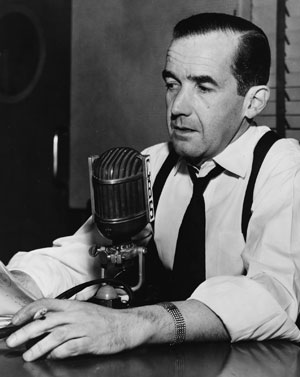
Murrow in 1954 (Library of Congress)

“When I was a young journalist, the most revered person in my profession was Edward R. Murrow, the CBS News reporter who brought down Sen. Joseph McCarthy.”

Brought down McCarthy.

It’s a story as famous and revered in American journalism as the notion that intrepid young reporters for the Washington Post brought down the corrupt presidency of Richard Nixon.

Both tales are exaggerated.

And both are media-driven myths that are examined in my forthcoming book, Getting It Wrong.

Murrow was a leading and ultimately a legendary figure in American broadcasting who in the 1950s  stood up to McCarthy, the Red-baiting junior senator from Wisconsin, when, supposedly, no one else would, or dared. In so doing, the story goes, Murrow brought an abrupt end to senator’s witchhunt for communists in the U.S. government.

The vehicle for Murrow’s brave exposé was his 30-minute television program, See It Now, which aired on CBS.

As I write in Getting It Wrong:

“Long before the See It Now program, several prominent journalists—including the Washington-based syndicated columnist Drew Pearson—had become persistent and searching critics of McCarthy, his record, and his tactics.”

Pearson, who wrote the widely published “Washington Merry-Go-Round” column, was the most assertive and, ultimately, acerbic of McCarthy’s media critics. He challenged McCarthy’s claims as early as 1950, soon after the senator began charging that communists had infiltrated the U.S. State Department.

McCarthy became so angered by Pearson’s searching columns that he threatened the columnist with physical harm–and followed through in December 1950 in the cloakroom of the exclusive Sulgrave Club on DuPont Circle in Washington. There, he slapped or tried to knee Pearson in the groin.

All that came long before Murrow confronted McCarthy on See It Now in 1954.

By 1954, I note in Getting It Wrong, “it wasn’t as if Americans … were hoping for someone to step up and expose McCarthy, or waiting for a white knight like Murrow to tell them about the toxic threat the senator posed.”

Pearson and others had been doing so for years.

WJC

Shoe leather, Watergate, and All the President’s Men

In Cinematic treatments, Debunking, Media myths, Washington Post, Watergate myth on February 28, 2010 at 2:36 pm

The heroic-journalist tale of Watergate–that two intrepid young reporters for the Washington Post brought down Richard Nixon’s corrupt presidency–is one of the most appealing and self-reverential stories in American media history.

It’s also a media-driven myth, one of 10 addressed in my forthcoming book, Getting It Wrong.

As I note in Getting It Wrong, an important factor for the tenacity of the heroic-journalist myth lies in its cinematic treatment. The media-centric storyline of Watergate was cemented by the film All the President’s Men, which came out to much acclaim in April 1976, 20 months after Nixon’s resignation.

An item posted the other day at the Politics Daily site fondly recalled All the President’s Men, saying the movie “about a bygone era” harkens to the “glory days of newspapers.”

The writer also indulged in the heroic-journalist myth, saying that the Post reporters “who brought down a sitting president” did so “with nothing more than shoe leather, determination, guts and a passion for the truth.”

It’s a wonderful story of journalists triumphant. But it’s exaggerated.

Even writers and officials at the Post have tried over the years to make clear that the newspaper and its reporters did not bring down Richard Nixon.

Howard Kurtz, the newspaper’s media writer, wrote in 2005, for example:

“Despite the mythology, The Post didn’t force Richard Nixon from office—there were also two special prosecutors, a determined judge, bipartisan House and Senate committees, the belated honesty of [former White House lawyer] John Dean and those infamous White House tapes.”

As I note in Getting It Wrong, “Nixon likely would have served out his term if not for the audiotape recordings he secretly made of most conversations in the Oval Office of the White House.

“Only when compelled by the Supreme Court [in 1974] did Nixon surrender those recordings, which captured him plotting the cover-up and authorizing payments of thousands of dollars in hush money.”

He resigned the presidency about two weeks later.

The cinematic version of All the President’s Men, however, placed Post reporters Bob Woodward and Carl Bernstein at the center of the unraveling of Watergate, while downplaying or dismissing the efforts of investigative agencies such as the FBI.

“The effect,” I write, “was to solidify and elevate the heroic-journalist myth, giving it dramatic power, and sustaining it in the collective memory.”

The movie helped make the heroic-journalist interpretation of Watergate vivid, memorable, accessible, and central.

After all, no other Watergate-related movie has retained such an appeal, or has likely been seen by as many people as All the President’s Men.

WJC

Recalling the mythical ‘Cronkite Moment’

In Cronkite Moment, Debunking, Media myths on February 26, 2010 at 6:09 am

Tomorrow is the anniversary of the so-called “Cronkite Moment,” which is widely believed to have been an exceptionally powerful and decisive moment in American journalism.

The “Cronkite Moment” occurred February 27, 1968, when CBS News Anchor Walter Cronkite declared on air that the U.S. war effort in Vietnam was mired in stalemate and suggested negotiations as a way to extricate the country from the conflict.

At the White House that night, President Lyndon Johnson supposedly watched the Cronkite program, a special report about Vietnam in the aftermath of the surprise Tet offensive. Upon hearing Cronkite’s pessimistic assessment, Johnson is said to have snapped off the television set and muttered to an aide, or aides:

“If I’ve lost Cronkite, I’ve lost Middle America.”

Or words to that effect.

With Cronkite having turned against the war, the Johnson White House supposedly reeled. And at the end of March 1968, the president announced he would not seek reelection.

It is one of the great stories American journalism tells about itself, a moment when the power of television was trained on foreign policy to make a difference in an unpopular and faraway war.

More accurately, though, it’s one of American journalism’s most enduring and appealing media-driven myths.

As I’ve noted on a number of occasions at Media Myth Alert, and as I write in Getting It Wrong, my forthcoming book on media-driven myths,  Johnson did not watch the Cronkite program on Vietnam when it aired that night 42 years ago.

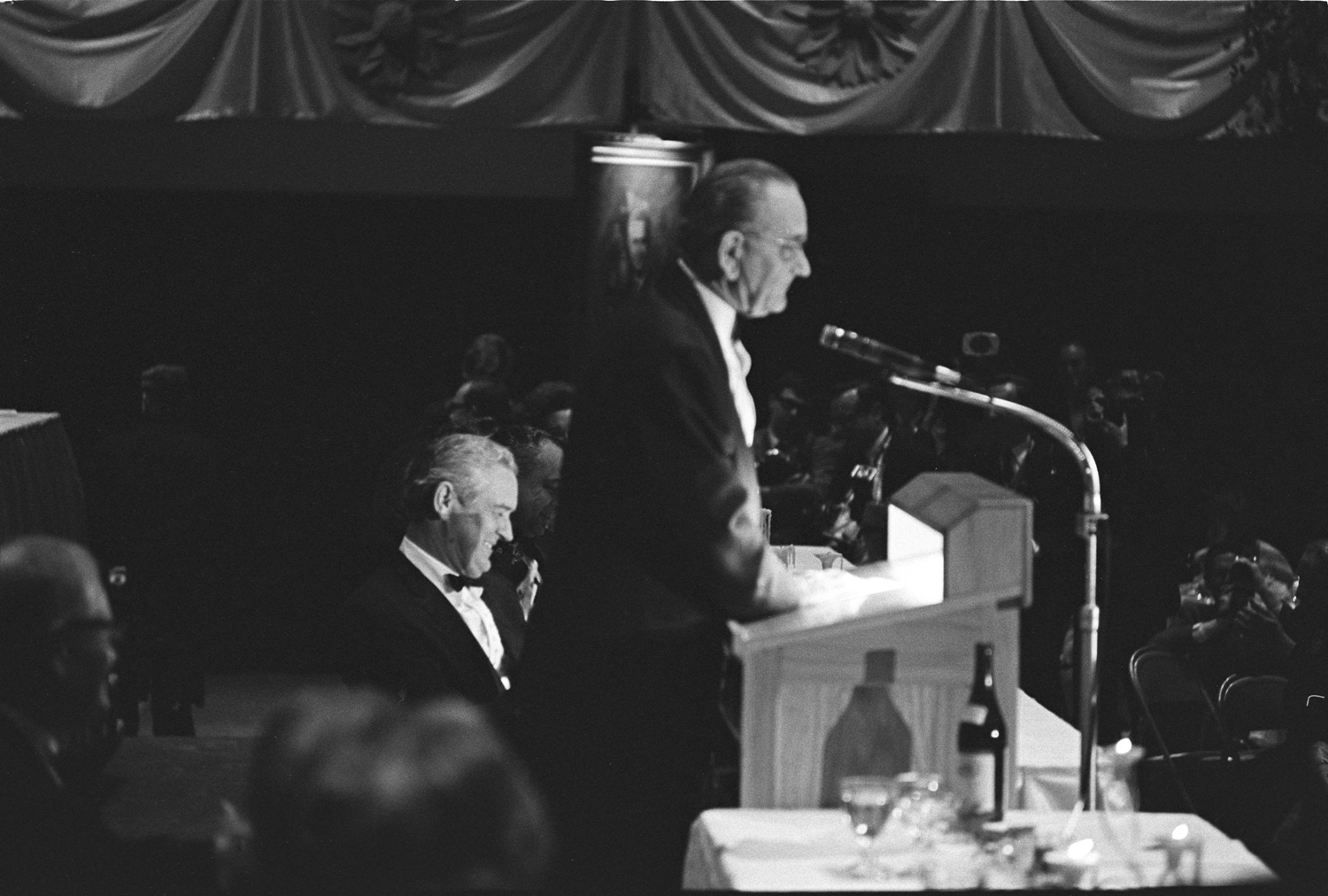
The president that night was in Austin, Texas, at the 51st birthday party of a political ally, Governor John Connally.

About the time Cronkite intoned his downbeat, “mired in stalemate” assessment, Johnson was offering light-hearted banter about Connally’s age, saying:

Johnson in Texas, February 27, 1968

“Today you are 51, John. That is the magic number that every man of politics prays for—a simple majority. Throughout the years we have worked long and hard—and I might say late—trying to maintain it, too.”

Earlier in the day, Johnson had delivered a rousing speech in Dallas, in which he characterized the U.S. war effort in Churchillian terms.

“There will be blood, sweat and tears shed,” he said, adding:  “I do not believe that America will ever buckle” in pursuit of its objectives in Vietnam.

Even if the president had seen the Cronkite program, it is difficult to imagine how his opinion could have swung so abruptly, from a vigorous defense of the war effort to resignation and despair.

Casting further doubt on the “Cronkite Moment” is uncertainty about what, exactly, Johnson supposedly said in reaction to Cronkite’s editorial comments about the war.

The most common version has him saying: “If I’ve lost Cronkite, I’ve lost Middle America.”

But another version is: “I’ve lost Cronkite, I’ve lost the country.”

Yet another version has it this way: “If I’ve lost Cronkite, I’ve lost the American people.”

Still another version is: “If I’ve lost Cronkite, I’ve lost the war.”

And another goes: “If we lose Cronkite, we lose America.”

And, unaccountably: “If I’ve lost Cronkite, I’ve lost the middle west.”

Version variability of  such magnitude signals implausibility.

So why, 42 years on, does it matter whether the “Cronkite Moment” is a myth?

As I write in Getting It Wrong, “Seldom, if ever, do the news media exert truly decisive influences in decisions to go to war or to seek negotiated peace.

“Such decisions typically are driven by forces and factors well beyond the news media’s ability to shape, alter, or significantly influence.”

And so it was with the “Cronkite Moment.”

WJC

Haig, Deep Throat, and the Watergate myth

In Debunking, Media myths, Washington Post, Watergate myth on February 23, 2010 at 12:03 am

The recent death of Alexander M. Haig, the combative general who became U.S. secretary of state in the early 1980s, brought reminders about how Haig had figured improbably in the years-long guessing game about the identity of “Deep Throat.”

Deep Throat was the well-placed, anonymous source to whom the Washington Post periodically turned in reporting the Watergate scandal that toppled Richard Nixon’s presidency. Haig was chief of staff in the Nixon White House as the Watergate scandal intensified and reached its culmination in 1973-74.

Haig was not implicated in the scandal and has been credited with helping to navigate Nixon’s resignation after it became clear the president had conspired to obstruct justice.

And Haig’s name surfaced periodically in the guessing game about Deep Throat’s identity, which began soon after publication in 1974 of All the President’s Men, Carl Bernstein and Bob Woodward’s book about their reporting on Watergate.

The identity of Deep Throat was the subject of a “parlor game that would not die,” as the Philadelphia Inquirer once put it. The prolonged guessing game, I write in my forthcoming book, Getting It Wrong, helped promote the notion that the Post and its reporting were central to unraveling the Watergate scandal.

That is, the speculation about Deep Throat’s identity “provided periodic and powerful reminders about the Post and its Watergate coverage,” I write, “serving to keep Woodward and Bernstein in the public eye far longer than they otherwise would have been.”

I saw Haig at news conference in Geneva, Switzerland, in the early 1980s and recall being struck by what a swaggering, cocky, arrogant guy he was: An unlikely candidate to have been the secret source whom Woodward would meet in an underground parking garage in suburban Washington in the wee hours of the morning.

But, then, so were many of the other Deep Throat candidates, who included Henry Kissinger, former secretary of state; John Dean, a former White House lawyer; Patrick Buchanan, a former Nixon aide, and Diane Sawyer, another former White House aide and now a TV news anchor.

It’s striking how improbable the Deep Throat candidates really were.

Haig, like most of the others, denied having been the Post’s source. And the guessing game finally came to an end in 2005, when W. Mark Felt, formerly a senior FBI official, confirmed he had been Deep Throat. Despite his denials, Felt had always been a leading suspect.

It’s important to note just how dramatically overstated Deep Throat’s role in the Watergate scandal has been. An obituary about Haig published in the Scotsman offers an example.

“For many years,” the Scotsman said, “Haig’s name was linked with that of ‘Deep Throat’, the code-name Washington Post reporters used for the informant who provided them with leaked information that brought down Nixon.”

Brought down Nixon.

Neither Felt’s “leaked information,” nor the Washington Post‘s reporting, brought down Nixon.

As I note in Getting It Wrong, “Nixon likely would have served out his term if not for the audiotape recordings he secretly made of most conversations in the Oval Office of the White House.

“Only when compelled by the Supreme Court did Nixon surrender those recordings, which captured him plotting the cover-up and authorizing payments of thousands of dollars in hush money.”

And against the intricate tableau of Watergate investigators–the federal prosecutors, the FBI, the bipartisan congressional panels–the contributions of the Post and the U.S. news media were modest, and certainly not decisive to the scandal’s denouement.

WJC

Journalists changing history: A double dose of media myth

In Debunking, Media myths, Murrow-McCarthy myth, Washington Post, Watergate myth on February 19, 2010 at 9:06 am

The Buffalo News today offers readers a double dose of media myth, in a column ruminating about the journalism of Diane Sawyer, the anchor of “ABC World News Tonight.”

The myths invoked have nothing to do with Sawyer (who used to work at the Nixon White House and was mentioned a few times as perhaps the elusive “Deep Throat” source who figured in the Washington Post‘s Watergate reporting; “Deep Throat” turned out to be Mark Felt of the FBI).

A double dose of myth in a single column is striking in that it’s fairly uncommon. In this case, the myths invoked are about Watergate and about Edward R. Murrow, the legendary CBS News journalist.

Both are myths addressed, and dismantled, in my forthcoming book, Getting It Wrong.

About Watergate, the column says “it was, to use the current expression, a total ‘game-changer’ in newsrooms, journalism schools, etc., and not entirely to the good. It established journalism as an effective force in—essentially— removing a sitting president.”

And about Murrow, the column declares: “he helped change history by denouncing Sen. Joseph McCarthy.”

Watergate, first: That the press, and specifically the Washington Post, unraveled the intricate scandal that ended Richard Nixon’s corrupt presidency is one of the most self-reverential stories American journalism tells about itself.

But it is a dubious and misleading claim.

As I write in Getting It Wrong:

“To roll up a scandal of such dimension required the collective if not always the coordinated forces of special prosecutors, federal judges, both houses of Congress, the Supreme Court, as well as the Justice Department and the FBI.

“Even then, Nixon likely would have served out his term if not for the audiotape recordings he secretly made of most conversations in the Oval Office of the White House. Only when compelled by the Supreme Court did Nixon surrender those recordings, which captured him plotting the cover-up and authorizing payments of thousands of dollars in hush money.”

Amid the tableau of prosecutors, courts, federal investigations, and bipartisan congressional panels, the contributions of the American press were modest, and certainly not decisive to Watergate’s outcome.

The Murrow-McCarthy myth is another self-reverential tale of the power of journalism to alter history through reportorial exposé, in this case through the steady eye of television.

As I further write in Getting It Wrong, Murrow supposedly “confronted and took down the most feared and loathsome American political figure of the Cold War, Joseph R. McCarthy, the Red-baiting Republican senator from Wisconsin,” when no one else dared to take him on.

The myth revolves around Murrow’s See It Now television program about McCarthy, which aired March 9, 1954. Interestingly Murrow and his co-producer, Fred Friendly, were resisted claims that the show was pivotal.

Jay Nelson Tuck, the television critic for the New York Post, wrote not long after the program aired that Murrow felt “almost a little shame faced at being saluted for his courage in the McCarthy matter.

“He said he had said nothing that … anyone might not have said without a raised eyebrow only a few years ago,” Tuck wrote.

And Friendly wrote in his memoir, published in 1967:

“To say that the Murrow broadcast of March 9, 1954, was the decisive blow against Senator McCarthy’s power is as inaccurate as it is to say that Joseph R. McCarthy … single-handedly gave birth to McCarthyism.”

I note in Getting It Wrong that the legendary status associated with the See It Now program has “obscured and diminished the contributions of journalists who took on McCarthy years earlier, at a time when doing so was quite risky.”

Notable among them was Drew Pearson who wrote the muckraking “Washington Merry Go Round” column.

Pearson’s columns began addressing, dissecting, and dismissing McCarthy’s claims as early as February 1950–more than four years before Murrow’s famous program.

WJC

‘Newspapers must learn from their history’

In 1897, Debunking, Furnish the war, Media myths, Spanish-American War on February 16, 2010 at 8:03 am

So read the headline over a column the other day in a Canadian newspaper, the Guardian of Charlottetown, which says it covers Prince Edward Island “like the dew.”

“Newspapers must learn from their history.”

A fine sentiment, that.

As the Guardian headline suggests, many journalists tend to be ahistoric: They have but a dim understanding of journalism’s past.

It’s not entirely their fault, though: The task of finding lessons in journalism history is complicated because journalism history often is badly mangled, and distorted by myth.

Young W.R. Hearst

The Guardian column offers a case in point: Despite its call to learn from the past, the column mangled an often-mangled moment in journalism history.

That is, it indulged in a hardy media-driven myth–the myth of the purported vow of New York newspaper publisher William Randolph Hearst to provide the war with Spain at the end of the 19th century.

Here’s what the Guardian column said:

“Hearst was embroiled in a newspaper war in New York City. He figured a war would do wonders for circulation. Cuba was run by the Spanish, and that didn’t seem right, so a war there seemed logical.

“Get down there and cover the war, he told his reporting staff. Those assigned to the story promptly booked passage on the next boat. Once there, however, they discovered they had a rather serious problem.

“Have arrived, but there doesn’t seem to be a war, they said in a cable.

“You provide the stories, I’ll provide the war, Hearst replied.”

So where to begin in unpacking this account?

As I write in Getting It Wrong, my forthcoming book about media-driven myths, the anecdote about Hearst’s vowing to bring about war with Spain is almost certainly apocryphal.

Here are some reasons why:

  • The telegram that supposedly contained Hearst’s vow has never turned up.
  • Hearst denied ever sending such a message.
  • Spanish censors in Cuba surely would have intercepted, and called attention to, such an inflammatory message, had it been sent.

And the anecdote lives on despite an irreconcilable internal inconsistency: It would have been absurd for Hearst to vow to furnish or provide the war because war—the Cuban rebellion against Spanish colonial rule—was the reason Hearst sent correspondents to Cuba in the first place.

In most retellings, the anecdote about Hearst’s vow revolves around the purported exchange of telegrams with the famous artist, Frederic Remington, whom Hearst sent to Cuba in early 1897. Paired with him on the assignment was the famous writer, Richard Harding Davis.

Remington and Davis were there at a time when anyone reading U.S. newspapers would have been well aware that Cuba was the theater of a nasty war. By then, Spain had sent nearly 200,000 soldiers in a failed attempt to put down the rebellion, which led in 1898 to the Spanish-American War.

Although the Guardian column suggested that Hearst blithely sought to foment a war as a ploy to boost readership (“a war would do wonders for circulation”), the causes of the conflict with Spain were of course far more profound and complex.

The Cubans who rebelled against Spanish rule were determined to win political independence, and would settle for nothing short of that.

The Spanish, for domestic economic and political reasons, would not grant Cuba its independence.

And the Americans could no longer tolerate the disruptions and human rights abuses created by Spain’s failed attempt to put down the Cuban rebellion.

That impasse became the formula for the U.S. war with Spain over Cuba in 1898.

It is quite likely the United States would have gone to war no matter what Hearst printed in his newspapers.

WJC

Why not the ‘McGee Moment’?

In Debunking, Media myths on February 14, 2010 at 11:41 pm

I recently reviewed Journalism’s Roving Eye, a hefty, impressively researched study by John Maxwell Hamilton of the history of American foreign correspondence.

In my review, written for the quarterly Journalism: Theory, Practice & Criticism, I note:

“Hamilton ranges widely and confidently over the colorful history of American foreign correspondence. …  Journalism’s Roving Eye is engaging, and highly readable.”

But I also note the book “projects a surprising sense of conventionality in recounting memorable moments in U.S. foreign correspondence.” As an example, I cite the anecdote — one of the favorites in all of American journalism — about Walter Cronkite’s on-air editorializing February 27, 1968.

That anecdote has become so wrapped in legend that it is has come to be known as the “Cronkite Moment.”

On that occasion, Cronkite, the CBS News anchorman, said the U.S. military effort in Vietnam had become “mired in stalemate” and suggested that time was approaching for negotiations to end the conflict.

President Lyndon Johnson supposedly watched the program at the White House. Upon hearing Cronkite’s dire assessment, the president abruptly switched off the television and supposedly told an aide or aides:

“If I’ve lost Cronkite, I’ve lost Middle America.”

Or words to that effect.

Hamilton cites that anecdote and quotes David Halberstam’s line from The Power That Be, that the Cronkite’s editorializing “was the first time that a war had been declared over by an anchorman.”

But, of course, that wasn’t the case.

The last U.S. combat troops did not leave Vietnam until 1973, more than five years after the “Cronkite Moment.”

What’s more, as I write in Getting It Wrong, my forthcoming book about media-driven myths, “Johnson did not have—could not have had—the abrupt yet resigned reaction that so often has been attributed to him.

“That’s because Johnson did not see the program when it was aired.”

The president was in Austin, Texas, at the time of the Cronkite program, attending the 51st birthday party of Governor John Connally.

Moreover, I write in Getting It Wrong, “Johnson’s supposedly downbeat, self-pitying reaction to Cronkite’s on-air assessment clashes sharply with the president’s aggressive characterization about the war. Hours before the Cronkite program, Johnson delivered [in Dallas] a little-recalled but rousing speech on Vietnam, a speech cast in Churchillian terms.”

In late winter 1968, Cronkite’s “mired in stalemate” assessment was neither stunning nor particularly cutting-edge. About seven months earlier, I note in the book, “the New York Times had suggested the war in Vietnam was stalemated.”

Cronkite’s assessment was far less assertive than the observations offered less than two weeks later by Frank McGee of the rival NBC network.

“The war,” McGee said on an NBC News program that aired March 10, 1968, “is being lost by the [Johnson] administration’s definition.”

There was no equivocating about being “mired in stalemate.” No nuanced suggestions about maybe opening negotiations.

Lost.

It’s faintly curious that McGee’s pointed and emphatic editorial comment is not more often remembered.

But of course no one ever talks about the “McGee Moment.”

WJC