W. Joseph Campbell

Posts Tagged ‘History’

Public opinion, Vietnam, and Cronkite’s ‘untouchable aura of authority’

In Cronkite Moment, Debunking, New York Times on November 5, 2011 at 8:58 am

The fantasy that Walter Cronkite represented an ideal of dispassionate, authoritative news reporting is so alluring that even the anchorman’s long-ago birthday has become an occasion for honoring his “untouchable aura of authority.”

The Smithsonian Institution’s “Around the Mall” blog did just that yesterday, in a post that recalled Cronkite, who was born November 4, 1916, as “an anchor who [spoke] with the authority of a religious leader or founding father.”

A “religious leader or founding father”?

Oh, spare us the hyperbole.

Cronkite read the news for 19 news as anchor of the CBS Evening News program. And his purported trustworthiness was more likely than not a function of a relic of mid-20th century broadcasting called the “Fairness Doctrine.”

Media critic Jack Shafer called attention to this linkage in a fine column written shortly after Cronkite’s death in 2009.

Shafer wrote:

“Accepting for the moment the argument the public trusted Cronkite because he practiced trustworthy journalism, it’s worth mentioning that between 1949 and 1987 — which come pretty close to bookending Cronkite’s TV career — news broadcasters were governed by the federal ‘Fairness Doctrine.’

“The doctrine required broadcast station licensees to address controversial issues of public importance but also to allow contrasting points of view to be included in the discussion. One way around the Fairness Doctrine was to tamp down controversy, which all three networks often did.”

Not often did Cronkite court controversy on the air.

The hagiographic “Around the Mall” piece hints at one of those few occasions — in late February 1968 when Cronkite, after a visit to Vietnam, declared the U.S. military effort there was “mired in stalemate.”

“Around the Mall” asserted that “Cronkite’s untouchable aura of authority led droves of viewers to change their opinions on Vietnam.”

And what evidence did the blog post produce?

A comment by David Ward, an historian at the National Portrait Gallery who is the biographer of Charles Willson Peale. Ward was quoted as saying about Cronkite’s reporting:

“He comes back [from Vietnam] and raises real questions about what our aims are, and whether the aims are being accurately reported to the American people. In 1968, there were plenty of people who were protesting the war in Vietnam. It’s the fact that he’s a firmly established, mainstream, church-going, centrist, respectable person that matters.”

Well, maybe. But the historian’s remark is hardly evidence that Cronkite’s views “led droves of viewers to change their opinions on Vietnam.”

More precisely, it was the other way round: Cronkite followed rather than led public opinion on the war.

As I discuss in my latest book, Getting It Wrong, public support for the war in Vietnam had begun declining months before Cronkite went on the air to say the conflict was “mired in stalemate.”

A Gallup poll conducted in October 1967 found for the first time that a plurality of Americans — 47 percent — felt sending troops to fight in Vietnam had been a mistake.

A little more than two years earlier, only 24 percent of respondents said they thought sending American forces to Vietnam had been a mistake.

I also point out in Getting It Wrong that print journalists detected a softening in support of the war long before Cronkite’s “mired in stalemate” assessment.

In December 1967, for example, Don Oberdorfer, a national correspondent for the Knight newspapers, noted that the “summer and fall of 1967 [had] been a time of switching, when millions of American voters — along with many religious leaders, editorial writers and elected officials — appeared to be changing their views about the war.”

What’s more, Cronkite’s “mired in stalemate” observation was hardly a novel or stunning characterization.

Journalists had been using the term “stalemate” for months in commentaries, analysis, and news reports about the war.

For example, syndicated columnist James J. Kilpatrick wrote in August 1967:

“So long as the present ground rules obtain in Vietnam, this war will drag along its indecisive way. … [T]he condition is stalemate.”

Also in August 1967, the New York Times said in a news analysis that the war in Vietnam “is not going well.”

U.S. victory, the Times said, “is not close at hand. It may be beyond reach.”

The analysis was published on the front page, beneath the headline:

“Vietnam: The Signs of Stalemate.”

So not only did he trail public opinion, Cronkite followed news media interpretations of the war as well.

WJC

Recent and related:

The ‘War of the Worlds’ radio show produced a ‘Paul Revere effect’

In Anniversaries, Debunking, Media myths, Media myths and radio on October 31, 2011 at 5:15 pm

I call it the “Paul Revere” effect, and it helps explain the many reports of fright associated with the radio dramatization 73 years ago of The War of the Worlds, a clever program that told of a lethal Martian invasion of Earth.

The radio show aired October 30, 1938, and supposedly stirred panic and hysteria across the United States — a delicious narrative that I debunk in my latest book, Getting It Wrong, as a media-driven myth.

I also discuss in Getting It Wrong the seldom-examined “Paul Revere effect” associated with The War of the Worlds program, which was the work of Orson Welles and his “Mercury Theatre on the Air” troupe.

This effect occurred when well-intentioned people who had little more than an incomplete understanding of The War of the Worlds broadcast decided individually and on their own to warn others about what they thought was a sudden and terrible threat.

These self-motivated Paul Reveres, I write in Getting It Wrong, “burst into churches, theaters, taverns, and other public places, shouting that the country was being invaded or bombed, or that the end of the world was near.”

I note that it must “have been a cruel and unnerving way of receiving word of a supposedly calamitous event — to be abruptly disturbed in familiar settings by a vague reports offered by people who themselves clearly were terror-stricken.”

The unsuspecting recipients of these invariably garbled, second- and third-hand accounts of calamity had no immediate way of verifying the wrenching news they had heard. Unlike the audiences of Welles’ dramatization, they could not spin the radio dial to find out whether other networks were reporting an invasion from Mars.

Scrutiny of contemporaneous newspaper accounts reveals numerous cases of this false-alarm contagion. This meant that people who had not heard not a word of The War of the Worlds show were themselves fearstricken, if only briefly.

In New York, for example, some apartment houses “were hurriedly emptied by frantic listeners to the program and by those who heard second- and third-hand accounts multiplying the supposed peril,” the Newark Star-Eagle reported.

“Many of the panic-stricken did not hear the original broadcast but got their misinformation from others,” the newspaper said.

A Methodist church service in Indianapolis was disrupted that night “when an hysterical woman member of the congregation entered shortly after worship had begun,” the Indianapolis Star reported.

The woman rushed to the pulpit, telling the pastor, “Something so terrible has happened that I must interfere.”

She told worshippers that “New York has been destroyed” and added: “I believe the end of the world has come. I heard it over the radio.”

The pastor offered a short prayer and excused anyone who wanted to return home. Several members of the choir “doffed robes and went from the church, followed by a portion of the congregation,” the Star reported. But the service continued.

Soon, several members of the congregation returned, explaining sheepishly that the alarm had been caused by nothing more than a misunderstood radio show.

As I note in Getting It Wrong, it is impossible to estimate the cumulative effect of the false-alarm contagion that night. But the second- and third-hand accounts, spread Paul Revere-like, stirred some measure of evanescent apprehension among untold thousands of people who had not listened to the program.

It is tempting to suggest, I write, “that what radio-induced fear there was that night was mostly spread by credulous people who heard muddled and fragmentary accounts about the program and set about to alert others,” on their own.

WJC

Recent and related:

Why the ‘panic broadcast’ myth lives on

In Debunking, Media myths, Media myths and radio, War of the Worlds on October 29, 2011 at 9:55 am

It’s a delicious media myth that The War of the Worlds radio dramatization 73 years ago set off nationwide panic and mass hysteria — a media myth that lives on for an impressive variety of reasons.

Welles and 'War of the Worlds'

What has been called the “panic broadcast” aired on CBS radio on Sunday evening, October 30, 1938. The War of the Worlds dramatization starred and was directed by Orson Welles, a 23-year-old prodigy. He was supported by actors of his “Mercury Theatre on the Air” troupe.

As I discuss in my media mythbusting book, Getting It Wrong, the dramatization supposedly was so alarming and realistic in its accounts of invading Martians wielding deadly heat rays, that listeners by the tens of thousands — or perhaps the hundreds of thousands — were convulsed in panic.

That, at least, is how American newspapers reported the reaction to the broadcast.

“A wave of mass hysteria seized thousands of radio listeners throughout the nation,” the New York Times said on its front page of October 31, 1938.

“For an hour,” the Washington Post declared, “hysterical pandemonium gripped the Nation’s Capital and the Nation itself.”

But the panic and hysteria so commonly associated with The War of the Worlds show was hyped. Exaggerated. It did not on anything approaching nationwide scale, as I discuss in Getting It Wrong.

Sure, some listeners may have been frightened or disturbed by what they heard. But that’s hardly synonymous with being panicked or pitched into mass hysteria.

Most listeners of the show, overwhelmingly, were not frightened. They recognized it for what it was, a clever and imaginative radio play on the eve of Halloween.

Nonetheless, the “panic broadcast” occupies an extraordinary place in American media history; it lives on as the radio show that caused fright and terror beyond measure.

A prominent reason is that the tale of panic and hysteria is almost too good, too delicious not to be true.

In that way, the “panic broadcast” is like many media myths — a savory, intriguing tale that never loses appeal. The War of the Worlds radio myth, of course, is especially popular this time of year.

Moreover, the “panic broadcast” myth endures because it evokes the latent power of media content:  Media messages have the potential to produce effects that are unpredictable, wide-ranging, and even dangerous.

The myth also lives on because it offers implicit reassurance for contemporary media audiences: It reminds and reassures them of their comparative sophistication. Back then, back in the 1930s, media audiences were pretty gullible, as the panicked reactions to The War of the Worlds suggest. But that’s not so much the case today, this line of thinking goes (which overlooks such recent stunts as the Colorado balloon boy and the TV report of the breakup of Belgium).

Another powerful explanation for the tenacity of The War of the Worlds myth is found in its link to the legend and bad-boy image of Orson Welles, who gained lasting fame and acclaim with his 1941 cinematic masterpiece, Citizen Kane.

The “panic broadcast” helped confirm the talent and reputation of Welles, who did his most memorable work before he was 30.

Interestingly, Welles appeared at what he called “a terrifying mass press interview” the day after the “panic broadcast” to say he regretted “any misapprehension which our broadcast last night created among some listeners.”

Welles, who was unshaven and acted a bit contrite, insisted it was unfathomable anyone really could have mistaken The War of the Worlds radio dramatization for an alien invasion.

Welles told reporters that he was “extremely surprised to learn that a story which has become familiar to children through the medium of comic strips and many succeeding novels and adventure stories should have had such an immediate and profound effect upon radio listeners.”

Years later, however, Welles was only too eager to endorse the notion that the broadcast had stirred wide panic. He gleefully told an interviewer:

“Houses were emptying, churches were filling up; from Nashville to Minneapolis, there was wailing in the street and the rending of garments.”

WJC

Recent and related:

Historian dismisses as ‘self-promotion’ the heroic-journalist interpretation of Watergate

In Debunking, Media myths, Washington Post, Watergate myth on October 25, 2011 at 5:44 am

Kutler

Stanley I. Kutler, the preeminent historian of the Watergate scandal, was on campus yesterday to speak to a government class, and he told me after his talk that the heroic-journalist interpretation of Watergate is grounded in reportorial “self-promotion.”

The heroic-journalist narrative has it that Richard Nixon’s corrupt presidency was brought down through the reporting of Bob Woodward and Carl Bernstein for the Washington Post.

It’s a myth, as I discuss in my latest book, Getting It Wrong. But it long ago became the dominant narrative of how Watergate was rolled up — a simplistic narrative that Kutler effectively dismantled during his appearance at American University.

In response to a question I posed afterward, Kutler said “self-promotion” by Woodward and Bernstein — notably their book about their Watergate reporting — explains the tenacity of what I call the heroic-journalist narrative.

Kutler, an emeritus professor at the University of Wisconsin, is the author, among other works, of The Wars of Watergate, a thorough and definitive treatment of the scandal that unfolded from 1972-74.

His talk at American was organized around the question, “Who really unraveled Watergate?”

In the final analysis, Kutler said, Nixon “was primarily responsible” for bringing down Nixon.

If not for the evidence of Nixon’s complicity — captured on audiotapes that he secretly recorded of conversations at the Oval Office of the White House — Nixon would have survived the scandal, Kutler said.

“Absent the tapes, Nixon walks,” he said. “You had to have that kind of corroborative evidence to nail the president of the United States.”

The tapes, which Nixon surrendered when compelled by the U.S. Supreme Court, captured the president participating in June 1972 in a clumsy attempt to cover up the signal crime of Watergate, the break-in a few days before at the headquarters of the Democratic National Committee.

Kutler devoted little time in his talk to the contributions of Woodward and Bernstein, whose book about their reporting, All the President’s Men, was an immediate best-seller when it came out in June 1974, less than two months before Nixon resigned.

Kutler said the book “is a potboiler in many, many ways” and offered “a layman’s brief for understanding Watergate.”

The book, he added, is “important in that way.”

Kutler praised the work of Earl Silbert, the U.S. attorney in Washington whose office investigated the unfolding scandal in 1972-73, until a special Watergate prosecutor was named. The criminal cases against Nixon’s closest aides were “made by these guys,” Kutler said of Silbert and his investigators.

The Senate select committee on Watergate, he added, “did incredible work” in investigating the scandal — notably in extracting testimony that revealed Nixon’s secret tape-recordings. “The whole story changes,” Kutler said, with the disclosure in July 1973 of the tapes’ existence.

Kutler also lauded the contributions of federal Judge John J. Sirica, of the Watergate special prosecutors, and of the House Judiciary Committee, which approved four articles of impeachment against Nixon before his resignation in August 1974.

“Everybody has a role to play” in unraveling Watergate, Kutler said. “But let’s face it: Richard Nixon was primarily responsible” for bringing down Nixon. “The tapes damn him.”

Kutler has been at the forefront of efforts to win release of transcripts of grand jury testimony that Nixon gave in June 1975.

He won a judge’s order to unseal the testimony, which is to be made available November 10 at the online site of the Nixon Presidential Library and Museum.

“We just don’t know what’s in there,” Kutler said of the grand jury testimony, adding, however, that he expects it to contain “no spectacular fireworks.”

Kutler said that Nixon in going before the grand jury was “not going to lie. … He knew how to give non-answers.”

WJC

Recent and related:

Expansive claims for a mythical ‘moment’

In Cronkite Moment, Debunking on October 24, 2011 at 1:05 am

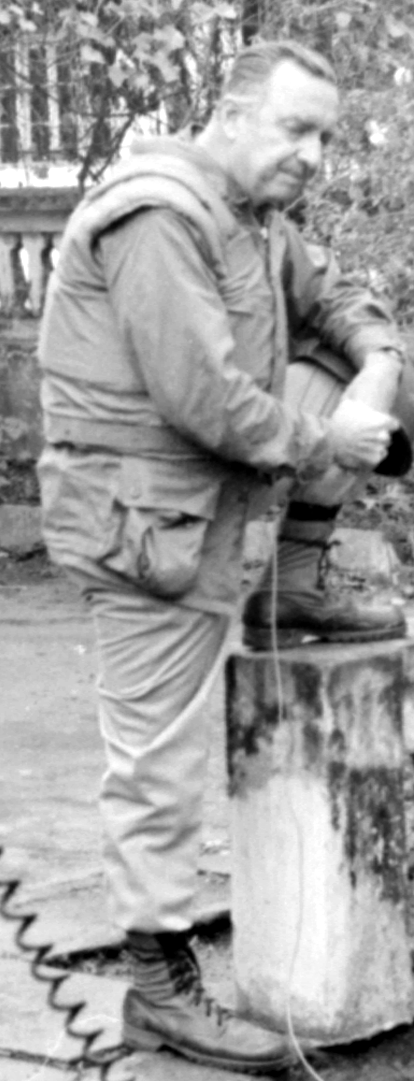
Cronkite in Vietnam, 1968

The claims about the presumed power of the “Cronkite Moment” of 1968 — when CBS News anchorman Walter Cronkite declared on-air that the U.S. military was “mired in stalemate” in Vietnam — are expansive and ever-expanding.

What supposedly made the “Cronkite Moment” so powerful and memorable was its effect of President Lyndon Johnson who, upon hearing the anchorman’s assessment, purportedly exclaimed:

“If I’ve lost Cronkite, I’ve lost Middle America.”

Or something to that effect.

Versions vary, markedly.

But as I discuss in my latest book, Getting It Wrong, Johnson did not see the Cronkite show when it aired on February 27, 1968. The president at the time was offering light-hearted remarks at the 51st birthday party of John Connally, then the governor of Texas.

So it’s hard to fathom how Johnson could have been much moved by a program he did not see.

Another expansive claim for the presumptive “Cronkite Moment” was that the “mired in stalemate” assessment turned American public opinion against the war.

Forbes magazine offered up that claim in a recent commentary, which declared:

“After viewing the carnage of a real war on televised nightly news for a few years, Middle America eventually agreed with CBS anchor Walter Cronkite, the ‘most trusted man in America,’ when he declared in 1968 that the war would end in stalemate.”

Agreed with Cronkite? In fact, Cronkite was following rather than leading American public opinion on the war.

As I discuss in Getting It Wrong, support for the war had begun ebbing months before the Cronkite program.

A Gallup poll in October 1967 found for the first time that a plurality of Americans — 47 percent — felt sending troops to fight in Vietnam had been a mistake.

A little more than two years earlier, only 24 percent of respondents said they thought sending American forces to Vietnam had been a mistake.

Not only that, but Cronkite’s “mired in stalemate” was hardly a remarkable or original assessment.

U.S. news media had used “stalemate” to describe the war months before Cronkite used the word in his on-air editorial comment.

For example, syndicated columnist James J. Kilpatrick wrote in August 1967:

“So long as the present ground rules obtain in Vietnam, this war will drag along its indecisive way. … [T]he condition is stalemate.”

And a few weeks before Cronkite’s on-air commentary, the NewYork Times declared in an editorial:

“Politically as well as militarily, stalemate increasingly appears as the unavoidable outcome of the Vietnam struggle.”

The Times’ observation, published February 8, 1968, anticipated Cronkite’s quite similar assessment of February 27, 1968:

“To say we are mired in stalemate seems the only realistic, yet unsatisfactory, conclusion.”

WJC

Recent and related:

Ignore new Jefferson-paternity study, see accuracy suffer

In Debunking, Media myths on October 20, 2011 at 9:53 am

The mainstream news media have largely shunned a significant new book that disputes the notion Thomas Jefferson had a long, loving relationship with a slave, Sally Hemings.

The drawbacks of ignoring the book, The Jefferson-Hemings Controversy: A Report of the Scholars Commission, are suggested by a Politico item posted yesterday.

Politico asserted:

“Most historians have concluded that, as a widower, Jefferson may have had as many as six children with Hemings, maintaining a 38-year relationship with her until his death in 1826.”

“Most historians”?

That’s a stretch, as The Jefferson-Hemings Controversy suggests.

It’s a collaborative work of 13 scholars, 12 of whom are either historians of Jefferson and his times or experts on politics and government. The outlier, as it were, is a biochemist, an expert on DNA testing.

The members of the scholars commission — empaneled by the Thomas Jefferson Heritage Society, which seeks to protect the reputation of the third president — describe in the book their collective credentials, writing:

“Most of us have studied Thomas Jefferson and his era for at least two decades, and we have held teaching or research appointments at Harvard, Yale, Stanford, Brown, Virginia, North Carolina, Kentucky, Indiana, Bowdoin, and many other respected institutions of higher learning.”

They also state that “after a careful review of all of the evidence, the commission agrees unanimously that the allegation [against Jefferson] is by no means proven. … With the exception of one member … our individual conclusions range from serious skepticism about the charge to a conviction that it is almost certainly false.”

But it’s “by no means proven.”

And yet media reports, such as that in Politico, typically treat the purported Jefferson-Hemings relationship as if it were settled history.

An important reason for the misinterpretation stems from DNA test results reported in 1998. The tests were widely misreported as identifying Jefferson as the father of Hemings’ youngest son, Eston.

The results were published in the journal Nature, which placed this erroneous headline above the article:

“Jefferson fathered slave’s last child.”

The Nature headline and its misreported findings had significant agenda-setting power.

The scholars commission, which was chaired by Robert Turner of the University of Virginia, note in the book that “much of the public has been misled about the significance of the DNA tests … reported in the journal Nature in November 1998.

“While the tests were professionally done by distinguished experts, they were never designed to prove, and in fact could not have proven, that Thomas Jefferson was the father of any of Sally Hemings’ children.”

The Jefferson-Hemings Controversy addresses the DNA evidence in some detail, noting that the tests “did no more than establish that Eston Hemings’ father was almost certainly a Jefferson.”

A Jefferson.

More than two dozen Jefferson men, including Thomas, could have been the father.

By then, though, Thomas Jefferson was 64-years-old — scarcely a leading paternity candidate.

The Jefferson-Hemings Controversy offers an intriguing hypothesis about why the DNA tests of 1998 were so widely misunderstood.

“Most Americans,” the book points out, “learned about DNA testing during the period leading up to and during the 1995 murder trial of O.J. Simpson, and they read in USA Today and other major papers than DNA ‘genetic fingerprints’ are ‘99.9 accurate’ or even ‘99.99 percent accurate.’

“When the Jefferson-Hemings story broke [nearly] four years later, it was not surprising that many people assumed scientists had matched Thomas Jefferson’s DNA with that of Sally Hemings’ children, and conclusively established Jefferson’s paternity by this remarkable new technology.

“But that is clearly not the case.”

WJC

Recent and related:

‘DNA evidence is all in’ on Jefferson? Got that wrong

In Debunking, Media myths on October 19, 2011 at 12:02 pm

Nearly 13 years have passed since the release of DNA testing evidence that was widely misreported as evidence that Thomas Jefferson had fathered children by a purported slave-mistress, Sally Hemings.

Jefferson (Library of Congress)

That evidence was scarcely so conclusive or definitive.

The testing in 1998 identified the third president as one of more than two dozen Jefferson men who may have been the father of Hemings’ youngest child, Eston.

One of more than two dozen Jefferson men.

Misrepresentations and mischaracterizations of the DNA evidence persist, as suggested by a commentary posted yesterday at the online site of U.S. News and World Report.

The commentary, written by Jamie Elizabeth Stiehm, asserted:

“After his beloved wife Martha died, Jefferson took as his mistress … a beautiful girl named Sally Hemings, decades years [sic] younger than he. At his stately Monticello in Virginia, his mountaintop, he was literally master of all he saw. That meant his two white daughters, horses, gardens, fields, a library of books, fine clothes, and the best of wines he chose during his Paris days.

“Never forget the 100 slaves Jefferson owned to make the wheels of wealthy planter life go round. Among them were the Hemings children born to Sally Hemings — his own, but never recognized as such by Jefferson, even informally. They were the only four slaves he later set free, however, probably by a pact he kept with Sally Hemings. (And the DNA evidence is all in.)”

The “DNA evidence is all in”?

Not so.

As a recently published scholarly study about the controversy notes, the DNA tests “were never designed to prove, and in fact could not have proven, that Thomas Jefferson was the father of any of Sally Hemings’ children.

“The tests merely establish a strong probability that Sally Hemings’ youngest son, Eston, was fathered by one of the more than two dozen Jefferson men in Virginia at the time, seven of whom there is documentary evidence to believe may well have been at Monticello when Eston was conceived.”

One of more than two dozen Jefferson men.

Thomas Jefferson was 64 and ailing at the time Eston Hemings was conceived; Jefferson’s advanced age and infirmities make him an improbable paternity candidate.

The scholarly study, titled The Jefferson-Hemings Controversy: Report of the Scholars Commission, also says:

“The problem [in misinterpreting the DNA evidence] lies not only with a news media prone to over simplifying and sensationalizing complex stories.  Numerous prominent scholars have contributed to the misunderstanding by characterizing the DNA study as ‘confirming’ or ‘clinching’ the case for Thomas Jefferson’s paternity.”

Stiehm’s unsourced and uncritical commentary adds to the confusion.

She stumbles on another point, too, in stating that Hemings’ children “were the only four slaves [Thomas Jefferson] later set free.”

That’s wrong.

Robert Turner, a University of Virginia professor who edited The Jefferson-Hemings Controversy, says that “Thomas Jefferson legally freed (manumitted) seven slaves that we know of.”

They included  Sally Hemings’ brothers, Robert and James, as well as  Burwell Colbert, a son of Sally’s sister, Bett; Sally’s brother, John, and Joseph Fossett, a son of Sally’s sister, Mary.

Jefferson also freed Sally’s youngest children, Madison and Eston, Turner notes.

The reference in The Jefferson-Hemings Controversy to the news media’s “over simplifying and sensationalizing complex stories” deserves additional comment.

Complexity-avoidance often characterizes news coverage, as I note in my latest book, Getting It Wrong.

“All too often,” I write, “the news media seem complexity-adverse and exceedingly eager to simplify and synthesize.

“This tendency is explained in part by the tyranny of deadlines and the limitations of on-air time and newsprint space. Even so, few important events can be explained without recognizing and acknowledging their context and intricacies.”

That certainly holds for the Jefferson-Hemings controversy. News reports and commentary about the matter almost invariably embrace the simplistic but wholly unproven narrative that Jefferson took a slave as a years-long mistress.

WJC

Recent and related:

Finally: Some attention for book disputing Jefferson-slave mistress liaison

In Debunking, Media myths on October 16, 2011 at 11:22 am

C-Span 3 aired today the news conference launch of a thoroughly researched but largely ignored book disputing the narrative that Thomas Jefferson had children by a slave-mistress.

The C-Span program represented a rare occasion in which prominent U.S. news media have given attention to the book, The Jefferson-Hemings Controversy: Report of the Scholars Commission, which was released September 1 at the National Press Club in Washington.

The C-Span program showed the 90-minute news conference in full, and featured the editor of the volume, Robert Turner, a history professor at the University of Virginia.

Turner headed a commission of Jefferson scholars, which was organized in 2000 by the Thomas Jefferson Heritage Society to explore claims about Jefferson and his slave, Sally Hemings.

Turner at the news conference reviewed a welter of evidence, circumstantial and otherwise, that points away from Jefferson’s paternity.

“You look at all the pieces,” Turner said, “and they don’t point to a romantic or a sexual relationship” between Jefferson and Hemings.

The book points out that little is known about Hemings and that she “appears to have been a very minor figure in Thomas Jefferson’s life.” The third U.S. president referred to her in just four of the tens of thousands of letters he wrote.

Mainstream U.S. news media have assiduously ignored the book and its exculpatory detail about Jefferson.

When of late they have mentioned the matter, they’ve essentially bowed to the orthodoxy that Jefferson and Hemings were sexual partners.

The Washington Post, for example, referred in an article late last week to “the discovery of descendants of Thomas Jefferson and his slave Sally Hemings” — without saying just who those descendants were, or how “the discovery” was made.

As The Jefferson-Hemings Controversy points out, the evidence is neither conclusive nor compelling that Jefferson fathered any of Hemings’ children.

The book notes that DNA testing conducted in 1998 was widely misreported as identifying Jefferson as having fathered children by Hemings. The DNA test results were reported in Nature in November 1998 beneath the erroneous headline, “Jefferson fathered slave’s last child.”

Nature’s error, Turner said, “caused a lot of confusion among the American people, very sadly.”

As the book points out, the DNA tests “were never designed to prove, and in fact could not have proven, that Thomas Jefferson was the father of any of Sally Hemings’ children.

“The tests merely establish a strong probability that Sally Hemings’ youngest son, Eston, was fathered by one of the more than two dozen Jefferson men in Virginia at the time, seven of whom there is documentary evidence to believe may well have been at Monticello when Eston was conceived.”

One of more than two dozen Jefferson men.

Thomas Jefferson at the time was 64 and ailing, hardly making him a leading paternity candidate. (Turner observed at the news conference that “most men in that era didn’t see 40.”)

A more likely candidate, Turner said, is Jefferson’s younger brother, Randolph, who was known to have socialized with the slaves at Thomas Jefferson’s home, Monticello.

So — will the Post correct or clarify its unsubstantiated and probably erroneous reference to “descendants” of Jefferson and Hemings?

That it will is probably as likely as the Post’s deciding to review The Jefferson-Hemings Controversy.

WJC

Recent and related:

‘New Yorker’ misinterprets Zhou’s ‘too early’ remark

In Debunking, Media myths on October 14, 2011 at 12:28 am

The New Yorker magazine ruminates in its latest number about the amorphous and bizarre Occupy Wall Street protests and in doing so invokes the mythical quotation about Chinese premier Zhou Enlai and the French Revolution.

About the protest movement, the New Yorker asked:

“[W]hat’s the meaning of it all? So far, the best answer is the one that Zhou Enlai, the Great Helmsman’s great henchman, supposedly gave when President Nixon supposedly asked him to assess the impact of the French Revolution: it’s too early to tell.”

Except that Zhou wasn’t referring to the French Revolution, which began in 1789. Rather, he was alluding to the civil unrest and protests that had seized France in 1968.

We know this from Nixon’s interpreter, a former U.S. diplomat named Charles W. (Chas) Freeman Jr., who was present at the meeting in Beijing in 1972 when Zhou made the remark.

First to call attention the Zhou misinterpretation was London’s Financial Times, which quoted Freeman’s remarks at a panel discussion four months ago in Washington, D.C.

Freeman told me in a subsequent interview that it was “absolutely clear” from the context of the conversation that Zhou’s “too early” comment was in reference to the turmoil of 1968.

Freeman said Zhou’s remark probably was made over lunch or dinner, during a discussion about revolutions that had succeeded and failed. They included, Freeman added, the Prague Spring of 1968 and the Hungarian uprising of 1956, both of which the Soviet Union had crushed.

Freeman characterized Zhou’s remark as “a classic of the genre of a constantly repeated misunderstanding that has taken on a life of its own.”

He’s quite right about that.

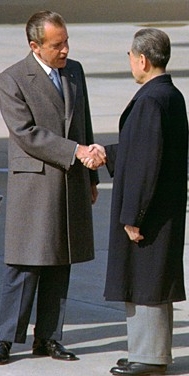
Nixon meets Zhou, 1972

The misinterpretation of Zhou’s remark long ago took on life of its own, offering as it did apparent confirmation about the sagaciousness of China’s leaders and their willingness or inclination to take an exceptionally long view of history.

But the misinterpreted version, Freeman noted, “conveniently bolstered a stereotype … about Chinese statesmen as far-sighted individuals who think in longer terms than their Western counterparts.”

The misconstrued comment, he added, fit nicely with “what people wanted to hear and believe.”

And so it told hold.

As the New Yorker essay suggests, the conventional interpretation — the erroneous version — retains broad appeal, despite Freeman’s well-publicized corrective.

Which does makes you wonder about the New Yorker’s vaunted fact-checkers, though.

WJC

Recent and related:

NYTimes errs, claims Woodward, Bernstein ‘unraveled’ Watergate

In Debunking, Media myths, Washington Post, Watergate myth on October 10, 2011 at 1:55 am

The New York Times inaccurately declared over the weekend that Bob Woodward and Carl Bernstein, in their reporting for the Washington Post, “unraveled the Watergate affair.”

The Times’ erroneous assertion was made in an obituary published Saturday about a minor figure in the Watergate scandal, Kenneth H. Dahlberg, who died last week. Watergate led to the resignation in 1974 of President Richard M. Nixon.

The obituary noted that Dahlberg was an “unwitting link between the Nixon re-election campaign and the five men … charged with breaking into the Democratic National Committee headquarters at the Watergate complex in Washington,” the scandal’s signal crime.

Dahlberg, the Times added, “had been a fund-raiser for Nixon’s re-election campaign, and his name was on a $25,000 cashier’s check that had been deposited in the bank account of one of the burglars, Bernard L. Barker. The money was to help cover the burglars’ expenses, and Mr. Barker had withdrawn that amount in $100 bills. He was carrying more than $5,000” when arrested at the DNC headquarters June 17, 1972.

The Times then asserted:

“Bob Woodward, a young reporter for The Washington Post who with Carl Bernstein unraveled the Watergate affair, has called the Dahlberg check the ‘connective tissue’ that turned what they thought was a story about a common crime into one of historic dimensions.”

That may be, but the Dahlberg connection was only a small, early step in unwinding the scandal. Interestingly, Dahlberg receives one, passing mention in Stanley I. Kutler’s exhaustive, single-volume work, The Wars of Watergate.

What’s more, Woodward and Bernstein scarcely can be credited with having “unraveled” Watergate — and the Times offered no evidence to support its exaggerated claim.

Rather, the Times effectively sidled up to the beguiling “heroic-journalist myth,”  which, as I write in my latest book,  Getting It Wrong, has become “the most familiar storyline of Watergate.”

What unraveled Nixon’s presidency wasn’t the reporting of Woodward and Bernstein for the Post but the incontrovertible evidence of his culpability in the crimes of Watergate — evidence captured on audiotapes that he secretly made of his conversations at the White House.

The decisive evidence — known as the “Smoking Gun” tape — revealed that Nixon at a meeting with his top aide, H.R. Haldemann, on June 23, 1972, sought to deflect or derail the FBI investigation into the Watergate burglary.

Woodward and Bernstein didn’t reveal the contents of that tape, which Watergate prosecutors had subpoenaed and which Nixon had refused to surrender until 1974, after the U.S. Supreme Court ordered him to do so.

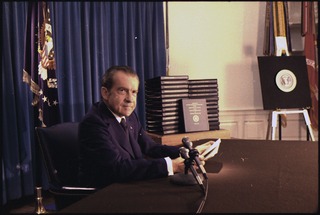
Nixon with tape transcripts, 1974

Nor did Woodward and Bernstein disclose the existence of Nixon’s secret audiotaping system, which proved so crucial to Watergate’s outcome.

The taping system was revealed in July 1973, during hearings of the U.S. Senate Select Committee on Watergate.

In All the President’s Men, their book about their Watergate reporting, Woodward and Bernstein said they had received a tip about the taping system a few days before its existence was made public.

According to All the President’s Men, Ben Bradlee, then the Post‘s executive editor, suggested not expending much energy pursuing the tip. And Woodward and Bernstein didn’t.

What really “unraveled” Watergate, I write in Getting It Wrong, “was the collective if not always the coordinated forces of special prosecutors, federal judges, both houses of Congress, the Supreme Court, as well as the Justice Department and the FBI.

Even then, despite all that scrutiny and pressure, Nixon, I argue, “likely would have served out his term if not for the audiotape recordings he secretly made of most conversations in the Oval Office of the White House.”

WJC

Many thanks to Jack Shafer for linking
to this post

Recent and related: