W. Joseph Campbell

Posts Tagged ‘New York Times’

The Internet’s uneven capacity to expose media fakes

In Debunking, Media myths, Media myths and radio, Newspapers, War of the Worlds on July 30, 2012 at 10:35 am

Glenn Greenwald, a columnist for the online magazine Salon, hailed yesterday the corrective capacity of the Internet, noting how quickly a purported column by Bill Keller, one-time executive editor of the New York Times, was exposed over the weekend as an imaginative fake.

In pressing the argument, though, Greenwald offered up a hoary media myth that has survived quite well in the age of the Internet.

Greenwald wrote: “For anyone who still believes that traditional journalism is inherently more reliable than the Internet, just … compare the duration and seriousness of the frauds and fakes enabled by the model of traditional journalism.

“Long before the Internet — in 1938 — a dramatized radio broadcast by Orson Wells [sic] (“The War of the Worlds”) of Martians landing on Earth spawned mass panic.”

The notion that The War of the Worlds radio dramatization set off “mass panic” is a delicious tale.

But as I discuss in my latest book, Getting It Wrong, it’s also a tenacious media-driven myth “that offers a deceptive message about the influence radio wielded over listeners in its early days and, more broadly, about the media’s potential to sow fright, panic, and alarm.”

I point out that “the panic and mass hysteria so readily associated with The War of The Worlds program did not occur on anything approaching nationwide dimension.”

Some people who listened to the show in 1938 were frightened or disturbed by what they heard. But there is no evidence their fright rose to anything approaching “mass panic” or nationwide hysteria.

Indeed, most listeners recognized Welles’ program for what it was— an imaginative and entertaining show on the night before Halloween.

But newspaper reports the following day advanced the notion that “mass panic” had swept the country.

“These reports,” I point out, “were almost entirely anecdotal and largely based on sketchy wire service roundups that emphasized breadth over in-depth detail.”

But newspapers in 1938 “simply had no reliable way of testing or ascertaining the validity of the sweeping claims they made about the radio show,” I write.

Nonetheless, the purported “panic-broadcast” offered U.S. newspapers “an exceptional and irresistible opportunity to rebuke radio — then an increasingly important rival source for news and advertising — as unreliable and untrustworthy,” I write.

The overwhelmingly negative commentary in the American press, helped frame and solidify the erroneous impression that The War of the Worlds dramatization had sown mass panic and hysteria.

The debunking of the myth is told not only in Getting It WrongI’ve blogged about the dubious “panic broadcast,” too, as posts here, here, here, and here indicate. I’ve also written about The War of the Worlds myth for the BBC online. Others have discussed the myth in blog posts as well, notably Michael Socolow in a fine dissection in 2008.

So why does the myth live on in the digital age? Why is it resistant to the Internet’s capacity, which Greenwald extols, to detect errors and swiftly banish them?

Obviously, the notion of the “panic broadcast” became entrenched in media lore long before the digital age. Indeed, it began taking dimension the day after Welles’ clever show.

Once a myth becomes thoroughly entrenched, it may be beyond the Internet’s power ever  to dismantle. (See also, William Randolph Hearst’s purported vow to “furnish the war” with Spain; the supposed “Cronkite Moment” of 1968, and the misleading dominant narrative of Watergate.)

What’s more, the notion that tens of thousands of Americans were abruptly pitched into “mass panic” one night long ago remains a perversely appealing and irresistible tale. Its retelling affirms in a way the reassuring view that Americans these days are hardly the gullible rubes their ancestors were, back when broadcast media was emergent.

The mythical “panic broadcast” also offers a timeless anecdote with which to bash the media. The tale, after all, does suggest that when circumstances are just so, the media can spread fear and disruption, profoundly and unexpectedly.

WJC

Many thanks to Instapundit
Glenn Reynolds for linking to this post

Recent or related:

Chris Matthews invokes the ‘if I’ve lost Cronkite’ myth in NYT review

In Cronkite Moment, Debunking, Media myths, New York Times, Quotes, Reviews on July 9, 2012 at 7:29 am

The New York Times lined up Chris Matthews, voluble host of cable television’s Hardball program, to review Douglas Brinkley’s Cronkite, the new biography about legendary CBS News anchorman Walter Cronkite.

LBJ wasn’t watching Cronkite’s report

Matthews turned in a fluffy review, published yesterday, that invoked one the American journalism’s best-known media myths — the claim that President Lyndon B. Johnson was dramatically moved by Cronkite’s on-air assessment about the war in  Vietnam.

“Cronkite never shied away from telling hard truths,” Matthews writes in his review. “Recall his half-hour ‘Report From Vietnam’ on Feb. 27, 1968, in which he declared the Vietnam War a ‘stalemate.’ It was a verdict the veteran war correspondent didn’t relish delivering, but Cronkite, who had recently returned from reporting on the Tet offensive, now believed that the war was unwinnable and indefensible.”

Matthews then repeats Brinkley’s thinly supported claim that Cronkite’s “stalemate” pronouncement had “seismic” effects.

Matthews adds, presumably as evidence of such an effect: “President Johnson reportedly said, ‘If I’ve lost Cronkite, I’ve lost the country.'”

But as I discuss in my latest book, Getting It Wrong, there’s no persuasive evidence that Johnson ever uttered such a remark.

Indeed, the president’s purported comment is defined by what I call acute version variability. That is, there is no agreed-upon version of what Johnson supposedly said in reacting to Cronkite’s “stalemate” assessment.

Other versions include:

“If I’ve lost Cronkite, I’ve lost Middle America.”

“If I’ve lost Cronkite, I’ve lost the war.”

“If I’ve lost Cronkite, I’ve lost the American people.”

“If I’ve lost Cronkite, I’ve lost the nation.”

And so on. (The Richmond Dispatch in a review published yesterday of Cronkite said Johnson exclaimed: “My God, if I’ve lost Cronkite, I’ve lost the country.”)

As I’ve noted previously at Media Myth Alert, if anyone’s words should be captured with precision, they ought to be the president’s. Especially on matters as critical as support for war policy. The wide variance as to what Johnson supposedly said is, then, a marker of a media myth.

Even more injurious to the case that Cronkite’s pronouncement was of great significance is that Johnson didn’t see the program when it was broadcast.

The president was not at the White House on February 27, 1968; nor was he in front of a television set when Cronkite’s program aired.

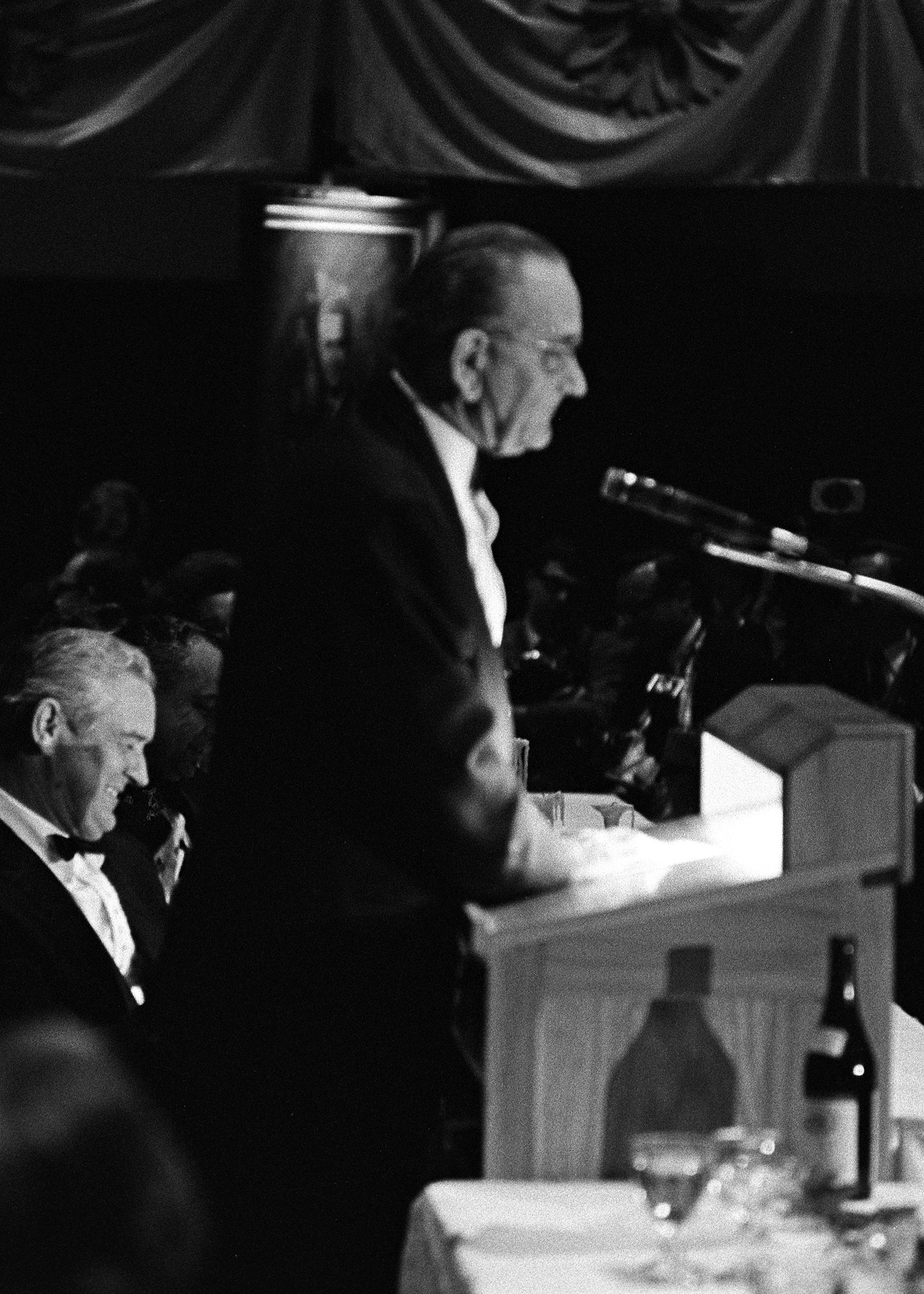
And about the time Cronkite intoned his “stalemate” assessment, Johnson was offering light-hearted remarks in Austin, Texas, at the 51st birthday party of Texas Governor John Connally (see photo, above).

“Today you are 51, John,” the president said. “That is the magic number that every man of politics prays for — a simple majority.”

I further note in Getting It Wrong that there is no compelling evidence that Johnson saw the Cronkite program later, on videotape.

Even if he had, Cronkite’s characterization of the was as a “stalemate” would have come as old news to the president. What Cronkite said about Vietnam on February 27, 1968, hardly earth-shaking, stunning, or original.

In no way did it alter the course of the war or influence American policy.

If anything, Cronkite’s observation about a “stalemate” was a rehash of what other news organizations, such as the New York Times, had been saying for months.

For example, the Times said in a news analysis published July 4, 1967:

“Many officers believe that despite the commitment of 466,000 United States troops now in South Vietnam … the military situation there has developed into a virtual stalemate.”

And in a report from Saigon that appeared on August 7, 1967, the Times noted:

“‘Stalemate’ is a fighting word in Washington. President Johnson rejects it as a description of the situation in Vietnam. But it is the word used by almost all Americans here, except the top officials, to characterize what is happening.”

So why bother calling out Matthews for casually invoking the central component of the mythical “Cronkite Moment”?

Doing so serves to highlight how insidious the myth has become, how blithely it is marshalled to support the notion that courageous and motivated journalists can do marvelous things.

Doing so also demonstrates anew that not even prominent and presumably fact-checked news organizations such as the Times are resistant to the intrusion of hoary media myths.

And doing so indicates that at least some high-profile contemporary journalists possess a shaky command of the history of their field.

WJC

Many thanks to Instapundit
Glenn Reynolds for linking to this post

Recent or related:

The media myths of Watergate: Part One

In Anniversaries, Cinematic treatments, Debunking, Media myths, Newspapers, Reviews, Scandal, Washington Post, Watergate myth on June 17, 2012 at 6:00 am

This is the first of five posts addressing prominent media-driven myths about the Watergate scandal, which began unfolding 40 years ago with the foiled burglary at the headquarters in Washington of the Democratic National Committee. This installment discusses the tenacious myth
that reporting by the 
Washington Post brought down
Richard Nixon’s corrupt presidency
.

Other posts in this series
may be accessed here, here, here, and here.

For years, the dominant narrative of Watergate has been that the dogged reporting of Bob Woodward and Carl Bernstein for the Washington Post revealed the crimes that forced Richard Nixon to resign the presidency in August 1974.

That’s also a media-driven myth — the heroic-journalist myth, as I called it in my 2010 book, Getting It Wrong.

I note in Getting It Wrong that the media-centric heroic-journalist construct “has become the most familiar storyline of Watergate,” serving as “ready short-hand for understanding Watergate and its denouement, a proxy for grasping the scandal’s essence while avoiding its forbidding complexity.”

The misdeeds of Watergate were many. Twenty men associated with Nixon’s presidency or his 1972 reelection campaign went to jail for crimes such as perjury, obstruction of justice, and conspiracy.

Three powerful and related factors have propelled and solidified the heroic-journalist trope in the popular consciousness.

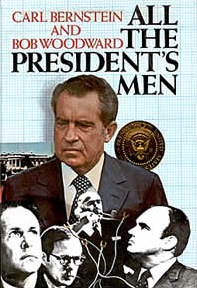
One factor was Woodward and Bernstein’s engaging book about their Watergate reporting, All the President’s Men, which came out in June 1974, just as the scandal was nearing culmination.

As Stanley I. Kutler, Watergate’s preeminent historian, has written, All the President’s Men “offered a journalistic brief to the nation as it prepared to understand and judge for itself” the growing evidence of Nixon’s guilt.

All the President’s Men was quite the success, holding the top spot on the New York Times’ non-fiction best-seller list for 15 weeks — through the climatic days of Watergate and beyond.

“The book’s impeccable timing,” I write in Getting It Wrong, served to “promote an impression that Woodward and Bernstein were central to Watergate’s ultimate outcome.”

The book that helped promote a myth

That impression was deepened in the cinematic version of All the President’s Men, which was released to great fanfare and rave reviews in April 1976.

The movie placed Woodward and Bernstein at the center of Watergate’s unraveling — and minimized or ignored the far more decisive contributions of subpoena-wielding investigators.

Indeed, rolling up a scandal of Watergate’s dimension and complexity required the collective efforts of special prosecutors, federal judges, both houses of Congress, the Supreme Court, as well as the Justice Department and the FBI.

And even then, as I write in Getting It Wrong, Nixon likely would have survived the scandal and served out his term if not for the audiotape recordings he secretly made of conversations in the Oval Office of the White House.

Only when compelled by the Supreme Court did Nixon surrender the recordings, which captured him approving a plan to divert the FBI’s investigation into Watergate’s seminal crime, the break-in June 17, 1972, at the headquarters of the Democratic National Committee.

The third factor in pressing the heroic-journalist myth firmly into the popular consciousness was the 30-year guessing game about the identity of Woodward’s stealthy, high-level source whom a Post editor code-named “Deep Throat.”

Speculation about the identity of “Deep Throat” came not infrequently and was often prominent. The guessing game offered periodic reminders about the Post and its Watergate coverage. The speculation effectively kept Woodward and Bernstein in the public eye far longer than they otherwise might have.

In 2005, W. Mark Felt, formerly second in command at the FBI, disclosed that he had been the “Deep Throat” source — giving rise to yet another round of reminiscing about the heroic journalists  of Watergate.

Such preening was misplaced, of course.

As Max Holland, author of Leak, a recent book about Watergate and “Deep Throat,” has aptly put it:

“Federal prosecutors and agents never truly learned anything germane from The Washington Posts [Watergate] stories — although they were certainly mortified to see the fruits of their investigation appear in print. … The government was always ahead of the press in its investigation of Watergate; it just wasn’t publishing its findings.”

Interestingly, principals at the Post have periodically scoffed at and rejected the heroic-journalist narrative.

For example, Katharine Graham, the Post’s publisher during and after Watergate, said at a program in 1997 marking the scandal’s 25th anniversary:

“Sometimes people accuse us of bringing down a president, which of course we didn’t do. The processes that caused [Nixon’s] resignation were constitutional.”

And Woodward  complained in 1996 that “the mythologizing of our role in Watergate has gone to the point of absurdity, where journalists write … that I, single-handedly, brought down Richard Nixon.

“Totally absurd.”

Indeed. To explain Watergate through the lens of the heroic-journalist is to simplify and misunderstand the scandal. It is to misread history and indulge in a beguiling media-driven myth.

WJC

Recent or related:

40 years on: The ‘napalm girl’ photo and its associated errors

In Anniversaries, Debunking, New York Times, Photographs on June 3, 2012 at 8:47 am

‘Napalm Girl’ image (Nick Ut/AP)

Nearly 40 years have passed since an Associated Press photographer, Nick Ut, took one of the most memorable photographs of the Vietnam War — the image of a 9-year-old girl screaming in terror as she fled, naked, from a misdirected napalm attack.

In a recent retrospective article, the AP said the famous photo, taken June 8, 1972, “communicated the horrors of the Vietnam War in a way words could never describe, helping to end one of the most divisive wars in American history.”

There’s no denying the stunning quality of what often is called the “napalm girl” image. But whether it helped “end” the Vietnam War is improbable: That’s an exaggeration, a case of locating far too much significance in a single image.

By mid-June 1972, after all, most U.S. combat units had been removed from South Vietnam. For American forces, the ground war was quickly winding down.

The “napalm girl” image figured in a recent New York Times obituary about Horst Faas, a gruff, German-born photographer who spent years in Vietnam, covering the conflict for the AP.

Faas won two Pulitzer Prizes for his work in Vietnam and, later, in Bangladesh. And he was instrumental in making sure the AP moved the “napalm girl” photograph across its wires.

The Times quoted Faas as saying in an AP oral history: “The girl was obviously nude, and one of the rules was we don’t — at the A.P. — we don’t present nude pictures, especially of girls in puberty age.” Even so, the Times wrote, Faas “set his mind on ‘getting the thing published and out.'”

Ut’s photograph won a Pulitzer Prize in 1973.

The Times’ obituary described the photograph as showing “the aftermath of one of the thousands of bombings in the countryside by American planes: a group of terror-stricken children fleeing the scene, a girl in the middle of the group screaming and naked, her clothes incinerated by burning napalm.”

Except that the plane that dropped the napalm wasn’t American.

It was South Vietnamese (as the AP correctly notes in its recent retrospective, stating: “As the South Vietnamese Skyraider plane grew fatter and louder, it swooped down toward her, dropping canisters like tumbling eggs flipping end over end”).

By referring to “American planes,” the Times‘ obituary insinuates that U.S. forces were responsible for the napalm attack that preceded Ut’s photograph — and I pointed this out in an email to the Times.

The newspaper’s assistant obituary editor, Peter Keepnews, replied by email, saying:

“You are correct that the bombing in question was conducted by the South Vietnamese Air Force. However, the obituary referred only to ‘American planes,’ and there does not seem to be any doubt that this plane was American –- a Douglas A-1 Skyraider, to be precise.”

As if the aircraft’s manufacturer was at all central or relevant.

I said as much in replying to Keepnews.

“I think you’re too eager to avoid a correction, or a clarification,” I wrote. “The manufacturer (or ownership) of the aircraft is inconsequential; far more important is who was flying the planes. And the obit’s wording (‘bombings in the countryside by American planes’) clearly suggests the aerial attacks were carried out [by] Americans, and that Americans caused the deaths and injuries. And that wasn’t the case. The aircraft were American-made, but flown by South Vietnamese pilots.

“A clarification seems in order,” I wrote, “to make the distinction clear.”

Keepnews sent this brief, dismissive response:

“Thank you for your feedback.”

In reply, I pointed out to Keepnews that the brief bios the Times published of the Pulitzer winners in 1973 correctly said that Ut had taken the photo “after South Vietnamese dropped napalm on own people by mistake.”

Keepnews sent no response, and the Times has neither corrected nor clarified the erroneous reference in the Faas obit to the aircraft that dropped the napalm.

The Times should.

After all, Bill Keller, then the newspaper’s executive editor, asserted in a column last year that “when we get it wrong, we correct ourselves as quickly and forthrightly as possible.”

It’s advice worth following.

WJC

Recent or related:

Kurtz invokes ‘if I’ve lost Cronkite’ myth in reviewing new Cronkite biography

In Cronkite Moment, Debunking, Media myths on May 21, 2012 at 3:50 pm

Media critic Howard Kurtz invokes one of American journalism’s most tenacious media myths in a review today about the forthcoming biography of Walter Cronkite, the CBS News anchorman from 1962-81.

Out soon

Kurtz writes in the review, which is posted at the Daily Beast:

“As everyone from presidents to astronauts catered to him, Cronkite used that access to drive unflinching coverage of civil rights, corruption, and especially the morass of Vietnam — when his own reporting led him to declare that ill-fated conflict a stalemate. When LBJ said that ‘if I’ve lost Cronkite, I’ve lost the country,’ he was acknowledging that a single newsman had the power to change a national narrative.”

It’s highly arguable whether Cronkite “had the power to change a national narrative.”

But first, that mythical “I’ve lost Cronkite” quotation.

As I discuss in my latest my book, Getting It Wrong, there is no compelling, first-hand evidence that LBJ — President Lyndon B. Johnson — ever uttered the comment about losing Cronkite.  (Douglas Brinkley, author of the Cronkite biography, writes in the latest issue of American Heritage magazine that Johnson “probably didn’t” make such a statement. The evidence is far more persuasive than “probably didn’t,” though.)

Legend has it that Johnson said something of the sort in reacting to Cronkite’s special televised report about Vietnam, which aired February 27, 1968. At the close of the broadcast, Cronkite declared the U.S. war effort was “mired in stalemate.”

Johnson, supposedly, watched the program at the White House. Upon hearing Cronkite’s assessment, the president snapped off the television set and declared to an aide or aides:

“If I’ve lost Cronkite, I’ve lost Middle America.”

Or, as Kurtz writes, the president said: “If I’ve lost Cronkite, I’ve lost the country.”

Or: “If I’ve lost Cronkite, I’ve lost the war.”

Or: “If I’ve lost Cronkite, I’ve lost the American people.”

Or something to that effect. Versions vary (and version variability of such magnitude is a signal of a media myth).

The power of that broadcast stems from the immediate and visceral effect the anchorman’s critique supposedly had on the president.

It is, though, exceedingly unlikely that Johnson had any reaction of the sort. After all, as I discuss in Getting It Wrong, the president wasn’t in front of a television set that night.

He was on the campus of the University of Texas at Austin, attending the 51st birthday party of Governor John Connally.

About the time the anchorman intoned his “mired in stalemate” comment, Johnson wasn’t lamenting any loss of support from Cronkite. Johnson was making light of Connally’s age, saying:

“Today you are 51, John. That is the magic number that every man of politics prays for — a simple majority.”

So it’s difficult to fathom how Johnson could have had much moved by a television program he didn’t see. Or ever discussed with Cronkite.

I further note in Getting It Wrong that Johnson’s supposedly “self-pitying reaction to Cronkite’s on-air assessment clashes sharply” with his contemporaneous characterizations of the war.

“Hours before the Cronkite program,” I write, “Johnson delivered a little-recalled but rousing speech on Vietnam, a speech cast in Churchillian terms. It seems inconceivable that Johnson’s views would have pivoted so swiftly and dramatically, upon hearing the opinion of a television news anchor, even one as esteemed as Cronkite.”

In that speech, Johnson declared:

“Persevere in Vietnam we will, and we must.” The militancy of the president’s remarks render the purported despairing comment about having “lost Cronkite” all the more improbable.

Even if Johnson later heard — or heard about— Cronkite’s “stalemate” assessment, it would have come as no epiphany. “Stalemate,” after all, had been bruited for months in Washington policy circles and in South Vietnam.

Indeed, less than three weeks before Cronkite’s televised commentary, the New York Times declared in an editorial:

“Politically as well as militarily, stalemate increasingly appears as the unavoidable outcome of the Vietnam struggle.”

The phrasing seemed to anticipate Cronkite’s on-air assessment, in which he declared:

“To say that we are mired in stalemate seems the only realistic, yet unsatisfactory, conclusion.”

In any case, Johnson didn’t turn dovish in the days following Cronkite’s report. Not long after the program, the president delivered a lectern-thumping speech in Minnesota in which he urged a “total national effort to win the war” in Vietnam.

“We love nothing more than peace,” Johnson said on that occasion, “but we hate nothing worse than surrender and cowardice.”

So publicly, at least, Johnson remained hawkish in the immediate aftermath of the Cronkite program.

And as for Kurtz’s claim that Cronkite possessed singular power “to change a national narrative”? Cronkite, himself, didn’t much buy into that notion, not in the context of his 1968 report on Vietnam.

For example, Cronkite said in 1997 in promoting his memoir that the program’s effect on Johnson was akin to “a very small straw on a very heavy load he was already carrying.” Hardly narrative-changing.

(In the years just before his death in 2009, Cronkite did begin to embrace the purported impact of his 1968 program.)

In any event, public opinion polls indicated that Americans were turning against the Vietnam War by autumn 1967, well before the Cronkite report.

As Daniel C. Hallin memorably wrote in the former Media Studies Journal in 1998:

“Lyndon Johnson had essentially lost Mr. Average Citizen months before Cronkite’s broadcast.”

WJC

Recent and related:

Cronkite biographer on the ‘Cronkite Moment’: A bit muddled

In Cronkite Moment, Debunking, Media myths on May 20, 2012 at 8:53 am

Historian Douglas Brinkley will be out soon with an 800-page biography of Walter Cronkite, the prominent CBS News anchorman from 1962-1981.

In a cover story in the latest issue of American Heritage, Brinkley indicates how his biography will treat the mythical “Cronkite Moment” of 1968, when the anchorman’s televised “mired in stalemate” assessment about the Vietnam War supposedly sent shock waves through the administration of President Lyndon Johnson.

Judging from the American Heritage article, Brinkley’s take on the “Cronkite Moment” is a bit muddled.

And even somewhat misleading.

Brinkley writes, for example, that Cronkite’s opinion about the war “was widely quoted in the press …. Even the conservative Wall Street Journal’s editorial page said, ‘The whole Vietnam effort may be doomed.'”

But the Journal took no leads from Cronkite. It published its “may be doomed” editorial four days before the Cronkite program.

The editorial appeared February 23, 1968, and said “everyone had better be prepared for the bitter taste of a defeat beyond America’s power to prevent.”

Strong stuff.

Far stronger than the fairly tepid “Cronkite Moment” commentary, which the anchorman offered on February 27, 1968, near the close of a 30-minute special program, “Report from Vietnam.”

Cronkite declared that night: “To say that we are closer to victory today is to believe, in the face of the evidence, the optimists who have been wrong in the past. To suggest we are on the edge of defeat is to yield to unreasonable pessimism.

“To say that we are mired in stalemate seems the only realistic, yet unsatisfactory, conclusion.”

Brinkley’s article notes that Cronkite’s “calling the war a ‘stalemate’ was a middling position in 1968.” Indeed, it was hardly novel. As I point out in my latest book, Getting It Wrong:

“By late February 1968 … Cronkite’s ‘mired in stalemate’ assessment was neither notable nor extraordinary.” I point out that “nearly seven months before the program, the New York Times correspondent R.W. Apple Jr. had cited ‘disinterested observers’ in reporting that the war in Vietnam ‘is not going well.’ Victory, Apple wrote, ‘is not close at hand. It may be beyond reach.’

“Apple’s analysis was published on the Times’ front page, beneath the headline: ‘Vietnam: The Signs of Stalemate.'”

The Times’ analysis also noted: “‘Stalemate’ is a fighting word in Washington. President Johnson rejects it as a description of the situation in Vietnam. But it is the word used by almost all Americans here, except the top officials, to characterize what is happening” in the war.

While Brinkley concedes the unremarkable character of “mired in stalemate,” he nonetheless writes that “Cronkite’s ‘Report from Vietnam’ represented a turning point.”

To support that claim, Brinkley turns to the exaggerated assertion in David Halberstam’s The Powers That Be, that the Cronkite program marked “the first time in American history that a war had been declared over by a commentator.” (In my edition of Halberstam’s book, the closing portion of that sentence reads: “the first time in American history a war had been declared over by an anchorman.”)

Of course, though, the war dragged on for years.

In no way was the “Cronkite Moment” anything approaching a turning point. American public opinion notably had clearly begun shifting against the war by fall 1967, months before the Cronkite report on Vietnam.

And as journalist Don Oberdorfer noted in December 1967, the “summer and fall of 1967 [had] been a time of switching, when millions of American voters — along with many religious leaders, editorial writers and elected officials — appeared to be changing their views about the war.”

So if anything, Cronkite’s program trailed the shifts in American public opinion.

It is often said that Cronkite’s “stalemate” assessment exerted a powerful effect on Johnson, that the president exclaimed upon hearing the anchorman’s interpretation:

“If I’ve lost Cronkite, I’ve lost Middle America” (or, “If I’ve lost Cronkite, I’ve lost the war”; or, “If I’ve lost Cronkite, I’ve lost the country”; or something to that effect).

But it’s quite clear Johnson did not see the Cronkite report when it was shown on CBS and there is no certain evidence that he ever saw it later, on videotape.

The night of the Cronkite program, the president was on the campus of the University of Texas at Austin, at birthday party for Governor John Connally, a longtime political ally.

About the time Cronkite was intoning his “mired in stalemate” assessment, Johnson was offering light-hearted remarks about Connally’s age, saying: “Today you are 51, John. That is the magic number that every man of politics prays for — a simple majority.”

Even so, Brinkley’s article speculates that “Johnson must have known that the Cronkite broadcast — while stating the obvious — had done him major political damage.”

But Cronkite for many years rejected the notion that his “Report from Vietnam” had had much effect on Johnson. Indeed, Brinkley’s article quotes Cronkite as saying as much:

“‘No one has claimed, and I certainly don’t believe, that our broadcast changed his mind about anything. I do believe it may have been the back-breaking piece of straw that was heaped on the heavy load he was already carrying.'”

But even the “piece of straw” metaphor seems to overstate the effects of a program the president did not see, and never discussed with Cronkite.

Brinkley’s article does include intriguing references to Cronkite’s having
“given speeches promoting Johnson’s Great Society domestic policies, including Medicaid-Medicare, wilderness preservation, civil rights, and a hopper full of antipoverty measures.”

I was unaware that Cronkite had been such an open advocate of Johnson’s domestic policy initiatives.

WJC

Recent and related:

NYTimes blog embraces ‘March Madness’ myth, claims ‘Zero Productivity Zone’

In Debunking, Media myths, New York Times on March 15, 2012 at 2:22 pm

The productivity myth of March Madness has kicked around for years, apparently immune to the most thorough of debunkings.

As the NCAA men’s basketball tournament opened today, the New York Times college sports blog, “The Quad,” embraced the myth with a headline warning that U.S. workplaces were entering the “Zero Productivity Zone.”

“It is officially time to celebrate the two days a year when American productivity goes in the toilet and it’s a good thing,” a post at the blog declared, adding:

“Thursday and Friday are like a little escape hatch from the usual grind, with N.C.A.A. tournament games going non-stop and while the Puritans of the business world can wring their bony hands over paying people who are suddenly obsessed with the fate of Virginia Commonwealth, the proper response is: tough noogies.”

Sure, some of that’s meant tongue in cheek. Or faintly snarky.

But, still: Media Myth Alert is tempted to say “tough noogies” in calling out a blog post that so blithely repeats the dubious claim and contributes to perpetuating a hardy seasonal myth. And one that does so without data or documentation.

A quick LexisNexis search finds other media outlets indulging in the productivity myth, too.

The Christian Science Monitor, for example, reported the other day:

“According some employment specialists, the next two or three weeks often rank low for productivity, as employees either keep one eye on the scoreboard or just try to cope with less sleep. Even leading up to the second round, which starts Thursday, many employees spend a lot of company time ‘researching’ teams to compete in their office pools or in ‘bracketology’ showdowns online.”

To support such assertions the Monitor article turned to estimates by the Chicago outplacement firm, Challenger, Gray & Christmas, which over the years has propelled the myth with outlandish claims about productivity loss.

This year, the firm is a bit coy about projecting productivity losses. It claims in a news release that U.S. employers today and Friday may end up paying $175 million in wages to workers distracted by the games.

But Challenger proceeds to dismiss its own estimate, saying it’s not to be taken seriously.

On the second page of its news release, Challengers advises taking the estimate “with a grain of salt, as it is meant to be a tongue-in-cheek look at how technology continues to blur the line between our professional and personal lives.

“Ultimately,” the statement says, “March Madness will not even register a blip on the nation’s economic radar and even the smallest company will survive the month without any impact on their bottom line.”

Not even a blip.

Which makes one wonder why the company offers such outlandish estimates in the first place, given that they inject fresh life into a myth that deserves disposal on the slag heap of statistical imprecision. Is it so eager for free publicity?

And as Carl Bialik, the Wall Street Journal’s Numbers Guy, asked in a column seven years ago, “why does the press report studies whose authors don’t take them that seriously?”

Why, indeed?

No doubt because they’re simplistic and easily accessible. As I point out in my latest book, Getting It Wrong, among the most tenacious media myths are those that “minimize or negate complexity” and “offer simplistic and misleading interpretations instead.”

WJC

Recent and related:

Online at BBC News: Recalling the derivation of ‘All the news that’s fit to print’

In 1897, Anniversaries, New York Times, Newspapers, Yellow Journalism on February 11, 2012 at 12:10 am

The most famous seven words in American journalism — “All the news that’s fit to print” — took a permanent place 115 years ago yesterday in the upper left corner, or left “ear,” of the New York Times masthead.

On front page for 115 years

And I recalled that occasion in a piece for the BBC News online site, writing:

“The motto appeared on the Times’ front page without notice, commentary, or fanfare. In the years since, the phrase has been admired as a timeless statement of purpose, interpreted as a ‘war cry’ for honest journalism, and scoffed at as pretentious, overweening, and impossibly vague.

“Even the Times hasn’t been entirely consistent in its embrace and interpretation of those seven words. In 1901, at the 50th anniversary of its founding, the Times referred to ‘All the news that’s fit to print’ as its ‘covenant. In 2001, a Times article commemorating the newspaper’s 150th anniversary said of the motto:

“’What, exactly, does it mean? You decide. The phrase has been debated, and endlessly parodied, both inside and outside the Times for more than a century.’

“On occasion, the motto has been taken far too seriously, as in 1960 when Wright Patman, a U.S. congressman from Texas, asked the Federal Trade Commission to investigate whether ‘All the news that’s fit to print’ amounted to false and misleading advertising.

“’Surely this questionable claim has a tendency to make the public believe, and probably does make the public believe, that the New York Times is superior to other newspapers,’ Patman wrote.

“The Trade Commission declined to investigate, saying: ‘We do not believe there are any apparent objective standards by which to measure whether “news” is or is not “fit to print.”’

“No matter how it’s interpreted, the motto certainly is remarkable in its permanence. One-hundred fifteen years on the front page has invested the motto with a certain gravitas. It often has been associated with fairness, restraint, and impartiality — objectives that nominally define mainstream American journalism.

“A commentary in the Wall Street Journal in 2001 addressed those sentiments, describing the motto as the ‘leitmotif not merely for the Times, but also, by a process of osmosis and emulation, for most other general-interest papers in the country, as well as for much of the broadcast media.

“Interestingly, the ‘leitmotif’ of American journalism had its origins in marketing and advertising.

“’All the news that’s fit to print’ first appeared on an illuminated advertising sign, spelled out in red lights above New York’s Madison Square in early October 1896. That was about six weeks after Adolph S. Ochs had acquired the newspaper in bankruptcy court.

“Ochs, patriarch of the family that still controls and publishes the Times, had come to New York from Tennessee. His task was to differentiate the Times from its larger, aggressive, and wealthier rivals — notably the yellow press of William Randolph Hearst and Joseph Pulitzer. It was a tall order, given the beleaguered status of the Times in New York’s crowded newspaper market.

“Ochs possessed a keen sense of promotion and turned to a number of techniques to call attention to the Times. The illuminated sign at Madison Square was one. An even more successful promotion was a contest inviting readers to propose a better motto.

“In late October 1896, the Times announced it was offering $100 for the phrase of ten words or fewer that ‘more aptly’ captured the newspaper’s ‘distinguishing characteristics’ than ‘All the news that’s fit to print.’

“Hundreds of entries poured in. …  As the contest unfolded in the fall of 1896, the Times amended the rules, making clear it would not abandon ‘All the news that’s fit to print’ but would still pay $100 for the best suggestion. And entries kept coming in.

“A committee of Times staff narrowed the field to 150, which in turn was winnowed to four by the motto contest judge, Richard W. Gilder, editor of The Century magazine. The finalists were:

  • “Always decent; never dull”
  • “The news of the day; not the rubbish”
  • “A decent newspaper for decent people”
  • “All the world’s news, but not a School for Scandal”

“The latter entry, Gilder determined, was the best of the lot, and the Times paid the prize money to the author of the phrase, D.M. Redfield of New Haven, Connecticut.

“What exactly prompted Ochs to move ‘All the news that’s fit to print’ to the front page 115 years ago is not entirely clear. But his intent was unmistakable — to throw down a challenge to the yellow press, a challenge that Ochs ultimately won. The Times has long outlived the New York newspapers of Hearst and Pulitzer.

“So the motto lives on as a reminder, as a daily rebuke to the flamboyant extremes of fin-de-siècle American journalism that helped inspire ‘All the news that’s fit to print.'”

WJC

Recent and related:

NYTimes errs, claims Woodward, Bernstein ‘unraveled’ Watergate

In Debunking, Media myths, Washington Post, Watergate myth on October 10, 2011 at 1:55 am

The New York Times inaccurately declared over the weekend that Bob Woodward and Carl Bernstein, in their reporting for the Washington Post, “unraveled the Watergate affair.”

The Times’ erroneous assertion was made in an obituary published Saturday about a minor figure in the Watergate scandal, Kenneth H. Dahlberg, who died last week. Watergate led to the resignation in 1974 of President Richard M. Nixon.

The obituary noted that Dahlberg was an “unwitting link between the Nixon re-election campaign and the five men … charged with breaking into the Democratic National Committee headquarters at the Watergate complex in Washington,” the scandal’s signal crime.

Dahlberg, the Times added, “had been a fund-raiser for Nixon’s re-election campaign, and his name was on a $25,000 cashier’s check that had been deposited in the bank account of one of the burglars, Bernard L. Barker. The money was to help cover the burglars’ expenses, and Mr. Barker had withdrawn that amount in $100 bills. He was carrying more than $5,000” when arrested at the DNC headquarters June 17, 1972.

The Times then asserted:

“Bob Woodward, a young reporter for The Washington Post who with Carl Bernstein unraveled the Watergate affair, has called the Dahlberg check the ‘connective tissue’ that turned what they thought was a story about a common crime into one of historic dimensions.”

That may be, but the Dahlberg connection was only a small, early step in unwinding the scandal. Interestingly, Dahlberg receives one, passing mention in Stanley I. Kutler’s exhaustive, single-volume work, The Wars of Watergate.

What’s more, Woodward and Bernstein scarcely can be credited with having “unraveled” Watergate — and the Times offered no evidence to support its exaggerated claim.

Rather, the Times effectively sidled up to the beguiling “heroic-journalist myth,”  which, as I write in my latest book,  Getting It Wrong, has become “the most familiar storyline of Watergate.”

What unraveled Nixon’s presidency wasn’t the reporting of Woodward and Bernstein for the Post but the incontrovertible evidence of his culpability in the crimes of Watergate — evidence captured on audiotapes that he secretly made of his conversations at the White House.

The decisive evidence — known as the “Smoking Gun” tape — revealed that Nixon at a meeting with his top aide, H.R. Haldemann, on June 23, 1972, sought to deflect or derail the FBI investigation into the Watergate burglary.

Woodward and Bernstein didn’t reveal the contents of that tape, which Watergate prosecutors had subpoenaed and which Nixon had refused to surrender until 1974, after the U.S. Supreme Court ordered him to do so.

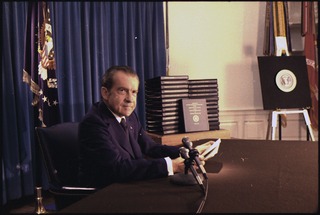
Nixon with tape transcripts, 1974

Nor did Woodward and Bernstein disclose the existence of Nixon’s secret audiotaping system, which proved so crucial to Watergate’s outcome.

The taping system was revealed in July 1973, during hearings of the U.S. Senate Select Committee on Watergate.

In All the President’s Men, their book about their Watergate reporting, Woodward and Bernstein said they had received a tip about the taping system a few days before its existence was made public.

According to All the President’s Men, Ben Bradlee, then the Post‘s executive editor, suggested not expending much energy pursuing the tip. And Woodward and Bernstein didn’t.

What really “unraveled” Watergate, I write in Getting It Wrong, “was the collective if not always the coordinated forces of special prosecutors, federal judges, both houses of Congress, the Supreme Court, as well as the Justice Department and the FBI.

Even then, despite all that scrutiny and pressure, Nixon, I argue, “likely would have served out his term if not for the audiotape recordings he secretly made of most conversations in the Oval Office of the White House.”

WJC

Many thanks to Jack Shafer for linking
to this post

Recent and related:

A counter-narrative: 9/11 did not ‘change everything’

In Anniversaries, Debunking, Media myths, New York Times, Newspapers, Washington Post on September 11, 2011 at 10:26 am

America’s news media have focused for days and more on the 10th anniversary of the terror attacks of September 11, 2001. The dominant, inevitable, yet misleading theme of the coverage: 9/11 “changed everything.”

“When Everything Changed,” the Washington Post declares on its front page today.

“The Day Everything Changed,” says the Star-Telegram of Fort Worth, Texas.

“A Decade of Change,” declares the Press of Atlantic City.

“Forever changed?” asks the lead headline in today’s Chattanooga Times Free Press.

That interrogative is inadvertently perceptive, suggesting as it does an important if largely ignored counter-narrative about 9/11:

It is striking how little, fundamentally, has changed in American life because of the attacks that killed nearly 3,000 people in lower Manhattan, at the Pentagon, and near Shanksville, Pennsylvania.

Airport check-ins, to be sure, are more imposing, grating, and intrusive than they were 10 years ago — suggestive of a broader if low-level and intermittent preoccupation with security matters.

But the hyperbolic, anniversary-driven coverage notwithstanding, the lives of most Americans seem not to have been dramatically or markedly altered by the vivid terror assaults 10 years ago.

Remember how the attacks were supposed to lead to a surge in patriotic sentiment? To a renewed commitment to religion and the spiritual side of life? To a deeper interest in news of the world? To a constant looking over one’s shoulder in anticipation of the next attack?

Polling data indicate that none of those responses to 9/11 was sustained or profound:

  • In June 2010, 59% of respondents to a Pew Research survey said they displayed the American flag at home, in the office, or on the car. That compares to 75% of the respondents  who said they did so in August 2002.
  • Pew Research data say that 36% of Americans attend religious services at least once a week, down from 42% in mid-November 2001.
  • In 2002, 48% of respondents to a Pew survey said they enjoyed keeping up with the news “a lot.”  In 2010, that response rate had ebbed to 45%.
  • Today’s Washington Post embeds revealing bits of survey data in its 16-page section devoted to the 9/11 anniversary. Particularly revealing was that 83% of residents in metropolitan Washington said no, they have not avoided a public event in recent years “because of concerns about terrorism.”

While the counter-narrative that 9/11 didn’t change everything has been obscure this year, it was somewhat in greater evidence at less-celebrated anniversaries of the attacks.

Two years ago, for example, the New York Times revisited predictions about how 9/11 would forever change Manhattan, and found them mostly empty and unfulfilled.

The Times article, “A Fortress City That Didn’t Come to Be,” recalled the expectations that emerged in the immediate aftermath of 9/11, writing:

“New York would become a fortress city, choked by apprehension and resignation, forever patrolled by soldiers and submarines. Another attack was coming. And soon.

“Tourists? Well, who would ever come again? Work in one of the city’s skyscrapers? Not likely. The Fire Department, gutted by 343 deaths, could never recuperate. …

“Eight years later, those presumptions are cobwebbed memories that never came to pass. Indeed, glimpses into a few aspects of the city help measure the gap between what was predicted and what actually came to be.”

“Cobwebbed memories that never came to pass.” A well-crafted passage, that — and an antidote, in a way, to the clichéd, “everything changed” coverage that has clouded the 10th anniversary of a terrible and infamous day.

After all, as columnist George Will wrote at the fifth anniversary of 9/11:

Nothing changes everything.”

WJC

Recent and related: