W. Joseph Campbell

Posts Tagged ‘Washington Post’

‘Getting It Wrong’ goes ‘On Point’

In Cinematic treatments, Cronkite Moment, Debunking, Furnish the war, Media myths, Media myths and radio, Spanish-American War, Washington Post, Watergate myth on June 3, 2010 at 8:52 pm

I was interviewed today by Tom Ashbrook, the engaging host of NPR’s On Point program, which is produced by WBUR in Boston.

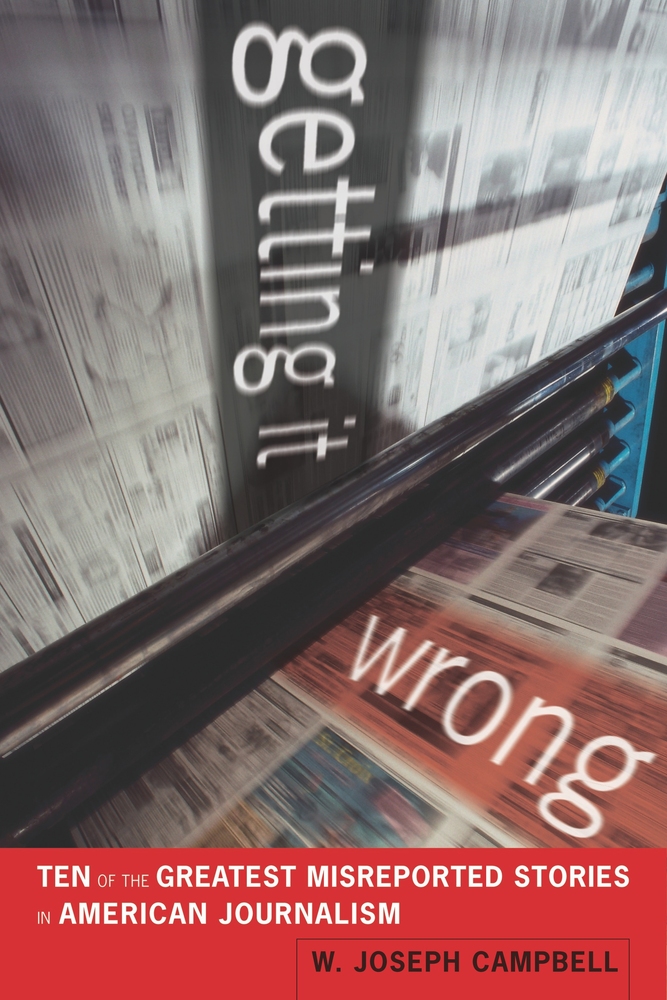
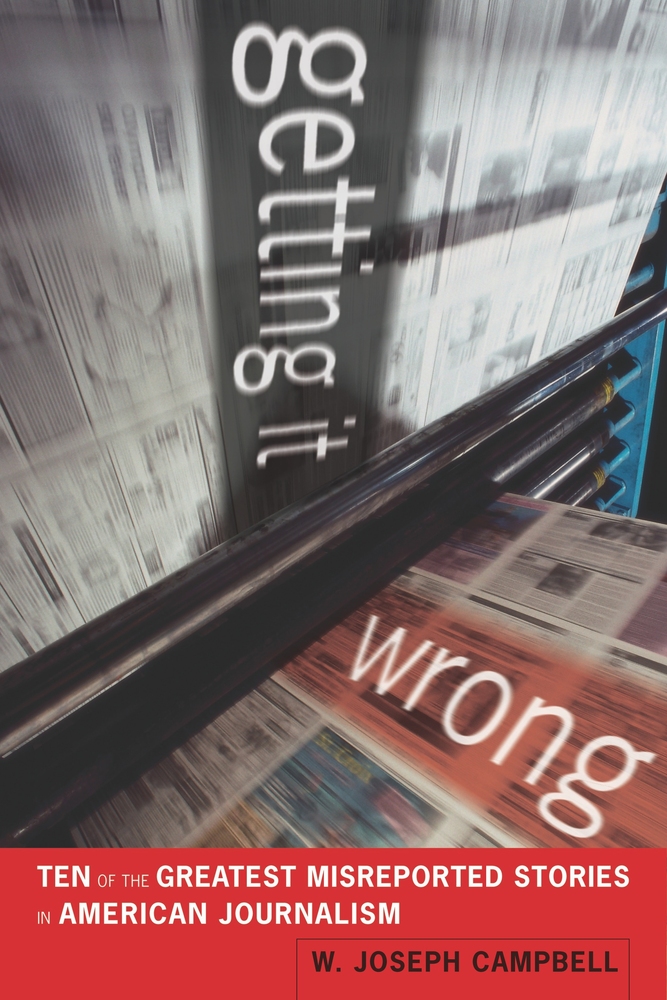
We discussed Getting It Wrong, my new book about media-driven myths, and it was a fine show. (Audio is available here.)

As Ashbrook promised in his introduction, the conversation ranged over a variety of topics–or what he called “iconic media tales from the Spanish-American War to Hurricane Katrina.”

We were joined by Jack Beatty, the program’s news analyst, and discussed at some length the myth of the so-called “Cronkite Moment” of 1968, in which CBS News anchorman Walter Cronkite characterized the war in Vietnam as a stalemate, supposedly prompting President Lyndon Johnson to alter his policy on the conflict.

We also took up myth surrounding the famous anecdote about William Randolph Hearst’s purported vow to “furnish the war” with Spain at the end of the 19th century, the dubious notion that Orson Welles’ 1938 radio dramatization of the War of the Worlds set off nationwide panic and mass hysteria, and what I call the heroic-journalist myth of Watergate, in which Bob Woodward and Carl Bernstein of the Washington Post supposedly brought down Richard Nixon’s corrupt presidency.

On the latter topic, I mentioned how the cinematic version of All the President’s Men, Woodward and Bernstein’s book about their Watergate reporting, has become the vehicle by which people learn about and remember the scandal.

Watergate was, I noted, “so complex that people these days, many years removed from it, find it hard to keep it all straight. … The high-quality, cinematic treatment of the Watergate scandal, featuring Woodward and Bernstein and the Washington Post in All the President’s Men, does happen to be the way that many people remember the Watergate scandal. …

“The movie’s a great movie,” I added. “But it helped to solidify the notion that the Post, the Washington Post, and Woodward and Bernstein were at the center, were at the heart, of uncovering the scandal.”

On Point featured questions and comments from a few callers–including a guy named Phil in Bowling Green, Kentucky, who said about me:

“I think the professor has got too much time on his hands. ” I chuckled.

He added: “I lived through most of that–the Watergate and Vietnam War.  I think he’s underestimating the persuasive attitude that Walter Cronkite had on this country. … Everybody’s opinion turned on what Walter Cronkite thought.”

But another caller, Gary from Nashville, Tennessee, weighed in, saying he disagreed with Phil from Bowling Green, offered the thought that public opinion about Vietnam turned not on the views of one journalist but on “the unrelenting reporting on the war by the media.”

It was a lively, substantive program that has generated a few dozen or so comments at the On Point online site.

The discussion made me recognize anew how deeply embedded and tenaciously held some media-driven myths really are, and how an hour-long program is hardly enough to encourage people even to think about giving them up. As Jack Shafer noted in his review of Getting It Wrong, “a debunker’s work is never done.”

But perhaps the show’s content will entice some listeners to buy and read the book. Even then, though, I suspect some media myths will prove resistant to thorough debunking.

WJC

Related:

A funny thing about media myths

In Cronkite Moment, Debunking, Media myths, Washington Post, Watergate myth on June 2, 2010 at 6:03 pm

Media-driven myths are prominent tales of doubtful authenticity—false, dubious, or improbable stories about the news media that masquerade as factual.

A funny thing about media-driven myths is that some of them live on despite having been pooh-poohed by figures who were central to the story.

The heroic-journalist myth of Watergate offers a telling example of this peculiar feature of some media myths.

The Watergate myth—one of 10 that I debunk in my soon-to-be-published book, Getting It Wrong—maintains that the intrepid investigative reporting of Bob Woodward and Carl Bernstein of the Washington Post brought down Richard Nixon’s corrupt presidency in the Watergate scandal.

“That Woodward and Bernstein exposed Nixon’s corruption is a favored theme in textbooks of journalism and mass communication,” I write in Getting It Wrong, noting how the tale has become “deeply ingrained in American journalism as one of the field’s most important and self-reverential stories.”

But leading figures at the Washington Post have sought periodically over the years to dismiss the notion that their newspaper took down a president.

Katharine Graham, the newspaper’s publisher during the Watergate years, insisted the Post did not topple Nixon. “Sometimes people accuse us of bringing down a president, which of course we didn’t do,” Graham said in 1997, at a program marking the scandal’s twenty-fifth anniversary. “The processes that caused [Nixon’s] resignation were constitutional.”

And Woodward has been quoted as saying, “To say that the press brought down Nixon, that’s horseshit.”

As I note in Getting It Wrong, to roll up a scandal of Watergate’s dimension and complexity “required the collective if not always the coordinated forces of special prosecutors, federal judges, both houses of Congress, the Supreme Court, as well as the Justice Department and the FBI.

“Even then,” I write, “Nixon likely would have served out his term if not for the audiotape recordings he secretly made of most conversations in the Oval Office of the White House. Only when compelled by the Supreme Court did Nixon surrender those recordings, which captured him plotting the cover-up and authorizing payments of thousands of dollars in hush money.”

Similarly, Walter Cronkite long dismissed claims that his televised report in February 1968 about the Vietnam War had a powerful influence on President Lyndon Johnson.

In an editorial comment at the close of that report, Cronkite said the war effort in Vietnam was “mired in stalemate” and suggested that negotiations eventually might offer a way out for the United States.

Upon hearing Cronkite’s dire assessment, Johnson supposedly snapped off the television set and exclaimed: “If I’ve lost Cronkite, I’ve lost Middle America.”

Or something to that effect. Versions vary.

The program and Johnson’s despairing response have become the stuff of legend—another media-driven myth.

Interestingly, Cronkite scoffed at the suggestion his report on Vietnam had a great effect on Johnson. For years, he characterized the program in modest terms, writing in his 1997 memoir that the “mired in stalemate” assessment was for Johnson “just one more straw in the increasing burden of Vietnam.”

But in what may have been tacit acknowledgement of the appeal of media-driven myths, Cronkite late in his life came to embrace the view that the program on Vietnam was a significant moment.

For example, he told Esquire magazine in 2006, about three years before his death:

“To be honest, I was rather amazed that my reporting from Vietnam had such an effect on history.”

But as is discussed in Getting It Wrong, Johnson did not see the Cronkite program when it aired. The president at the time was in Austin, Texas, making an appearance at the 51st birthday of a longtime political ally, Governor John Connally.

“Today you are 51, John,” the president said at about the time Cronkite was offering his “mired in stalemate” commentary. “That,” Johnson said, “is the magic number that every man of politics prays for—a simple majority.”

WJC

An earlier version of this post first appeared at the University of California Press blog.

‘Deep Throat’ outed self, five years ago today

In Anniversaries, Debunking, Media myths, Washington Post, Watergate myth on May 31, 2010 at 3:39 pm

It’s been five years since W. Mark Felt outed himself as the shadowy “Deep Throat” source of the Watergate scandal, the former No. 2 official at the FBI who in places like parking garages periodically passed information to Bob Woodward of the Washington Post.

Remarkably, Felt’s identity as the elusive “Deep Throat” had remained a secret (and was the subject of often-intense speculation) for more than 30 years, until Vanity Fair published an article on May 31, 2005, disclosing Felt’s “Deep Throat” role.

Felt was then 91 and in declining health. He died in 2008.

As I write in Getting It Wrong, my forthcoming book about media-driven myths, the prolonged guessing game about the identity of “Deep Throat” helped solidify the notion that the Washington Post was central to uncovering Watergate scandal. (Stanley I. Kutler, the leading historian of Watergate, once wrote that the “endless, pointless game of trying to identify Deep Throat” was a distraction from the lessons of Watergate.)

Getting It Wrong includes a chapter addressing and debunking what I call the heroic-journalist myth of Watergate–that the reporting of Woodward and his Post colleague, Carl Bernstein, brought down Richard Nixon’s corrupt presidency.

I write that the “guessing game about the identity of the ‘Deep Throat’ source provided periodic and powerful reminders about the Post and its Watergate coverage, serving to keep Woodward and Bernstein in the public eye far longer than they otherwise would have been.”

I also note:

“They and the mysterious ‘Deep Throat’ source became central figures” in what the Philadelphia Inquirer described as “the parlor game that would not die. … With each passing year, as ‘Deep Throat’s’ cloak of anonymity remained securely in place, his perceived role in Watergate gained gravitas.”

“And so,” I write, “… did the roles of Woodward and Bernstein.”

Although many people were named in the guessing game about “Deep Throat,” Felt always ranked high on the roster of likely candidates. As I note in Getting It Wrong, speculation about who was “Deep Throat” began in June 1974, with a front-page article in the Wall Street Journal, and continued periodically for the next 31 years.

The Journal article appeared soon after publication of All the President’s Men, Woodward and Bernstein’s best-selling book about Watergate in which they introduced the furtive source they called “Deep Throat.” The Journal article described Felt as the top suspect.

But Felt repeatedly denied having been “Deep Throat.” He was quoted as saying in the Journal article in 1974:

“I’m just not that kind of person.”

He told the Hartford Courant newspaper in 1999 that he “would have been more effective” had he indeed been Woodward’s secretive source, adding:

“Deep Throat didn’t exactly bring the White House crashing down, did he?”

On the day Felt was confirmed to have been “Deep Throat,” his family issued a statement calling him “a great American hero who went well above and beyond the call of duty at much risk to himself to save his country from a horrible injustice. We all sincerely hope the country will see him this way as well.”

But Felt hardly was such a noble character.

In his senior position at the FBI, Felt had authorized illegal burglaries as part of FBI investigations into leftists associated with the radical Weather Underground in the early 1970s.

Felt was convicted in 1980 on felony charges related to the break-ins but pardoned by President Ronald Reagan.

WJC

Related:


Recalling Mansfield’s contribution to unraveling Watergate

In Debunking, Media myths, Washington Post, Watergate myth on May 29, 2010 at 1:22 pm

Politics Daily posted yesterday an admiring piece–make that a hagiographic piece–about former U.S. Senate leader Mike Mansfield, saying his “savvy and sensibilities … are what our politics need on Memorial Day 2010.”

Well, maybe.

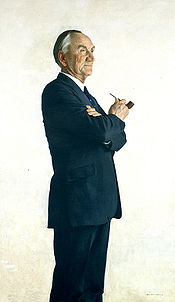
Mansfield (left), who died in 2001, was a Democrat from Montana and the Senate’s longest-serving majority leader, holding the position from 1961-1977.

In its most interesting passage, the Politics Daily commentary recalled Mansfield’s seldom-remembered contribution to unraveling the Watergate scandal, which culminated with President Richard Nixon’s resignation in 1974.

The commentary noted:

“He insisted on a special Senate committee to investigate the unfolding sins of the Nixon era … Because of Mike’s strategic decision to make the Senate investigation open, fair and bipartisan, the country supported a constitutional political process that, for the first time in history, forced a crook out of the White House.”

While that’s a bit over the top, it is clear that Mansfield’s efforts as majority leader to empanel a bipartisan select committee was crucial to the outcome of the scandal, which broke in June 1972 with the arrest of burglars inside Democratic National headquarters at the Watergate complex in Washington, D.C.

As Stanley I. Kutler, the leading historian of the scandal, wrote in his fine book, The Wars of Watergate:

“Watergate might have remained as the story-that-never-was had it not been for the determination of Mike Mansfield and Sam Ervin.”

Ervin, a Democrat from North Carolina, “played a crucial role in securing Senate passage of a resolution calling for the creation of a Select Committee to investigate illegal and unethical conduct in the 1972 presidential campaign,” Kutler wrote. “Mansfield, meanwhile, worked behind the scenes to marshal Democratic support for the resolution. He kept Ervin in the forefront, shrewdly using Ervin’s political capital among Southern Democrats and Republican senators.”

Ervin presided over the hearing of the select committee, which riveted much of the country during the summer of 1973. Its investigation led to the disclosure that Nixon had secretly tape-recorded most Oval Office conversations. Those tapes were crucial to revealing Nixon’s complicity in the scandal and forcing his resignation.

So why is this of interest, and pertinent, to Media Myth Alert?

Recalling Mansfield’s role illustrates anew how a variety of forces were needed to bring down Nixon’s corrupt presidency–a point raised in Getting It Wrong, my soon-to-be-published book that debunks prominent media-driven myths, those false, dubious, or improbable stories about the news media that masquerade as factual.

As I write in Getting It Wrong, rolling up a scandal of Watergate’s complexity required “the collective if not always the coordinated forces of special prosecutors, federal judges, both houses of Congress, the Supreme Court, as well as the Justice Department and the FBI.”

Even then, I argue, “Nixon likely would have served out his term if not for the audiotape recordings.”

The media-centric interpretation of Watergate is that the investigative reporting of the Washington Post was what brought down Nixon. A related claim is that if its reporting didn’t exactly take Nixon down, the Post alone kept the story alive in the summer and fall of 1972, when few people and institutions were much interested in Watergate.

Such claims are mistaken.

The Post didn’t take down Nixon; as leading figures at the newspaper have insisted as much from time to time over the years.

Nor was the Post alone in digging into Watergate during the summer and fall 1972. As I note in Getting It Wrong, rival news organizations such as Los Angeles Times and New York Times also pursued the scandal during those months.

Despite some revealing reporting by the Post and other news organizations, the dimensions of the Watergate scandal were hardly certain by May 1973, when the Senate select committee convened. It was “like an unassembled picture puzzle with crucial pieces missing,” Ervin recalled in his memoir of Watergate.

But with the committee’s hearings during summer of 1973, the scope of the scandal became clearer, leading relentlessly to Nixon and his closest aides.

WJC

Related:

At HuffPo books

In Cronkite Moment, Debunking, Media myths, Washington Post, Watergate myth on May 22, 2010 at 8:27 am

Check out my guest post at the Huffington Post books page about Getting It Wrong, my forthcoming book about media-driven myths.

I discuss the book, which will be published soon by University of California Press, and address reasons that help explain the tenacity and enduring appeal of media-driven myths.

I write:

“They are, first of all, deliciously good stories–too good, almost, to be disbelieved.

“They also are appealingly reductive, in that they minimize complexity of historical events and offer simplistic and misleading interpretations instead. The Washington Post no more brought down [President Richard] Nixon than Walter Cronkite swayed [President Lyndon] Johnson’s views about the war in Vietnam. Yet those and other media myths endure because they present unambiguous, easy-to-remember explanations for complex historic events.

“Some media-driven myths can be self-flattering, offering up heroes in a profession more accustomed to scorn and criticism than applause.

“More important, though, is that media-driven myths often emerge from an eagerness to find influence and significance in what journalists do. These myths affirm the centrality of the news media in public life and ratify the notion the media are powerful, even decisive actors.

“To identify these tales as media-driven myths is to confront the reality that the news media are not the powerful agents they, and so many others, assume them to be.”

That’s often the case: Because the media are everywhere, it is easy, as Robert J. Samuelson once wrote, to confound their presence with power.

And as the sociologist Herbert J. Gans has observed:

“If news audiences had to respond to all the news to which they are exposed, they would not have time to live their own lives. In fact, people screen out many things, including the news, that could interfere with their own lives.”

WJC

Woodward’s reporting ‘changed course of American history’?

In Debunking, Media myths, Washington Post, Watergate myth on May 16, 2010 at 12:10 pm

Bob Woodward’s “investigative reporting of Watergate changed the course of American history.”

So asserted a column in yesterday’s St. Petersburg Times.

Woodward (Library of Congress)

The author didn’t elaborate, or offer supporting evidence for such an exuberant claim. Presumably, he meant that reporting by Woodward and his Washington Post colleague, Carl Bernstein, brought down Richard Nixon’s corrupt presidency in the Watergate scandal of the early 1970s.

That, of course, is among the most appealing and enduring of the many media-driven myths–stories about and or by the news media that are widely believed and often retold but which, under scrutiny, prove apocryphal or wildly exaggerated.

I address, and debunk, 10 prominent media-driven myths in my forthcoming book, Getting It Wrong. Among them is what I call the heroic-journalist myth of Watergate–a trope that knows few bounds.

As I note in Getting It Wrong, even Washington Post officials over the years have scoffed at such claims.

Notable among them was Katherine Graham, the publisher during the Watergate period.

“Sometimes people accuse us of bringing down a president, which of course we didn’t do,” Graham said in 1997, at a program marking the scandal’s twenty-fifth anniversary. “The processes that caused [Nixon’s] resignation were constitutional,” she insisted.

Indeed, I write in Getting It Wrong, “Nixon’s fall was the consequence of his criminal conduct, which was exposed in the convergence of many forces, newspaper reporting being among the least decisive.”

Still, the heroic-journalist myth endures.

An important reason why Woodward and Bernstein are given so much credit is the need for heroes in a business that is much derided and little trusted. As I note in Getting It Wrong, which will be out next month, “media myths can be self-flattering, offering heroes like Woodward and Bernstein to a profession more accustomed to criticism than applause.”

I further write:

“Similarly, media myths invite indulgence in the ‘golden age fallacy,’ the flawed but enticing belief that there really was a time when journalism and its practitioners were respected and inspiring—the time, say, of Murrow or Cronkite, or Woodward and Bernstein.”

Such misplaced nostalgia has helped embed these myths firmly and decisively in media history.

WJC

Too good to be disbelieved: The military, myth, and Jessica Lynch

In Jessica Lynch, Washington Post on May 10, 2010 at 2:01 pm

I blogged last week about how the international spotlight periodically lands on Jessica Lynch, even though seven years have passed since a sensational but erroneous report in the Washington Post vaulted her to unsought fame and celebrity.

The spotlight has dimmed considerably in the years since the Post article about the Army private’s supposed heroics in an ambush in Nasiriyah in southern Iraq in 2003.

But when the spotlight does find Lynch, the dubious notion that the military promoted the fictional account of her battlefield derring-do inevitably seems to reemerge.

Such was the case yesterday in an article about Lynch in the Pittsburgh Post-Gazette.

The article asserted, without attribution, that “military officials, in widely circulated reports early in the war, initially described her as a female Rambo who fought back fiercely after the ambush. Ms. Lynch has maintained she never fired her weapon and was knocked unconscious during the attack.”

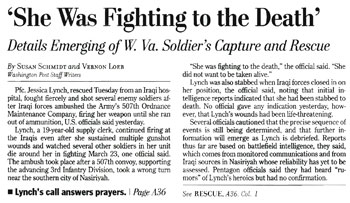
My forthcoming book on media-driven myths, titled Getting It Wrong, revisits the Lynch case, recalling how the Washington Post reported that Lynch had “fought fiercely” when her unit, the 507th Maintenance Company, was ambushed at Nasiriyah, that she had “shot several enemy soldiers” and had kept “firing her weapon until she ran out of ammunition.”

News organizations “around the world,” I write, “followed the Post’s lead by prominently reporting the supposed heroics of young Jessica Lynch and contemplating their significance.”

These outlets included the Pittsburgh Post-Gazette which at the time predicted Lynch “appears headed for life as an American icon, regardless of whether she likes it.”

Lynch is no icon, and her battlefield heroics were misattributed:  It wasn’t Lynch who had fought heroically at Nasiriyah, it was most likely Donald Walters, a cook-sergeant in Lynch’s unit who, after running out of ammunition, was captured by Iraqi irregulars, and executed.

Walters’ selfless deeds at Nasiriyah have received nothing akin to the attention bestowed upon Lynch, who suffered shattering injuries in the crash of a Humvee as she and others tried to flee the ambush.

Lynch, then 19, was taken prisoner and treated at by Iraqis a hospital in Nasiriyah, from where she was rescued on April 1, 2003, by a U.S. special operations team.

The Post's botched story

The Post has never disclosed the sources of its botched report about Lynch. The article, which was published on the front page on April 3, 2003, vaguely cited “U.S. officials.”

But as I note in Getting It Wrong, the newspaper’s then defense writer, Vernon Loeb, went on an NPR program in late 2003 and said he “could never get anybody from the Pentagon to talk about” the raw, battlefield intelligence reports that hinted of Lynch’s heroism.

“I got indications that they had, in fact, received those intelligence reports, but the Pentagon was completely unwilling to comment on those reports at all,” Loeb said in an interview on the “Fresh Air” show. “They wouldn’t say anything about Jessica Lynch.”

Loeb added:

“I just didn’t see the Pentagon trying to create a hero where there was none. I mean …they never showed any interest in doing that, to me.”

Like many media-driven myths, the notion that the Pentagon pushed the phony hero-warrior story of Jessica Lynch has proven irresistible–too good and delicious, almost, to be disbelieved.

Despite substantial evidence to the contrary.

WJC

Turning a spotlight again on Jessica Lynch

In Debunking, Jessica Lynch, Media myths, Washington Post on May 6, 2010 at 3:54 pm

It’s striking how a measure of fame still attaches to Jessica Lynch, the Army private thrust into the international spotlight seven years ago by an erroneous report in the Washington Post about her heroism in Iraq.

The Post's erroneous story

As I write in Getting It Wrong, my forthcoming book about media-driven myths, the “international spotlight … has never fully receded” from Lynch, a waif-like 19-year-old whom the Post misidentified as having fought fiercely after supposedly being shot and stabbed.

As it turned out, Lynch never fired a shot in anger in Iraq. She suffered neither gunshot nor stab wounds. She was severely injured, in the crash of a fleeing Humvee.

Lynch was taken captive by Iraqis and placed in a hospital, from where she was rescued by a U.S. special operation team.

The Post‘s botched report about her derring-do on the battlefield appears to have been a case of mistaken identity: It wasn’t Lynch who had fought heroically; it was most likely Sergeant Donald Walters, who was in Lynch’s unit and who was captured by Iraqi irregulars, and executed.

Walters never received anything near to the attention that was bestowed upon Lynch.

Further evidence of that came yesterday, with reports of a new show on cable’s Bio Channel that will feature William Shatner of Star Trek fame catching up with people who had won sudden fame and attention. (Bio formerly was the Biography Channel.)

Lynch was mentioned by name in writeups about the program, to be called Shatner’s Aftermath and to premiere in the fall. TV Guide said today that six episodes of Shatner’s Aftermath have been ordered.

The Post’s erroneous article about Lynch was published in early April 2003—and was picked up by news organizations around the world.

Lynch’s photograph appeared on the cover of Time and Newsweek magazines.

She insisted she was no hero. But no matter.

She accepted a book deal estimated at $1 million, half of which reportedly went to her biographer, Rick Bragg, a former New York Times correspondent. She went on morning and evening  television shows to promote the book, I Am a Soldier, Too, which Bragg completed in time for publication on November 11, 2003—Veterans Day.

Lynch inspired a television movie, Saving Jessica Lynch. She was offered tuition-free education at West Virginia University. And she was named “West Virginian of the year” in 2003.

Although the frenzy long ago subsided, Lynch still pops up in the news from time to time. She still attracts a spotlight.

For example, NBC’s Today show in December 2009 featured the Lynch as one of the “buzziest” people in the news during the first decade of the 21st century.

In 2007, Lynch testified at a much-publicized hearing of the House Committee on Oversight and Government Reform. And she later wrote a first-person article for Glamour magazine.

She said in the Glamour article: “I don’t know why the military and the media tried to make me a legend.”

As I point out in Getting It Wrong, the story of Lynch’s heroics was a media-driven myth. The U.S. military was loath to promote the case. In fact, one of the Post reporters who worked on the erroneous article told NPR’s Fresh Air program in late 2003:

“I could never get anybody from the Pentagon to talk about those reports [of Lynch’s supposed heroism] at all. I got indications that they had, in fact, received those intelligence reports, but the Pentagon was completely unwilling to comment on those reports at all. They wouldn’t say anything about Jessica Lynch.”

WJC

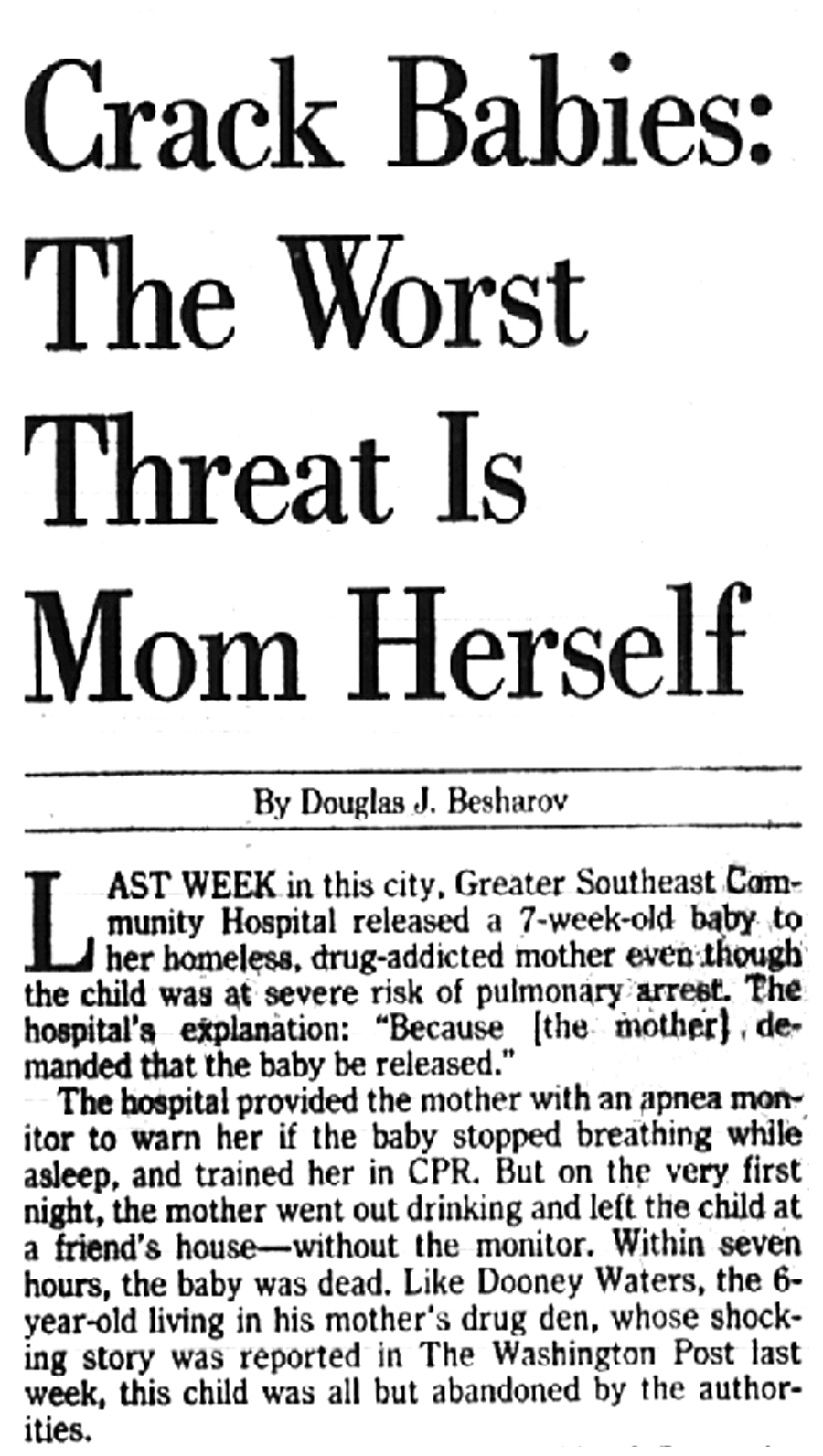
NPR revisits ‘crack baby’ panic, ignores media role

In Debunking, Media myths, Media myths and radio, Washington Post on May 4, 2010 at 1:21 pm

NPR’s “Tell Me More” program yesterday became the latest national news outlet to revisit the “crack baby” scare of the late 1980s and 1990s, and pronounce it all had been overblown.

As in the recent Washington Post retrospective about “crack babies,” NPR failed to confront the news media’s central role in promoting and spreading what one leading researcher has called a “fantasy panic.”

Washington Post, 1989

That turn of phrase inspired the title of the chapter about “crack babies” in Getting It Wrong, my forthcoming book that confronts and debunks 10 media-driven myths.

Getting It Wrong is being published this summer by University of California Press.

The crack-baby myth centers around the notion that women who took cocaine during pregnancy would give birth to children so mentally and physically deficient that they would constitute a helpless, dependent “bio-underclass,” as syndicated columnist Charles Krauthammer put it in 1989.

In Getting It Wrong,  I call attention “to the risks of anecdote-driven reporting, which characterized news coverage of the crack baby phenomenon.

“Disturbing images and heart-wrenching descriptions of helpless newborns supposedly damaged by their mothers’ toxic indulgence were,” I write, “frequent and irresistible elements of the coverage. Anecdotes were fuel for a powerful but misleading storyline.”

Yesterday’s “Tell Me More” segment on “crack babies” overlooked all that, referring vaguely to “all manner of pronouncements about how children who were exposed to crack in utero were destined to a life of physical and mental disability.”

The program’s description at the “Tell Me More” online site ignored the news coverage, saying instead that “the nation’s health specialists panicked over the growing number of so-called ‘crack babies’—children exposed to crack cocaine in utero. These children were said to be doomed to lives of physical and mental disability.”

The panic, though, was largely media-driven, as I discuss in Getting It Wrong.

The “Tell Me More” segment–which noted that “children who [had been] exposed to crack cocaine before birth are proving these worst case scenarios were all wrong”–did include an intriguing, media-related passage.

That came late in the show, when Dr. Carl Bell, a clinical professor of psychiatry and public health at the University of Illinois-Chicago, spoke of “media epidemiology.”

He said:

“I think it’s important for society to move away from what I refer to as media epidemiology and media hypotheses and making all these generalizations about things because frequently they’re flat out wrong, as it shows.”

I asked Bell by email to elaborate on “media epidemiology.”

He replied, stating:

“‘Media epidemiology’ is a term I began using about two years ago to describe how the public gets its understanding about epidemiology of various public health issues from the media, which of course is the absolutely wrong place to get such information as the media does not report on the common but on the uncommon which is defined as news.

“For example, ten years ago the homicide rates in Chicago were 1,000 but because of a lot of work done in public health in the city the homicide rates are down to 500, but the media keeps referring to the ‘homicide epidemic’ in Chicago; thereby misleading the public with their ‘media epidemiology.'”

It, too, is’ an interesting turn-of-phrase–and may help explain why the news media sometimes get it wrong in reporting on issues of science and public health.

WJC

Another movie list, another myth invoked

In Cinematic treatments, Debunking, Media myths, Washington Post, Watergate myth on April 26, 2010 at 11:52 am

The cinema can be a powerful propellant of media-driven myths.

As I note in my forthcoming book, Getting It Wrong, cinematic treatments can and do “influence how historical events are collectively remembered and can harden media-driven myths against debunking.”

I invoke as an example the Watergate scandal, which culminated in 1974 with the resignation of President Richard Nixon. It is often said that the Watergate reporting of Washington Post reporters Bob Woodward and Carl Bernstein “brought down” Nixon’s corrupt presidency.

Woodward and Bernstein’s best-selling book about their Watergate reporting, All the President’s Men, was turned into a highly successful motion picture by the same title.

And as I write in Getting It Wrong, the cinematic version of All the President’s Men, which cast Robert Redford and Dustin Hoffman in the roles of Woodward and Bernstein, “helped ensure that the journalists and their newspaper would be regarded as central to cracking the Watergate scandal.”

Testimony to that observation was offered yesterday in an item at the Huffington Post blog referring to All the President’s Men as “one of the top films about the presidency.”

The item said the film “documents how the power of the press and the determination of two young journalists brought down this occupant [Nixon], who only two years prior had won re-election by the widest margin in history.”

As I’ve noted several times at MediaMythAlert, the notion that Woodward, Bernstein, and the Washington Postbrought down” Nixon is a media-driven myth, a trope that knows few bounds.

It is, I write in Getting It Wrong, a misleading interpretation that “minimizes the far more decisive forces that unraveled the scandal and forced Nixon from office.”

The “heroic-journalist myth of Watergate” took hold for a number of reasons, among them the sheer complexity of the scandal. Not only was Nixon turned from office but  19 men associated with his presidency or his 1972 reelection campaign went to jail.

The “heoric-journalist” memo has become, I write, “a proxy for grasping the scandal’s essence while avoiding its forbidding complexity.”

The cinematic version of All the President’s Men accomplished that, too, by offering what I call “an unmistakable assertion of the power and centrality of the press in Nixon’s fall.”

The contribution of other agencies and entities in unraveling Watergate and prosecuting Nixon’s men is downplayed or ignored.

The Huffington Post item that invoked the heroic-journalist myth discussed 11 films that examine the American presidency, including two fine motion pictures, Primary Colors and the Manchurian Candidate.

Also on the movie list was Dick, an improbable spoof about Watergate and the Nixon White House that depicts Woodward and Bernstein as antagonistic incompetents who bungle their way to a Pulitzer Prize.

WJC