W. Joseph Campbell

Posts Tagged ‘Watergate’

Myths going polyglot: An emblem of hardiness

In Debunking, Media myths, Washington Post, Watergate myth on April 16, 2010 at 9:29 am

It’s a sure sign of tenacity and hardiness when media-driven myths cross linguistic barriers to become embedded in other languages.

The heroic-journalist myth of Watergate–which I explore in Getting It Wrong, my forthcoming book about media-driven-myths–represents that phenomenon quite well.

In the past few days, references to the myth–which maintains that the work of two young, intrepid reporters for the Washington Post brought down Richard Nixon’s corrupt presidency–have appeared online in French and Italian.

The French version was posted at the Web site of the weekly lifestyle magazine, Paris Match.  The item was about Sheri Fink, who this week became a winner of a Pulitzer Prize in investigative reporting.

Paris Match said of Fink: “She enters the pantheon of the press that includes famous predecessors such as Bob Woodward of the Washington Post who disclosed the Watergate scandal leading to the impeachment of President Nixon.”

For starters, Nixon was never impeached; he resigned the presidency in 1974, to head off certain impeachment and conviction.

Moreover, Woodward and his reporting partner, Carl Bernstein, did not uncover or disclose the Watergate scandal.

As Edward Jay Epstein wrote years ago in a marvelous essay about the news media and Watergate, “the FBI, the federal prosecutors, the [federal] grand jury, and the Congressional committees … unearthed and developed all the actual evidence and disclosures of Watergate.”

Epstein noted that Woodward and Bernstein, in All the President’s Men, their book about their Watergate reporting, “systematically ignored or minimized” the work of those agencies and institutions.

“Instead,” Epstein wrote, “they simply focus on those parts of the prosecutors’ case, the grand-jury investigation, and the FBI reports that were leaked to them.”

The heroic-journalist meme also popped up in an item posted the other day at VignaClaraBlog, an online local news site in Rome. That item told of an upcoming interview with Bernstein, whom it credited with breaking the Watergate scandal, leading to Nixon’s resignation.

The objective here is not to score points at the expense of foreign-language sites invoking the heroic-journalist myth. Rather, it is to underscore how persistent and insidious media-driven myths can be.

Crossing linguistic barriers not only is an emblem of their appeal: It suggests that myths such as that of the heroic-journalist of Watergate are now thoroughly immune to conclusive uprooting.
WJC

On bringing down Nixon

In Cinematic treatments, Debunking, Media myths, Newspapers, Washington Post, Watergate myth on April 12, 2010 at 4:07 pm

My guestpost the other day at the “Political Bookworm” blog–in which I reviewed three media-driven myths explored in my forthcoming book, Getting It Wrong–has attracted more than a few comments, including this particularly blinkered rhetorical question:

“Do you really know anyone who believes the Washington Post brought Nixon down?”

For starters, check Investor’s Business Daily.

On the day the guestpost and the blinkered comment appeared, Investor’s Business Daily said the New York Times, in its coverage of sexual abuses by Roman Catholic priests, was “seeking the biggest prey since Woodward and Bernstein brought down Richard Nixon.”

There you go: Brought down Nixon.

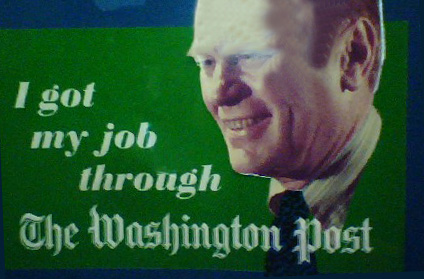
Gerald Ford became president on Nixon's resignation

The Investor’s Business Daily reference, of course, was to Bob Woodward and Carl Bernstein of the Washington Post whose investigative reporting in the Watergate scandal is often and inaccurately said to have toppled Richard Nixon’s corrupt presidency.

As I note in Getting It Wrong, the heroic-journalist meme of Watergate is one of the most hardy, persistent, and delicious myths in American media history.

Interestingly, it lives on despite periodic efforts by principals at the Washington Post to dismiss it. (“Political Bookworm” is a Washington Post blog, it should be noted.)

The newspaper’s media reporter, Howard Kurtz, wrote in 2005, for example:

“Despite the mythology, The Post didn’t force Richard Nixon from office—there were also two special prosecutors, a determined judge, bipartisan House and Senate committees, the belated honesty of [former White House lawyer] John Dean and those infamous White House tapes.”

Kurtz’s observations parallel those of Stanley I. Kutler, a leading historian of Watergate, who has written:

“The fact is, an incredible array of powerful actors all converged on Nixon at once—the FBI, prosecutors, congressional investigators, the judicial system.”

Amid this array of subpoena-wielding authorities investigating Watergate, the contributions of Woodward and Bernstein were modest–and certainly not decisive to the scandal’s outcome.

Still, the heroic-journalist myth is alive, well–and often invoked.

In large measure, that’s because the 1976 motion picture All the President’s Men–the leading movie about Watergate–depicted Woodward and Bernstein as essential to unraveling the scandal.

Indeed, this myth is a trope that knows few bounds.

WJC

In today’s ‘Outlook’ section

In Cronkite Moment, Debunking, Furnish the war, Media myths, Murrow-McCarthy myth, Newspapers, Washington Post, Watergate myth on April 11, 2010 at 12:13 pm

An abbreviated version of my recent guestpost at the “Political Bookworm” blog appeared today in the “Outlook” section of the Washington Post.

Here’s the text of the “Outlook” piece, with links that I’ve added:

W. Joseph Campbell, a professor of communication at American University, busts some media myths in his book, “Getting It Wrong: Ten of the Greatest Misreported Stories in American Journalism,” coming in July from the University of California Press. Here are three of Campbell’s biggies:

1. William Randolph Hearst’s purported vow, telegraphed to the artist Frederic Remington in Cuba, to “furnish the war” with Spain. Hearst denied making such a statement. The telegram containing his purported pledge has never turned up. The “furnish the war” anecdote can be traced to 1901 and a memoir by another journalist, James Creelman, who did not say when or how he learned the story about Hearst’s vow.

2. Edward R. Murrow brought an end to Sen. Joseph R. McCarthy’s communists-in-government witch hunt. This myth stems from Murrow’s CBS program “See It Now” on March 9, 1954, when the newsman dissected McCarthy’s crude investigative techniques and taste for the half-truth — none of which was unknown to American audiences at the time. The myth took hold even though years before the program aired, several prominent journalists — including Washington-based syndicated columnist Drew Pearson — had become searching critics of McCarthy and his tactics.

Nixon resigns, 1974

3. The Washington Post’s investigative reporting brought down Richard Nixon’s corrupt presidency. Katharine Graham, The Post’s publisher during the Watergate period, said in 1997: “Sometimes people accuse us of bringing down a president, which of course we didn’t do. The processes that caused [Nixon’s] resignation were constitutional.” She was right, but the complexities of Watergate are not readily recalled these days. What does stand out is a media-centric interpretation that the dogged reporting of Post journalists Bob Woodward and Carl Bernstein brought Nixon down.

WJC

Now at Political Bookworm, where ‘must-read books are discovered’

In Cronkite Moment, Debunking, Furnish the war, Media myths, Washington Post, Watergate myth on April 9, 2010 at 7:35 am

I guestpost today at the Political Bookworm, a Washington Post-sponsored site that describes itself as a blog where “tomorrow’s must-read political books are discovered today.”

In my post, I discuss three of the media-driven myths examined in my forthcoming book, Getting It Wrong, which the University of California Press will publish in the summer.

Political Bookworm is edited by Steven Levingston, the Post‘s nonfiction editor. The blog notes that it “discusses new books long before they hit the shelves.”

And here’s the text of my guest post:

The most famous anecdote in American journalism may be William Randolph Hearst’s purported vow, telegraphed to the artist Frederic Remington in Cuba, to “furnish the war” with Spain at the end of the 19th century.

Or it may be Edward R. Murrow’s television program on CBS in 1954, which supposedly brought an end to Sen. Joseph R. McCarthy’s communists-in-government witch-hunt.

Or it may be the interpretation of Watergate that says The Washington Post’s investigative reporting brought down Richard Nixon’s corrupt presidency.

All three are well-known stories about the exercise of media power, for good or bad. All three anecdotes are often retold.

All three are media-driven myths.

Media myths often confer on the news media far more power and influence than they merit or possess. Media myths also tend to minimize the complexity of historical events in favor of simplistic and misleading interpretations.

That’s an important reason why Hearst’s vow has lived on for more than 100 years: It is succinct, savory, and easily remembered. It conforms to the popular image of Hearst as war-monger.

Hearst, though, denied making such a statement. The telegram containing his purported pledge has never turned up. And it would have been absurd for Hearst to vow to “furnish the war” because war — Cuba’s rebellion against Spain’s colonial rule — was the reason he sent Remington to Cuba. (The Cuban rebellion gave rise in 1898 to the Spanish-American War.)

The “furnish the war” anecdote can be traced to 1901 and a memoir by another journalist, James Creelman, who did not say when or how he learned story about Hearst’s vow.

The Murrow-McCarthy myth stems from Murrow’s See It Now program on March 9, 1954. See It Now that night dissected McCarthy’s crude investigative techniques and taste for the half-truth — none of which was unknown to American audiences at the time

Years before the program aired, several prominent journalists — including the Washington-based syndicated columnist Drew Pearson — had become searching critics of McCarthy and his tactics.

Interestingly, the myth took hold despite Murrow’s protests. In the weeks following the See It Now program, Murrow said he recognized that at best he had reinforced what others had long said about the red-baiting senator.

Similarly, principals at The Washington Post over the years have disputed the notion their newspaper toppled Nixon, who resigned in 1974. Among them was Katharine Graham, the Post’s publisher during the Watergate period. “Sometimes people accuse us of bringing down a president, which of course we didn’t do,” she said in 1997. “The processes that caused [Nixon’s] resignation were constitutional.”

She was right, but the complexities of Watergate — the deceit and criminality that characterized the Nixon White House and the multiple lines of investigation that slowly unwound the scandal — are not readily recalled these days.

What does stand out is a media-centric interpretation, that the dogged reporting of Washington Post journalists Bob Woodward and Carl Bernstein brought Nixon down. It’s a familiar storyline, a proxy for grasping Watergate’s essence while sidestepping its complexities.

That storyline was solidified by the 1976 motion picture, “All the President’s Men,” the screen adaptation of Bernstein and Woodward’s book of the same title. The film casts the reporters as central to unraveling the scandal.

Debunking these and other media myths matters for a variety of reasons. Media myths can and do feed stereotypes. They distort our understanding of the news media and of history. And there is inherent value in setting the record straight.

In that sense, myth-busting is aligned with a central objective of newsgathering — that of getting it right.

WJC

15 movies about journalists: At least 3 boosted myths

In Cinematic treatments, Debunking, Media myths, Murrow-McCarthy myth, Washington Post, Watergate myth on April 8, 2010 at 7:47 pm

It was the day of the journalist (“Dia do Jornalista”) in Brazil yesterday and to help mark the occasion, the RevistaMonet blog posted a lineup, with brief descriptions, of 15 movies about the work of journalists.

They included classics such as The Front Page and His Girl Friday, as well as surprises such as How to Lose a Guy in 10 Days and Superman Returns.

All 15 were English-language films. At least three of them have contributed to, or helped solidify, media-driven myths.

The three myth-builders: All the President’s Men; Good Night, and Good Luck, and my favorite, Citizen Kane.

Cinema’s role in solidifying media-driven myths is discussed in Getting It Wrong, my next book, which will be out in the summer.

“Cinematic treatments,” I write, “influence how historical events are collectively remembered and can harden media-driven myths against debunking.”

That certainly was so with All the President’s Men, the 1976 screen adaptation of Carl Bernstein and Bob Woodward’s book by the same title.

The film characterized Bernstein and Woodward, both of the Washington Post, as central and essential to unraveling the Watergate scandal that toppled President Richard Nixon.

The upshot, I write in  Getting It Wrong, has been “to solidify and elevate the heroic-journalist myth” of Watergate and sustain it in the collective memory.

Indeed, it’s hard to think of Watergate without thinking of All the President’s Men.

Similarly, the 2005 motion picture Good Night, and Good Luck served to popularize and extend the media myth that broadcasting legend Edward R. Murrow exposed and abruptly ended the communists-in-government witch-hunt of Senator Joseph R. McCarthy.

Good Night, and Good Luck was a dramatic retelling of Murrow’s See It Now program on McCarthy, which aired on CBS on March 9, 1954, and often is credited with exposing McCarthy’s crude investigative tactics and bullying ways.

McCarthy in 1954

But as I point out in Getting It Wrong, Murrow’s program on McCarthy came very late–years after other journalists had confronted and challenged the red-baiting senator. By 1954, it wasn’t as if American audiences were waiting for a white knight like Murrow to tell them of the toxic threat McCarthy posed.

They already knew. And in the months immediately before Murrow’s program, the senator’s favorability ratings had begun to fall.

While it never explicitly said as much, Good Night, and Good Luck left the inescapable but erroneous impression that Murrow had courageously and single-handedly challenged and stopped McCarthy.

Citizen Kane, which was released in 1941, arguably is the finest motion picture ever made about journalism: It may have been the best movie, ever.

It certainly was Orson Welles’ towering and most memorable cinematic achievement. Kane was vaguely based on the life and times of media mogul William Randolph Hearst.

Kane‘s contribution to media mythmaking came in a scene that paraphrased Hearst’s purported vow to “furnish the war” with Spain at the end of the 19th century.

As I note in Getting It Wrong,  the Hearstian vow lives on despite a nearly complete absence of supporting documentation. It lives on even though the telegram that supposedly contained Hearst’s message has never turned up. It lives on even though Hearst denied ever making such a statement.

Like many media-driven myths, the story of Hearst’s purported vow is almost too good not to be true.

And given cinematic treatment, it may be impossible ever to inter.

WJC

Embedded myths of journalism history

In Cronkite Moment, Debunking, Media myths, Washington Post, Watergate myth on March 15, 2010 at 11:44 am

Popular media myths were in circulation over the weekend at the conference of journalism historians—signaling anew how embedded myths are in American media history and how difficult they can be to uproot.

One presentation at the conference in New York City discussed Walter Cronkite’s standing in collective American memory and in media history. The presentation inevitably invoked the notion that the Cronkite’s on-air commentary in 1968 dissuaded Lyndon Johnson from seeking reelection to the presidency.

Supposedly, Johnson watched Cronkite’s special report on CBS about Vietnam. Cronkite ended the program with by saying the U.S. war effort was “mired in stalemate” and that negotiations eventually might be considered as a way out of the conflict.

Upon hearing Cronkite’s downbeat editorial assessment, Johnson switched off the television and turned to an aide or aides, muttering something to the effect of:

“If I’ve lost Cronkite, I’ve lost Middle America.”

The program’s effect supposedly was so singularly powerful that it also turned public opinion against the war and came to be called the “Cronkite Moment.”

As I’ve noted several times at MediaMythAlert, and as I write in Getting It Wrong, my  forthcoming book about media-driven myths, Johnson did not watch Cronkite’s special report about Vietnam when it aired February 27, 1968.

Johnson in Texas, February 27, 1968

Johnson at the time was not in front of a television set but on the campus of the University of Texas at Austin, at a party marking the 51st birthday of one of his political allies, Governor John Connally.

Nor is there evidence that Johnson later saw the Cronkite program on videotape.

Not only that, but as I discuss in Getting It Wrong, there is scant evidence to suggest that the “Cronkite Moment” had much influence at all on public opinion about the war.

Indeed, polling data “clearly show that American sentiment had begun shifting months before the Cronkite program,” I write in the book, which will be out this summer.

Also heard during conference presentations was what I call the heroic-journalist myth of Watergate–the notion that the reporting of two young reporters for the Washington Post brought down Richard Nixon’s corrupt presidency.

This is a trope that even Post officials have dismissed over the years.

In 2005, for example, the newspaper’s then-ombudsman, Michael Getler, wrote:

“Ultimately, it was not The Post, but the FBI, a Congress acting in bipartisan fashion and the courts that brought down the Nixon administration. They saw Watergate and the attempt to cover it up as a vast abuse of power and attempted corruption of U.S. institutions.”

The heroic-journalist myth is addressed, and debunked, in Getting It Wrong, which says that interpreting Watergate “through the lens of the heroic-journalist is to abridge and misunderstand the scandal and to indulge in a particularly beguiling media-driven myth.”

The conference in New York was Saturday, and was sponsored by the History Division of AEJMC and the American Journalism Historians Association. AEJMC is the acronym for the Association for Education in Journalism and Mass Communication.

WJC

If not for the Post’s digging …

In Debunking, Media myths, Washington Post, Watergate myth on March 7, 2010 at 1:26 pm

Then the Watergate scandal might never have come to light.

Right.

That, in any case, is a variation on the heroic-journalist meme of Watergate, which holds that the work of Bob Woodward and Carl Bernstein, two young reporters for the Washington Post, brought down Richard Nixon and his corrupt presidency.

It’s a claim too sweeping for many to embrace. As I write in my forthcoming book, Getting It Wrong, the heroic-journalist interpretation of Watergate is a media-driven myth–one that even officials at the Post tend to dismiss.

The variation on the heroic-journalist meme holds that the Post‘s persistent reporting during the summer and early fall of 1972–in the early weeks and months of the scandal–helped keep Watergate from fading completely from public view.

The variation theme was invoked yesterday in a column in the New Britain Herald in Connecticut.

The writer says about Watergate and Nixon’s eventual resignation:

“Sure, a federal judge and the members of Congress had something to do with it — Lowell Weicker made his name nationally at the [Senate] Watergate hearings. But without Woodward and Bernstein digging and writing in the Washington Post, it could all have been pushed under the rug.”

Alas, the writer offers no evidence for his speculative conclusion.

Even so, it’s not an uncommon interpretation.

Howard Simons, the Post‘s managing editor during the Watergate period, once said:

“For months we were out there alone on this story. What scared me was that the normal herd instincts of Washington journalism didn’t seem to be operating. … It was months of loneliness.”

Such characterizations are not entirely accurate, however. As I write in Getting It Wrong:

“The Post may well have led other newspapers on the Watergate story—principally was because Watergate at first was a local story, based in Washington, D.C. But rival news organizations such as Los Angeles Times and New York Times did not ignore Watergate as the scandal slowly took dimension during the summer and fall of 1972,” while Nixon’s reelection campaign gathered momentum.

In his classic essay on journalism and Watergate, Edward Jay Epstein noted that the Post and other newspapers were joined during the summer of 1972 by the General Accounting Office, the investigative arm of Congress, and Common Cause, a foundation that seeks accountability in government office, in calling attention to the scandal.

Nixon’s Democratic challenger for the presidency, George McGovern, often invoked Watergate in campaign appearances during the summer and fall of 1972. At one point, McGovern charged that Nixon was “at least indirectly responsible” for the Watergate scandal, which stemmed from a break-in at the headquarters of the Democratic National Committee.

McGovern also termed the break-in “the kind of thing you expect under a person like Hitler.”

So in its reporting on the emergent scandal, the Post in fact was one of several institutions seeking to delineate the reach and contours of Watergate.

Woodward and Bernstein were very much not alone in their digging. And the number of entities and institutions that were digging, even in the early days of the scandal, guaranteed that Watergate could not be “pushed under the rug.”

WJC

<!–[if !mso]> Edward Jay Epstein noted in his classic essay disputing the heroic-journalist myth of Watergate that the Post and other newspapers were joined during the summer of 1972 by the General Accounting Office, the investigative arm of Congress,[i] and Common Cause, a foundation that seeks accountability in government office, in calling attention to the scandal. Within a few days of the Watergate break-in, moreover, the Democratic National Committee filed a civil lawsuit against the Committee for the Reelection of the President, which ultimately compelled statements under oath. And Nixon’s Democratic challenger for the presidency, George McGovern, repeatedly invoked Watergate in his campaign appearances in the summer and fall of 1972. At one point, McGovern charged that Nixon was “at least indirectly responsible” for the Watergate burglary. McGovern also termed the break-in “the kind of thing you expect under a person like Hitler.”[ii] In its reporting on the emergent scandal in the summer and fall of 1972, the Post in fact was one of several institutions seeking to delineate the reach and contours of Watergate.[iii] The Post, that is, was very much not alone.


[i] See Bernard Gwertzman, “G.A.O. Report Asks Justice Inquiry Into G.O.P. Funds,” New York Times (27 August 1972): 1.

[ii] See James M. Naughton, “McGovern Bars Briefings By Kissinger as Unhelpful,” New York Times (16 August 1972): 1, 20.

[iii] Edward Jay Epstein, Between Fact and Fiction: The Problem of Journalism (New York: VintageBooks, 1975), 26. See also, Martin Schram, “Watergate in media legend,” Journal of Commerce (19 June 1997): 6A. Schram wrote: “Even in the early days [of the Watergate scandal], the Post was not always the Lone Ranger we now remember.

Yet again: Watergate and the Washington Post

In Debunking, Media myths, Newspapers, Washington Post, Watergate myth on March 4, 2010 at 7:00 am

Bob Woodward, he of the Washington Post and Watergate fame, is to give a talk today in Hartford, Connectict about “evolution of the media, politics, health care and the economy,” according to the city’s newspaper, the Courant.

In an article about the visit, the Courant (where I once worked) indulged in one of American journalism’s most persistent and delicious myths, declaring that Woodward’s “reporting of the Watergate scandal brought down a president and reshaped the journalism industry.”

Of course, the Courant article–which is mostly a Q-and-A with Woodward–leaves it at that. It never explains how the Post‘s reporting on Watergate accomplished either feat–bringing down Richard Nixon’s corrupt presidency let alone reshaping the journalism industry.

As I write in Getting It Wrong, my forthcoming book about media-driven myths, the Post‘s reporting on Watergate had only a marginal effect on the outcome of the Watergate scandal.

Indeed, Nixon likely would have completed his term if not for the secret recordings of many of his conversations in the Oval Office, conversations that captured his guilty role in authorizing a coverup of the Watergate scandal.

It was the Senate Select Committee on Watergate–not Woodward and his reporting partner Carl Bernstein–that uncovered and disclosed the existence of the White House tapes, the evidence most crucial in the scandal.

The special federal prosecutors on Watergate (one of whom Nixon ordered fired) pressed for the release of the tapes. And the U.S. Supreme Court unanimously ordered Nixon to turn over the recordings subpoenaed by the special prosecutor.

When Nixon complied, his presidency was all but over.

He resigned August 9, 1974.

As Stanley I. Kutler, a leading historian of Watergate, has written:

“The fact is, an incredible array of powerful actors all converged on Nixon at once—the FBI, prosecutors, congressional investigators, the judicial system.”

Amid this tableau of subpoena-wielding authorities, the contributions of Woodward and Bernstein were modest, and certainly not decisive, I write in Getting It Wrong, adding:

“Principals at the Post have acknowledged as much. Katharine Graham, the newspaper’s doughty publisher [during the Watergate period], often insisted the Post did not topple Nixon.

“‘Sometimes people accuse us of bringing down a president, which of course we didn’t do,’ Graham said in 1997, at a program marking the scandal’s twenty-fifth anniversary.

“’The processes that caused [Nixon’s] resignation were constitutional,’” she said.

Indeed.

WJC

Blithely invoking the Murrow-McCarthy myth

In Debunking, Media myths, Murrow-McCarthy myth, Watergate myth on March 3, 2010 at 11:15 am

It’s fairly remarkable how blithely and routinely media myths can be invoked.

A reminder of that appeared in a column posted today in the Times-News, a newspaper in Twin Falls, Idaho. The column, which ruminated about the use of middle initials, opened this way:

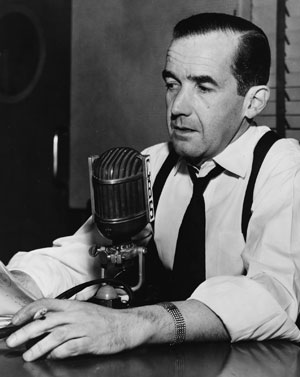
Murrow in 1954 (Library of Congress)

“When I was a young journalist, the most revered person in my profession was Edward R. Murrow, the CBS News reporter who brought down Sen. Joseph McCarthy.”

Brought down McCarthy.

It’s a story as famous and revered in American journalism as the notion that intrepid young reporters for the Washington Post brought down the corrupt presidency of Richard Nixon.

Both tales are exaggerated.

And both are media-driven myths that are examined in my forthcoming book, Getting It Wrong.

Murrow was a leading and ultimately a legendary figure in American broadcasting who in the 1950s  stood up to McCarthy, the Red-baiting junior senator from Wisconsin, when, supposedly, no one else would, or dared. In so doing, the story goes, Murrow brought an abrupt end to senator’s witchhunt for communists in the U.S. government.

The vehicle for Murrow’s brave exposé was his 30-minute television program, See It Now, which aired on CBS.

As I write in Getting It Wrong:

“Long before the See It Now program, several prominent journalists—including the Washington-based syndicated columnist Drew Pearson—had become persistent and searching critics of McCarthy, his record, and his tactics.”

Pearson, who wrote the widely published “Washington Merry-Go-Round” column, was the most assertive and, ultimately, acerbic of McCarthy’s media critics. He challenged McCarthy’s claims as early as 1950, soon after the senator began charging that communists had infiltrated the U.S. State Department.

McCarthy became so angered by Pearson’s searching columns that he threatened the columnist with physical harm–and followed through in December 1950 in the cloakroom of the exclusive Sulgrave Club on DuPont Circle in Washington. There, he slapped or tried to knee Pearson in the groin.

All that came long before Murrow confronted McCarthy on See It Now in 1954.

By 1954, I note in Getting It Wrong, “it wasn’t as if Americans … were hoping for someone to step up and expose McCarthy, or waiting for a white knight like Murrow to tell them about the toxic threat the senator posed.”

Pearson and others had been doing so for years.

WJC

Shoe leather, Watergate, and All the President’s Men

In Cinematic treatments, Debunking, Media myths, Washington Post, Watergate myth on February 28, 2010 at 2:36 pm

The heroic-journalist tale of Watergate–that two intrepid young reporters for the Washington Post brought down Richard Nixon’s corrupt presidency–is one of the most appealing and self-reverential stories in American media history.

It’s also a media-driven myth, one of 10 addressed in my forthcoming book, Getting It Wrong.

As I note in Getting It Wrong, an important factor for the tenacity of the heroic-journalist myth lies in its cinematic treatment. The media-centric storyline of Watergate was cemented by the film All the President’s Men, which came out to much acclaim in April 1976, 20 months after Nixon’s resignation.

An item posted the other day at the Politics Daily site fondly recalled All the President’s Men, saying the movie “about a bygone era” harkens to the “glory days of newspapers.”

The writer also indulged in the heroic-journalist myth, saying that the Post reporters “who brought down a sitting president” did so “with nothing more than shoe leather, determination, guts and a passion for the truth.”

It’s a wonderful story of journalists triumphant. But it’s exaggerated.

Even writers and officials at the Post have tried over the years to make clear that the newspaper and its reporters did not bring down Richard Nixon.

Howard Kurtz, the newspaper’s media writer, wrote in 2005, for example:

“Despite the mythology, The Post didn’t force Richard Nixon from office—there were also two special prosecutors, a determined judge, bipartisan House and Senate committees, the belated honesty of [former White House lawyer] John Dean and those infamous White House tapes.”

As I note in Getting It Wrong, “Nixon likely would have served out his term if not for the audiotape recordings he secretly made of most conversations in the Oval Office of the White House.

“Only when compelled by the Supreme Court [in 1974] did Nixon surrender those recordings, which captured him plotting the cover-up and authorizing payments of thousands of dollars in hush money.”

He resigned the presidency about two weeks later.

The cinematic version of All the President’s Men, however, placed Post reporters Bob Woodward and Carl Bernstein at the center of the unraveling of Watergate, while downplaying or dismissing the efforts of investigative agencies such as the FBI.

“The effect,” I write, “was to solidify and elevate the heroic-journalist myth, giving it dramatic power, and sustaining it in the collective memory.”

The movie helped make the heroic-journalist interpretation of Watergate vivid, memorable, accessible, and central.

After all, no other Watergate-related movie has retained such an appeal, or has likely been seen by as many people as All the President’s Men.

WJC