Today’s New York Times offers up a double-myth story, a rare article that incorporates two prominent media-driven myths.
 The Times invokes the Murrow-McCarthy and “Cronkite Moment” myths in suggesting that TV comedian Jon Stewart is a latter-day equivalent of Edward R. Murrow for advocating congressional approval of a health-aid package for first responders to the terror attacks of September 11, 2001.
That’s certainly a stretch.
But here’s what the Times says in presenting its double dose of media myths–both of which are addressed and debunked in my latest book, Getting It Wrong:
- “Edward R. Murrow turned public opinion against the excesses of Senator Joseph McCarthy in the 1950s.”
- “Walter Cronkite’s editorial about the stalemate in the war in Vietnam after the Tet Offensive in 1968 convinced President Lyndon B. Johnson that he had lost public support and influenced his decision a month later to decline to run for re-election.”
Both claims are delicious, and often invoked as evidence of the power of the news media.
But both claims are specious.
 As I discuss in Getting It Wrong, public opinion began turning against McCarthy well before Murrow’s often-recalled half-hour television report in March 1954 that scrutinized the senator and his communists-in-government witch-hunt.
Specifically, I note Gallup Poll data showing McCarthy’s appeal having crested in December 1953, when 53 percent of Americans said they had a favorable view of him. The senator’s favorable rating fell to 40 percent by early January 1954, and to 39 percent in February 1954, when an almost identical number of Americans viewed him unfavorably.
“To be sure,” I write in Getting It Wrong, “it wasn’t as if Americans in early 1954 were hoping for someone to step up and expose McCarthy, or waiting for a white knight like Murrow to tell them about the toxic threat the senator posed.
“By then, McCarthy and his tactics were well-known and he had become a target of withering ridicule—a sign of diminished capacity to inspire dread.”
On March 9, 1954, the day Murrow’s See It Now program on McCarthy was aired, former president Harry Truman reacted to reports of an anonymous threat against McCarthy’s life by quipping:
“We’d have no entertainment at all if they killed him.”
And long before Murrow took on McCarthy, “several prominent journalists—including the Washington-based syndicated columnist Drew Pearson—had become persistent and searching critics of McCarthy, his record, and his tactics,” I note.
A media-driven myth even more tenacious than the Murrow-McCarthy tale is the legendary “Cronkite Moment” of February 1968, when CBS anchorman Cronkite declared on-air that the U.S. military was “mired in stalemate” in Vietnam.
I point out in Getting It Wrong that by early 1968, Cronkite’s assessment was neither novel nor exceptional.
Indeed, the Times had reported August 1967, months before Cronkite’s on-air assessment, that the war effort was not going well.
Victory in Vietnam, the Times said then, “is not close at hand. It may be beyond reach.”
The article appeared on the front page August 7, 1967, beneath the headline:
“Vietnam: The Signs of Stalemate”
That wasn’t only occasion in 1967 when the Times invoked “stalemate” to characterize the war. In a news analysis published July 4, 1967, the newspaper stated:
“Many officers believe that despite the commitment of 466,000 United States troops now in South Vietnam … the military situation there has developed into a virtual stalemate.”
Moreover, the Times anticipated Cronkite’s “mired in stalemate” commentary in an editorial published February 8, 1968.
“Politically as well as militarily,” the editorial declared, “stalemate increasingly appears as the unavoidable outcome of the Vietnam struggle.”
So “stalemate” was much in the air weeks and months before Cronkite invoked the word on television.
Moreover, as I note in Getting It Wrong, President Johnson didn’t even see the Cronkite program when it aired February 27, 1968.
Johnson wasn’t at the White House that night. And he wasn’t in front of a TV set.
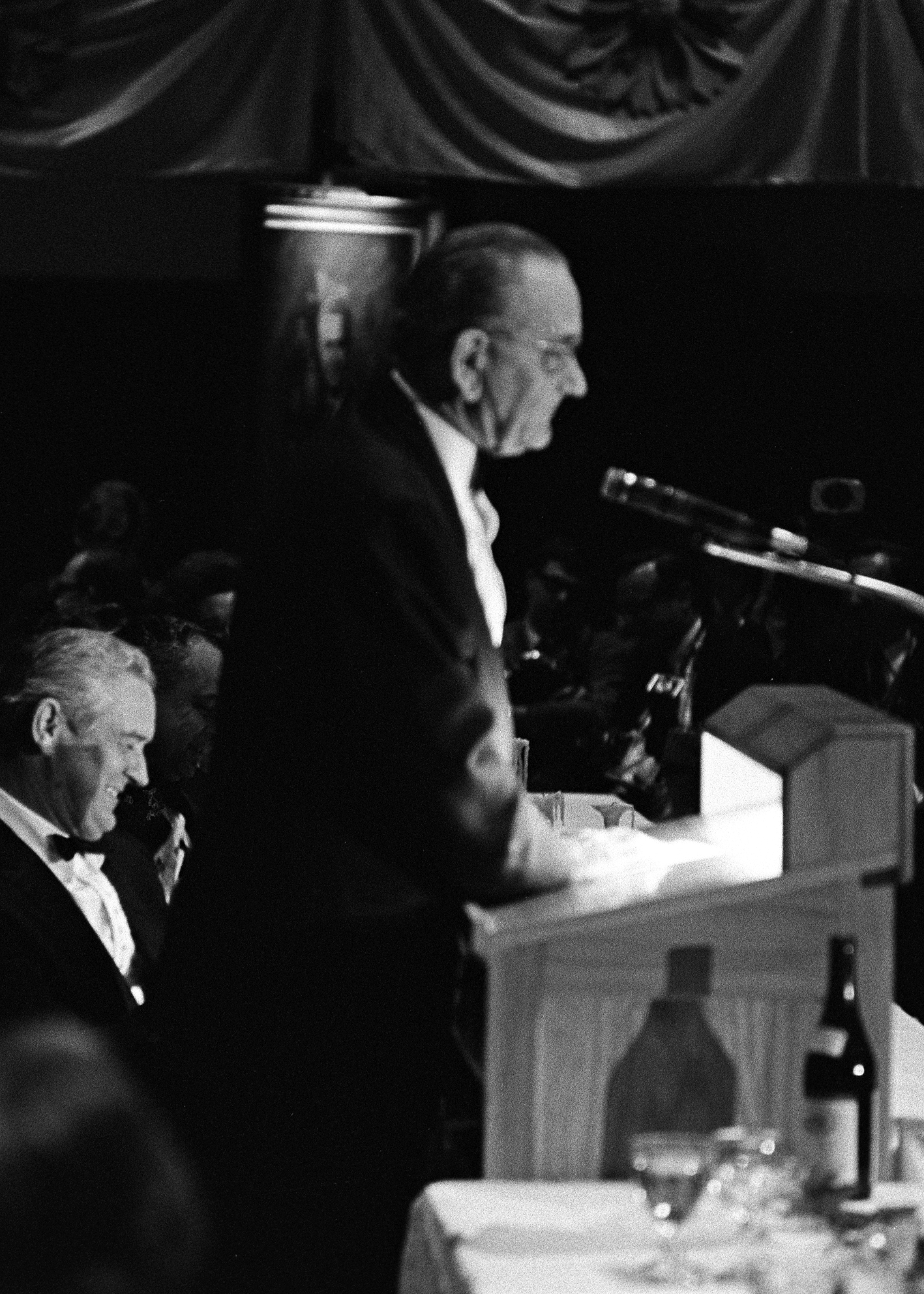
The president was in Austin, Texas, offering light-hearted remarks at the 51st birthday party of a longtime political ally, Governor John Connally.
About the time Cronkite was intoning his “mired in stalemate” assessment, Johnson was saying in jest:
“Today, you are 51, John. That is the magic number that every man of politics prays for—a simple majority.”
It’s difficult to make a persuasive case that the president could have been much moved by a television report he didn’t see.
Not only that, but Johnson may have decided in 1967 or even earlier against seeking reelection in 1968. He wrote in his memoir, The Vantage Point: “Long before I settled on the proper forum to make my announcement, I had told a number of people of my intention not to run again.”
Johnson’s memoir, by the way, has nothing to say about the Cronkite program of February 1968.
Recent and related:
- ‘The newspaper that uncovered Watergate’?
- On Cronkite, Jon Stewart and ‘the most trusted’ man
- Knocking down the ‘Cronkite Moment’
- Slaying the McCarthy dragon: It wasn’t Murrow
- One paragraph, three myths
- Recalling Mark Twain and the ‘calamity of calamities’
- ‘Good narrative trumps good history’
- On the high plateau of media distrust
- Mythbusting at the Smithsonian
Many thanks for Ed Driscoll and Jim Romenesko for linking to this post








 Media Myth Alert