W. Joseph Campbell

Archive for the ‘Debunking’ Category

The Washington Post ‘wrecked’ Nixon’s life? Sure it did

In Debunking, Media myths, Washington Post, Watergate myth on August 25, 2010 at 2:29 pm

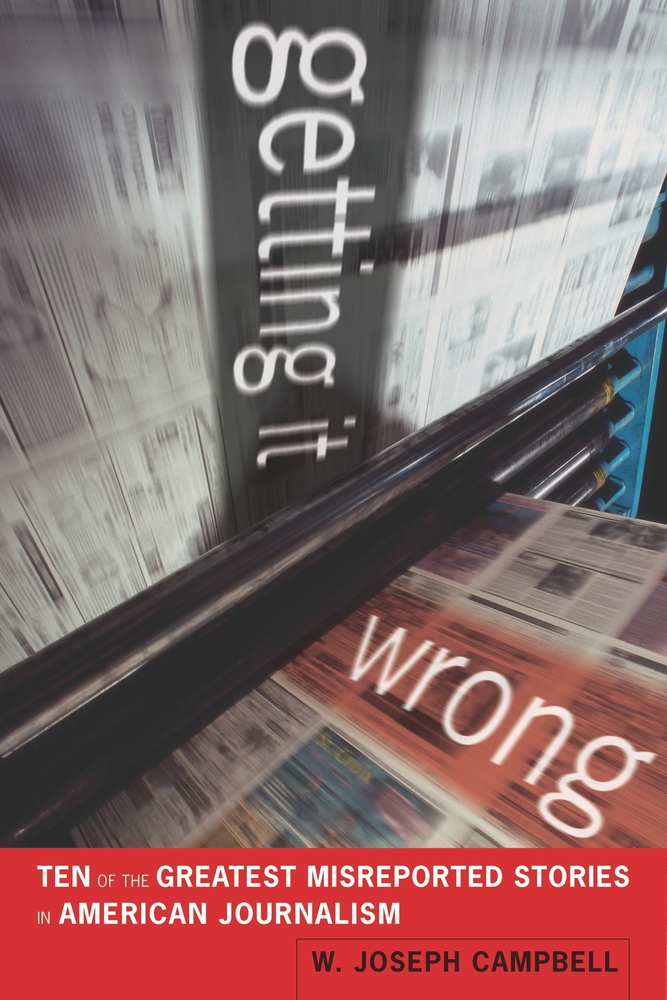
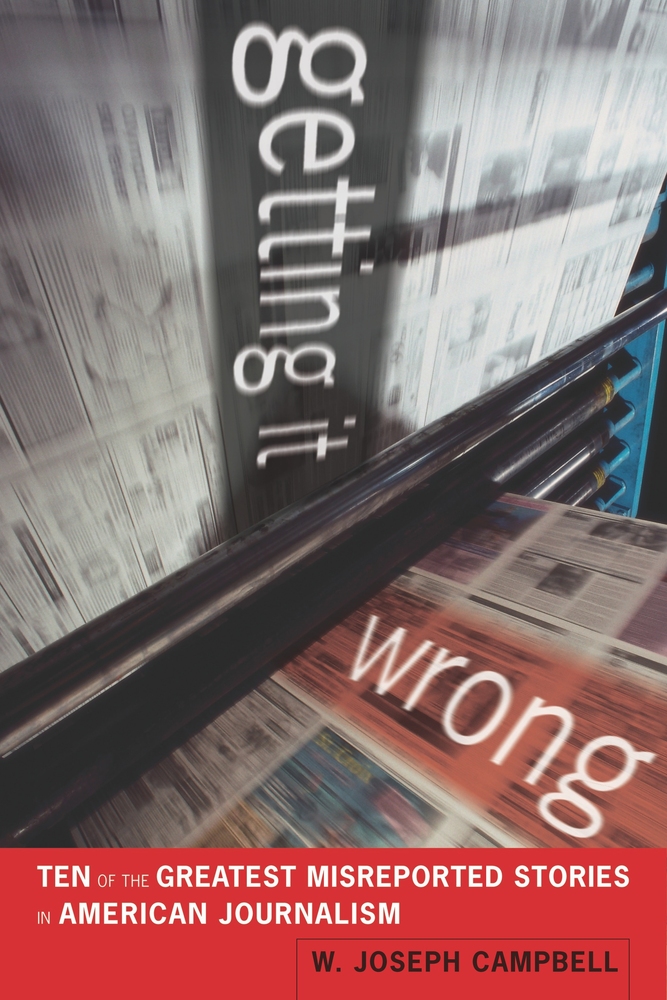
I’m tough on the Washington Post in a couple of chapters in Getting It Wrong, my new book that addresses and debunks prominent media-driven myths.

I call out the newspaper for its singular role in publicizing the erroneous hero-warrior tale about Jessica Lynch who, because of botched reporting by the Post, unwittingly became the best-known Army private of the Iraq War.

I also challenge the hero-journalist myth of the Watergate scandal, asserting in Getting It Wrong that (contrary to the dominant popular narrative) the Post and its reporters did not topple Richard Nixon’s corrupt presidency. (The Post, to its credit, also has challenged that narrative from time to time over the years.)

While I’m no apologist for the Post and consider it far weaker than its reputation,  I have no patience for such off-handed and outlandish characterizations as those appearing in a post yesterday at the Felsenthal Files, a blog of Chicago Magazine.

The blog post was titled “Blago: The View from Washington” and addressed the Post‘s editorial last week about retrying Rod Blagojevich, the former Illinois governor, on federal corruption charges. A jury in Chicago this month convicted Blagojevich on one charge of lying to federal investigators but failed to return verdicts on 23 other counts.

The Post in the editorial said Blagojevich’s prosecutor, U.S. Attorney Patrick J. Fitzgerald, “took his shot and lost. He should stand down before crossing another fine line–the one that separates prosecution from persecution.”

The Felsenthal Files found towering irony in that view, stating:

“If Rod Blagojevich has one hero in life besides Elvis, it’s Richard Nixon, and if there’s one newspaper that wrecked Nixon’s life and legacy it’s the Washington Post. How ironic, then, that the Washington Post is trumpeting almost the same line as Blago himself.”

Putting aside the wisdom of retrying Blagojevich, the Felsenthal Files’ flippant passage, alluding to the Watergate scandal, cries out for comment: “… if there’s one newspaper that wrecked Nixon’s life and legacy it’s the Washington Post.”

Wrecked?

Oh, c’mon.

The Washington Post didn’t wreck Richard Nixon.

It was Nixon’s criminal misconduct that defined the Watergate scandal and ultimately led to his resigning the presidency in disgrace in August 1974.

It wasn’t the Post‘s doing.

To regard Nixon’s fall as an effect of the Post‘s investigative reporting is, I write in Getting It Wrong, “to abridge and misunderstand the scandal and to indulge in a particularly beguiling media-driven myth.”

I further write that the “heroic-journalist interpretation [of Watergate] minimizes the far more decisive forces that unraveled the scandal and forced Nixon from office”–the special prosecutors, the federal judges, bipartisan congressional panels, the Justice Department, the FBI, and the Supreme Court.

Even then, Nixon probably would have served out his term–if as a wounded and weakened chief executive–had it not been for the existence of the audiotapes he made of many of his conversations in the Oval Office.

Only when ordered by the Supreme Court in July 1974 did Nixon surrender those recordings that captured him plotting to cover up the crimes of Watergate and authorizing payments of thousands of dollars in hush money.

The wreckage of Watergate undeniably was of Nixon’s own doing.

WJC

Related:

Jessica Lynch returns to spotlight in unedifying Bio interview

In Debunking, Jessica Lynch, Media myths, Washington Post on August 24, 2010 at 12:41 am

Jessica Lynch returned to the national spotlight last night in a tedious and unedifying television interview that not once mentioned the Washington Post and its erroneous report that thrust her into unsought and largely undeserved fame early in the Iraq War.

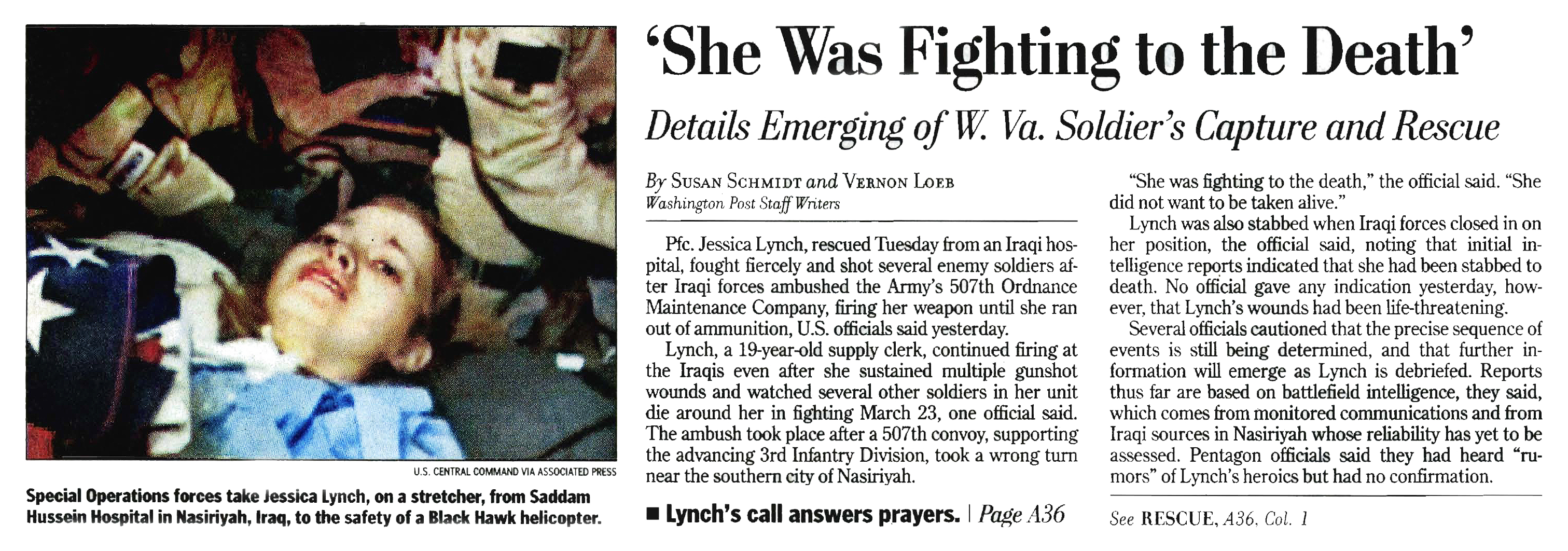
Lynch, an Army supply clerk taken prisoner after her unit was ambushed at Nasiriyah in March 2003, was said by the Post in a sensational front-page account that to have fiercely battled her Iraqi attackers.

That Post‘s report–published April 3, 2003, beneath the headline “‘She Was Fighting to the Death'”–made her the single best-known Army private of the war.

Lynch, then 19, was rescued by U.S. special forces after nine days in captivity at an Iraqi hospital.

She was interviewed by William Shatner, the actor of Star Trek fame, on the Bio channel’s Aftermath show, which  seeks to catch up on people who once had been famous, or notorious.

Probing, Shatner proved not to be.

He was sappy, patronizing, and wholly uninterested in the derivation of the erroneous but electrifying story of Lynch’s battlefield heroics.

Shatner referred vaguely to the “machinery of publicity” and the “stage-managed media frenzy,” clearly suggesting–but not explicitly stating–that the Pentagon had concocted the hero-warrior story.

Astonishingly, neither Shatner nor Lynch spoke specifically about the Washington Post report that was solely responsible for placing her name and supposed heroics into the public domain.

The Post said in its hero-warrior story that Lynch had been shot and stabbed by attacking Iraqis, but had kept “firing her weapon until she ran out of ammunition.”

It was stunning detail, but none of it was true.

Lynch never fired a shot at Nasiriyah. She suffered severe injuries not from gunfire, but from the crash of the Humvee in which she tried to flee the ambush.

The Aftermath interview made no mention of the account offered by Vernon Loeb, a reporter who shared a byline on the hero-warrior story about Lynch. Loeb, in an interview with NPR’s Fresh Air program late in late 2003, made clear the Pentagon was not the source for the erroneous story about Lynch.

In the Fresh Air interview–which I cite in Getting It Wrong, my new book debunking prominent media-driven myths–Loeb said of U.S. military officials:

“They wouldn’t say anything about Jessica Lynch.”

He added:

“I just didn’t see the Pentagon trying to create a hero where there was none. I mean …they never showed any interest in doing that, to me.”

On another occasion, Loeb was quoted in the New York Times as saying:

“Far from promoting stories about Lynch, the military didn’t like the story.”

While he did not identify the Post’s sources for the hero-warrior story about Lynch, Loeb characterized them as “U.S. officials” who were “really good intelligence sources” in Washington, where he was based.

But more than seven years later, the identity of the Post‘s sources on the hero-warrior story remain unclear.

Lynch, who remained fairly poised throughout the hour-long Aftermath interview, said at one point “it would have been easy for me” to have adopted the hero’s mantle and embraced the Post‘s report about her supposed derring-do.

But in reality, doing so would have been untenable.

As I note in Getting It Wrong, the colonel commanding the Army hospital at Landstuhl, Germany, where Lynch was treated after her rescue, told journalists the day after the Post published its hero-warrior story that Lynch had been neither shot nor stabbed.

He thus undercut a crucial element of the hero-warrior narrative.

And as I write in Getting It Wrong:

“If the military was complicit in fabricating the Lynch saga, it defies logic to believe that it would permit one of its own, an Army colonel, to impugn that narrative just as it had begun circulating around the world.”

WJC

Related:

NBC’s Katrina retrospective sidesteps media failings

In Anniversaries, Debunking, Hurricane Katrina, Media myths on August 22, 2010 at 9:47 pm

I watched this evening’s NBC Dateline retrospective  about Hurricane Katrina, and couldn’t help but wonder: What’s the point?

The hour-long program lacked a news peg, other than it aired in the run-up to the fifth anniversary of the storm’s landfall on the Gulf Coast.

Recollections of NBC anchorman Brian Williams, who covered Katrina and its aftermath in New Orleans, were the centerpiece of the show, which went strong on the images of suffering throngs of people at the New Orleans Superdome and the Convention Center in the days following the hurricane.

But beyond vague references to government incompetence, there was little explanation as to why the suffering there was so intense. Without analysis, such images seemed gratuitous, and voyeuristic.

New Orleans, post-Katrina

In his recollections, which were recorded in 2005, Williams veered close to embracing what I call the myth of superlative reporting–the notion that news coverage of Katrina’s aftermath was little short of heroic, that journalists stood tall in telling truth to power.

“People say, on this crisis, the media found their voice,” Williams said on Dateline, adding, “We owed it to these people [suffering in New Orleans] to ride herd of these officials.”

I write about the myth of superlative reporting in my new book, Getting It Wrong, and note:

“Journalists did confront incompetent government officials who seemed to dither in the face of the disaster. Journalists did let their emotions show. Many of them took great risks in New Orleans to report a demanding, multidimensional story in a city that was 80 percent under water. Some journalists there went days without much of a break, sleeping little and toiling amid despairing conditions.”

But I also write that “Katrina’s aftermath was no high, heroic moment in American journalism.

“The coverage was in important respects flawed and exaggerated. On crucial details, journalists erred badly, and got it wrong. In the days following Katrina’s landfall, news reports described apocalyptic horror that the hurricane supposedly had unleashed.”

The Dateline show addressed none of that–none of the exaggerated descriptions of Mad Max-like violence and mayhem that many news reports said gripped post-Katrina New Orleans.

The exaggerated reporting, I write, “had the cumulative the effect of painting for America and the rest of the world a scene of surreal violence and terror.” And little of it was true.

I also write in Getting It Wrong that reports of “nightmarish violence and wanton criminality in New Orleans following Hurricane Katrina’s landfall … defamed a battered city and impugned its residents at a time of their deep despair.”

Moreover, the over-the-top reporting “had the very real and serious effects,” I write, “of delaying the arrival of aid to New Orleans, of diverting and distorting the deployment of resources and capabilities, of heightening the anxiety of evacuees at the Superdome and Convention Center.”

I cite in Getting It Wrong a nearly 600-page report about Katrina’s aftermath, prepared by a bipartisan select committee of the House of Representatives. The report, titled “Failure of Initiative,” stated that  “accurate reporting was among Katrina’s many victims.

“If anyone rioted, it was the media.”

The House report also declared:

“Many stories of rape, murder, and general lawlessness were at best unsubstantiated, at worst simply false. And that’s too bad because this storm needed no exaggeration.”

I suspect in the days ahead, as the news media indulge in “anniversary journalism” about Hurricane Katrina, that we’ll read and hear little about their failings five years ago in covering the deadly storm.

WJC

Related:

Many thanks to Jim Romenesko for linking to this post

Mythical ‘Cronkite Moment’ invoked in ‘USA Today’

In Cronkite Moment, Debunking, Media myths, Year studies on August 21, 2010 at 10:08 am

In his column this week, Al Neuharth, founder of USA Today, invokes the dubious “Cronkite Moment” of 1968 and suggests an outspoken television journalist today could help end the U.S. military presence in Afghanistan.

Neuharth’s column refers to Walter Cronkite’s special report on Vietnam, which aired February 27, 1968. Near the end of the report, the CBS anchorman declared the U.S. war effort was “mired in stalemate.” Cronkite suggested that negotiations might represent a “rational” way out of Vietnam.

Neuharth then invokes the mythical component of the “Cronkite Moment,” writing that President Lyndon Johnson, upon hearing “the CBS shocker,” declared:

“If I’ve lost Cronkite, I’ve lost Middle America.”

As I write in Getting It Wrong, my new book debunking the “Cronkite Moment” and nine other prominent media-driven myths, Johnson did not see the Cronkite program when it aired. Nor is there evidence he watched the program later, on videotape.

Johnson on the night of the program was in Austin, Texas, at the 51st birthday party of Governor John Connally. About the time Cronkite was intoning his “mired in stalemate” assessment, Johnson was offering light-hearted remarks about Connally’s age.

Johnson at Connally's party

“Today you are 51, John,” the president said. “That is the magic number that every man of politics prays for—a simple majority. Throughout the years we have worked long and hard—and I might say late—trying to maintain it, too.”

Even if Johnson later saw the Cronkite program, he “gave no indication of having taken the anchorman’s message to heart,” I write in Getting It Wrong.

It represented no epiphany for him.

Indeed, in the days and weeks immediately following Cronkite’s program, Johnson’s rhetoric on the war remained hawkish. On March 18, 1968, for example, Johnson delivered a rousing speech in Minneapolis, in which he urged “a total national effort” to win the war in Vietnam.

He also declared in that speech:

“We love nothing more than peace, but we hate nothing worse than surrender and cowardice.”

Moreover, it’s clear that by early 1968, Cronkite’s “mired in stalemate” assessment about the war was unremarkable. Mark Kurlansky said as much in his well-received year-study about 1968.

Nearly seven months before Cronkite’s report on Vietnam, the New York Times published a front-page news analysis that said victory in southeast Asia “is not close at hand. It may be beyond reach.”

The Times analysis was published in August 1967 and carried the headline, “Vietnam: The Signs of Stalemate.”

And as I’ve noted at Media Myth Alert, former NBC newsman Frank McGee offered an analysis about Vietnam in March 1968 that was more forceful and direct Cronkite’s “mired in stalemate” characterization.

“The war,” McGee said on an NBC News program March 10, 1968, “is being lost by the [Johnson] administration’s definition.”

“Being lost,” McGee said: No hedging there.

But almost no one remembers Frank McGee’s blunt assessment.

I note in Getting It Wrong that the purported “Cronkite Moment” has become for many American journalists “an ideal, a standard that suggests both courage and influence in wartime reporting. It is an objective that contemporary practitioners at times seem desperate to recapture or recreate.”

Neuharth’s column makes  just that point, stating:

“The TV man—or woman—who suggests a ‘rational’ way out of Afghanistan could become today’s Cronkite.”

Not likely, not in today’s diverse and splintered media landscape in which audiences for network television have been in sustained decline.

In any case, it’s interesting to note that until late in his life, Cronkite disputed the notion that his 1968 report on Vietnam had much of an effect.

In his 1997 memoir, for example, Cronkite characterized his “mired in stalemate” assessment in decidedly modest terms, stating that it represented for Johnson “just one more straw in the increasing burden of Vietnam.”

He reiterated the “just one more straw” analogy in interviews promoting the book.

But by 2007, two years before his death, Cronkite had embraced the purported power of the “Cronkite Moment,” saying in an interview with the Gazette of Martha’s Vineyard:

“There are a lot of journalists out there today who if they chose to take that strong stand and course [in opposing the Iraq War] would probably enjoy a similar result.”

WJC

Related:

Getting it right about ‘yellow journalism’

In 1897, Debunking, Media myths, Yellow Journalism on August 19, 2010 at 11:16 am

“Yellow journalism” is an evocative sneer that has morphed over the decades.

Hearst's New York Evening Journal, April 1898

The term these days is sometimes invoked as an off-hand description for sensational treatment of the news. Or, more broadly, it’s used to describe egregious journalistic misconduct of almost any kind.

Or, as AlterNet blog noted in a post yesterday, “sometimes, yellow journalism is seen as synonymous with [William Randolph] Hearst, himself.”

But that’s really an imprecise characterization of a robust genre practiced by Hearst and others in the late 19th century.

As I wrote in my 2001  book, Yellow Journalism: Puncturing the Myths, Defining the Legacies, yellow journalism was defined by these features and characteristics:

  • the frequent use of multicolumn headlines that sometimes stretched across the front page.
  • a variety of topics reported on the front page, including news of politics, war, international diplomacy, sports, and society.
  • the generous and imaginative use of illustrations, including photographs and other graphic representations such as locator maps.
  • bold and experimental layouts, including those in which one report and illustration would dominate the front page. Such layouts sometimes were enhanced by the use of color.
  • a tendency to rely on anonymous sources, particularly in dispatches of leading reporters.
  • a penchant for self-promotion, to call attention frequently to the newspaper’s accomplishments. This tendency was notably evident in crusades against monopolies and municipal corruption.

Given those defining features, I wrote in Yellow Journalism that the genre “certainly could not be called predictable, boring, or uninspired—complaints of the sort that are frequently raised about U.S. newspapers of the early twenty-first century.”

Moreover, yellow journalism of a century or more ago was often criticized–but its salient features, including its bold typography, were often emulated. As such, it exerted a powerful influence in American journalism of the late 19th and early 20th centuries.

So it was much more than merely sensational.

But largely due to its association with Hearst–a toxic personality who ran the New York Journal and later turned the newspaper into a platform for a succession of failed campaigns for high public office–“yellow journalism” has mutated into the caricature that’s commonplace today.

The AlterNet post, which assails Rupert Murdoch and his recent $1 million donation to the Republicans, also says “yellow journalism” was “originally coined to describe the journalistic practices of Joseph Pulitzer….”

Not so.

As I discuss in Yellow Journalism, the epithet was devised in early 1897 to impugn the journalism of both Pulitzer and Hearst.

Yellow journalism” first appeared in print in the New York Press, which was edited by the austere Ervin Wardman, who once was described as revealing his “Calvinistic ancestry in every line of his face.”

The term appeared in Wardman’s newspaper on January 31, 1897, and quickly caught on, as a way to denigrate what then was called the “new journalism” of Hearst’s Journal and of Pulitzer‘s New York World.  By the end of March 1897, references to “yellow journalism” had appeared in newspapers in Providence, Richmond, and San Francisco.

A sneer thus had been born.

Precisely how Wardman and the Press landed on “yellow journalism” is not clear, however.

As I note in Yellow Journalism, the newspaper’s own brief discussion of the term’s origins was vague and unrevealing: “We called them Yellow because they are Yellow,” it said in 1898 about the Journal and the World.

In the 1890s, the color yellow sometimes was associated with depraved literature, which may have been an inspiration to the Harvard-educated Wardman, who plainly despised Hearst and Pulitzer, and editorially supported an ill-fated boycott of their newspapers in New York City in 1897.

Related:

Lynch heroics ‘ginned up by Bush-era Pentagon’?

In Debunking, Jessica Lynch, Media myths, Washington Post on August 17, 2010 at 4:44 pm

Private Lynch

The Huffington Post today reviews the new movie about Pat Tillman, the pro football player turned Army Ranger who was killed in Afghanistan in 2004. The review also takes a swipe at the Pentagon for supposedly concocting a hero-warrior story around 19-year-old Army private Jessica Lynch in the early days of the Iraq War.

The review says that Lynch’s “combat actions, as ginned up by the Bush-era Pentagon, did not square with reality.”

Well, frankly, that observation doesn’t quite “square with reality.”

I discuss the myths that have been spun off from the Lynch case in my new book Getting It Wrong, noting that the Pentagon wasn’t the source for the erroneous account of Lynch’s battlefield heroics.

The Washington Post thrust that account into the public domain in a sensational, front-page report on April 3, 2003.

The Post‘s story described how Lynch, despite being shot and stabbed, fiercely fought Iraqi attackers in an ambush at Nasiriyah. The electrifying report appeared beneath the headline:

“‘She was fighting to the death.’”

And the story was picked up around the world. But it was wrong, badly wrong.

Lynch never fired a shot in the fighting at Nasiriyah. She suffered neither gunshot nor stab wounds; her injuries were severe, and came in the crash of a Humvee fleeing the ambush.

The Post‘s article was based on sources identified only as “U.S. officials.” The article said that “Pentagon officials … had heard ‘rumors’ of Lynch’s heroics but had no confirmation” to offer.

As I note in Getting It Wrong, one of the Post reporters on the story said on at least two occasions that the Pentagon was not the source for the Lynch story.

The reporter, Vernon Loeb, who has since moved on to the Philadelphia Inquirer, told the NPR Fresh Air program in December 2003 that he “could never get anybody from the Pentagon to talk about those reports [of Lynch’s supposed heroics] at all.”

He added that the Pentagon “was completely unwilling to comment on those reports at all.

“They wouldn’t say anything about Jessica Lynch.”

As denials and knock-downs go, that one is pretty solid. And unequivocal.

A few months earlier, Loeb was quoted in an op-ed article in the New York Times as saying: “Far from promoting stories about Lynch, the military didn’t like the story.”

As I also note in Getting It Wrong, the Pentagon’s then-spokeswoman, Victoria Clarke, told the Associated Press in June 2003: “We were downplaying [the Lynch story]. We weren’t hyping it.”

Even in the face of such denials, the notion the Pentagon concocted a phony hero-warrior story about Lynch has become the dominant narrative–one repeated blithely and often.

Interestingly, those pushing the Pentagon-made-it-up meme never seem to explain just how the veteran Post reporters on the Lynch story were so easily and thoroughly duped.

Loeb shared the byline on the story with Susan Schmidt, who later won a Pulitzer Prize for investigative reporting. Among those contributing to the story was Dana Priest, who also has won a Pulitzer.

And if the Pentagon had “ginned up” the hero-warrior story about Lynch, “it failed miserably in keeping the ruse from unraveling, ” I write in Getting It Wrong.

The day after the Post‘s “‘fighting to the death'” article appeared, the head of the Army hospital at Landstuhl, Germany, told reporters that Lynch had been neither shot nor stabbed–undercutting crucial elements of the hero-warrior tale.

WJC

Related:

<!–[if !mso]> the article that their information about Lynch and her heroics was from “U.S. officials” with access to what the reporters called “battlefield intelligence” compiled from “monitored communications and from Iraqi sources in Nasiriyah whose reliability has yet to be assessed.” The article said that “Pentagon officials … had heard ‘rumors’ of Lynch’s heroics but had no confirmation” to offer.[i]


[i] Schmidt and Loeb, “‘She Was Fighting to the Death,’” Washington Post.

‘Perverse appeal of apocalyptic’ emerged in Gulf spill coverage

In Debunking, Media myths on August 16, 2010 at 6:29 pm

In Getting It Wrong, my new book dismantling prominent media-driven myths, I discuss a phenomenon I call “the perverse appeal of the would-be apocalyptic.”

By that I mean a tendency or eagerness among journalists “to identify and report on trends and developments that seem so exceptional or frightening as to be without precedent.”

This is not to characterize journalists “as morbid or macabre in their newsgathering,” I write in Getting It Wrong. “But they respond with undeniable excitement and energy when trends of exceptional and hazardous proportion seem to being taking hold.”

I invoke “the perverse appeal of the would-be apocalyptic” in chapters devoted to the myth of the crack baby and the myth of superlative reporting in the immediate aftermath of Hurricane Katrina’s landfall.

About Katrina coverage, I write that the hurricane–which struck five years ago this month–seemed to unleash “a disaster of almost biblical proportion: Storms and floods, death and mayhem; criminal gangs run amok in a city collapsing in chaos. New Orleans seemed to promise a descent into the truly apocalyptic. And for a time the reporting matched that premise: It was as if the some of most dreadful events imaginable were taking place in New Orleans.”

But little of the apocalyptic reporting proved true.

The “perverse appeal of the would-be apocalyptic” reemerged in the more recent coverage of BP’s Deepwater Horizon oil spill in the Gulf of Mexico, which President Barack Obama called “the worst environmental disaster America has ever faced.”

News coverage anticipated near-apocalyptic effects, that the BP oil spill could ruin the Gulf, spread across Florida’s beaches, and be propelled by the loop current up the East Coast, “all the way to Cape Hatteras off North Carolina” by July or August.

Hasn’t happened.

A marine scientist named Ivor van Heerden was quoted by Time magazine as saying:

“There’s just no data to suggest this is an environmental disaster. I have no interest in making BP look good—I think they lied about the size of the spill—but we’re not seeing catastrophic impacts.”

Van Heerden was further quoted as saying, “There’s a lot of hype, but no evidence to justify it.”

Time, in a revealing contrarian assessment that asked whether damage from the Gulf spill was exaggerated, offered four reasons why the environmental consequences have been less than dire.

First, the BP oil, unlike that from the Exxon Valdez in 1989, “is unusually light and degradable, which is why the slick in the Gulf is dissolving surprisingly rapidly now that the gusher has been capped. Second, the Gulf of Mexico, unlike Alaska’s Prince William Sound, is very warm, which has helped bacteria break down the oil. Third, heavy flows of Mississippi River water have helped keep the oil away from the coast, where it can do much more damage. And finally, Mother Nature can be incredibly resilient.”

Such assessments are not without challenges, of course. But the near-apocalyptic predictions of spring and early summer simply haven’t held up.

As USA Today noted in an editorial, the Gulf of Mexico “is an enormous and surprisingly resilient place. The spilled oil … would fill the Louisiana Superdome in New Orleans about one-sixth full. If that sounds like a lot—and perhaps to some it doesn’t—consider that it would take about 554 million Superdomes to fill the Gulf of Mexico.”

Now that, the newspaper said, is “a strikingly different image from one emblazoned in people’s mind by the early reaction.”

True enough.

And the sometimes over-the-top coverage of the Gulf spill offers another reminder to journalists about resisting the impulse to indulge in the perverse appeal of the would-be apocalyptic, to recognize that the truly apocalyptic–the “worst environmental disaster” of all time–arrives very rarely.

WJC

Related:

Ignoring the astonishing reporting lapses in Lynch case

In Debunking, Jessica Lynch, Media myths on August 15, 2010 at 9:09 am

It’s astonishing, and a bit dismaying, how readily the Jessica Lynch case is cited as an example as a hoax perpetuated by the Pentagon. And how readily the Washington Post‘s central role in promoting the case is overlooked and ignored.

Lynch was the waiflike, 19-year-old Army private whom the Washington Post, in its erroneous reporting, catapulted into sudden and undeserved international fame in April 2003, during the first days of the Gulf War.

As I discuss in Getting It Wrong, my new book debunking prominent media-driven myths, the Post published a sensational, front-page report on April 3, 2003, that  said Lynch had fought with Rambo-like ferocity in an ambush at Nasiriyah in southern Iraq.

Washington Post, April 3, 2003

The Post said Lynch had “shot several enemy soldiers,” had herself been shot and stabbed, but had kept “firing her weapon until she ran out of ammunition.”

The article quoted a U.S. official as saying, anonymously:

“‘She was fighting to the death. She did not want to be taken alive.’”

“It was an electrifying account,” I write, one picked up by news outlets across the United States and around the world.

Only it wasn’t true.

Lynch didn’t fire a shot in the ambush.

She was badly injured not from gunshots and stabbings but from the crash of the Humvee fleeing the attack.

In the years since, the narrative of the Lynch case has shifted. The Post‘s role in injecting the story into the public domain has been largely forgotten–even though the newspaper “never fully acknowledged or explained its extraordinary error about Jessica Lynch,” as I write in Getting It Wrong.

Instead, the dominant narrative now blames the Pentagon for supposedly concocting a story about a heroic female soldier.

There’s scant evidence to support such claims, which reemerged the other day at the Huffington Post, in an interview with author Laura Browder.

The interview was to promote Browder’s book, When Janey Comes Marching Home. And in the interview, Browder declares:

“The Army’s first story about Lynch was that she tried to fight off her captors, then was taken prison[er] and needed to be rescued. Their version of events was pure fiction. And it embodied this stereotype of women in the military: the damsel in distress.”

Let’s see: The “pure fiction” part was that Lynch “tried to fight off her captors,” and that came from the Post, which cited as sources unidentified “U.S. officials.”

The Pentagon was not the source for the Post‘s erroneous account, one of the Post reporters on the story has said.

That reporter, Vernon Loeb, told the Fresh Air radio program in December 2003:

“I could never get anybody from the Pentagon to talk about those reports at all. I got indications that they had, in fact, received those intelligence reports [about Lynch], but the Pentagon was completely unwilling to comment on those reports at all.

“They wouldn’t say anything about Jessica Lynch.”

Loeb added:

“I just didn’t see the Pentagon trying to create a hero where there was none. I mean …they never showed any interest in doing that, to me.”

As I note in Getting It Wrong, Loeb on another occasion was quoted by the New York Times as saying:

“Far from promoting stories about Lynch, the military didn’t like the story.”

While he did not identify the Post’s sources for its “fighting to the death” article about Lynch, Loeb characterized them as “U.S. officials” who were “really good intelligence sources” in Washington, where he was based at the time.

It is little-remembered these days, but the Post‘s stunning story about Lynch’s heroics began unraveling within hours after publication.

I note in Getting It Wrong that Lynch’s father told reporters on the day the Post‘s account appeared that doctors at the U.S. military hospital in Landstuhl, Germany, said Jessica Lynch had suffered neither gunshot nor knife wounds.

If the military were complicit in fabricating the Lynch hero-warrior saga, it defies logic to believe that it would permit its doctors at Landstuhl to impugn that narrative just as it had begun circulating around the world.

WJC

Related:

Country turned against Vietnam before ‘Cronkite Moment’

In Cronkite Moment, Debunking, Media myths, Year studies on August 12, 2010 at 6:33 am

Politico posted an item yesterday asserting that President Barack Obama “has lost the most trusted man in the Hispanic media”–the Univision anchorman, Jorge Ramos.

Ramos and Obama, in chummier times

Ramos, Politico said, “has been called the Walter Cronkite of Spanish-language media, an unparalleled nationwide voice for Hispanics. And just like the famed CBS newsman’s commentary helped turn the country against the Vietnam War, Ramos may be on the leading edge of a movement within the Hispanic media to challenge the president on immigration—a shift that some observers believe is contributing to Obama’s eroding poll numbers among Latino voters.”

There’s no doubt Obama’s poll numbers are sliding. But the Cronkite analogy is in error. And misleading.

Cronkite’s commentary–an on-air assessment in February 1968 that the U.S. military effort was “mired in stalemate”–did little to “turn the country against the Vietnam War.”

That’s because public opinion had been souring on Vietnam for months before Cronkite’s commentary aired on February 27, 1968.

As I write in Getting It Wrong, my new book debunking prominent media-driven myths, the Gallup Organization reported in October 1967 that a plurality of Americans (47 percent to 44 percent) said deploying U.S. troops to Vietnam had been a mistake.

A roughly similar response was reported in early February 1968, three weeks before Cronkite’s offered his “mired in stalemate” assessment.

Anecdotally, journalists also detected a softening in support for the war.

I point out in Getting It Wrong that Don Oberdorfer, then a national correspondent for the Knight newspapers, wrote in December 1967 “that the ‘summer and fall of 1967 [had] been a time of switching, when millions of American voters—along with many religious leaders, editorial writers and elected officials—appeared to be changing their views about the war.'”

More recently, Greg Mitchell, then editor of the trade journal Editor & Publisher, noted in 2005: “Those who claim that [the Cronkite program] created a seismic shift on the war overlook the fact that there was much opposition to the conflict already.”

By late February 1968, then, “Cronkite’s ‘mired in stalemate’ assessment was neither notable nor extraordinary,” I note in Getting It Wrong. I cite Mark Kurlansky’s year-study of the 1968 which said that Cronkite’s view was “hardly a radical position” for the time.

Indeed, just four days before Cronkite’s assessment, the Wall Street Journal declared in an editorial that the U.S. war effort in Vietnam “may be doomed” and that “everyone had better be prepared for the bitter taste of defeat beyond America’s power to prevent.”

So reservations and pessimism were abundant and growing by the time of Cronkite’s commentary (which nowadays is often referred to as the “Cronkite Moment”).

As Jack Gould, the New York Times’ television critic, noted in a column soon after the purported “Cronkite Moment,” the anchorman’s assessment about America’s predicament in Vietnam “did not contain striking revelations.”

WJC

Related:

On media myths and the ‘golden age’ fallacy

In Cronkite Moment, Debunking, Media myths, Washington Post, Watergate myth on August 11, 2010 at 11:49 am

Carl Bernstein, he of Watergate and Washington Post fame, offered a thoughtful observation recently about investigative reporting and the notion that its best days were long ago.

Bernstein said an interview “there’s a little too much nostalgia about maybe a golden age of ‘investigative journalism’ that never really existed.”

That “golden age” sometimes is associated with the post-Watergate era, when investigative reporting, and teams of investigative reporters, flourished at American newspapers.

Howard Kurtz, the Washington Post’s media writer, indulged in this fallacy a few years ago, writing about a “golden glow” that Bernstein and his Watergate reporting colleague Bob Woodward supposedly cast across the news business in the mid-1970s.

“Newspapermen became cinematic heroes,” Kurtz wrote, adding that they were “determined diggers who advanced the cause of truth by meeting shadowy sources in parking garages, and journalism schools were flooded with aspiring sleuths and crusaders.

“But the media’s reputation since then has sunk like a stone….”

The notion there was a “golden age” of journalism or of investigative reporting is as alluring as it is misleading. And the “golden age fallacy” contributes to the tenacity of media-driven myths, those dubious and improbable tales about the news media that masquerade as factual.

I address the fallacy in Getting It Wrong, my new book that debunks the heroic-journalist myth of Watergate as well as nine other prominent tales about the news media.

I note in Getting It Wrong how  “media myths invite indulgence in the ‘golden age fallacy,’ the flawed but enticing belief that there really was a time when journalism and its practitioners were respected and inspiring—the time, say, of Murrow or Cronkite, or Woodward and Bernstein.”

As I discuss in Getting It Wrong, the heroic contributions of Edward R. Murrow and Walter Cronkite often have been overstated.

The “golden age fallacy” in the case of Woodward and Bernstein certainly was deepened and solidified with the cinematic version of All the President’s Men, their 1974 book about reporting on Watergate. The roles of Woodward and Bernstein were played, respectively, by Robert Redford and Dustin Hoffman.

“Such is the power of movies,” Frank Rich of the New York Times once noted, that the first image ‘Watergate’ brings to mind [more than] three decades later is not Richard Nixon so much as the golden duo of Redford and Hoffman riding to the nation’s rescue in ‘All the President’s Men.'”

True enough.

And while it is not specifically discussed in Getting It Wrong, another fallacy helps account for the appeal and tenacity of media-driven myths. And that is what the venerable historian David Hackett Fischer has called the “telescopic fallacy”–the urge to make a long story short.

“This form of error is common today,” Fischer wrote 40 years ago in his influential work, Historians’ Fallacies, “and likely to become still more so, as historians become increasingly interested in putting big questions to little tests.”

The heroic-journalist interpretation of Watergate is, in a way, a representation of the “telescopic fallacy.” That interpretation compresses the details and complexities of what was a sprawling scandal into a readily understood, digestible package that Woodward and Bernstein’s investigative reporting toppled Richard Nixon’s corrupt presidency.

However, “to explain Watergate through the lens of the heroic-journalist is to abridge and misunderstand the scandal and to indulge in a particularly beguiling media-driven myth,” I write in Getting It Wrong. “The heroic-journalist interpretation minimizes the far more decisive forces that unraveled the scandal and forced Nixon from office.”

WJC

Related: