W. Joseph Campbell

Archive for the ‘Debunking’ Category

15 movies about journalists: At least 3 boosted myths

In Cinematic treatments, Debunking, Media myths, Murrow-McCarthy myth, Washington Post, Watergate myth on April 8, 2010 at 7:47 pm

It was the day of the journalist (“Dia do Jornalista”) in Brazil yesterday and to help mark the occasion, the RevistaMonet blog posted a lineup, with brief descriptions, of 15 movies about the work of journalists.

They included classics such as The Front Page and His Girl Friday, as well as surprises such as How to Lose a Guy in 10 Days and Superman Returns.

All 15 were English-language films. At least three of them have contributed to, or helped solidify, media-driven myths.

The three myth-builders: All the President’s Men; Good Night, and Good Luck, and my favorite, Citizen Kane.

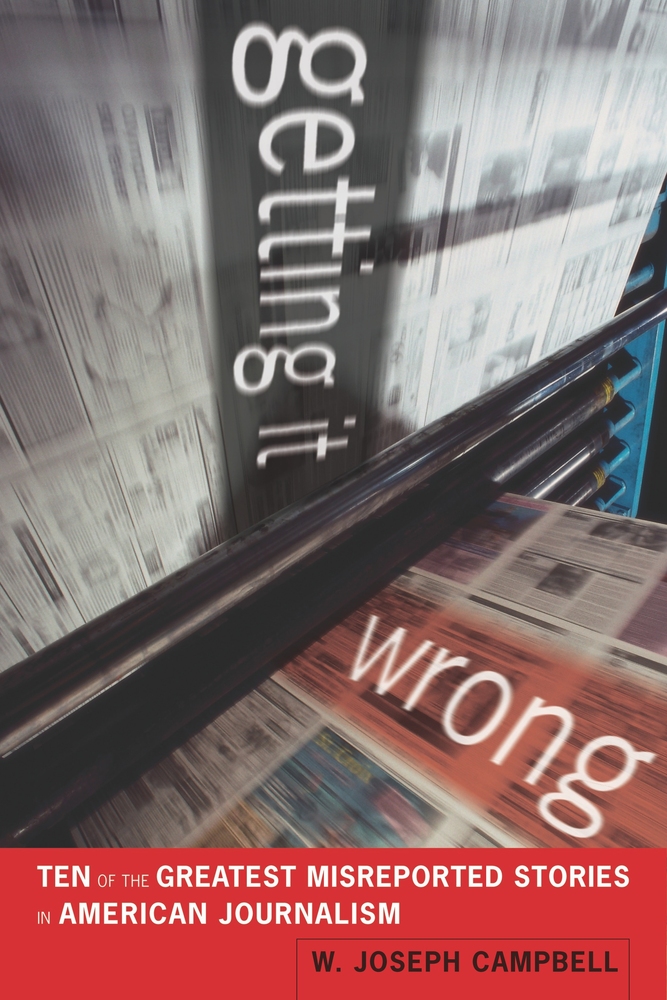
Cinema’s role in solidifying media-driven myths is discussed in Getting It Wrong, my next book, which will be out in the summer.

“Cinematic treatments,” I write, “influence how historical events are collectively remembered and can harden media-driven myths against debunking.”

That certainly was so with All the President’s Men, the 1976 screen adaptation of Carl Bernstein and Bob Woodward’s book by the same title.

The film characterized Bernstein and Woodward, both of the Washington Post, as central and essential to unraveling the Watergate scandal that toppled President Richard Nixon.

The upshot, I write in  Getting It Wrong, has been “to solidify and elevate the heroic-journalist myth” of Watergate and sustain it in the collective memory.

Indeed, it’s hard to think of Watergate without thinking of All the President’s Men.

Similarly, the 2005 motion picture Good Night, and Good Luck served to popularize and extend the media myth that broadcasting legend Edward R. Murrow exposed and abruptly ended the communists-in-government witch-hunt of Senator Joseph R. McCarthy.

Good Night, and Good Luck was a dramatic retelling of Murrow’s See It Now program on McCarthy, which aired on CBS on March 9, 1954, and often is credited with exposing McCarthy’s crude investigative tactics and bullying ways.

McCarthy in 1954

But as I point out in Getting It Wrong, Murrow’s program on McCarthy came very late–years after other journalists had confronted and challenged the red-baiting senator. By 1954, it wasn’t as if American audiences were waiting for a white knight like Murrow to tell them of the toxic threat McCarthy posed.

They already knew. And in the months immediately before Murrow’s program, the senator’s favorability ratings had begun to fall.

While it never explicitly said as much, Good Night, and Good Luck left the inescapable but erroneous impression that Murrow had courageously and single-handedly challenged and stopped McCarthy.

Citizen Kane, which was released in 1941, arguably is the finest motion picture ever made about journalism: It may have been the best movie, ever.

It certainly was Orson Welles’ towering and most memorable cinematic achievement. Kane was vaguely based on the life and times of media mogul William Randolph Hearst.

Kane‘s contribution to media mythmaking came in a scene that paraphrased Hearst’s purported vow to “furnish the war” with Spain at the end of the 19th century.

As I note in Getting It Wrong,  the Hearstian vow lives on despite a nearly complete absence of supporting documentation. It lives on even though the telegram that supposedly contained Hearst’s message has never turned up. It lives on even though Hearst denied ever making such a statement.

Like many media-driven myths, the story of Hearst’s purported vow is almost too good not to be true.

And given cinematic treatment, it may be impossible ever to inter.

WJC

Remembering the Maine — and a myth of yellow journalism

In Anniversaries, Debunking, Media myths, New York Times, Spanish-American War on April 6, 2010 at 5:33 pm

American yellow journalism of the late 19th century, led by the newspapers of William Randolph Hearst, has been often blamed for bringing on the Spanish-American War, which began 112 years ago this month.

Wreckage of the Maine (Library of Congress)

Wreckage of the Maine

It is an enduring media-driven myth, a misleading, media-centric interpretation that refuses to die, despite considerable evidence to the contrary.

The media myth of the Spanish-American War was invoked in a commentary posted today at the conservative online news site, Human Events.

The commentary–which contemplated parallels in the recent sinking of a South Korean Navy vessel and the destruction in Havana harbor in 1898 of the USS Maine– declared:

“While the cause of the explosion [that destroyed the Maine] remained a mystery, newspapers fighting for readership jumped on the incident as a means to increase sales. Exploiting and distorting the news—an industry art form that came to be called ‘yellow journalism’—reporters slanted the news to sensationalize it. As the Navy continued its investigation [into the causes of the battleship’s loss], the newspapers worked the American public’s emotions into a frenzy.”

There is, quite simply,  little evidence to support such a claim. (And coining the term “yellow journalism” predated the Maine‘s destruction by more than a year.)

Rather than stirring emotions “into a frenzy” in late winter 1898,  the American press was “notably becalmed and restrained,” as I wrote in my 2001 book, Yellow Journalism: Puncturing the Myths, Defining the Legacies.

I cited the trade journal Fourth Estate, which observed that the “frightful news from Havana, telling of the destruction of the . . . Maine, was treated here as a terrible calamity. The natural suspicion that Spanish methods of warfare had destroyed the ship moved men to cry for war, but the press as a whole published and reiterated the message from the [Maine’s] Captain, to ‘suspend judgment.’”

The trade journal also noted:

“Some of our papers, overheated with natural anger, have clamored for war, but the great majority have shown to the world that the press of the United States is in accord with the Government and is anxious for war only when it must be.” (Emphasis added.)

The Fourth Estate‘s reference to “some” papers clamoring for war no doubt was a reference to Hearst’s New York Journal and its racy sister publication, the Evening Journal. Hearst’s papers, as well as those of Joseph Pulitzer, were often speculative and over-the-top in their reporting.

But these newspapers, the leading exemplars of yellow journalism, hardly set an agenda for the American press in the aftermath of the Maine‘s destruction.

As I wrote in Yellow Journalism, scholarly “studies of the heartland press in 1898 signal the limited influence of the Hearst and Pulitzer newspapers—and note that few local newspapers immediately and vigorously advocated war” because of the loss of the Maine in a harbor under Spanish control.

The staid New York Times, which in the late 19th century began emerging as the antithesis to yellow journalism, also noted the generally calm reaction in the United States after the Maine‘s destruction.

The Times stated in late February 1898:

“No Latin race, we imagine, would have kept its head as well as the American people have kept theirs during the disturbing events of the past two weeks. In Spain or France or Italy there would have been tumultuous assemblages, much outcry in the streets, and incitements to riots.

“Outside of the reckless newspapers there has been no raving here.”

So it scarcely can be said that newspapers “worked the American public’s emotions into a frenzy” that led to the Spanish-American War. There is  little to support the notion that a journalistic war cry arose in the wake of the Maine’s destruction.

WJC

Remembering big: Another April anniversary

In Anniversaries, Debunking, Jessica Lynch, Media myths, Washington Post, Watergate myth on April 4, 2010 at 5:56 pm

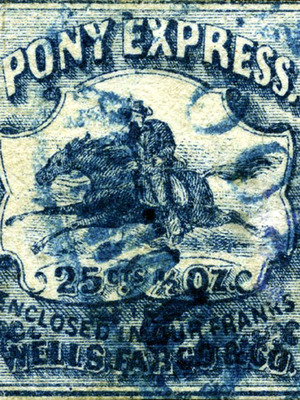
April 3 not only was the seventh anniversary of the Washington Post‘s botched report about the mythical battlefield heroics of Jessica Lynch. The date also marked the 150th anniversary of the first run of the legendary Pony Express–a short-lived institution that is impressively steeped in myth.

As Christopher Corbett wrote in an engaging commentary published Friday in the Wall Street Journal:

“We remember the Pony Express as one of the most enduring and endearing of American stories, a tale of the frontier, a story of bold entrepreneurs, daring young horsemen, true riders of the purple sage and all that.

“In truth, the venture hemorrhaged money from day one, was doomed by technology (another particularly American story), lasted a mere 78 weeks, ruined its backers and then disappeared into what historian Bernard DeVoto called ‘the border land of fable.'”

Corbett noted: “It was all over in 18 months. The service was shut down in the flash of a telegrapher’s key when the transcontinental telegraph was completed in October 1861.”

But for years afterward, “the West was aswarm with old men who claimed to be ‘the last of the Pony Express riders,'” Corbett wrote.

The tall tales and exaggerations that grew up around the Pony Express were in large part promoted by the cinema and the entertainment industry–factors akin to those that contribute to the rise and tenacity of media-driven myths, which are stories about and/or by the news media that are widely believed and often retold but which, on close inspection, prove to be apocryphal or wildly exaggerated.

The filmmaker John Ford incorporated the Pony Express into the 1948 Western, Fort Apache, where, Corbett noted, “the brave rider thunders into the fort to bring news of Custer’s Last Stand, which, alas, took place some 15 years after the Pony stopped running.”

It’s faintly reminiscent of the classic cinematic treatment of the Watergate scandal: Easily the best-known Watergate movie is All the President’s Men, a screen adaptation of the best-selling book by the same title.

The cinematic version of All the President‘s characterized the book’s authors, Carl Bernstein and Bob Woodward of the Washington Post, as central and essential to the scandal’s unraveling.

The upshot of that misrepresentation, I write in  Getting It Wrong, my forthcoming book about media-driven myths, has been “to solidify and elevate the heroic-journalist myth” of Watergate, to give it dramatic power, and sustain it in the collective memory.

I further note in Getting It Wrong that the film offers an unmistakable and unambiguous statement about “the power and centrality of the press in Nixon’s fall. All the President’s Men allows no other interpretation: It was the work Woodward and Bernstein that set in motion far-reaching effects that brought about the first-ever resignation of a U.S. president,” Richard Nixon.

What’s more, the heroic-journalist interpretation of Watergate minimizes or ignores the more decisive contributions in Nixon’s fall by agencies and organizations besides the Washington Post.

In his fine commentary, Corbett noted “the person who immortalized the Pony was William Frederick Cody, or Buffalo Bill. (He also claimed he had been a rider. Not true.)

“The [Pony Express] fast-mail service may have lasted only a year and a half, but it thrived for four decades in Cody’s Wild West show, seen by millions in the U.S. and Europe. To add drama to his re-enactment, Buffalo Bill might throw in a war party of savage Indians chasing a heroic rider who always managed to escape.

“It would become one of the most enduring images of the Pony Express, but it was not true; the actual riders rarely tangled with Indians,” Corbett wrote, adding:

“Why would a Paiute want a two-week-old copy of Horace Greeley’s New York Tribune?”

Corbett noted in closing:

“If the Pony Express continues to thrill and baffle us, consider the words of an old horseman in western Nebraska who advised me when I expressed some concerns about the pedigree of this yarn. ‘We don’t lie out here,’ he explained kindly. ‘We just remember big.'”

“Remember big.” A great line. And it’s certainly applicable in understanding why media-driven myths can be so tenacious and enduring.

WJC

‘War means profits’? It didn’t for Hearst’s papers

In 1897, Debunking, Furnish the war, Media myths, Newspapers, Spanish-American War, Yellow Journalism on April 3, 2010 at 9:05 am

William Randolph Hearst’s purported vow to “furnish the war” with Spain in the late 1890s may be the anecdote most often told in American journalism.

Hearst

It’s a woolly tale that’s been in circulation since 1901, and it lives on despite repeated and thorough debunking. It’s one of the ten media-driven myths examined in my forthcoming book, Getting It Wrong.

“Furnish the war” is so tenacious because it offers a tidy summary of the news media at their worst. And it’s a pithy quotation, easily digested and readily recalled.

The anecdote reemerged the other day, in a commentary posted at TheCitizen.com, an online news site of Fayette Publishing in Fayetteville, GA. The commentary stated:

“William Randolph Hearst in 1897 [told] the artist Frederic Remington: ‘You furnish the pictures and I’ll furnish the war.’ Think for a minute what that statement means. War means business, war means profits and war means death.”

Hearst’s purported message to Remington is almost certainly apocryphal–as is the notion that war meant profits for Hearst’s newspapers. In their intensive coverage of the four-month Spanish-American War of 1898, his papers lost money.

As I wrote in my 2001 book, Yellow Journalism: Puncturing the Myths, Defining the Legacies, the Spanish-American War generally boosted newspaper circulation. But advertising revenues fell, as advertisers feared the war would undercut the nascent recovery from the hard economic times of the 1890s.

In addition, newsprint costs soared, as did news-gathering expenditures.

The trade journal Fourth Estate estimated in 1899 that Hearst’s New York Journal had spent $50,000 a week—the equivalent these days of more than $1 million—on cable tolls, reporters’ salaries, and dispatch boats that ferried correspondents’ reports from the war’s principal theater in Cuba to Jamaica and elsewhere for transmission to New York.

Hearst's 'New York Evening Journal'

The Journal scoffed at claims that it helped foment the conflict in a cynical scheme to build circulation and boost profits.

“Would you like to know what effect the war had on the money-making feature of this particular newspaper? The wholesale price of paper was greatly increased. Advertising diminished, expenses increased enormously,” the Journal said, adding that its expenses related to covering the conflict exceeded $750,000—the equivalent these days of more than $20 million.

During the war, which lasted 114 days, the Journal‘s racy sister publication, the Evening Journal,  produced as many as forty extra editions a day–a late 19th century manifestation of what contemporary journalists would recognize as the unrelenting, 24-hour news cycle.

WJC

Seven years after ‘fighting to the death’: Who was the Post’s source?

In Anniversaries, Debunking, Jessica Lynch, Media myths, Washington Post on April 2, 2010 at 10:49 am

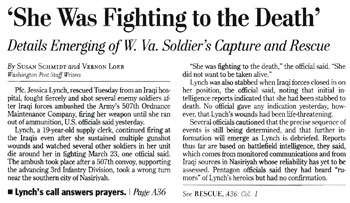
It will be seven years tomorrow since the Washington Post published its erroneous front-page report about Jessica Lynch, the Army private whom the newspaper had said “fought fiercely” in an early engagement of the Iraq War.

“‘She Was Fighting to the Death,'” the Post‘s headline said of Lynch, then a 19-year-0ld supply clerk in the Army’s 507th Maintenance Company.

The Post cited “U.S. officials” who otherwise were unidentified as saying Lynch had “continued firing at the Iraqis even after she sustained multiple gunshot wounds and watched several other soldiers in her unit die around her in fighting” at Nasiriyah on March 23, 2003.

The Post further cited the unnamed sources in reporting that Lynch had “shot several enemy soldiers after Iraqi forces ambushed” the 507th and kept “firing her weapon until she ran out of ammunition.”

None of it was true, however.

Lynch never fired a shot at Nasiriyah; her rifle jammed during the attack. She suffered shattering injuries when a rocket-propelled grenade struck her Humvee, causing the vehicle to crash. But she wasn’t shot.

Lynch was taken prisoner and treated at an Iraqi hospital, from where she was rescued April 1, 2003, by a U.S. special operations team.

As I write in Getting It Wrong, my forthcoming book about media-driven myths, “The Post’s erroneous hero-warrior tale thrust Lynch into an international spotlight that has never fully receded.”

The Post, though, has never disclosed identity of the source or sources for its bogus “fighting to the death” report, which was published April, 3, 2003.

Over the years, speculation has been that the U.S. military leaked the hero-warrior tale about Lynch. But one of the reporters on the story, Vernon Loeb, has said the Pentagon wasn’t the source.

“I could never get anybody from the Pentagon to talk about those reports at all,” Loeb said on an NPR program in late 2003. “I got indications that they had, in fact, received those intelligence reports, but the Pentagon was completely unwilling to comment on those reports at all. They wouldn’t say anything about Jessica Lynch.”

He added that “we wrote a story that turned out to be wrong because intelligence information we were given was wrong.”

So who were the Post‘s sources? Who supplied the erroneous details about Lynch?

When I reached him by phone in 2008 to talk about the Lynch case, Loeb hung up on me.

The author Jon Krakauer claimed in a book published last year that a former White House operative named Jim Wilkinson “arranged to give the Washington Post exclusive access to classified intelligence that was the basis for the now-discredited ‘She Was Fighting to the Death’ story that ran on the front page of that newspaper.”

Krakauer, writing in Where Men Win Glory: The Odyssey of Pat Tillman, called Wilkinson a “master propagandist” and said he “deserves top billing for creating the myth of Jessica Lynch.”

Krakauer’s book identified no specific sources for its claims about Wilkinson, who at the time of Lynch’s capture and rescue was director of strategic communications for General Tommy Franks, then the commander of U.S. forces in Iraq.

I recently spoke by phone with Wilkinson, now a managing partner for the Brunswick Group in San Francisco. He vigorously disputed Krakauer’s account as “factually incorrect” and insisted that “not one shred of evidence” links him to leaking the erroneous report to the Post.

Wilkinson also said:

“Tommy Franks would have killed me” had he been the Post’s source for the erroneous report about Lynch.

Wilkinson’s denial has the ring of authenticity, especially so his point about Tommy Franks. The tenor of Franks’ memoir, American Soldier, makes it clear that Wilkinson’s subordinate and advisory role would have ended abruptly had he crossed the general.

So seven years on, the Post‘s bogus report about Jessica Lynch reverberates still.

WJC

Did he say it? A curious Murrow quote

In Debunking, Media myths, Murrow-McCarthy myth on March 30, 2010 at 2:38 pm

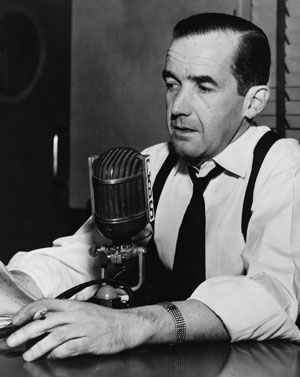
Edward R. Murrow’s bravery in taking on Senator Joseph R. McCarthy in a televised report in 1954 is the stuff of legend–and of media-driven myth.

The notion that Murrow’s half-hour CBS program halted McCarthy’s communists-in-government witch hunt is one of 10 media-driven myths addressed, and debunked, in my forthcoming book, Getting It Wrong.

Murrow: Did he say it?

The courage Murrow supposedly showed back then was invoked yesterday in a commentary at the Huffington Post blog. The commentary deplored the decline of civility in American political life and declared:

“One of the most courageous heroes steering Americans back to sanity during the McCarthy period, Edward R. Murrow, commented: ‘We must not confuse dissent with disloyalty. When the loyal opposition dies, I think the soul of America dies with it.'”

Besides the reference to Murrow as hero, I was struck by the quotation’s second sentence:

“When the loyal opposition dies, I think the soul of America dies with it.”

I wondered: Did Murrow really say that?

The first portion of the quote–“We must not confuse dissent with disloyalty”–is quite familiar. Murrow intoned the passage during his 1954 program on McCarthy, in a closing editorial comment.

But the rest of quotation– “When the loyal opposition dies, I think the soul of America dies with it”–was not uttered during Murrow’s program on McCarthy.

I ran that passage through the “historical newspapers” database, which includes the New York Times, Washington Post, Chicago Tribune, and Los Angeles Times. No articles quoting the passage were returned.

A search of the LexisNexis database produced a few returns, but none dated before 2001. And none stated when and where Murrow made the comment.

Among the LexisNexis returns was a book review published in 2003 in the Washington Post. The review invoked the “loyal opposition” passage and said Murrow made the remark “half a century ago, at the height of the McCarthy era.” But exactly when and where was left unsaid.

Harry Reid, now the U.S. Senate majority leader, invoked the passage, and cited Murrow as its author, in a speech in 2006 about Iraq. But Reid didn’t say when and where Murrow supposedly made the comment.

Otherwise, the articles, statements, and letters to the editor retrieved from LexisNexis offered no details about the quotation’s derivation.

A Google search produced links to nearly 9,000 online sites that cite the passage. A check of several of those sites turned up nothing about the quote’s derivation.

Google Books identifies seven books that contain the verbatim passage, none of which was published before 2003. None of the seven books is a biography about Murrow.

I could be wrong, but the passage strikes me as dubious, as a flexible, handy, all-purpose comment useful in scoring points by the political left as well as the right.

If it were genuine, if Murrow really said it, its derivation wouldn’t be difficult to track down.

Moreover, the quotation seems almost too neat and tidy to be authentic.

In that sense, it’s evocative of William Randolph Hearst’s often-quoted vow to “furnish the war” with Spain.

And that is a hardy and enduring media-driven myth.

WJC

That heroic Ed Murrow: The myth endures

In Debunking, Media myths, Murrow-McCarthy myth on March 29, 2010 at 10:30 am

Few media-driven myths are as tenacious as the notion that Edward R. Murrow abruptly ended the communists-in-government witch-hunt of Senator Joseph R. McCarthy.

The myth dates to March 9, 1954, when Murrow’s 30-minute See It Now program on CBS television examined the campaign of innuendo, exaggeration, and half-truth that McCarthy had been waging for more than four years.

And the myth was invoked today at Minnesota Public Radio’s online site, in a commentary that declared:

“In the spring of 1954, McCarthy’s crusade of insinuation, innuendo and guilt by association was brought to an end by journalist Edward R. Murrow and Joseph Welsh, attorney for the U.S. Army.”

(The commentary mentioned Welsh because he dramatically confronted McCarthy at a congressional hearing in June 1954, pointedly asking the senator: “Have you no sense of decency, sir? At long last, have you left no sense of decency?”)

As for Murrow, though, his See It Now program on McCarthy was quite belated.

He took on McCarthy only after several other journalists had challenged the senator and his tactics for months, even years.

The Murrow-McCarthy myth is one of 10 that I address, and debunk, in my book, Getting It Wrong. (Note: A second edition of Getting It Wrong came out in 2017.)

I point out in the book that even Murrow’s friend and CBS colleague, Eric Sevareid, “chafed at the misleading interpretation attached to the See It Now program which, he noted, ‘came very late in the day.’

“Sevareid said: ‘The youngsters read back and they think only one person in broadcasting and the press stood up to McCarthy and this has made a lot of people feel very upset, including me, because that program came awfully late.’”

Murrow, himself, acknowledged that his accomplishments in confronting McCarthy were modest, that he had at best reinforced what others had long said about the Republican senator.

I note in Getting It Wrong that Jay Nelson Tuck, then the television critic for the New York Post, wrote in April 1954 that Murrow felt “almost a little shame faced at being saluted for his courage in the McCarthy matter.

“He said he had said nothing that … anyone might not have said without a raised eyebrow only a few years ago,” Tuck wrote.

In no way, then, can Murrow’s See It Now program be said to have “brought to an end” the McCarthy menace.

By the time Murrow took to the air in March 1954, McCarthy’s popularity was already in decline. By then, other journalists–notably Washington’s leading muckraker, Drew Pearson–had called attention to the senator’s crude investigative techniques. And the Army-McCarthy hearings, at which Welch gained lasting fame, proved pivotal to the senator’s downfall.

The hearings led to the Senate’s censuring McCarthy, and to his retreat into political oblivion.

WJC

Now in Italian: The Cronkite Moment

In Cronkite Moment, Debunking, Media myths on March 25, 2010 at 6:08 pm

The Italian online site InviatoSpeciale indulges today in the legendary though dubious “Cronkite Moment” of February 1968.

That was when CBS News anchorman Walter Cronkite delivered a downbeat editorial assessment about the Vietnam War, saying the U.S. military effort there was “mired in stalemate.”

Thanks to the Babelfish online translation site, here is what InviatoSpeciale had to  say about that mythical occasion:

“The most followed anchorman of the American country explained to the people that war was mistaken and soon after the president, Lyndon Johnson, commented, ‘If I have lost Walter Cronkite, I have lost the moderate America’ and withdrew from the race for the White House.”

Even if roughly translated, that’s a pretty fair summary of the “Cronkite Moment,” a media-driven myth that I address and debunk in my forthcoming book, Getting It Wrong.

The “Cronkite Moment,” which derives its appeal and tenacity as an example of news media’s making a swift and profound difference in the conduct of American foreign policy.

But there are many reasons to doubt that the Cronkite program had much of an effect on Johnson at all.

As I note in Getting It Wrong, the president did not see the program when it aired February 27, 1968 .

Johnson then wasn’t in front of a television. He was in Austin, Texas, at the 51st birthday party of a political ally, Governor John Connally.

Even if he later saw a videotaped recording of the Cronkite program, “Johnson gave no indication of having taken the anchorman’s message to heart,” I write in Getting It Wrong, adding:

“Just three days after the program aired, Johnson vowed in remarks at a testimonial dinner in Texas that the United States would ‘not cut and run’ from Vietnam. ‘We’re not going to be Quislings,’ the president said, invoking the surname of a Norwegian politician who helped the Nazis take over his country. ‘And we’re not going to be appeasers….’”

As for Johnson’s decision against seeking reelection in 1968, the Cronkite program was of little or no consequence.

Critical to Johnson’s decision–which he announced at the end of March 1968, a month after the Cronkite program–was the advice and counsel of advisers, and the implications of Senator Eugene McCarthy’s insurgent bid for the Democratic nomination for president.

The potency of McCarthy’s antiwar campaign was demonstrated in the Democratic primary election in New Hampshire on March 12, 1968. McCarthy won 42 percent of the vote, a far greater portion than expected. Johnson won 49 percent.

Not only that, there’s evidence that Johnson never intended to seek reelection in 1968.

The appearance in Italian of the “Cronkite Moment” is a bit amusing. It’s also indicative of how deeply embedded the myth has become.

Moreover, it’s suggestive of how difficult it will be to uproot it completely.

WJC

‘Pharm patries’ and the howler-correction of the month

In Debunking, Media myths, Newspapers on March 21, 2010 at 8:36 pm

The once-great Chicago Tribune offered up the howler-correction of the month the other day, saying this about a story it published nearly four months ago:

“In a Nov. 22 article about teenagers who abuse prescription drugs, a reference to ‘pharm parties‘ being a craze among teens did not sufficiently support that assertion.”

Huh?

That, no doubt, was the reaction of many people who read and puzzled over that correction: It befuddled more than it clarified.

Here’s what the Tribune said about “pharm parties” back in the fall:

“‘Pharm parties’ are a disturbing craze in which teens steal prescription medicine from home, take the pills to a gathering, and dump the load into a bowl. The partygoers then pop the pills and wait for a reaction.”

The “pharm party” meme is a media-driven myth, one of remarkable tenacity. The myth’s most energetic debunker, Jack Shafer of slate.com, has traced the meme to 1966, when, he says, “pharm parties” were known as “fruit salad parties.”

“There are at least two basic problems with the pharm-party scenario reported in the press,” Shafer has written.

“To begin with, if you were a young drug fiend and stole potent drugs, why would you deposit them in a communal bowl if there was a good chance that when your turn came to draw a drug at random, you might get an antihistamine? And second, I’ve yet to read a story in which a journalist actually attends such a gathering, interviews a participant, or cites a police report alleging such behavior.”

More recently, Shafer deliciously excoriated the San Francisco Chronicle for its front-page report a week ago about “pharm parties,” which declared–on the basis of few if any statistics–that  “the phenomenon is getting worse.”

The headline over Shafer’s column described the Chronicle account as “the worst ‘pharm party’ story ever.”

He pointed out:

“To my knowledge, no journalist has ever witnessed such random consumption of drugs by young people in a party setting, yet the story continues to get major play as if these affairs are common.”

So why has the “pharm party” myth demonstrated such tenacty? Why does it seem to defy the most thorough of debunkings?

An important factor, no doubt, is stereotyping–a ready willingness to believe that teens readily indulge in mindlessly dangerous conduct.

To that end, a graduate student of mine recently called attention to passage in 1988 film Heathers in which the protagonist, J.D., says:

“Your society nods its head at any horror the American teenager can think to bring upon itself.”

Like many media-driven myths–including those addressed and debunked in my forthcoming book Getting It Wrong–the “pharm party” meme is a delicious tale. Like the dubious story about William Randolph Hearst’s vowing to “furnish the war” with Spain, it’s just too good not to be true.

Or retold.

(Hearst’s famous vow has achieved status as an all-purpose anecdote, one useful in illustrating any number of media sins and shortcomings. It has been invoked to illustrate the media’s willingness to compromise impartiality, promote political agendas, and indulge in sensationalism. It has been used, more broadly, to suggest the media’s capacity to inject malign influence into international affairs.)

So what to do about these nasty and persistent media myths?

I believe that pounding away at them–directing attention to them whenever they arise– is the only effective way to address them and thus begin to alter the narrative.

The Tribune‘s correction suggests that Shafer’s debunking is having an effect.

The Annenberg Public Policy Center, moreover, has demonstrated that some myths can be curbed or contained. Over the past 10 years, Phildelphia-based Annenberg Center has endeavored to debunk the notion that suicides rise during the year-end holidays.

They don’t.

The Annenberg Center hasn’t buried this media myth. But to its credit, it has begun to tame it.

WJC

Recalling the overlooked heroism of Sgt. Walters

In Debunking, Jessica Lynch, Media myths, Washington Post on March 19, 2010 at 2:05 pm

Oregon Public Broadcasting aired a segment today recalling the death seven years ago in Iraq of Sergeant Donald Walters, whose battlefield heroics were mistakenly attributed to Private Jessica Lynch.

“In later accounts,” the OPB report noted, “Don emerged as a hero who’d stayed behind to cover for his escaping comrades, before his capture and brutal death” at the hands of Iraqi irregulars, the Fedayeen.

The OPB report represents one of the few occasions when U.S. news media have called attention to Walters, a 33-year-old cook in the Army’s 507th Maintenance Company who either was left behind or stayed behind as his unit tried to escape an ambush in Nasiriyah in March 2003, during the first days of the Iraq War.

Walters laid down covering fire as his comrades fled. When his ammunition ran out, Walters was captured and soon after executed.

Owing apparently to a mistaken translation of Iraqi battlefield reports, Walters’ heroics initially were attributed to Lynch, then a 19-year-old supply clerk in the 507th.

The Washington Post sent the erroneous account about Lynch into worldwide circulation on April 3, 2003, in a sensational report on its front page. The Post said Lynch had “fought fiercely” in Nasiriyah and had “shot several enemy soldiers after Iraqi forces ambushed” elements of the 507th, “firing her weapon until she ran out of ammunition.”

The Post cited “U.S. officials” who otherwise were unidentified as saying that Lynch had “continued firing at the Iraqis even after she sustained multiple gunshot wounds and watched several other soldiers in her unit die around her in fighting March 23.” One official was quoted anonymously as saying:

“‘She was fighting to the death. She did not want to be taken alive.’”

As I write in Getting It Wrong, my forthcoming book about media-driven myths, “the Post never fully acknowledged or explained its extraordinary error about Jessica Lynch.”

I also note: “The Post’s erroneous hero-warrior tale thrust Lynch into an international spotlight that has never fully receded.”

Indeed, the hoopla over her supposed derring-do in battle obscured the actions of Walters, whose conduct Nasiriyah probably saved lives of fellow soldiers. Walters posthumously was awarded the Silver Star, the U.S. military’s third-highest decoration for valor.

Walters’ parents live in Salem, Oregon. In the OPB report, Walters’ mother, Arlene, points to an imponderable about her son in his last hours. “Our big question,” she said, “is did he choose to stay or was he left out there” in Nasiriyah in the rush to escape the ambush.

Perhaps the best account of the ambush at Nasiriyah appears in Richard Lowry’s masterful book, Marines in the Garden of Eden.

Lowry wrote:

“We will never really know the details of Walters’ horrible ordeal. We do know that he risked his life to save his comrades and was separated from the rest of the convoy, deep in enemy territory. We know that he fought until he could no longer resist.”

As I note in Getting It Wrong:

“Walters’ actions, when they became known, attracted little more than passing interest from the American news media—certainly nothing akin to the intensity of the Lynch coverage after the Post’s ‘fighting to the death’ story appeared.”

WJC