The recent death of Alexander M. Haig, the combative general who became U.S. secretary of state in the early 1980s, brought reminders about how Haig had figured improbably in the years-long guessing game about the identity of “Deep Throat.”
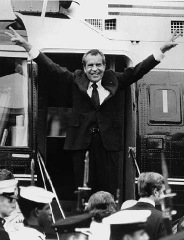
Deep Throat was the well-placed, anonymous source to whom the Washington Post periodically turned in reporting the Watergate scandal that toppled Richard Nixon’s presidency. Haig was chief of staff in the Nixon White House as the Watergate scandal intensified and reached its culmination in 1973-74.
Haig was not implicated in the scandal and has been credited with helping to navigate Nixon’s resignation after it became clear the president had conspired to obstruct justice.
And Haig’s name surfaced periodically in the guessing game about Deep Throat’s identity, which began soon after publication in 1974 of All the President’s Men, Carl Bernstein and Bob Woodward’s book about their reporting on Watergate.
The identity of Deep Throat was the subject of a “parlor game that would not die,” as the Philadelphia Inquirer once put it. The prolonged guessing game, I write in my forthcoming book, Getting It Wrong, helped promote the notion that the Post and its reporting were central to unraveling the Watergate scandal.
That is, the speculation about Deep Throat’s identity “provided periodic and powerful reminders about the Post and its Watergate coverage,” I write, “serving to keep Woodward and Bernstein in the public eye far longer than they otherwise would have been.”
I saw Haig at news conference in Geneva, Switzerland, in the early 1980s and recall being struck by what a swaggering, cocky, arrogant guy he was: An unlikely candidate to have been the secret source whom Woodward would meet in an underground parking garage in suburban Washington in the wee hours of the morning.
But, then, so were many of the other Deep Throat candidates, who included Henry Kissinger, former secretary of state; John Dean, a former White House lawyer; Patrick Buchanan, a former Nixon aide, and Diane Sawyer, another former White House aide and now a TV news anchor.
It’s striking how improbable the Deep Throat candidates really were.
Haig, like most of the others, denied having been the Post’s source. And the guessing game finally came to an end in 2005, when W. Mark Felt, formerly a senior FBI official, confirmed he had been Deep Throat. Despite his denials, Felt had always been a leading suspect.
It’s important to note just how dramatically overstated Deep Throat’s role in the Watergate scandal has been. An obituary about Haig published in the Scotsman offers an example.
“For many years,” the Scotsman said, “Haig’s name was linked with that of ‘Deep Throat’, the code-name Washington Post reporters used for the informant who provided them with leaked information that brought down Nixon.”
Brought down Nixon.
Neither Felt’s “leaked information,” nor the Washington Post‘s reporting, brought down Nixon.
As I note in Getting It Wrong, “Nixon likely would have served out his term if not for the audiotape recordings he secretly made of most conversations in the Oval Office of the White House.
“Only when compelled by the Supreme Court did Nixon surrender those recordings, which captured him plotting the cover-up and authorizing payments of thousands of dollars in hush money.”
And against the intricate tableau of Watergate investigators–the federal prosecutors, the FBI, the bipartisan congressional panels–the contributions of the Post and the U.S. news media were modest, and certainly not decisive to the scandal’s denouement.







 Media Myth Alert