W. Joseph Campbell

Archive for the ‘Jessica Lynch’ Category

Launching ‘Getting It Wrong’ at Newseum

In Bay of Pigs, Bra-burning, Cronkite Moment, Debunking, Furnish the war, Jessica Lynch, Media myths, Murrow-McCarthy myth, War of the Worlds, Washington Post, Watergate myth on June 14, 2010 at 6:28 am

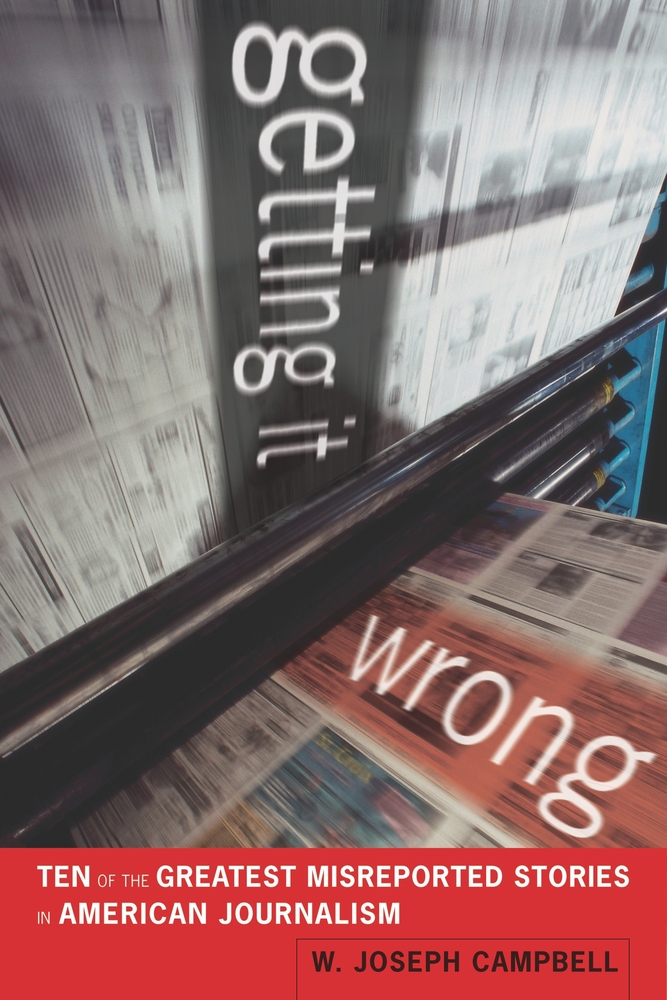
My new book, Getting It Wrong, will be launched Saturday, June 19, at an “Inside Media” program at the Newseum, the $450 million museum of news in downtown Washington, D.C.

The program will begin at 2:30 p.m. in the Knight TV Studio on the third level and will feature a discussion with the Newseum’s John Maynard, followed by audience Q-and-A.

I’ll be signing copies of Getting It Wrong afterward.

The book addresses, and debunks, 10 prominent media-driven myths–stories about and/or by the news media that are widely believed and often retold but which, on close inspection, proved to be apocryphal or wildly exaggerated.

Here is a brief description about each of the 10 myths:

  1. Remington-Hearst: William Randolph Hearst’s famous vow, “you furnish the pictures, I’ll furnish the war,” is almost certainly apocryphal.
  2. War of Worlds: The notion that the War of Worlds radio dramatization in 1938 caused nationwide panic and mass hysteria is exaggerated.
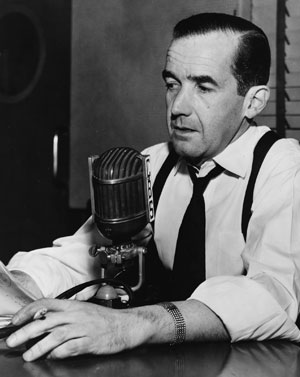
  3. Murrow-McCarthy: Edward R. Murrow’s famous See It Now program in March 1954 did not end Senator Joseph McCarthy’s communists-in-government witch-hunt; Murrow in fact was very late to take on McCarthy.

    Murrow in 1954

  4. Bay of Pigs: The New York Times did not suppress its reporting in the run-up to the ill-fated Bay of Pigs invasion in April 1961.
  5. Cronkite-Johnson: Walter Cronkite’s special report on Vietnam in February 1968 did not prompt an immediate reassessment of U.S. war policy.
  6. Bra-burning: Humor columnist Art Buchwald helped spread the notion that feminist demonstrators dramatically burned their bras at a Miss America protest in September 1968.
  7. Watergate: The Washington Post’s intrepid reporters, Carl Bernstein and Bob Woodward, did not bring down Richard Nixon’s corrupt presidency. That they did is a trope that knows few bounds.
  8. Crack babies: The much-feared “bio-underclass” of children born to women who smoked crack cocaine during their pregnancies never materialized.
  9. Jessica Lynch: The Washington Post’s erroneous reporting about Jessica Lynch early in the Iraq War gave rise to several myths about her capture and rescue.
  10. Hurricane Katrina: News coverage of Katrina’s aftermath in New Orleans in early September 2005 was marred by wild exaggerations of extreme, Mad Max-like violence.
As I write in Getting It Wrong, the myths debunked “are among American journalism’s best-known stories. Most of them are savory tales. And at least some of them seem almost too good to be false.”

I further write that because it “takes on some of the most treasured stories in American journalism,” Getting It Wrong is “a work with a provocative edge. It could not be otherwise.”

WJC

Related:

War, the ‘apex of yellow journalism’? Not so

In Debunking, Jessica Lynch, Media myths, Spanish-American War on June 10, 2010 at 11:52 am

I’ve noted from time to time how some media-driven myths–those false, dubious, improbable stories about the news media that masquerade as factual–travel quite well, crossing linguistic barriers with frequency and ease.

Hearst's New York Evening Journal, 1898

One of the more hearty, adaptable, and internationally appealing media myths is that of American “yellow journalism,” and how its sensational and exaggerated content supposedly brought about the Spanish-American War in 1898.

That myth was debunked in my 2001 study, Yellow Journalism: Puncturing the Myths, Defining the Legacies. But it is probably too deliciously appealing, too neat and tidy, ever to die away.

Indeed, it popped up in an international way yesterday, in a commentary in the English-language edition of China’s Global Times. The commentary appeared beneath the headline, “Yellow journalism creeping into Chinese media,” and declared:

“The term yellow journalism was coined during … late 19th century when media barons William Randolph Hearst and Joseph Pulitzer’s respective newspapers, the New York Journal and the New York World, were in cutthroat competition. …

“The apex of US yellow journalism came when the two newspapers’ fear mongering and sensationalism led to the Spanish-American War in 1898.”

As I wrote in Yellow Journalism, the notion that the yellow press of Hearst and Pulitzer brought on the war with Spain over Cuba rests on a narrow, decidedly media-centric interpretation of the conflict’s causes.

That interpretation ignores, I noted, the “more relevant and immediate factors that give rise to armed conflict.

“In the case of the Spanish-American War,” I wrote in Yellow Journalism, “the policy objectives between the United States and Spain ultimately proved irreconcilable. Months of intricate diplomatic efforts ultimately failed to resolve what had become an intolerable state of affairs in Cuba, dramatized by the destruction of the [U.S. warship] Maine in a harbor under Spanish control and supervision.

“To indict the yellow press for causing the Spanish-American War is to misread the evidence and to ignore the intricacies of the diplomatic quandary that culminated in the spring of 1898 in an impasse that led to war.”

Failed diplomacy gave rise to the Spanish-American War, not the content of the yellow press of Hearst and Pulitzer.

Even so, it is intriguing how wartime can and does give rise to media-driven myths.

Of the 10 prominent myths addressed and debunked in my new book, Getting It Wrong, five of them (including the case of Jessica Lynch in the Iraq War) are related to conflict and upheaval.

I consider the linkage of war and media myth in Getting It Wrong, writing:

“That war can be a breeding ground for myth is scarcely surprising. The stakes in war are quite high, and the shock of combat is alien and unfamiliar to most people. Given their limited first-hand experience with war, media audiences usually find themselves in no position to challenge reports from the battlefield.

“The confusion and intensity inherent in warfare can lead journalists to place fragmented information that emerges from conflict into recognizable if sometimes misleading frames.

“In the process, distortion can arise and media myths can flourish.”

But unfamiliarity with warfare only partly explains the tenacity and international appeal of the myth that yellow journalism fomented the Spanish-American War.

Another, perhaps more important factor is that the anecdote outlines the purported extremes–the malevolent extremes–of media influence. That is, the news media can be so powerful that they can lead the country into war, if we’re not mindful.

Which is absurd.

WJC

Related:

Too good to be disbelieved: The military, myth, and Jessica Lynch

In Jessica Lynch, Washington Post on May 10, 2010 at 2:01 pm

I blogged last week about how the international spotlight periodically lands on Jessica Lynch, even though seven years have passed since a sensational but erroneous report in the Washington Post vaulted her to unsought fame and celebrity.

The spotlight has dimmed considerably in the years since the Post article about the Army private’s supposed heroics in an ambush in Nasiriyah in southern Iraq in 2003.

But when the spotlight does find Lynch, the dubious notion that the military promoted the fictional account of her battlefield derring-do inevitably seems to reemerge.

Such was the case yesterday in an article about Lynch in the Pittsburgh Post-Gazette.

The article asserted, without attribution, that “military officials, in widely circulated reports early in the war, initially described her as a female Rambo who fought back fiercely after the ambush. Ms. Lynch has maintained she never fired her weapon and was knocked unconscious during the attack.”

My forthcoming book on media-driven myths, titled Getting It Wrong, revisits the Lynch case, recalling how the Washington Post reported that Lynch had “fought fiercely” when her unit, the 507th Maintenance Company, was ambushed at Nasiriyah, that she had “shot several enemy soldiers” and had kept “firing her weapon until she ran out of ammunition.”

News organizations “around the world,” I write, “followed the Post’s lead by prominently reporting the supposed heroics of young Jessica Lynch and contemplating their significance.”

These outlets included the Pittsburgh Post-Gazette which at the time predicted Lynch “appears headed for life as an American icon, regardless of whether she likes it.”

Lynch is no icon, and her battlefield heroics were misattributed:  It wasn’t Lynch who had fought heroically at Nasiriyah, it was most likely Donald Walters, a cook-sergeant in Lynch’s unit who, after running out of ammunition, was captured by Iraqi irregulars, and executed.

Walters’ selfless deeds at Nasiriyah have received nothing akin to the attention bestowed upon Lynch, who suffered shattering injuries in the crash of a Humvee as she and others tried to flee the ambush.

Lynch, then 19, was taken prisoner and treated at by Iraqis a hospital in Nasiriyah, from where she was rescued on April 1, 2003, by a U.S. special operations team.

The Post's botched story

The Post has never disclosed the sources of its botched report about Lynch. The article, which was published on the front page on April 3, 2003, vaguely cited “U.S. officials.”

But as I note in Getting It Wrong, the newspaper’s then defense writer, Vernon Loeb, went on an NPR program in late 2003 and said he “could never get anybody from the Pentagon to talk about” the raw, battlefield intelligence reports that hinted of Lynch’s heroism.

“I got indications that they had, in fact, received those intelligence reports, but the Pentagon was completely unwilling to comment on those reports at all,” Loeb said in an interview on the “Fresh Air” show. “They wouldn’t say anything about Jessica Lynch.”

Loeb added:

“I just didn’t see the Pentagon trying to create a hero where there was none. I mean …they never showed any interest in doing that, to me.”

Like many media-driven myths, the notion that the Pentagon pushed the phony hero-warrior story of Jessica Lynch has proven irresistible–too good and delicious, almost, to be disbelieved.

Despite substantial evidence to the contrary.

WJC

Turning a spotlight again on Jessica Lynch

In Debunking, Jessica Lynch, Media myths, Washington Post on May 6, 2010 at 3:54 pm

It’s striking how a measure of fame still attaches to Jessica Lynch, the Army private thrust into the international spotlight seven years ago by an erroneous report in the Washington Post about her heroism in Iraq.

The Post's erroneous story

As I write in Getting It Wrong, my forthcoming book about media-driven myths, the “international spotlight … has never fully receded” from Lynch, a waif-like 19-year-old whom the Post misidentified as having fought fiercely after supposedly being shot and stabbed.

As it turned out, Lynch never fired a shot in anger in Iraq. She suffered neither gunshot nor stab wounds. She was severely injured, in the crash of a fleeing Humvee.

Lynch was taken captive by Iraqis and placed in a hospital, from where she was rescued by a U.S. special operation team.

The Post‘s botched report about her derring-do on the battlefield appears to have been a case of mistaken identity: It wasn’t Lynch who had fought heroically; it was most likely Sergeant Donald Walters, who was in Lynch’s unit and who was captured by Iraqi irregulars, and executed.

Walters never received anything near to the attention that was bestowed upon Lynch.

Further evidence of that came yesterday, with reports of a new show on cable’s Bio Channel that will feature William Shatner of Star Trek fame catching up with people who had won sudden fame and attention. (Bio formerly was the Biography Channel.)

Lynch was mentioned by name in writeups about the program, to be called Shatner’s Aftermath and to premiere in the fall. TV Guide said today that six episodes of Shatner’s Aftermath have been ordered.

The Post’s erroneous article about Lynch was published in early April 2003—and was picked up by news organizations around the world.

Lynch’s photograph appeared on the cover of Time and Newsweek magazines.

She insisted she was no hero. But no matter.

She accepted a book deal estimated at $1 million, half of which reportedly went to her biographer, Rick Bragg, a former New York Times correspondent. She went on morning and evening  television shows to promote the book, I Am a Soldier, Too, which Bragg completed in time for publication on November 11, 2003—Veterans Day.

Lynch inspired a television movie, Saving Jessica Lynch. She was offered tuition-free education at West Virginia University. And she was named “West Virginian of the year” in 2003.

Although the frenzy long ago subsided, Lynch still pops up in the news from time to time. She still attracts a spotlight.

For example, NBC’s Today show in December 2009 featured the Lynch as one of the “buzziest” people in the news during the first decade of the 21st century.

In 2007, Lynch testified at a much-publicized hearing of the House Committee on Oversight and Government Reform. And she later wrote a first-person article for Glamour magazine.

She said in the Glamour article: “I don’t know why the military and the media tried to make me a legend.”

As I point out in Getting It Wrong, the story of Lynch’s heroics was a media-driven myth. The U.S. military was loath to promote the case. In fact, one of the Post reporters who worked on the erroneous article told NPR’s Fresh Air program in late 2003:

“I could never get anybody from the Pentagon to talk about those reports [of Lynch’s supposed heroism] at all. I got indications that they had, in fact, received those intelligence reports, but the Pentagon was completely unwilling to comment on those reports at all. They wouldn’t say anything about Jessica Lynch.”

WJC

Remembering big: Another April anniversary

In Anniversaries, Debunking, Jessica Lynch, Media myths, Washington Post, Watergate myth on April 4, 2010 at 5:56 pm

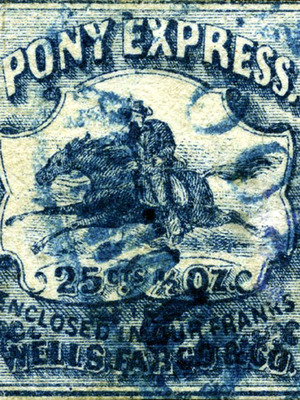
April 3 not only was the seventh anniversary of the Washington Post‘s botched report about the mythical battlefield heroics of Jessica Lynch. The date also marked the 150th anniversary of the first run of the legendary Pony Express–a short-lived institution that is impressively steeped in myth.

As Christopher Corbett wrote in an engaging commentary published Friday in the Wall Street Journal:

“We remember the Pony Express as one of the most enduring and endearing of American stories, a tale of the frontier, a story of bold entrepreneurs, daring young horsemen, true riders of the purple sage and all that.

“In truth, the venture hemorrhaged money from day one, was doomed by technology (another particularly American story), lasted a mere 78 weeks, ruined its backers and then disappeared into what historian Bernard DeVoto called ‘the border land of fable.'”

Corbett noted: “It was all over in 18 months. The service was shut down in the flash of a telegrapher’s key when the transcontinental telegraph was completed in October 1861.”

But for years afterward, “the West was aswarm with old men who claimed to be ‘the last of the Pony Express riders,'” Corbett wrote.

The tall tales and exaggerations that grew up around the Pony Express were in large part promoted by the cinema and the entertainment industry–factors akin to those that contribute to the rise and tenacity of media-driven myths, which are stories about and/or by the news media that are widely believed and often retold but which, on close inspection, prove to be apocryphal or wildly exaggerated.

The filmmaker John Ford incorporated the Pony Express into the 1948 Western, Fort Apache, where, Corbett noted, “the brave rider thunders into the fort to bring news of Custer’s Last Stand, which, alas, took place some 15 years after the Pony stopped running.”

It’s faintly reminiscent of the classic cinematic treatment of the Watergate scandal: Easily the best-known Watergate movie is All the President’s Men, a screen adaptation of the best-selling book by the same title.

The cinematic version of All the President‘s characterized the book’s authors, Carl Bernstein and Bob Woodward of the Washington Post, as central and essential to the scandal’s unraveling.

The upshot of that misrepresentation, I write in  Getting It Wrong, my forthcoming book about media-driven myths, has been “to solidify and elevate the heroic-journalist myth” of Watergate, to give it dramatic power, and sustain it in the collective memory.

I further note in Getting It Wrong that the film offers an unmistakable and unambiguous statement about “the power and centrality of the press in Nixon’s fall. All the President’s Men allows no other interpretation: It was the work Woodward and Bernstein that set in motion far-reaching effects that brought about the first-ever resignation of a U.S. president,” Richard Nixon.

What’s more, the heroic-journalist interpretation of Watergate minimizes or ignores the more decisive contributions in Nixon’s fall by agencies and organizations besides the Washington Post.

In his fine commentary, Corbett noted “the person who immortalized the Pony was William Frederick Cody, or Buffalo Bill. (He also claimed he had been a rider. Not true.)

“The [Pony Express] fast-mail service may have lasted only a year and a half, but it thrived for four decades in Cody’s Wild West show, seen by millions in the U.S. and Europe. To add drama to his re-enactment, Buffalo Bill might throw in a war party of savage Indians chasing a heroic rider who always managed to escape.

“It would become one of the most enduring images of the Pony Express, but it was not true; the actual riders rarely tangled with Indians,” Corbett wrote, adding:

“Why would a Paiute want a two-week-old copy of Horace Greeley’s New York Tribune?”

Corbett noted in closing:

“If the Pony Express continues to thrill and baffle us, consider the words of an old horseman in western Nebraska who advised me when I expressed some concerns about the pedigree of this yarn. ‘We don’t lie out here,’ he explained kindly. ‘We just remember big.'”

“Remember big.” A great line. And it’s certainly applicable in understanding why media-driven myths can be so tenacious and enduring.

WJC

Seven years after ‘fighting to the death’: Who was the Post’s source?

In Anniversaries, Debunking, Jessica Lynch, Media myths, Washington Post on April 2, 2010 at 10:49 am

It will be seven years tomorrow since the Washington Post published its erroneous front-page report about Jessica Lynch, the Army private whom the newspaper had said “fought fiercely” in an early engagement of the Iraq War.

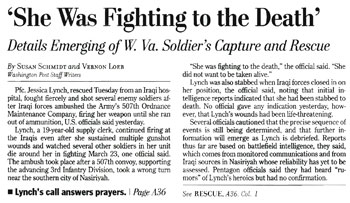
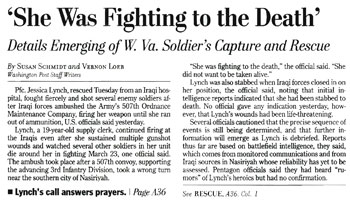
“‘She Was Fighting to the Death,'” the Post‘s headline said of Lynch, then a 19-year-0ld supply clerk in the Army’s 507th Maintenance Company.

The Post cited “U.S. officials” who otherwise were unidentified as saying Lynch had “continued firing at the Iraqis even after she sustained multiple gunshot wounds and watched several other soldiers in her unit die around her in fighting” at Nasiriyah on March 23, 2003.

The Post further cited the unnamed sources in reporting that Lynch had “shot several enemy soldiers after Iraqi forces ambushed” the 507th and kept “firing her weapon until she ran out of ammunition.”

None of it was true, however.

Lynch never fired a shot at Nasiriyah; her rifle jammed during the attack. She suffered shattering injuries when a rocket-propelled grenade struck her Humvee, causing the vehicle to crash. But she wasn’t shot.

Lynch was taken prisoner and treated at an Iraqi hospital, from where she was rescued April 1, 2003, by a U.S. special operations team.

As I write in Getting It Wrong, my forthcoming book about media-driven myths, “The Post’s erroneous hero-warrior tale thrust Lynch into an international spotlight that has never fully receded.”

The Post, though, has never disclosed identity of the source or sources for its bogus “fighting to the death” report, which was published April, 3, 2003.

Over the years, speculation has been that the U.S. military leaked the hero-warrior tale about Lynch. But one of the reporters on the story, Vernon Loeb, has said the Pentagon wasn’t the source.

“I could never get anybody from the Pentagon to talk about those reports at all,” Loeb said on an NPR program in late 2003. “I got indications that they had, in fact, received those intelligence reports, but the Pentagon was completely unwilling to comment on those reports at all. They wouldn’t say anything about Jessica Lynch.”

He added that “we wrote a story that turned out to be wrong because intelligence information we were given was wrong.”

So who were the Post‘s sources? Who supplied the erroneous details about Lynch?

When I reached him by phone in 2008 to talk about the Lynch case, Loeb hung up on me.

The author Jon Krakauer claimed in a book published last year that a former White House operative named Jim Wilkinson “arranged to give the Washington Post exclusive access to classified intelligence that was the basis for the now-discredited ‘She Was Fighting to the Death’ story that ran on the front page of that newspaper.”

Krakauer, writing in Where Men Win Glory: The Odyssey of Pat Tillman, called Wilkinson a “master propagandist” and said he “deserves top billing for creating the myth of Jessica Lynch.”

Krakauer’s book identified no specific sources for its claims about Wilkinson, who at the time of Lynch’s capture and rescue was director of strategic communications for General Tommy Franks, then the commander of U.S. forces in Iraq.

I recently spoke by phone with Wilkinson, now a managing partner for the Brunswick Group in San Francisco. He vigorously disputed Krakauer’s account as “factually incorrect” and insisted that “not one shred of evidence” links him to leaking the erroneous report to the Post.

Wilkinson also said:

“Tommy Franks would have killed me” had he been the Post’s source for the erroneous report about Lynch.

Wilkinson’s denial has the ring of authenticity, especially so his point about Tommy Franks. The tenor of Franks’ memoir, American Soldier, makes it clear that Wilkinson’s subordinate and advisory role would have ended abruptly had he crossed the general.

So seven years on, the Post‘s bogus report about Jessica Lynch reverberates still.

WJC

Recalling the overlooked heroism of Sgt. Walters

In Debunking, Jessica Lynch, Media myths, Washington Post on March 19, 2010 at 2:05 pm

Oregon Public Broadcasting aired a segment today recalling the death seven years ago in Iraq of Sergeant Donald Walters, whose battlefield heroics were mistakenly attributed to Private Jessica Lynch.

“In later accounts,” the OPB report noted, “Don emerged as a hero who’d stayed behind to cover for his escaping comrades, before his capture and brutal death” at the hands of Iraqi irregulars, the Fedayeen.

The OPB report represents one of the few occasions when U.S. news media have called attention to Walters, a 33-year-old cook in the Army’s 507th Maintenance Company who either was left behind or stayed behind as his unit tried to escape an ambush in Nasiriyah in March 2003, during the first days of the Iraq War.

Walters laid down covering fire as his comrades fled. When his ammunition ran out, Walters was captured and soon after executed.

Owing apparently to a mistaken translation of Iraqi battlefield reports, Walters’ heroics initially were attributed to Lynch, then a 19-year-old supply clerk in the 507th.

The Washington Post sent the erroneous account about Lynch into worldwide circulation on April 3, 2003, in a sensational report on its front page. The Post said Lynch had “fought fiercely” in Nasiriyah and had “shot several enemy soldiers after Iraqi forces ambushed” elements of the 507th, “firing her weapon until she ran out of ammunition.”

The Post cited “U.S. officials” who otherwise were unidentified as saying that Lynch had “continued firing at the Iraqis even after she sustained multiple gunshot wounds and watched several other soldiers in her unit die around her in fighting March 23.” One official was quoted anonymously as saying:

“‘She was fighting to the death. She did not want to be taken alive.’”

As I write in Getting It Wrong, my forthcoming book about media-driven myths, “the Post never fully acknowledged or explained its extraordinary error about Jessica Lynch.”

I also note: “The Post’s erroneous hero-warrior tale thrust Lynch into an international spotlight that has never fully receded.”

Indeed, the hoopla over her supposed derring-do in battle obscured the actions of Walters, whose conduct Nasiriyah probably saved lives of fellow soldiers. Walters posthumously was awarded the Silver Star, the U.S. military’s third-highest decoration for valor.

Walters’ parents live in Salem, Oregon. In the OPB report, Walters’ mother, Arlene, points to an imponderable about her son in his last hours. “Our big question,” she said, “is did he choose to stay or was he left out there” in Nasiriyah in the rush to escape the ambush.

Perhaps the best account of the ambush at Nasiriyah appears in Richard Lowry’s masterful book, Marines in the Garden of Eden.

Lowry wrote:

“We will never really know the details of Walters’ horrible ordeal. We do know that he risked his life to save his comrades and was separated from the rest of the convoy, deep in enemy territory. We know that he fought until he could no longer resist.”

As I note in Getting It Wrong:

“Walters’ actions, when they became known, attracted little more than passing interest from the American news media—certainly nothing akin to the intensity of the Lynch coverage after the Post’s ‘fighting to the death’ story appeared.”

WJC

Gleanings from the conference

In Debunking, Jessica Lynch, Media myths, Washington Post on March 14, 2010 at 6:41 pm

My paper about the media myths surrounding the case of Jessica Lynch, the Army private whom the Washington Post lifted from obscurity early in the Iraq War, stirred a fair amount of comment and questions at yesterday’s conference of journalism historians in New York.

That’s hardly surprising given that the paper—which is drawn from a chapter in Getting It Wrong,  my forthcoming book about media-driven myths—challenges the dominant narrative about the Lynch case that the Pentagon supposedly made up the account of her supposed heroics on the battlefield.

Her heroics were reported on the Post‘s front page April 3, 2003.

The newspaper said Lynch, then 19, had “fought fiercely” in the ambush of her unit, the 507th Maintenance Company, in Nasiriyah in southeastern Iraq. The Post article cited unnamed “U.S. officials” in reporting that Lynch had “shot several enemy soldiers after Iraqi forces ambushed” her unit, “firing her weapon until she ran out of ammunition.”

One official was quoted anonymously as saying: “‘She was fighting to the death. She did not want to be taken alive.’” Lynch was taken prisoner and nine days later rescued from an Iraqi hospital by a U.S. Special Operations team.

The Post’s story about Lynch’s derring-do was electrifying–and picked up by news organizations around the world.

It soon proved to be almost entirely in error.

Lynch hadn’t “fought fiercely.” She had never fired her weapon.

She suffered shattering injuries in the crash of a Humvee as she and others in the 507th fled the ambush.

Soon enough, though, the dominant narrative about the Lynch saga took shape: The Pentagon had concocted the hero-warrior story in order to boost support back home.

But as I noted during my presentation yesterday, Vernon Loeb, one of the Post reporters who shared a byline on the “Fighting to the Death” story said late in 2003 that the Pentagon was not the source for that report.

I also noted that the Pentagon hardly would have been desperate to boost morale back home: Just before Lynch’s rescue, support for the Iraq War was topping 70 percent, according to opinion polls in the United States.

One of the questions raised at the conference yesterday was: If the military wasn’t the source, then who gave the Post the story?

It’s a fair question, and I noted that Loeb and other reporters on the story have never disclosed their sources, beyond citing the otherwise unidentified “U.S. officials.” I also pointed out that they had reported the hero-warrior story about Lynch from Washington, and that no journalists were with Lynch and her unit during the ambush in Iraq.

Not surprisingly, the crucial element of mistaken identity in the Lynch saga stirred little comment from yesterday’s audience.

The hoopla stirred by the Post‘s story about Lynch had the effect of obscuring the recognition of a real hero of the ambush. He was Sergeant Donald Walters, a cook in the 507th who did fight to the death at Nasiriyah.

As his unit tried to flee the ambush, Walters stayed behind, laying down covering fire. When his ammunition ran out, Walters was captured and, shortly afterward, executed.

But when they became known, Walters’ actions on the battlefield attracted scant interest among the American news media.

The daylong conference was sponsored by the History Division of AEJMC and the American Journalism Historians Association. AEJMC is the acronym for the Association for Education in Journalism and Mass Communication.

WJC

‘Mythmaking in Iraq,’ at a conference in New York

In Debunking, Jessica Lynch, Media myths, Washington Post on March 12, 2010 at 8:47 am

I’ll be in New York tomorrow to present a paper that’s drawn on my forthcoming book, Getting It Wrong.

The venue will be the annual, daylong Joint Journalism Historians Conference; my paper is titled, “‘She Was Fighting to the Death’: Mythmaking in Iraq.”

The paper deconstructs the media-driven myth surrounding the case of Jessica Lynch, the Army private whom the Washington Post lifted from obscurity in early April 2003, in an electrifying account of her supposed heroics at Nasiriyah in the first days of the Iraq War.

The Post’s hero-warrior tale about Lynch, then 19, carried the headline:

“’She was fighting to the death.’”

The Post‘s story was picked up around the world, in a classic case of intermedia agenda-setting (wherein large news organizations set a news agenda for other, smaller outlets).

But the account proved badly in error: Lynch never fired a shot in the fighting at Nasiriyah.

Washington Post's story about Lynch, April 2003

Given that the Post’s hero-warrior narrative proved untrue, it’s scarcely surprising that other suspicions arose about the Lynch saga–namely that Pentagon officials planted the “fighting to the death” report and that the rescue of Lynch by a U.S. special forces team was contrived to boost flagging morale back home.

As I’ll note in my presentation, the Pentagon did little to promote the hero-warrior story about Lynch. Indeed, the Post‘s story was not based on Pentagon sources.

I’ll also point out that U.S. public support for the war was quite high at the time the Lynch case began unfolding.

A national CNN/USA Today/Gallup poll taken of 1,012 American adults in late March  2003—a few days before publication of the Post‘s erroneous report about Lynch—found that 85.5 percent of respondents thought the war effort was going “very well” or “moderately well” for U.S. forces.

The hoopla over Lynch had another, lasting effect: That of obscuring the recognition of an Army sergeant named Donald Walters who did fight to the death at Nasiriyah.

Walters was captured when his ammunition ran out, and executed.

Sgt. Donald Walters

Walters’ heroics were mistakenly attributed to Lynch, apparently because of faulty translation of Iraqi battlefield reports.

But when they became known, Walters’ heroics attracted little more than passing attention in the American news media.

Walters’ mother, Arlene, told me a few years ago that she called the editors of newsweeklies that had placed Lynch’s image on their covers. But “there was never any story about Don,” she said. “I called all these magazines. … They didn’t really care.”

I’ll bet most attendees at tomorrow’s conference never have heard of Sergeant Donald Walters.

The conference is sponsored by the History Division of AEJMC and the American Journalism Historians Association. AEJMC is the Association for Education in Journalism and Mass Communication.

WJC

Jessica Lynch and the lingering hero myth

In Jessica Lynch, Media myths, Washington Post on February 2, 2010 at 8:05 am

It’s amazing how “hero” still attaches to Jessica Lynch, the blonde, waiflike Army private from West Virginia who, through no exceptional effort of her own, became the best-known American military figure of the early days of the Iraq War.

Jessica Lynch, before the war

Lynch was in Florida the other day, promoting  I Am a Soldier, Too, a book about her that was written by Rick Bragg and published in November 2003 to decidedly mixed reviews.

In a report online, a Florida television station gave 267 words to Lynch’s visit; in that report, “hero” was invoked twice.

It’s amazing, too, how the media-driven aspect of her emergence to sudden fame usually is obscured these days. The Florida station made no mention of the Washington Post‘s overheated and erroneous report that gave rise to the hero-warrior myth of Jessica Lynch.

The myth is examined in detail in a chapter in my forthcoming book, Getting It Wrong, which is due out in the summer.

In it, I recount how Lynch was catapaulted to sudden and unsought fame during the first days of the war in Iraq. Lynch then was a 19-year-old supply clerk in the Army’s 507th Maintenance Company.

On March 23, 2003, elements of the 507th were ambushed by Iraqi irregulars in the southern city of Nasiriyah.  Lynch was badly injured in the crash of her Humvee and was taken prisoner.

Nine days later, she was rescued by a U.S. special operations unit from a hospital in Nasiriyah.

Two days after that, on April 3, 2003, the Washington Post published a sensational report on its front page that said Lynch had “fought fiercely” in Nasiriyah and had “shot several enemy soldiers after Iraqi forces ambushed” her unit, “firing her weapon until she ran out of ammunition.”

Washington Post's erroneous front-page report

The Post’s report cited “U.S. officials” who otherwise were unidentified as saying that Lynch had “continued firing at the Iraqis — even after she sustained multiple gunshot wounds and watched several other soldiers in her unit die around her in fighting March 23.”

One official was quoted anonymously as saying:

“‘She was fighting to the death. She did not want to be taken alive.’”

It was a terrific story that was immediately picked up by news outlets across the United States and around the world.

But it wasn’t true.

The battlefield heroics attributed to Lynch were, quite likely, the deeds of another soldier in her unit, a cook from Oregon named Donald Walters. He fought the Iraqis till his ammunition ran out, was captured, and was executed.

Central to the myth enveloping the Lynch case is that the U.S. military encouraged and promoted the phony hero-warrior story, to help boost public support for the war.

But as I describe in Getting It Wrong, one of the reporters on the Post’s erroneous “fighting to the death” report, told an NPR radio program in late 2003 that “the Pentagon … wouldn’t say anything about Jessica Lynch.”

The reporter, Vernon Loeb, also said in that interview: “I just didn’t see the Pentagon trying to create a hero where there was none.”

And the Post‘s erroneous “Fighting to the death” report about Lynch included this passage:

“Pentagon officials said they had heard ‘rumors’ of Lynch’s heroics but had no confirmation.”

The Post’s hero-warrior story about Lynch has had many unintended consequences beyond vaulting Lynch to celebrity status, which, as her appearance in Florida suggests, has never fully receded.

Her celebrity status also helped pave the way for her lucrative book contract with Bragg. And certainly it obscured the actions of Walters, whose conduct Nasiriyah probably saved the lives of some of his fellow soldiers.

WJC