W. Joseph Campbell

Archive for the ‘Media myths’ Category

‘Getting It Wrong’ on the road in Oberlin, OH

In Cronkite Moment, Debunking, Furnish the war, Media myths, Murrow-McCarthy myth, Spanish-American War, War of the Worlds, Watergate myth, Yellow Journalism on June 27, 2010 at 8:40 am

I gave a talk yesterday about Getting It Wrong to an engaging audience at the college bookstore in Oberlin, Ohio.

The talk was facilitated quite well by Kira McGirr, the bookstore’s tradebook manager, and covered such topics as William Randolph Hearst’s purported vow to “furnish the war” with Spain at the end of the 19th century, the myth of the “Cronkite Moment” of February 1968, and the heroic-journalist myth of Watergate.

We also discussed the media-driven myth of “crack babies” and the famous 1938 radio dramatization of The War of the Worlds, which supposedly was so dramatic that tens of thousands of Americans were seized by panic and mass hysteria.

One of Kira’s questions was how long it may take before the myths discussed and debunked in Getting It Wrong to be excised from history books. It’s a very good question, and difficult to say for sure.

I responded by saying some of the myths–such as those of Watergate and the War of the Worldsare so appealing, delicious, and ingrained that they may never be totally uprooted.

The same probably goes for Hearst’s purported vow: That anecdote has been around since 1901 and likely is too appealing ever to be utterly debunked. What’s more, the “furnish the war” tale is a neat, tidy, reductive way of explaining the causes of the Spanish-American War:  Hearst, the war-mongering publisher, is to blame.

It’s far easier to blame Hearst than it is to grapple with the complexities of the diplomatic demarche in 1897-98 that failed to resolve differences among Spain, Cuba, and the United States: Failed diplomacy, not the contents of Hearst’s yellow press, led to the Spanish-American War.

We also discussed how high-quality cinematic treatments can press media myths into the public consciousness.

That certainly was the case with All the President’s Men, the most-viewed movie about Watergate, in which Robert Redford and Dustin Hoffman played the starring roles of Washington Post reporters Bob Woodward and Carl Bernstein.

The film depicted the reporters as central, indeed crucial, to cracking the Watergate scandal, I noted. For many Americans,  All the President’s Men is an important way of learning about Watergate. As I write in Getting It Wrong: “More than thirty-five years later, what remains most vivid, memorable, and accessible about Watergate is the cinematic version of All the President’s Men.”
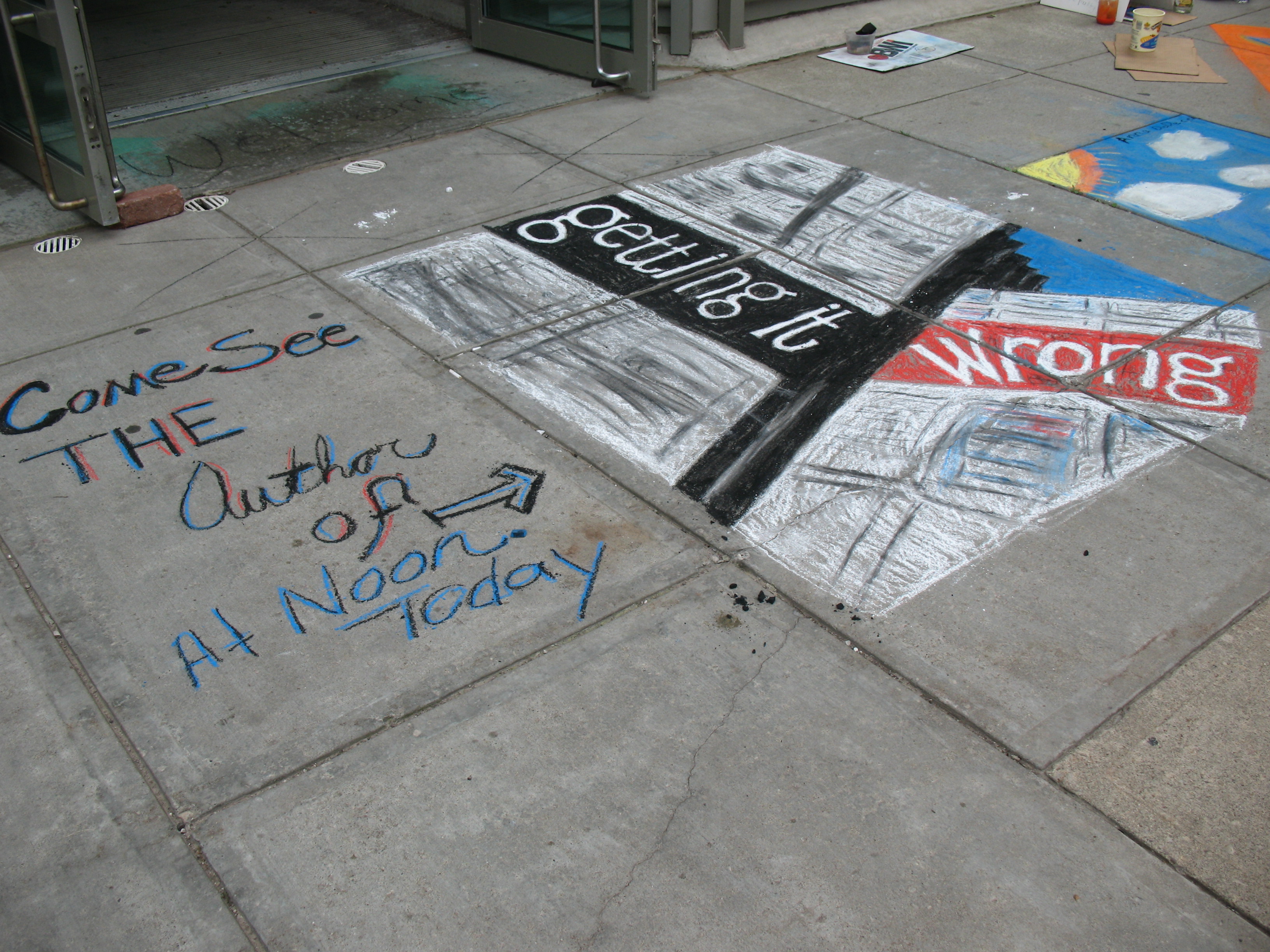
The book talk coincided with Oberlin’s fifth annual Chalk Walk event, at which artists and aspiring artists draw often-elaborate pastel images on the sidewalks in the heart of town.

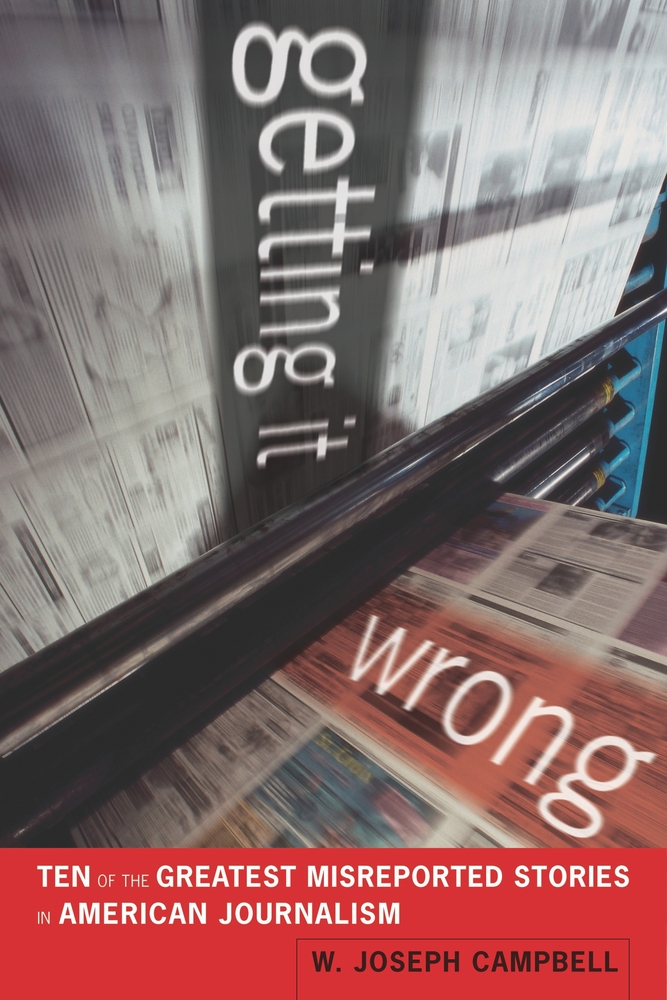
One of Kira’s colleagues, Amanda Turner, drew a fine rendering of the cover of Getting It Wrong at the entrance to the bookstore (see photo).

Amanda, Kira, and I posed for the photo below.
Several former classmates of mine at Oberlin Firelands High School (class of 1970) also attended the book talk.

WJC

Related:

Photo credit: Ann-Marie C. Regan (Chalk Walk images)
Welcome perspective on the ‘Cronkite moment’

In Cronkite Moment, Debunking, Media myths on June 26, 2010 at 7:37 am

A blog post yesterday at the Atlantic Free Press offered some unusual–and refreshing–perspective about the so-called “Cronkite Moment” of 1968, when CBS anchorman Walter Cronkite declared the U.S. military was “mired in stalemate” in Vietnam.

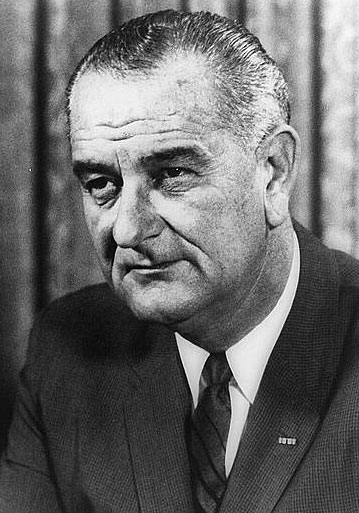
Johnson

The tenacious media-driven myth surrounding the “Cronkite Moment” has it that the anchorman’s insight was so powerful and so incisive that public opinion promptly swung against the war and President Lyndon Johnson immediately realized his war policy was doomed.

As has been discussed often at Media Myth Alert, neither of those characterizations is accurate. Months before Cronkite’s pronouncement, U.S. public opinion began to turn against the war. And Johnson did not watch Cronkite’s program when it aired on February 27, 1968. At that time, the president was in Austin, Texas,  at the 51st birthday party of Governor John Connally.

As I write in Getting It Wrong, my new book about media-driven myths, the power of the so-called “Cronkite moment”  lies “in the sudden, unexpected, and decisive effect it supposedly had on the president. Such an effect would have been absent, or greatly diminished, had Johnson had seen the program on videotape at some later date.”

Indeed, the power of the anecdote would have been diluted severely.

As I say, the Atlantic Free Press post offered perspective about the “Cronkite Moment” that is seldom encountered in the news media, traditional or online.

The post said that “words like ‘stymied’ and ‘stalemate’ are often applied to the Afghanistan war. But that hardly means the U.S. military is anywhere near withdrawal.

“Walter Cronkite used the word ‘stalemate’ in his famous February 1968 declaration to CBS viewers that the Vietnam War couldn’t be won. ‘We have been too often disappointed by the optimism of the American leaders both in Vietnam and Washington to have faith any longer in the silver linings they find in the darkest clouds,’ he said. And: ‘It seems now more certain than ever that the bloody experience of Vietnam is to end in a stalemate.’

“Yet the U.S. war on Vietnam continued for another five years, inflicting more unspeakable horrors on a vast scale.”
It is rarely noted in discussions of the “Cronkite Moment” that U.S. combat troops were not completely withdrawn from Vietnam until 1973–despite the claim by David Halbertstam in The Powers That Be that Cronkite’s program represented “the first time in American history a war had been declared over by an anchorman.”
That’s just not so. Not at all.

WJC

Related:

Media myths and their spinoffs: The case of Watergate

In Debunking, Media myths, Washington Post, Watergate myth on June 23, 2010 at 3:53 pm

Prominent media-driven myths, the subject of my new book, Getting It Wrong, can be self-sustaining: That is, they can and do give rise to subsidiary media myths.

The heroic-journalist myth of Watergate is a notable example of this tendency. It has given rise to particularly tenacious, though appealing, subsidiary myth.

The  heroic-journalist myth has it that the intrepid investigative reporting of Bob Woodward and Carl Bernstein of the Washington Post brought down Richard Nixon’s corrupt presidency in the Watergate scandal.

Nixon resigns, 1974

As I write in Getting It Wrong:

“The heroic-journalist has become the most familiar storyline of Watergate—ready short-hand for understanding Watergate and its denouement, a proxy for grasping the scandal’s essence while avoiding its forbidding complexity. How the Post and its reporters uncovered Watergate is deeply ingrained in American journalism as one of the field’s most important and self-reverential stories.”

Except that it’s exaggerated.

“The heroic-journalist interpretation” of Watergate, I write in Getting It Wrong, “minimizes the far more decisive forces that unraveled the scandal and forced Nixon from office.” Those forces were typically subpoena-wielding and including federal prosecutors, the FBI, bipartisan Congressional committees, and ultimately the U.S. Supreme Court.

In the end, the contributions of the Washington Post to the scandal’s outcome were modest, and certainly not decisive. Over the years, principals at the Post have emphasized as much. For example, Katharine Graham, the newspaper’s doughty publisher, insisted the Post did not topple Nixon.

“Sometimes people accuse us of bringing down a president, which of course we didn’t do,” Graham said in 1997, at a program in Washington marking the scandal’s twenty-fifth anniversary. “The processes that caused [Nixon’s] resignation were constitutional,” she said.

In earthier terms, Woodward has concurred, telling American Journalism Review in 2004:

“To say that the press brought down Nixon, that’s horseshit.”

Nonetheless, the heroic-journalist myth lives on. It’s a robust myth, little-restrained in its reach and infiltration, and highly resistant to debunking. It is retold in textbooks, in classrooms, in newsrooms.

And it has spun off a durable subsidiary myth, one that revolves around the hoopla associated with Woodward and Bernstein: Their book about their reporting, All the President’s Men, was a best-seller. Its cinematic version was a box office success and, quite likely, is the most-viewed film ever about Watergate.

The book and the movie made journalism seem sexy, and caused enrollments at college and university journalism programs to soar.

Supposedly.

As I write in Getting It Wrong, “there is no evidence to support the notion that enrollments in journalism programs surged because of Woodward, Bernstein … and All the President’s Men. The subsidiary myth lives on despite its thorough repudiation in scholarly research.”

A study financed by the Freedom Forum media foundation and released in 1995 reported that “growth in journalism education result[ed] not from specific events as Watergate … but rather to a larger extent from the appeal of the field to women, who ha[d] been attending universities in record numbers. The growth also in part reflect[ed] the applied nature of the field and its link to specific job skills.”

Seven years earlier, Maxwell E. McCombs reported in the Gannett Center Journal that “the boom in journalism education was underway at least five years before” the Watergate scandal broke in 1972.

McCombs, a veteran mass communication scholar, further wrote:

“It is frequently, and wrongly, asserted that the investigative reporting of Woodward and Bernstein provided popular role models for students, and led to a boom in journalism school enrollments. The data … reveal, however, that enrollments already had doubled between 1967 and 1972….”

Despite such solid scholarly research, the subsidiary myth lives on.

It’s a neat and tidy tale, the notion that the exploits of Woodward and Bernstein were a profound stimulus to enrollments in collegiate journalism programs. Like many other media myths, it’s a tale almost too good not to be true.

WJC

A version of this post first appeared at the University of California Press blog.

LBJ’s ‘Vietnam epiphany’ wasn’t Cronkite’s show

In Cronkite Moment, Debunking, Media myths on June 22, 2010 at 12:28 pm

The irresistible “Cronkite Moment” emerged again the other day, this time in a column in a Michigan newspaper claiming that “President Lyndon Baines Johnson had his Vietnam epiphany when he lost Walter Cronkite.”

The “Cronkite Moment” was a broadcast in February 1968 that supposedly was so potent  that it had the effect of prompting Johnson to realize the hopelessness of his war policy in Vietnam.

The story goes that Johnson at the White House watched Cronkite’s special report on Vietnam and, after hearing the anchorman say the U.S. military was “mired in stalemate” and might consider a negotiated settlement, snapped off the television set and exclaimed:

“If I’ve lost Cronkite, I’ve lost Middle America.”

Or words to that effect.

As is described in Getting It Wrong, my new book about media-driven myths, versions vary as to what the president supposedly said.

Getting It Wrong also points out that Johnson did not see the Cronkite program when it aired. The president at the time was in Austin, Texas, making light-hearted comments at the 51st birthday party of Governor John Connally.

As I write in Getting It Wrong, “Even if he later heard—or heard about— Cronkite’s assessment, it was no epiphany for Johnson. Not long after the program, Johnson gave a rousing, lectern-pounding speech in which he urged a ‘total national effort’ to win the war in Vietnam.”

Thus in the days and weeks immediately after the Cronkite program, Johnson remained hawkish on the war.

Johnson’s “epiphany,” as it were, came not in front of a television set in late February 1968 but in discussions a month later with informal advisers at the White House.

As I write in Getting It Wrong, “Johnson’s change of heart on Vietnam came about through a complex process in which Cronkite’s views counted for little. Among the forces and factors that influenced Johnson’s thinking … was the counsel of an influential and informal coterie of outside advisers known as the ‘Wise Men.’

“They included such foreign policy notables as Dean Acheson, a former secretary of state; McGeorge Bundy, a former National security adviser to Kennedy and Johnson; George Ball, a former under-secretary of state; Douglas Dillon, a former treasury secretary; General Omar Bradley, a former chairman of the joint chiefs of staff, and Abe Fortas, a U.S. Supreme Court justice and friend of Johnson.

“The ‘Wise Men’ had met in November 1967, and expressed their near-unanimous support for Johnson’s Vietnam policy. They met again, at the request of the White House, in late March 1968.”

Largely, though not unanimously, the “Wise Men,” expressed opposition to escalating the war in Vietnam.

“The theme that ran around the table was, ‘You’ve got to lower your sights,’” George Ball later recalled.

Johnson, he said, “was shaken by this kind of advice from people in whose judgment he necessarily had some confidence, because they’d had a lot of experience.”

The counsel of the Wise Men represented a tipping point in Johnson’s deciding to seek “peace through negotiations.” In a speech March 31, 1968, the president announced a limited halt to U.S. aerial bombing of North Vietnam as an inducement to the communist government in Hanoi to enter peace talks.

Johnson closed his speech with the stunning announcement that he would not seek reelection to the presidency.

WJC

Related:

<!–[if !mso]> .[i] In a nationally televised speech on March 31, Johnson announced that he had decided to seek “peace through negotiations.” He ordered a limited halt to U.S. aerial bombing of North Vietnam as an inducement to the Hanoi government to enter peace talks. Johnson closed the speech with the stunning announcement that he would not seek reelection to the presidency


[i] George C. Herring, LBJ and Vietnam: A Different Kind of War (Austin: University of Texas Press, 1994), 163.

‘Getting It Wrong’ launched at Newseum

In Cronkite Moment, Debunking, Furnish the war, Media myths, Murrow-McCarthy myth, Spanish-American War, Washington Post, Watergate myth on June 20, 2010 at 2:09 pm

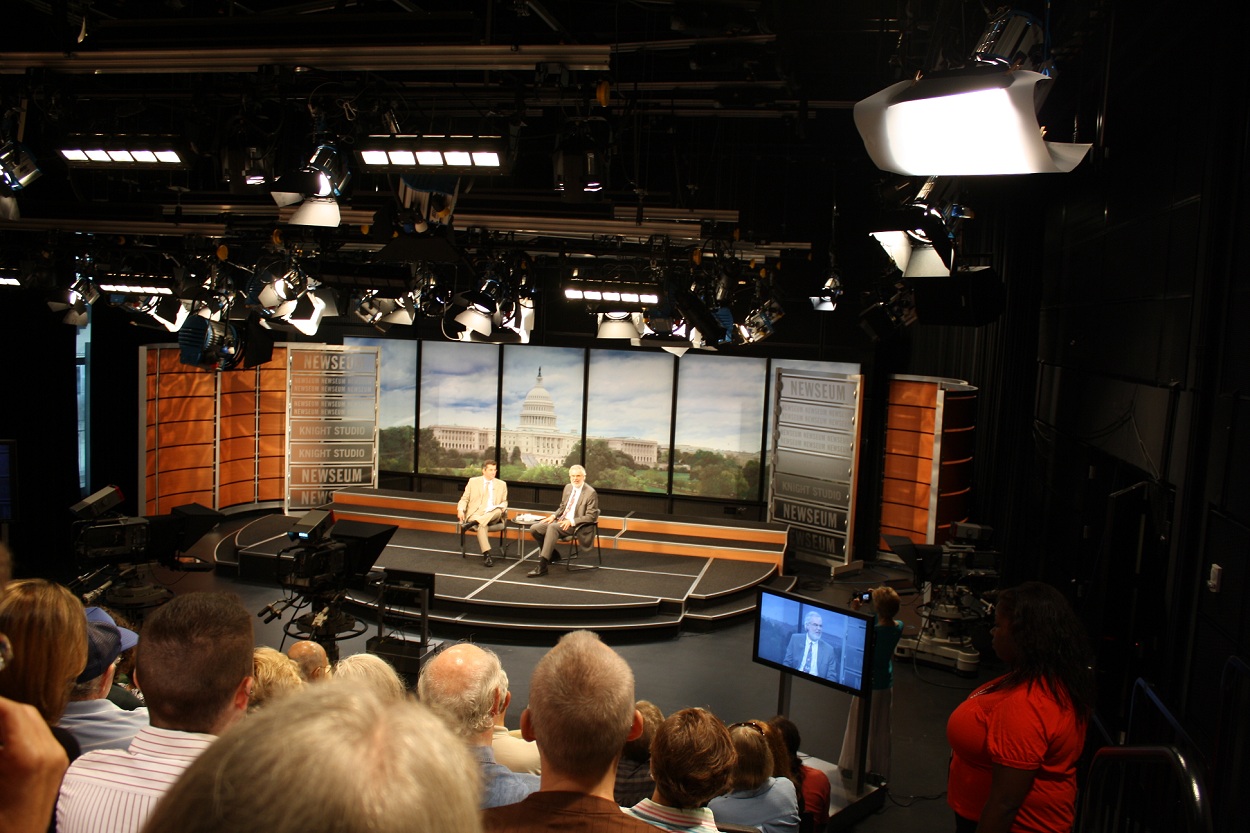
Newseum program, audience view

Getting It Wrong, my new book about media-driven myths, was launched at a terrific program yesterday at the Newseum, the $450 million museum of news in downtown Washington, D.C.

The Newseum’s John Maynard moderated a brisk “Inside Media” talk, during which I reviewed the myths of:

  • William Randolph Hearst’s purported vow to “furnish the war” with Spain,
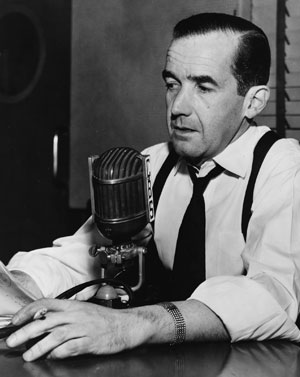
  • Edward R. Murrow‘s  1954 See It Now television program that supposedly ended Senator Joseph R. McCarthy’s communists-in-government witch-hunt,
  • the so-called “Cronkite moment” of 1968,
  • the heroic-journalist of Watergate, and
  • the supposedly superlative reporting in the immediate aftermath of Hurricane Katrina‘s landfall in 2005.

The audience (see photo, above) posed several intriguing questions about the book. Among them was whether I thought the media myths confronted in Getting It Wrong would now be forever buried.

It’s probably too soon to say, given the book’s recent publication. But I mentioned in my reply that I’ve been struck by how dearly some myths are held.

The myth of the “Cronkite moment” is an example, I said: It seems quite difficult for some people to believe that Walter Cronkite’s program on Vietnam in February 1968 was not of decisive effect.

The “Cronkite moment” may live on, and continue to be embraced, despite the weight of the evidence that Cronkite’s television report about Vietnam was of scant importance in revising policy or in shaping the president’s thinking about reelection.

At the book launch

A question was posed about how media myths emerge, and I noted that they arise from several sources, including an urge to identify examples of media power. Another factor is  what I call “complexity-avoidance”–the appeal of simplified explanations for complex historical events.

It is, after all, far easier to believe that Hearst and his “yellow press” brought on the Spanish-American War in 1898, I said, than it is to grasp the complexities of the failed diplomacy among Spain, Cuba, and the United States that gave rise to that conflict. It is far easier to believe that the Washington Post brought down Richard Nixon’s corrupt presidency, I said, than it is to sort through tangled lines of investigation of the Watergate scandal that ultimately forced Nixon from office.

Even then, I said, Nixon may have served out his term if not for the tape-recordings he made of his private Oval Office conversations. Those tapes, which the U.S. Supreme Court forced Nixon to produce in 1974, revealed his guilty role in the Watergate coverup.

I also was asked whether there are other media myths to bust.

Indeed there are, I said.

Getting It Wrong may deserve a sequel and suggested as candidates for a follow-on book the dubious phenomenon of “Pharm Parties” and the question of whether Cronkite really was “the most trusted man in America.”

Book signing at Newseum

I signed copies of Getting It Wrong following the “Inside Media” program, and then toasted the book’s publication at a reception sponsored by the Newseum and American University’s School of Communication.

The School’s dean, Larry Kirkman, offered generous remarks in his toast at the reception, which was attended by AU colleagues, former students, past research assistants, and friends and family.

WJC

Related:

Photo credits:

  • Ruxandra Giura (audience view)
  • Bruce Guthrie

‘Regret the Error’ considers ‘Getting It Wrong’

In Cronkite Moment, Debunking, Jessica Lynch, Media myths, Reviews, Watergate myth on June 18, 2010 at 6:41 pm

Craig Silverman’s latest “Regret the Error” column, posted today at the Columbia Journalism Review online site, offers a searching discussion of my new book, Getting It Wrong, and notes, insightfully:

“Every society needs heroes and villains, and stories that help forge identity and community. That’s why myths exist in the first place. But the press has the ability and means to shape and disseminate the tales of champions and villains, to create and propagate stories that reinforce role and identity. Media-driven myths are particularly powerful, which in turn makes them even harder to debunk.”

Silverman is the author of the well-received 2007 book, Regret the Error: How Media Mistakes Pollute the Press and Imperil Free Speech. His column discussing Getting It Wrong begins this way:

“Journalism is a profession built on storytelling, so it’s no surprise that its history is filled with some remarkable tales. Think Woodward and Bernstein bringing down a president. Or Walter Cronkite’s 1968 CBS News special about Vietnam that caused President Lyndon Johnson to exclaim, ‘If I’ve lost Cronkite, I’ve lost Middle America.’ Think of Edward R. Murrow demolishing Senator [Joe] McCarthy’s communist witch hunt on television, or William Randolph Hearst telling his correspondent in Cuba, ‘You furnish the pictures, I’ll furnish the war.’

McCarthy

“Great stories, all of them. If only they were built on facts—the other thing our profession is supposed to revere. W. Joseph Campbell, a professor at American University and respected journalism scholar, smashes the above media-driven myths, along with a few more, in his new book, Getting It Wrong: Ten of the Greatest Misreported Stories in American Journalism.”

About the emergence of media-driven myths, Silverman quotes me as saying:

“The notion of media power both for good, as in the Watergate example, or for bad, as in the William Randolph Hearst example, is one of the driving forces behind media myths.”

Indeed. Media myths, I write in Getting It Wrong, often stem from “an eagerness to find influence and lasting significance in what journalists do and tend to extend credit where credit is not entirely due.”

I further note in the book that media myths can “be self-flattering, offering heroes … to a profession more accustomed to criticism than applause.”

Silverman’s column wraps up by considering how to combat media-driven myths, quoting me as underscoring the importance of viewpoint diversity in American media newsrooms.

“There is room for a newsroom culture that embraces diverse viewpoints, and I think that will help encourage skepticism … and negate the groupthink that tends to take hold in newsroom culture,” he quotes me as saying.

“Challenging the dominant narrative and encouraging contrarian thinking is a good thing.”

On that point, I write in Getting It Wrong:

“It is certainly not inconceivable that a robust newsroom culture that embraces viewpoint diversity, encourages skepticism, invites challenges to dominant narratives, and rewards contrarian thinking would have helped thwart publication of embarrassing tales such as the Washington Post’s ‘fighting to the death‘ story about Jessica Lynch.”

WJC

Related:

Behind the ‘nuanced myth’: Bra-burning at Atlantic City

In Bra-burning, Debunking, Media myths on June 17, 2010 at 6:10 am

What I call the “nuanced myth” of bra-burning can be traced to September 7, 1968, and the women’s liberation protest on the boardwalk of Atlantic City, N.J., against the Miss America pageant.

Protesting Miss America, 1968

A centerpiece of the demonstration was the so-called Freedom Trash Can (see photo, right) into which the protesters consigned “instruments of torture,” such as brassieres, girdles, high-heeled shoes, false eyelashes, and copies of magazines such as Playboy and Cosmopolitan.

But the protest’s organizers have long insisted that nothing had been set ablaze at Atlantic City. The lead organizer, Robin Morgan, has asserted, for example:

“There were no bras burned. That’s a media myth.”

And yet the epithet “bra-burning” took hold, serving to denigrate and trivialize the objectives of the women’s liberation movement.

In researching bra-burning for Getting It Wrong, my new book about prominent media myths, I was inclined to accept the denials. They seemed insistent and solid—and no one had produced evidence to the contrary. Bra-burning certainly seemed to be a media-driven myth.

Still, I was curious about what the local newspaper, the Atlantic City Press, had written about the 1968 demonstration. I had never seen references to its reporting.

Microfilm of the Press for September 1968 proved impossible to obtain through inter-library loan, so I paid a visit to the public library in Atlantic City, to crank microfilm there.

I found that the Press published two articles about the protest, both on page 4. The lead article appeared beneath the intriguing headline:

“Bra-burners blitz boardwalk.”

The article conveyed a sense of astonishment that such a protest would take place at the venue of the Miss America pageant, then a revered tradition in Atlantic City.

The article’s ninth paragraph offered stunning detail, in a matter-of-fact sort of way.

“As the bras, girdles, falsies, curlers, and copies of popular women’s magazines burned in the ‘Freedom Trash Can,’” it said, “the demonstration reached the pinnacle of ridicule when the participants paraded a small lamb wearing a gold banner worded ‘Miss America.’”

“Whoa,” I said to myself in reading that paragraph. “Whoa.”

Here, after all, was a contemporaneous, eyewitness account—the first such account I had ever seen—that said that bras had indeed been burned during the protest.

The single mention of bra-burning was significant and striking. But it was a single mention, and I needed detail and corroboration.

The other article in the Press described the bewildered reactions of boardwalk-strollers who watched the protest; it made no mention of burning bras.

The author of the lead article, John L. Boucher, died in 1973.

Boucher, I learned, could be gruff and tough, in a old-school way. He was also an informal adviser to young reporters at the Atlantic City newspaper.

Among them was Jon Katz, who in 1968 was at the outset of a career that took him to the Philadelphia Inquirer and Boston Globe, and to the CBS Morning News as executive producer. After leaving daily journalism, Katz became a writer of mysteries and nonfiction.

Katz had been on the boardwalk that long-ago September day: He had written the other article about the protest for the Press.

I traced Katz to upstate New York. In interviews by email and phone, Katz said without hesitation that he recalled that bras and other items had been set afire during the demonstration against Miss America.

“I quite clearly remember the ‘Freedom Trash Can,’ and also remember some protestors putting their bras into it along with other articles of clothing, and some Pageant brochures, and setting the can on fire,” Katz said. “I am quite certain of this.”

He added:

“I recall and remember noting at the time that the fire was small, and quickly was extinguished, and didn’t pose a credible threat to the boardwalk. I noted this as a reporter in case a fire did erupt.”

Katz thus offered confirmation that bras and other items had been burned in the Freedom Trash Can.

I sought to interview with Robin Morgan about these new details. She replied to my inquiries through a spokeswoman, declaring:

“There were NO bras EVER burned at the 1968 protest.”

So how is all this treated in Getting It Wrong, which will be launched Saturday, June 19, at an “Inside Media” program at the Newseum in Washington, D.C.?

The account by Boucher and the recollections of Katz offer “fresh dimension to the bra-burning legend,” I write in the book. “They represent two witness accounts that bras and other items were burned, or at least smoldered, in the Freedom Trash Can. There is now evidence that bras and other items were set afire, if briefly, at the 1968 Miss America protest in Atlantic City. This evidence cannot be taken lightly, dismissed or ignored.”

But at the same time, their accounts lend no support to the more vivid popular imagery that many bras went up in flames in flamboyant protest on the boardwalk.

Boucher and Katz offered no endorsement for the central feature of the media-driven myth that angry women burned their bras in a fiery public spectacle.

At most, fire was a subtle, modest, and fleeting element of the protest that day.

And yet, “bra-burning” is an epithet not entirely misapplied to the demonstration at Atlantic City.

WJC

A version of this post first appeared at the University of California Press blog.

Many thanks to Jim Romenesko for linking to this post.

Launching ‘Getting It Wrong’ at Newseum

In Bay of Pigs, Bra-burning, Cronkite Moment, Debunking, Furnish the war, Jessica Lynch, Media myths, Murrow-McCarthy myth, War of the Worlds, Washington Post, Watergate myth on June 14, 2010 at 6:28 am

My new book, Getting It Wrong, will be launched Saturday, June 19, at an “Inside Media” program at the Newseum, the $450 million museum of news in downtown Washington, D.C.

The program will begin at 2:30 p.m. in the Knight TV Studio on the third level and will feature a discussion with the Newseum’s John Maynard, followed by audience Q-and-A.

I’ll be signing copies of Getting It Wrong afterward.

The book addresses, and debunks, 10 prominent media-driven myths–stories about and/or by the news media that are widely believed and often retold but which, on close inspection, proved to be apocryphal or wildly exaggerated.

Here is a brief description about each of the 10 myths:

  1. Remington-Hearst: William Randolph Hearst’s famous vow, “you furnish the pictures, I’ll furnish the war,” is almost certainly apocryphal.
  2. War of Worlds: The notion that the War of Worlds radio dramatization in 1938 caused nationwide panic and mass hysteria is exaggerated.
  3. Murrow-McCarthy: Edward R. Murrow’s famous See It Now program in March 1954 did not end Senator Joseph McCarthy’s communists-in-government witch-hunt; Murrow in fact was very late to take on McCarthy.

    Murrow in 1954

  4. Bay of Pigs: The New York Times did not suppress its reporting in the run-up to the ill-fated Bay of Pigs invasion in April 1961.
  5. Cronkite-Johnson: Walter Cronkite’s special report on Vietnam in February 1968 did not prompt an immediate reassessment of U.S. war policy.
  6. Bra-burning: Humor columnist Art Buchwald helped spread the notion that feminist demonstrators dramatically burned their bras at a Miss America protest in September 1968.
  7. Watergate: The Washington Post’s intrepid reporters, Carl Bernstein and Bob Woodward, did not bring down Richard Nixon’s corrupt presidency. That they did is a trope that knows few bounds.
  8. Crack babies: The much-feared “bio-underclass” of children born to women who smoked crack cocaine during their pregnancies never materialized.
  9. Jessica Lynch: The Washington Post’s erroneous reporting about Jessica Lynch early in the Iraq War gave rise to several myths about her capture and rescue.
  10. Hurricane Katrina: News coverage of Katrina’s aftermath in New Orleans in early September 2005 was marred by wild exaggerations of extreme, Mad Max-like violence.

As I write in Getting It Wrong, the myths debunked “are among American journalism’s best-known stories. Most of them are savory tales. And at least some of them seem almost too good to be false.”

I further write that because it “takes on some of the most treasured stories in American journalism,” Getting It Wrong is “a work with a provocative edge. It could not be otherwise.”

WJC

Related:

Helen Thomas and Iraq War: What’s she talking about?

In Debunking, Furnish the war, Media myths, Newspapers on June 11, 2010 at 8:12 am

Helen Thomas, the cranky, now-disgraced columnist for Hearst newspapers who resigned under fire this week, claims in an interview that White House press corps bears some responsibility for the Iraq War.

Thomas, who quit after saying Jews should “get the hell out of Palestine” and go to Germany and Poland, asserted in the interview posted yesterday by Vice magazine:

“Everyone rolled over and played dead at a time when they should have been really penetrating. … But in this case they bought all the propaganda. Or, whether they bought it or not, they took it and spouted it.”

Thomas, who is almost 90,  didn’t elaborate on her “rolled over and played dead” comment, which has the whiff of a gratuitous shot at her erstwhile colleagues.

She’s made similar comments before, claiming for example that the American news media were “comatose” in the run-up to the war. But seldom has she offered much in the way of specific, supporting detail. As in who “rolled over” when?

While her claims have hardened into something approaching conventional wisdom about pre-war coverage, Thomas’ views have been challenged, notably by David Gregory of NBC, who has asserted:

“I think the questions were asked [in the run-up to the war].  I think we pushed. I think we prodded. I think we challenged the president. I think not only those of us the White House press corps did that, but others in the rest of the landscape of the media did that.

“If there wasn’t a debate in this country,” Gregory has said, “then maybe the American people should think about, why not?  Where was Congress? Where was the House? Where was the Senate? Where was public opinion about the war?”

As to his last question, where was public opinion? It heavily favored the war in Iraq. And as I note in a chapter in my new book, Getting It Wrong, a Washington Post-ABC News poll, taken in the early days of the war found that 69 percent of Americans thought the invasion of Iraq was justified even if weapons of mass destruction were not found.

Reason magazine also has challenged the argument that the U.S. news media could have been more searching in the run-up to the war, asserting in a well-argued piece in 2007:

“The ‘we should have done more to head off this war’ argument assumes too much, exaggerates the media’s power to influence, removes the onus from politicians and infantilizes news consumers.”

Those are all good points. And blaming the news media does tend to deflect blame from Congress, which in 2002 authorized military force against Iraq.

What’s more, the content leading U.S. daily newspapers in the weeks before the Iraq War began included a sustained amount of searching coverage. A good deal of the coverage in February and March 2003 focused on diplomatic démarche at the United Nations, where the U.S. pro-war policy came under frequent attack by the French, Germans, Russians, and others.

Those challenges to U.S. policy were given prominence in U.S. newspapers, as were the massive anti-war demonstrations in Europe and in some American cities.

Thomas has never impressed me as a particularly incisive or even careful reporter. She notably indulged in media myth in her 2006 book, Watchdogs of Democracy?: The Waning Washington Press Corps and How It Has Failed the Public.

The book repeated the hoary anecdote about Hearst’s vowing to “furnish the war” with Spain in the late 19th century–one of the media-driven myths that I debunk in Getting It Wrong.

Thomas’ use of the “furnish the war” anecdote helped Watchdogs of Democracy? make the tail-end of my lineup of the dozen overrated books about journalism history–a roster I compiled in 2009 for the quarterly journal American Journalism.

Topping my “overrated” list was David Halberstam‘s The Powers That Be, followed by Carl Bernstein and Bob Woodward‘s All the President’s Men and Hadley Cantril’s The Invasion From Mars.

About Thomas’ Watchdogs of Democracy?, I wrote:

“The title of Thomas’ book promises far more than its disjointed and repetitive content delivers,” adding, “don’t turn to Watchdogs of Democracy? for searching analysis.”

WJC

Related:

War, the ‘apex of yellow journalism’? Not so

In Debunking, Jessica Lynch, Media myths, Spanish-American War on June 10, 2010 at 11:52 am

I’ve noted from time to time how some media-driven myths–those false, dubious, improbable stories about the news media that masquerade as factual–travel quite well, crossing linguistic barriers with frequency and ease.

Hearst's New York Evening Journal, 1898

One of the more hearty, adaptable, and internationally appealing media myths is that of American “yellow journalism,” and how its sensational and exaggerated content supposedly brought about the Spanish-American War in 1898.

That myth was debunked in my 2001 study, Yellow Journalism: Puncturing the Myths, Defining the Legacies. But it is probably too deliciously appealing, too neat and tidy, ever to die away.

Indeed, it popped up in an international way yesterday, in a commentary in the English-language edition of China’s Global Times. The commentary appeared beneath the headline, “Yellow journalism creeping into Chinese media,” and declared:

“The term yellow journalism was coined during … late 19th century when media barons William Randolph Hearst and Joseph Pulitzer’s respective newspapers, the New York Journal and the New York World, were in cutthroat competition. …

“The apex of US yellow journalism came when the two newspapers’ fear mongering and sensationalism led to the Spanish-American War in 1898.”

As I wrote in Yellow Journalism, the notion that the yellow press of Hearst and Pulitzer brought on the war with Spain over Cuba rests on a narrow, decidedly media-centric interpretation of the conflict’s causes.

That interpretation ignores, I noted, the “more relevant and immediate factors that give rise to armed conflict.

“In the case of the Spanish-American War,” I wrote in Yellow Journalism, “the policy objectives between the United States and Spain ultimately proved irreconcilable. Months of intricate diplomatic efforts ultimately failed to resolve what had become an intolerable state of affairs in Cuba, dramatized by the destruction of the [U.S. warship] Maine in a harbor under Spanish control and supervision.

“To indict the yellow press for causing the Spanish-American War is to misread the evidence and to ignore the intricacies of the diplomatic quandary that culminated in the spring of 1898 in an impasse that led to war.”

Failed diplomacy gave rise to the Spanish-American War, not the content of the yellow press of Hearst and Pulitzer.

Even so, it is intriguing how wartime can and does give rise to media-driven myths.

Of the 10 prominent myths addressed and debunked in my new book, Getting It Wrong, five of them (including the case of Jessica Lynch in the Iraq War) are related to conflict and upheaval.

I consider the linkage of war and media myth in Getting It Wrong, writing:

“That war can be a breeding ground for myth is scarcely surprising. The stakes in war are quite high, and the shock of combat is alien and unfamiliar to most people. Given their limited first-hand experience with war, media audiences usually find themselves in no position to challenge reports from the battlefield.

“The confusion and intensity inherent in warfare can lead journalists to place fragmented information that emerges from conflict into recognizable if sometimes misleading frames.

“In the process, distortion can arise and media myths can flourish.”

But unfamiliarity with warfare only partly explains the tenacity and international appeal of the myth that yellow journalism fomented the Spanish-American War.

Another, perhaps more important factor is that the anecdote outlines the purported extremes–the malevolent extremes–of media influence. That is, the news media can be so powerful that they can lead the country into war, if we’re not mindful.

Which is absurd.

WJC

Related: