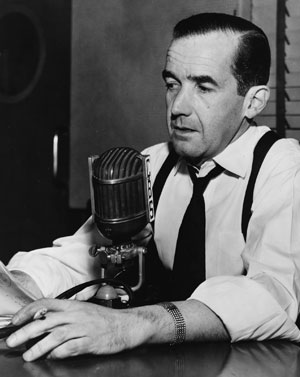
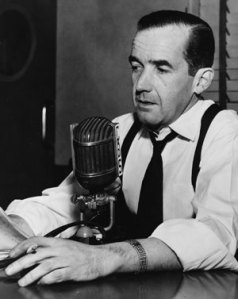
 In the hand-wringing of late about the partisanship of cable news, Edward R. Murrow, the patron saint of American broadcasting, has been invoked as a brave and exemplary journalist who remained properly above the sordid fray.
That was just the sentiment expressed the other day by a commentator for CNN’s online site, who wrote:
“In the current hyperpartisan media environment, it’s easy to forget that it hasn’t always been this way.
“Broadcast icon Edward R. Murrow was not a registered Democrat or Republican–he was an independent. Before courageously taking on Sen. Joe McCarthy, he was considered an anti-communist, supporting, for example, the execution of the Rosenbergs as spies for the Soviet Union. He wouldn’t have dreamed of giving donations to political candidates.”
To say Murrow he was studiously nonpartisan is to misread history. Murrow wasn’t so above the fray, and he was no white knight.
Notably, he donated time and expertise to helping the 1956 Democratic presidential candidate, Adlai Stevenson.
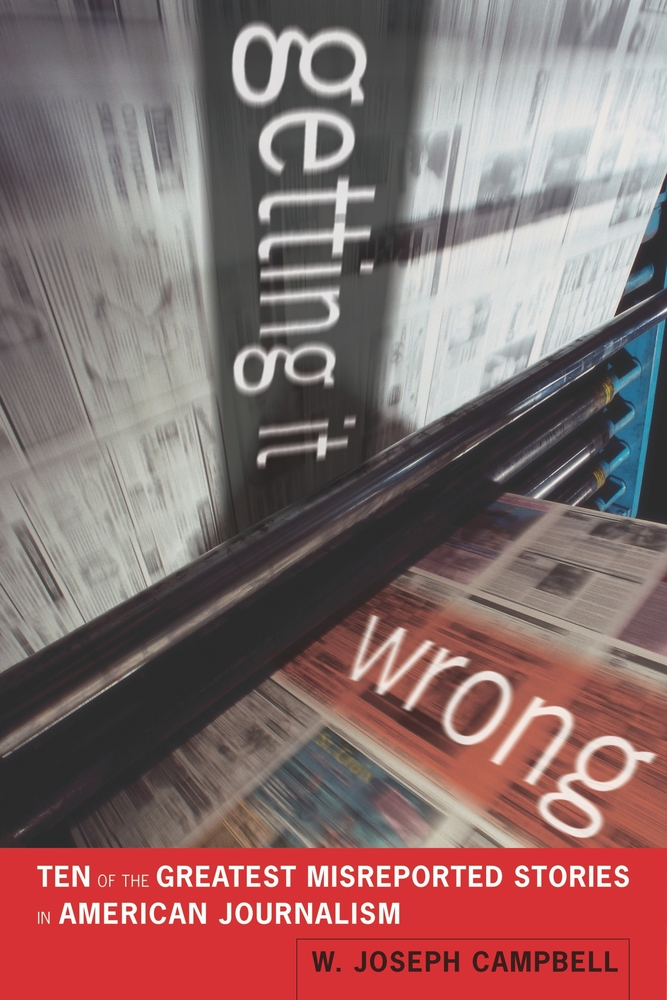
In my latest book, Getting It Wrong, I cite A.M. Sperber, one of Murrow’s leading biographers, in noting how Murrow privately counseled Stevenson on “the finer points of speaking to the camera.”
Sperber wrote in her 1986 work, Murrow: His Life and Times, that although the 1956 presidential election was a foregone conclusion, that Republican incumbent Dwight D. Eisenhower was certain to win, Murrow agreed “to help the Democrats.” Sperber called Murrow’s decision “a radical departure from his usual practice.”
The idea, Sperber wrote, was “to effect a liaison between the broadcaster and the candidate, to discuss the use of TV in the forthcoming campaign.”
She noted that the Murrow-Stevenson “connection was kept under wraps,” that the “understanding” between the broadcaster and Stevenson advisers was that Murrow “was acting as a private citizen” and that the matter was to be “kept quiet.”
Why did Murrow do it?
“He wouldn’t say,” Sperber wrote, adding that Murrow’s “friends, knowing his detestation of [John] Foster Dulles, were not surprised.” Dulles, a political conservative, was Eisenhower’s secretary of state and Time magazine’s “Man of the Year” in 1954.
In the end, Murrow’s coaching of Stevenson came to little, Sperber wrote. They met in a New York studio in June 1956 and Murrow “sweated over the candidate, trying to inculcate the finer points of speaking to the camera. Stevenson barely endured it, chiding campaign manager George Ball about the money this was costing the Democrats.”
Sperber added that Murrow also “dictated a few ideas for issue-oriented TV spots” that were “never put to use.”
I write in Getting It Wrong that there is “no small irony in journalism’s veneration of Murrow, who died in 1965. He was in some respects a flawed character—and hardly a ‘journalist above reproach.’ On his employment application at CBS, Murrow added five years to his age and claimed to have majored in college in international relations and political science. In fact, he had been a speech major at Washington State.”
“Murrow,” I added, “also passed himself off as the holder of a master’s degree from Stanford University, a degree he never earned.”
Given those lapses, Murrow wouldn’t qualify for high positions in mainstream American journalism today, I write in Getting It Wrong.
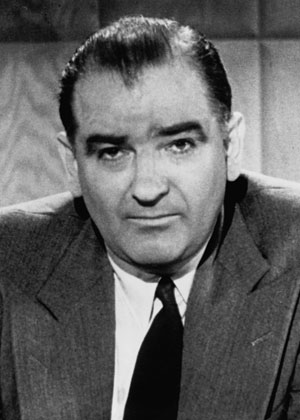
Not only that, but Murrow wasn’t especially courageous in taking on the red-baiting Joe McCarthy in a famous report in 1954 on the CBS program, See It Now.
As I discuss in Getting It Wrong, Murrow “was very late in confronting McCarthy,” doing so “after other journalists had challenged the senator and his tactics for months, even years.”
Recent and related:
- How late was Ed Murrow in taking on Joe McCarthy?
- Media ‘too scared’ to challenge McCarthy? Hardly
- Did he say it? A curious Murrow quote
- Suspicious Murrow quote reemerges
- ‘Follow the money’: A made-up Watergate line
- Journalists changing history: A double dose of media myth
- Getting it right about yellow journalism
- Discussing ‘Getting It Wrong’ at a special place







 Media Myth Alert