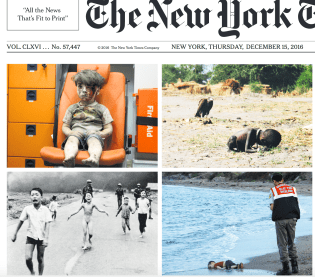
Prominently displayed on the front page of today’s New York Times were powerful images of war — the memorable and myth-burdened “Napalm Girl” photograph of 1972 among them.
The wartime images accompanied an essay about the misery of Syria’s battered city, Aleppo, once a rebel stronghold in the country’s prolonged civil war.
“They keep coming,” the essay began, “both the bombs and the images from Aleppo, so many of them ….”
“Pictures of war and suffering have pricked the public conscience and provoked action before. … There was Nick Ut’s 1972 photograph from South Vietnam of the naked 9-year-old Phan Thi Kim Phuc, screaming, burned by napalm. These pictures drove news cycles for weeks, months, years, helping tip the scales of policy.”
The photograph, which showed a cluster of terror-stricken children fleeing an errant napalm attack on their village northwest of what was then called Saigon, provoked no prolonged conversation in the American press in the days following its publication. It prompted few newspaper editorials.
There’s no evidence, moreover, that “Napalm Girl” helped “tip the scales of policy.” (The essay in the Times cited none.)
“Over the years,” I write in Getting It Wrong, “the superlatives associated with the image have edged into hyperbole and exaggeration. Napalm Girl has become invested with mythic qualities and a power that no photograph, however distinctive and exceptional, can project.”
Among the myths is that “Napalm Girl” was so arresting and extraordinary that it appeared on the front pages of newspapers across the United States. I present data challenging that notion, reporting in Getting It Wrong that of 40 major U.S. dailies examined, 21 placed the photograph on the front page in the days soon after it was taken on June 8, 1972.
Fourteen of the 21 newspapers displayed “Napalm Girl” above the front-page fold, a newspaper’s most coveted placement.
But 19 newspapers examined either did not publish “Napalm Girl” or placed the photograph on an inside page.
Reservations about front nudity no doubt led some newspapers to decline to publish “Napalm Girl” or give it prominence, I note, although the depth of such reluctance is difficult to measure.
In any event, it is clear that “Napalm Girl” did not drive “news cycles for weeks, months, years,” as the Times’ essay asserted.
Nor did the image drive policy.
It had no discernible effect on the U.S. policy of Vietnamization, which was put in place during the presidency of Richard Nixon and sought to shift the bulk of fighting to America’s South Vietnamese allies.
By June 1972, most American combat troops had been removed from South Vietnam, a drawdown neither slowed nor accelerated by publication of “Napalm Girl.”
This is not to say Nixon was unaware of the photograph, however. He briefly discussed “Napalm Girl” with his top White House aide, H.R. Haldeman, a conversation captured on Nixon’s secret taping system.
The tapes show that Haldeman on June 12, 1972, brought up what he called the “napalm thing.” Nixon replied by saying:
“I wonder if that was a fix” meaning: Was the image staged?
“Could have been,” Haldeman said, adding, “Napalm bothers people. You get a picture of a little girl with her clothes burnt off.”
“I wondered about that,” Nixon replied.
The photograph had no known effect on Nixon’s thinking about the war, I write in Getting It Wrong, pointing out that his attention was soon diverted. On June 17, 1972, burglars linked to Nixon’s reelection campaign were arrested inside the headquarters of the Democratic National Committee in Washington, the signal crime of what ballooned into the Watergate scandal.
Nixon’s attempts to cover up the burglary’s links to his campaign — a scheme he discussed with Haldeman in tape-recorded conversation June 23, 1972 — eventually cost Nixon the presidency.
The New York Timesobituary today about Fidel Castro not only praised the brutal Cuban dictator as “a towering international figure,” it stepped into the dogged media myth about its own coverage of the run-up to the failed Bay of Pigs invasion in 1961.
The obituary said that the Times, “at the request of the Kennedy administration, withheld some” details of it was planning to report about invasion plans, “including information that an attack was imminent.”
Not quite.
As I discuss in my media-mythbusting book, Getting It Wrong — a second edition of which was published recently — the notion that the administration of President John F. Kennedy “asked or persuaded the Times to suppress, hold back, or dilute any of its reports about the impending Bay of Pigs invasion is utter fancy.
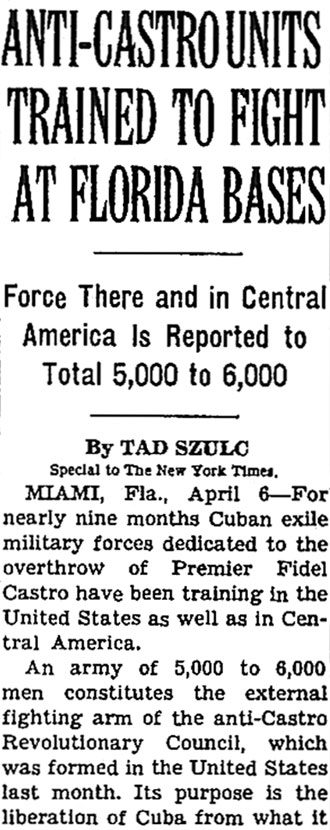
“There is no evidence that Kennedy or his administration knew in advance about the Times report of April 7, 1961, a front-page article [see nearby] that lies at the heart of this media myth.”
The article was written by Tad Szulc, a veteran foreign correspondent for the Times, and filed from Miami on the afternoon of April 6, 1961 — 11 days before the CIA-backed assault on Cuba’s southern coast.
Kennedy, I point out, essentially had no opportunity to speak with Times officials between the time when Szulc’s story was received at the Times building in midtown Manhattan and when it was set in type.
That’s because the president “spent the last half of the afternoon of April 6, 1961, playing host to Harold Macmillan, the British prime minister, on a lengthy cruise down the Potomac River to Mount Vernon,” I note in Getting It Wrong. “They traveled aboard the Honey Fitz, a ninety-two-foot presidential yacht. The round trip from Washington on that chilled and windy afternoon lasted two hours and forty minutes.
“It was 6:25 p.m. when the yacht returned to an Army Engineers dock in Washington, at the end of the outing. Kennedy and Macmillan rode together to the White House, arriving at 6:28 p.m. … leaving only a very small window for Kennedy to have been in touch with Times executives before the first edition of the newspaper hit the streets.”
I further note that the John F. Kennedy Presidential Library and Museum in Boston has said that “White House telephone logs reveal no calls that were placed to senior Times officials on April 6, 1961.”
Had the writer of the Times obituary consulted Without Fear or Favor, an insider’s account by Harrison Salisbury, a Pulitzer Prize-winner and former Times assistant managing editor, he would have found an unequivocal assertion that Kennedy was unaware of Szulc’s dispatch before it was published.
Salisbury wrote:
“The government in April 1961 did not … know that The Times was going to publish the Szulc story although it was aware that The Times and other newsmen were probing in Miami. Nor did President Kennedy telephone [top Times officials] about the story…. The action which The Times took [in editing Szulc’s report] was on its own responsibility,” the result of internal discussions and deliberations.
Those discussions included Szulc’s characterization of the invasion as imminent. The reference was removed from the article — an entirely justifiable decision, especially, as it turned out, the invasion was not imminent.
“Most important,” Salisbury added, “The Times had not killed Szulc’s story. … The Times believed it was more important to publish than to withhold. Publish it did.”
In addition, I write in Getting It Wrong, the suppression myth myth about the Times and the Bay of Pigs “fails to recognize or acknowledge that the Times coverage was not confined to Szulc’s article” published 10 days before the invasion.
“It ignores that several follow-up stories and commentaries appeared in the Times during the run-up to the invasion. The Times did not abandon the Cuba-invasion story after April 7, 1961,” I note. “Far from it.
“Subsequent reporting in the Times, by Szulc and others, kept expanding the realm of what was publicly known about a coming assault against Castro.”
On April 8, 1961, the Times published a front-page article about the Cuban exiles and their eagerness to topple Castro. The article appeared beneath the headline “Castro Foe Says Uprising Is Near” and quoted the president of the U.S.-based umbrella group of exiles, the Cuban Revolutionary Council, as saying that a revolt against the Castro regime was “imminent.”
On April 9, 1961, the Times published another front-page article by Szulc that report how Cuban exile leaders were attempting to paper over rivalries and divisions in advance of what Szulc described as the coming “thrust against Premier Fidel Castro.” The “first assumption” of the leaders’ plans, Szulc wrote, “is that an invasion by a ‘liberation army,’ now in the final stages of training … will succeed with the aid of an internal uprising in Cuba. It is also assumed that a provisional ‘government in arms’ will be established promptly on the island.”
As I point out in Getting It Wrong, Szulc in those sentences effectively summarized the strategic objectives for what soon became the Bay of Pigs invasion.
Two days later, on April 11, James Reston, the Washington bureau chief, reported on the Times’s front page that Kennedy administration officials were divided “about how far to go in helping the Cuban refugees to overthrow the Castro Government.” Reston recounted in detail how Kennedy had been receiving conflicting counsel from advisers in the White House, the CIA, and the State and Defense departments. Reston also identified the time pressures facing Kennedy, writing:
“It is feared that unless something is done fairly soon nothing short of direct military intervention by United States forces will be enough to shake the Castro Government’s hold over the Cuban people.”
As I note in Getting It Wrong, the Times “continued to cover and comment on invasion preparations until the Cuban exiles hit the beaches at the Bay of Pigs.” Not all preinvasion reports were spot-on accurate. But the newspaper’s coverage of the run-up to the Bay of Pigs debacle was fairly extensive.
“Not only does the suppression myth ignore this,” I write, “it also fails to recognize that coverage of invasion preparations appeared in newspapers other than the New York Times.
“Indeed, the coverage reached a point where Kennedy, a week before the invasion, told his press secretary, Pierre Salinger: ‘I can’t believe what I’m reading! Castro doesn’t need agents over here. All he has to do is read our papers. It’s all laid out for him.'”
Amid the media’s self-flagellation and agonized introspection in the days since Donald Trump’s stunning election victory — days that brought such astonishing turns as the New York Times all but begging subscribers not to quit the newspaper — I have thought often of an ombudsman’s column published eight years ago, soon after Barack Obama won the presidency.
NYTimes letter to subscribers
The ombudsman, or in-house critic, was Deborah Howell of the Washington Post, who wrote:
“I’ll bet that most Post journalists voted for Obama. I did. There are centrists at The Post as well. But the conservatives I know here feel so outnumbered that they don’t even want to be quoted by name in a memo.”
The column stuck with me not only because of Howell’s evident candor in describing conservatives in the newsroom — you could almost see them cowering — but because viewpoint diversity remains largely elusive in mainstream American journalism.
Howell was right in 2008, and her analysis rings true today: Leading U.S. news outlets have done little to address a failing that has been evident for years.
As John Kass, a conservative columnist for the Chicago Tribune wrote recently, “It’s no secret that most of American journalism is liberal in its politics. The diversity they prize has nothing to do with diversity of thought.”
The viewpoint-diversity deficit was highlighted anew in Trump’s electoral victory over Democratic nominee Hillary Clinton, an outcome that gave journalists what Joshua Benton of the Nieman Journalism Lab called “the shock of their professional lives.”
The shock was of 1948 proportions, the year when President Harry S. Truman defied broad expectations that he would handily lose the election to Republican Thomas Dewey. This year, as Nate Silver of the FiveThirtyEight data blog observed, “most campaign coverage was premised on the idea that Clinton was all but certain to become the next president.”
The outcome revealed how inadequately journalists had prepared their audiences for a Trump victory.
Granted, the viewpoint-diversity deficit in leading American newsrooms hasn’t been much measured. As I note in my media mythbusting book, Getting It Wrong— an expanded second edition of which came out late last month — a survey in 2008 for the Washington-based Committee of Concerned Journalists found that 8 percent of national correspondents for U.S. news media considered themselves “conservative.” The overwhelming majority self-reported as “moderate” or “liberal.”
That such surveys have been rare is hardly reason to pretend the deficit is imaginary. Or that it can be justified by arguing, “Well, conservatives have Fox News,” the cable outlet.
Few media self-critiques following Trump’s victory were as brutally discerning — or as revealing of the viewpoint-diversity deficit — as the essay Will Rahn wrote for CBS News.
Rahn, managing director of political coverage for CBS News Digital, did not refer specifically to viewpoint diversity in his essay. But he said as much, writing:
“Journalists love mocking Trump supporters. We insult their appearances. We dismiss them as racists and sexists. We emote on Twitter about how this or that comment or policy makes us feel one way or the other, and yet we reject their feelings as invalid. It’s a profound failure of empathy in the service of endless posturing.”
Rahn further wrote of journalists:
“We must become more impartial, not less so. We have to abandon our easy culture of tantrums and recrimination. We have to stop writing these know-it-all, 140-character sermons on social media and admit that, as a class, journalists have a shamefully limited understanding of the country we cover. … There’s a fleeting fun to gang-ups and groupthink. But it’s not worth what we are losing in the process.”
The periodic Wikileaks disclosures during the fall campaign that revealed fawning interactions of journalists and the Clinton campaign further confirmed that the deficit in viewpoint diversity is no evanescent problem.
And it’s not of recent vintage.
Howell’s column in 2008 quoted Tom Rosenstiel, then the director of the Washington-based Project for Excellence in Journalism as saying that “conservatives are right that journalism has too many liberals and not enough conservatives. It’s inconceivable that that is irrelevant.”
Rosenstiel added: “More conservatives in newsrooms will bring about better journalism.”
In this year’s election, journalists openly challenged or flouted professional norms of impartiality and detachment in reporting, saying the incendiary character of Trump’s views and remarks was so egregious that they were left with no choice.
Columbia Journalism Review fairly rejoiced in what it saw as a latter-day “Murrow Moment” for journalists, a reference to the mythical 1954 television program when Edward R. Murrow took on the red-baiting Republican senator, Joseph R. McCarthy.
The journalism review said “we … are witnessing a change from existing practice of steadfast detachment, and the context in which journalists are reacting is not unlike that of Murrow: The candidate’s comments fall outside acceptable societal norms, and critical journalists are not alone in speaking up.”
Powerful stuff. Except that the “Murrow Moment” is a false precedent.
As I discuss in Getting It Wrong, Murrow took on McCarthy years after other journalists had directed pointed and sustained attention to the senator’s brutish tactics — and in some instances paid a price for having done so. McCarthy, I point out, had no more sustained or prominent critic in journalism than Drew Pearson of the nationally syndicated muckraking column, “Washington Merry-Go-Round.”
Pearson first challenged McCarthy in February 1950, shortly after the senator began a campaign against communists in government, and persisted in questioning the validity of McCarthy’s accusations. That was four years before Murrow’s program.
Not only that, but McCarthy’s favorability rating had hit the skids before Murrow’s program aired on March 9, 1954.
So the “Murrow Moment” can’t be considered a high moment in American journalism.
It looks something like 1948 for mainstream American news media today.
Donald Trump’s stunning victory in yesterday’s presidential election brought reminders of the embarrassment of 1948, when Thomas Dewey, the presumptive favorite for the presidency, was upset by President Harry S. Truman, much to the shock of the American press.
In the weeks and months before yesterday’s election, prominent media analysts predicted Trump was going to lose, and probably decisively, to Democratic nominee Hillary Clinton.
Notable among these misplaced predictions was that of Stuart Rothenberg, who wrote on August 9 at the Washington Post’sPowerPost blog:
“Three months from now, with the 2016 presidential election in the rearview mirror, we will look back and agree that the presidential election was over on Aug. 9th.
“Of course,” he added, “it is politically incorrect to say that the die is cast. …
“But a dispassionate examination of the data, combined with a coldblooded look at the candidates, the campaigns and presidential elections, produces only one possible conclusion: Hillary Clinton will defeat Donald Trump in November, and the margin isn’t likely to be as close as Barack Obama’s victory over Mitt Romney” in 2012.
Trump won at least 290 electoral votes yesterday; Clinton, at least 228. Four years ago, Obama defeated Romney by an electoral count of 332-206.
In another essay at PowerPost a few days before the election, Rothenberg asserted: “Partisan pollsters on both sides” agreed it was “very unlikely that Trump will sweep all of the toss-up states and pick off one or two Clinton-leaning states, which he would need to do to win.”
Trump essentially accomplished just that: He won toss-up states Florida, Iowa, North Carolina, and Ohio, and flipped Pennsylvania, and Wisconsin, both Democratic-leaning states where Clinton had been expected to win.
Misguided media predictions went well beyond Rothenberg’s projections.
In a column published October 11, David Brooks of the New York Times ruminated about what he called “the essential loneliness of Donald Trump” and declared:
“On Nov. 9, the day after Trump loses, there won’t be solidarity and howls of outrage. Everyone will just walk away.”
Nate Silver, founder and editor of the widely followed Five Thirty Eight data-blog, wrote on October 20, the day after the third and final presidential debate of the campaign:
“I’m not sure I need to tell you this, but Hillary Clinton is probably going to be the next president. It’s just a question of what ‘probably’ means.”
Referring to Trump’s deficit of some seven percentage points in public opinion polling at that time, Silver declared:
“There aren’t really any direct precedents for a candidate coming back from this far down to win an American presidential election, although you can make a few loose analogies. Harry Truman’s comeback over Thomas Dewey in 1948 almost works as a comparison, but Truman wasn’t coming from as far behind as Trump is, and there was much less polling in 1948.”
New York magazine election cover
The Washington Postreported on October 20 that Trump’s performance at the third debate, at which he declined to say whether he would accept the election result, touched off a “wave of apprehension and anguish [that] swept the Republican Party … with many GOP leaders alarmed by Donald Trump’s refusal to accept the outcome of the election and concluding that it is probably too late to salvage his flailing presidential campaign.”
Such eagerness to declare the election over prompted a rebuke from Howard Kurtz, an analyst and media reporter for Fox News.
“The tenor of the coverage certainly suggests that Donald Trump has no hope and Hillary Clinton is coasting to victory,” Kurtz wrote in a commentary posted October 24 at the Fox News site.
Many pundits, Kurtz noted, “are now portraying the billionaire’s plight as Mission Impossible.”
He added, presciently:
“I’m always more cautious than that. I’ve seen too many elections where a candidate bounced back after being written off, the polls were off, or some unexpected event moved the needle.”
Such a development came 11 days before the election, when FBI Director James Comey announced the reopening of the agency’s investigation into Clinton’s use of private email while she was secretary of state. But then, two days before the election, Comey said Clinton should face no criminal charges.
The media prize for excessive self-confidence has to go to New York magazine: Its election issue cover featured a photograph of an angry Trump, a taunting sneer, “LOSER,” emblazoned across his face. The issue’s publication date was October 31.
The cover today evokes the Chicago Tribune’s memorable and stunningly wrong front-page headline of November 3, 1948, which announced Dewey’s victory over Truman.
Assailing Donald Trump’s foreign policy credentials, and his recent speech on the topic, is hardly a demanding task. The blustery frontrunner for the Republican presidential nomination exhibits little more than shallow familiarity with national security issues.
But Trump’s superficiality hasn’t stopped critics from overreaching as they lambaste him on foreign policy — overreaching to the point of summoning the media myth about Richard Nixon’s “secret plan” to end the war in Vietnam. Activist Phyllis Bennis did just that the other day in an appearance on the MSNBC primetime program, The Last Word with Lawrence O’Donnell.
In his speech last week, Trump vowed to eradicate ISIS, the radical Islamic State, early in his presidency, but didn’t explain how that would be accomplished. With unconcealed smugness, Bennis declared that Trump’s reference to ISIS “was very reminiscent of Nixon’s call when he was running for president [in 1968] and said, ‘I have a secret plan to end the war.’ The secret plan of course turned out to be escalation.”
Her remark about Nixon’s “secret plan” gained fresh circulation yesterday in a post at a Huffington Post politics blog.
But it’s a claim Nixon never made. And he didn’t campaign for the presidency touting a “secret plan” on Vietnam.
That he did not is made clear in the search results of a full-text database of leading U.S. newspapers in 1968, including the New York Times, Los Angeles Times, Baltimore Sun, Wall Street Journal, Washington Post, and Chicago Tribune. The search terms “Nixon” and “secret plan” returned no articles during the period from January 1, 1967, to January 1, 1969, in which Nixon was quoted as saying he had a “secret plan” for Vietnam. (The search period included all of Nixon’s presidential campaign and its immediate aftermath.)
Surely, had Nixon campaigned on a “secret plan” in 1968, as Bennis so blithely asserted, the country’s leading newspapers would have publicized it.
Nixon did confront the notion he had a “secret plan” for Vietnam. In an article published March 28, 1968, in the Los Angeles Times, he was quoted as saying he had “no gimmicks or secret plans” for Vietnam.
Nixon also said:
“If I had any way to end the war, I would pass it on to President [Lyndon] Johnson.” (Nixon’s remarks were made just a few days before Johnson announced he would not seek reelection.)
Nixon may or may not have had a “secret plan” in mind in 1968. But he did not make such a claim a feature of his campaign that year. (William Safire, a former Nixon speechwriter and columnist for the New York Times, periodically called attention to the “secret plan” myth, once observing: “Like the urban myth of crocodiles in the sewers, the non-quotation never seems to go away ….”)
Nixon’s foes, however, tried to pin the “secret plan” calumny on him. Supporters of Democratic presidential candidate Hubert H. Humphrey, for example, took out a display advertisement in the New York Times on October 23, 1968; the ad included this statement: “Last March he said he had a secret plan to end the war.”
The ad included no reference to exactly when or where Nixon had made such a statement. And it carried the headline, “Trust Humphrey.”
The derivation of the “secret plan” tale can be traced to March 5, 1968 and a speech in Hampton, New Hampshire, in which Nixon said “new leadership” in Washington — a Nixon administration, in other words — would “end the war” in Vietnam.
The wire service United Press International noted in reporting Nixon’s vague remarks that the candidate “did not spell out how” he would “end the war.” The UPI dispatch also said “Nixon’s promise recalled Dwight D. Eisenhower’s pledge in 1952, when Nixon was his running mate, to end the war in Korea.” Eisenhower was elected president that year.
The New York Times account of Nixon’s speech, published March 6, 1968, quoted the former vice president as saying he “could promise ‘no push-button technique’ to end the war. Nixon said he was not suggesting ‘withdrawal’ from Vietnam.” A brief, follow-on report that day in the Times quoted Nixon as saying he envisioned applying military pressure as well as diplomatic efforts in ending the war.
Nixon may have been vague during the 1968 campaign in describing his ideas about Vietnam. But clearly he wasn’t touting, proclaiming, or otherwise running on a “secret plan.”
The mythical tale that Richard M. Nixon ran for president in 1968 touting a “secret plan” to end the Vietnam War is a dubious bit of political lore that has proven quite resistant to debunking. William Safire, a former Nixon speechwriter and columnist for the New York Times, once called the “secret plan” chestnut a “non-quotation [that] never seems to go away.”
Quite so.
The chestnut made an appearance yesterday in a Politico Magazine essay ruminating about the foreign policy smarts of Democratic presidential candidate Bernie Sanders.
“Candidate Nixon said he had a secret plan to end the war in Vietnam but never said what it was.”
It’s a claim that Nixon never made — a claim he even tried to knock down.
But it lives on, irresistibly, as presumptive evidence of Nixon’s fecklessness and his scheming ways.
The tale’s derivation can be traced to March 5, 1968 and a speech in Hampton, New Hampshire, in which Nixon said that “new leadership” in Washington — a Nixon administration, that is — would “end the war” in Vietnam.
The wire service United Press International noted in reporting Nixon’s remarks that the candidate “did not spell out how” he would “end the war.” The UPI dispatch also said “Nixon’s promise recalled Dwight D. Eisenhower’s pledge in 1952, when Nixon was his running mate, to end the war in Korea.” Eisenhower was elected president that year.
What ‘secret plan’?
The New York Times account of Nixon’s speech, published March 6, 1968, quoted the candidate as saying he “could promise ‘no push-button technique’ to end the war. He said he was not suggesting ‘withdrawal’ from Vietnam.” A brief, follow-on report that day in the Times quoted Nixon as saying he envisioned applying military pressure as well as diplomatic efforts in ending the war.
Nixon may have been vague in describing his ideas about Vietnam.
But clearly he was not touting a “secret plan.”
That he wasn’t is underscored by the search results of a full-text database of leading U.S. newspapers in 1968, including the New York Times, Los Angeles Times, Baltimore Sun, Wall Street Journal, Washington Post, and Chicago Tribune. The search terms “Nixon” and “secret plan” returned no articles during the period from January 1, 1967, to January 1, 1969, in which Nixon was quoted as saying he had a “secret plan” for Vietnam. (The search period included all of Nixon’s presidential campaign and its immediate aftermath.)
Surely, had Nixon promised or campaigned on a “secret plan” in 1968, the country’s leading newspapers would have picked up on it.
Moreover, an article published March 28, 1968, in the Los Angeles Times reported that Nixon addressed the notion, saying he had “no gimmicks or secret plans” for Vietnam.
Nixon further stated:
“If I had any way to end the war, I would pass it on to President [Lyndon] Johnson.” (Nixon’s remarks were made just a few days before Johnson announced he would not seek reelection.)
Nixon may or may not have had a “secret plan” in mind in 1968. But he did not make such a claim a feature of his campaign that year.
Nixon’s political foes, however, tried to pin the “secret plan” calumny on him. For example, supporters of Democratic candidate Hubert Humphrey took out a large display advertisement in the New York Times on October 23, 1968; the ad included this statement: “Last March he said he had a secret plan to end the war.”
The ad included no reference about exactly when or where Nixon had made such a statement. And it carried the headline, “Trust Humphrey.”
It is a heroic narrative that found mention today’s New York Times, in an article discussing two movies about journalists that could be contenders this year for Academy Awards.
One of them is Truth, a perversely titled film that celebrates former CBS News anchor Dan Rather and producer Marla Mapes who in 2004 used bogus documents to claim President George W. Bush dodged wartime service in Vietnam. No way does that movie deserve Oscar consideration. The other contender-film is titled Spotlight.
But what most interests Media Myth Alert is the Times article’s blithe and mistaken reference to “the investigation by Bob Woodward and Carl Bernstein that led to Richard M. Nixon’s resignation.”
“All the President’s Men allows no other interpretation: It was the work Woodward and Bernstein that set in motion far-reaching effects that brought about the first-ever resignation of a U.S. president. And it is a message that has endured.”
Indeed, this year marks the 40th anniversary of the movie’s release and the notion that Woodward and Bernstein toppled Nixon remains the principal way Watergate is understood, a version that disregards and diminishes the far more accurate interpretation of what led to Nixon’s fall in August 1974.
To roll up a scandal of Watergate’s dimensions, I wrote in Getting It Wrong, “required the collective if not always the coordinated forces of special prosecutors, federal judges, both houses of Congress, the Supreme Court, as well as the Justice Department and the FBI.
“Even then, Nixon likely would have served out his term if not for the audiotape recordings he secretly made of most conversations in the Oval Office of the White House. Only when compelled by the Supreme Court did Nixon surrender those recordings, which captured him plotting the cover-up” of the burglary in June 1972 that was Watergate’s seminal crime.
Principals at the Post have, over the years, rejected the simplistic notion that the newspaper’s reporting led Nixon to resign.
Katharine Graham, the Post’s publisher during Watergate, said in 1997, for example:
“Sometimes people accuse us of bringing down a president, which of course we didn’t do. The processes that caused [Nixon’s] resignation were constitutional.”
In 2005, Michael Getler, then the Post’s ombudsman, or in-house critic, wrote:
“Ultimately, it was not The Post, but the FBI, a Congress acting in bipartisan fashion and the courts that brought down the Nixon administration. They saw Watergate and the attempt to cover it up as a vast abuse of power and attempted corruption of U.S. institutions.”
Not even Woodward has embraced the heroic-journalist myth. He once told an interviewer for American Journalism Review:
And in an interview with the PBS “Frontline” program, Woodward said “the mythologizing of our role in Watergate has gone to the point of absurdity, where journalists write … that I, single-handedly, brought down Richard Nixon. Totally absurd.”
Today’s article wasn’t the first time the Times has turned to the mythical claim about the Post’s Watergate reporting.
In a cover article in 2014, the Times Sunday magazine mentioned Woodward and Bernstein, saying they “actually managed to take down a mendacious American president, and in doing so they came to symbolize the hope and heroism of a new generation.”
And in 2008,in an article about Woodward’s finally introducing his high-level Watergate source to Bernstein, the Times referred to the “two young Washington Post reporters [who] cracked the Watergate scandal and brought down President Richard M. Nixon.”
Media Myth Alertcalled attention in 2015 to the appearance of prominent media-driven myths, including cases in which celebrities took up and repeated dubious tall tales about journalists and their work.
Here is a rundown of the blog’s five top posts of the year, followed by a roster of other notable mythbusting writeups of 2015.
The hoary old myth received a boost in April when, on the 152d anniversary of Hearst’s birth, the humorist and radio personality, Garrison Keillor, blithely invoked the unsubstantiated anecdote, which reinforces the superficial and misleading notion of Hearst as war-mongering newspaper publisher.
“In 1898,” Keillor told listeners of his “Writer’s Almanac” podcast that airs on NPR, “Hearst sent the artist Frederic Remington to Cuba to cover the war. And Remington wrote home, ‘There is no war. Request to be recalled.’
“And he was told, ‘You furnish the pictures, I’ll furnish the war.’ And the Hearst newspapers did their best to promulgate what came to be called the Spanish-American War.”
The tale is one of the best-known in American journalism, and it is almost certainly apocryphal, for reasons described in my 2010 media-mythbusting book, Getting It Wrong.
Keillor
Notably, the anecdote lives on despite the absence of supporting documentation: The telegraphed messages that Remington and Hearst supposedly exchanged have never turned up. And the Spanish authorities who controlled incoming and outbound telegraphic traffic in Cuba surely would have intercepted and called attention to Hearst’s incendiary message, had it been sent.
Moreover, the sole original source of the “furnish the war” anecdote, James Creelman, a portly, cigar-chomping journalist prone to hyperbole and exaggeration, never said how or where he learned about the purported Remingt0n-Hearst exchange.
And almost no one remembers that Hearst denied having sent such a message.
By the way, the transcript of Keillor’s remarks about Hearst and Remington remains posted at the “Writer’s Almanac” Web site. Uncorrected.
Peter Landesman, who is to produce and direct the film, was quoted last week as saying Felt will be akin to “a Shakespearean melodrama, a massively powerful story. It’s like a domestic spy thriller but there’s a very powerful, almost Shakespearean thing happening inside his home, but it will incorporate all those elements.”
But why is Mark Felt, who died in 2008, biopic worthy?
FBI agents who conducted the illegal break-ins went through “desks, closets, clothing and private papers for clues to the whereabouts of the Weathermen,” according to an account in the New York Times. “With a camera that could be concealed in an attaché case, the agents photographed diaries, love letters, address books and other documents” belonging to relatives of Weather radicals.
In 1980, Felt was convicted of felony charges related to those warrantless break-ins, which were known in the FBI as “black bag jobs.” He was fined $5,000 but not sentenced to prison for the crimes.
The following year, Felt received an unconditional pardon from President Ronald Reagan.
In its obituary about the former FBI official, the Los Angeles Times recalled that tears welled in Felt’s eyes as he acknowledged at trial having approved secret break-ins by FBI agents between May 1972 and May 1973 — “roughly the same time he was talking to Woodward about Watergate.”
Felt and co-defendant Edward S. Miller argued that the warrantless entries were justified for reasons of national security.
In doing so, Noonan tripped over the mythical “Cronkite Moment” of 1968.
Noonan
That “moment” was when CBS News anchorman Walter Cronkite declared on the air that the U.S. military effort in Vietnam was “mired in stalemate.” Cronkite’s assessment supposedly came as an epiphany to President Lyndon B. Johnson, who, in visceral reaction, said something to the effect of:
“If I’ve lost Cronkite, I’ve lost Middle America.”
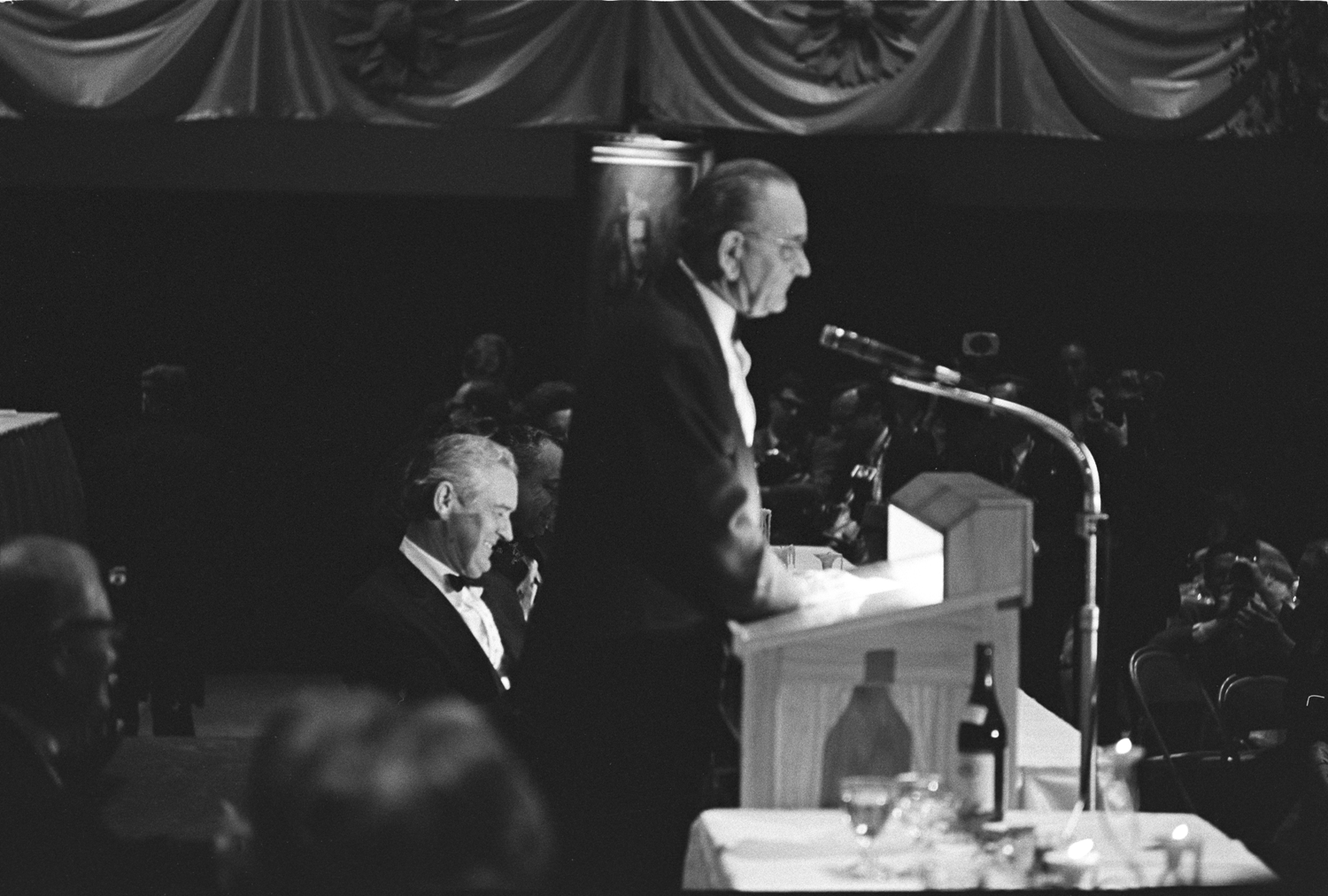
But as I discussed in Getting It Wrong, Johnson did not see Cronkite’s program when it aired on February 27, 1968; the president then was attending a black-tie birthday party in Texas for Governor John Connally.
I also noted in Getting It Wrong that by 1968, “stalemate” was hardly a novel or shocking way to characterize the Vietnam War: “Stalemate” had circulated in the news media months before Cronkite spoke the word on the air.
In her column, Noonan referred to shifting contours in American politics that have boosted Trump’s bid for the Republican presidential nomination. She also wrote:
“Old style: If I’ve lost Walter Cronkite, I’ve lost middle America. New style: How touching that an American president once thought if you lost a newsman you’d lost a country.”
Noonan’s reference to the “Cronkite Moment” may have been indirect and a bit confusing, given the topic of her column. But there was no doubt she was treating as authentic one of American journalism’s most tenacious myths.
Dowd did so in February, in a commentary that ruminated about the bizarre falsehoods told by Brian Williams, the disgraced former anchor of NBC Nightly News, about an assignment to Iraq in 2003: Williams claimed to have been aboard a U.S. Army helicopter when it was struck by a rocket-propelled grenade.
Dowd, after noting that network evening news shows are shells of their much-watched former selves, turned implicitly to the “Cronkite Moment,” writing that CBS anchorman had “risked his career to go on TV and tell the truth about the fact that we were losing the Vietnam War.”
Except Cronkite didn’t say “we were losing.” He said the war was stalemated and that negotiations might eventually prove to be the way out. But saying so posed no risk to Cronkite’s career. By then, it was commonplace, and safe, to say the war had reached a stalemate.
Of course, it had no such effect, as Bradlee himself had said, on the 25th anniversary of the seminal crime of Watergate–the burglary in June 1972 at the headquarters of the Democratic National Committee.
On Meet the Press in June 1997, Bradlee said “it must be remembered that Nixon got Nixon. The Post didn’t get Nixon.”
Bradlee, who died in 2014, was referring to the White House audio tapes which Nixon secretly made and which revealed the president’s guilty role in conspiring to obstruct the FBI’s investigation into the breakin at the DNC headquarters.
As I noted in Getting It Wrong the notion that the Post and its lead Watergate reporters, Bob Woodward and Carl Bernstein, “brought down” Nixon’s presidency represents a fundamental misreading of history that diminishes “the far more decisive forces that unraveled the scandal and forced Nixon from office.”
Those forces included special prosecutors and federal judges, FBI agents, bipartisan congressional panels, and the U.S. Supreme Court, which unanimously ruled that Nixon must turn over to prosecutors the tapes that captured his guilty participation in the attempted coverup.
Against this tableau, the contributions of the Post and Woodward and Bernstein to the outcome of Watergate were minimal. Modest at best. They were hardly decisive, Politico’s claim notwithstanding.
■Jorge Ramos, media-myth-teller (posted September 5): The international reach of media-driven myths was best defined in 2015 when Jorge Ramos, the self-important anchorman for Univision, went on an ABC News program and claimed that the Washington Post’s reporting of Watergate forced Nixon’s resignation.
He stated:
“I think that, as a reporter, many times, you have to take a stand. … And the best examples of journalism that I have—Edward R. Murrow against McCarthy; Cronkite during the Vietnam War, or the Washington Post reporters forcing the resignation of Richard Nixon—that’s when reporters challenge those who are in power.”
Ramos, who has been called the “Walter Cronkite of Latino America,” invoked a similar claim a few days later in a commentary posted at the online site of AM, a newspaper in Mexico.
What prompted these claims was Ramos’ conduct a news conference convened by Donald Trump. Ramos insisted on posing a question before being called on, a showboating moment that led to his being escorted from the room.
Not even the newspaper’s principal figures during the Watergate period embraced the notion that the Post forced Nixon to quit in August 1974.
Notable among them was the publisher during Watergate, Katharine Graham. She said 1997:
“Sometimes people accuse us of bringing down a president, which of course we didn’t do. The processes that caused [Nixon’s] resignation were constitutional.”
Peggy Noonan, the prominent weekend columnist for the Wall Street Journal, attempts in her latest commentary to explain the political phenomenon that is Donald Trump — and in doing so trips over the mythical “Cronkite Moment” of 1968.
Noonan (Harvard University)
That was when CBS News anchorman Walter Cronkite declared on the air that the U.S. military effort in Vietnam was “mired in stalemate.” Cronkite’s assessment supposedly came as an epiphany to President Lyndon B. Johnson, who in visceral reaction said something to the effect of:
“If I’ve lost Cronkite, I’ve lost Middle America.”
But as I discussed in my media-mythbusting book, Getting It Wrong, Johnson did not see Cronkite’s program when it aired on February 27, 1968; he was at a black-tie birthday party in Texas for Governor John Connally. Nor is there evidence the president watched Cronkite’s report on videotape at some later date.
So it’s hard to imagine how the president could have been much moved by a TV program he did not see.
I further noted in Getting It Wrong that by 1968, “stalemate” was hardly a novel or shocking way to characterize the Vietnam War.
“Stalemate” had circulated in the news media months before Cronkite’s report. For example, the New York Times published a front-page analysis on August 7, 1967, that declared “the war is not going well. Victory is not close at hand.”
The Times report was published on its front page beneath the headline:
Which takes us to Noonan, formerly a speechwriter for President Ronald Reagan. She opens her column this weekend by writing: “So, more thoughts on Donald Trump’s candidacy, because I can’t stop being fascinated.”
The Trump phenomenon, she argues, signals that “[s]omething is going on, some tectonic plates are moving in interesting ways” in American political life.
She also invokes Trump’s recent news conference confrontation with Jorge Ramos, the showboating anchorman for Univision. At the news conference, he refused to wait his turn in posing a question and was escorted from the room. Ramos was allowed back in a short time later.
Noonan, whose columns invariably lean on personal anecdotes, mentions an acquaintance named “Cesar,” a Dominican immigrant who works at a New York City grocery and who, she says, is more impressed by Trump than Ramos.
Cesar’s views, Noonan suggests, may be representative of the shifting political contours.
“Old style: Jorge Ramos speaks for Hispanic America,” she writes. “New style: Jorge Ramos speaks for Jorge Ramos. Old style: If I’ve lost Walter Cronkite, I’ve lost middle America. New style: How touching that an American president once thought if you lost a newsman you’d lost a country.”
Noonan’s reference to the “Cronkite Moment” may seem odd, indirect, and even a bit confusing, given the context. But there’s no doubt she was treating as genuine one of American journalism’s most tenacious myths.
The “Cronkite Moment” indeed is one of journalism’s favored and most compelling stories, as it tells how a perceptive and courageous anchorman could effect powerful change.
Johnson in Texas, February 27, 1968
After all, Cronkite’s assessment is often said to have shifted U.S. public opinion about the Vietnam War.
Except that it didn’t.
That shift had taken place months earlier, and was detected when a plurality of respondents to a Gallup survey in October 1967 characterized as a mistake the Johnson administration’s decision to send U.S. troops to Vietnam.
A little more than two years earlier, in August 1965, just 24 percent of respondents said they thought it was a mistake to have deployed American forces to Vietnam.
Gallup asked the question again in a poll completed on the day Cronkite’s program aired: Forty-nine percent of the respondents said “yes,” U.S. military intervention in Vietnam had been a mistake; 42 percent said “no.”
In April 1968, Gallup found that 48 percent of respondents said U.S. military intervention in Vietnam had been a mistake; 42 percent said it had not been.
Moreover, print journalists had reported softening support for the war well before Cronkite’s “mired in stalemate” assessment.
In December 1967, for example, a national correspondent for Knight newspapers, Don Oberdorfer, noted that the previous summer and fall had “been a time of switching, when millions of American voters — along with many religious leaders, editorial writers and elected officials — appeared to be changing their views about the war.”
Cronkite’s “stalemate” assessment had little demonstrable effect on Americans’ views about Vietnam. Indeed, it can be said that Cronkite in early 1968 was following rather than leading public opinion on the war.
The tale about the New York Timessuppressing its own reporting in the runup to the Bay of Pigs invasion of Cuba isn’t necessarily the most popular of media myths.
The suppression myth, which is addressed and debunked in my 2010 book, Getting It Wrong: Ten of the Greatest Misreported Stories in American Journalism, has it that the Times bowed to pressure from the administration of President John F. Kennedy and spiked, killed, or otherwise sanitized a detailed report about the pending invasion.
Shipler invokes the suppression tale this way:
“The most famous and catastrophic case of journalists’ abandoning their role in getting the facts out was the Times‘s decision to water down advance information on the Bay of Pigs invasion of Cuba.” He doesn’t say what the Times supposedly held back, or just how that was “catastrophic.”
But he does claim that “a full-throated disclosure might have helped derail the plan, saving lives and preventing a humiliating defeat.”
Speculation aside, Shipler’s right that the ill-fated invasion was a humiliating defeat for the Kennedy administration: A brigade of U.S.-trained foes of the regime of Fidel Castro landed on the beaches of southern Cuba in April 1961 and was rolled up within three days.
But Shipler’s claim about the Times’ having watered down “advance information” is supported by no relevant or persuasive evidence. He cites none in the endnotes of his book.
The Times article that rests at the heart of this media myth was neither suppressed, killed, nor eviscerated.
That article (see above) was written by a veteran correspondent, Tad Szulc, who reported from Miami that 5,000 to 6,000 Cuban exiles had received military training for a mission to topple Castro’s communist regime; the actual number of invaders was closer to 1,400.
Overstatement was hardly the article’s most controversial or memorable element.
Supposedly, editors at the Times caved in to pressure from the White House and emasculated Szulc’s report, removing key elements about the invasion plans.
That Kennedy intervened in the Times’ editorial decisionmaking in April 1961 is widely believed, and lives on as a cautionary tale, as Shipler suggests.
But as I discussed in Getting It Wrong, “the notion that Kennedy asked or persuaded the Times to suppress, hold back, or dilute any of its reports about the pending Bay of Pigs invasion is utter fancy. There is no evidence that Kennedy or his administration knew in advance” about Szulc’s dispatch, which was filed April 6, 1961.
The article was published the following day, above the fold on the Times’ front page.
In his book Without Fear or Favor, an insider’s look at the Times, Harrison Salisbury offered a detailed account about the handling of Szulc’s dispatch.
“The government in April 1961,” Salisbury wrote, “did not … know that The Times was going to publish the Szulc story, although it was aware that The Times and other newsmen were probing in Miami. …. The action which The Times took [in editing Szulc’s report] was on its own responsibility,” the result of internal discussions and deliberations.
The editing was cautious but hardly unreasonable.
A reference to the invasion’s imminence was removed, which served to improve the story’s accuracy. The anti-Castro exile force launched its assault on April 17, 1961, 10 days after Szulc’s report appeared, an interval that hardly connotes “imminence.”
References to the CIA’s role in training the Cuban exiles were omitted from the story in favor of the more nebulous terms “U.S. officials” and “U.S. experts.” Turner Catledge, then the Times managing editor, said the U.S. government had more than a few intelligence agencies, “more than most people realize, and I was hesitant to specify the CIA when we might not be able to document the charge.”
An entirely defensible editorial decision.
The prominence given Szulc’s report was modified, from a planned four-column display to a single column. If the invasion was not believed imminent, then a four-column headline was difficult to justify, Catledge reasoned.
Those decisions were judicious, and certainly not unreasonable.
“Most important,” as Salisbury wrote, “The Times had not killed Szulc’s story. … The Times believed it was more important to publish than to withhold. Publish it did.”
On the front page.
What’s often ignored is that Szulc’s article of April 7, 1961, was no one-off story. It scarcely was the Times’ last word about invasion plans.
As I noted in Getting It Wrong, “Subsequent reporting in the Times, by Szulc and others, kept expanding the realm of what was publicly known about a coming assault against Castro.” Not all the reports were accurate in all their details, but the combined effect was to signal something important was afoot.
For example, on April 8, 1961, the Times published a front-page article about the exiles and their eagerness to topple Castro.
The article appeared beneath the headline, “Castro Foe Says Uprising Is Near,” and quoted the president of the U.S.-based umbrella group of exiles, the Cuban Revolutionary Council.
The following day, the Times front page included a report by Szulc describing how Cuban exile leaders were attempting to paper over differences in advance of what was termed the coming “thrust against Premier Fidel Castro.”
The “first assumption” of the leaders’ plans, Szulc wrote, “is that an invasion by a ‘liberation army,’ now in the final stages of training in Central America and Louisiana, will succeed with the aid of internal uprising in Cuba. It is also assumed that a provisional ‘government in arms’ will be established promptly on the island.”
That essentially was the plan to topple Castro.
Three days later, James Reston, then the newspaper’s Washington bureau chief, wrote in a column that considered the moral dimensions of an assault on the Castro regime. Reston’s column said that “while the papers have been full of reports of U.S. aid to overthrow Castro, the moral and legal aspects of the question have scarcely been mentioned.”
Other news organizations, including the MiamiHerald and New York Herald Tribune, reported on pre-invasion preparations as well, all of which prompted Pierre Salinger, Kennedy’s press secretary, to recall in a memoir a few years later:
“To declare in mid-April of 1961 that I knew nothing of the impending military action against Cuba except what I read in the newspapers or heard on the air was to claim an enormous amount of knowledge.”
 The wartime images accompanied an essay about the misery of Syria’s battered city, Aleppo, once a rebel stronghold in the country’s prolonged civil war.
 Not quite.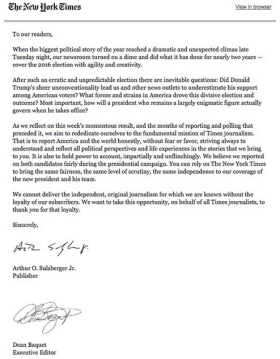
 In the weeks and months before yesterday’s election, prominent media analysts predicted Trump was going to lose, and probably decisively, to Democratic nominee Hillary Clinton.
 “But a dispassionate examination of the data, combined with a coldblooded look at the candidates, the campaigns and presidential elections, produces only one possible conclusion: Hillary Clinton will defeat Donald Trump in November, and the margin isn’t likely to be as close as Barack Obama’s victory over Mitt Romney” in 2012.
 But Trump’s superficiality hasn’t stopped
  The chestnut made an appearance yesterday in a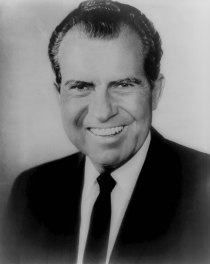

 The hoary old myth received a boost in April when, on the 152d anniversary of Hearst’s birth, the humorist and radio personality, Garrison Keillor,



 Media Myth Alert