W. Joseph Campbell

Archive for the ‘Newspapers’ Category

Newspapers ‘not dead yet’: But a slow death, still

In New York Times, Newspapers on June 12, 2010 at 10:03 am

The venerable and often-contrarian Economist magazine this week offers an intriguing if superficial defense of the newspaper, declaring in an editorial that they’re “not dead yet.”

Indeed, the Economist asks with a hint of snark, “Whatever happened to the death of newspapers? A year ago the end seemed near.”

It adds:

“The recession threatened to remove the advertising and readers that had not already fled to the internet. Newspapers like the San Francisco Chronicle were chronicling their own doom. America’s Federal Trade Commission launched a round of talks about how to save newspapers. Should they become charitable corporations? Should the state subsidise them? It will hold another meeting on June 15th. But the discussions now seem out of date.”

The Economist notes that U.S. newspapers, “which inhabit the most troubled corner of the global industry, have not only survived but often returned to profit.”

But the data the Economist invokes point to another interpretation: Newspapers are still dying, albeit a slower death.

The pressures on American newspapers have scarcely abated. And I’m hardly ready to retreat from my view that their predicament “is as bleak as it is unprecedented.”

Despite the snark–“whatever happened to the death of newspapers?”–they are in peril still.

The Economist cites recent estimates of the American Society of News Editors that 13,500 newsroom jobs have been eliminated since 2007. (The Economist didn’t mention it, but ASNE also says that American newsrooms since 2001 have lost more than 25 per cent of their fulltime staff.)

“Car and film reviewers have gone,” the Economist notes. “So have science and general business reporters. Foreign bureaus have been savagely pruned. Newspapers are less complete as a result.”

Indeed, many U.S. dailies are mere husks of their former fat selves. They offer fewer pages, publish fewer articles, have fewer reporters–all of which often adds up to an uninteresting product little able to compete in the digital century.

To that point, the Economist says:

“It is grim to forecast still more writers losing their jobs. But whether newspapers are thrown onto doorsteps or distributed digitally, they need to deliver something that is distinctive.”

Readers, it says, invoking a familiar bromide, “will pay for news if they think it has value. Newspapers need to focus relentlessly on that.”

But there are great numbers of Americans who find the news routinely irrelevant.

Nearly 20 percent of adult Americans go without news during a typical day, according to a Pew Research Center’s media-use survey in 2008. (Ten years earlier, the percentage of American adults who went newsless was 14 percent.)

Among adults 18-to-24-years-old these days, 34 percent say they go newsless, according to Pew Research–data I cite in my new book, Getting It Wrong.

This declining constituency for news offers no encouragement for newspapers.

And newspapers have been complicit in their decline. Their credibility—the notion that they play it straight in reporting the news—is deeply doubted among Americans.

Slightly more than 20 percent of adult Americans believe all or most of what they read in their local newspaper, Pew data say. For the  New York Times, the believability quotient is 18 percent. It’s 16 percent for USA Today.

On top of all that, the worst recession in years has made it nearly impossible for prominent newspaper companies, such as the New York Times and the Chicago-based Tribune Co., to dig out from staggering loads of debt.

Another factor contributing to the long decline of newspapers is the fractured business model in which newspapers conveniently and effectively brought together buyers and sellers through advertising. For years, advertising has been deserting the press for the Internet, where bringing together buyers and sellers is cheaper and far more timely and efficient.

The Internet also has unbundled media content, meaning there’s no need for anyone to buy a newspaper just for sports news. Or international news. It’s all online, in discrete packages and in unmatched variety. News à la carte is irresistible in its appeal–and can’t be matched by printed newspapers.

None of these powerful trends has been reversed.

Alas, discussions about the death of newspapers scarcely are “out of date.”

WJC

Related:

Helen Thomas and Iraq War: What’s she talking about?

In Debunking, Furnish the war, Media myths, Newspapers on June 11, 2010 at 8:12 am

Helen Thomas, the cranky, now-disgraced columnist for Hearst newspapers who resigned under fire this week, claims in an interview that White House press corps bears some responsibility for the Iraq War.

Thomas, who quit after saying Jews should “get the hell out of Palestine” and go to Germany and Poland, asserted in the interview posted yesterday by Vice magazine:

“Everyone rolled over and played dead at a time when they should have been really penetrating. … But in this case they bought all the propaganda. Or, whether they bought it or not, they took it and spouted it.”

Thomas, who is almost 90,  didn’t elaborate on her “rolled over and played dead” comment, which has the whiff of a gratuitous shot at her erstwhile colleagues.

She’s made similar comments before, claiming for example that the American news media were “comatose” in the run-up to the war. But seldom has she offered much in the way of specific, supporting detail. As in who “rolled over” when?

While her claims have hardened into something approaching conventional wisdom about pre-war coverage, Thomas’ views have been challenged, notably by David Gregory of NBC, who has asserted:

“I think the questions were asked [in the run-up to the war].  I think we pushed. I think we prodded. I think we challenged the president. I think not only those of us the White House press corps did that, but others in the rest of the landscape of the media did that.

“If there wasn’t a debate in this country,” Gregory has said, “then maybe the American people should think about, why not?  Where was Congress? Where was the House? Where was the Senate? Where was public opinion about the war?”

As to his last question, where was public opinion? It heavily favored the war in Iraq. And as I note in a chapter in my new book, Getting It Wrong, a Washington Post-ABC News poll, taken in the early days of the war found that 69 percent of Americans thought the invasion of Iraq was justified even if weapons of mass destruction were not found.

Reason magazine also has challenged the argument that the U.S. news media could have been more searching in the run-up to the war, asserting in a well-argued piece in 2007:

“The ‘we should have done more to head off this war’ argument assumes too much, exaggerates the media’s power to influence, removes the onus from politicians and infantilizes news consumers.”

Those are all good points. And blaming the news media does tend to deflect blame from Congress, which in 2002 authorized military force against Iraq.

What’s more, the content leading U.S. daily newspapers in the weeks before the Iraq War began included a sustained amount of searching coverage. A good deal of the coverage in February and March 2003 focused on diplomatic démarche at the United Nations, where the U.S. pro-war policy came under frequent attack by the French, Germans, Russians, and others.

Those challenges to U.S. policy were given prominence in U.S. newspapers, as were the massive anti-war demonstrations in Europe and in some American cities.

Thomas has never impressed me as a particularly incisive or even careful reporter. She notably indulged in media myth in her 2006 book, Watchdogs of Democracy?: The Waning Washington Press Corps and How It Has Failed the Public.

The book repeated the hoary anecdote about Hearst’s vowing to “furnish the war” with Spain in the late 19th century–one of the media-driven myths that I debunk in Getting It Wrong.

Thomas’ use of the “furnish the war” anecdote helped Watchdogs of Democracy? make the tail-end of my lineup of the dozen overrated books about journalism history–a roster I compiled in 2009 for the quarterly journal American Journalism.

Topping my “overrated” list was David Halberstam‘s The Powers That Be, followed by Carl Bernstein and Bob Woodward‘s All the President’s Men and Hadley Cantril’s The Invasion From Mars.

About Thomas’ Watchdogs of Democracy?, I wrote:

“The title of Thomas’ book promises far more than its disjointed and repetitive content delivers,” adding, “don’t turn to Watchdogs of Democracy? for searching analysis.”

WJC

Related:

On Hearst, yellow journalism, and war

In Debunking, Furnish the war, Media myths, Newspapers, Spanish-American War, Yellow Journalism on June 5, 2010 at 10:04 am

The dubious linkage of William Randolph Hearst, late 19th century yellow journalism,  and the Spanish-American War was invoked yesterday in a post at the Breaking Media online site.

The item discussed the latest deal by Hearst Corp., noting the reported acquisition was “not a newspaper, a magazine or even a website, but [iCrossing Inc.,] a company specializing in buying search keywords and performing social media“—and suggested that William Randolph, the company’s founder who died in 1951, would have approved.

Hearst before the war

Inevitably, perhaps, the Breaking Media item offered an historically flabby slice of context, asserting that “the Hearst name will forever be associated with yellow journalism techniques that led to a war and mainstream acceptance of all kinds of crazy pseudoscience.”

I don’t know about the last bit, the “acceptance of all kinds of crazy pseudoscience.”

But the claim about Hearst, yellow journalism, and war is an exaggeration, a media-driven myth.

The reference to “war” is, of course, to the Spanish-American War of 1898, the 114-day conflict in which the United States routed Spanish forces in Cuba, Puerto Rico, and the Philippines. The myth is that Hearst and his flamboyant yellow journalism whipped American public opinion to such an extent that war with Spain (over its harsh colonial rule of Cuba) became inevitable.

The myth is addressed, and debunked, in my 2001 book, Yellow Journalism: Puncturing the Myths, Defining the Legacies. A slice of the myth–that notion that Hearst vowed to “furnish the war” with Spain–is discussed in a chapter my new book, Getting It Wrong.

In Yellow Journalism, I noted that the argument that Hearst fomented the war with Spain over Cuba rests on a decidedly narrow, media-centric interpretation of the conflict’s causes.

That interpretation ignores, I noted, the “more relevant and immediate factors that give rise to armed conflict.

“In the case of the Spanish-American War,” I wrote, “the policy objectives between the United States and Spain ultimately proved irreconcilable. Months of intricate diplomatic efforts ultimately failed to resolve what had become an intolerable state of affairs in Cuba, dramatized by the destruction of the [U.S. warship] Maine in a harbor under Spanish control and supervision.

“To indict the yellow press for causing the Spanish-American War is to misread the evidence and to ignore the intricacies of the diplomatic quandary that culminated in the spring of 1898 in an impasse that led to war.”

Failed diplomacy gave rise to the Spanish-American War, not the content of Hearst’s newspapers in New York and San Francisco.

I also pointed out in Yellow Journalism:

“The notion that the yellow press incited or fomented the Spanish-American War stands, moreover, as testimony to the supposedly powerful, even malevolent effects of the news media—that they can and sometimes do act in dangerous, devious, and manipulative ways.”

And that’s an important reason why the myth about Hearst, yellow journalism, and war has proved so tenacious. It offers a lesson, however misleading, about the extreme hazards of unchecked media power: Unscrupulous media moguls can take us into wars that otherwise we would not fight.

WJC

Related:

About the innovative social media deck, and ‘yellow blogging’

In 1897, Newspapers, Yellow Journalism on April 20, 2010 at 10:22 am

Kudos to my nephew, Rob Campbell, and the innovative social media deck he’s helped launch at the Cleveland Indians’ ballpark, Progressive Field.

The Tribe Social Deck, believed to be the first of its kind in a major professional sports venue, is described as “a press box for bloggers/social media types.”

The Deck was launched last week at the team’s home opener.

As far as is known, Rob has been quoted as saying, “the Tribe Social Deck is a one-of-a-kind endeavor.  Other professional sports teams have offered individual bloggers press credentials on occasion but to our knowledge there has never been a section exclusively catering to the internet and social media community.”

Rob heads up social media efforts for the Indians and posts frequently to the team’s Twitter site, Tribetalk.

In other developments in social media, a writer for the BetaNews blog has proposed “yellow blogging” as a latter day “reincarnation” of yellow journalism, which flared in the U.S. press more than 100 years ago.

By “yellow blogging,” he means those “gossip and rumor blogsites [that] ruthlessly compete for pageviews.”

Cool term, “yellow blogging.”  I like it.

But as heir to yellow journalism, as it was practiced in urban America at the end of the 19th century and early 20th century–unh-uh.

As I wrote in my 2001 book, Yellow Journalism: Puncturing the Myths, Defining the Legacies, “yellow journalism” has become a shorthand term–a cliché, really–for exaggerated, sensationalized, rumor-driven treatment of the news.

But that’s far from what “yellow journalism” was.

Hearst caricature, 1896

Newspapers of a century or so ago that can be classified as “yellow journals” (such as those of William Randolph Hearst and Joseph Pulitzer)  “were, at a minimum, typographically bold in their use of headlines and illustrations,” I wrote in Yellow Journalism, adding:

“They certainly looked different from their gray, conservative counterparts, and their use of design elements was more conspicuous and imaginative. They were, moreover, inclined to campaign against powerful interests and municipal abuses, ostensibly on behalf of ‘the people.’ And they usually were not shy about doing so.”

More specifically, yellow journalism–a term that emerged in 1897–was defined by these features and characteristics:

  • the frequent use of multicolumn headlines that sometimes stretched across the front page.
  • a variety of topics reported on the front page, including news of politics, war, international diplomacy, sports, and society.
  • the generous and imaginative use of illustrations, including photographs and other graphic representations such as locator maps.
  • bold and experimental layouts, including those in which one report and illustration would dominate the front page. Such layouts sometimes were enhanced by the use of color.
  • a tendency to rely on anonymous sources, particularly in dispatches of leading reporters.
  • a penchant for self-promotion, to call attention frequently to the newspaper’s accomplishments.

So the yellow press back then was certainly anything but boring, predictable, or uninspired—complaints of the sort that frequently are raised about contemporary American newspapers.

The yellow journals were hardly wretched scandal sheets, indulging in gossip and rumor.

WJC

Skirting the media’s role in the ‘crack baby’ scare

In Debunking, Media myths, Newspapers, Washington Post on April 18, 2010 at 3:40 pm

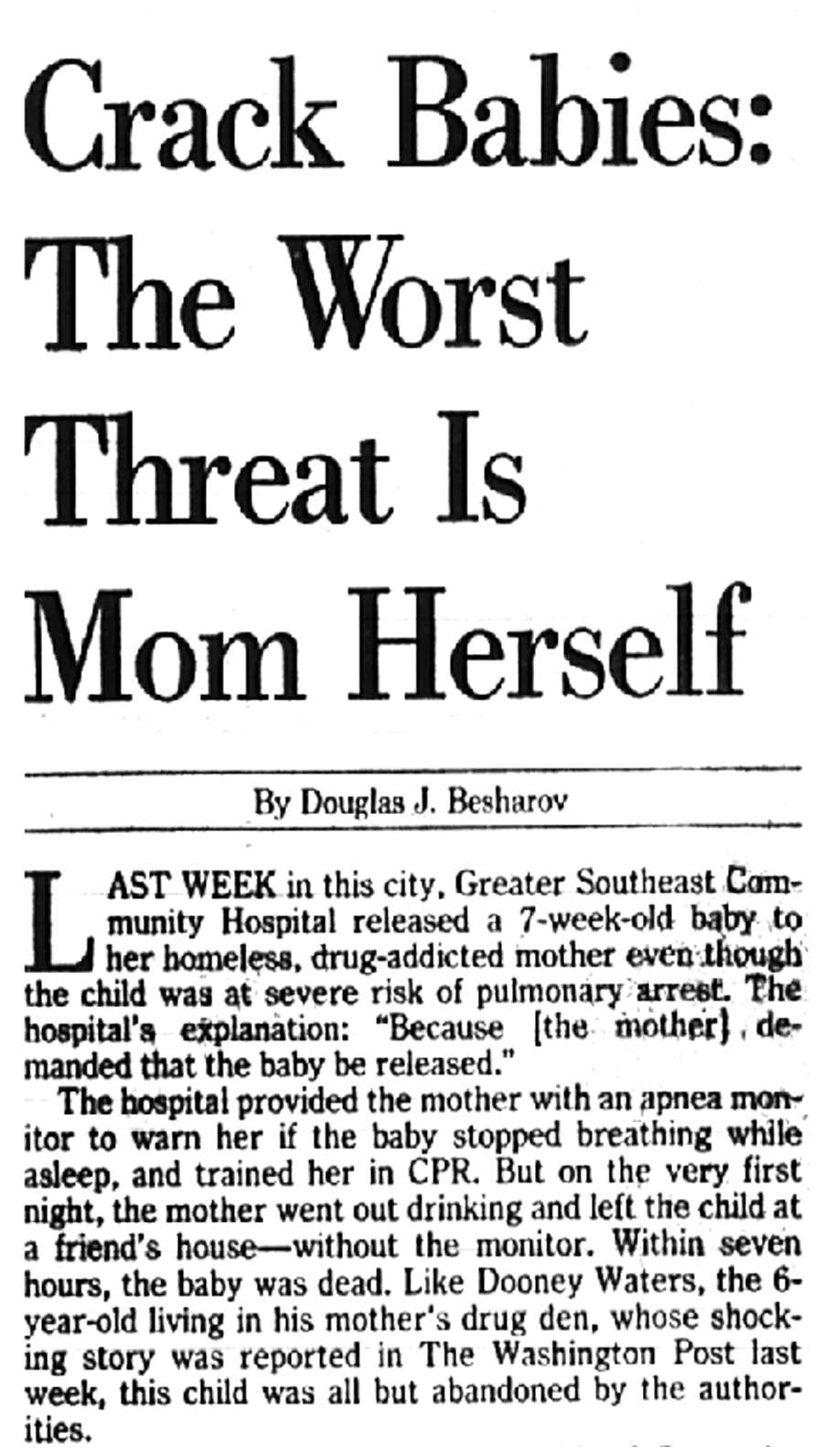
The Washington Post today revisits the “crack baby” scare of the late 1980s and 1990s and reports that “in the two decades that have passed since … these babies have grown into young adults who can tell their stories–and for the most part, they are tales of success.”

The Post notes that “a lot of misinformation surfaced” about the “crack baby” phenomenon, and cites an often-quoted column by Charles Krauthammer who in 1989 wrote:

Washington Post, August 1989

“Theirs will be a life of certain suffering, of probable deviance, of permanent inferiority.”

(Although the Post article doesn’t mention it, Krauthammer also wrote in that column: “The inner-city crack epidemic is now giving birth to the newest horror: a bio-underclass, a generation of physically damaged cocaine babies whose biological inferiority is stamped at birth.”)

Otherwise, the Post‘s report steered well clear of considering the news media’s central role in spreading “misinformation” about “crack babies,” a topic is explored in Getting It Wrong, my forthcoming book about media-driven myths.

The scare, I write, “was a media-driven myth based more on anecdote than solid, sustained research, a myth that had the effect of stigmatizing underprivileged children presumed to have been born damaged and despised as ‘crack babies.’”

I further note:

“To be sure, smoking crack during pregnancy is hardly risk-free, and certainly neither prudent nor sensible.”

However, I add, “the effects of prenatal cocaine exposure have proved more subtle than sweeping: Newborns exposed to crack during pregnancy tend to be smaller in birth weight, in length, and in head circumference. Some research suggested that mild cognitive deficiencies, such as difficulties in concentrating on tasks at hand, might be attributable to prenatal cocaine exposure, especially as cognitive demands on children intensify as they grow older.

“But biomedical research has found nothing akin to a ‘bio-underclass,’” that Krauthammer and others warned about some 20 years ago.

Revisiting the media-driven myth of the crack baby is important, I write in Getting It Wrong, because doing so “allows insights into a tendency among journalists to neglect or disregard the tentativeness that characterizes serious scientific and biomedical research, and to reach for certainty and definitiveness that are not often found in preliminary findings.

“The tendency of journalists to push hard on tentative data has been apparent in coverage of more recent drug scares, notably that of methamphetamine in 2004 and 2005.”

The Post‘s report today was the latest in what, in effect, has been an intermittent series in leading newspapers to revisit the “crack baby” scare and find it to have been exaggerated.

In a lengthy article published 15 months ago, the New York Times called the scare “the epidemic that wasn’t.” A columnist for the New York Daily News acknowledged in 2004 that “we probably overreacted with forecasts of harm to so-called ‘crack babies.’”

And more than 12 years ago, the Post carried a story similar to today’s. That article appeared on page Z10, beneath the headline: “‘Crack Baby’ Fears May Have Been Overstated.”

As I note in Getting It Wrong, “The news media’s retreat or rollback on crack babies was neither as extensive nor as prominent as the dramatic and ominous reports about the scourge in the late 1980s and early 1990s.”

I quote the alternative magazine, Mother Jones, which pointed out in 1995:

“The publicity blitz that spread the crack-baby myth has not been matched by an attempt to unmake the myth—and many, many people still believe in it.”

The term “crack babies” remains firmly in circulation; it is invoked casually and idiomatically, as something of a cliché.

WJC

Movies about journalists: Another list, another myth

In Cinematic treatments, Debunking, Furnish the war, Media myths, Newspapers, Washington Post, Watergate myth on April 17, 2010 at 6:31 pm

The blog True/Slant includes a ranking today of the 10 best-ever movies about journalism, and the Bogart film, Deadline U.S.A., tops the list.

This 10-best lineup was inspired by the series of newspapering movies running at Film Forum in Manhattan.

Absence of Malice (which I thought was dreadfully stereotypical), ranked second on the True/Slant list; The Paper was third, and All the President’s Men, the best-known movie about the Watergate scandal, was fourth.

Almost predictably, the description about All the President’s Men said:  “Robert Redford and Dustin Hoffman play Washington Post reporters Carl Bernstein and Bob Woodward, who reported the Watergate scandal and brought down a President. One of the few movies that makes journalism look like something worth doing.”

So there we are again–the hoary claim resurfaces that Nixon was “brought down” by the reporting of the intrepid Post reporters.

It’s what I call the heroic-journalist myth, and it’s addressed, and debunked, in Getting It Wrong, my forthcoming book about media-driven myths.

I note in the book, which is due out this summer, that heroic-journalist myth of Watergate is one of the most appealing and self-reverential stories in American media history.

It is striking indeed how routinely and even off-handedly Bernstein and Woodward are credited with the accomplishment, especially when the record of Watergate shows that the Post’s reporting had at best a marginal effect on forcing Nixon’s resignation in 1974.

Other forces and factors were far more decisive to the denouement of Watergate. As Howard Kurtz, the Post’s media reporter, has written:

“Despite the mythology, The Post didn’t force Richard Nixon from office—there were also two special prosecutors, a determined judge, bipartisan House and Senate committees, the belated honesty of [former White House lawyer] John Dean and those infamous White House tapes.”

Nixon’s White House tapes were crucial to the outcome. He resigned the presidency shortly after the Supreme Court ordered him to turn over the tapes subpoenaed by the Watergate special prosecutor.

One of the tapes undeniably showed Nixon participating in the coverup of the burglary at Democratic national headquarters, the signal crime of the Watergate scandal.

I also note in Getting It Wrong that motion pictures have a way of solidifying media-driven myths in the public’s consciousness.

“High-quality cinematic treatments,” I write, “are powerful agents of media myth-making, and can enhance a myth’s durability.”

And so what’s my top movie about newspapering? The 1941 Orson Welles masterpiece, Citizen Kane.

And that’s probably because I get such a laugh every time I watch the scene that paraphrases William Randolph Hearst‘s purported vow “to furnish the war” with Spain.

That may be the hardiest media myth of all.

A sleeper in my lineup of best movies about journalism is John Ford’s 1962 Western, The Man Who Shot Liberty Valence.

Why Liberty Valence?

Solely because of the movie’s greatest line, which is so applicable to media myth-making:

“This is the West, sir. When the legend becomes fact, print the legend.”

WJC

On bringing down Nixon

In Cinematic treatments, Debunking, Media myths, Newspapers, Washington Post, Watergate myth on April 12, 2010 at 4:07 pm

My guestpost the other day at the “Political Bookworm” blog–in which I reviewed three media-driven myths explored in my forthcoming book, Getting It Wrong–has attracted more than a few comments, including this particularly blinkered rhetorical question:

“Do you really know anyone who believes the Washington Post brought Nixon down?”

For starters, check Investor’s Business Daily.

On the day the guestpost and the blinkered comment appeared, Investor’s Business Daily said the New York Times, in its coverage of sexual abuses by Roman Catholic priests, was “seeking the biggest prey since Woodward and Bernstein brought down Richard Nixon.”

There you go: Brought down Nixon.

Gerald Ford became president on Nixon's resignation

The Investor’s Business Daily reference, of course, was to Bob Woodward and Carl Bernstein of the Washington Post whose investigative reporting in the Watergate scandal is often and inaccurately said to have toppled Richard Nixon’s corrupt presidency.

As I note in Getting It Wrong, the heroic-journalist meme of Watergate is one of the most hardy, persistent, and delicious myths in American media history.

Interestingly, it lives on despite periodic efforts by principals at the Washington Post to dismiss it. (“Political Bookworm” is a Washington Post blog, it should be noted.)

The newspaper’s media reporter, Howard Kurtz, wrote in 2005, for example:

“Despite the mythology, The Post didn’t force Richard Nixon from office—there were also two special prosecutors, a determined judge, bipartisan House and Senate committees, the belated honesty of [former White House lawyer] John Dean and those infamous White House tapes.”

Kurtz’s observations parallel those of Stanley I. Kutler, a leading historian of Watergate, who has written:

“The fact is, an incredible array of powerful actors all converged on Nixon at once—the FBI, prosecutors, congressional investigators, the judicial system.”

Amid this array of subpoena-wielding authorities investigating Watergate, the contributions of Woodward and Bernstein were modest–and certainly not decisive to the scandal’s outcome.

Still, the heroic-journalist myth is alive, well–and often invoked.

In large measure, that’s because the 1976 motion picture All the President’s Men–the leading movie about Watergate–depicted Woodward and Bernstein as essential to unraveling the scandal.

Indeed, this myth is a trope that knows few bounds.

WJC

In today’s ‘Outlook’ section

In Cronkite Moment, Debunking, Furnish the war, Media myths, Murrow-McCarthy myth, Newspapers, Washington Post, Watergate myth on April 11, 2010 at 12:13 pm

An abbreviated version of my recent guestpost at the “Political Bookworm” blog appeared today in the “Outlook” section of the Washington Post.

Here’s the text of the “Outlook” piece, with links that I’ve added:

W. Joseph Campbell, a professor of communication at American University, busts some media myths in his book, “Getting It Wrong: Ten of the Greatest Misreported Stories in American Journalism,” coming in July from the University of California Press. Here are three of Campbell’s biggies:

1. William Randolph Hearst’s purported vow, telegraphed to the artist Frederic Remington in Cuba, to “furnish the war” with Spain. Hearst denied making such a statement. The telegram containing his purported pledge has never turned up. The “furnish the war” anecdote can be traced to 1901 and a memoir by another journalist, James Creelman, who did not say when or how he learned the story about Hearst’s vow.

2. Edward R. Murrow brought an end to Sen. Joseph R. McCarthy’s communists-in-government witch hunt. This myth stems from Murrow’s CBS program “See It Now” on March 9, 1954, when the newsman dissected McCarthy’s crude investigative techniques and taste for the half-truth — none of which was unknown to American audiences at the time. The myth took hold even though years before the program aired, several prominent journalists — including Washington-based syndicated columnist Drew Pearson — had become searching critics of McCarthy and his tactics.

Nixon resigns, 1974

3. The Washington Post’s investigative reporting brought down Richard Nixon’s corrupt presidency. Katharine Graham, The Post’s publisher during the Watergate period, said in 1997: “Sometimes people accuse us of bringing down a president, which of course we didn’t do. The processes that caused [Nixon’s] resignation were constitutional.” She was right, but the complexities of Watergate are not readily recalled these days. What does stand out is a media-centric interpretation that the dogged reporting of Post journalists Bob Woodward and Carl Bernstein brought Nixon down.

WJC

‘War means profits’? It didn’t for Hearst’s papers

In 1897, Debunking, Furnish the war, Media myths, Newspapers, Spanish-American War, Yellow Journalism on April 3, 2010 at 9:05 am

William Randolph Hearst’s purported vow to “furnish the war” with Spain in the late 1890s may be the anecdote most often told in American journalism.

Hearst

It’s a woolly tale that’s been in circulation since 1901, and it lives on despite repeated and thorough debunking. It’s one of the ten media-driven myths examined in my forthcoming book, Getting It Wrong.

“Furnish the war” is so tenacious because it offers a tidy summary of the news media at their worst. And it’s a pithy quotation, easily digested and readily recalled.

The anecdote reemerged the other day, in a commentary posted at TheCitizen.com, an online news site of Fayette Publishing in Fayetteville, GA. The commentary stated:

“William Randolph Hearst in 1897 [told] the artist Frederic Remington: ‘You furnish the pictures and I’ll furnish the war.’ Think for a minute what that statement means. War means business, war means profits and war means death.”

Hearst’s purported message to Remington is almost certainly apocryphal–as is the notion that war meant profits for Hearst’s newspapers. In their intensive coverage of the four-month Spanish-American War of 1898, his papers lost money.

As I wrote in my 2001 book, Yellow Journalism: Puncturing the Myths, Defining the Legacies, the Spanish-American War generally boosted newspaper circulation. But advertising revenues fell, as advertisers feared the war would undercut the nascent recovery from the hard economic times of the 1890s.

In addition, newsprint costs soared, as did news-gathering expenditures.

The trade journal Fourth Estate estimated in 1899 that Hearst’s New York Journal had spent $50,000 a week—the equivalent these days of more than $1 million—on cable tolls, reporters’ salaries, and dispatch boats that ferried correspondents’ reports from the war’s principal theater in Cuba to Jamaica and elsewhere for transmission to New York.

Hearst's 'New York Evening Journal'

The Journal scoffed at claims that it helped foment the conflict in a cynical scheme to build circulation and boost profits.

“Would you like to know what effect the war had on the money-making feature of this particular newspaper? The wholesale price of paper was greatly increased. Advertising diminished, expenses increased enormously,” the Journal said, adding that its expenses related to covering the conflict exceeded $750,000—the equivalent these days of more than $20 million.

During the war, which lasted 114 days, the Journal‘s racy sister publication, the Evening Journal,  produced as many as forty extra editions a day–a late 19th century manifestation of what contemporary journalists would recognize as the unrelenting, 24-hour news cycle.

WJC

‘Pharm patries’ and the howler-correction of the month

In Debunking, Media myths, Newspapers on March 21, 2010 at 8:36 pm

The once-great Chicago Tribune offered up the howler-correction of the month the other day, saying this about a story it published nearly four months ago:

“In a Nov. 22 article about teenagers who abuse prescription drugs, a reference to ‘pharm parties‘ being a craze among teens did not sufficiently support that assertion.”

Huh?

That, no doubt, was the reaction of many people who read and puzzled over that correction: It befuddled more than it clarified.

Here’s what the Tribune said about “pharm parties” back in the fall:

“‘Pharm parties’ are a disturbing craze in which teens steal prescription medicine from home, take the pills to a gathering, and dump the load into a bowl. The partygoers then pop the pills and wait for a reaction.”

The “pharm party” meme is a media-driven myth, one of remarkable tenacity. The myth’s most energetic debunker, Jack Shafer of slate.com, has traced the meme to 1966, when, he says, “pharm parties” were known as “fruit salad parties.”

“There are at least two basic problems with the pharm-party scenario reported in the press,” Shafer has written.

“To begin with, if you were a young drug fiend and stole potent drugs, why would you deposit them in a communal bowl if there was a good chance that when your turn came to draw a drug at random, you might get an antihistamine? And second, I’ve yet to read a story in which a journalist actually attends such a gathering, interviews a participant, or cites a police report alleging such behavior.”

More recently, Shafer deliciously excoriated the San Francisco Chronicle for its front-page report a week ago about “pharm parties,” which declared–on the basis of few if any statistics–that  “the phenomenon is getting worse.”

The headline over Shafer’s column described the Chronicle account as “the worst ‘pharm party’ story ever.”

He pointed out:

“To my knowledge, no journalist has ever witnessed such random consumption of drugs by young people in a party setting, yet the story continues to get major play as if these affairs are common.”

So why has the “pharm party” myth demonstrated such tenacty? Why does it seem to defy the most thorough of debunkings?

An important factor, no doubt, is stereotyping–a ready willingness to believe that teens readily indulge in mindlessly dangerous conduct.

To that end, a graduate student of mine recently called attention to passage in 1988 film Heathers in which the protagonist, J.D., says:

“Your society nods its head at any horror the American teenager can think to bring upon itself.”

Like many media-driven myths–including those addressed and debunked in my forthcoming book Getting It Wrong–the “pharm party” meme is a delicious tale. Like the dubious story about William Randolph Hearst’s vowing to “furnish the war” with Spain, it’s just too good not to be true.

Or retold.

(Hearst’s famous vow has achieved status as an all-purpose anecdote, one useful in illustrating any number of media sins and shortcomings. It has been invoked to illustrate the media’s willingness to compromise impartiality, promote political agendas, and indulge in sensationalism. It has been used, more broadly, to suggest the media’s capacity to inject malign influence into international affairs.)

So what to do about these nasty and persistent media myths?

I believe that pounding away at them–directing attention to them whenever they arise– is the only effective way to address them and thus begin to alter the narrative.

The Tribune‘s correction suggests that Shafer’s debunking is having an effect.

The Annenberg Public Policy Center, moreover, has demonstrated that some myths can be curbed or contained. Over the past 10 years, Phildelphia-based Annenberg Center has endeavored to debunk the notion that suicides rise during the year-end holidays.

They don’t.

The Annenberg Center hasn’t buried this media myth. But to its credit, it has begun to tame it.

WJC