W. Joseph Campbell

Archive for the ‘Newspapers’ Category

Media myths of Watergate, ’60 debate circulate as campaign enters closing days

In Debate myth, Debunking, Error, Media myths, Media myths and radio, Newspapers, Watergate myth on November 4, 2016 at 9:45 pm
'Nixon did in Nixon'

Nixon’s resignation: Not the media’s doing

Coinciding with the closing days of this year’s wretched election campaign has been the appearance of prominent media myths about the Watergate scandal and the first televised debate in 1960 between major party presidential candidates John F. Kennedy and Richard Nixon.

The myths, respectively, have it that the dogged reporting by Washington Post reporters Bob Woodward and Carl Bernstein uncovered the crimes that brought down Nixon’s presidency in 1974, and that television viewers and radio listeners reached sharply different conclusions about the debate outcome, signaling that image trumps substance.

Both myths have become well-entrenched dominant narratives over the years and they tend to be blithely invoked by contemporary journalists.

Take, for example, the lead paragraph of an Atlantic article posted a couple of days ago; it flatly declared:

“The Watergate Scandal was a high point of American journalism. Two dedicated young reporters from The Washington Post, Bob Woodward and Carl Bernstein, brought down President Richard Nixon for his role in the coverup of the 1972 attempted break in of the Democratic Party headquarters by Republican operatives.”

In an otherwise thoughtful analysis posted today about the new media’s failings in this year presidential campaign, David Zurawik of the Baltimore Sun invoked the Watergate myth, stating:

“And how was Nixon forced to resign if not through the old-school, legacy standards of dogged investigative journalism?”

Zurawik referred to Bernstein as “[o]ne of the journalistic elders who brought Nixon down.”
screen-shot-2016-09-23-at-3-53-56-pmAs I discuss in my media-mythbusting book, Getting It Wrong — a second edition of which recently was published — the Washington Post was at best a marginal contributor to Nixon’s fall.

Unraveling a scandal of Watergate’s dimensions, I write in Getting It Wrong, “required the collective if not always the coordinated forces of special prosecutors, federal judges, both houses of Congress, the Supreme Court, as well as the Justice Department and the FBI.

“Even then,” I add, “Nixon likely would have served out his term if not for the audiotape recordings he secretly made of most conversations in the Oval Office of the White House. Only when compelled by the Supreme Court did Nixon surrender those recordings, which captured him plotting the cover-up” of the burglary of Democratic National Committee headquarters in June 1972, the seminal crime of Watergate.

Most senior figures at the Post during the Watergate period — including Woodward, Executive Editor Ben Bradlee, and Publisher Katharine Graham — scoffed at claims the newspaper’s reporting toppled Nixon.

Woodward, for example, told American Journalism Review in 2004:

“To say the press brought down Nixon, that’s horse shit.”

The myth about the 1960 debate was invoked almost casually in a column the other day in Raleigh’s News & Observer newspaper. The writer asserted:

“The televised debates were said to give the nod to the telegenic Kennedy, while radio listeners believed Nixon the victor.”

But as I point out in the new edition of Getting It Wrong, the notion of viewer-listener disagreement is “a dubious bit of political lore”  often cited as presumptive “evidence of the power of television images and the triumph of image over substance.”

The myth of viewer-listener disagreement, I also point out, “was utterly demolished” nearly 30 years ago in a scholarly journal article by David L. Vancil and Sue D. Pendell.

Vancil and Pendell, writing in Central States Speech Journal, reviewed and dissected the few published surveys that hinted at a viewer-listener disconnect in the Kennedy-Nixon debate of September 26, 1960.

Central to the claim that radio audiences believed Nixon won the debate was a survey conducted by Sindlinger & Company. The Sindlinger survey indicated that radio listeners thought Nixon had prevailed in the debate, by a margin of 2-to-1.

Vancil and Pendell pointed out that the Sindlinger survey included more than 2,100 respondents — just 282 of whom said they had listened on radio. Of that number, 178 (or fewer than four people per state) “expressed an opinion on the debate winner,” they wrote. The sub-sample was decidedly too small few and unrepresentative to permit meaningful generalizations or conclusions, Vancil and Pendell noted.

Not only was it unrepresentative, the sub-sample failed to identify from where the radio listeners were drawn. “A location bias in the radio sample,” Vancil and Pendell wrote, “could have caused dramatic effects on the selection of a debate winner. A rural bias, quite possible because of the relatively limited access of rural areas to television in 1960, would have favored Nixon.”

Those and other defects render the Sindlinger survey meaningless in offering insights to reactions of radio listeners.

In the second edition of Getting It Wrong, I seek to build upon the work of Vancil and Pendell, offering contemporaneous evidence from a detailed review of debate-related content in three dozen large-city U.S. daily newspapers. Examining the news reports and commentaries published in those newspapers in the debate’s immediate aftermath turned up no evidence to support the notion of viewer-listener disagreement, I write, adding:

“None of the scores of newspaper articles, editorials, and commentaries [examined] made specific reference” to the supposed phenomenon of viewer-listener disagreement. “Leading American newspapers in late September 1960 spoke of nothing that suggested or intimated pervasive differences in how television viewers and radio listeners reacted to the landmark debate.”

And they were well-positioned to have done so, given the keen interest in, and close reporting about, the first debate between major party candidates.

WJC

More from Media Myth Alert:

‘Scorched by American napalm’: The media myth of ‘Napalm Girl’ endures

In Debunking, Error, Media myths, Newspapers, Photographs on August 22, 2016 at 7:33 am

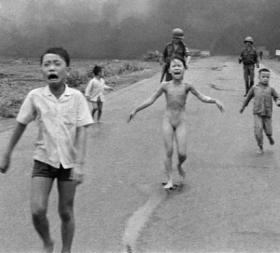
One of the most memorable photographs of the Vietnam War was “The Terror of War,” better known as “Napalm Girl.”

The image showed a cluster of terrified Vietnamese children fleeing an errant bombing raid near their village, Trang Bang. At the center of the photograph was a naked, 9-year-old girl named Kim Phuc who was badly burned in the napalm attack.

'Napalm girl,' 1972 (Nick Ut/AP)

‘Napalm Girl,’ 1972 (Nick Ut/AP)

The photograph was taken June 8, 1972, by an Associated Press photographer, Nick Ut. The photograph won a Pulitzer Prize in 1973 and much acclaim in the years since then.

It also has given rise to enduring media myths — notably that Ut’s photograph showed the effects of a U.S. bombing raid at Trang Bang, northwest of Saigon, the South Vietnamese capital now known as Ho Chi Minh City.

That myth of the “Napalm Girl” was invoked yesterday in a 900-word profile of Ut in the Los Angeles Times. The article referred in its opening paragraph to Kim Phuc, saying she had been “scorched by American napalm.”

In fact, the aerial napalm attack was carried out by the South Vietnamese Air Force, as news reports at the time made clear.

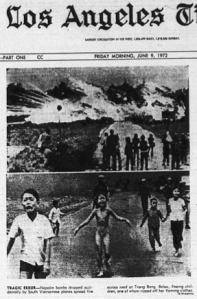
The Los Angeles Times prominently displayed the photograph on its front page of June 9, 1972 (see right), and stated in its caption that the napalm had been “dropped accidentally by South Vietnamese planes.”Screen Shot 2016-08-21 at 9.39.27 AM

The New York Times reported on June 9, 1972, that “a South Vietnamese plane mistakenly dropped flaming napalm right on his troops and a cluster of civilians.” The Chicago Tribune told of “napalm dropped by a Vietnamese air force Skyraider [warplane] diving onto the wrong target.”

Christopher Wain of Britain ITN television network wrote in a dispatch from Trang Bang for the United Press International news service:

“These were South Vietnamese planes dropping napalm on South Vietnamese peasants and troops.”

The myth of American culpability in the attack at Trang Bang has been invoked often over the years. Early this month, for example, a columnist for USAToday referred to Ut’s photograph and said it showed “a naked nine-year-old Vietnamese girl fleeing her village after U.S. forces bombed it with napalm….”

The making of the myth can be traced to the hapless campaign in 1972 of George McGovern, the Democratic nominee for president.

In a televised speech in October 1972, McGovern invoked the image of “the little South Vietnamese girl, Kim, fleeing in terror” and “running naked into the lens of that camera.

“That picture ought to break the heart of every American,” McGovern said. “How can we rest with the grim knowledge that the burning napalm that splashed over little Kim and countless thousands of other children was dropped in the name of America?”

How he determined that Kim Phuc was representative of “countless thousands of other children” sprayed by napalm, McGovern did not say.

But his claim that the napalm had been “dropped in the name of America” insinuated U.S. responsibility for the errant attack — which misstated what had happened at Trang Bang. The aerial attack was carried out by South Vietnamese forces to roust communist troops from bunkers at the outskirts of the village.

The fighting there was an all-Vietnamese encounter.

WJC

More from Media Myth Alert:

The campaign pledge Nixon never made

In Debunking, Error, Media myths, Newspapers, Quotes on July 10, 2016 at 9:31 am

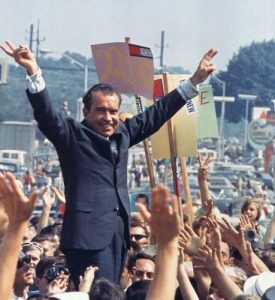
When it comes to cynical campaign pledges, few top Richard Nixon’s assertion that he had a “secret plan” to end the Vietnam War, a plan he wouldn’t reveal while running for president in 1968.

Nixon 1968

What ‘secret plan’?

It’s a great story, quintessentially Nixon in its deceit and duplicity.

But it’s a claim Nixon never made.

Like many other media-driven myths, it’s a tale almost too good, and too delicious, to resist. (William Safire, a former Nixon speechwriter and columnist for the New York Times, periodically called attention to the “secret plan” myth, once observing: “Like the urban myth of crocodiles in the sewers, the [Nixon] non-quotation never seems to go away ….”)

Most recently, the bogus anecdote found its way into a USA Today article about campaign promises presidential candidates failed to keep.

The article, which was re-posted yesterday at the Web site of a New Orleans television station, declared, flatly:

“Richard Nixon, campaigning in 1968, claimed he had a ‘secret plan’ to end the Vietnam War.”

No source or citation was offered.

Nixon never touted a “secret plan” to end the war. In fact, he pointedly and publicly disavowed such a notion. In an article published March 28, 1968, in the Los Angeles Times, Nixon was quoted as saying he had “no gimmicks or secret plans” for Vietnam.

“If I had any way to end the war,” he was further quoted as saying, “I would pass it on to President [Lyndon] Johnson.” (Nixon’s remarks were made just a few days before Johnson announced he would not seek reelection.)

Nixon may or may not have had a “secret plan” in mind in 1968. But he did not make such a claim a feature of his campaign that year. That much is clear in reviewing the search results of a full-text database of leading U.S. newspapers in 1968, including the New York Times, Los Angeles Times, Baltimore Sun, Wall Street Journal, Washington Post, and Chicago Tribune.

The search terms “Nixon” and “secret plan” returned no articles during the period from January 1, 1967, to January 1, 1969, in which Nixon was quoted as saying he had a “secret plan” for Vietnam. (The search period included the months of Nixon’s presidential campaign and its aftermath.)

If Nixon had claimed during the 1968 campaign to possess a “secret plan” for Vietnam, the country’s leading newspapers surely would have publicized it.

It is clear that Nixon’s  foes tried to foist the “secret plan” calumny on him. For example, supporters of Democratic presidential candidate Hubert H. Humphrey took out a display advertisement in the New York Times on October 23, 1968; the ad included this statement: “Last March he said he had a secret plan to end the war.”

The ad included no reference to exactly when or where Nixon had made such a statement. And it carried the headline, “Trust Humphrey.”

The derivation of the “secret plan” anecdote can be traced to March 5, 1968, and a speech in Hampton, New Hampshire, in which Nixon declared that “new leadership” in Washington — a Nixon administration, in other words — would “end the war” in Vietnam.

The wire service United Press International, in reporting on Nixon’s remarks, pointed out that the candidate “did not spell out how” he would “end the war.” The UPI dispatch also said “Nixon’s promise recalled Dwight D. Eisenhower’s pledge in 1952, when Nixon was his running mate, to end the war in Korea.” Eisenhower was elected president that year.

The New York Times account of Nixon’s speech, published March 6, 1968, quoted him as saying he “could promise ‘no push-button technique’ to end the war. Nixon also said he was not suggesting ‘withdrawal’ from Vietnam.” A brief, follow-on report published in the Times that day quoted Nixon as saying he envisioned applying military pressure as well as diplomatic efforts in ending the war.

But Nixon wasn’t inclined to say much specifically about Vietnam. Michael A. Cohen writes in American Maelstrom, a recently published book about political upheaval in America in 1968:

“Nixon knew he had little to gain by talking about Vietnam. Doing so would give his opponents the ammunition with which to attack him; not doing so allowed potential supporters to believe whatever they wanted about his intentions. And if elected president he would enter office with no embarrassing campaign pronouncements to explain away.”

WJC

More from Media Myth Alert:

Smug MSNBC guest invokes Nixon’s mythical ‘secret plan’ on Vietnam

In Debunking, Error, Media myths, New York Times, Newspapers, Quotes on May 3, 2016 at 9:10 pm

Assailing Donald Trump’s foreign policy credentials, and his recent speech on the topic, is hardly a demanding task. The blustery frontrunner for the Republican presidential nomination exhibits little more than shallow familiarity with national security issues.

MSNBC logoBut Trump’s superficiality hasn’t stopped critics from overreaching as they lambaste him on foreign policy — overreaching to the point of summoning the media myth about Richard Nixon’s “secret plan” to end the war in Vietnam. Activist Phyllis Bennis did just that the other day in an appearance on the MSNBC primetime program, The Last Word with Lawrence O’Donnell.

In his speech last week, Trump vowed to eradicate ISIS, the radical Islamic State, early in his presidency, but didn’t explain how that would be accomplished. With unconcealed smugness, Bennis declared that Trump’s reference to ISIS “was very reminiscent of Nixon’s call when he was running for president [in 1968] and said, ‘I have a secret plan to end the war.’ The secret plan of course turned out to be escalation.”

Her remark about Nixon’s “secret plan” gained fresh circulation yesterday in a post at a Huffington Post politics blog.

But it’s a claim Nixon never made. And he didn’t campaign for the presidency touting a “secret plan” on Vietnam.

That he did not is made clear in the search results of a full-text database of leading U.S. newspapers in 1968, including the New York Times, Los Angeles Times, Baltimore Sun, Wall Street Journal, Washington Post, and Chicago Tribune. The search terms “Nixon” and “secret plan” returned no articles during the period from January 1, 1967, to January 1, 1969, in which Nixon was quoted as saying he had a “secret plan” for Vietnam. (The search period included all of Nixon’s presidential campaign and its immediate aftermath.)

Surely, had Nixon campaigned on a “secret plan” in 1968, as Bennis so blithely asserted, the country’s leading newspapers would have publicized it.

Nixon did confront the notion he had a “secret plan” for Vietnam. In an article published March 28, 1968, in the Los Angeles Times, he was quoted as saying he had “no gimmicks or secret plans” for Vietnam.

Nixon also said:

“If I had any way to end the war, I would pass it on to President [Lyndon] Johnson.” (Nixon’s remarks were made just a few days before Johnson announced he would not seek reelection.)

Nixon may or may not have had a “secret plan” in mind in 1968. But he did not make such a claim a feature of his campaign that year. (William Safire, a former Nixon speechwriter and columnist for the New York Times, periodically called attention to the “secret plan” myth, once observing: “Like the urban myth of crocodiles in the sewers, the non-quotation never seems to go away ….”)

Nixon’s  foes, however, tried to pin the “secret plan” calumny on him. Supporters of Democratic presidential candidate Hubert H. Humphrey, for example, took out a display advertisement in the New York Times on October 23, 1968; the ad included this statement: “Last March he said he had a secret plan to end the war.”

The ad included no reference to exactly when or where Nixon had made such a statement. And it carried the headline, “Trust Humphrey.”

The derivation of the “secret plan” tale can be traced to March 5, 1968 and a speech in Hampton, New Hampshire, in which Nixon said “new leadership” in Washington — a Nixon administration, in other words — would “end the war” in Vietnam.

The wire service United Press International noted in reporting Nixon’s vague remarks  that the candidate “did not spell out how” he would “end the war.” The UPI dispatch also said “Nixon’s promise recalled Dwight D. Eisenhower’s pledge in 1952, when Nixon was his running mate, to end the war in Korea.” Eisenhower was elected president that year.

The New York Times account of Nixon’s speech, published March 6, 1968, quoted the former vice president as saying he “could promise ‘no push-button technique’ to end the war. Nixon said he was not suggesting ‘withdrawal’ from Vietnam.” A brief, follow-on report that day in the Times quoted Nixon as saying he envisioned applying military pressure as well as diplomatic efforts in ending the war.

Nixon may have been vague during the 1968 campaign in describing his ideas about Vietnam. But clearly he wasn’t touting, proclaiming, or otherwise running on a “secret plan.”

WJC

NYTimes invokes Watergate myth in writeup about journalists and movies

In Anniversaries, Cinematic treatments, Debunking, Error, Media myths, New York Times, Newspapers, Scandal, Washington Post, Watergate myth on January 3, 2016 at 2:03 pm

There’s no doubt Hollywood is an important reason why Watergate’s dominant narrative has it that Bob Woodward, Carl Bernstein, and the Washington Post toppled Richard Nixon’s corrupt presidency.

Not the Post's doing

Not the Post’s doing

It is a heroic narrative that found mention today’s New York Times, in an article discussing two movies about journalists that could be contenders this year for Academy Awards.

One of them is Truth, a perversely titled film that celebrates former CBS News anchor Dan Rather and producer Marla Mapes who in 2004 used bogus documents to claim President George W. Bush dodged wartime service in Vietnam. No way does that movie deserve Oscar consideration. The other contender-film is titled Spotlight.

But what most interests Media Myth Alert is the Times article’s blithe and mistaken reference to “the investigation by Bob Woodward and Carl Bernstein that led to Richard M. Nixon’s resignation.”

Woodward and Bernstein’s Watergate reporting for the Post had no such effect, however much the cinematic version of their book, All the President’s Men, encouraged that notion. As I noted in my 2010 book, Getting It Wrong, the movie promotes an “unmistakable assertion of the power and centrality of the press in Nixon’s fall.

All the President’s Men allows no other interpretation: It was the work Woodward and Bernstein that set in motion far-reaching effects that brought about the first-ever resignation of a U.S. president. And it is a message that has endured.”

Indeed, this year marks the 40th anniversary of the movie’s release and the notion that Woodward and Bernstein toppled Nixon remains the principal way Watergate is understood, a version that disregards and diminishes the far more accurate interpretation of what led to Nixon’s fall in August 1974.

To roll up a scandal of Watergate’s dimensions, I wrote in Getting It Wrong, “required the collective if not always the coordinated forces of special prosecutors, federal judges, both houses of Congress, the Supreme Court, as well as the Justice Department and the FBI.

“Even then, Nixon likely would have served out his term if not for the audiotape recordings he secretly made of most conversations in the Oval Office of the White House. Only when compelled by the Supreme Court did Nixon surrender those recordings, which captured him plotting the cover-up” of the burglary in June 1972 that was Watergate’s seminal crime.

Principals at the Post have, over the years, rejected the simplistic notion that the newspaper’s reporting led Nixon to resign.

Katharine Graham, the Post’s publisher during Watergate, said in 1997, for example:

“Sometimes people accuse us of bringing down a president, which of course we didn’t do. The processes that caused [Nixon’s] resignation were constitutional.”

In 2005, Michael Getler, then the Post’s ombudsman, or in-house critic, wrote:

“Ultimately, it was not The Post, but the FBI, a Congress acting in bipartisan fashion and the courts that brought down the Nixon administration. They saw Watergate and the attempt to cover it up as a vast abuse of power and attempted corruption of U.S. institutions.”

Not even Woodward has embraced the heroic-journalist myth. He once told an interviewer for American Journalism Review:

To say the press brought down Nixon, that’s horse shit.”

And in an interview with the PBS “Frontline” program, Woodward said “the mythologizing of our role in Watergate has gone to the point of absurdity, where journalists write … that I, single-handedly, brought down Richard Nixon. Totally absurd.”

Today’s article wasn’t the first time the Times has turned to the mythical claim about the Post’s Watergate reporting.

In a cover article in 2014, the Times Sunday magazine mentioned Woodward and Bernstein, saying they “actually managed to take down a mendacious American president, and in doing so they came to symbolize the hope and heroism of a new generation.”

And in 2008,in an article about Woodward’s finally introducing his high-level Watergate source to Bernstein, the Times referred to the “two young Washington Post reporters [who] cracked the Watergate scandal and brought down President Richard M. Nixon.”

WJC

More from Media Myth Alert:

WaPo move to new quarters stirs retelling of hero-journalist myth

In Debunking, Error, Media myths, Newspapers, Scandal, Washington Post, Watergate myth on December 14, 2015 at 10:34 am

Sometimes it doesn’t take much to stir up a media myth.

Consider, for example, the recent move of the Washington Post to new quarters in the capital — a move the newspaper reported on to absurd excess.

Leaving prompts myth-telling

Leaving this mythical place

The Guardian newspaper of London took up the development today in a report online, posted beneath the headline: “Washington Post bids farewell to office where it broke Watergate.”

The Guardian described the Post’s former home on 15th Street NW as the place “where Woodward and Bernstein exposed the Watergate scandal and brought down president Richard Nixon.” It’s almost as if any excuse will do to trot out the bromide that the Bob Woodward and Carl Bernstein, through their dogged reporting for the Post, exposed the crimes of Watergate and forced Nixon’s resignation in 1974.

Untenable though it is, the heroic-journalist trope has become the dominant narrative of Watergate — an engaging but simplified account of the country’s gravest political crisis that not even principals at the Post have embraced.

Woodward, for example, once told an interviewer for American Journalism Review:

To say the press brought down Nixon, that’s horseshit.”

On another occasion, Woodward declared that “the mythologizing of our role in Watergate has gone to the point of absurdity, where journalists write … that I, single-handedly, brought down Richard Nixon. Totally absurd.”

And Katharine Graham, the Post’s publisher during Watergate, said in 1997: “Sometimes people accuse us of bringing down a president, which of course we didn’t do. The processes that caused [Nixon’s] resignation were constitutional.”

True enough. So why does the myth persist? What explains its tenacity in the face of denial, repudiation, and debunking?

An important explanation is that the epic scandal has become so distant that few Americans can accurately describe what took place.

The heroic-journalist interpretation makes Watergate accessible.

As I discussed in my media-mythbusting book, Getting It Wrong, that explanation strips away the scandal’s daunting complexity, does away with the intricate investigations that slowly exposed high-level misconduct, leaving the Post, Woodward, and Bernstein as celebrated stand-ins “for understanding Watergate and its denouement.”

It’s a trope that reassures journalists, too, reminding them in these unsettled times that the work of their predecessors supposedly had significant and memorable consequences. As the inimitable media critic Jack Shafer wrote the other day, journalists are “sentimental creatures who draw on the past to self-mythologize.”

To indulge in the heroic-journalist trope is to indulge in dubious history. As I noted in Getting It Wrong, “to explain Watergate through the lens of the heroic-journalist is to abridge and misunderstand the scandal and to indulge in a particularly beguiling media-driven myth. The heroic-journalist interpretation minimizes the far more decisive forces that unraveled the scandal and forced Nixon from office.”

Rolling up a scandal of the dimensions of Watergate, I wrote, “required the collective if not always the coordinated forces of special prosecutors, federal judges, both houses of Congress, the Supreme Court, as well as the Justice Department and the FBI.

“Even then, Nixon likely would have served out his term if not for the audiotape recordings he secretly made of most conversations in the Oval Office of the White House. Only when compelled by the Supreme Court did Nixon surrender those recordings, which captured him plotting the cover-up” of Watergate’s signal crime — the break-in at the headquarters of the Democratic National Committee in June 1972.

Guardian was not alone in recalling the heroic-journalist myth as the Post staff decamped a short distance to an address on K Street NW.

In a dispatch last week, the French new agency, Agence France-Presse, described the Post’s erstwhile home as “the scene of groundbreaking reporting on the Watergate scandal by young reporters Bob Woodward and Carl Bernstein, leading to the resignation of President Richard Nixon in 1974.”

The Post’s reporting, in fact, was quite marginal to Wategate’s outcome.

WJC

More from Media Myth Alert:

The mythical ‘panic broadcast’: Tired cliché of Halloween

In Debunking, Error, Media myths, Media myths and radio, Newspapers, War of the Worlds on October 30, 2015 at 9:16 am
Welles_monument

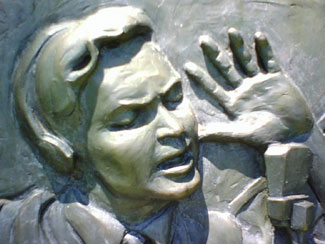
Welles and The War of the Worlds

The days around Halloween can be among the most myth-indulgent of the year, given the many media reminders about The War of the Worlds radio dramatization that aired 77 years ago tonight.

The hour-long show, which aired on CBS radio and starred 23-year-old Orson Welles, was so vivid in telling of the invasion of Earth by Martians wielding deadly heat rays that tens of thousands of Americans supposedly were convulsed in panic and mass hysteria.

Or as the Indianapolis Star put it the other day, “Pandemonium swept the nation that evening” in 1938.

Or as the Louisville Courier-Journal said about the program, “unsuspecting listeners reacted in horror while listening to descriptions of a devastating landing of ‘ferocious Martian invaders.'”

And so it goes: Late October brings predictable references to the “panic broadcast” of 1938 and to the upheaval it supposedly caused. It’s so predictable as to have become a cliché.

That the program set off widespread panic and mass hysteria also is a hoary media myth, a myth that offers deceptive messages about the influence radio wielded over listeners decades ago and about the media’s capacity to sow terror and alarm. There is scant evidence that The War of the Worlds had such effects: Whatever fright there was that night 77 years ago did not reach nationwide proportions.

As I discuss in my media-mythbusting book, Getting It Wrong, had panic spread across America during The War of the Worlds broadcast, the resulting trauma and turmoil surely would have resulted in deaths, including suicides, and in serious injuries.

But nothing of the sort — no deaths, no suicides, no serious injuries — were conclusively linked to the show.

Moreover, newspapers in 1938 would have devoted extensive coverage to the consequences of the extraordinary phenomenon of nationwide panic and mass hysteria — had it occurred. But after an initial burst of misleading and highly exaggerated reporting about the show’s supposed panic-inducing effects, large-city U.S. newspapers quickly dropped The War of the Worlds story.

What, then, accounts for the enduring fascination with a long ago radio show, the effects of which have been routinely hyped and overblown?

It is, for starters, famous, or infamous, for what it suggests about the presumptive dark power of mass media.

It is, moreover, a deliciously clever story, one well-suited for retelling at Halloween.

Indeed, the show is often rebroadcast, or re-enacted, this time of year — which serves to reintroduce and celebrate the performance, keeping it fresh in the popular consciousness.

The “panic broadcast” also lives on because it allows contemporary media consumers to indulge, if quietly and privately, in a bit of smugness — that we would never be so gullible as to believe such a media hoax; we are too media-savvy. But back then, in the 1930s when radio was still new, they weren’t so sophisticated: They were more naïve, more easily duped by exaggerated media messages.

This is known as the third-person effect, the belief that others are more credulous, or more susceptible to media influences, than we are.

Such smugness has helped keep alive the tired Halloween cliché of The War of the Worlds.

WJC

More from Media Myth Alert:

Jorge Ramos, media myth-teller

In Debunking, Error, Media myths, Newspapers, Scandal, Washington Post, Watergate myth on September 5, 2015 at 12:30 pm

Jorge Ramos, the Univision anchorman, demonstrated recently that he is a self-important showboat in disrupting a news conference convened by presidential candidate Donald Trump.

Ramos also has demonstrated a taste for media myth.

In a commentary posted yesterday at the online site of AM, a newspaper in Mexico, Ramos invoked the myth that the Washington Post brought down the corrupt presidency of Richard Nixon in its reporting of the Watergate scandal.

He wrote, according to the Google translation from Spanish, that among “the best examples of journalism” was the Washington Post’s “forcing Nixon to resign” in 1974.

Ramos made a similar claim on the ABC News “This Week” program Sunday, stating:

“I think that, as a reporter, many times, you have to take a stand. … And the best examples of journalism that I have — Edward R. Murrow against McCarthy; Cronkite during the Vietnam War, or the Washington Post reporters forcing the resignation of Richard Nixon — that’s when reporters challenge those who are in power.”

Of course, though, the Post did not force Nixon’s resignation.

Not even principals at the Post during the Watergate period embraced that notion.

For example, the Post’s publisher during Watergate, Katharine Graham, said 1997:

“Sometimes people accuse us of bringing down a president, which of course we didn’t do. The processes that caused [Nixon’s] resignation were constitutional.”

Bob Woodward, one of the Post’s lead Watergate reporters, concurred, albeit in earthier terms. He told an interviewer in 2006:

To say the press brought down Nixon, that’s horseshit.”

And Ben Bradlee, the Post’s executive editor during Watergate, said on “Meet the Press” in 1997 that “it must be remembered that Nixon got Nixon. The Post didn’t get Nixon.”

Bradlee was referring to the White House audio tapes which Nixon secretly made and which revealed the president’s guilty role in seeking to thwart the FBI’s investigation into the break-in of Democratic National Committee headquarters in Washington in June 1972. The break-in touched off the scandal — and the country’s gravest political crisis of the 20th century.

As I discussed in my media-mythbusting book, Getting It Wrong:

“How the Post and its reporters uncovered Watergate is deeply ingrained in American journalism as one of the field’s most important and self-reverential stories.”

But it is a simplistic and decidedly misleading interpretation, one that minimizes the more powerful and decisive forces that unraveled the scandal and ended Nixon’s corrupt presidency.

“To roll up a scandal of” the dimensions of Watergate, I wrote in Getting It Wrong, “required the collective if not always the coordinated forces of special prosecutors, federal judges, both houses of Congress, the Supreme Court, as well as the Justice Department and the FBI.

“Even then, Nixon likely would have served out his term if not for the audiotape recordings he secretly made of most conversations in the Oval Office of the White House.”

Only when compelled by the Supreme Court did Nixon surrender those recordings — effectively ending his presidency.

WJC

More from Media Myth Alert:

WSJ columnist, trying to explain Trump, trips over Cronkite-Johnson myth

In Cronkite Moment, Debunking, Error, Media myths, New York Times, Newspapers, Quotes, Television on August 30, 2015 at 1:34 pm

Peggy Noonan, the prominent weekend columnist for the Wall Street Journal, attempts in her latest commentary to explain the political phenomenon that is Donald Trump — and in doing so trips over the mythical “Cronkite Moment” of 1968.

Peggy Noonan

Noonan (Harvard University)

That was when CBS News anchorman Walter Cronkite declared on the air that the U.S. military effort in Vietnam was “mired in stalemate.” Cronkite’s assessment supposedly came as an epiphany to President Lyndon B. Johnson, who in visceral reaction said something to the effect of:

“If I’ve lost Cronkite, I’ve lost Middle America.”

But as I discussed in my media-mythbusting book, Getting It Wrong, Johnson did not see Cronkite’s program when it aired on February 27, 1968; he was at a black-tie birthday party in Texas for Governor John Connally. Nor is there evidence the president watched Cronkite’s report on videotape at some later date.

So it’s hard to imagine how the president could have been much moved by a TV program he did not see.

I further noted in Getting It Wrong that by 1968, “stalemate” was hardly a novel or shocking way to characterize the Vietnam War.

“Stalemate” had circulated in the news media months before Cronkite’s report. For example, the New York Times published a front-page analysis on August 7, 1967, that declared “the war is not going well. Victory is not close at hand.”

The Times report was published on its front page beneath the headline:

Vietnam: The Signs of Stalemate.

Which takes us to Noonan, formerly a speechwriter for President Ronald Reagan. She opens her column this weekend by writing: “So, more thoughts on Donald Trump’s candidacy, because I can’t stop being fascinated.”

The Trump phenomenon, she argues, signals that “[s]omething is going on, some tectonic plates are moving in interesting ways” in American political life.

She also invokes Trump’s recent news conference confrontation with Jorge Ramos, the showboating anchorman for Univision. At the news conference, he refused to wait his turn in posing a question and was escorted from the room. Ramos was allowed back in a short time later.

Noonan, whose columns invariably lean on personal anecdotes, mentions an acquaintance named “Cesar,” a Dominican immigrant who works at a New York City grocery and who, she says, is more impressed by Trump than Ramos.

Cesar’s views, Noonan suggests, may be representative of the shifting political contours.

“Old style: Jorge Ramos speaks for Hispanic America,” she writes. “New style: Jorge Ramos speaks for Jorge Ramos. Old style: If I’ve lost Walter Cronkite, I’ve lost middle America. New style: How touching that an American president once thought if you lost a newsman you’d lost a country.”

Noonan’s reference to the “Cronkite Moment” may seem odd, indirect, and even a bit confusing, given the context. But there’s no doubt she was treating as genuine one of American journalism’s most tenacious myths.

The “Cronkite Moment” indeed is one of journalism’s favored and most compelling stories, as it tells how a perceptive and courageous anchorman could effect powerful change.

Johnson in Texas, February 27, 1968

Johnson in Texas, February 27, 1968

After all, Cronkite’s assessment is often said to have shifted U.S. public opinion about the Vietnam War.

Except that it didn’t.

That shift had taken place months earlier, and was detected when a plurality of respondents to a Gallup survey in October 1967 characterized as a mistake the Johnson administration’s decision to send U.S. troops to Vietnam.

A little more than two years earlier, in August 1965, just 24 percent of respondents said they thought it was a mistake to have deployed American forces to Vietnam.

Gallup asked the question again in a poll completed on the day Cronkite’s program aired: Forty-nine percent of the respondents said “yes,” U.S. military intervention in Vietnam had been a mistake; 42 percent said “no.”

In April 1968, Gallup found that 48 percent of respondents said U.S. military intervention in Vietnam had been a mistake; 42 percent said it had not been.

Moreover, print journalists had reported softening support for the war well before Cronkite’s “mired in stalemate” assessment.

In December 1967, for example, a national correspondent for Knight newspapers, Don Oberdorfer, noted that the previous summer and fall had “been a time of switching, when millions of American voters — along with many religious leaders, editorial writers and elected officials — appeared to be changing their views about the war.”

Cronkite’s “stalemate” assessment had little demonstrable effect on Americans’ views about Vietnam. Indeed, it can be said that Cronkite in early 1968 was following rather than leading public opinion on the war.

WJC

More from Media Myth Alert:

10 years on: News media shy from revisiting flawed Katrina coverage

In Anniversaries, Error, Hurricane Katrina, Media myths, Newspapers, Television on August 25, 2015 at 1:23 pm
NOAA_Katrina

Katrina, 10 years ago

I call it the “myth of superlative reporting,” the notion that in the aftermath of Hurricane Katrina’s onslaught 10 years ago, journalists bravely held powerful officials accountable for their inept responses to a storm blamed for the deaths of 1,800 people.

Dan Rather, the former CBS News anchorman, gave voice to the “myth of superlative reporting,” describing Katrina coverage as “one of the quintessential great moments in television news,” ranking “right there with the Nixon/Kennedy debates, the Kennedy assassination, Watergate coverage, you name it.”

A quintessential great moment is was not.

The reporting of Katrina, as I wrote in my 2010 media-mythbusting book, Getting It Wrong, “was in important respects flawed and exaggerated. On crucial details, journalists erred badly, and got it wrong” in describing horrors the storm supposedly unleashed across New Orleans after making landfall east of the city on August 29, 2005.

Journalists reported snipers firing at medical personnel, I noted. They reported shots were fired at helicopters, halting evacuations from the Convention Center in New Orleans. They told of bodies being stacked like cordwood inside the Convention Center.

News reports also spoke of roving gangs that terrorized occupants of the Louisiana Superdome, where many people had taken shelter. The reports said children were victims of sexual assault, that one seven-year-old was raped and her throat was slit. They reported that sharks were plying the flooded streets of New Orleans.

None of those reports, as it turned out, was verified or substantiated.

“If anyone rioted,” said a bipartisan congressional report about Katrina, “it was the media.

“Many stories of rape, murder, and general lawlessness were at best unsubstantiated, at worst simply false.”

Erroneous and over-the-top reporting, I wrote in Getting It Wrong, “had the cumulative the effect of painting for America and the rest of the world a scene of surreal violence and terror, something straight out of Mad Max or Lord of the Flies.”

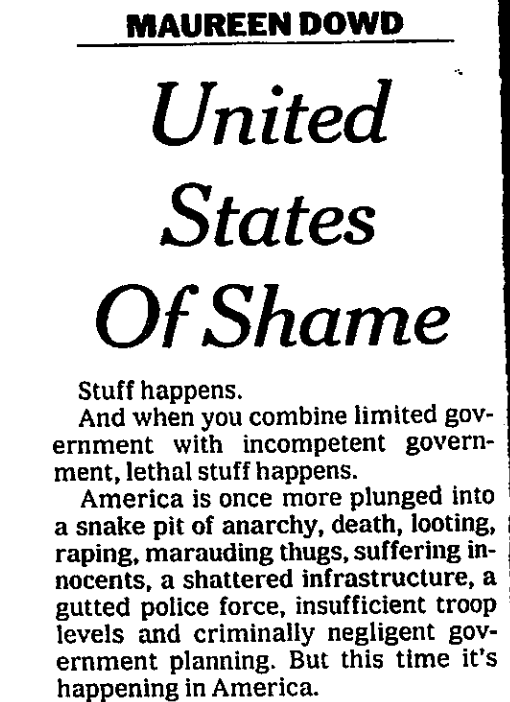
Which was rather how Maureen Dowd characterized Katrina’s aftermath in her New York Times column, published September 3, 2005, under the headline, “United States Of Shame”:Screen Shot 2015-08-23 at 3.39.57 PM

“America,” she wrote, “is once more plunged into a snake pit of anarchy, death, looting, raping, marauding thugs, suffering innocents, a shattered infrastructure, a gutted police force, insufficient troop levels and criminally negligent government planning. But this time it’s happening in America.”

Far more measured and perceptive was her Times colleague, Jim Dwyer, whom Brian Thevenot quoted this way, in a searching critique of the coverage of Katrina:

“I just thought that some of the reports were so garish, so untraceable and always seemed to stop short of having actual witnesses to the atrocities … like a galloping mythical nightmare had taken control.”

The erroneous and exaggerated reporting had the important effect delaying the delivery of aid to New Orleans — and of defaming the residents of a battered city, depicting them as having shed all restraint in the face of a disaster.

Little of the flawed coverage has been revisited or recalled in the run-up to the 10th anniversary of Katrina’s landfall. As they did in fifth anniversary retrospectives, journalists have mostly shied from addressing the errors in their coverage and have avoided considering how that coverage offers broader insights about reporting on disasters and other dramatic events.

The 10th anniversary reports have instead offered conflicting assessments about how New Orleans has made a comeback, or really hasn’t, or how impressions of the city’s recovery can sharply differ.

Heavily advertised television specials shown on ABC and Fox News skirted the wrong-headed reporting of 10 years ago, if they alluded to it at all.

ABC’s retrospective was broadcast Sunday night and was so sappy and boosterish as to be almost unwatchable.

Fox, which aired its look-back on Friday, was notably rough on Ray Nagin, the incompetent, bloviating mayor of New Orleans 10 years ago. Nagin since has gone to federal prison on corruption convictions unrelated to Katrina.

It’s worth recalling how in the storm’s aftermath, Nagin went on Oprah Winfrey’s program to claim that “hundreds of armed gang members” were terrorizing Katrina evacuees inside the Louisiana Superdome.

Nagin said conditions at the Superdome had deteriorated to “an almost animalistic state” and evacuees had been “in that frickin’ Superdome for five days, watching dead bodies, watching hooligans killing people, raping people.”

Almost all of those claims were untrue: The mayor was winging it on national television, and smearing his city in the process. The Fox program alluded to some of Nagin’s exaggerations.

An exception to the media’s sidestepping was a segment Saturday on NPR’s On the Media show. The segment noted the flawed reporting, but didn’t much explore why or how it occurred.

In her introduction, co-host Brooke Gladstone said of journalists covering the storm’s aftermath:

“They didn’t always speak fact. While covering Katrina’s horrific aftermath, the media often perpetuated myths about what was going on in the streets and the gathering places for the displaced, like the Superdome in New Orleans.”

The broad effect, of the exaggerated reporting, she said, was to paint “an apocalyptic picture that never matched reality.”

Her observations were a sequeway to an extended conversation with James A. Cobb Jr., the lawyer who won acquittals in 2007 of Sal and Mabel Mangano, owners of a nursing home in suburban New Orleans where 35 old people drowned in floodwaters released by the collapsed levees.

The Manganos both were charged with 35 counts of negligent homicide and 24 counts of cruelty.

Before the storm hit, the Manganos had decided it was safer to hunker down and not evacuate their frail and bedridden charges — and they were pilloried by the media when word of the deaths of their elderly charges began to circulate.

WJC

More from Media Myth Alert: