W. Joseph Campbell

Archive for the ‘Quotes’ Category

The media myths of Watergate: Part Four

In Anniversaries, Cinematic treatments, Debunking, Media myths, Newspapers, Quotes, Reviews, Washington Post, Watergate myth on June 20, 2012 at 7:40 am

This is the fourth of five posts addressing prominent media-driven myths about the Watergate scandal, which began unfolding 40 years ago this week, with
the foiled burglary at the headquarters
in Washington of the Democratic National Committee.
This installment addresses the notion that the Watergate reporting of Bob Woodward and Carl Bernstein
placed the reporters in grave danger.

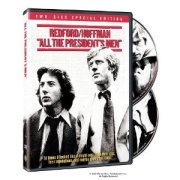
No film or documentary about Watergate has been seen more often by more people than All the President’s Men, the 1976 adaptation of the eponymous book by the Washington Post’s lead reporters on the scandal, Bob Woodward and Carl Bernstein.

The movie won rave reviews. The New York Times called it “a spellbinding detective story” and “an unequivocal smash-hit — the thinking man’s Jaws.”

The Post once immodestly described All the President’s Men as “journalism’s finest 2 hours and 16 minutes” and “the best film ever made about the craft of journalism.”

For all its glowing notices, All the President’s Men was often sluggish in pacing. More than a few scenes showed reporters at their desk, talking into telephones and banging away at typewriters.

Hardly gripping cinema.

But a measure of drama and menace was injected near the close of the movie (see video clip below).

That came when Woodward’s stealthy, high-level “Deep Throat” source, at a meeting in a darkened parking garage, grimly warns the wide-eyed reporter, played by Robert Redford:

“Your lives are in danger.”

But was it even true? Had Woodward and Bernstein, in their reporting about the misdeeds of men close to President Richard Nixon, unknowingly put their lives on the line? Were they targeted by Nixon’s henchmen? Or was this just dramatic license by Hollywood?

The movie leaves such questions hanging. The Woodward/Redford character informs the Bernstein character (played by Dustin Hoffman) about what “Deep Throat” said, and together they confer with the Post’s executive editor character (Jason Robards) — in the middle of the night, in the middle of the editor’s lawn.

But the movie closes before resolving the question of the hazards the reporters faced.

So were their lives really in danger?

Nope.

Not according to the book, All the President’s Men.

The book discusses a late-night meeting between Woodward and “Deep Throat” in mid-May 1973 when the source — W. Mark Felt, a senior official at the FBI, as it turned out — advised the reporter to “be cautious.”

Woodward returned to his apartment and invited Bernstein to stop by. When he did, Woodward typed out a message and handed it to his colleague:

Everyone’s life is in danger.”

Bernstein gave a curious look and Woodward typed another note:

Deep Throat says electronic surveillance is going on and we had better watch it.”

Who was doing the surveillance? Bernstein asked in long hand.

“C-I-A,” Woodward silently mouthed.

For a time afterward, the reporters and senior editors at the Post took precautions to avoid the suspected surveillance of their activities.

Woodward and Bernstein wrote in All the President’s Men that they “conferred on street corners, passed notes in the office, avoided telephone conversations.”

But soon, they said, “it all seemed rather foolish and melodramatic” and they went back to their routines.

No evidence, they wrote, was ever found “that their telephones had been tapped or that anyone’s life had been in danger.”

At a program last week at the Newseum, Woodward said he took Felt’s warning “too literally. I think he was speaking metaphorically” about the hazards.

“I think it was an overreaction,” Woodward said.

On another occasion — an online chat five years ago — Woodward said the “most sinister pressure” he and Bernstein felt during Watergate “was the repeated denial” by Nixon’s White House “of the information we were publishing” as the scandal deepened.

Also in that chat, Woodward said of the cinematic version of All the President’s Men:

“The movie is an incredibly accurate portrait of what happened.”

Oh, sure, it is.

Even that Post review, which called the movie journalism’s finest 2 hours and 16 minutes, noted that All the President’s Men “over-glamorizes reporting, oversimplifies editing and makes power appear the only proper subject for a newsman’s pen.”

WJC

Recent or related:

The media myths of Watergate: Part Three

In Anniversaries, Debunking, Media myths, Newspapers, Quotes, Washington Post, Watergate myth on June 19, 2012 at 5:25 am

This is the third of five posts addressing prominent media-driven myths about the Watergate scandal, which began
unfolding 40 years ago this week with the foiled burglary at the headquarters in Washington of the Democratic National Committee.
This installment discusses the most famous made-up line of Watergate.

“Follow the money.” It’s the best-known, most popular turn-of-phrase associated with the Watergate scandal of 1972-74.

Felt: Never said it

It’s often said that “follow the money” was sage counsel offered by the stealthy, high-level “Deep Throat” source with whom Bob Woodward of the Washington Post periodically met as the scandal unfolded.

The guidance to “follow the money” supposedly proved crucial in understanding and unraveling the labyrinthine scandal that was Watergate.

Except that it really wasn’t.

“Deep Throat” never advised Woodward to “follow the money.”

The passage appears in no Watergate-related article or editorial in the Post until June 1981, nearly seven years after Nixon’s resignation. It doesn’t appear, either, in All the President’s Men, the book Woodward and his Post colleague, Carl Bernstein, wrote about their Watergate reporting.

Follow the money” was written into the screenplay of All the President’s Men, the cinematic adaptation of Woodward and Bernstein’s book.

The line was spoken by Hal Holbrook, the actor who played “Deep Throat” in the movie. (The real “Deep Throat” was self-revealed in 2005 to have been W. Mark Felt, a senior FBI official.)

Holbrook in All the President’s Men turned in a marvelous performance as a twitchy, conflicted, chain-smoking “Deep Throat.”

‘All the President’s Men,’ the movie

He delivered the line, “follow the money,” with such raspy assurance and conviction that it seemed for all the world to be vital to understanding the scandal that began unfolding 40 years ago.

Follow the money” is certainly Watergate’s most memorable and mythical phrase; it is so pithy and emphatic that it seems almost too good not to be true.

Indeed, “follow the money” tends to be treated with reverence by news media. A “credo,” it’s been called.

Take, for example, a recent post at the “Daily Intel” blog of New York Magazine. The blog post began by invoking the famous phrase, with emphasis:

Follow the money. The pithy investigative advice Woodward and Bernstein attributed to Deep Throat is still brilliant and important, whatever else the Watergate reporters may have embellished.”

Brilliant and important?

Made up is more like it.

But even if Woodward had been counseled to “follow the money,” the advice neither would have unraveled the Watergate scandal nor led him to Nixon.

Besides, Woodward and Bernstein already were on the money trail.

One of their most important stories was in reporting that a $25,000 check to Nixon’s reelection campaign had been deposited in the bank account of one of the Watergate burglars.

The scandal, though, was much more than Nixon’s improper use of campaign funds. The president was forced to resign because he obstructed justice by approving a plan to cover up the burglary at the Democratic National Committee.

The simplified, follow-the-money construct not only is inaccurate and misleading: It serves to deflect attention from the array of forces that combined to expose Nixon’s crimes.

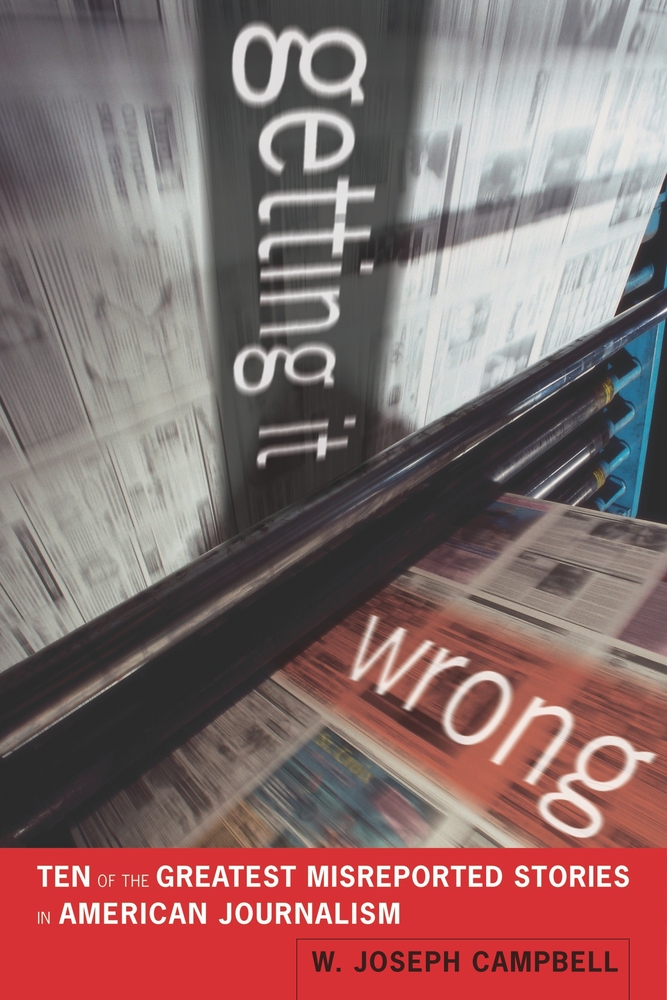
As I note in my 2010 book Getting It Wrong, rolling up a scandal of Watergate’s depth and dimension required “the collective if not always the coordinated forces of special prosecutors, federal judges, both houses of Congress, the Supreme Court, as well as the Justice Department and the FBI.

“Even then,” I write, “Nixon likely would have served out his term if not for the audiotape recordings he secretly made of most conversations in the Oval Office of the White House.

“Only when compelled by the Supreme Court did Nixon surrender those recordings, which captured him plotting the cover-up” that cost him the presidency.

WJC

Recent or related:

Taking stock: Top mythbusting posts of 2011

In Anniversaries, Bra-burning, Cronkite Moment, Debunking, Jessica Lynch, Media myths, Murrow-McCarthy myth, Quotes, Washington Post, Watergate myth on December 31, 2011 at 4:45 am

Reviewing the year in media-mythbusting reveals a number of memorable posts. Here are the Media Myth Alert five top writeups of 2011, with a roster of other mythbusting posts of note:

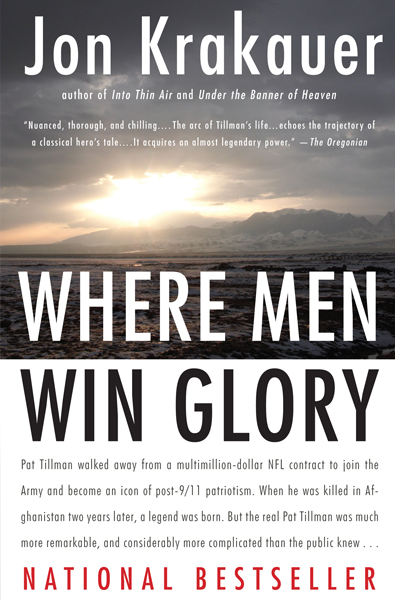
Krakauer retreats from Lynch-source claim (posted November 11): This post revealed author Jon Krakauer’s quiet retreat from claims in a 2009 book that Jim Wilkinson, a former White House official, was the source for the bogus Washington Post report about Jessica Lynch and her supposed battlefield heroics in the Iraq War in 2003.

The claims in Krakauer’s book were unattributed — and vigorously denied by Wilkinson, who sought a correction.

When it came, the correction was inserted unobtrusively in a new printing of the paperback edition of Krakauer’s book, Where Men Win Glory. It read:

“Earlier editions of this book stated that it was Jim Wilkinson ‘who arranged to give the Washington Post exclusive access’ to this leaked intelligence [about Jessica Lynch]. This is incorrect. Wilkinson had nothing to do with the leak.”

I’ve noted that the Post’s enduring silence about its sources on the Lynch story has allowed for the emergence not only of false allegations such as those about Wilkinson, but of a false narrative that the military concocted the tale about Lynch’s derring-do.

The false narrative  also has deflected attention from the soldier whose heroics apparently were misattributed to Lynch. He was Sgt. Donald Walters, a cook in Lynch’s unit.

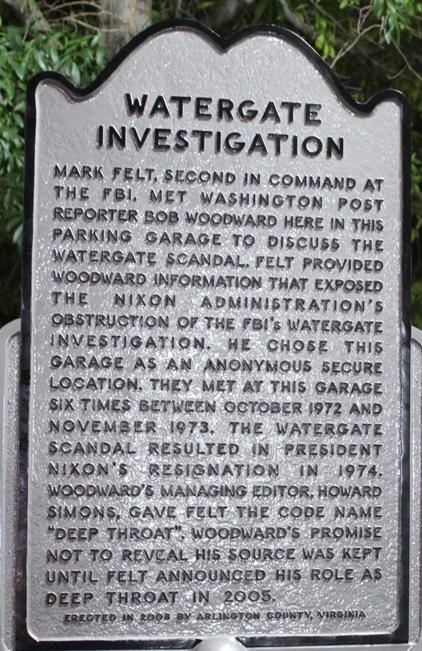
‘Deep Throat’ garage marker errs about Watergate source disclosures (posted August 18): A handsome historical marker went up in August outside the parking garage in Arlington, Virginia, where Bob Woodward of the Post conferred occasionally in 1972 and 1973 with his stealthy Watergate source, “Deep Throat.”

The marker, I pointed out, errs in describing the information Woodward received from the “Deep Throat” source, who in 2005 revealed himself as W. Mark Felt, formerly the FBI’s second in command.

The marker says:

“Felt provided Woodward information that exposed the Nixon administration’s obstruction of the FBI’s Watergate investigation.”

Which just isn’t so.

Such evidence, had “Deep Throat” offered it to Woodward, would have been so damaging and so explosive that it surely would have forced Richard Nixon to resign the presidency well before he did, in August 1974.

Felt didn’t have that sort of information — or (less likely) didn’t share it with Woodward.

I noted in my post about the marker that All the President’s Men, the book Woodward wrote with Carl Bernstein about their Watergate reporting, says Woodward’s conversations with “Deep Throat” were intended “only to confirm information that had been gathered elsewhere and to add some perspective.”

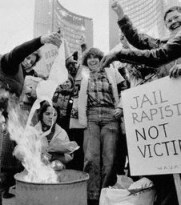
Bra-burning in Toronto: Confirmed (posted February 19): I ascertained in this post that an image of a bra-burning protest in Toronto in 1979 was no hoax, that the photograph was authentic.

I had not seen the photograph before it appeared in February with an article at the online site of  London’s Guardian newspaper.

I had doubts about the photo’s authenticity — given the periodic claims that no bras ever were burned at a feminist protest. The Toronto image, I suspected, might have been unethically altered.

Turns out that was not the case.

I tracked down one of the participants at the Toronto protest and she confirmed the bra-burning, saying by phone from Vancouver:

“The photo is authentic. Absolutely. It happened.”

The participant was Vicki Trerise, who appears at the far right in the photograph above.

The photograph shows a moment of demonstrative bra-burning, although Trerise said it “wasn’t a focal point” of the protest, which took place not far from Toronto’s City Hall.

The bra-burning came near the end of the demonstration, which was called to protest what the organizers said was an illogical report about rape, prepared by the Ontario Provincial Police.

Trerise said the demonstrators in Toronto were media-savvy and “knew that if they burned a bra, someone would take their picture.”

Suspect Murrow quote pulled at Murrow school (posted February 17): The online welcome page of the dean of the Edward R. Murrow College of Communication at Washington State University contained a quotation attributed to Murrow that’s only half-true.

Murrow

The quote reads:

“We must not confuse dissent with disloyalty. When the loyal opposition dies, I think the soul of America dies with it.”

As I’ve reported previously, the first portion of the quote was indeed spoken by Murrow, in his mythical 1954 television program that addressed Senator Joseph McCarthy’s red-baiting ways.

The second part of the quote — “When the loyal opposition dies, I think the soul of America dies with it” — is apocryphal.

In February, I found that the full quotation — accompanied by a facsimile of Murrow’s signature — was posted at the welcome page of Dean Lawrence Pintak of Murrow College at Washington State, Murrow’s alma mater.

I asked the dean what knew about the quote’s provenance, noting that I had consulted, among other sources, a database of historical newspapers which contained no articles quoting the “loyal opposition” passage.

Pintak referred my inquiry to an instructor on his faculty who, a few hours later, sent an email to the dean and me, stating:

“While [the ‘loyal opposition’ quotation] seems to reflect the Murrow spirit, the lack of evidence that he phrased it that way is indeed suspicious.”

He added: “I feel the evidence says no, Murrow did not say this.”

By day’s end, the suspect quote had been pulled from the welcome page. Just the authentic portion — “We must not confuse dissent with disloyalty” — remained posted there.

Mythmaking in Moscow: Biden says WaPo brought down Nixon (posted March 12): Joe Biden, the hapless U.S. vice president, repeated the dominant but misleading narrative about the Watergate scandal in March by telling an audience in Moscow that the Washington Post had “brought down” Richard Nixon’s corrupt presidency.

The gaffe-prone Biden told his audience:

“In my country it was a newspaper, not the FBI, or the Justice Department, it was a newspaper, the Washington Post that brought down a President for illegal actions.”

It’s a version of scandal that few serious historians accept. Not even the Washington Post buys into such a myth-encrusted interpretation.

Indeed, principals at the Post from time to time have sought to distance the newspaper from that misleading assessment.

For example, Katharine Graham, the newspaper’s publisher during and after the Watergate scandal, said in 1997, at a program marking the 25th anniversary of the scandal:

“Sometimes people accuse us of bringing down a president, which of course we didn’t do. The processes that caused [Nixon’s] resignation were constitutional.”

More recently, Michael Getler, then the newspaper’s ombudsman, wrote in 2005:

“Ultimately, it was not The Post, but the FBI, a Congress acting in bipartisan fashion and the courts that brought down the Nixon administration.”

Such comments are not the expressions of false modesty. Instead, they represent a more accurate reading of the history of Watergate than Biden offered up in Moscow.

Even so, in the run-up to the scandal’s 40th anniversary in 2012, the Watergate myth — the heroic-journalist trope — is sure to emerge often and insistently.

But the Post and its reporting of Watergate assuredly did not bring down Nixon, as I discuss in Getting It Wrong, my latest book which was published in 2010.

WJC

Many thanks to Instapundit
Glenn Reynolds for linking to this post.

Other memorable posts of 2011:

Apocryphal, but still quotable

In Debunking, Media myths, Quotes on December 24, 2011 at 7:24 am

Apocryphal, but still quotable.

That’s the takeaway from a commentary posted yesterday at the online site of the Nation. The commentary invoked Zhou Enlai’s misinterpreted comment about the upshot of the French Revolution.

Zhou supposedly said in 1972 that it was “too early to say” what the effects would be. But Zhou was speaking about the political turmoil in France in 1968, not the years-long upheaval that began in 1789.

The Nation’s commentary, “The Soviet Union’s Afterlife,” tried to have it both ways with Zhou’s remark; the opening paragraph asserted:

“Asked to evaluate the French Revolution nearly 200 years later, the Chinese Premier Zhou Enlai was famously reported to have replied, ‘Too early to say.’ Though apocryphal, the long perspective attributed to Zhou is better informed than the certitudes of American commentators about the causes and consequences of the end of the Soviet Union only twenty years ago.”

If it’s apocryphal, then why invoke it? To do is to distort and confuse and even mislead.

The temptation to invoke telling quotes of dubious derivation can be too powerful to avoid. As I point out in my latest book, Getting It Wrong, “Turns of phrase that sound too neat and tidy often are too perfect to be true.”

Craig Silverman, author of Regret The Error and a columnist for Columbia Journalism Review, has likened dubious quotes to “little gems that supposedly tell a story in just a few words. They lodge themselves in our culture and consciousness.”

So it is with Zhou’s remark, which was made during President Richard Nixon’s historic trip to China in February 1972.

The conventional interpretation — which the Nation commentary invoked — is that the comment stands as evidence of the sage and far-sighted ways of Chinese leaders.

But we know from a retired U.S. diplomat, Charles W. (Chas) Freeman, that Zhou in his talks with Nixon in 1972 was taking a decidedly shorter and more immediate view of turmoil in France.

Freeman was Nixon’s interpreter during the trip and was present when Zhou made the “too early” comment.

Freeman has said that Zhou’s remark came during a discussion about revolutions that had succeeded and failed. The revolutions cited, Freeman said, included the Prague Spring of 1968 and the Hungarian uprising of 1956, both of which the Soviet Union crushed.

Freeman said it was clear from the context that in saying it was “too early to say,” Zhou was speaking about the events in France in May 1968.

How Zhou’s “too early” remark came to be so badly misinterpreted, Freeman was unable to say.

“I cannot explain the confusion about Zhou’s comment except in terms of the extent to which it conveniently bolstered a stereotype (as usual with all stereotypes, partly perceptive) about Chinese statesmen as far-sighted individuals who think in longer terms than their Western counterparts,” he said, adding:

“It was what people wanted to hear and believe, so it took” hold.

First to report Freeman’s debunking was Richard McGregor, a journalist and China expert writing for London’s Financial Times.

As I’ve pointed out, the appeal and tenacity of Zhou’s misinterpreted remark is reminiscent of William Randolph Hearst’s purported vow to “furnish the war” with Spain at the end of the 19th century.

Hearst’s reputed vow  supposedly was made in an exchange of telegrams with the artist Frederic Remington, who was on assignment in Cuba for Hearst’s New York Journal.

As I point out in Getting It Wrong, it “would have been absurd for Hearst to vow to ‘furnish the war’ because war — specifically, the Cuban rebellion against Spain’s colonial rule — was the very reason Hearst sent Remington to Cuba in the first place.”

“Like many media-driven myths,” I further note, the purported Hearstian vow “is succinct, savory, and easily remembered.

“It is almost too good not to be true.”

WJC

Many thanks to Instapundit
Glenn Reynolds for linking to this post.

Recent and related: