W. Joseph Campbell

Archive for the ‘Scandal’ Category

Still hardy after 40 years: The myth that Woodward, Bernstein ‘brought down’ Nixon

In Anniversaries, Debunking, Error, Media myths, Scandal, Washington Post, Watergate myth on May 17, 2013 at 10:30 am

Forty years ago today, a Senate select committee convened public hearings into the then-emergent Watergate scandal. The hearings stretched into the summer of 1973 and helped make “Watergate” a household term.

More important, the panel’s inquiry produced the disclosure that President Richard Nixon had secretly taped many of his private conversations at the White House — a revelation that was to prove decisive to the scandal’s outcome.

http://www.youtube.com/watch?v=zSpFIRrm0Bw

The most incriminating tape, released under Supreme Court directive in July 1974, captured Nixon plotting a coverup of the FBI’s investigation into the break-in at the headquarters of the Democratic National Committee in Washington in June 1972.

If not for the tapes, Nixon likely would have remained in office — a wounded and hobbled president, but one who would have completed his term.

So the Senate select committee was vital in the array of subpoena-wielding forces that produced evidence that eventually compelled Nixon’s resignation.

And yet, on this anniversary, the simplistic, media myth circulates anew — that two dogged reporters for the Washington Post, Bob Woodward and Carl Bernstein, exposed the crimes of Watergate and brought down Nixon’s corrupt presidency.

The latest to invoke what I call the heroic-journalist myth of Watergate was the executive director of the ACLU of Massachusetts, Carol Rose, who declared in a commentary for Boston’s NPR station, WBUR:

“Nixon himself was brought down by two enterprising young reporters at the Washington Post and a whistleblower by the name of ‘Deep Throat.'”

Rose’s commentary, posted yesterday at the “Cognoscenti” page of WBUR’s Web site, focused on and rightly took issue with the Justice Department’s snooping into phone records of Associated Press reporters and editors in Washington, New York, and Hartford, Connecticut.

“Lest there be any confusion: This is a big deal,” Rose says of the Justice Department’s activity. (She also writes, “Dismantle the free press, and you pretty much dismantle democracy,” which probably is to put it backwards: A free press is a marker and byproduct of democratic government, not an essential precondition.)

But what most concerns Media Myth Alert is the blithely offered claim about the work of Woodward and Bernstein — those “enterprising young reporters” to whom Rose refers.

Simply put, Woodward and Bernstein did not bring down Nixon’s corrupt presidency.

Their Watergate reporting for the Post as the scandal slowly unfolded in the summer and fall of 1972 did win a Pulitzer Prize in 1973. But Woodward and Bernstein were not central to the major disclosures of Watergate.

Notably, they did not reveal the existence of the Nixon’s tapes.

Nor did they describe the extent of the Nixon administration’s coverup of the crimes of Watergate.

Interestingly, authorities at the Post over the years have scoffed at claims that Woodward and Bernstein’s reporting took down Nixon.

Katharine Graham, the Post’s publisher during Watergate, said in 1997:

“Sometimes people accuse us of bringing down a president, which of course we didn’t do. The processes that caused [Nixon’s] resignation were constitutional.”

Woodward, himself, has pooh-poohed the notion, too. He once told an interviewer:

To say the press brought down Nixon, that’s horse shit.”

More delicately, Woodward said in an interview with the PBS “Frontline” program that “the mythologizing of our role in Watergate has gone to the point of absurdity, where journalists write … that I, single-handedly, brought down Richard Nixon. Totally absurd.”

As for the “whistleblower” Rose mentions, the shadowy “Deep Throat” source?

He turned out to be W. Mark Felt, a senior FBI official motivated not so much by whistleblowing as by high-stakes, inter-office politics.

Felt wanted the FBI top job after the death in May 1972 of the agency’s director, J. Edgar Hoover. Leaking to Woodward (Felt never met Bernstein during Watergate) was a way to pursue those ambitions — and to undercut the official who was appointed acting FBI director, L. Patrick Gray.

Felt was no noble figure. As I note in my media-mythbusting book, Getting It Wrong, he authorized burglaries as part of the FBI’s investigations into leftists associated with the radical Weather Underground.

Felt was convicted in 1980 on felony charges related to the break-ins, but was pardoned the following year by President Ronald Reagan.

WJC

More from Media Myth Alert:

Obama’s ‘Cronkite Moment’? ‘Salon’ dials up a media myth

In Cronkite Moment, Debunking, Error, Media myths, Quotes, Scandal, Television on May 14, 2013 at 6:48 pm

The online news and commentary site Salon today invokes the mythical “Cronkite Moment” of 1968 in mulling TV comedian Jon Stewart’s obscenity-laced criticism last night about the scandals battering the administration of President Barack Obama.

Salon logoStewart’s remarks on his Daily Show are evocative, Salon declares, of “one of the most famed moments in broadcasting, when CBS News legend Walter Cronkite delivered an editorial opinion after the Tet Offensive in February 1968,” in which he suggested that negotiations could offer a way out of Vietnam.

Salon adds the media myth, stating:

“Apparently watching at the White House, President Johnson, who had lost the left long ago, reportedly turned to an aide and said, ‘If I’ve lost Cronkite, I’ve lost Middle America.’ Just a few weeks later, Johnson announced he would not seek reelection.”

Salon then injects a muddled caveat, stated parenthetically: “Critics say the event has been widely misreported and overblown, but it still looms large in the American consciousness of the era, even if apocryphally.”

How’s that? It “looms large … even if apocryphally”?

Simply put, the “Cronkite Moment” is apocryphal.

And here are a few of the reasons why:

  • Johnson did not see the Cronkite program when it aired on February 27, 1968. He wasn’t at the White House, either. He was in Austin, Texas, at a black-tie party marking the 51st birthday of a longtime political ally, Governor John Connally. About the time Cronkite was intoning his commentary about Vietnam, Johnson was making light of Connally’s age, saying: “Today, you are 51, John. That is the magic number that every man of politics prays for — a simple majority.”
  • Cronkite’s on-air remarks had little to do with Johnson’s decision, announced at the end of March 1968, not to seek reelection. Far more decisive was Johnson’s eroding political support: By mid-March 1968, the president was confronting intra-party challenges from Democratic senators Eugene McCarthy and Robert F. Kennedy. And Johnson may have decided well before then against another term. He wrote in his 1971 memoir, The Vantage Point, that well before March 1968, he “had told a number of people” of his “intention not to run again.”
  • Cronkite for years rejected the notion that his on-air comments about Vietnam had had much effect on Johnson. The anchorman characterized his observations as akin to “another straw on the back of a crippled camel.” Evidence is scant, moreover, that Cronkite’s commentary had much influence on popular opinion, either. Polls had detected shifts in public sentiment against Vietnam months before Cronkite’s on-air remarks. Which means the anchorman can be said to have followed rather than have precipitated deepening disenchantment about the war.

What’s more, as I discuss in my media-mythbusting book, Getting It Wrong, Cronkite’s commentary — he also said the U.S. war effort was “mired in stalemate” — was far less emphatic than the on-air remarks not long afterward by a rival network newsman, Frank McGee of NBC News.

On March 10, 1968, McGee declared: “The war is being lost by the administration’s definition.”

Lost: No hedging there about a stalemate.

Not only does Salon indulge in media myth, its commentary probably overstates the impact of Stewart’s segment about the scandals.

The comedian was hardly direct or unrelenting in criticizing Obama. His frustration was aimed primarily at IRS and the agency’s stunning recent acknowledgement that it had singled out conservative organizations for detailed scrutiny.

As such, Stewart’s remarks are unlikely to be remembered as much of a turning point in popular views about the Obama administration.

WJC

More from Media Myth Alert:

‘All the President’s Men Revisited’: A mediacentric rehash, with some insight

In Anniversaries, Cinematic treatments, Debunking, Media myths, Scandal, Washington Post, Watergate myth on April 22, 2013 at 2:49 pm

The much-ballyhooed documentary, All the President’s Men Revisited, was mostly a mediacentric rehash of the Watergate scandal 40 years ago. Even so, the show, which aired last night on the Discovery channel, managed to present insight into the forces that really uncovered the criminality of what was America’s gravest political scandal.

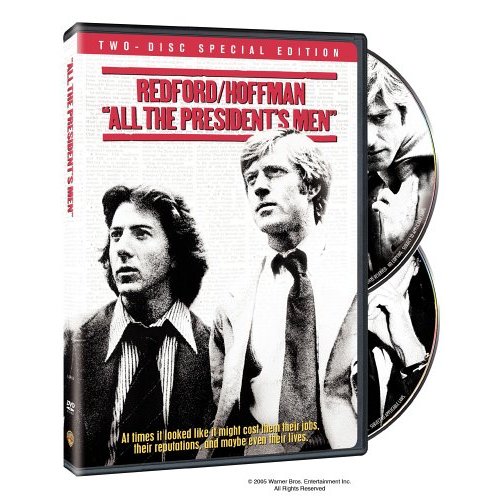
The two-hour program took a look back at Watergate often through the context of All the President’s Men, the 1976 cinematic adaptation of Bob Woodward and Carl Bernstein’s eponymous book about their Watergate reporting for the Washington Post.

The movie, which starred Robert Redford and Dustin Hoffman, idealized Woodward and Bernstein, identifying their reporting as central to uncovering the scandal that toppled Richard Nixon’s corrupt presidency. The first hour of the Discovery program similarly emphasized that misleading interpretation, mostly through frequent snippets of interviews with the aging Woodward and Bernstein.

The inescapable impression was that their reporting was essential to spurring the federal and congressional investigations that ultimately produced tape-recorded evidence that showed Nixon conspired to cover up the signal crime of Watergate — the break-in in June 1972 at the headquarters of the Democratic National Committee.

That interpretation — that Woodward and Bernstein’s reporting set the table for the crucial official inquiries — is favored by the Post (its Web site explains Watergate that way).

But  it is utterly misleading.

As serious historians of Watergate have demonstrated, federal investigators were far ahead of Woodward and Bernstein in their piecemeal reporting about the unfolding scandal in the summer and fall of 1972.

For example, Max Holland, author of Leak, a book about Watergate published last year, has aptly noted:

“Federal prosecutors and agents never truly learned anything germane from The Washington Posts [Watergate] stories — although they were certainly mortified to see the fruits of their investigation appear in print. … The government was always ahead of the press in its investigation of Watergate; it just wasn’t publishing its findings.”

What’s more, the Post’s investigation into Watergate “ran out of gas” by late October 1972, Barry Sussman, then the newspaper’s city editor, acknowledged in an interview in 1974.

The most interesting segments of All the President’s Men Revisited were during the program’s second hour, when the federal and congressional investigations of Watergate figured prominently. At the same time, Woodward and Bernstein receded noticeably from the limelight, replaced by the likes of Alexander Butterfield, the former White House aide who disclosed that Nixon recorded his conversations in the Oval Office.

Butterfield’s revelation about the tapes came during a U.S. Senate select committee’s investigation into Watergate — and represented a decisive pivot in the unfolding the scandal. Nixon ultimately was compelled to surrender audiotapes that demonstrated his role in attempting to coverup the Watergate breakin. He resigned soon afterward.

http://www.youtube.com/watch?v=MeQXopJ5U-Q

Interestingly, All the President’s Men Revisited  made clear that Woodward and Bernstein did not break the story about the existence of the tapes — and pinned the blame on the Post’s executive editor, Ben Bradlee.

Woodward recounted in the program (as he did in the book All the President’s Men) that he had heard about the tapes and asked Bradlee about pursuing a story along those lines. Bradlee, according to Woodward’s recollections, rated a prospective story about the tapes a B-plus: Not good enough for Woodward to pursue immediately.

(In the book, Bradlee is quoted as saying: “See what more you can find out, but I wouldn’t bust one on it.” And the reporters didn’t, thus failing to report a pivotal story about the scandal.)

The program’s second-half focus on the federal and congressional inquiries in a way addresses a major flaw of All the President’s Men, the movie, which was criticized for ignoring the contributions of federal investigators, special prosecutors, and congressional panels in ripping away the coverup of the Watergate break-in.

The movie’s narrow focus, I wrote in my media-mythbusting book Getting It Wrong, served “to solidify and elevate the heroic-journalist myth” of Watergate — the notion that the dogged work of Woodward and Bernstein brought down Nixon.

While the program did not challenge the deeply entrenched heroic-journalist myth, All the President’s Men Revisited did offer an historically accurate interpretation about how the scandal unspooled: As such, it rather succeeded where the movie had clearly failed.

WJC

More from Media Myth Alert:

Woodward ‘destroyed the Nixon presidency’: More dubious history from Rush Limbaugh

In Cinematic treatments, Debunking, Error, Media myths, Scandal, Washington Post, Watergate myth on March 1, 2013 at 7:21 am

Talk-radio host Rush Limbaugh was at it again yesterday, offering up the dubious interpretation that Bob Woodward’s Watergate reporting “destroyed the Nixon presidency.”

That’s a seriously exaggerated version of the Watergate scandal, which led to Nixon’s resignation in 1974. Not even Woodward embraces that interpretation, once telling an interviewer: “To say the press brought down Nixon, that’s horse shit.”

(Woodward(Jim Wallace/Smithsonian)

Woodward
(Jim Wallace/Smithsonian)

Limbaugh’s remark about Woodward’s having “destroyed the Nixon presidency” came during a lengthy commentary about Woodward’s recent criticism about the administration of President Barack Obama.

Woodward has asserted that Obama proposed the controversial sequester plan — the automatic federal spending cuts that are to begin taking effect today.

What most intrigues Media Myth Alert is Limbaugh’s repeated claim that Woodward’s reporting was decisive in ending Nixon’s presidency. The talk-show host’s remark yesterday about Woodward and Nixon marked the second time this week he has made such an assertion.

On his show Monday, Limbaugh said flatly that “Woodward brought down Nixon” in the Watergate scandal.

The record, though,  is far more nuanced and complex than that: Woodward and his Washington Post reporting colleague Carl Bernstein played rather modest roles in unraveling the scandal.

Their reporting in the summer and fall 1972 progressively linked White House officials to a secret fund used to finance the foiled burglary at the headquarters of the Democratic National Committee — the signal crime of Watergate.

But by late October 1972, the Post’s investigation into Watergate “ran out of gas,” as Barry Sussman, then the newspaper’s city editor, later acknowledged.

Significantly, Woodward and Bernstein did not break such crucial stories as the existence of Nixon’s audiotaping system at the White House. The tapes ultimately provided evidence that the president had obstructed justice by approving a scheme to deflect the FBI’s inquiry into the burglary.

The disclosure about the taping system came in July 1973, during a Senate select committee’s investigation into the unfolding Watergate scandal.

Nor did Woodward and Bernstein disclose the payment of hush money to operatives arrested in the burglary — a key development in tying the White House to the Watergate scandal.

I discuss the media myth of Watergate in my latest book, Getting It Wrong, and write that the scandal demanded “the collective if not always the coordinated forces of special prosecutors, federal judges, both houses of Congress, the Supreme Court, as well as the Justice Department and the FBI.”

What I call the hero-journalist myth of Watergate — the notion that Woodward and Bernstein’s dogged reporting brought down Nixon — stems in large measure from the 1976 motion picture, All the President’s Men.

The movie, an adaptation of Woodward and Bernstein’s book by the same title, concentrated on the  reporters and ignored the far more decisive contributions of subpoena-wielding investigators and special prosecutors.Getting It Wrong_cover

The movie was critically acclaimed and widely seen. Its effect, I write in Getting It Wrong, was “to solidify and elevate the heroic-journalist myth, giving it dramatic power, and sustaining it in the collective memory.”

All the President’s Men, the movie, promoted a simplistic yet readily accessible interpretation of the Watergate scandal that is often invoked — as Limbaugh’s recent comments suggest. But it is an interpretation that nonetheless is utterly wrong.

WJC

More from Media Myth Alert:

Runup to the Oscars: ‘Politically inspired movies’ and the myth of Watergate

In Cinematic treatments, Debunking, Error, Media myths, Scandal, Washington Post, Watergate myth on February 22, 2013 at 2:51 pm

The runup to the Academy Awards ceremony brings inevitable bursts of nostalgia — as well as the almost-predictable appearance of hoary media myths.

CNN logoCNN.com today offered a gauzy look back at “politically inspired movies that have been nominated [for] or won” an Oscar. In doing so, CNN bought into the media myth of the Watergate scandal.

The retrospective discussed the 1976 film All The President’s Men, noting that it “won four Oscars and was nominated for four more.”

The movie was an adaptation of a book by the Washington Post’s lead Watergate reporters, Bob Woodward and Carl Bernstein, who, according to CNN, were “responsible for uncovering the Watergate scandal and forcing the resignation of President Richard Nixon.”

All the President’s Men, CNN added, “provided context and drama about how the reporters brought down the most powerful man on Earth.”

That’s an expansive claim. It’s also glib, and totally mythical.

As I discuss in my media mythbusting book, Getting It Wrong, Woodward and Bernstein’s reporting did not bring down Nixon. They didn’t uncover the scandal, either.

All President's Men

The movie

Far from it.

Woodward and Bernstein and the Post were at best modest contributors in unraveling an intricate scandal that sent to jail nearly 20 men associated with Nixon’s presidency or his 1972 reelection campaign.

Indeed, when considered against the far more decisive forces and factors that uncovered Watergate, Woodward and Bernstein’s contributions recede into near insignificance.

The decisive forces included special prosecutors, federal judges, the FBI, panels of both houses of Congress, and the Supreme Court.

Even in the face of such an array of forces, I write in Getting It Wrong, “Nixon likely would have served out his term if not for the audiotape recordings he secretly made of most conversations in the Oval Office of the White House. Only when compelled by the Supreme Court did Nixon surrender those recordings, which captured him plotting the cover-up” of the signal crime of Watergate — the breakin in June 1972 at the headquarters of the Democratic National Committee.

Notably, Woodward and Bernstein didn’t reveal existence of Nixon’s secret tapes, the contents of which proved vital in Watergate’s outcome. Nor did Woodward and Bernstein disclose the extent of the attempted coverup of the crimes of Watergate.

What’s more, principals at the Washington Post have from time to time over the years dismissed the notion that the newspaper was central in forcing Nixon’s resignation.

For example, the Post’s publisher during and after the Watergate scandal, Katharine Graham, said in 1997 at a program marking the scandal’s 25th anniversary:

“Sometimes people accuse us of bringing down a president, which of course we didn’t do. The processes that caused [Nixon’s] resignation were constitutional.”

Even Woodward has scoffed at the notion, telling American Journalism Review in 2004:

To say the press brought down Nixon, that’s horse shit.”

The cinematic version of All the President’s Men contains few references to the subpoena-wielding authorities who really did break open the scandal. Instead, the movie leads audiences to just one, misleading conclusion — that the tireless reporting of Woodward and Bernstein was vital to Watergate’s ultimate outcome.

WJC

More from Media Myth Alert:

The ‘newsroom where two reporters took down a president’? Sure it was

In Debunking, Error, Media myths, Scandal, Washington Post, Watergate myth on February 2, 2013 at 7:58 am

News that the Washington Post is exploring the sale of its headquarters building inevitably stirred reminders of the Watergate scandal, supposedly the newspaper’s most memorable exposé.

The Wall Street Journal makes that link in an article today while credulously invoking the heroic-journalist myth of Watergate, the scandal that forced Richard Nixon to resign the presidency in 1974.

wapo-logo“The Washington, D.C., newsroom where two reporters took down a president may soon be on the block,” the Journal states, referring to Bob Woodward and Carl Bernstein, the Post’s lead reporters on America’s greatest political scandal.

While it may make for a catchy “lede” (journalese for a story’s opening paragraph), the reference to the reporters who “took down a president” is wrong-headed: It’s a media myth that simplifies and distorts the forces and factors that led Nixon to quit in disgrace.

Even principals at the PostWoodward among them — have asserted over the years that the newspaper did not bring down Nixon’s corrupt presidency. And they weren’t indulging in false modesty in saying so. (Ben Bradlee, the Post’s executive editor during Watergate, once said, for example: “[I]t must be remembered that Nixon got Nixon. The Post didn’t get Nixon.”)

And as I write in my media-mythbusting book, Getting It Wrong, “to explain Watergate through the lens of the heroic-journalist is to abridge and misunderstand the scandal and to indulge in a particularly beguiling media-driven myth. The heroic-journalist interpretation minimizes the far more decisive forces that unraveled the scandal and forced Nixon from office.”

Those forces included special federal prosecutors, federal judges, both houses of Congress, the Supreme Court, as well as the Justice Department and the FBI.

“Even then,” I note in Getting It Wrong, “Nixon likely would have served out his term if not for the audiotape recordings he secretly made of most conversations in the Oval Office of the White House.

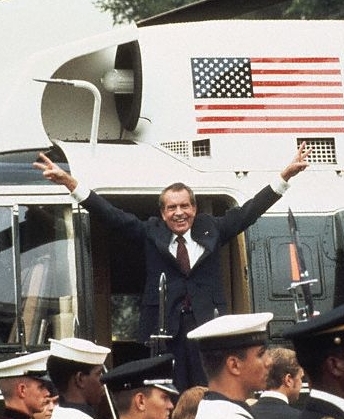
Nixon quits

‘Nixon got Nixon’

“Only when compelled by the Supreme Court did Nixon surrender those recordings, which captured him plotting the cover-up and authorizing payments of thousands of dollars in hush money.”

So why does the mediacentric heroic-journalist interpretation of Watergate live on? Why is it so tempting to invoke, as the Journal does today?

Explanations go well beyond a reporter’s need for a catchy lede.

An especially compelling reason for the myth’s tenacity is that it makes accessible and understandable the intricate scandal that was Watergate.

That complexity —the webs of lies, the deceit, and the criminality that characterized the Nixon White House; the multiple lines of investigation that slowly unwound the scandal, and the drama of a constitutional crisis — are not readily recalled these days.

The scandal that unfolded from 1972 to 1974 has become so distant that few Americans can accurately describe what took place.

What does stand out, though, is the heroic-journalist meme — the appealing if misleading notion that the tireless reporting of Woodward and Bernstein exposed the crimes of Watergate and brought Nixon down.

It’s history lite, history made simple.

The myth is endlessly reassuring for journalists, too, suggesting as it does that journalism can make a difference, can bring about dramatic change. As I point out in Getting It Wrong, “How the Post and its reporters uncovered Watergate is deeply ingrained in American journalism as one of the field’s most important and self-reverential stories.”

It’s also one of journalism’s self-sustaining tales, as the Wall Street Journal demonstrates quite well today.

WJC

Many thanks to Instapundit
Glenn Reynolds for linking to this post

More from Media Myth Alert:

The media myths of Watergate: Part Five

In Anniversaries, Cinematic treatments, Debunking, Media myths, Scandal, Washington Post, Watergate myth on June 21, 2012 at 6:32 am

This is the last of five posts addressing prominent media-driven myths about the Watergate scandal, which began unfolding 40 years ago this week with the foiled burglary at the headquarters in Washington of the
Democratic National Committee.
This installment address the often-stated claim that enrollments in college journalism programs in the United States
soared in the aftermath of Watergate.

Watergate made Gerald Ford president — and made journalism seem sexy

It’s a subsidiary myth of Watergate, that the reporting exploits of Bob Woodward and Carl Bernstein of the Washington Post — made legendary by the cinematic adaptation of their book, All the President’s Men — turned journalism into glamorous and alluring profession.

So alluring and heroic were the depictions of Woodward and Bernstein as they, ahem, toppled a corrupt president that young adult Americans in the 1970s thronged to collegiate journalism programs.

A commentary last week in Post made just that point, declaring that the film had “inspired a generation of journalism school students.” Similarly, a recent essay at Gawker.com said the glowing accounts of Woodward and Bernstein’s work “helped swell enrollments at journalism schools across the nation as eager young college graduates came to view reporting not as a lowly trade but as a noble profession.”

But it’s a media myth that Watergate stimulated journalism school enrollments — a myth that endures despite its thorough repudiation by scholarly research.

As I discuss in my 2010 book, Getting It Wrong (which includes a chapter confronting what I call the heroic-journalist myth of Watergate), two scholarly studies about enrollments in collegiate journalism programs found no evidence that Watergate was much of a stimulus.

Enrollment data are reasonably good proxies as they would surely have reflected heightened interest in careers in the profession. If Watergate and All the President’s Men inspired broad interest in careers in journalism, evidence of the stimulus should be apparent in surging j-school enrollments.

But the evidence just isn’t there.

A study conducted for the Freedom Forum media foundation and released in 1995 found that “growth in journalism education” resulted “not from specific events as Watergate … but rather to a larger extent from the appeal of the field to women, who have been attending universities in record numbers. The growth also in part reflects the applied nature of the field and its link to specific job skills.”

The study’s authors, Lee Becker and Joseph Graf, stated flatly that “students didn’t come rushing to the university because they wanted to follow in the footsteps of Woodward and Bernstein ….”

A separate study, conducted by a senior journalism scholar, Maxwell E. McCombs, reported in 1988 that “the boom in journalism education was underway at least five years before” the Watergate break-in in 1972.

McCombs wrote:

“It is frequently, and wrongly, asserted that the investigative reporting of Woodward and Bernstein provided popular role models for students, and led to a boom in journalism school enrollments. The data … reveal, however, that enrollments already had doubled between 1967 and 1972.”

I point out in Getting It Wrong that the notion that Watergate reporting made journalism appealing and sexy lives on “because it seems irresistibly logical and straightforward— too obvious, almost, not to be true.”

Watergate’s presumed stimulus on journalism school enrollments is an attractive and simplistic construct, easy to grasp, and easy to remember.

And such characteristics — easy to grasp, easy to remember — often are propellants. Propellants of media-driven myths.

WJC

Recent or related:

The media myths of Watergate: Part Two

In Anniversaries, Debunking, Media myths, Newspapers, Scandal, Washington Post, Watergate myth on June 18, 2012 at 5:42 am

This is the second of five posts addressing prominent media-driven myths about the Watergate scandal, which began unfolding 40 years ago this week with
the foiled burglary at the headquarters in Washington
of the Democratic National Committee.
This installment discusses the notion
that the 
Washington Post “uncovered” the Watergate story.

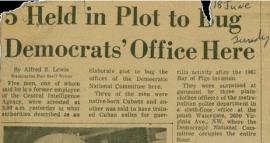
Post’s Watergate story, June 18, 1972 (Ransom Center, University of Texas)

Watergate was America’s gravest political scandal. It began as a police beat story.

News of the scandal’s seminal crime — the thwarted break-in of June 17, 1972, at the headquarters of the Democratic National Committee at the Watergate complex in Washington, D.C. — was circulating within hours.

The opening paragraph of the Posts front-page report about the burglary, published 40 years ago today, made it clear that details had come from investigating authorities. The paragraph read:

“Five men, one of whom said he is a former employee of the Central Intelligence Agency, were arrested at 2:30 a.m. yesterday in what authorities described as an elaborate plot to bug the offices of the Democratic National Committee here.”

So it can’t be said the Post “uncovered” the Watergate story.

Nor can it be said that the newspaper “uncovered” crucial elements of the deepening scandal, which ultimately forced President Richard Nixon to resign the presidency in August 1974.

Take, for example, Nixon’s secret audiotaping system at the White House.

Existence of the tapes was disclosed in July 1973 to a bipartisan select committee of the U.S. Senate (see video clip below).

http://youtu.be/MeQXopJ5U-Q

The tapes were decisive to Watergate’s outcome; Watergate’s leading historian, Stanley I. Kutler, has characterized them as “the gift of the gods.”

The so-called “smoking gun” tape revealed that Nixon had approved a plan to divert the FBI’s investigation of the break-in of DNC headquarters.

He did so in a conversation June 23, 1972, with his top aide, H.R. Haldeman. The contents of the “smoking gun” tape were made public in early August 1974, shortly after the U.S. Supreme Court ordered Nixon to turn it over to investigators.

The “smoking gun” tape sealed Nixon’s fate and led to his resigning the presidency.

(As Kutler has noted, Nixon-White House tapes “released in 1997 clearly reveal” that the president knew about “hush money” payments to the Watergate burglars.)

Interestingly, the Post’s Watergate reporters, Bob Woodward and Carl Bernstein, later claimed to have had a solid lead about Nixon’s taping system — a lead they did not pursue.

They mentioned in their book, All the President’s Men, that Woodward had spoken about the tip with Ben Bradlee, then the Post’s executive editor.

Bradlee advised: “See what more you can find out, but I wouldn’t bust one on it.”

And they didn’t.

Had they, Woodward and Bernstein may well have broken a pivotal story about the scandal.

Principals at the Post often have said that the newspaper’s reporting kept the Watergate story alive during the summer and fall of 1972, a time when few other news organizations seemed interested in pursuing the scandal.

Leonard Downie, who succeeded Bradlee as executive editor, renewed that claim in a recent commentary in the Post.

For “several months after the Watergate burglary in 1972,” Downie wrote, “Woodward, Bernstein and their colleagues on the local news staff of The Post were alone on the story.

“We were ignored and doubted by the rest of the news media and most of the country, and under heavy fire from the Nixon administration and its supporters.”

It’s a heroic interpretation.

But it’s not entirely accurate.

As I point out in my 2010 book, Getting It Wrong, “The Post may well have led other newspapers on the Watergate story — principally was because Watergate at first was a local story, based in Washington, D.C.

“But rival news organizations such as Los Angeles Times and New York Times did not ignore Watergate as the scandal slowly took dimension during the summer and fall of 1972.”

The Los Angeles Times, for example, published a first-person account in early October 1972 of Alfred C. Baldwin III, a former FBI agent who acted as a lookout man in the Watergate burglary.

Significantly, the New York Times was the first news organization to report the payment of hush money to the burglars, a pivotal disclosure in mid-January 1973. The Times report made clear that efforts were under way to cover up and conceal the roles of others in the scandal.

John Dean, Nixon’s former counsel, recalled in a memoir published years later that the Times report about hush-money payments “hit home!”

The disclosure, Dean wrote, “had everyone concerned and folks in the White House and at the reelection committee were on the wall.”

And as Edward Jay Epstein pointed out in a classic essay in 1974, the Post and other newspapers were joined during the summer of 1972 by the General Accounting Office, the investigative arm of Congress, and Common Cause, a foundation that seeks accountability in government office, in directing attention to the scandal.

Moreover, George McGovern, Nixon’s hapless Democratic challenger for the presidency in 1972, not infrequently invoked Watergate in his campaign appearances. At one point in the summer of 1972, McGovern charged that Nixon was “at least indirectly responsible” for the Watergate burglary.

So in the summer and fall of 1972, the Post was one of several institutions seeking to delineate the reach and contours of Watergate.

The Post, as I note in Getting It Wrong, “was very much not alone.”

WJC

Recent or related:

The media myths of Watergate: Part One

In Anniversaries, Cinematic treatments, Debunking, Media myths, Newspapers, Reviews, Scandal, Washington Post, Watergate myth on June 17, 2012 at 6:00 am

This is the first of five posts addressing prominent media-driven myths about the Watergate scandal, which began unfolding 40 years ago with the foiled burglary at the headquarters in Washington of the Democratic National Committee. This installment discusses the tenacious myth
that reporting by the 
Washington Post brought down
Richard Nixon’s corrupt presidency
.

Other posts in this series
may be accessed here, here, here, and here.

For years, the dominant narrative of Watergate has been that the dogged reporting of Bob Woodward and Carl Bernstein for the Washington Post revealed the crimes that forced Richard Nixon to resign the presidency in August 1974.

That’s also a media-driven myth — the heroic-journalist myth, as I called it in my 2010 book, Getting It Wrong.

I note in Getting It Wrong that the media-centric heroic-journalist construct “has become the most familiar storyline of Watergate,” serving as “ready short-hand for understanding Watergate and its denouement, a proxy for grasping the scandal’s essence while avoiding its forbidding complexity.”

The misdeeds of Watergate were many. Twenty men associated with Nixon’s presidency or his 1972 reelection campaign went to jail for crimes such as perjury, obstruction of justice, and conspiracy.

Three powerful and related factors have propelled and solidified the heroic-journalist trope in the popular consciousness.

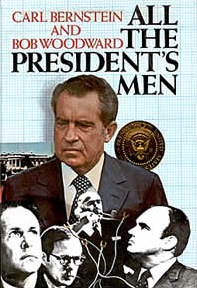
One factor was Woodward and Bernstein’s engaging book about their Watergate reporting, All the President’s Men, which came out in June 1974, just as the scandal was nearing culmination.

As Stanley I. Kutler, Watergate’s preeminent historian, has written, All the President’s Men “offered a journalistic brief to the nation as it prepared to understand and judge for itself” the growing evidence of Nixon’s guilt.

All the President’s Men was quite the success, holding the top spot on the New York Times’ non-fiction best-seller list for 15 weeks — through the climatic days of Watergate and beyond.

“The book’s impeccable timing,” I write in Getting It Wrong, served to “promote an impression that Woodward and Bernstein were central to Watergate’s ultimate outcome.”

The book that helped promote a myth

That impression was deepened in the cinematic version of All the President’s Men, which was released to great fanfare and rave reviews in April 1976.

The movie placed Woodward and Bernstein at the center of Watergate’s unraveling — and minimized or ignored the far more decisive contributions of subpoena-wielding investigators.

Indeed, rolling up a scandal of Watergate’s dimension and complexity required the collective efforts of special prosecutors, federal judges, both houses of Congress, the Supreme Court, as well as the Justice Department and the FBI.

And even then, as I write in Getting It Wrong, Nixon likely would have survived the scandal and served out his term if not for the audiotape recordings he secretly made of conversations in the Oval Office of the White House.

Only when compelled by the Supreme Court did Nixon surrender the recordings, which captured him approving a plan to divert the FBI’s investigation into Watergate’s seminal crime, the break-in June 17, 1972, at the headquarters of the Democratic National Committee.

The third factor in pressing the heroic-journalist myth firmly into the popular consciousness was the 30-year guessing game about the identity of Woodward’s stealthy, high-level source whom a Post editor code-named “Deep Throat.”

Speculation about the identity of “Deep Throat” came not infrequently and was often prominent. The guessing game offered periodic reminders about the Post and its Watergate coverage. The speculation effectively kept Woodward and Bernstein in the public eye far longer than they otherwise might have.

In 2005, W. Mark Felt, formerly second in command at the FBI, disclosed that he had been the “Deep Throat” source — giving rise to yet another round of reminiscing about the heroic journalists  of Watergate.

Such preening was misplaced, of course.

As Max Holland, author of Leak, a recent book about Watergate and “Deep Throat,” has aptly put it:

“Federal prosecutors and agents never truly learned anything germane from The Washington Posts [Watergate] stories — although they were certainly mortified to see the fruits of their investigation appear in print. … The government was always ahead of the press in its investigation of Watergate; it just wasn’t publishing its findings.”

Interestingly, principals at the Post have periodically scoffed at and rejected the heroic-journalist narrative.

For example, Katharine Graham, the Post’s publisher during and after Watergate, said at a program in 1997 marking the scandal’s 25th anniversary:

“Sometimes people accuse us of bringing down a president, which of course we didn’t do. The processes that caused [Nixon’s] resignation were constitutional.”

And Woodward  complained in 1996 that “the mythologizing of our role in Watergate has gone to the point of absurdity, where journalists write … that I, single-handedly, brought down Richard Nixon.

“Totally absurd.”

Indeed. To explain Watergate through the lens of the heroic-journalist is to simplify and misunderstand the scandal. It is to misread history and indulge in a beguiling media-driven myth.

WJC

Recent or related:

National Press Club invokes media myths of Watergate

In Media myths, Newspapers, Scandal, Washington Post, Watergate myth on April 30, 2012 at 5:45 am

The National Press Club indulged in a couple of tenacious media myths about Watergate in announcing the other day it was giving its top award to Bob Woodward, one of the Washington Post’s lead reporters on what was the country’s greatest political scandal.

In its statement that Woodward will receive this year’s Fourth Estate Award, the Press Club declared that his “work on the Watergate scandal led to the resignation of an American president” — an interpretation that not even Woodward embraces.

He once told the PBS “Frontline” program that “the mythologizing of our role in Watergate has gone to the point of absurdity, where journalists write … that I, single-handedly, brought down [President] Richard Nixon. Totally absurd.”

And on another occasion, Woodward declared more bluntly:

To say that the press brought down Nixon, that’s horseshit.”

As I note in my latest book, Getting It Wrong, the simplified notion that Woodward’s Watergate reporting for the Post led to Nixon’s resignation serves to diminish “the far more decisive forces that unraveled the scandal and forced Nixon from office.”

To roll up a scandal of the dimension of Watergate required, I write, “the collective if not always the coordinated forces of special prosecutors, federal judges, both houses of Congress, the Supreme Court, as well as the Justice Department and the FBI.

“Even then, Nixon likely would have served out his term if not for the audiotape recordings he secretly made of most conversations in the Oval Office of the White House” — recordings the U.S. Supreme Court ruled that he had to surrender.

So the notion that Woodward’s reporting for the Post was decisive to Watergate’s outcome is absurd.

So, too, is the subsidiary myth that Watergate reporting — and the cinema’s depiction of the Post’s coverage in All the President’s Men — made the field seem so alluring  that enrollments in college journalism programs surged as a result.

The Press Club statement about Woodward’s award invokes that myth, too, asserting that “enrollment in journalism departments rose in the post-Watergate era, especially after ‘All the President’s Men’ was made into a movie.” It was based on a book by the same title, which was written by Woodward and his Post colleague, Carl Bernstein.

As I point out in Getting It Wrong, however, separate scholarly studies have debunked the notion of Watergate’s  propellant effect on college enrollments in journalism.

One study, conducted for the Freedom Forum media foundation and released in 1995, said that “growth in journalism education result[ed] not from specific events as Watergate … but rather to a larger extent from the appeal of the field to women, who ha[d] been attending universities in record numbers.”

The study’s author, Lee Becker and Joseph Graf, stated flatly:

“There is no evidence … that Watergate had any effect on enrollments.”

A separate study, conducted by veteran journalism scholar Maxwell E. McCombs and published in 1988, reported that “the boom in journalism education was underway at least five years before” the Watergate break-in in 1972.

McCombs further wrote:

“It is frequently, and wrongly, asserted that the investigative reporting of Woodward and Bernstein provided popular role models for students, and led to a boom in journalism school enrollments. The data … reveal, however, that enrollments already had doubled between 1967 and 1972….”

So why are these Watergate myths so appealing, and so tenacious, that even the National Press Club embraces them?

One reason is that they’re simplistic, easy-to-remember narratives that locate the news media heroically at the heart of unraveling America’s greatest political scandal.

Indulging in myths such as the heroic-journalist trope of Watergate also offers a subtle way of investing the Press Club award with even greater distinction.

And as I note in Getting It Wrong, the tale about how “the Post and its reporters uncovered Watergate is deeply ingrained in American journalism as one of the field’s most important and self-reverential stories.”

It’s a myth that’s no doubt too resilient, too media-centric, and too widely applicable ever to eradicate.

WJC