W. Joseph Campbell

Archive for the ‘Watergate myth’ Category

‘Getting It Wrong’ launched at Newseum

In Cronkite Moment, Debunking, Furnish the war, Media myths, Murrow-McCarthy myth, Spanish-American War, Washington Post, Watergate myth on June 20, 2010 at 2:09 pm

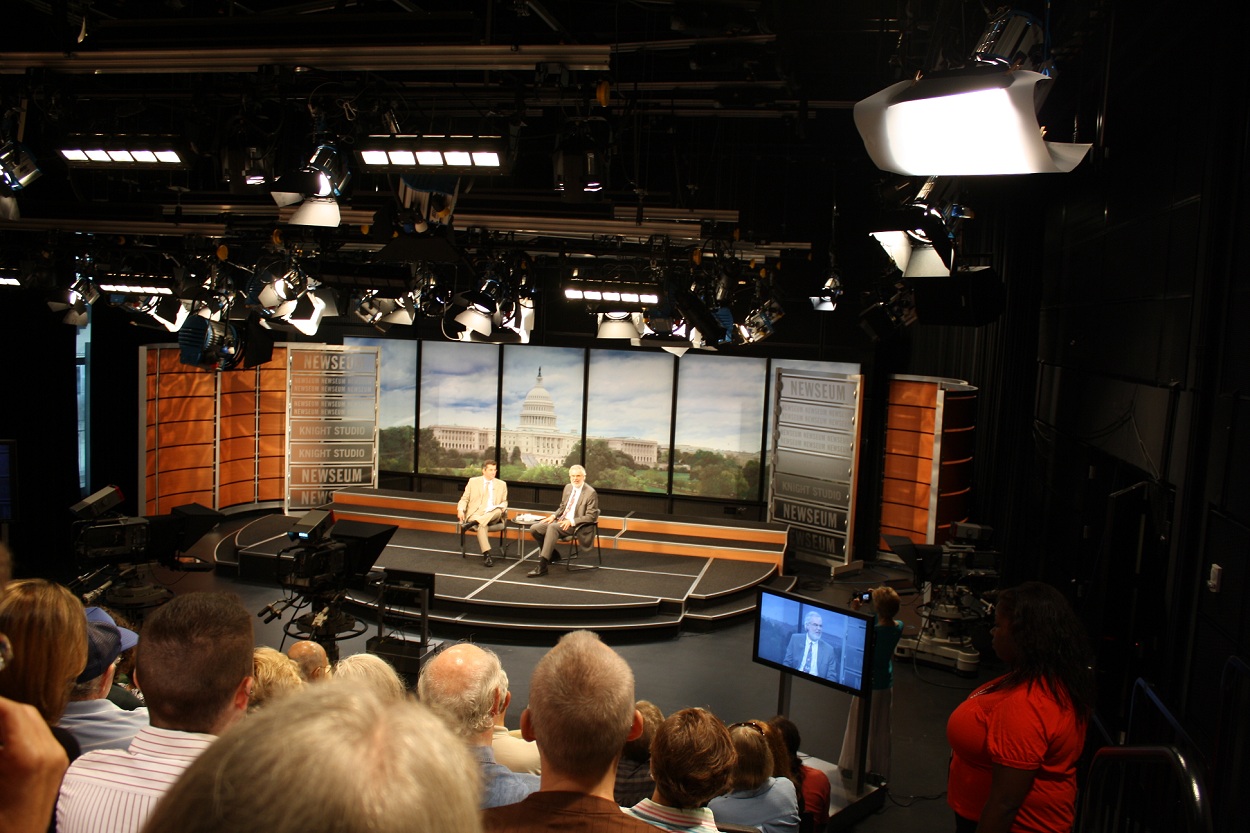
Newseum program, audience view

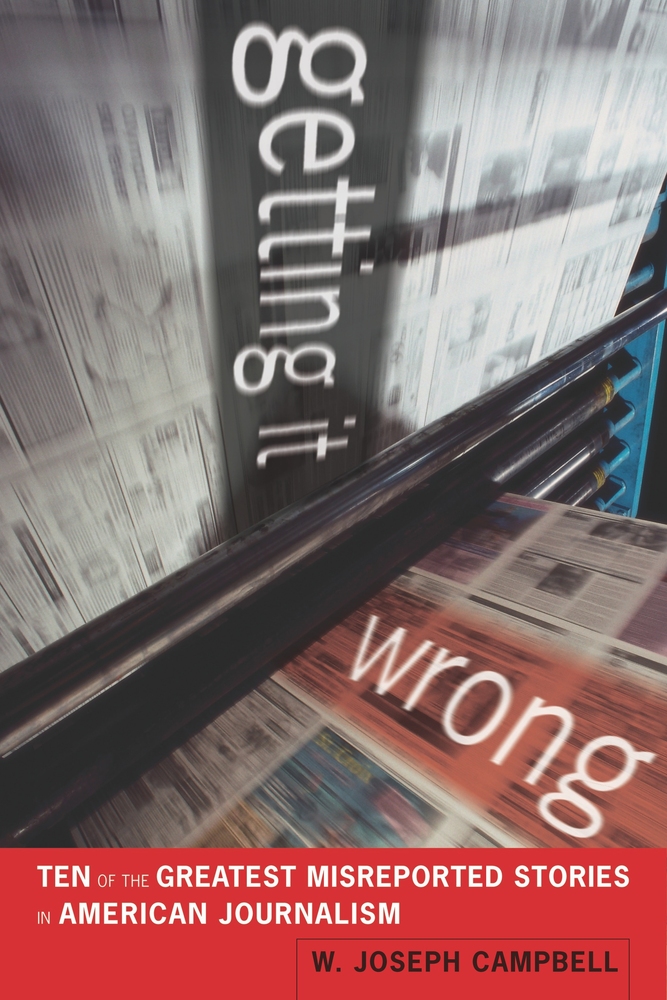
Getting It Wrong, my new book about media-driven myths, was launched at a terrific program yesterday at the Newseum, the $450 million museum of news in downtown Washington, D.C.

The Newseum’s John Maynard moderated a brisk “Inside Media” talk, during which I reviewed the myths of:

  • William Randolph Hearst’s purported vow to “furnish the war” with Spain,
  • Edward R. Murrow‘s  1954 See It Now television program that supposedly ended Senator Joseph R. McCarthy’s communists-in-government witch-hunt,
  • the so-called “Cronkite moment” of 1968,
  • the heroic-journalist of Watergate, and
  • the supposedly superlative reporting in the immediate aftermath of Hurricane Katrina‘s landfall in 2005.

The audience (see photo, above) posed several intriguing questions about the book. Among them was whether I thought the media myths confronted in Getting It Wrong would now be forever buried.

It’s probably too soon to say, given the book’s recent publication. But I mentioned in my reply that I’ve been struck by how dearly some myths are held.

The myth of the “Cronkite moment” is an example, I said: It seems quite difficult for some people to believe that Walter Cronkite’s program on Vietnam in February 1968 was not of decisive effect.

The “Cronkite moment” may live on, and continue to be embraced, despite the weight of the evidence that Cronkite’s television report about Vietnam was of scant importance in revising policy or in shaping the president’s thinking about reelection.
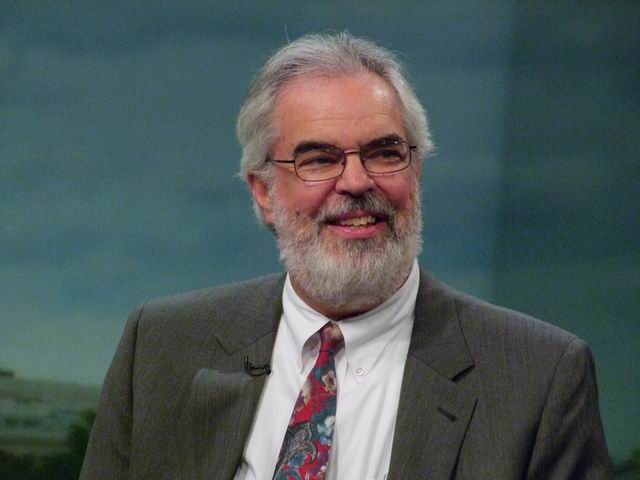
At the book launch

A question was posed about how media myths emerge, and I noted that they arise from several sources, including an urge to identify examples of media power. Another factor is  what I call “complexity-avoidance”–the appeal of simplified explanations for complex historical events.

It is, after all, far easier to believe that Hearst and his “yellow press” brought on the Spanish-American War in 1898, I said, than it is to grasp the complexities of the failed diplomacy among Spain, Cuba, and the United States that gave rise to that conflict. It is far easier to believe that the Washington Post brought down Richard Nixon’s corrupt presidency, I said, than it is to sort through tangled lines of investigation of the Watergate scandal that ultimately forced Nixon from office.

Even then, I said, Nixon may have served out his term if not for the tape-recordings he made of his private Oval Office conversations. Those tapes, which the U.S. Supreme Court forced Nixon to produce in 1974, revealed his guilty role in the Watergate coverup.

I also was asked whether there are other media myths to bust.

Indeed there are, I said.

Getting It Wrong may deserve a sequel and suggested as candidates for a follow-on book the dubious phenomenon of “Pharm Parties” and the question of whether Cronkite really was “the most trusted man in America.”

Book signing at Newseum

I signed copies of Getting It Wrong following the “Inside Media” program, and then toasted the book’s publication at a reception sponsored by the Newseum and American University’s School of Communication.

The School’s dean, Larry Kirkman, offered generous remarks in his toast at the reception, which was attended by AU colleagues, former students, past research assistants, and friends and family.

WJC

Related:

Photo credits:

  • Ruxandra Giura (audience view)
  • Bruce Guthrie

‘Regret the Error’ considers ‘Getting It Wrong’

In Cronkite Moment, Debunking, Jessica Lynch, Media myths, Reviews, Watergate myth on June 18, 2010 at 6:41 pm

Craig Silverman’s latest “Regret the Error” column, posted today at the Columbia Journalism Review online site, offers a searching discussion of my new book, Getting It Wrong, and notes, insightfully:

“Every society needs heroes and villains, and stories that help forge identity and community. That’s why myths exist in the first place. But the press has the ability and means to shape and disseminate the tales of champions and villains, to create and propagate stories that reinforce role and identity. Media-driven myths are particularly powerful, which in turn makes them even harder to debunk.”

Silverman is the author of the well-received 2007 book, Regret the Error: How Media Mistakes Pollute the Press and Imperil Free Speech. His column discussing Getting It Wrong begins this way:

“Journalism is a profession built on storytelling, so it’s no surprise that its history is filled with some remarkable tales. Think Woodward and Bernstein bringing down a president. Or Walter Cronkite’s 1968 CBS News special about Vietnam that caused President Lyndon Johnson to exclaim, ‘If I’ve lost Cronkite, I’ve lost Middle America.’ Think of Edward R. Murrow demolishing Senator [Joe] McCarthy’s communist witch hunt on television, or William Randolph Hearst telling his correspondent in Cuba, ‘You furnish the pictures, I’ll furnish the war.’

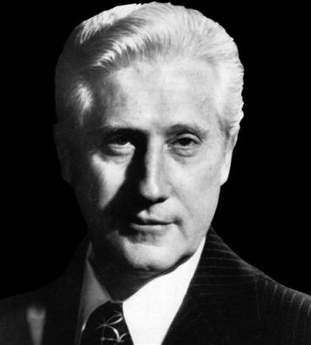
McCarthy

“Great stories, all of them. If only they were built on facts—the other thing our profession is supposed to revere. W. Joseph Campbell, a professor at American University and respected journalism scholar, smashes the above media-driven myths, along with a few more, in his new book, Getting It Wrong: Ten of the Greatest Misreported Stories in American Journalism.”

About the emergence of media-driven myths, Silverman quotes me as saying:

“The notion of media power both for good, as in the Watergate example, or for bad, as in the William Randolph Hearst example, is one of the driving forces behind media myths.”

Indeed. Media myths, I write in Getting It Wrong, often stem from “an eagerness to find influence and lasting significance in what journalists do and tend to extend credit where credit is not entirely due.”

I further note in the book that media myths can “be self-flattering, offering heroes … to a profession more accustomed to criticism than applause.”

Silverman’s column wraps up by considering how to combat media-driven myths, quoting me as underscoring the importance of viewpoint diversity in American media newsrooms.

“There is room for a newsroom culture that embraces diverse viewpoints, and I think that will help encourage skepticism … and negate the groupthink that tends to take hold in newsroom culture,” he quotes me as saying.

“Challenging the dominant narrative and encouraging contrarian thinking is a good thing.”

On that point, I write in Getting It Wrong:

“It is certainly not inconceivable that a robust newsroom culture that embraces viewpoint diversity, encourages skepticism, invites challenges to dominant narratives, and rewards contrarian thinking would have helped thwart publication of embarrassing tales such as the Washington Post’s ‘fighting to the death‘ story about Jessica Lynch.”

WJC

Related:

Launching ‘Getting It Wrong’ at Newseum

In Bay of Pigs, Bra-burning, Cronkite Moment, Debunking, Furnish the war, Jessica Lynch, Media myths, Murrow-McCarthy myth, War of the Worlds, Washington Post, Watergate myth on June 14, 2010 at 6:28 am

My new book, Getting It Wrong, will be launched Saturday, June 19, at an “Inside Media” program at the Newseum, the $450 million museum of news in downtown Washington, D.C.

The program will begin at 2:30 p.m. in the Knight TV Studio on the third level and will feature a discussion with the Newseum’s John Maynard, followed by audience Q-and-A.

I’ll be signing copies of Getting It Wrong afterward.

The book addresses, and debunks, 10 prominent media-driven myths–stories about and/or by the news media that are widely believed and often retold but which, on close inspection, proved to be apocryphal or wildly exaggerated.

Here is a brief description about each of the 10 myths:

  1. Remington-Hearst: William Randolph Hearst’s famous vow, “you furnish the pictures, I’ll furnish the war,” is almost certainly apocryphal.
  2. War of Worlds: The notion that the War of Worlds radio dramatization in 1938 caused nationwide panic and mass hysteria is exaggerated.
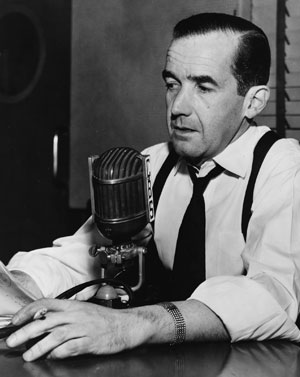
  3. Murrow-McCarthy: Edward R. Murrow’s famous See It Now program in March 1954 did not end Senator Joseph McCarthy’s communists-in-government witch-hunt; Murrow in fact was very late to take on McCarthy.

    Murrow in 1954

  4. Bay of Pigs: The New York Times did not suppress its reporting in the run-up to the ill-fated Bay of Pigs invasion in April 1961.
  5. Cronkite-Johnson: Walter Cronkite’s special report on Vietnam in February 1968 did not prompt an immediate reassessment of U.S. war policy.
  6. Bra-burning: Humor columnist Art Buchwald helped spread the notion that feminist demonstrators dramatically burned their bras at a Miss America protest in September 1968.
  7. Watergate: The Washington Post’s intrepid reporters, Carl Bernstein and Bob Woodward, did not bring down Richard Nixon’s corrupt presidency. That they did is a trope that knows few bounds.
  8. Crack babies: The much-feared “bio-underclass” of children born to women who smoked crack cocaine during their pregnancies never materialized.
  9. Jessica Lynch: The Washington Post’s erroneous reporting about Jessica Lynch early in the Iraq War gave rise to several myths about her capture and rescue.
  10. Hurricane Katrina: News coverage of Katrina’s aftermath in New Orleans in early September 2005 was marred by wild exaggerations of extreme, Mad Max-like violence.

As I write in Getting It Wrong, the myths debunked “are among American journalism’s best-known stories. Most of them are savory tales. And at least some of them seem almost too good to be false.”

I further write that because it “takes on some of the most treasured stories in American journalism,” Getting It Wrong is “a work with a provocative edge. It could not be otherwise.”

WJC

Related:

‘Commentary’ reviews ‘Getting It Wrong’

In Cronkite Moment, Debunking, Murrow-McCarthy myth, Reviews, Washington Post, Watergate myth on June 4, 2010 at 11:27 am

The June 2010 number of Commentary magazine includes a fine, favorable, and thoughtful review of Getting It Wrong, my new book about media-driven myths.

The reviewer, Andrew Ferguson, who writes the “Press Man” column for Commentary, says of Getting It Wrong:

“It may be the best book about journalism in recent memory; it is certainly the most subversive.”

A wonderful, telling line, that.

He also writes:

“Campbell does what journalists, and most journalism professors, seldom think to do when they exchange the oft-repeated tales: he checks them out. And through a pitiless accretion of detail, he dissolves them one by one.

“As he reveals, Edward R. Murrow did not ‘bring down Joe McCarthy’ with his famous 1954 episode of See It Now; Campbell looked up the poll numbers and found that McCarthy’s favorability ratings were in free fall well before Murrow took to the air.

“No, Cronkite did not turn the public against the Vietnam War with an on-air editorial in February 1968: five months earlier, Gallup had registered that a plurality of Americans, 47 percent, agreed that the war was a mistake.

“And no, Woodward and Bernstein were not responsible for uncovering the entirety of the Watergate scandal; as reporters, they had pretty much run out of scoops by October 1972, when congressional investigators, criminal prosecutors, and other newspapers took over the story and drove it till President Nixon’s resignation in August 1974.

“And no, the bestselling author David Halberstam, who promoted each of these stories with unfailing pomposity, was not a reliable chronicler of even the most recent past.”

Ferguson wraps up his review by writing:

“Journalism’s myths about journalism, you’ll notice, are self-aggrandizing. They cast the journalist as hero. No wonder they’re so popular… among journalists. We warm ourselves by such tales, draw compensation and comfort from them, which is why they’re taught in our trade schools as elements of basic training.”

WJC

Related:

‘Getting It Wrong’ goes ‘On Point’

In Cinematic treatments, Cronkite Moment, Debunking, Furnish the war, Media myths, Media myths and radio, Spanish-American War, Washington Post, Watergate myth on June 3, 2010 at 8:52 pm

I was interviewed today by Tom Ashbrook, the engaging host of NPR’s On Point program, which is produced by WBUR in Boston.

We discussed Getting It Wrong, my new book about media-driven myths, and it was a fine show. (Audio is available here.)

As Ashbrook promised in his introduction, the conversation ranged over a variety of topics–or what he called “iconic media tales from the Spanish-American War to Hurricane Katrina.”

We were joined by Jack Beatty, the program’s news analyst, and discussed at some length the myth of the so-called “Cronkite Moment” of 1968, in which CBS News anchorman Walter Cronkite characterized the war in Vietnam as a stalemate, supposedly prompting President Lyndon Johnson to alter his policy on the conflict.

We also took up myth surrounding the famous anecdote about William Randolph Hearst’s purported vow to “furnish the war” with Spain at the end of the 19th century, the dubious notion that Orson Welles’ 1938 radio dramatization of the War of the Worlds set off nationwide panic and mass hysteria, and what I call the heroic-journalist myth of Watergate, in which Bob Woodward and Carl Bernstein of the Washington Post supposedly brought down Richard Nixon’s corrupt presidency.

On the latter topic, I mentioned how the cinematic version of All the President’s Men, Woodward and Bernstein’s book about their Watergate reporting, has become the vehicle by which people learn about and remember the scandal.

Watergate was, I noted, “so complex that people these days, many years removed from it, find it hard to keep it all straight. … The high-quality, cinematic treatment of the Watergate scandal, featuring Woodward and Bernstein and the Washington Post in All the President’s Men, does happen to be the way that many people remember the Watergate scandal. …

“The movie’s a great movie,” I added. “But it helped to solidify the notion that the Post, the Washington Post, and Woodward and Bernstein were at the center, were at the heart, of uncovering the scandal.”

On Point featured questions and comments from a few callers–including a guy named Phil in Bowling Green, Kentucky, who said about me:

“I think the professor has got too much time on his hands. ” I chuckled.

He added: “I lived through most of that–the Watergate and Vietnam War.  I think he’s underestimating the persuasive attitude that Walter Cronkite had on this country. … Everybody’s opinion turned on what Walter Cronkite thought.”

But another caller, Gary from Nashville, Tennessee, weighed in, saying he disagreed with Phil from Bowling Green, offered the thought that public opinion about Vietnam turned not on the views of one journalist but on “the unrelenting reporting on the war by the media.”

It was a lively, substantive program that has generated a few dozen or so comments at the On Point online site.

The discussion made me recognize anew how deeply embedded and tenaciously held some media-driven myths really are, and how an hour-long program is hardly enough to encourage people even to think about giving them up. As Jack Shafer noted in his review of Getting It Wrong, “a debunker’s work is never done.”

But perhaps the show’s content will entice some listeners to buy and read the book. Even then, though, I suspect some media myths will prove resistant to thorough debunking.

WJC

Related:

A funny thing about media myths

In Cronkite Moment, Debunking, Media myths, Washington Post, Watergate myth on June 2, 2010 at 6:03 pm

Media-driven myths are prominent tales of doubtful authenticity—false, dubious, or improbable stories about the news media that masquerade as factual.

A funny thing about media-driven myths is that some of them live on despite having been pooh-poohed by figures who were central to the story.

The heroic-journalist myth of Watergate offers a telling example of this peculiar feature of some media myths.

The Watergate myth—one of 10 that I debunk in my soon-to-be-published book, Getting It Wrong—maintains that the intrepid investigative reporting of Bob Woodward and Carl Bernstein of the Washington Post brought down Richard Nixon’s corrupt presidency in the Watergate scandal.

“That Woodward and Bernstein exposed Nixon’s corruption is a favored theme in textbooks of journalism and mass communication,” I write in Getting It Wrong, noting how the tale has become “deeply ingrained in American journalism as one of the field’s most important and self-reverential stories.”

But leading figures at the Washington Post have sought periodically over the years to dismiss the notion that their newspaper took down a president.

Katharine Graham, the newspaper’s publisher during the Watergate years, insisted the Post did not topple Nixon. “Sometimes people accuse us of bringing down a president, which of course we didn’t do,” Graham said in 1997, at a program marking the scandal’s twenty-fifth anniversary. “The processes that caused [Nixon’s] resignation were constitutional.”

And Woodward has been quoted as saying, “To say that the press brought down Nixon, that’s horseshit.”

As I note in Getting It Wrong, to roll up a scandal of Watergate’s dimension and complexity “required the collective if not always the coordinated forces of special prosecutors, federal judges, both houses of Congress, the Supreme Court, as well as the Justice Department and the FBI.

“Even then,” I write, “Nixon likely would have served out his term if not for the audiotape recordings he secretly made of most conversations in the Oval Office of the White House. Only when compelled by the Supreme Court did Nixon surrender those recordings, which captured him plotting the cover-up and authorizing payments of thousands of dollars in hush money.”

Similarly, Walter Cronkite long dismissed claims that his televised report in February 1968 about the Vietnam War had a powerful influence on President Lyndon Johnson.

In an editorial comment at the close of that report, Cronkite said the war effort in Vietnam was “mired in stalemate” and suggested that negotiations eventually might offer a way out for the United States.

Upon hearing Cronkite’s dire assessment, Johnson supposedly snapped off the television set and exclaimed: “If I’ve lost Cronkite, I’ve lost Middle America.”

Or something to that effect. Versions vary.

The program and Johnson’s despairing response have become the stuff of legend—another media-driven myth.

Interestingly, Cronkite scoffed at the suggestion his report on Vietnam had a great effect on Johnson. For years, he characterized the program in modest terms, writing in his 1997 memoir that the “mired in stalemate” assessment was for Johnson “just one more straw in the increasing burden of Vietnam.”

But in what may have been tacit acknowledgement of the appeal of media-driven myths, Cronkite late in his life came to embrace the view that the program on Vietnam was a significant moment.

For example, he told Esquire magazine in 2006, about three years before his death:

“To be honest, I was rather amazed that my reporting from Vietnam had such an effect on history.”

But as is discussed in Getting It Wrong, Johnson did not see the Cronkite program when it aired. The president at the time was in Austin, Texas, making an appearance at the 51st birthday of a longtime political ally, Governor John Connally.

“Today you are 51, John,” the president said at about the time Cronkite was offering his “mired in stalemate” commentary. “That,” Johnson said, “is the magic number that every man of politics prays for—a simple majority.”

WJC

An earlier version of this post first appeared at the University of California Press blog.

‘Deep Throat’ outed self, five years ago today

In Anniversaries, Debunking, Media myths, Washington Post, Watergate myth on May 31, 2010 at 3:39 pm

It’s been five years since W. Mark Felt outed himself as the shadowy “Deep Throat” source of the Watergate scandal, the former No. 2 official at the FBI who in places like parking garages periodically passed information to Bob Woodward of the Washington Post.

Remarkably, Felt’s identity as the elusive “Deep Throat” had remained a secret (and was the subject of often-intense speculation) for more than 30 years, until Vanity Fair published an article on May 31, 2005, disclosing Felt’s “Deep Throat” role.

Felt was then 91 and in declining health. He died in 2008.

As I write in Getting It Wrong, my forthcoming book about media-driven myths, the prolonged guessing game about the identity of “Deep Throat” helped solidify the notion that the Washington Post was central to uncovering Watergate scandal. (Stanley I. Kutler, the leading historian of Watergate, once wrote that the “endless, pointless game of trying to identify Deep Throat” was a distraction from the lessons of Watergate.)

Getting It Wrong includes a chapter addressing and debunking what I call the heroic-journalist myth of Watergate–that the reporting of Woodward and his Post colleague, Carl Bernstein, brought down Richard Nixon’s corrupt presidency.

I write that the “guessing game about the identity of the ‘Deep Throat’ source provided periodic and powerful reminders about the Post and its Watergate coverage, serving to keep Woodward and Bernstein in the public eye far longer than they otherwise would have been.”

I also note:

“They and the mysterious ‘Deep Throat’ source became central figures” in what the Philadelphia Inquirer described as “the parlor game that would not die. … With each passing year, as ‘Deep Throat’s’ cloak of anonymity remained securely in place, his perceived role in Watergate gained gravitas.”

“And so,” I write, “… did the roles of Woodward and Bernstein.”

Although many people were named in the guessing game about “Deep Throat,” Felt always ranked high on the roster of likely candidates. As I note in Getting It Wrong, speculation about who was “Deep Throat” began in June 1974, with a front-page article in the Wall Street Journal, and continued periodically for the next 31 years.

The Journal article appeared soon after publication of All the President’s Men, Woodward and Bernstein’s best-selling book about Watergate in which they introduced the furtive source they called “Deep Throat.” The Journal article described Felt as the top suspect.

But Felt repeatedly denied having been “Deep Throat.” He was quoted as saying in the Journal article in 1974:

“I’m just not that kind of person.”

He told the Hartford Courant newspaper in 1999 that he “would have been more effective” had he indeed been Woodward’s secretive source, adding:

“Deep Throat didn’t exactly bring the White House crashing down, did he?”

On the day Felt was confirmed to have been “Deep Throat,” his family issued a statement calling him “a great American hero who went well above and beyond the call of duty at much risk to himself to save his country from a horrible injustice. We all sincerely hope the country will see him this way as well.”

But Felt hardly was such a noble character.

In his senior position at the FBI, Felt had authorized illegal burglaries as part of FBI investigations into leftists associated with the radical Weather Underground in the early 1970s.

Felt was convicted in 1980 on felony charges related to the break-ins but pardoned by President Ronald Reagan.

WJC

Related:


Recalling Mansfield’s contribution to unraveling Watergate

In Debunking, Media myths, Washington Post, Watergate myth on May 29, 2010 at 1:22 pm

Politics Daily posted yesterday an admiring piece–make that a hagiographic piece–about former U.S. Senate leader Mike Mansfield, saying his “savvy and sensibilities … are what our politics need on Memorial Day 2010.”

Well, maybe.

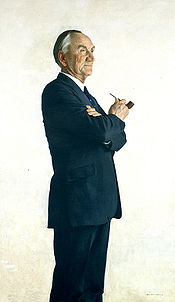
Mansfield (left), who died in 2001, was a Democrat from Montana and the Senate’s longest-serving majority leader, holding the position from 1961-1977.

In its most interesting passage, the Politics Daily commentary recalled Mansfield’s seldom-remembered contribution to unraveling the Watergate scandal, which culminated with President Richard Nixon’s resignation in 1974.

The commentary noted:

“He insisted on a special Senate committee to investigate the unfolding sins of the Nixon era … Because of Mike’s strategic decision to make the Senate investigation open, fair and bipartisan, the country supported a constitutional political process that, for the first time in history, forced a crook out of the White House.”

While that’s a bit over the top, it is clear that Mansfield’s efforts as majority leader to empanel a bipartisan select committee was crucial to the outcome of the scandal, which broke in June 1972 with the arrest of burglars inside Democratic National headquarters at the Watergate complex in Washington, D.C.

As Stanley I. Kutler, the leading historian of the scandal, wrote in his fine book, The Wars of Watergate:

“Watergate might have remained as the story-that-never-was had it not been for the determination of Mike Mansfield and Sam Ervin.”

Ervin, a Democrat from North Carolina, “played a crucial role in securing Senate passage of a resolution calling for the creation of a Select Committee to investigate illegal and unethical conduct in the 1972 presidential campaign,” Kutler wrote. “Mansfield, meanwhile, worked behind the scenes to marshal Democratic support for the resolution. He kept Ervin in the forefront, shrewdly using Ervin’s political capital among Southern Democrats and Republican senators.”

Ervin presided over the hearing of the select committee, which riveted much of the country during the summer of 1973. Its investigation led to the disclosure that Nixon had secretly tape-recorded most Oval Office conversations. Those tapes were crucial to revealing Nixon’s complicity in the scandal and forcing his resignation.

So why is this of interest, and pertinent, to Media Myth Alert?

Recalling Mansfield’s role illustrates anew how a variety of forces were needed to bring down Nixon’s corrupt presidency–a point raised in Getting It Wrong, my soon-to-be-published book that debunks prominent media-driven myths, those false, dubious, or improbable stories about the news media that masquerade as factual.

As I write in Getting It Wrong, rolling up a scandal of Watergate’s complexity required “the collective if not always the coordinated forces of special prosecutors, federal judges, both houses of Congress, the Supreme Court, as well as the Justice Department and the FBI.”

Even then, I argue, “Nixon likely would have served out his term if not for the audiotape recordings.”

The media-centric interpretation of Watergate is that the investigative reporting of the Washington Post was what brought down Nixon. A related claim is that if its reporting didn’t exactly take Nixon down, the Post alone kept the story alive in the summer and fall of 1972, when few people and institutions were much interested in Watergate.

Such claims are mistaken.

The Post didn’t take down Nixon; as leading figures at the newspaper have insisted as much from time to time over the years.

Nor was the Post alone in digging into Watergate during the summer and fall 1972. As I note in Getting It Wrong, rival news organizations such as Los Angeles Times and New York Times also pursued the scandal during those months.

Despite some revealing reporting by the Post and other news organizations, the dimensions of the Watergate scandal were hardly certain by May 1973, when the Senate select committee convened. It was “like an unassembled picture puzzle with crucial pieces missing,” Ervin recalled in his memoir of Watergate.

But with the committee’s hearings during summer of 1973, the scope of the scandal became clearer, leading relentlessly to Nixon and his closest aides.

WJC

Related:

Media myths, the ‘junk food of journalism’

In Debunking, Furnish the war, Murrow-McCarthy myth, Spanish-American War, Washington Post, Watergate myth on May 26, 2010 at 9:14 pm

Media-driven myths, the subject of my soon-to-be-published book, Getting It Wrong, are prominent tales of doubtful authenticity—false, dubious, or improbable stories about the news media that masquerade as factual.

The  myths addressed and debunked in the book include the notion that two intrepid reporters for the Washington Post took down Richard Nixon’s corrupt presidency, that Edward R. Murrow’s See It Now television program brought an end to Senator Joseph McCarthy’s communists-in-government witch-hunt, and that newspaper magnate William Randolph Hearst vowed to “furnish the war” with Spain at the end of the 19th century.

“In a way,” I write in Getting It Wrong, media myths “are the junk food of journalism—alluring and delicious, perhaps, but not especially wholesome or nourishing.”

But why bother: Why devote a book to debunking media-driven myths?

It’s a question that, somewhat to my surprise, arises not infrequently.

Several answers offer themselves.

For one, there is inherent value is seeking to set straight the historical record. As I write in Getting It Wrong, “the effort to dismantle [media myths] is certainly worthy, if only to insist on a demarcation between fact and fiction.” That effort is aligned with a core objective of newsgathering—that of getting it right.

Media-driven myths, moreover, are neither trivial nor innocuous. They can have adverse consequences. They tend, for example, to minimize the nuance and complexity of historical events and offer simplistic and misleading interpretations instead. It’s effortless and undemanding to say the Washington Post brought down Nixon, that Murrow ended McCarthyism, or that Hearst plunged the United States into war with Spain. The historical reality in each of those cases is, of course, significantly more complex.

So media-driven myths distort popular understanding about the roles and functions of journalism in American society. They tend to confer on the news media far more power and influence than they typically wield.

Media influence, I write in the book, usually “is trumped by other forces” and further undercut by the traditional self-view of American journalists as messengers first, rather than as makers and shapers of news.

What’s more, the news media these days are too splintered and diverse—print, broadcast, cable, satellite, online—to exert much in the way of collective and sustained influence on policymakers or media audiences.

Thus, debunking media-driven myths can help to locate media influence in a more coherent context. Getting It Wrong offers the case that such influence tends to modest, nuanced, and situational.

There are occasions, though, when the splintered news media coalesce and devote exceptionally intense attention to a single topic—such as Hurricane Katrina’s rampage along the Gulf Coast nearly five years ago. The news media gave themselves high marks for their coverage of the disaster’s aftermath, especially of the federal government’s fitful response.

But as I discuss in Getting It Wrong, the coverage also was characterized by highly exaggerated reports of nightmarish violence and wanton criminality in New Orleans in the hurricane’s wake. The misreporting of the disaster’s aftermath, I write, effectively “defamed a battered city and impugned its residents at a time of their deep despair.”

Thus, another reason why debunking matters—media-driven myths can and do feed prejudices and stereotypes.

Finally, confronting media myths discourages the tendency to regard prominent journalists in extreme terms—as heroes or villains. Piercing the myth surrounding Murrow renders him somewhat less Olympian. Similarly, debunking the myth about Hearst and his purported vow to “furnish the war” with Spain makes him seem less manipulative, and less demonic.

Getting It Wrong is a work with a provocative edge. Given that it takes on some of the most treasured stories in American journalism, it could not be otherwise.

WJC

This post first appeared at the University of California Press blog.

At HuffPo books

In Cronkite Moment, Debunking, Media myths, Washington Post, Watergate myth on May 22, 2010 at 8:27 am

Check out my guest post at the Huffington Post books page about Getting It Wrong, my forthcoming book about media-driven myths.

I discuss the book, which will be published soon by University of California Press, and address reasons that help explain the tenacity and enduring appeal of media-driven myths.

I write:

“They are, first of all, deliciously good stories–too good, almost, to be disbelieved.

“They also are appealingly reductive, in that they minimize complexity of historical events and offer simplistic and misleading interpretations instead. The Washington Post no more brought down [President Richard] Nixon than Walter Cronkite swayed [President Lyndon] Johnson’s views about the war in Vietnam. Yet those and other media myths endure because they present unambiguous, easy-to-remember explanations for complex historic events.

“Some media-driven myths can be self-flattering, offering up heroes in a profession more accustomed to scorn and criticism than applause.

“More important, though, is that media-driven myths often emerge from an eagerness to find influence and significance in what journalists do. These myths affirm the centrality of the news media in public life and ratify the notion the media are powerful, even decisive actors.

“To identify these tales as media-driven myths is to confront the reality that the news media are not the powerful agents they, and so many others, assume them to be.”

That’s often the case: Because the media are everywhere, it is easy, as Robert J. Samuelson once wrote, to confound their presence with power.

And as the sociologist Herbert J. Gans has observed:

“If news audiences had to respond to all the news to which they are exposed, they would not have time to live their own lives. In fact, people screen out many things, including the news, that could interfere with their own lives.”

WJC