W. Joseph Campbell

Posts Tagged ‘1968’

Johnson was ‘panicked’ by Cronkite show on Vietnam?

In Cronkite Moment, Debunking, Media myths on May 11, 2010 at 1:28 pm

The flexibility and wide applicability of prominent media-driven myths is little short of astonishing sometimes.

Cronkite in Vietnam, 1968

Take, for example, the column in today’s Jerusalem Post, which invoked the often-told anecdote about the supposed effects of Walter Cronkite’s special report in 1968 about the Vietnam War.

As I discuss in Getting It Wrong, my forthcoming book about media-driven myths, it is widely believed that President Lyndon Johnson essentially threw up his hands in dismay upon hearing Cronkite’s pessimistic assessment about the war.

Cronkite, the CBS News anchorman, said the U.S. military was “mired in stalemate” in Vietnam and suggested that negotiations might be a way out.

Johnson supposedly realized the war effort was now hopeless, telling an aide or aides, “If I’ve lost Cronkite, I’ve lost Middle America.”

Or something along those lines. Versions of what the president supposedly said vary markedly.

Today’s Jerusalem Post column offered another variation, saying that Johnson “panicked when he lost Walter Cronkite over Vietnam….”

Panicked?

What? How so?

As I discuss in Getting It Wrong, Johnson didn’t even see the Cronkite report when it aired late in the evening of February 27, 1968.

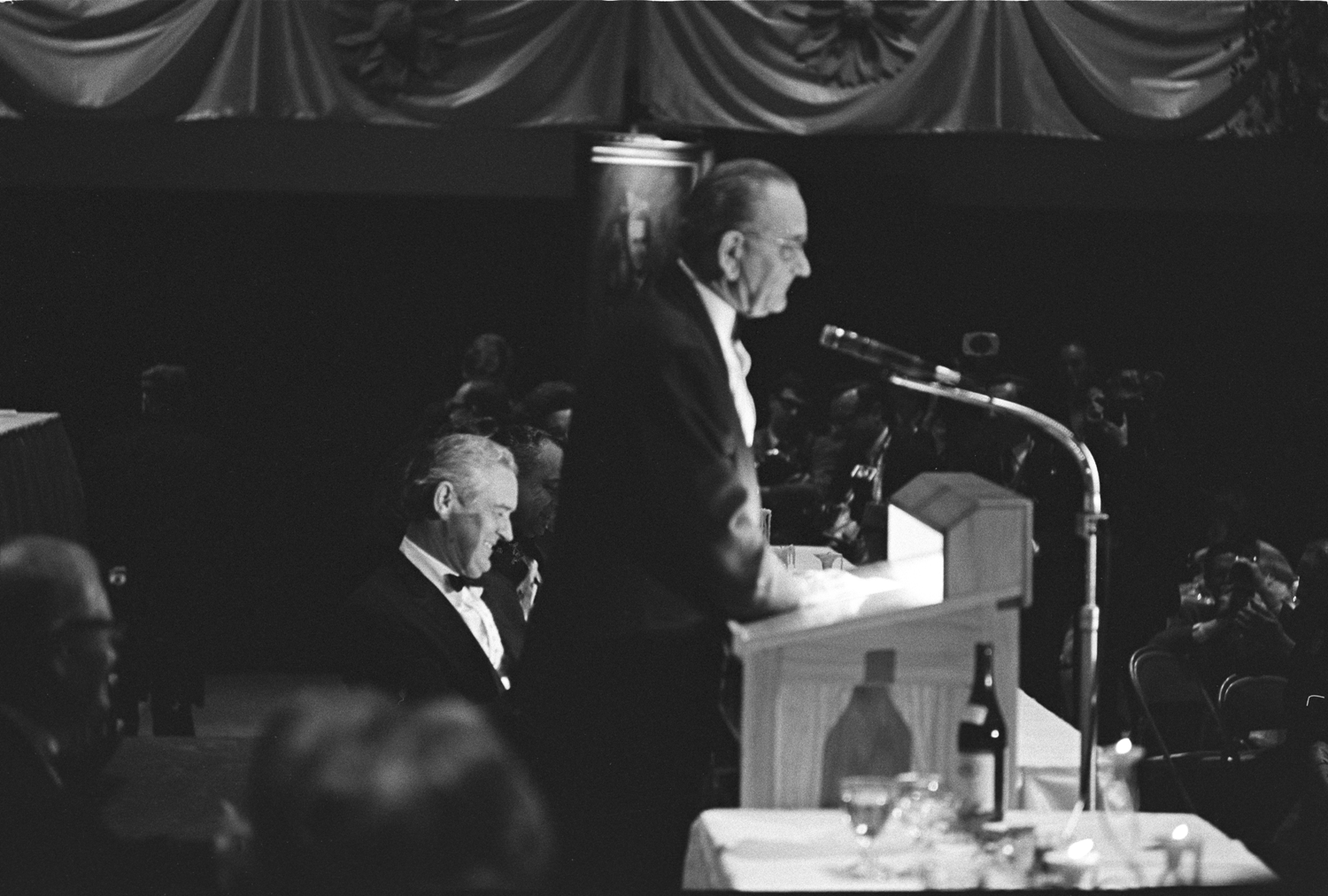
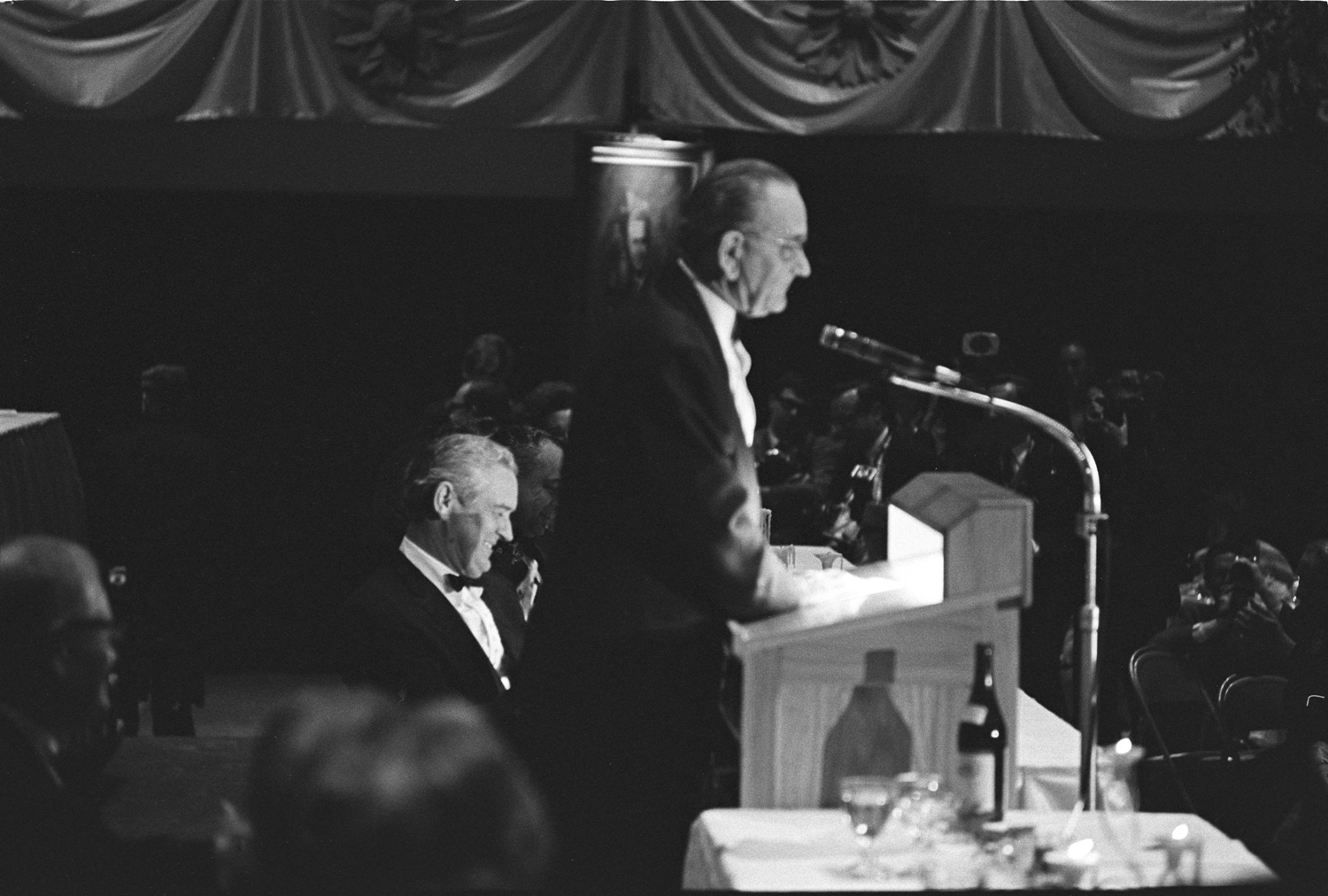
Johnson then was in Austin, Texas, at the 51st birthday party of Governor John Connally, one of his long-time political allies.

About the time Cronkite was intoning his downbeat assessment on Vietnam, Johnson was offering light-hearted remarks about Connally’s age, saying:

“Today you are 51, John. That is the magic number that every man of politics prays for—a simple majority. Throughout the years we have worked long and hard—and I might say late—trying to maintain it, too.”

No panic there.

Nor was there any in the days that followed.

I note in Getting It Wrong that even if Johnson saw the Cronkite program on videotape, the anchorman’s assessment represented no epiphany for the president.

About three weeks after the Cronkite program, I write, “Johnson gave a rousing, lectern-pounding speech in which he urged a ‘total national effort’ to win the war in Vietnam.”

So no panic there, either.

And on the day of the Cronkite program, Johnson offered a forceful defense of his war policy, vowing in a midday speech in Dallas there would be “no retreat from the responsibilities of the hour of the day.”

Johnson declared: “We are living in a dangerous world and we must understand it. We must be prepared to stand up when we need to. There must be no failing our fighting sons” in Vietnam.

“It seems inconceivable,” I write in Getting It Wrong, “that Johnson’s views [on Vietnam] would have pivoted so swiftly and dramatically, upon hearing the opinion of a television news anchor, even one as esteemed as Cronkite.”

It’s quite improbable.

So, no, Johnson wasn’t “panicked” by Cronkite’s assessment on Vietnam.

Not at all.

WJC

<!–[if !mso]> <!– st1\:*{behavior:url(#ieooui) } –> Johnson’s speech, the newspaper said, was “perhaps his strongest public call yet for unity in pushing the Vietnam war.”[i]


[i] Sell, “No Viet Retreat,” Los Angeles Times, 1.

‘Bra-burning feminists’: Who were they?

In Bra-burning, Debunking, Media myths on May 3, 2010 at 1:58 pm

A commentary today at the Huffington Post blog salutes trailblazing, rule-breaking American women–including the elusive “bra-burners” of the 1960s.

The commentary reads in part:

“From Revolutionary War icon Betsy Ross to World War II’s Rosie the Riveter, from sexually liberated 1920s femme fatale Louise Brooks to bra-burning feminists in the 1960s, from anti-slavery orator Sojourner Truth to controversial civil rights activist Angela Davis, American history is filled with female archetypes who pushed against the barriers of repression and social convention.”

True enough: History indeed counts many “female archetypes who pushed against the barriers of repression and social convention.”

But as for those “bra-burning feminists in the 1960s”–just who were they?

The commentary doesn’t say, leaving an implication that bra-burning was widespread, and even commonplace, during the 1960s.

Which just isn’t so.

I devote a chapter to bra-burning in Getting It Wrong, my forthcoming book about media-driven myths.

In that chapter, I trace the diffusion of the “bra-burning” epithet to the aftermath of the Miss America pageant at Atlantic City, N.J., on September 7, 1968.

That afternoon, about 100 women gathered on the Atlantic City boardwalk to protest the pageant as degrading to women.

A highlight of the afternoon came when demonstrators tossed into a barrel what they called “instruments of torture,” including brassieres, girdles, high-heeled shoes, and such magazines as Playboy and Cosmopolitan. The protesters dubbed the barrel the Freedom Trash Can.

The protest organizers, who included the feminist and former child actor Robin Morgan, have long insisted that the bras and other contents of the Freedom Trash Can were not set afire during the protest.

But the notion that bras had been set ablaze in flamboyant protest became a misleading legacy of that long-ago afternoon–an image promoted and spread by columnists Harriett Van Horne and Art Buchwald.

Neither of them was at the protest.

Two days afterward, Van Horne wrote in her column that there had been a bonfire in a Freedom Trash Can.

“With screams of delight,” she said of the protesters, “they consigned to the flames such shackling, demeaning items as girdles, bras, high-heeled slippers, hair curlers and false eyelashes.”

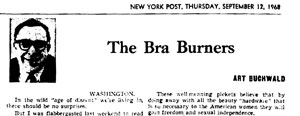
As I write in Getting It Wrong, this highly imaginative characterization was taken up a few days later by Art Buchwald in his nationally syndicated column.

Buchwald, who by then was American journalism’s leading humor columnist, wrote with tongue in cheek that he had been “flabbergasted to read that about 100 women had picketed the Miss America pageant in Atlantic City against ‘ludicrous beauty standards that had enslaved the American woman.’”

He also wrote:

“The final and most tragic part of the protest took place when several of the women publicly burned their brassieres.”

And he closed the column by writing:

“If the women in Atlantic City wanted to picket the Miss America beauty pageant because it is lily-white, that is one thing, and if they wanted to picket because it is a bore, that is also a legitimate excuse. But when they start asking young American women to burn their brassieres and throw away their false eyelashes, then we say dissent in this country has gone too far.”

And an embryonic media-driven myth had begun to emerge.

WJC

Recent and related:


On columnists and burning bras

In Bra-burning, Debunking, Media myths on May 1, 2010 at 9:16 am

Two dozen men and women bared torsos and marched in Farmington, Maine, yesterday, prompting a snarky commentary in the Bangor Daily News about social protests–and bra-burning.

“In the 1960s and 1970s there was that whole Vietnam War issue and the sexual revolution to boot. There were lots of things to protest and stand for,” the commentary declared, adding:

“During that time I believe there were more than a few college-age women who burned their bras. Some believe young women tossed their bras into burning trash cans as a protest of the Vietnam War, but others stand firm that the first ‘bra burning’ incident actually occurred in 1968 at a demonstration against the Miss America contest.”

Like many discussions about bra-burning–a topic addressed in Getting It Wrong, my forthcoming book about media-driven myths–the commentary is more than a bit tangled and confused.

As I write in Getting It Wrong, the notion of bra-burning took hold in the days after the Miss America pageant at Atlantic City, N.J., on September 7, 1968.

“Early that afternoon,” I write, “about 100 women from New York City, New Jersey, Boston, Washington, D.C., and elsewhere arrived by bus at the Atlantic City boardwalk.

“They were, according to the New York Times, ‘mostly middle-aged careerists and housewives’ and they set up a picket line at Kennedy Plaza, across from the Convention Center. They were there, as one participant declared, ‘to protest the degrading image of women perpetuated by the Miss America pageant,’ which took place that night inside the Convention Center.”

A highlight of their protest came when the demonstrators tossed into a barrel what they called “instruments of torture,” including brassieres, girdles, high-heeled shoes, and magazines such as Playboy and Cosmopolitan. The protesters dubbed the barrel the Freedom Trash Can.

The protest organizers, who included the activist and former child actor Robin Morgan, have long insisted that bras and other contents of the Freedom Trash Can were not set afire during the protest.

But the notion that bra-burning was a dramatic element of the demonstration at Atlantic City was driven by syndicated columnists, including Harriett Van Horne.

Soon after the protest, Van Horne wrote that the protesters had been “scarred by consorting with the wrong men. Men who do not understand the way to a woman’s heart, i.e., to make her feel utterly feminine, desirable and almost too delicate for this hard world. … No wonder she goes to Atlantic City and burns her bra.”

Van Horne was not at the protest, however. Nor was Art Buchwald, then American journalism’s preeminent humorist, who played on the bra-burning trope in a column published in the Washington Post and other newspapers.

With tongue in cheek, Buchwald wrote that he had been “flabbergasted to read that about 100 women had picketed the Miss America pageant in Atlantic City against ‘ludicrous beauty standards that had enslaved the American woman.’”

He added: “The final and most tragic part of the protest took place when several of the women publicly burned their brassieres.”

As I note in Getting It Wrong, Buchwald’s “characterization of the protest at Atlantic City introduced the notion of flamboyant bra-burning to a national audience, conjuring as it did a powerful mental image of angry women setting fire to bras and twirling them, defiantly, for all … to see.”

But as for the claim in the Bangor Daily News commentary that “more than a few college-age women … burned their bras” in the 1960s and 1970s, well, the supporting evidence just isn’t there.

WJC

Advance pub for ‘Getting It Wrong’

In 1897, Cronkite Moment, Debunking, Media myths, War of the Worlds, Washington Post on April 28, 2010 at 3:47 pm

The online site of the School of Communication here at American University posts today a Q-and-A with me about Getting It Wrong, my forthcoming book that debunks 10 prominent media-driven myths.

Topics addressed include the Remington-Hearst/furnish the war anecdote; the War of the Worlds/mass hysteria myth, and the “Cronkite moment“/”I’ve lost Middle America” meme.

And while the topic is not considered in Getting It Wrong, I also mention the “pharm parties” myth, in which young people are said to take pills of any kind from their parents’ medicine cabinets. They supposedly show up at a party and dump the purloined pills into a large, common bowl. Then they are purported to take turns scooping out and swallowing handfuls of the medications, not knowing what they’re taking, in the supposed pursuit of a drug-induced high.

Jack Shafer, media critic for slate.com, has done fine work in knocking down the “pharm party” meme.

Here are excerpts from the Q-and-A:

Q: “Myth busting” can upset people who have accepted, or even benefited from, the myth. Have you gotten any negative feedback?

A:  Not really. Not so far. I do know that some people wonder “who cares?” about some of the myths debunked in Getting It Wrong. The Hearst—”furnish the war” myth, after all, is more than 100 years old. But I emphasize in the book that media-driven myths are neither innocuous nor trivial. They can, and do, promote stereotypes. They can deflect attention or blame away from the makers of flawed policies. They can, and often do, offer an exaggerated sense of the power and influence of the news media. Plus, debunking myths is a pursuit that’s aligned with a fundamental objective of mainstream American journalism—that of getting it right.

Q: What’s next?

A: I’d like to think there’s a sequel to Getting It Wrong. The universe of media-driven myths isn’t confined to 10, after all. There are more to confront. Also, in fall 2010, I’ll be teaching a “wild card” course in the University’s General Education program titled “Media Myth and Power.” The course will consider several of the myths debunked in Getting It Wrong.

A tip of the chapeau to Michael Wargo of the School of Communication for putting together the Q-and-A, which follows the writeup about the book that appeared April 11 in the “Outlook” section of the Washington Post.

WJC

One paragraph, three myths

In Cronkite Moment, Debunking, Media myths, Murrow-McCarthy myth, New York Times, Washington Post, Watergate myth on April 21, 2010 at 11:45 am

A column posted today at a Canadian online news site achieved the feat of working three media-driven myths into a single paragraph.

Here’s what the columnist wrote, in a paean to the power and influence that traditional news media once wielded, supposedly:

“A Walter Cronkite could, however belatedly, expose the pointlessness of Vietnam. Famously, Edward R. Murrow deflated McCarthy. A pair of scruffy reporters could bring down a Nixon.”

Three sentences, three myths–a trifecta that is very rare.

All three media-driven myths are addressed, and debunked, in my book, Getting It Wrong, to be published in summer by the University of California Press.

The reference to Cronkite is to the CBS anchorman’s report of February 27, 1968, in which he said the U.S. military was “mired in stalemate” in Vietnam. As I write in Getting It Wrong, such a characterization was scarcely original or exceptional at the time. It was no exposé.

Indeed, nearly seven months before Cronkite’s pronouncement, the New York Times had suggested in a front-page report that the war was stalemated.

Victory in Vietnam, the Times report said, “is not close at hand. It may be beyond reach.”

That Murrow “deflated” Senator Joseph R. McCarthy is another media myth, stemming from Murrow’s See It Now television program of March 9, 1954.

Murrow in fact was quite belated in confronting McCarthy and the senator’s communists-in-government witch hunt.

The half-hour See It Now program on McCarthy came many months–even years–after other journalists had pointedly challenged the senator and his bullying tactics. Eric Sevareid, a friend and CBS colleague of Murrow, pointedly noted that Murrow’s program “came very late in the day.”

In an interview in 1978, Sevareid said: “The youngsters read back and they think only one person in broadcasting and the press stood up to McCarthy and this has made a lot of people feel very upset, including me, because that program came awfully late.”

And by the time Murrow’s report aired, McCarthy’s favorable ratings had been in decline for three months, as also I note in Getting It Wrong.

The Canadian columnist’s reference to “a pair of scruffy reporters” who supposedly brought down Richard Nixon is, of course, to Carl Bernstein and Bob Woodward, who covered the Watergate scandal for the Washington Post.

As I’ve noted in previous posts at MediaMythAlert, the notion that the reporters brought down Nixon and his corrupt presidency is a myth that even the Post has tried to dismiss.

Howard Kurtz, the newspaper’s media reporter, wrote in 2005, for example:

“Despite the mythology, The Post didn’t force Richard Nixon from office—there were also two special prosecutors, a determined judge, bipartisan House and Senate committees, the belated honesty of [former White House lawyer] John Dean and those infamous White House tapes.”

Kurtz’s observations parallel those of Stanley I. Kutler, a leading historian of the  Watergate scandal, who has written:

“The fact is, an incredible array of powerful actors all converged on Nixon at once—the FBI, prosecutors, congressional investigators, the judicial system.”

The three myths are stories well-known and even cherished in American journalism. They almost always are cited as examples of media power and influence, of journalists at their courageous best.

But as I write in Getting It Wrong:

“To identify these tales as media myths is to confront the reality that the news media are not the powerful agents they, and many others, assume them to be.”

WJC

Now in Italian: The Cronkite Moment

In Cronkite Moment, Debunking, Media myths on March 25, 2010 at 6:08 pm

The Italian online site InviatoSpeciale indulges today in the legendary though dubious “Cronkite Moment” of February 1968.

That was when CBS News anchorman Walter Cronkite delivered a downbeat editorial assessment about the Vietnam War, saying the U.S. military effort there was “mired in stalemate.”

Thanks to the Babelfish online translation site, here is what InviatoSpeciale had to  say about that mythical occasion:

“The most followed anchorman of the American country explained to the people that war was mistaken and soon after the president, Lyndon Johnson, commented, ‘If I have lost Walter Cronkite, I have lost the moderate America’ and withdrew from the race for the White House.”

Even if roughly translated, that’s a pretty fair summary of the “Cronkite Moment,” a media-driven myth that I address and debunk in my forthcoming book, Getting It Wrong.

The “Cronkite Moment,” which derives its appeal and tenacity as an example of news media’s making a swift and profound difference in the conduct of American foreign policy.

But there are many reasons to doubt that the Cronkite program had much of an effect on Johnson at all.

As I note in Getting It Wrong, the president did not see the program when it aired February 27, 1968 .

Johnson then wasn’t in front of a television. He was in Austin, Texas, at the 51st birthday party of a political ally, Governor John Connally.

Even if he later saw a videotaped recording of the Cronkite program, “Johnson gave no indication of having taken the anchorman’s message to heart,” I write in Getting It Wrong, adding:

“Just three days after the program aired, Johnson vowed in remarks at a testimonial dinner in Texas that the United States would ‘not cut and run’ from Vietnam. ‘We’re not going to be Quislings,’ the president said, invoking the surname of a Norwegian politician who helped the Nazis take over his country. ‘And we’re not going to be appeasers….’”

As for Johnson’s decision against seeking reelection in 1968, the Cronkite program was of little or no consequence.

Critical to Johnson’s decision–which he announced at the end of March 1968, a month after the Cronkite program–was the advice and counsel of advisers, and the implications of Senator Eugene McCarthy’s insurgent bid for the Democratic nomination for president.

The potency of McCarthy’s antiwar campaign was demonstrated in the Democratic primary election in New Hampshire on March 12, 1968. McCarthy won 42 percent of the vote, a far greater portion than expected. Johnson won 49 percent.

Not only that, there’s evidence that Johnson never intended to seek reelection in 1968.

The appearance in Italian of the “Cronkite Moment” is a bit amusing. It’s also indicative of how deeply embedded the myth has become.

Moreover, it’s suggestive of how difficult it will be to uproot it completely.

WJC

Embedded myths of journalism history

In Cronkite Moment, Debunking, Media myths, Washington Post, Watergate myth on March 15, 2010 at 11:44 am

Popular media myths were in circulation over the weekend at the conference of journalism historians—signaling anew how embedded myths are in American media history and how difficult they can be to uproot.

One presentation at the conference in New York City discussed Walter Cronkite’s standing in collective American memory and in media history. The presentation inevitably invoked the notion that the Cronkite’s on-air commentary in 1968 dissuaded Lyndon Johnson from seeking reelection to the presidency.

Supposedly, Johnson watched Cronkite’s special report on CBS about Vietnam. Cronkite ended the program with by saying the U.S. war effort was “mired in stalemate” and that negotiations eventually might be considered as a way out of the conflict.

Upon hearing Cronkite’s downbeat editorial assessment, Johnson switched off the television and turned to an aide or aides, muttering something to the effect of:

“If I’ve lost Cronkite, I’ve lost Middle America.”

The program’s effect supposedly was so singularly powerful that it also turned public opinion against the war and came to be called the “Cronkite Moment.”

As I’ve noted several times at MediaMythAlert, and as I write in Getting It Wrong, my  forthcoming book about media-driven myths, Johnson did not watch Cronkite’s special report about Vietnam when it aired February 27, 1968.

Johnson in Texas, February 27, 1968

Johnson at the time was not in front of a television set but on the campus of the University of Texas at Austin, at a party marking the 51st birthday of one of his political allies, Governor John Connally.

Nor is there evidence that Johnson later saw the Cronkite program on videotape.

Not only that, but as I discuss in Getting It Wrong, there is scant evidence to suggest that the “Cronkite Moment” had much influence at all on public opinion about the war.

Indeed, polling data “clearly show that American sentiment had begun shifting months before the Cronkite program,” I write in the book, which will be out this summer.

Also heard during conference presentations was what I call the heroic-journalist myth of Watergate–the notion that the reporting of two young reporters for the Washington Post brought down Richard Nixon’s corrupt presidency.

This is a trope that even Post officials have dismissed over the years.

In 2005, for example, the newspaper’s then-ombudsman, Michael Getler, wrote:

“Ultimately, it was not The Post, but the FBI, a Congress acting in bipartisan fashion and the courts that brought down the Nixon administration. They saw Watergate and the attempt to cover it up as a vast abuse of power and attempted corruption of U.S. institutions.”

The heroic-journalist myth is addressed, and debunked, in Getting It Wrong, which says that interpreting Watergate “through the lens of the heroic-journalist is to abridge and misunderstand the scandal and to indulge in a particularly beguiling media-driven myth.”

The conference in New York was Saturday, and was sponsored by the History Division of AEJMC and the American Journalism Historians Association. AEJMC is the acronym for the Association for Education in Journalism and Mass Communication.

WJC

Recalling the mythical ‘Cronkite Moment’

In Cronkite Moment, Debunking, Media myths on February 26, 2010 at 6:09 am

Tomorrow is the anniversary of the so-called “Cronkite Moment,” which is widely believed to have been an exceptionally powerful and decisive moment in American journalism.

The “Cronkite Moment” occurred February 27, 1968, when CBS News Anchor Walter Cronkite declared on air that the U.S. war effort in Vietnam was mired in stalemate and suggested negotiations as a way to extricate the country from the conflict.

At the White House that night, President Lyndon Johnson supposedly watched the Cronkite program, a special report about Vietnam in the aftermath of the surprise Tet offensive. Upon hearing Cronkite’s pessimistic assessment, Johnson is said to have snapped off the television set and muttered to an aide, or aides:

“If I’ve lost Cronkite, I’ve lost Middle America.”

Or words to that effect.

With Cronkite having turned against the war, the Johnson White House supposedly reeled. And at the end of March 1968, the president announced he would not seek reelection.

It is one of the great stories American journalism tells about itself, a moment when the power of television was trained on foreign policy to make a difference in an unpopular and faraway war.

More accurately, though, it’s one of American journalism’s most enduring and appealing media-driven myths.

As I’ve noted on a number of occasions at Media Myth Alert, and as I write in Getting It Wrong, my forthcoming book on media-driven myths,  Johnson did not watch the Cronkite program on Vietnam when it aired that night 42 years ago.

The president that night was in Austin, Texas, at the 51st birthday party of a political ally, Governor John Connally.

About the time Cronkite intoned his downbeat, “mired in stalemate” assessment, Johnson was offering light-hearted banter about Connally’s age, saying:

Johnson in Texas, February 27, 1968

“Today you are 51, John. That is the magic number that every man of politics prays for—a simple majority. Throughout the years we have worked long and hard—and I might say late—trying to maintain it, too.”

Earlier in the day, Johnson had delivered a rousing speech in Dallas, in which he characterized the U.S. war effort in Churchillian terms.

“There will be blood, sweat and tears shed,” he said, adding:  “I do not believe that America will ever buckle” in pursuit of its objectives in Vietnam.

Even if the president had seen the Cronkite program, it is difficult to imagine how his opinion could have swung so abruptly, from a vigorous defense of the war effort to resignation and despair.

Casting further doubt on the “Cronkite Moment” is uncertainty about what, exactly, Johnson supposedly said in reaction to Cronkite’s editorial comments about the war.

The most common version has him saying: “If I’ve lost Cronkite, I’ve lost Middle America.”

But another version is: “I’ve lost Cronkite, I’ve lost the country.”

Yet another version has it this way: “If I’ve lost Cronkite, I’ve lost the American people.”

Still another version is: “If I’ve lost Cronkite, I’ve lost the war.”

And another goes: “If we lose Cronkite, we lose America.”

And, unaccountably: “If I’ve lost Cronkite, I’ve lost the middle west.”

Version variability of  such magnitude signals implausibility.

So why, 42 years on, does it matter whether the “Cronkite Moment” is a myth?

As I write in Getting It Wrong, “Seldom, if ever, do the news media exert truly decisive influences in decisions to go to war or to seek negotiated peace.

“Such decisions typically are driven by forces and factors well beyond the news media’s ability to shape, alter, or significantly influence.”

And so it was with the “Cronkite Moment.”

WJC

Why not the ‘McGee Moment’?

In Debunking, Media myths on February 14, 2010 at 11:41 pm

I recently reviewed Journalism’s Roving Eye, a hefty, impressively researched study by John Maxwell Hamilton of the history of American foreign correspondence.

In my review, written for the quarterly Journalism: Theory, Practice & Criticism, I note:

“Hamilton ranges widely and confidently over the colorful history of American foreign correspondence. …  Journalism’s Roving Eye is engaging, and highly readable.”

But I also note the book “projects a surprising sense of conventionality in recounting memorable moments in U.S. foreign correspondence.” As an example, I cite the anecdote — one of the favorites in all of American journalism — about Walter Cronkite’s on-air editorializing February 27, 1968.

That anecdote has become so wrapped in legend that it is has come to be known as the “Cronkite Moment.”

On that occasion, Cronkite, the CBS News anchorman, said the U.S. military effort in Vietnam had become “mired in stalemate” and suggested that time was approaching for negotiations to end the conflict.

President Lyndon Johnson supposedly watched the program at the White House. Upon hearing Cronkite’s dire assessment, the president abruptly switched off the television and supposedly told an aide or aides:

“If I’ve lost Cronkite, I’ve lost Middle America.”

Or words to that effect.

Hamilton cites that anecdote and quotes David Halberstam’s line from The Power That Be, that the Cronkite’s editorializing “was the first time that a war had been declared over by an anchorman.”

But, of course, that wasn’t the case.

The last U.S. combat troops did not leave Vietnam until 1973, more than five years after the “Cronkite Moment.”

What’s more, as I write in Getting It Wrong, my forthcoming book about media-driven myths, “Johnson did not have—could not have had—the abrupt yet resigned reaction that so often has been attributed to him.

“That’s because Johnson did not see the program when it was aired.”

The president was in Austin, Texas, at the time of the Cronkite program, attending the 51st birthday party of Governor John Connally.

Moreover, I write in Getting It Wrong, “Johnson’s supposedly downbeat, self-pitying reaction to Cronkite’s on-air assessment clashes sharply with the president’s aggressive characterization about the war. Hours before the Cronkite program, Johnson delivered [in Dallas] a little-recalled but rousing speech on Vietnam, a speech cast in Churchillian terms.”

In late winter 1968, Cronkite’s “mired in stalemate” assessment was neither stunning nor particularly cutting-edge. About seven months earlier, I note in the book, “the New York Times had suggested the war in Vietnam was stalemated.”

Cronkite’s assessment was far less assertive than the observations offered less than two weeks later by Frank McGee of the rival NBC network.

“The war,” McGee said on an NBC News program that aired March 10, 1968, “is being lost by the [Johnson] administration’s definition.”

There was no equivocating about being “mired in stalemate.” No nuanced suggestions about maybe opening negotiations.

Lost.

It’s faintly curious that McGee’s pointed and emphatic editorial comment is not more often remembered.

But of course no one ever talks about the “McGee Moment.”

WJC

Another twist to the ‘Cronkite Moment’

In Cronkite Moment, Debunking, Media myths on January 21, 2010 at 11:47 pm

The “Cronkite Moment” — that legendary occasion in February 1968 when a CBS News special report by Walter Cronkite supposedly altered the course of the Vietnam War — is one impressively dogged, tenacious media myth.

Cronkite in Vietnam

As I noted in a recent post, the “Cronkite Moment” knows few bounds. It supposedly “turned the tide of American public opinion” against the U.S. war effort in Vietnam and “influenced Lyndon Johnson not to seek reelection” to the presidency.

And just the other day, the TVWeek online site claimed:

“President Lyndon Johnson once famously said about his support of the Vietnam War that once he had lost Walter Cronkite he had lost America. Johnson was referring to a report Cronkite once did where he said the war could not be won.”

Where to start?

First, there is no evidence Johnson ever saw Cronkite’s special report about Vietnam, which aired February 27, 1968. At the close of the program, Cronkite claimed the U.S. military was “mired in stalemate” in Vietnam.

As I write in my forthcoming book, Getting It Wrong, Johnson at the time was not in front of a television set but on the campus of the University of Texas at Austin, attending a party marking the 51st birthday of Governor John Connally.

There is no evidence Johnson later saw the Cronkite program on videotape.

Second, Cronkite did not say in that special report that “the war could not be won.” What the anchorman did say was that the time might be approaching when the United States might seek a negotiated settlement to the war.

As I note in Getting It Wrong, “a close reading of the transcript of Cronkite’s closing remarks reveals how hedged and cautious they really were.”

Cronkite in those remarks held open the possibility that the U.S. military efforts might still force the North Vietnamese to the bargaining table, and suggested the U.S. forces be given a few months more to press the fight in Vietnam.

In addition, the TVWeek item represents a minor addition to the varied accounts of what Johnson supposedly said in response to Cronkite’s closing assessment.

The most common version has Johnson saying: “If I’ve lost Cronkite, I’ve lost Middle America.”

Another version quotes him this way: “I’ve lost Cronkite, I’ve lost the country.”

And another has it this way: “If I’ve lost Cronkite, I’ve lost the American people.”

And: “If I’ve lost Cronkite, I’ve lost the war.”

And “If we lose Cronkite, we lose America.”

The TVWeek item indirectly quotes Johnson as saying that “once he had lost Walter Cronkite he had lost America.”

Version variability of  such magnitude is a strong signal of implausibility.

And of a media-driven myth.

WJC