W. Joseph Campbell

Posts Tagged ‘All the President’s Men’

‘Follow the money’: You won’t find that line in the book

In Anniversaries, Cinematic treatments, Debunking, Media myths, Washington Post, Watergate myth on April 27, 2011 at 4:00 am

The most famous line about Watergate reporting — “follow the money” — appears nowhere in the most famous book about Watergate reporting, All the President’s Men.

Not in this book

It’s often thought that it does. The Post and Courier newspaper in Charleston, S.C., said so, for example, in an editorial posted online yesterday.

The editorial referred to the stealthy Watergate source of Washington Post reporter Bob Woodward and declared:

“‘Deep Throat,’ finally identified in 2005 as former FBI associate director Mark Felt, gave Carl Bernstein and Bob Woodward the inside dirt on the Nixon administration’s attempt to cover up its dirty tricks.

“He also gave them, as chronicled in their book ‘All the President’s Men,’ this tip: ‘Follow the money.'”

Felt was Woodward’s source; he never met Bernstein until late in Felt’s life.

And Felt never offered Woodward the advice of “follow the money.”

That line doesn’t appear in All the President’s Men, Woodward and Bernstein’s book about their reporting on Watergate. Nor does it appear in any Watergate-related article or editorial published in the Washington Post before 1981.

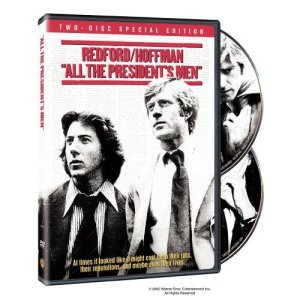
The passage was, though, written into the screenplay of All the President’s Men, the 1976 cinematic version of Woodward and Bernstein’s book. The movie came out 35 years ago this month, and has aged quite well.

The acting was notably strong and included a memorable performance by Hal Holbrook, who played a shadowy, tormented “Deep Throat.”

Holbrook delivered his lines about “follow the money” with such certainty and quiet insistence that it sounded as if it really were guidance vital to rolling up Watergate.

But in the real-life investigation of Watergate, “follow the money” wouldn’t have taken investigators to the point of determining Nixon’s guilty role in the crimes of Watergate.

As I write in Getting It Wrong, my media-mythbusting book that came out last year, some 20 men associated with Nixon’s administration or his 1972 reelection campaign went to jail for crimes linked to Watergate.

Rolling up a scandal of such sweep, I write in Getting It Wrong, “required the collective if not always the coordinated forces of special prosecutors, federal judges, both houses of Congress, the Supreme Court, as well as the Justice Department and the FBI.

“Even then,” I add, “Nixon likely would have served out his [second] term if not for the audiotape recordings he secretly made of most conversations in the Oval Office of the White House. Only when compelled by the Supreme Court did Nixon surrender those recordings, which captured him plotting the cover-up and authorizing payments of thousands of dollars in hush money.”

What cost Nixon the presidency wasn’t of the improper use of campaign monies but his efforts to obstruct justice and deter the FBI’s investigation of the scandal.

Still, it’s curious why “follow the money” crossed so seamlessly from the silver screen to the vernacular.

One reason no doubt are proximate release dates of the book and movie of All the President’s Men, allowing the two versions to become confounded.

The book came out in June 1974, just as Watergate was nearing its endgame with Nixon’s resignation in August 1974. The movie was released in April 1976, as the wounds of Watergate were only beginning to heal.

Another reason for the persistent appeal of “follow the money” lies in its pithiness. Like many media-driven myths — those dubious or apocryphal tales about the news media and their power — “follow the money” is neat, tidy, succinct. It’s easy to remember, and it seems almost too good not to be true.

But probably the most compelling explanation for its tenacity lies in the power of the cinema to propel media myths and to offer plausible if greatly simplified versions of history.

Richard Bernstein addressed this tendency quite well in a memorable essay published in 1989 in the New York Times.

He wrote that “movies-as-history” tend “to construct Technicolored and sound-tracked edifices of entertainment on the slender foundations of what appear to be actual events, or, at the very least, to mingle fact with fancy, history with imagination, in such a way that the average viewer has no way of sorting out one from the other.”

Quite so.

I note in Getting It Wrong that the cinematic version of All the President’s Men helped ensure that Woodward, Bernstein, and the Post would be regarded as vital and central to the unraveling of Watergate.

The mediacentric version of Watergate — or what I call the heroic-journalist interpretation — allows audiences to sidestep the scandal’s off-putting complexity and engage in a narrative that is entertaining and reassuring.

WJC

Recent and related:

Woodward, ‘tombeur de Nixon’

In Anniversaries, Cinematic treatments, Debunking, Media myths, Washington Post, Watergate myth on April 25, 2011 at 7:18 am

That headline — which appeared with an item posted yesterday at Les In Rocks, a slick, Paris-based arts and music blog — translates to:

“Woodward, the guy who brought down Nixon.”

Which is hyperbole.

Bob Woodward and the Washington Post did not bring down Richard Nixon in the Watergate scandal of 1972-74.

But as the headline and accompanying interview with Woodward suggest, Wooward-hero worship can be surprisingly intense and deep-seated abroad.

The article’s opening paragraph declared:

“Not many people can boast of having been played in the movies by Robert Redford. In fact, there’s only one. His name is Bob Woodward. He’s a journalist, and with his colleague Carl Bernstein, in life as in the film All the President’s Men, brought down Richard Nixon in 1974 in the Watergate affair.”

(Here’s the original French version: “Peu d’hommes peuvent se vanter d’avoir été incarnés au cinéma par Robert Redford. En fait, il n’y en a qu’un. Il s’appelle Bob Woodward. Il est journaliste et, avec son collègue Carl Bernstein, dans la vie comme dans le film Les Hommes du Président, il fit tomber Richard Nixon en 1974 avec l’affaire du Watergate.”)

Redford, of course, played Woodward in the motion picture, All the President’s Men, which was released 35 years ago this month.

It is easily the most-viewed film about the scandal and, as I point out in Getting It Wrong, my media-mythbusting book that came out last year, All the President’s Men effectively sealed the heroic-journalist myth of Watergate.

The heroic-journalist interpretation has it that the scandal’s disclosure pivoted on Woodward and Bernstein’s dogged reporting for the Post, that they exposed the crimes of Watergate and forced Nixon’s resignation.

That’s an interpretation not even the Post — and not even Woodward — buy into.

As Woodward declared in an interview in 2004 with American Journalism Review:

To say the press brought down Nixon, that’s horseshit.”

Less indelicately, the Post’s then-ombudsman, Michael Getler, wrote in 2005:

“Ultimately, it was not The Post, but the FBI, a Congress acting in bipartisan fashion and the courts that brought down the Nixon administration. They saw Watergate and the attempt to cover it up as a vast abuse of power and attempted corruption of U.S. institutions.”

But the movie — which has aged impressively well — offers another, simpler, less-accurate interpretation.

As I write in Getting It Wrong:

All the President’s Men placed Woodward and Bernstein at the center of Watergate’s unraveling while denigrating the efforts of investigative agencies such as the FBI. The effect was to solidify and elevate the heroic-journalist myth, giving it dramatic power, and sustaining it in the collective memory.”

The film closes with the Woodward and Bernstein characters (played by Redford and Dustin Hoffman, respectively) at their respective desks in the Post’s brilliantly lighted newsroom, pounding away at their typewriters.

The newsroom is otherwise empty. Woodward and Bernstein remain oblivious to their colleagues as they slowly drift in. It’s Inauguration Day 1973 and the Post editors and reporters are shown gathering at television sets in the newsroom to watch as Nixon is sworn in to a second term. Woodward and Bernstein, however, remain at their desks, focused on their work.

The television sets show Nixon smiling as he completes the oath of office. The first volleys of a twenty-one gun salute begin to boom. Woodward and Bernstein continue their frantic typing and the cannonade resounds ever louder. The newsroom scene dissolves to a close-up of an overactive teletype machine, noisily battering out summaries about indictments, trials, and convictions of Nixon’s men.

The clattering machine spells out “Nixon resigns, Ford sworn in,” and stops abruptly. The movie’s over.

It’s an imaginative and effective ending which, as I write in Getting It Wrong, “pulls together the many strands of Watergate. But more than that, it offers an unmistakable assertion of the power and centrality of the press in Nixon’s fall.”

Indeed, it is perhaps the most powerful and vivid assertion of Watergate’s heroic-journalist myth. Who else but Woodward and Bernstein?

WJC

Recent and related:

That’s rich: Woodward bemoans celebrity journalism

In Anniversaries, Cinematic treatments, Debunking, Media myths, Washington Post, Watergate myth on April 24, 2011 at 11:33 am

The country’s foremost celebrity journalist, Bob Woodward of the Washington Post and Watergate fame, has deplored what he called the “curse” of celebrity journalism, which he reportedly said has infected the news media.

Woodward, celebrity journalist

Woodward was speaking the other night at a panel in Austin, Texas, that was convened to mark the 35th anniversary of All the President’s Men, the motion picture about the Watergate reporting of Woodward and his Post colleague, Carl Bernstein.

According to a report posted online by ABC News, Bernstein, who also was on the panel, complained that the culture of journalism has shifted dramatically since the Watergate era of the early 1970s. Woodward, according to the ABC post, characterized this shift the “curse” of celebrity journalism — the “Paris Hilton factor and Kardashian equation.”

Even if he was referring to excessive media attention to the likes of Paris Hilton and Kim Kardashian, it’s still pretty rich for Woodward to bemoan celebrity journalism — given that All the President’s Men established the cult of the contemporary celebrity journalist.

By “celebrity journalist,” I mean the journalist who has attained outsize prominence or who is regarded as more important than the people and the events he or she covers.

Sydney Schanberg, writing in the Village Voice in 2005, pointed out that the Watergate era of the early 1970s “can be fairly marked as the starting point of the age of journalists as celebrities. Bob Woodward and Carl Bernstein weren’t celebrities when they cracked the story for The Washington Post, but they soon would be, and a wave of emulators quickly began applying to journalism schools.”

Schanberg was incorrect about the Watergate effect on journalism schools: The surge in enrollments was well underway before Watergate, before Woodward and Bernstein became household names.

But he was quite correct about Watergate’s having represented a demarcation of modern celebrity journalism. (Alicia Shepard referred to this phenomenon in 1997, writing in American Journalism Review in 1997: “The Watergate affair changed journalism in many ways, not the least of which was by launching the era of the journalist as celebrity.” She also claimed in the article that Woodward and Bernstein “brought down a president.” Not so.)

More than any other single factor, the movie All the President’s Men propelled the media myth of the heroic journalist — the beguiling notion that Woodward and Bernstein’s investigative reporting of the Watergate scandal exposed the corruption of Richard Nixon and forced his resignation in disgrace in 1974.

As I discuss in Getting It Wrong, my media-mythbusting book that came out last year, All the President’s Men placed the characters of Woodward and Bernstein squarely if inappropriately “at the center of Watergate’s unraveling while denigrating the efforts of investigative agencies such as the FBI.

“The effect,” I write, “was to solidify and elevate the heroic-journalist myth, giving it dramatic power, and sustaining it in the collective memory.”

The heroic-journalist interpretation of Watergate has become “the most familiar storyline of Watergate: ready short-hand for understanding Watergate and its denouement, a proxy for grasping the scandal’s essence while avoiding its forbidding complexity,” I note in Getting It Wrong, adding:

“How the Post and its reporters uncovered Watergate is deeply ingrained in American journalism as one of the field’s most important and self-reverential stories.”

I further note in Getting It Wrong that the notion Woodward and Bernstein “exposed Nixon’s corruption is a favored theme in textbooks of journalism and mass communication.” And that offers a wholly inaccurate misleading reading of the history of Watergate.

Woodward and Bernstein didn’t bring down Nixon’s corrupt presidency. That was the effect of the collective if not always the coordinated efforts of the Justice Department, the FBI, special Watergate prosecutors, bipartisan panels of both houses of Congress, and the U.S. Supreme Court.

Against that tableau, the contributions of Woodward and Bernstein recede in significance.

WJC

Many thanks to Instapundit
Glenn Reynolds for linking to this post

Recent and related:

Something exaggerated in hero-worship of Woodward

In Anniversaries, Cinematic treatments, Debunking, Media myths, Washington Post, Watergate myth on April 21, 2011 at 9:55 am

There’s something exaggerated, and a bit cloying, about the recent spasm of adulation of Bob Woodward, he of the Washington Post and Watergate fame.

Movie that solidified the myth

Early this week, Woodward and former Post executive editor Ben Bradlee received a standing ovation from the nearly 1,000 people at a program at the Richard Nixon Presidential Library and Museum in California.

The library recently opened a gallery about the Watergate, the  scandal that cost Nixon the presidency in 1974.

The new exhibit replaced a display that offered a dubious and seriously distorted interpretation of Watergate, which declared among other things that Woodward and his reporting colleague, Carl Bernstein, “used anonymous sources exclusively to try and convict the President in the pages of the Post….” Nixon wasn’t a specific target of their award-winning Watergate reporting.

The replacement exhibit was undertaken after the National Archives took over the library from a private foundation. Woodward and Bradlee went to the library for what was billed as a conversation about Watergate.

Politico reported that Woodward and Bradlee attracted an audience that “listened with rapt attention and regular laughter as the two men traded wisecracks and reminisced about their roles in bringing down the 37thpresident.”

Left unaddressed by Politico was just what were those “roles in bringing down” Nixon. The implication was that their work for the Post was central in forcing the resignation of a corrupt president.

But not even Woodward and Bradlee go so far as to embrace that misleading interpretation of Watergate.

Bradlee asserted in 1997, at the 25th anniversary of Watergate’s signal crime, the break-in at the headquarters of the Democratic national committee:

“[I]t must be remembered that Nixon got Nixon. The Post didn’t get Nixon.”

And in 2004, Woodward told American Journalism Review:

To say the press brought down Nixon, that’s horseshit.”

The Politico piece noted that Bradlee “marveled at how many people still care about a decades-old conflict — one that turned Woodward, his reporting partner Carl Bernstein and Bradlee into the most famous journalists of their era.”

Why people still care is not especially difficult to fathom. It’s largely because Woodward, Bernstein, and to a lesser extent, Bradlee, are living reminders of the unmasking of America’s greatest political scandal — one that sent to jail nearly 20 men associated with Nixon’s presidency or his 1972 reelection campaign.

As I point out in my media-mythbusting book, Getting It Wrong:

“The complexity of the Watergate scandal— the lies, deceit, and criminality that characterized the Nixon White House; the multiple lines of investigation that slowly unwound the scandal, and the drama of what was an exceptional constitutional crisis — are not routinely recalled these days.

“The epic scandal [of 1972-74] has grown so distant that few Americans can accurately describe what took place.”

I further write in Getting It Wrong:

“What does stand out amid the scandal’s many tangles is the heroic-journalist version of Watergate — the endlessly appealing notion that the dogged reporting of two young, hungry, and tireless Washington Post journalists, Bob Woodward and Carl Bernstein, brought down Nixon and his corrupt presidency.

“The heroic-journalist has become the most familiar storyline of Watergate: ready short-hand for understanding Watergate and its denouement, a proxy for grasping the scandal’s essence while avoiding its forbidding complexity.”

The heroic-journalist myth — and the celebrity cult of Watergate — were solidified by the cinematic version of All the President‘s Men, Woodward and Bernstein’s book about their Watergate reporting.

The movie came out 35 years ago this month — and is to be a topic of discussion tonight when  Woodward, Bernstein, and movie star Robert Redford gather at the Lyndon Baines Johnson Library & Museum in Austin, Texas.

Redford played the Woodward character in All the President’s Men.

The event no doubt will be the occasion for more standing ovations, more cloying hero-worship.

WJC

Recent and related:

More mythical claims for WaPo’s Watergate reporting

In Debunking, Media myths, Washington Post, Watergate myth on April 16, 2011 at 8:35 am

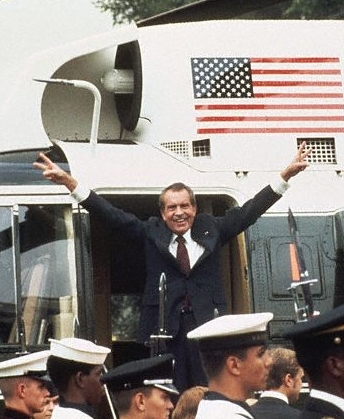
Nixon quits

The claims for the Watergate reporting of Bob Woodward and Carl Bernstein seldom are very modest. The mythical notion that their reporting brought down President Richard Nixon in 1974 is among the most cherished — and extravagant — tales in American journalism.

But the assertions posted yesterday at the online site of a Texas alternative newspaper were extraordinary in their lavishness.

The newspaper, the Austin Chronicle, declared:

“In the summer of 1972, when the unlikely duo of Washington Post reporters Woodward and Bernstein stumbled onto what would turn out to be the most important hard news story of the century, investigative journalism and the gritty and laborious, but ultimately necessary, processes it entailed reached a zenith.

“Public people in positions of great – and presumably unassailable – power went to prison as a result of Woodward and Bernstein’s dogged determination not to allow what was initially perceived as a nonstory to die out. They stuck to their guns, their guts, and their deadlines. And in the end, President Richard Milhous Nixon, facing impeachment and charges of high crimes and misdemeanors, was forced out of office by genuine, bipartisan outrage. Absolute hubris corrupted absolutely. It was a brief, shining moment when American journalism not only shook the pillars of power but also very nearly toppled them.”

There’s a lot of exaggeration to unpack there, so let’s focus on key claims:

  • Woodward and Bernstein “stumbled onto what would turn out to be the most important hard news story of the century.”
  • “Public people” went to prison because of their Watergate reporting.
  • Woodward and Bernstein’s work on Watergate was a moment when “American journalism … shook the pillars of power.”

This is not to quibble with word choice, but Woodward and Bernstein certainly did not stumble onto the Watergate scandal. They were assigned by editors at the Washington Post to dig into the highly suspicious breakin in June 1972 at the headquarters of the Democratic national committee.

As Edward Jay Epstein pointed out in his brilliant 1974 essay, the reporting of Woodward and Bernstein was highly derivative, sustained by leaks from federal investigations into the crimes of Watergate.

And I note in my media-mythbusting book, Getting It Wrong, that “Woodward and Bernstein did not uncover defining and decisive elements of the Watergate scandal” — the White House attempt to cover-up crimes associated with the breakin and the payment of hush money to the Watergate burglars.

Those aspects of the scandal, Woodward was quoted as saying in 1973, were “held too close. Too few people knew. We couldn’t get that high.”

As for the claim that Woodward and Bernstein sent “public people” to jail: Well, who were they?

This is not a claim that Woodward and Bernstein are known to make publicly. And it’s not a claim that appears in their book, All the President’s Men, which describes their reporting on Watergate.

A case might be made that their reporting about the “dirty tricks” organized by Donald Segretti, a minor figure in the Watergate scandal, led to his imprisonment. Segretti pleaded guilty to three misdemeanor charges of distributing illegal campaign materials during the 1972 Democratic primaries and spent 4 1/2 months in prison.

But as Epstein noted in his essay, “neither the prosecutors, the grand jury, nor the Watergate Committee … found any evidence to support the Bernstein-Woodward thesis that Watergate was part of the Segretti operation.” Segretti’s dirty tricks were a sideshow, not central elements of the Watergate scandal.

Nor can it be accurately said that Woodward and Bernstein’s work on Watergate represented a moment when “American journalism … shook the pillars of power.”

Those pillars were shaken by an unprecedented constitutional crisis caused not by investigative journalism but by the illegal conduct of Nixon, his senior aides, and officials in reelection campaign.

Nixon resigned the presidency in August 1974 following release of audiotapes he secretly made; the content of the tapes showed he had approved an attempt to divert the FBI from investigating the crimes of Watergate. The incriminating tapes were surrendered only after the Supreme Court ruled unanimously that the president must turn them over to federal prosecutors.

Nixon, then, was forced from office only after the disclosure of unequivocal proof that he had obstructed justice in the investigation of the crimes of Watergate. The Washington Post had nothing to do with those disclosures.

As Ben Bradlee, the Post’s executive editor during the Watergate period has said: It “must be remembered that Nixon got Nixon. The Post didn’t get Nixon.”

Or as Woodward put it in an interview in 2004:

To say the press brought down Nixon, that’s horseshit.”

That’s earthy but telling perspective. And it represents a useful antidote to breathtaking and lavish claims about the effects of newspaper reporting.

WJC

Recent and related:

Always ‘follow the money’ — even if it’s made up

In Anniversaries, Cinematic treatments, Debunking, Media myths, Washington Post, Watergate myth on April 11, 2011 at 10:26 am

Watergate’s single most famous line — “follow the money” — is impressively durable and versatile.

Especially so for a made-up line.

Follow the money” wasn’t guidance offered during the Watergate scandal of 1972-74. It wasn’t advice crucial to unraveling the most significant case of corruption in American history.

It was a line written into the screenplay of All the President’s Men, the 1976 motion picture that dramatized the Watergate reporting of Bob Woodward and Carl Bernstein for the Washington Post.

“Follow the money” was spoken by Hal Hollbrook, who played Woodward’s stealthy “Deep Throat” source in All the President’s Men. (The real-life “Deep Throat” was revealed in 2005 to have been W. Mark Felt, formerly the second-ranking official at the FBI.)

The line is so pithy — and seems to offer such sage and telling advice — that it crossed long ago from the cinema to the vernacular, and has become embedded in Watergate lore.

A telling example of how deeply “follow the money” has burrowed into popular culture was apparent in a commentary posted yesterday by the scrappy Washington Times newspaper.

The commentary discussed companies that pay no corporate federal taxes, declaring: “For too long the American public has been hornswoggled by this century’s ‘robber barons.'”

The commentary included this passage:

“No wonder corporations court politicians. As Deep Throat so wisely told reporter Bob Woodward, ‘Always follow the money.‘”

Always follow the money, eh?

Even if Felt, Woodward’s real-life “Deep Throat” source, had offered such guidance, it wouldn’t have been sufficient to implicate Nixon in the crimes of  Watergate.

Unraveling the scandal required much more than identifying and following a trail of illicit fundraising and money-laundering. Those were elements of Watergate, but they weren’t decisive in forcing President Richard Nixon’s resignation in August 1974.

As I note in Getting It Wrong, my media-mythbusting book that came out last year, some 20 men associated with Nixon’s  presidency or reelection campaign went to jail for crimes linked to Watergate.

To roll up a scandal of such dimension, I write in Getting It Wrong, “required the collective if not always the coordinated forces of special prosecutors, federal judges, both houses of Congress, the Supreme Court, as well as the Justice Department and the FBI.

“Even then,” I note, “Nixon likely would have served out his [second] term if not for the audiotape recordings he secretly made of most conversations in the Oval Office of the White House. Only when compelled by the Supreme Court did Nixon surrender those recordings, which captured him plotting the cover-up and authorizing payments of thousands of dollars in hush money.”

Those were the disclosures that brought about Nixon’s resignation in August 1974.

The reporting of the Washington Post was marginal to that outcome, despite the message and storyline of All the President’s Men.

WJC

Recent and related:

Inspirations to journalists: Woodward, Bernstein — and Gaga?

In Cinematic treatments, Debunking, Media myths, Washington Post, Watergate myth on April 9, 2011 at 7:41 am

The Poynter Institute, a journalism training center dedicated to “teaching and inspiring journalists and media leaders,” offered up a myth of Watergate yesterday in an article that ruminated about Lady Gaga’s potential to “awaken her young fans to 21st century journalism.”

Gaga: Inspiring?

The Poynter piece discussed the, ahem, news that pop star Gaga would guest-edit the May 17 editions of the giveaway newspaper Metro. The freesheet is available in many large cities in North America, Europe, and Asia. Metro was launched by a Swedish company in 1995.

Of particular interest to Media Myth Alert is not so much Lady Gaga’s one-off editing adventure but the Poynter article’s reference to Bob Woodward and Carl Bernstein, lead Washington Post reporters on the Watergate scandal of the 1970s.

The article stated:

“As Lady Gaga takes her celebrity into the worlds of journalism and photography, does it bring cachet to a struggling and confused industry that might need a tad of glamour and inspiration? She certainly has encouraged her fans to blog, create videos and design costumes.

“In the 1970s Bob Woodward and Carl Bernstein inspired a generation to major in journalism and become investigative reporters. … Could Lady Gaga awaken her young fans to 21st century journalism?”

Woodward

The notion that the work of Woodward and Bernstein “inspired a generation” of journalism students is a persistent subsidiary myth of Watergate.

There’s no evidence to support it.

I note in my media-mythbusting book, Getting It Wrong, that the subsidiary myth “lives on despite its thorough repudiation in scholarly research.”

One study was financed by the Freedom Forum media foundation and released in 1995. In it, researchers Lee B. Becker and Joseph D. Graf reported finding that “growth in journalism education result[ed] not from specific events as Watergate … but rather to a larger extent from the appeal of the field to women, who ha[d] been attending universities in record numbers. The growth also in part reflect[ed] the applied nature of the field and its link to specific job skills.”

Becker and Graf added:

“There is no evidence … that Watergate had any effect on enrollments.”

Seven years earlier, Maxwell E. McCombs reported in the Gannett Center Journal that “the boom in journalism education was underway at least five years before” the Watergate break-in in 1972. That also was the year Woodward and Bernstein published the investigative reports about Watergate that won for the Post the coveted Pulitzer Prize for public service.

McCombs, a veteran mass communication scholar, further wrote:

“It is frequently, and wrongly, asserted that the investigative reporting of Woodward and Bernstein provided popular role models for students, and led to a boom in journalism school enrollments. The data … reveal, however, that enrollments already had doubled between 1967 and 1972….”

The appeal of the subsidiary myth, I write in Getting It Wrong, stems from the fact that it is so “easily understood: It endures because it seems irresistibly logical and straightforward—too obvious, almost, not to be true.”

That is, Woodward and Bernstein made journalism seem sexy, vital, urgent. They were, after all, subjects of a major motion picture, All the President’s Men, which was based on their best-selling book by the same title.

And their reporting did bring down a corrupt president.

Or so goes the central myth of Watergate — that of the heroic-journalist. The heroic-journalist meme holds that Woodward and Bernstein exposed the crimes and misdeeds of Richard Nixon’s presidency, forcing him from office.

But as I point out in Getting It Wrong, not even the Post buys into that simplistic interpretation of American journalism’s greatest political scandal.

To explain Watergate “through the lens of the heroic-journalist is to abridge and misunderstand the scandal and to indulge in a particularly beguiling media-driven myth,” I write, noting:

“The heroic-journalist interpretation minimizes the far more decisive forces that unraveled the scandal and forced Nixon from office.”

Those forces typically wielded subpoenas and included special Watergate prosecutors, federal judges, bipartisan panels of both houses of Congress, the Supreme Court, the Justice Department, and the FBI.

“Even then,” I write in Getting It Wrong, “Nixon likely would have served out his term if not for the audiotape recordings he secretly made of most conversations in the Oval Office of the White House. Only when compelled by the Supreme Court did Nixon surrender those recordings, which captured him plotting the cover-up and authorizing payments of thousands of dollars in hush money.”

WJC

My thanks to LittleMissAttila for linking to this post.

Recent and related:

‘Follow the money,’ again and again

In Anniversaries, Cinematic treatments, Debunking, Media myths, Washington Post, Watergate myth on March 21, 2011 at 7:24 am

“Follow the money.

“That advice from Watergate informant ‘Deep Throat’ led Washington Post reporter Bob Woodward to the truth that uncovered corruption in the nation’s public office. The concept applies to situations beyond the Oval Office, though. The commitment of a significant amount of money reveals the motivation (and the identity) of the spender.”

So read the opening lines of a commentary posted yesterday at the online site of the Terre Haute Tribune-Star in Indiana — yet another news outlet to indulge in the most famous made-up line of Watergate, “follow the money.”

The guidance to “follow the moneywasn’t offered by Woodward’s stealthy “Deep Throat” source during the Watergate scandal, which broke in 1972 with the break-in at headquarters of the Democratic National Committee in Washington, D.C. (“Deep Throat” was revealed in 2005 to have been W. Mark Felt, the second-ranking FBI official in the early days of Watergate.)

What’s more, the line “follow the money” didn’t appear in any Watergate-related article or commentary published by the Post until 1981 — years after the scandal had brought about the resignation of President Richard Nixon.

As I’ve noted at Media Myth Alert, the line was written into the screenplay of All the President’s Men, the cinematic version of the book Woodward and his colleague, Carl Bernstein, wrote about their Watergate reporting.

The line was spoken by the actor Hal Holbrook, who turned in a marvelous performance as the “Deep Throat” source in All the President’s Men, the movie.

Holbrook, who recently turned 86, delivered his lines about “follow the money” with such quiet assurance and knowing insistence that it sounded for all the world as if it really were guidance vital to rolling up Watergate and identifying Nixon’s misconduct.

Except that in real life, such advice wouldn’t have taken Woodward very far — certainly not to the point of determining Nixon’s guilty role in the crimes of Watergate, certainly not “to the truth” about the scandal.

As I write in Getting It Wrong, my mythbusting book that came out last year, some 20 men associated with Nixon’s administration or his 1972 reelection campaign went to jail for crimes linked to Watergate.

Rolling up a scandal of such dimension, I write in Getting It Wrong, “required the collective if not always the coordinated forces of special prosecutors, federal judges, both houses of Congress, the Supreme Court, as well as the Justice Department and the FBI.

“Even then,” I add, “Nixon likely would have served out his [second] term if not for the audiotape recordings he secretly made of most conversations in the Oval Office of the White House. Only when compelled by the Supreme Court did Nixon surrender those recordings, which captured him plotting the cover-up and authorizing payments of thousands of dollars in hush money.”

What cost Nixon the presidency wasn’t of the improper use of campaign funds but his efforts to obstruct justice in the FBI’s investigation of the break-in and related crimes.

It’s likely we’ll encounter many other references in weeks ahead to “follow the money.” After all, the 35th anniversary of the release of All the President’s Men falls next month.

And already, the University of Texas at Austin — repository for Woodward and Bernstein’s Watergate papers — has scheduled three programs related to All the President’s Men, the movie.

WJC

Recent and related:

Fact-checking Watergate advice that ‘worked’

In Cinematic treatments, Debunking, Washington Post, Watergate myth on March 11, 2011 at 8:32 am

In an online commentary posted yesterday, media critic Eric Alterman treated as factual the most famous invented line of the Watergate scandal, “Follow the money.”

As I’ve noted at Media Myth Alert, “follow the money” was advice written into the screenplay of All the President’s Men, the 1976 cinematic version of the book by Bob Woodward and Carl Bernstein about their Watergate reporting for the Washington Post.

Felt: Didn't say it

The line was spoken by the actor Hal Holbrook, who in the movie played Woodward’s secretive high-level source, “Deep Throat” (who in real life turned out to be W. Mark Felt, formerly the second-ranking official at the FBI).

“Follow the money” doesn’t appear in All the President’s Men, the book.

It appears in no Post article or editorial published during the Watergate period.

And in his periodic meetings with Woodward (he never spoke with Bernstein during Watergate), “Deep Throat”/Felt never uttered the line.

Alterman, the author of  What Liberal Media? and other books, ruminated in his commentary about what he called the willingness of people in politics and the media “to debase themselves for cash.”

His essay appeared beneath the headline, “Think Again: ‘Follow the Money’,” and opened with an allusion to “follow the money,” declaring:

“Deep Throat’s advice worked for Woodward and Bernstein, and it remains useful today.”

Maybe it is “useful” still.

But it is a made-up line.

Screenwriter William Goldman has taken credit for writing “follow the  money” into the script of All the President’s Men, which came out in April 1976 — 20 months after Watergate reached a denouement with the resignation of President Richard Nixon.

Since then, millions of people have repeated the evocative and pithy line, oblivious to its derivation and unaware of its falsity.

As I point out in my latest book, Getting It Wrong, “Turns of phrase that sound too neat and tidy often are too perfect to be true.”

So it is with “follow the money”: Too good to be true.

In that respect, it’s akin to William Randolph Hearst’s purported vow to “furnish the war” with Spain. That famous line is almost certainly apocryphal, as I discuss in Getting It Wrong, which addresses and debunks 10 prominent media-driven myths.

But why bother calling attention to “follow the money”? After all, the movie into which the line was written is nearly 35 years old.

It matters because historical accuracy matters.

As I’ve noted, “follow the money” suggests that rolling up Watergate was a case of identifying and pursuing a money trail. There was, though, much more to the scandal than that.

Nixon lost the presidency not because of illegal campaign contributions but because he obstructed justice in the investigation of the scandal’s signal crime, the break-in in June 1972 at the Democratic National Committee headquarters.

All the President’s Men the movie doesn’t reach that level of complexity.

Calling attention to “follow the money” also matters because of the power and influence invested in the cinema.

I note in Getting It Wrong that high-quality cinematic treatments can be “powerful agents of media myth-making, and can enhance a myth’s durability.”

Richard Bernstein, in an essay published in 1989 in the New York Times, offered a thoughtful discussion about cinema’s capacity to shape perceptions about historical events. Although Bernstein didn’t mention All the President’s Men, his essay is germane nonetheless.

He noted that “even small details have value as history.

“To change them is the rough cinematic equivalent of a newspaper’s inventing quotations on the grounds that, even if nobody actually made the quoted statement, it represents what people were thinking or feeling at the time.”

Indeed.

Bernstein’s essay quoted Richard Slotkin, a Wesleyan University English and American studies professor, as saying:

”Even when you know that something didn’t happen, movie photography gives you the illusion that it did.”

And that helps explain the wide and enduring appeal of “follow the money”: The made-up line was delivered by Holbrook with such quiet assurance and dramatic effect that it offered the illusion of having been advice essential to investigating Watergate.

That is, to being advice that “worked.”

WJC

Many thanks to Instapundit Glenn Reynolds for linking to this post

Recent and related:

WaPo on ‘historically faulty’ films: Ignoring ATPM

In Cinematic treatments, Debunking, Newspapers, Reviews, Washington Post, Watergate myth on February 27, 2011 at 8:26 am

(Oscars.org)

Today’s Washington Post offers an insightful commentary about movies that won best-picture Oscars despite having taken liberties with historical truth.

The commentary notes that this year’s favorite for best picture, The King’s Speech, “won’t win any awards for historical accuracy.

“King George VI didn’t really stammer that badly, we’ve been told. Critics have also pointed out that Winston Churchill didn’t actually think it necessary for the king’s brother, Edward VIII, to abdicate the throne before marrying a divorced woman. We’ve also learned that Churchill was not nearly as fat as Timothy Spall portrays him … and that King George was far too plain and short to be played by the tall, handsome Colin Firth.”

What’s more, the Post notes:

“The Oscar voters have often favored historically faulty movies, with the inaccuracies ranging from minor details to outright fiction. In ‘Patton,’ 1970’s Best Picture, Axis and Allied powers fought each other in the same kind of tanks — American ones, manufactured after the war. ‘Braveheart’ in 1995 put Mel Gibson in a kilt, even though his character, William Wallace, was a lowland Scot (and only highlanders wore kilts).”

Good stuff.

Surely it’s not churlish to call out the Post for failing to include All the President’s Men in the discussion about historical inaccuracy in movie-making — even if All the President’s Men (or ATPM) didn’t win the best picture Oscar for the year in which it was released.

Rocky did.

All the President’s Men of course was a 1976 film about the Washington Post and its Watergate investigation, starring those dogged reporters, Bob Woodward and Carl Bernstein. It won four Oscars, including best supporting actor, for Jason Robards’ role as the Post executive editor, Ben Bradlee.

The movie — which was based on Woodward and Bernstein’s 1974 book by the same title — distorted, stretched, and otherwise toyed with historical accuracy in several ways, namely:

  • It embraced and solidified the mythical heroic-journalist interpretation of Watergate.
  • It minimized, even denigrated, the decisive contributions of investigative agencies in unraveling the crimes of Watergate.
  • It depicted Woodward and Bernstein as facing dangers far greater than they really encountered.
  • It introduced into the vernacular the made-up line, “follow the money,” which many people believe was advice crucial to uncovering the scandal.

Let’s examine those points in turn.

As I discuss in my latest book, Getting It Wrong, the cinematic version of All the President’s Men promoted the misleading interpretation that Woodward and Bernstein’s reporting was decisive in uncovering the crimes of Watergate and forcing the resignation of President Richard Nixon.

I write in Getting It Wrong:

All the President’s Men allows no other interpretation: It was the work Woodward and Bernstein that set in motion far-reaching effects that brought about the first-ever resignation of a U.S. president.”

I also note:

“To an extent far greater than the book, the cinematic version of All the President’s Men placed Woodward and Bernstein at the center of Watergate’s unraveling while denigrating the efforts of investigative agencies such as the FBI. The effect was to solidify and elevate the heroic-journalist myth, giving it dramatic power, and sustaining it in the collective memory.”

To roll up a scandal of the dimensions of Watergate, I point out in Getting It Wrong, “required the collective if not always the coordinated forces of special prosecutors, federal judges, both houses of Congress, the Supreme Court, as well as the Justice Department and the FBI.

“Even then,” I add, “Nixon likely would have served out his term if not for the audiotape recordings he secretly made of most conversations in the Oval Office of the White House. Only when compelled by the Supreme Court did Nixon surrender those recordings, which captured him” plotting to cover up the signal crime of Watergate — the 1972 break-in at headquarters of the Democratic National Committee.

The cinematic version of All the President’s Men includes few references to subpoena-wielding agencies and congressional panels that broke open the scandal.

In addition, the movie excessively dramatizes the risks and hazards to which Woodward and Bernstein were exposed in their Watergate reporting.

In a  scene near the close of the movie, Woodward’s shadowy, high-level source “Deep Throat” — superbly played by Hal Holbrook — says the reporters’ “lives are in danger.”

The warning, which injected drama into the movie’s sometimes-leaden pacing, also was mentioned in All the President’s Men the book.

But it was fairly quickly recognized to have been a false alarm.

For a while, Woodward, Bernstein, and senior Post editors took precautions to avoid what they suspected was electronic surveillance. But as Woodward recounted in his book The Secret Man, such measures “soon seemed melodramatic and unnecessary.

“We never found any evidence that our phones were tapped or that anyone’s life was in danger,” Woodward added.

The Holbrook/”Deep Throat” character in All the President’s Men pressed into the vernacular what may be Watergate’s most famous line — “follow the money.”

The line does not appear in Woodward and Bernstein’s book. Nor was it spoken in real life by the stealthy “Deep Throat,” whose identity was kept secret for more than 30 years. (In 2005, the former second-ranking official at the FBI, W. Mark Felt, disclosed that he had been Woodward’s high-level source.)

“Follow the money” was worked into the script of All the President’s Men by the screenwriter, William Goldman.

The Holbrook/”Deep Throat” character delivered the line  with such quiet authority that it’s not difficult to understand how “follow the money” crossed from the silver  screen to the vernacular, how the phrase has been widely embraced not only as plausible but understood as guidance that had been invaluable.

As I’ve noted, however, Watergate was far more complex than a matter of identifying, pursuing, and describing a money trail.

The best cinematic antidote to All the President’s Men has to be the 1999 spoof Dick, which includes an amusing if over-the-top skewering of Woodward and Bernstein as klutzy, antagonistic, and ultimately very lucky.

Dick the movie won no Oscars. But it’s great fun, and deserves to be seen more widely than it was in 1999.

WJC

Recent and related: