The National Journal offered an intriguing discussion yesterday about what it called “the background briefing racket,” in which government officials meet with reporters to “spew their clever lines of lies and spin, and declare it all ‘on background'” — meaning they aren’t linked by name to what they said.
It is a racket that allows officials to evade accountability.
But what most interested Media Myth Alert was this passage in the article, written by veteran Washington journalist Ron Fournier:
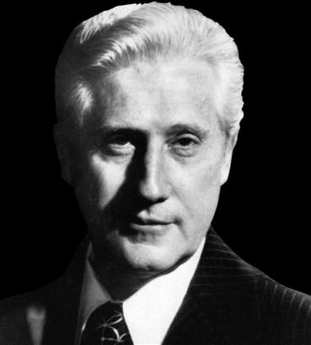
The ambitious Mark Felt
“When reporters call the shots, anonymous sources are vital to uncovering government secrets and wrongdoing (Bob Woodward and Carl Bernstein used Mark Felt and other whistleblowers to chase Richard Nixon out of office).”
And as I pointed out in my media-mythbusting book, Getting It Wrong, rolling up a scandal of the complexity and dimension of Watergate “required the collective if not always the coordinated forces of special prosecutors, federal judges, both houses of Congress, the Supreme Court, as well as the Justice Department and the FBI.
“Even then, Nixon likely would have served out his term if not for the audiotape recordings he secretly made of most conversations in the Oval Office of the White House. Only when compelled by the Supreme Court did Nixon surrender those recordings,” which captured him approving a plan to deflect the FBI’s investigation into the signal crime of Watergate — the foiled burglary in mid-June 1974 at the headquarters of the Democratic National Committee.
The Postdid not disclose the existence of the White House tapes. Nor did the Post reveal the White House coverup of the crimes of Watergate.
So to assert, even in an off-handed way, that Woodward and Bernstein were pivotal or central to chasing Nixon from the White House is to misread history and indulge in one of American journalism’s most tenacious media myths.
A couple of other points about the parenthetical phrase, “Bob Woodward and Carl Bernstein used Mark Felt and other whistleblowers to chase Richard Nixon out of office.”
Bernstein never met Mark Felt during Watergate scandal, nor for many years afterward. Felt was the secret source and senior FBI official known as “Deep Throat,” with whom Woodward periodically conferred in 1972 and 1973, sometimes in a parking garage in the Rosslyn section of Arlington, Virginia.
Also, Felt was no whistleblower, not in a high-minded, altruistic sense. As Christopher Hitchens pointed out almost 10 years ago in a review of Woodward’s book about Felt, Watergate represented “the single most successful use of the news media by an anonymous unelected official with an agenda of his own.” Meaning Felt’s own kind of “background briefing racket.”
Max Holland’s book, Leak: Why Mark Felt Became Deep Throat, argues persuasively that Felt was no principled whistleblower.
He was driven by the internal struggle at the FBI to replace J. Edgar Hoover, who died in May 1972. Felt in leaking to Woodward sought to undercut the acting director, L. Patrick Gray III, and thereby enhance Felt’s chances of being named to the bureau’s top position.
Self-advancement was his principal motive. He failed, and retired in 1973.
It deserves mentioning that Felt was no hero, no noble figure.
As I note in Getting It Wrong, Felt authorized burglaries as part of the FBI’s investigations into leftists associated with the radical Weather Underground. He was convicted in 1980 of felony charges related to the break-ins, but was pardoned the following year by President Ronald Reagan.
Politico yesterday posted an intriguing if flawed account about the file the FBI kept on Ben Bradlee, executive editor of the Washington Post during the Watergate scandal that toppled Richard Nixon’s presidency in 1974.
Intriguing because of such nuggets as J.Edgar Hoover’s characterization of Bradlee as “a colossal liar.” Hoover was the FBI’s long-serving director who died in 1972.
Flawed because the Politico writeup referred to Bradlee as “a man whose Washington Post brought down a president.”
Not even Bradlee, who died last October, embraced that notion. And most principals at the Post during Watergate rejected that superficial interpretation as well.
Notably, Bradlee pointed out in 1997, at the 25th anniversary of the seminal crime of the Watergate scandal, that “it must be remembered that Nixon got Nixon. The Post didn’t get Nixon.”
Bradlee was referring to the White House audio tapes which Nixon secretly made and which revealed the president’s guilty role in attempting to obstruct the FBI’s investigation into the breakin of Democratic National Committee headquarters in Washington in June 1972. The breakin touched off the scandal — and the country’s gravest political crisis of the 20th century.
“Nixon got Nixon. The Post didn’t get Nixon”: That’s a tidy rebuttal to the extravagant claims made about the Post and its Watergate reporting.
Those forces included special prosecutors and federal judges, FBI agents, bipartisan congressional panels, and the U.S. Supreme Court, which unanimously ruled that Nixon must turn over to prosecutors the tapes that captured his guilty participation in the Watergate coverup.
Against this tableau, the contributions of the Post and Woodward and Bernstein to the outcome of Watergate were minimal, modest at best. Hardly decisive.
Katharine Graham, the Post’s publisher during Watergate, essentially said as much in 1997. “Sometimes people accuse us of bringing down a president, which of course we didn’t do,” Graham said then. “The processes that caused [Nixon’s] resignation were constitutional.”
Woodward concurred, if in earthier terms. He told an interviewer in 2006:
Interestingly, Bradlee had an important part in the Post’s failing to disclose the existence of the tapes.
Woodward and Bernstein wrote in their 1974 book, All the President’s Men, that they received a tip about the secret White House taping system a few days before Senate select committee made their existence known.
According to the book, Bradlee suggested they not expend much energy pursuing the tip. They didn’t, and they missed reporting a decisive breakthrough in Watergate.
The tale about the New York Timessuppressing its own reporting in the runup to the Bay of Pigs invasion of Cuba isn’t necessarily the most popular of media myths.
The suppression myth, which is addressed and debunked in my 2010 book, Getting It Wrong: Ten of the Greatest Misreported Stories in American Journalism, has it that the Times bowed to pressure from the administration of President John F. Kennedy and spiked, killed, or otherwise sanitized a detailed report about the pending invasion.
Shipler invokes the suppression tale this way:
“The most famous and catastrophic case of journalists’ abandoning their role in getting the facts out was the Times‘s decision to water down advance information on the Bay of Pigs invasion of Cuba.” He doesn’t say what the Times supposedly held back, or just how that was “catastrophic.”
But he does claim that “a full-throated disclosure might have helped derail the plan, saving lives and preventing a humiliating defeat.”
Speculation aside, Shipler’s right that the ill-fated invasion was a humiliating defeat for the Kennedy administration: A brigade of U.S.-trained foes of the regime of Fidel Castro landed on the beaches of southern Cuba in April 1961 and was rolled up within three days.
But Shipler’s claim about the Times’ having watered down “advance information” is supported by no relevant or persuasive evidence. He cites none in the endnotes of his book.
The Times article that rests at the heart of this media myth was neither suppressed, killed, nor eviscerated.
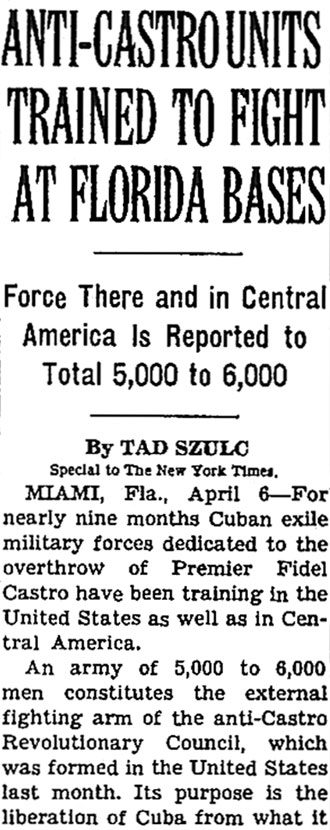
That article (see above) was written by a veteran correspondent, Tad Szulc, who reported from Miami that 5,000 to 6,000 Cuban exiles had received military training for a mission to topple Castro’s communist regime; the actual number of invaders was closer to 1,400.
Overstatement was hardly the article’s most controversial or memorable element.
Supposedly, editors at the Times caved in to pressure from the White House and emasculated Szulc’s report, removing key elements about the invasion plans.
That Kennedy intervened in the Times’ editorial decisionmaking in April 1961 is widely believed, and lives on as a cautionary tale, as Shipler suggests.
But as I discussed in Getting It Wrong, “the notion that Kennedy asked or persuaded the Times to suppress, hold back, or dilute any of its reports about the pending Bay of Pigs invasion is utter fancy. There is no evidence that Kennedy or his administration knew in advance” about Szulc’s dispatch, which was filed April 6, 1961.
The article was published the following day, above the fold on the Times’ front page.
In his book Without Fear or Favor, an insider’s look at the Times, Harrison Salisbury offered a detailed account about the handling of Szulc’s dispatch.
“The government in April 1961,” Salisbury wrote, “did not … know that The Times was going to publish the Szulc story, although it was aware that The Times and other newsmen were probing in Miami. …. The action which The Times took [in editing Szulc’s report] was on its own responsibility,” the result of internal discussions and deliberations.
The editing was cautious but hardly unreasonable.
A reference to the invasion’s imminence was removed, which served to improve the story’s accuracy. The anti-Castro exile force launched its assault on April 17, 1961, 10 days after Szulc’s report appeared, an interval that hardly connotes “imminence.”
References to the CIA’s role in training the Cuban exiles were omitted from the story in favor of the more nebulous terms “U.S. officials” and “U.S. experts.” Turner Catledge, then the Times managing editor, said the U.S. government had more than a few intelligence agencies, “more than most people realize, and I was hesitant to specify the CIA when we might not be able to document the charge.”
An entirely defensible editorial decision.
The prominence given Szulc’s report was modified, from a planned four-column display to a single column. If the invasion was not believed imminent, then a four-column headline was difficult to justify, Catledge reasoned.
Those decisions were judicious, and certainly not unreasonable.
“Most important,” as Salisbury wrote, “The Times had not killed Szulc’s story. … The Times believed it was more important to publish than to withhold. Publish it did.”
On the front page.
What’s often ignored is that Szulc’s article of April 7, 1961, was no one-off story. It scarcely was the Times’ last word about invasion plans.
As I noted in Getting It Wrong, “Subsequent reporting in the Times, by Szulc and others, kept expanding the realm of what was publicly known about a coming assault against Castro.” Not all the reports were accurate in all their details, but the combined effect was to signal something important was afoot.
For example, on April 8, 1961, the Times published a front-page article about the exiles and their eagerness to topple Castro.
The article appeared beneath the headline, “Castro Foe Says Uprising Is Near,” and quoted the president of the U.S.-based umbrella group of exiles, the Cuban Revolutionary Council.
The following day, the Times front page included a report by Szulc describing how Cuban exile leaders were attempting to paper over differences in advance of what was termed the coming “thrust against Premier Fidel Castro.”
The “first assumption” of the leaders’ plans, Szulc wrote, “is that an invasion by a ‘liberation army,’ now in the final stages of training in Central America and Louisiana, will succeed with the aid of internal uprising in Cuba. It is also assumed that a provisional ‘government in arms’ will be established promptly on the island.”
That essentially was the plan to topple Castro.
Three days later, James Reston, then the newspaper’s Washington bureau chief, wrote in a column that considered the moral dimensions of an assault on the Castro regime. Reston’s column said that “while the papers have been full of reports of U.S. aid to overthrow Castro, the moral and legal aspects of the question have scarcely been mentioned.”
Other news organizations, including the MiamiHerald and New York Herald Tribune, reported on pre-invasion preparations as well, all of which prompted Pierre Salinger, Kennedy’s press secretary, to recall in a memoir a few years later:
“To declare in mid-April of 1961 that I knew nothing of the impending military action against Cuba except what I read in the newspapers or heard on the air was to claim an enormous amount of knowledge.”
It’s striking how prominent politicians, entertainers, and celebrities contribute to the recycling and, thus, the solidifying of media-driven myths, those hoary and exaggerated tales that often tell of magnificent deeds by journalists.
During his vice presidency, gaffe-prone Joe Biden went to Moscow and repeated the heroic-journalist trope of Watergate, about how, in his words, “it was a newspaper, not the FBI, or the Justice Department, it was a newspaper, the Washington Post that brought down a President for illegal actions.”
Cavett: Pushing the Cronkite myth
He was referring to the resignation of President Richard M. Nixon in August 1974.
The claim is absurd, but it has resonance across the political spectrum. Last year, for example, Rush Limbaugh, the voluble conservative talk-radio host, indulged in the heroic-journalist myth, declaring on his show last year that Bob Woodward’s Watergate reporting for the Washington Post “destroyed the Nixon presidency.”
Now comes Dick Cavett, the former television talk show host, who in a shrill and shallow commentary posted recently at the New York Times online site, recycles the media myth of the “Cronkite Moment” of 1968, when an analysis of the CBS News anchorman about the Vietnam War supposedly brought an epiphany to President Lyndon B. Johnson.
Cavett writes in what is a sneering and superficial assessment of the Vietnam conflict:
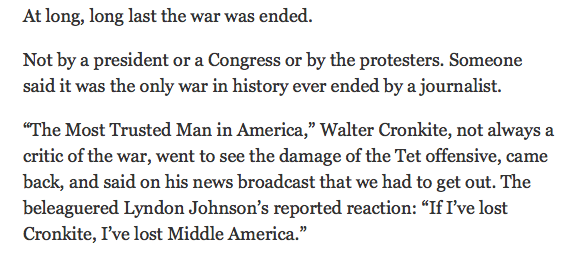
“At long, long last the war was ended.
“Not by a president or a Congress or by the protesters. Someone said it was the only war in history ever ended by a journalist.
“‘The Most Trusted Man in America,’ Walter Cronkite, not always a critic of the war, went to see the damage of the Tet offensive, came back, and said on his news broadcast that we had to get out. The beleaguered Lyndon Johnson’s reported reaction: ‘If I’ve lost Cronkite, I’ve lost Middle America.'”
From Cavett’s commentary
So let’s unpack that bundle of myth and exaggeration.
The reference to “only war in history ever ended by a journalist” sounds much like David Halberstam’s hyperbolic and unsourced claim in his book, The Powers That Be, that Cronkite’s analysis about Vietnam “was the first time in history a war had been declared over by an anchorman.”
Moreover, the notion that Cronkite reigned as America’s “most trusted man” rests more on advertising by CBS News, his employer, than on persuasive empirical evidence such as representative survey samples.
As for Cavett’s claim that Cronkite “said on his news broadcast that we had to get out” — well, that’s not what Cronkite said.
The claim refers to Cronkite’s special report about Vietnam, which CBS aired on February 27, 1968. At the close of the program, Cronkite said the U.S. war effort in Vietnam was “mired in stalemate” and that negotiations might prove to be a way out.
It was hardly a call for withdrawal.
Johnson with Connolly: Not watching Cronkite
It was in fact a tepid reiteration of the thinking prevalent in the news media at the time: The war was stalemated. The New York Times had been saying as much periodically for months.
Finally, there’s no compelling evidence that President Lyndon Johnson reacted to Cronkite’s assessment by declaring in a flash of insight:
“If I’ve lost Cronkite, I’ve lost Middle America.”
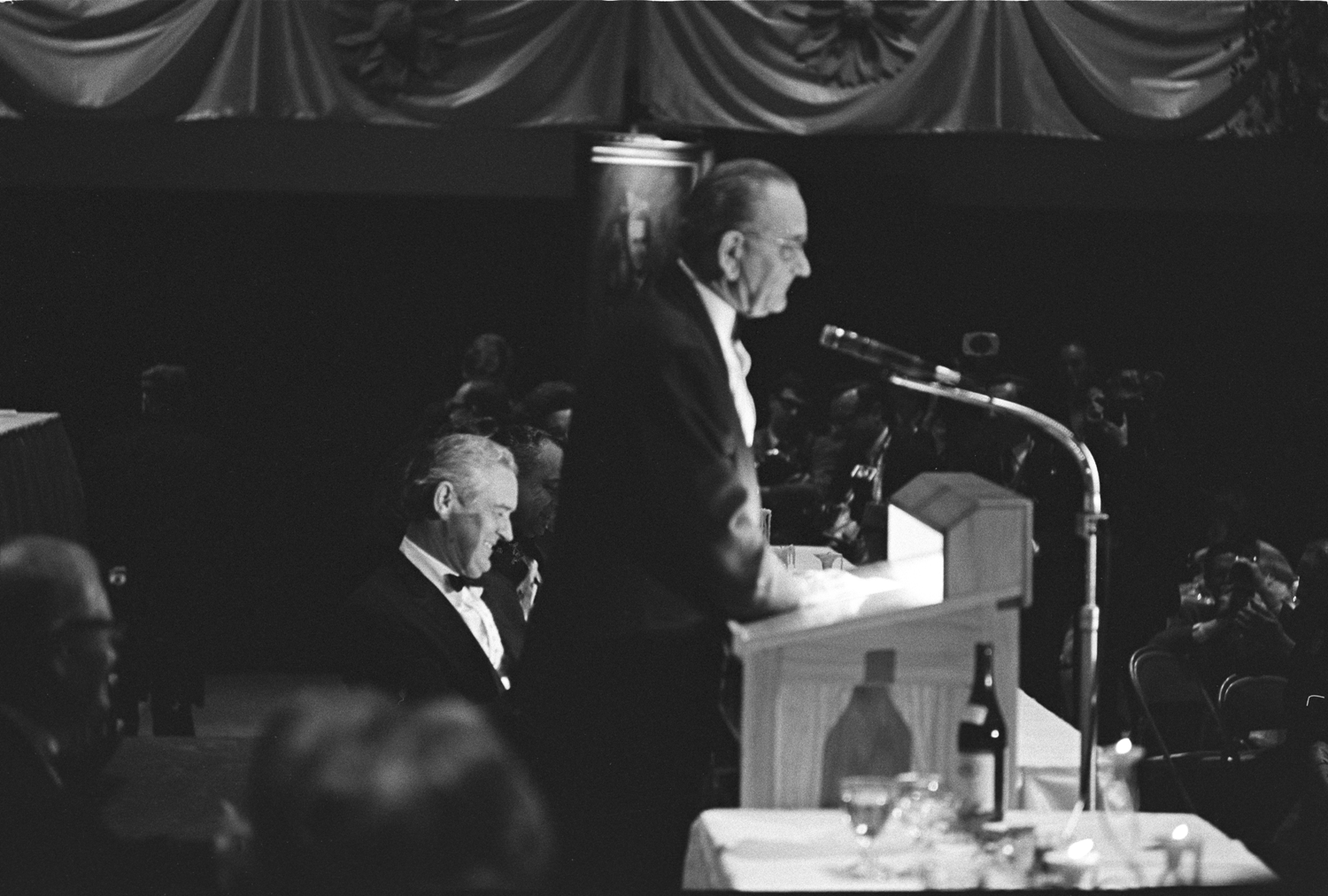
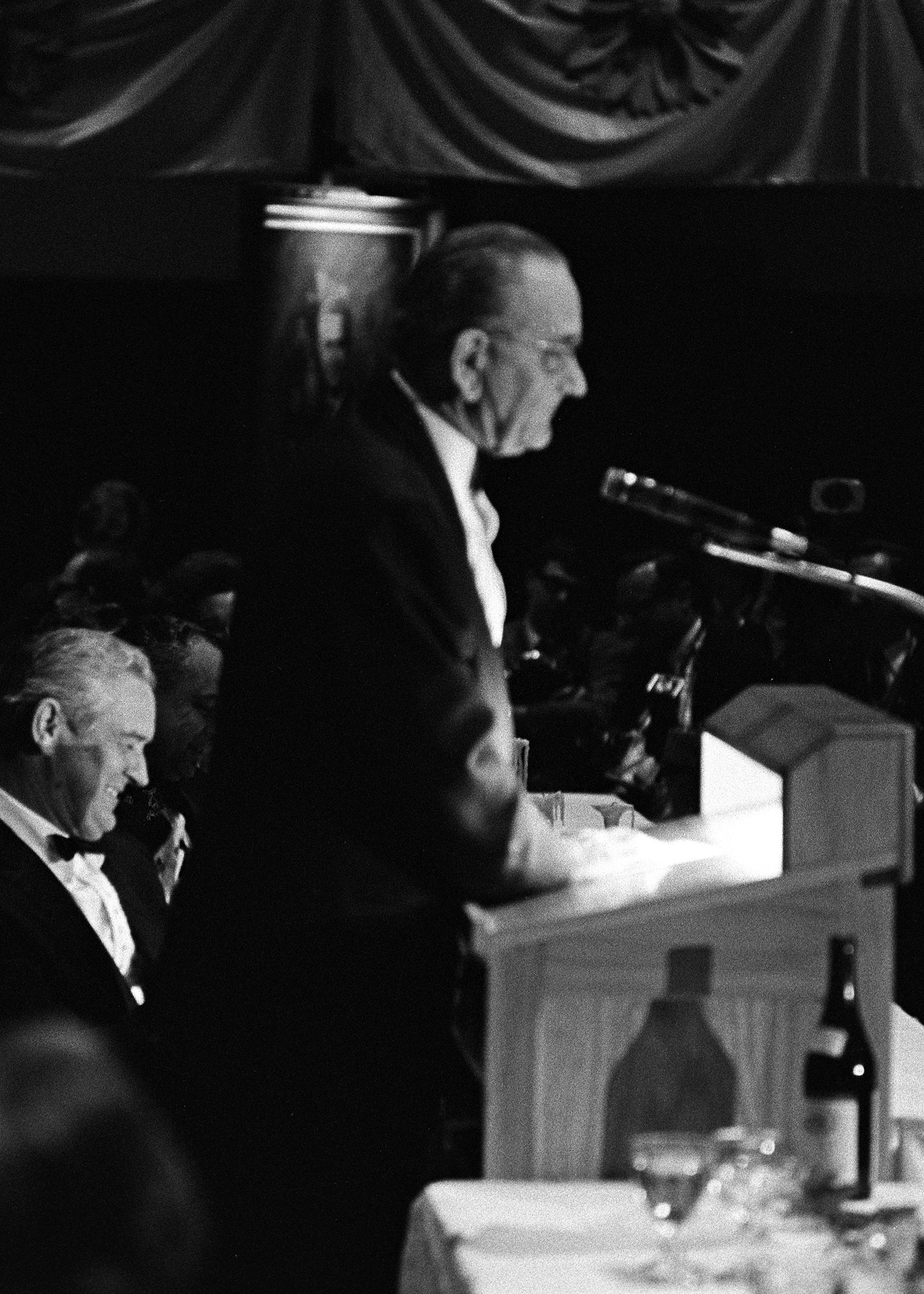
Johnson that night was on the campus of the University of Texas at Austin, attending a black-tie birthday party for his longtime political ally, Texas Governor John Connolly.
About the time Cronkite’s was intoning his tired “mired in stalemate” observation, the president was making light of Connolly’s age.
“Today, you are 51, John,” he said. “That is the magic number that every man of politics prays for—a simple majority.”
With a bit of routine fact-checking, news organizations usually can sidestep the embarrassment of trading in prominent media myths.
But, no: The narrative power of many media myths often makes them too good to check. And so the myth gets retold.
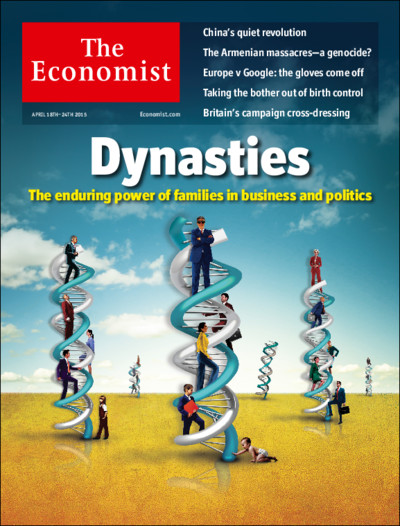
Consider the latest issue of Britain’s Economist newsmagazine. In an extended report about family-run companies, the Economist offers up the simplistic and ever-appealing myth that Richard Nixon’s corrupt presidency was brought low in the 1970s by the Washington Post, then owned by Katharine Graham and family.
“Under her iron reign,” the Economist says of Graham, “the Washington Post brought down President Nixon with its investigation into the Watergate break-in and challenged the New York Times for the title of America’s most illustrious newspaper.”
Katharine Graham herself said as much, at the 25th anniversary of the break-in in June 1972 of Democratic National Committee headquarters at the Watergate complex in Washington, D.C., the scandal’s seminal crime.
Speaking at an event in suburban Virginia, at the original Newseum (humble predecessor to the $450 million edifice on Pennsylvania Avenue), Graham insisted that the Post had not toppled Nixon.
“Sometimes,” she said, “people accuse us of bringing down a president, which of course we didn’t do. The processes that caused [Nixon’s] resignation were constitutional.”
Graham’s comment is not difficult to track down. It’s in my 2010 mythbusting book, Getting It Wrong, and I have incorporated the quote in many blog posts at Media Myth Alert, including those here, here, here, and here.
Graham was quite right about the processes that forced Nixon’s resignation (he quit in August 1974 in the face of certain impeachment by the U.S. House of Representatives).
And over the years, Graham’s views have been echoed by other principals at the newspaper.
Ben Bradlee, the executive editor during and after the Watergate period, likewise rejected the notion that the Post’sWatergate reporting brought down the president, saying in 1997 that “it must be remembered that Nixon got Nixon. The Post didn’t get Nixon.” (Bradlee was referring to the many hours of White House tapes which Nixon secretly made and which revealed the president’s active role in seeking to block the FBI’s investigation of the seminal crime of Watergate — the break-in at the DNC headquarters.)
Howard Kurtz, formerly the newspaper’s media reporter, wrote in 2005:
“Despite the mythology, The Post didn’t force Richard Nixon from office ….”
And Bob Woodward, one of the newspaper’s lead reporters on Watergate, once told American Journalism Review:
It is revealing to consider what critical disclosures the Post missed in its Watergate reporting.
It notably did not disclose the White House cover up of the Watergate crimes. It likewise failed to reveal the existence of Nixon’s White House tapes. Indeed, as I noted in Getting It Wrong, the contributions of Woodward and his reporting partner Carl Bernstein to the outcome of Watergate “were modest, and certainly not decisive.”
Far more important, I wrote, were “the collective if not always the coordinated forces of special prosecutors, federal judges, both houses of Congress, the Supreme Court, as well as the Justice Department and the FBI.”
And even then, despite the forces arrayed against him, Nixon probably would have survived Watergate and served out his term as president if not for the tapes — the existence of which was revealed by Alexander Butterfield, a former Nixon aide, before a U.S. Senate select committee in July 1973.
Its latest issue is not the first in which the Economist has indulged in Watergate mythology. In October, shortly after his death, the newsmagazine published a tribute to Bradlee, beneath a headline that read:
“The editor who toppled Nixon.”
That mythical claim appeared in the text of the eulogy as well.
Because he looked poised and confident, it is often said that television viewers felt Senator John F. Kennedy won the first-ever U.S. presidential debate in 1960.
Radio listeners, perhaps put off by Kennedy’s New England accent, thought his Republican foe, Vice President Richard M. Nixon, performed better.
The exhibition includes, the review said, a “video clip from the televised presidential debate between Vice President Nixon and Senator John F. Kennedy in 1960,” a clip that “seems to show the handsome, youthful Kennedy trouncing a visibly sweating Nixon. (Those who caught the debate on the radio thought Nixon trumped Kennedy.)”
Well, not really: There’s no solid, persuasive evidence to support the notion that radio listeners felt that Nixon had “trumped” Kennedy, or that listeners sharply disagreed with television viewers about who did better in the debate, which took place in Chicago on September 26, 1960.
That there must have been such an effect is appealing on many levels, notably because it suggests that appearance can trump substance in politics.
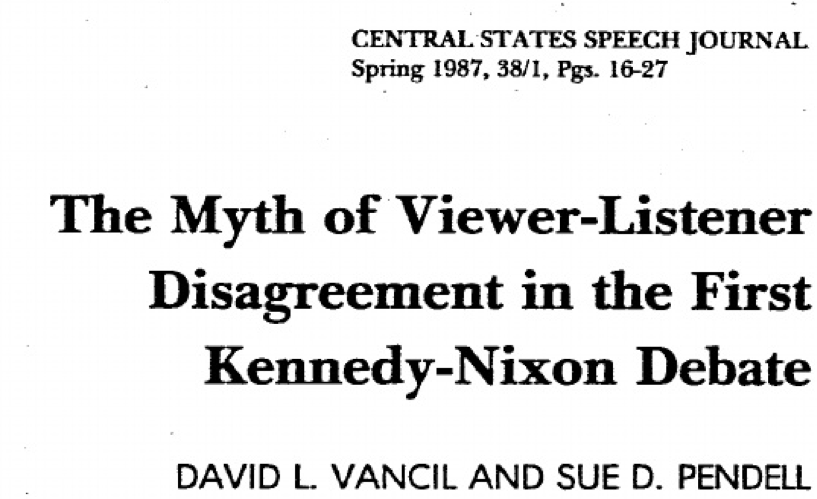
But the notion of viewer-listener disagreement in the 1960 debate is a media myth — a media myth that endures despite being thoroughly dismantled nearly 30 years ago in research published by scholars David L. Vancil and Sue D. Pendell.
In an article in Central States Speech Journal in 1987, Vancil and Pendell pointed out that accounts of viewer-listener disagreement about the debate typically were anecdotal and hardly representative of the American electorate in 1960.
They also called attention to “a false impression” that “major polling organizations, such as Gallup, concentrated part of their attention on the reactions of radio listeners.” That hardly was the case.
The one polling organization that did identify radio listeners in a post-debate survey was Sindlinger & Co.
Sindlinger reported that poll respondents who listened to the debate on radio thought Nixon won, by a 2-to-1 margin.
But the Sindlinger sub-sample of radio listeners included 282 respondents. Of that number, only 178 offered an opinion about the debate winner, which was far too few to permit meaningful generalizations or conclusions, Vancil and Pendell noted.
Not only was the sub-sample unrepresentative, it did not identify from where the sub-sample of radio listeners was drawn. “A location bias in the radio sample,” Vancil and Pendell pointed out, “could have caused dramatic effects on the selection of a debate winner. A rural bias, quite possible because of the relatively limited access of rural areas to television in 1960, would have favored Nixon.”
Those and other defects render the Sindlinger result meaningless.
Vancil and Pendell’s article also questioned the notion that Nixon’s haggard and sweaty appearance during the debate was necessarily decisive to views about who won the encounter.
“Appearance problems, such as Nixon’s perspiring brow, could have had a negative impact on viewer perceptions,” they wrote, “but it is also possible for viewers to be sympathetic to such problems, or to interpret them as evidence of attractive or desirable qualities.”
They added: “Even if viewers disliked Nixon’s physical appearance, the relative importance of this factor is a matter of conjecture.”
It is important to note that a good deal of post-debate commentary declared the Kennedy-Nixon encounter — the first of four debates during the 1960 campaign — to have been a draw, or nearly so.
For example, James Reston, then the Washington bureau chief for the New York Times, wrote:
“Who took the first round is a matter of individual opinion. My own view is that Kennedy gained more than Nixon, but it was a fielder’s choice, settling nothing.”
Writing in the old New York Herald Tribune, columnist John Crosby stated:
“I think Kennedy outpointed Nixon. I think it was a close fight and perhaps a disappointing one. … Both candidates were awfully cautious, as if they’d been warned that a mistake could cost them the whole prize.”
The Washington Post saw it another way, stating in a post-debate editorial:
“Of the two performances, Mr. Nixon’s was probably the smoother. He is an accomplished debater with a professional polish, and he managed to convey a slightly patronizing air of a master instructing a pupil.”
Right after the Kennedy-Nixon encounter, the Associated Press news service conducted an unscientific survey of 100 Americans in 10 major U.S. cities and reported finding that most respondents said they weren’t influenced by the exchanges.
“Only a few persons,” the AP reported, “said they had actually switched from one candidate to the other because of the debate.”
A Gallup poll taken in the week after the debate and released October 11, 1960, reported that 43 percent of voters thought Kennedy “did the better job” in the debate; 23 percent thought Nixon was better, and 29 percent said both candidates were about the same. Five percent offered no opinion.
The survey, moreover, detected no marked, post-debate shift of support to Kennedy. The survey reported Kennedy to be narrowly ahead, by 49 percent to 46 percent, with 5 percent undecided.
“The prudent reader can see,” wrote George Gallup, the head of the polling organization, in reporting those results, that polling “has not reached the degree of accuracy required to say with certainty which candidate is ahead in a close race such as the present one.”
Kennedy narrowly won the election, receiving 49.72 percent of the popular vote to Nixon’s 49.55 percent.
Indeed, according to the Los Angeles Times, Cronkite’s report of February 27, 1968, “shifted public opinion on the war.”
But it didn’t. Not demonstrably, not measurably.
The “shifted public opinion” claim is embedded in the Times’profile of Scott Pelley, a successor to Cronkite as anchor of the CBS Evening News.
The profile, posted online yesterday, mentions photographs on Pelley’s office walls, images that include “Walter Cronkite in Vietnam for his documentary that shifted public opinion on the war.”
What CBS aired 47 years ago tonight was a special, hour-long news report about the Tet offensive launched at the end of January 1968. The communist North Vietnamese and their Viet Cong allies struck then across South Vietnam and the extent of their attacks surprised the American public, which had been told the U.S. military was making significant progress in the war.
The offensive prompted Cronkite to travel to Vietnam to gather material for his special report, which he closed by declaring the U.S. war effort in Vietnam was “mired in stalemate” — a tepid characterization that hardly was very original.
Cronkite also suggested in his wrap-up assessment that negotiations might eventually prove to be a way out of the war. Nor was that a particularly bold suggestion.
In time, though, Cronkite’s report came to be thought of as legendary, as exceptional, as the “Cronkite Moment.” It has become barnacled with media myth.
It is often said the President Lyndon Johnson was at the White House that night (he was in Texas), that he watched Cronkite’s report (he did not), and that Cronkite’s assessment prompted him to say something to the effect of “If I’ve lost Cronkite, I’ve lost Middle America” (there’s no evidence he said anything of the sort, and it’s hard to believe the president was much moved by a report he did not see).
As for the notion that Cronkite’s analysis altered American public opinion about the war, supporting evidence is extremely thin.
As I discuss in my media-mythbusting book, Getting It Wrong, popular support for the war had begun declining months before the Cronkite report. That shift was evident by Fall 1967.
A Gallup poll conducted in October 1967 found for the first time that a plurality of Americans — 47 percent — believed that sending troops to fight in Vietnam had been a mistake.
A little more than two years earlier, just 24 percent of respondents said they thought it was a mistake to have deployed American forces to Vietnam.
Gallup asked the question again in a poll completed on the day Cronkite’s program aired: Forty-nine percent of the respondents said “yes,” U.S. military intervention in Vietnam had been a mistake; 42 percent said “no.”
In April 1968, Gallup found that 48 percent of respondents said U.S. military intervention in Vietnam had been a mistake; 42 percent said it had not been.
Moreover, print journalists had detected a softening in support for the war well before Cronkite’s “mired in stalemate” assessment.
In December 1967, for example, a national correspondent for the Knight newspapers, Don Oberdorfer, noted that the previous summer and fall had “been a time of switching, when millions of American voters — along with many religious leaders, editorial writers and elected officials — appeared to be changing their views about the war.”
So Cronkite’s report had little demonstrable effect on Americans’ views about Vietnam. Indeed, it can be said that Cronkite followed rather than led public opinion on the war.
As if there’s no need to let a media myth stand in the way of a useful anecdote.
The “oft-cited” anecdote centers around Cronkite’s claim, offered February 27, 1968, at the close of a special report on CBS, that the U.S. military was “mired in stalemate” in Vietnam and that negotiations might eventually offer a way out of the conflict.
Supposedly, Johnson watched the program at the White House and, upon hearing Cronkite’s “mired in stalemate” observation, snapped off the television set and told an aide or aides:
“If I’ve lost Cronkite, I’ve lost Middle America.”
Or something to that effect: Versions vary markedly as to what the president purportedly said.
Here’s how the Times presented the anecdote today, embedded in a report about the influence of Jorge Ramos, news anchor for the Spanish-language Univision network:
“‘Remember what L.B.J. said, “When you lose Walter Cronkite, you’ve lost the war”?’ said Matthew Dowd, a campaign adviser to George W. Bush, recalling the oft-cited if disputed story that President Lyndon B. Johnson said he lost ‘middle America’ when Cronkite turned against the Vietnam War. Among Latino voters, Mr. Ramos has the sort of influence and audience that Cronkite had more broadly among Americans in his day.”
Let’s unpack that myth-freighted paragraph.
First, Johnson did not see the Cronkite report when it aired. This is crucial because the power of the Cronkite-Johnson anecdote rests on the immediate and visceral effect that anchorman’s assessment supposedly had on the president. It was, supposedly, an epiphany for Johnson: He suddenly understood the futility of pressing the war in Vietnam (even though U.S. combat troops remained in Vietnam until 1973).
As I discussed in my media-mythbusting book, Getting It Wrong, Johnson at the time was not at the White House.
He was in Austin, Texas, attending a birthday party for a longtime political ally, Governor John Connally. And about the moment Cronkite was on television intoning his “mired in stalemate” remark, Johnson was making light of Connally’s age.
“Today, you are 51, John,” the president said. “That is the magic number that every man of politics prays for — a simple majority.”
Johnson on that occasion (see photo, above) had nothing to say about Cronkite.
Second, it is impossible to square Johnson’s purportedly downbeat reaction — “If I’ve lost Cronkite, I’ve lost Middle America” — with his sharply more hawkish remarks made at that time about Vietnam.
Just hours before the Cronkite program aired Johnson, delivered a rousing speech in Dallas, in which he cast the war effort in Churchillian terms, saying at one point:
“There will be blood, sweat and tears shed.”
Johnson also declared in the Dallas speech, “I do not believe that America will ever buckle” in pursuit of its objectives in Vietnam. “I believe that every American will answer now for his future and for his children’s future. I believe he will say, ‘I did not buckle when the going got tough.’”
He further said:
“Thousands of our courageous sons and millions of brave South Vietnamese have answered aggression’s onslaught and they have answered it with one strong and one united voice. ‘No retreat,’ they have said. Free men will never bow to force and abandon their future to tyranny. That must be our answer, too, here at home. Our answer here at home, in every home, must be: No retreat from the responsibilities of the hour of the day.”
It is inconceivable that Johnson’s assertive, “no retreat” views about the war would have swung so immediately, and so dramatically, upon hearing the opinion of a television news anchor.
An opinion that was hardly exceptional, novel, or shocking in late February 1968.
By the time of Cronkite’s report, “stalemate” had become an unremarkable — and not uncommon — way to characterize the war in Vietnam.
The Times, for example, had invoked “stalemate” months before Cronkite’s television report, notably in a front-page news analysis published August 7, 1967. In it, the Times observed that “the war is not going well. Victory is not close at hand.”
The Times analysis, filed from Vietnam, further declared:
“‘Stalemate’ is a fighting word in Washington. President Johnson rejects it as a description of the situation in Vietnam. But it is the word used by almost all Americans here, except the top officials, to characterize what is happening.”
The analysis was published on the Times front page, beneath the headline:
Moreover, even if Johnson later heard — or heard about — Cronkite’s “mired in stalemate” assessment, it represented no epiphany. If the president later heard — or heard about — Cronkite’s analysis, he didn’t take it to heart in his public statements.
Not long after the Cronkite program, Johnson was in Minneapolis where he delivered a hawkish, lectern-pounding speech, urging a “total national effort” to win the war in Vietnam.
“We love nothing more than peace, but we hate nothing worse than surrender and cowardice,” Johnson said in the speech, in which he disparaged foes of the war as wanting the country to “tuck our tail and violate our commitments.”
So the Times would do well to offer a correction or clarification: The Cronkite-Johnson tale certainly is “oft-cited,” but it is more problematic than merely “disputed.”
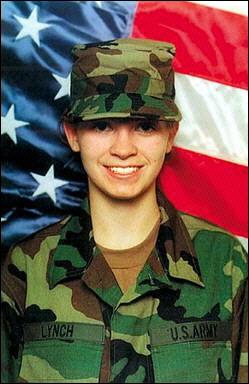
The newspaper that brought us the bogus story about the battlefield heroics of Jessica Lynch during the Iraq War has goofed again in recounting details about the case.
Lynch: Never fired a shot
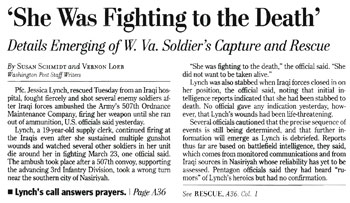
The Washington Post — which erroneously claimed in early April 2003 that Lynch had fought fiercely despite being shot and stabbed in the ambush of her unit — mistakenly described in a blog post yesterday the circumstances of Lynch’s subsequent rescue from captivity.
Lynch was a supply clerk in the 507th Maintenance Company, which was attacked in Nasiriyah on March 23, 2003. Lynch, who never fired a shot in the ambush, was severely injured in the crash of a Humvee as she and four colleagues tried to escape. She was neither shot nor stabbed.
Two days later, the Post published its bogus, front-page report about Lynch’s purported derring-do on the battlefield, a story that cited otherwise anonymous “U.S. officials” and appeared beneath the headline:
Yesterday, the Post’s “Checkpoint” Web log erred in asserting that Lynch was one of several U.S. soldiers “held in captivity for 22 days before being rescued by Marines.” Lynch was not among those prisoners and her rescuers were special operations forces.
The “Checkpoint” post focused on about a talk given at a conference in San Antonio by Shoshana Johnson, who was shot in the ankles in the Nasiriyah ambush and also taken prisoner. Her rescue from captivity came more than a week after the operation that freed Lynch.
Conflating the cases of Lynch and Johnson obviously is not an error as significant as the Post’s report of April 3, 2003, which said Lynch “continued firing at the Iraqis even after she sustained multiple gunshot wounds and watched several other soldiers in her unit die around her in fighting” at Nasiriyah.
Still, the erroneous “Checkpoint” report is sloppy, and signals continued inattention to detail about the Lynch case.
One might think, given the embarrassment of the botched “fighting to the death” story, that Post reporters would be especially mindful about the details of the Lynch case.
And yet, the “Checkpoint” writeup wasn’t the first time in recent years that the newspaper has erred in referring to Lynch.
The Post invoked the Lynch case in 2010, in a movie review that disingenuously blamed the Pentagon for the bogus tale about Lynch’s heroics. Nearly seven weeks later, the newspaper published a belated and awkwardly worded correction about the review’s erroneous passage.
It is worth noting that the Post has never fully accounted for its botched hero-warrior story in 2003. It has never disclosed the identities of the anonymous sources who provided the salient details for a story so electrifying that was picked up by news organizations around the world.
The Post’s unwillingness to identify its sources contributed to the tenacity of a toxic narrative that the Pentagon concocted the story and somehow fed it to the Post in a crude attempt to boost U.S. public support for the war.
As I discuss in my media-mythbusting book, Getting It Wrong, Vernon Loeb, who shared a byline on the Post’s hero-warrior story about Lynch, has said unequivocally that the anonymous sources were not Pentagon officials.
Media Myth Alert revisits its top-ever posts today in observing its fifth anniversary.
The blog went live October 31, 2009, and its objective was, and remains, twofold: Calling out the appearance and publication of media myths and helping to promote Getting It Wrong, my media mythbusting book that came out in 2010.
This is the second of a two-part review of the 10 top posts published at Media Myth Alert, home over the years to more than 640 essays and commentaries. The top posts shared these elements: All were about prominent topics, all received a fair amount of attention in the blogosphere and beyond, and all represented disclosures exclusive to Media Myth Alert.
Credible, first-hand accounts are cited in Getting It Wrong that bras and other items were set afire, briefly, at a women’s liberation protest at Atlantic City during the 1968 Miss American pageant. And in Toronto in March 1979, a demonstration was capped by a bra-burning, intended as a way to attract media attention. A photograph of the Toronto bra-burning is at right.
I had not seen the photograph before it appeared in February 2011 with an article at the online site of London’s Guardian newspaper. I had doubts about its authenticity, given the periodic claims about no bras ever having been burned at a feminist protest.
The Toronto image, I thought at first, might have been faked — or unethically altered somehow.
Turns out that was not the case.
I tracked down one of the participants at the Toronto protest and she confirmed the bra-burning, saying by phone from Vancouver:
“The photo is authentic. Absolutely. It happened.”
The participant was Vicki Trerise, who appears at the far right in the photograph above.
The photograph shows a moment of demonstrative bra-burning, although Trerise said that “wasn’t a focal point” of the protest, which took place not far from Toronto’s City Hall.
The bra-burning came near the end of the demonstration, which was called to protest what the organizers said was an illogical report about rape, prepared by the Ontario Provincial Police. (The report said that of 337 rapes investigated, 140 were “unprovoked.” The report also said “promiscuity” was a factor in many rapes.)
Trerise said the demonstrators in Toronto were media-aware and “knew that if they burned a bra, someone would take their picture.”
Toronto newspapers the next day reported on the protest — but did not mention the bra-burning.
The Post report cited otherwise unidentified “U.S. officials” and declared that Lynch, a 19-year-old Army private, had fought fiercely in the ambush of her unit, the 507th Maintenance Company, in Nasiriyah in southern Iraq on March 23, 2003. Lynch suffered severe injuries in the crash of a Humvee in Nasiriyah. She was taken prisoner by the Iraqis but rescued by U.S. special forces on April 1, 2003.
Vernon Loeb, one of the Post reporters on the hero-warrior story — which was wrong in its important details — later made clear that the Pentagon had not been the newspaper’s source.
As I noted in Getting It Wrong, Loeb went on NPR’s Fresh Air program in December 2003 and declared, unequivocally:
“Our sources for that story were not Pentagon sources.”
None of that vital context was acknowledged by Maddow as she discussed the Lynch case on June 3, 2014.
“If the heroics that the Pentagon made up about her didn’t really happen, and they didn’t, maybe the U.S. special forces who rescued her, maybe they shouldn’t have bothered,” Maddow said about Lynch. (Maddow’s commentary was inspired by controversy surrounding the release a few days before of Bowe Bergdahl, an Army sergeant who apparently had walked away from his post in Afghanistan and was held captive by the Taliban for five years. The administration of President Barack Obama released five senior Taliban figures to gain Bergdahl’s freedom.)
When Maddow was called out on her erroneous claim about the Pentagon, she dodged a correction by cherry-picking — by referring to an obscure report in the Military Times on April 3, 2003, in which a military spokesman, Frank Thorp, was quoted as saying that Lynch “waged quite a battle prior to her capture.
“We do have very strong indications that Jessica Lynch was not captured very easily,” Thorp was additionally quoted as saying.
Crowed Maddow: “That information straight from a military public affairs official was not true. It was made up. But it landed in press reports anyway.”
What Maddow neglected to mention was that Thorp was recapping for the Military Times what the Washington Post had already published.
Thorp, then a Navy captain assigned to U.S. Central Command headquarters in Doha, Qatar, was not inventing — he was following. He was, unwisely, restating elements of the Post’s story already in circulation and quickly gaining international attention.
I wrote in discussing Maddow’s cherry-picking that “it is impossible to address the hero-warrior tale about Lynch without considering the Washington Post’s central and decisive role in the story.” But Maddow ignored the Post’s exclusive role in pushing the botched Lynch story into the public domain.
The Post did so by relying on sources it has never disclosed.
But try finding online the Post’s famously wrong reporting about Jessica Lynch’s derring-do in Iraq, notably the electrifying front-page report that appeared April 3, 2003, beneath the headline:
“‘She was fighting to the death.'”
That story — which said Lynch had fought fiercely against Iraqi attackers and had suffered gunshot and stab wounds before running out of ammunition and being taken prisoner — was in error in all important details. You won’t find it online at any Washington Post site. (The Post’s story is available in full at the online site of the Pittsburgh Post-Gazette.)
Nor will you find freely available online the scathing reviews of the Lynch story published by the Post’s then-ombudsman, Michael Getler, in April and June 2003.
All of which suggests digital scrubbing of embarrassing content — conduct of the sort the Post criticized in 2012, in noting that Vogue magazine expunged the online version of a fawning profile of Syrian dictator Bashar al-Assad. The Post at that time said Vogue had taken “an almost-unheard-of step for a mainstream media organization” and had committed “a generally acknowledged violation of digital etiquette.”
But had the Post not committed a similar “violation” in excising the digital reminders of the embarrassing Lynch case, a dramatic story that it had thoroughly and exclusively botched?
Rather looks like it.
I asked the newspaper’s then-ombudsman, Patrick Pexton, about the apparent digital scrubbing of the Lynch content.
Pexton took weeks to reply, finally stating in an email that he had found “nothing nefarious about this.” He said the Post since 2003 “has gone through several changes of content management systems,” by which articles are posted online.
He noted that the “fighting to the death” story about Lynch and related content are available in the Post’s fee-based archive.
“Restoring the digital version of the article of April 3, 2003, would represent a contribution to the record about the case of Jessica Lynch, which the Post is solely responsible for having placed in the public domain,” I wrote in an email to Pexton.
He never replied before leaving the position in 2013, when his two-year term as ombudsman expired. He was not replaced.
The gaffe, in turn, is said to have inspired one of the most scathing putdowns in American political history.
But my research found that the context of the supposed putdown is unclear at best.
The gaffe was committed in late August 1967 by George Romney, then governor of Michigan and a presumptive leading candidate for the Republican presidential nomination in 1968.
In an interview with a Detroit television reporter, Romney referred to a visit he had made to South Vietnam in 1965 and said:
“You know, when I came back from Vietnam, I’d just had the greatest brainwashing that anybody could get. … Well, not only by the generals but by the diplomatic corps over there. They do a very thorough job.”
Romney’s claim that he had been duped into supporting America’s war effort in Vietnam suggested gullibility, muddled thinking, and an uncertain command of foreign policy. His run for the presidency never righted itself; he quit the race at the end of February 1968.
A witty putdown attributed to Democratic Senator Eugene McCarthy ensured that Romney’s gaffe would remain unforgettable. Rather than a “brainwashing,” McCarthy supposedly said, all Romney needed was a “light rinse.”
So incisive was McCarthy’s quip that it is said to have “essentially finished Romney” as a candidate for president.
But unclear is where, when, and even whether McCarthy made the “light rinse” comment.
A search of a full-text database of leading U.S. newspapers — including the New York Times, the Washington Post, Chicago Tribune, Los Angeles Times, and Baltimore Sun — turned up no published reference to the “light rinse” quip in 1967 or 1968. Or for years afterward. (The first reference was in 1983, a column in the Baltimore Sun that did not say when, where, or to whom McCarthy uttered the remark.)
It seems improbable that American journalists in 1967 or 1968 would have failed to report a retort as deft and delicious as McCarthy’s.
American Melodrama, a hefty book published in 1969, described McCarthy’s remark as off-hand and said the senator’s aides persuaded reporters to hush it up.
While intriguing, American Melodrama doesn’t say where McCarthy made the comment, when, or specifically to whom.
Such vagueness invites suspicion about the “light rinse” quip. It also sounds a bit too perfect — not unlike, say, William Randolph Hearst’s purported vow to “furnish the war” with Spain or Lyndon B. Johnson’s supposed epiphany on the Vietnam War: “If I’ve lost Cronkite, I’ve lost Middle America.”
This was apparent in late summer 2013, when the newspaper refused to acknowledge and correct an inarguably erroneous reference to Richard Nixon’s supposed “secret plan” to end the war in Vietnam.
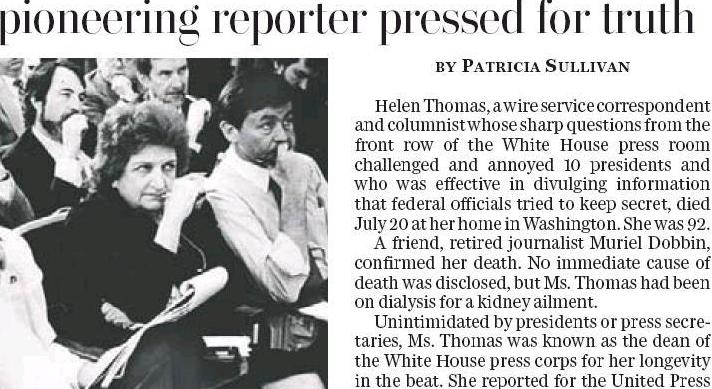
The wrong-headed reference to Nixon’s “secret plan” was embedded in the Post’s front-page obituary about Helen Thomas, a querulous and overrated Washington journalist who covered the White House for years for United Press International.
The Post’s obit of Thomas
The Post’s obituary was glowing and, as if to suggest Thomas’s impressive assertiveness, claimed that she once “asked President Richard M. Nixon point-blank what his secret plan to end the Vietnam War was.”
Trouble is, there is no evidence that Thomas ever posed such a question, point-blank or otherwise.
The nearest approximation came at a news conference in late January 1969, when Thomas asked Nixon about his “peace plan” for Vietnam. That’s probably what the obituary writer had in mind.
But Thomas had asked about Nixon’s peace plan, not a “secret plan.”
The Post’s error in the obituary had broader dimension, in that it suggested an embrace of the persistent notion that Nixon ran for president in 1968 touting a “secret plan” to end the war in Vietnam.
Which is untrue. Nixon did not campaign for the White House on a “secret plan.” The belief that he did circulates still, as supposedly powerful evidence of Nixon’s devious and conniving ways.
The obituary’s writer, Patricia Sullivan, said as much, telling me in response to an email query: “I recall the Nixon years and his promise during his candidacy that he had a plan to end the Vietnam War, which he would not explain in detail.”
In fact, Nixon was asked during the 1968 campaign about having a “secret plan” to end the war. And according to a report in the Los Angeles Times on March 28, 1968, he replied that he had “no gimmicks or secret plans.”
He also said: “If I had any way to end the war, I would pass it on to President [Lyndon] Johnson.”
I brought all this to the attention of Douglas Feaver, who had been designated the Post’sreader representative, a sort of ombudsman-lite position set up months after Pexton’s departure.
I noted to Feaver that if the Post could identify an occasion when Thomas asked Nixon about a “secret plan” on Vietnam — if the newspaper could back up the claim in its obituary, in other words — then that would represent an intriguing if modest contribution to the understanding about Nixon’s campaign in 1968. It would indicate that journalists at the time suspected Nixon was less than forthcoming about his intended war policy.
If, on the other hand, the Post could not identify such an occasion, then, I wrote, a correction was in order.
Feaver took more than two weeks to reply to my query, and when he did, he absolved the Post of error. “I see nothing here that deserves a correction,” he wrote.
How obtuse.
Coincidentally, not long after the Post published its flawed obituary about Thomas, the newspaper was sold for $250 million to Jeff Bezos, founder of Amazon.com. In an open letter to the newspaper’s employees soon after the sale was announced, Bezos stated:
“We will continue to follow the truth wherever it leads, and we’ll work hard not to make mistakes. When we do, we will own up to them quickly and completely.”
Sure: Quickly and completely. Just as it did in its mistaken reference to Nixon’s “secret plan.”





 Media Myth Alert