W. Joseph Campbell

Posts Tagged ‘Debunking’

Abrupt WaPo rollback stirs fresh questions about anonymous source use

In Debunking, Jessica Lynch, Washington Post on January 11, 2012 at 12:14 pm

The Washington Post offered online readers a dramatic example of “whiplash journalism” yesterday, reporting that the goal of U.S. sanctions against Iran was to topple the regime in Tehran then rolling back that stunning report.

Left thoroughly unclear was how the Post got the story so utterly wrong in the first place.

The original report, though based on the paraphrased remarks of a single anonymous source, seemed to signal a U.S. policy departure that would “reverberate around the world,” as Blake Hounsell, managing editor of Foreign Policy, promptly pointed out at the journal’s “Passport” blog.

Hounsell called it “a bombshell revelation” — if true.

The original report certainly seemed of bombshell quality; its opening paragraph declared:

“The goal of U.S. and other sanctions against Iran is regime collapse, a senior U.S. intelligence official said, offering the clearest indication yet that the Obama administration is at least as intent on unseating Iran’s government as it is on engaging with it.”

(The report was touted at the Post’s CheckpointWash” Twitter feed, which stated: “Goal of US sanctions on Iran is regime collapse, senior US intel official says.”)

But later in the day, the Post amended — and considerably softened — its report to say:

“The Obama administration sees economic sanctions against Iran as building public discontent that will help compel the government to abandon an alleged nuclear weapons program, according to a senior U.S. intelligence official.”

Discontent in Iran is quite pronounced already, so the Post’s revised version added little that’s new.

But quite puzzling is that the newspaper’s reporting could reach such dramatically differing interpretations on a leading foreign policy issue. The two-sentence correction appended to the revised version served only to deepen confusion.

The correction read:

“An earlier version of this article incorrectly reported that a U.S. intelligence official had described regime collapse as a goal of U.S. and other sanctions against Iran. An updated version clarifies the official’s remarks.”

Huh?

Did the Post reporters on the story not understand what their source — the “senior U.S. intelligence official” — was telling them? Did the source exaggerate under the cover of anonymity? Did the blanket of anonymity grant him license to speculate incautiously, or to go beyond his brief?

By email today, I asked Patrick Pexton, the Post’s ombudsman or reader’s representative, if he knew how or why the two versions of the same story differed so sharply.

Pexton has not replied to my inquiry. replied, saying he would look into the matter.

I also asked Pexton whether the Post’s rollback represented another example of playing fast and loose with the newspaper’s policy on anonymous sources. I believe it may.

Pexton’s predecessor as ombudsman, Andrew Alexander, noted in a column in 2010 that “too often it seems The Post grants anonymity at the drop of a hat.”

That may have been the case on the Iran-sanctions reporting: A too-quick grant of anonymity.

Alexander further wrote in the column:

“The Post’s internal policies set a high threshold for granting anonymity. It ‘should not be done casually or automatically.’ … If sources refuse to go on the record, ‘the reporter should consider seeking the information elsewhere.'”

That guidance seems not to have been followed in the Iran-sanctions report, which, in the confusion caused by relying on an anonymous source, is reminiscent of the enduring messiness created by another sensational Post story — its botched report in 2003 about Jessica Lynch’s purported battlefield heroics.

The Lynch story — a Post exclusive that was picked up by news organizations around the world — was based on anonymous sources whom the newspaper identified merely as “U.S. officials.”

The Post indirectly quoted one of the anonymous sources as saying Lynch, then a 19-year-old Army supply clerk, “continued firing” at her attackers “even after she sustained multiple gunshot wounds and watched several other soldiers in her unit die around her in fighting” in southern Iraq on March 23, 2003.

That source was quoted directly as saying:

“She was fighting to the death. She did not want to be taken alive.”
The comment inspired the memorable headline that accompanied the hero-warrior story:

“‘She was fighting to the death.'”

But the Post’s report about Lynch’s derring-do proved utterly wrong.

Lynch had not fired a shot in the attack; she cowered in the back of a fleeing Humvee which was struck by a rocket-propelled grenade and crashed, killing four of her Army comrades and leaving her unconscious and badly injured.

Lynch was taken to an Iraqi hospital, from where she was rescued nine days later, in a raid mounted by U.S. special forces.

The Post’s erroneous story about Lynch was has had enduring consequences.

The newspaper’s unwillingness to explain just how it got the hero-warrior story so utterly wrong, as well as its unwillingness to identify the sources who led it astray, have given rise to the tenacious false narrative that the military ginned up the story to bolster support for the war.

We know that it’s a false narrative from one of the reporters on the Lynch story, Vernon Loeb, who said in an interview with NPR in December 2003:

“Our sources for that story were not Pentagon sources.”

He also said in the interview that military officials “wouldn’t say anything about Jessica Lynch. I’ve never believed that, at least as far as the story we wrote goes, that it was a Pentagon attempt to create a hero there. … I just didn’t see the Pentagon trying to create a hero where there was none.”

Even so, the false narrative took hold and lives on, an ugly media-driven myth.

WJC

Many thanks to Instapundit
Glenn Reynolds for linking to this post.

Recent and related:

‘Getting It Wrong’ goes on ‘One Hour of Hope’

In Anniversaries, Cinematic treatments, Cronkite Moment, Debunking, Jessica Lynch, Media myths, Washington Post, Watergate myth on January 10, 2012 at 12:15 pm

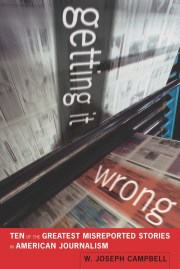
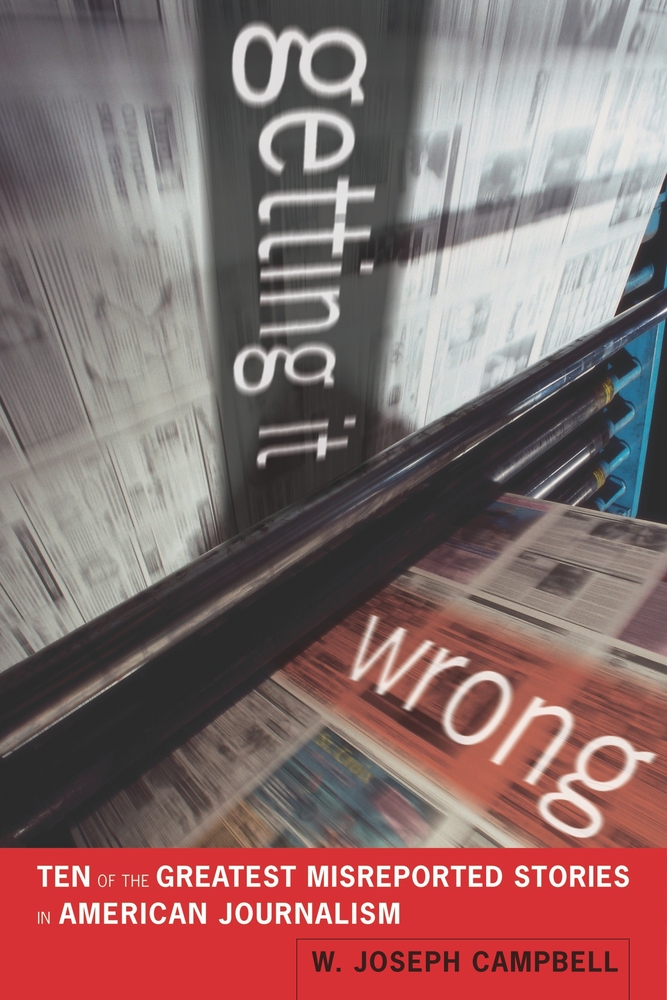
I recently was on “One Hour of Hope,” a satirically named radio show in Gainesville, Florida, to speak about several of the media-driven myths debunked in my latest book, Getting It Wrong.

Among them are the heroic-journalist trope of Watergate, the so-called “Cronkite Moment” of 1968, and the battlefield derring-do misattributed to Jessica Lynch early in the Iraq War.

The host of “One Hour of Hope,” Doug Clifford, noted at the outset of the interview that 2012 marks the 40th anniversary of the Watergate scandal’s signal crime, the breakin in June 1972 at the headquarters of the Democratic National Committee.

I am sure the anniversary will give rise  to a resurgence of the heroic-journalist interpretation of Watergate, which holds that the dogged investigative reporting of Washington Post reporters Bob Woodward and Carl Bernstein uncovered the scandal and brought about President Richard M. Nixon’s resignation in August 1974.

That media myth has become the dominant narrative of Watergate, I noted during the radio interview, which aired on WSKY-FM.

The persistence of that misreading narrative, I said, can be traced to All the President’s Men, Woodward and Bernstein’s 1974 book about their Watergate reporting, and especially to the 1976 movie by the same title.

The movie, by focusing on the exploits of Woodward and Bernstein, projects the notion that the reporters, with help from a the stealthy, high-level source code-named “Deep Throat,” unearthed the evidence that forced Nixon to quit.

That, I said, is a very simplistic interpretation, “a serious misreading of history” that ignores the far more powerful forces and factors that combined to uncover evidence of Nixon’s culpability.

Those forces, I noted, were typically subpoena-wielding and included committees of both houses of Congress, the Justice Department, the FBI, and a federal judge in Washington named John Sirica.

(Interestingly, the Washington Post, in its obituary of Sirica, said the judge’s “persistence in searching for the facts while presiding over the Watergate cases led to President Nixon’s resignation.”)

The myth of the “Cronkite Moment” represents another serious misreading of history, I said.

Clifford summarized the purported “Cronkite Moment,” that President Lyndon Johnson, in reaction to the CBS News anchor Walter Cronkite’s pessimistic assessment of the Vietnam War, said, “If I’ve lost Cronkite, I’ve lost America.”

I noted that versions of what the president said vary markedly and also include:

  • “If I’ve lost Cronkite, I’ve lost Middle America.”
  • “If I’ve lost Cronkite, I’ve lost the country.”
  • “If I’ve lost Cronkite, I’ve lost the war.”

(Version variability of such magnitude, I write in Getting It Wrong, is a revealing marker of a media-driven myth.)

I noted in the interview that there’s no evidence Johnson saw Cronkite’s television report about Vietnam when it aired February 27, 1968. At the time, the president was attending a birthday party for Governor John Connally on the campus of the University of Texas at Austin.

Nor is there any credible evidence that Cronkite’s reporting about Vietnam influenced  Johnson’s decision, announced in late March 1968, not to seek reelection.

Clifford asked about reporting of the Jessica Lynch case, and I said the bogus tale of her battlefield heroics was largely due to “sloppy reporting by the Washington Post.”

I described the newspaper’s electrifying report, published April 3, 2003, that cited otherwise unidentified “U.S. officials” in saying Lynch had fought fiercely in the ambush of Army unit in Iraq, that she had kept firing at Iraqi attackers even as she suffered gunshot and stab wounds.

But none of that proved true. Lynch fired not a shot in the attack. She was wounded not in the firefight with the Iraqis but in the crash of her Humvee as it tried to flee the ambush.

I also noted in the interview how a “false narrative that the military made up the story” has come to define the Lynch tale.

One of the reporters on the Post’s botched story, I pointed out, has said that the Pentagon wasn’t the newspaper’s source, and also has said that far “from promoting stories about Lynch, the military didn’t like the story.”

The false narrative, I added, has had the additional effect of obscuring recognition of the heroics of Donald Walters, a cook-sergeant who apparently performed the heroics deeds wrongly attributed to Lynch.

Walters laid down covering fire as Lynch and others in their unit sought to escape. He was captured when he ran out of ammunition, and soon afterward executed.

Clifford said his show’s title, “One Hour of Hope,” is a satiric gesture; his once-weekly, 60-minute program leans left while much of the rest of the station’s talk-show content is conservative in political orientation.

WJC

Recent and related:

‘Follow the money’ and the power of cinema

In Cinematic treatments, Debunking, Media myths, Washington Post, Watergate myth on January 8, 2012 at 9:17 am

No film about the Watergate scandal has been viewed by more people than All the President’s Men, the cinematic paean to the Washington Post and the reporting of Bob Woodward and Carl Bernstein.

And no single line from All the President’s Men has proved more memorable and quotable than “follow the money.”

The line is so compelling that it’s often thought that “follow the money” was genuine and vital advice offered by the stealthy, high-level source whom the Post code-named “Deep Throat.”

Except that it wasn’t genuine advice.

Follow the money” was invented for the movie.

The line was spoke by Hal Holbrook, the actor who played “Deep Throat” in All the President’s Men. (The real “Deep Throat” was self-revealed in 2005 to have been W. Mark Felt, a senior FBI official.)

Although it is fundamentally a contrivance, “follow the money” is granted no small measure of reverence, as suggested by a commentary posted the other day at a blog of London’s Guardian newspaper.

The commentary in its opening paragraph declared :

“The famous advice of Deep Throat to Woodward and Bernstein in the dark underground car park during the Watergate investigation applies to the world of politics as much as it does to investigative journalism. ‘Follow the money,’ the FBI agent Mark Felt is said to advised the two Washington Post reporters.”

“Deep Throat” the source met Woodward a half-dozen times in 1972 and 1973 in a car park — a parking garage — in the Rosslyn section of Arlington, Va. That’s true.

But “Deep Throat”/Felt was exclusively Woodward’s source. Bernstein met Felt only a few weeks before Felt’s death in 2008.

And Felt never advised Woodward to “follow the money.” That he did is cinema-induced pseudo reality.

Not only that, but Felt as “Deep Throat” wasn’t all that vital to the Post’s reporting on Watergate, which won a Pulitzer Prize in 1973.

We know that from Barry Sussman, the Post’s lead editor on Watergate, who wrote in 2005:

“Deep Throat was nice to have around, but that’s about it. His role as a key Watergate source for the Post is a myth, created by a movie and sustained by hype for almost 30 years.”

Note the passage, “created by a movie.”

All the President’s Men is more than an engaging, mid-1970s film that has aged admirably well. As Sussman noted, the movie certainly helped propel the myth of “Deep Throat” — and make famous “follow the money.”

The film — which the Post once described as journalism’s “finest 2 hours and 16 minutes” — also was central in promoting and solidifying the heroic-journalist myth of Watergate.

As I discuss in my latest book, Getting It Wrong, the heroic-journalist myth is the notion that Woodward and Bernstein’s reporting brought down the corrupt presidency of Richard Nixon.

Which is an interpretation of Watergate that not even the Post embraces.

As Woodward once said in an interview with American Journalism Review:

To say the press brought down Nixon, that’s horse shit.”

But it’s clear, I write in Getting It Wrong, that the cinema “helped ensure the myth would live on by offering a neat, tidy, and vastly simplified account the Watergate scandal, one that allowed viewers to sidestep the scandal’s complexity while engaging in an entertaining storyline.”

Indeed, what could be more straightforward and understandable than a story featuring two young reporters guided by a shadowy source who, oracle-like, advises them to “follow the money”and helps them bring down a crooked president?

It’s Watergate simplified, Watergate made easy.

But it’s also a far-fetched and distorted version of America’s greatest political scandal.

WJC

Recent and related:

The military’s ‘fabrication’? No, Jessica Lynch was WaPo’s story

In Jessica Lynch, Media myths, Washington Post on January 5, 2012 at 9:15 am

A passage in a recent  essay at a Washington Post blog demonstrates just how insidious the notion is that the military made up the hero-warrior tale about Army private Jessica Lynch in the early days of the Iraq War.

The Post’s higher education blog, “College Inc.,” cited “the fabrication of the story of Jessica Lynch” as an example of “a serious problem in the military’s relationship with the civilian world.” (The essay discussed what the author called the “shrill insistence by the military on its own virtue.”)

Lynch in 2003

The author, a Naval Academy professor named Bruce Fleming, also invoked the case of Pat Tillman — an Army Ranger killed slain by friendly fire in Afghanistan — in asserting:

“This is lying to the people the military is meant to protect, and who pay for it. It is absolutely, completely, unacceptable. Yet it now has become common.”

Strong stuff.

But it’s exceedingly the top in the case of Jessica Lynch: The claim that the military made up the tale of her battlefield heroics is seriously misstated. And more than faintly ironic, given that it was the Washington Post that reported Lynch had “gone down firing,” that she had fought ferociously in the ambush of her unit, the 507th Maintenance Company, in southern Iraq in March 2003.

It was the Post — citing otherwise anonymous “U.S. officials” — that claimed Lynch had “shot several enemy soldiers” in the ambush.

It was the Post that said Lynch “continued firing at the Iraqis even after she sustained multiple gunshot wounds and watched several other soldiers in her unit die around her” in the fighting.

It was the Post that placed the electrifying heroic-warrior tale about Lynch on its front page of April 3, 2003, beneath a headline that read:

“‘She was fighting to the death.'”

It was the Post — alone — that placed the story into the public domain.

And none of it was true.

Lynch was neither shot nor stabbed. She suffered shattering injuries in the crash of a Humvee as it attempted to flight the ambush. But she fired not a shot in the attack.

Lynch was taken prisoner, but rescued nine days later from an Iraqi hospital by U.S. special forces.

The Post for its part has never fully explained how it got so utterly wrong a story that was picked up by news organizations around the world, turning the unsuspecting Lynch into the best-known Army private of the war.

However, as I point out in my latest book, Getting It Wrong, we know from one of the Post reporters on the Lynch story that the military wasn’t pushing the hero-warrior story.

That reporter, Vernon Loeb, said in an interview on NPR’s Fresh Air program in December 2003:

“Our sources for that story were not Pentagon sources.”

He also said in the interview:

“They wouldn’t say anything about Jessica Lynch.”

Loeb added:

“I just didn’t see the Pentagon trying to create a hero where there was none. I mean …they never showed any interest in doing that, to me.”

On another occasion, Loeb was quoted in a commentary in the New York Times as saying:

“Far from promoting stories about Lynch, the military didn’t like the story.”

The author of the Times commentary was Mark Bowden, who wrote the critically acclaimed Black Hawk Down, a book about the failed U.S. military mission in Somalia in 1998 1993. Of the Lynch case, Bowden said in his commentary:

“There is no doubt that the American media took these bits and pieces from the fog of war and assembled them into a heroic tale. … This is how the media works today, for better or worse. It happens without any prompting from the Pentagon.”

What, then, explains the persistence of the false narrative that military concocted the hero-warrior tale about Lynch?

Part of the answer lies in a dim understanding about the military and its ways. Few Americans have much first-hand knowledge about the armed services and warfare. Such limited familiarity can lead to the embrace of flawed narratives and misleading caricatures.

The Post’s erroneous account of Lynch as a female Rambo pouring lead into attacking Iraqis was cinematic — and more than vaguely reminiscent of scenes in the 1996 motion picture Courage Under Fire.

Another part of the answer lies in the news media’s tendency to shift blame away from major mistakes. As media critic Jack Shafer has pointed out:

“The rotten truth is that media organizations are better at correcting trivial errors of fact — proper spellings of last names, for example — than they are at fixing a botched story.”

The false narrative that the military concocted the Lynch tale has enabled the Post to dodge accountability for a botched story still oozes venom, suspicion, and misunderstanding.

The newspaper’s unwillingness to set the record straight by  identifying the sources that led it awry has given rise to false claims, including those about the military’s “fabrication.”

WJC

Many thanks to Instapundit Glenn Reynolds, and to smalldeadanimals.com and Blackfive.net, for linking to this post.

Recent and related:

Taking stock: Top mythbusting posts of 2011

In Anniversaries, Bra-burning, Cronkite Moment, Debunking, Jessica Lynch, Media myths, Murrow-McCarthy myth, Quotes, Washington Post, Watergate myth on December 31, 2011 at 4:45 am

Reviewing the year in media-mythbusting reveals a number of memorable posts. Here are the Media Myth Alert five top writeups of 2011, with a roster of other mythbusting posts of note:

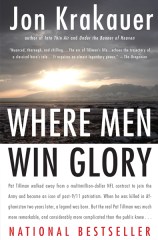
Krakauer retreats from Lynch-source claim (posted November 11): This post revealed author Jon Krakauer’s quiet retreat from claims in a 2009 book that Jim Wilkinson, a former White House official, was the source for the bogus Washington Post report about Jessica Lynch and her supposed battlefield heroics in the Iraq War in 2003.

The claims in Krakauer’s book were unattributed — and vigorously denied by Wilkinson, who sought a correction.

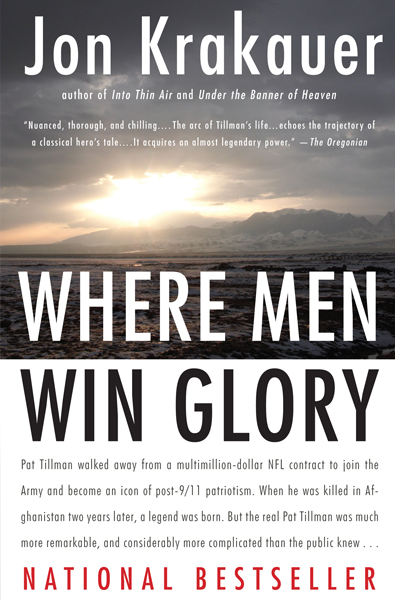
When it came, the correction was inserted unobtrusively in a new printing of the paperback edition of Krakauer’s book, Where Men Win Glory. It read:

“Earlier editions of this book stated that it was Jim Wilkinson ‘who arranged to give the Washington Post exclusive access’ to this leaked intelligence [about Jessica Lynch]. This is incorrect. Wilkinson had nothing to do with the leak.”

I’ve noted that the Post’s enduring silence about its sources on the Lynch story has allowed for the emergence not only of false allegations such as those about Wilkinson, but of a false narrative that the military concocted the tale about Lynch’s derring-do.

The false narrative  also has deflected attention from the soldier whose heroics apparently were misattributed to Lynch. He was Sgt. Donald Walters, a cook in Lynch’s unit.

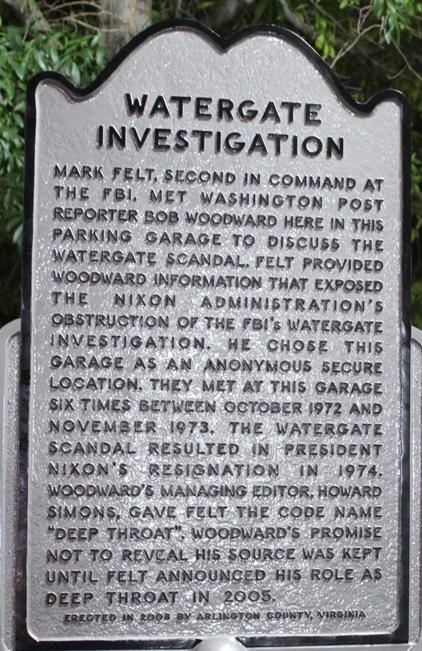
‘Deep Throat’ garage marker errs about Watergate source disclosures (posted August 18): A handsome historical marker went up in August outside the parking garage in Arlington, Virginia, where Bob Woodward of the Post conferred occasionally in 1972 and 1973 with his stealthy Watergate source, “Deep Throat.”

The marker, I pointed out, errs in describing the information Woodward received from the “Deep Throat” source, who in 2005 revealed himself as W. Mark Felt, formerly the FBI’s second in command.

The marker says:

“Felt provided Woodward information that exposed the Nixon administration’s obstruction of the FBI’s Watergate investigation.”

Which just isn’t so.

Such evidence, had “Deep Throat” offered it to Woodward, would have been so damaging and so explosive that it surely would have forced Richard Nixon to resign the presidency well before he did, in August 1974.

Felt didn’t have that sort of information — or (less likely) didn’t share it with Woodward.

I noted in my post about the marker that All the President’s Men, the book Woodward wrote with Carl Bernstein about their Watergate reporting, says Woodward’s conversations with “Deep Throat” were intended “only to confirm information that had been gathered elsewhere and to add some perspective.”

Bra-burning in Toronto: Confirmed (posted February 19): I ascertained in this post that an image of a bra-burning protest in Toronto in 1979 was no hoax, that the photograph was authentic.

I had not seen the photograph before it appeared in February with an article at the online site of  London’s Guardian newspaper.

I had doubts about the photo’s authenticity — given the periodic claims that no bras ever were burned at a feminist protest. The Toronto image, I suspected, might have been unethically altered.

Turns out that was not the case.

I tracked down one of the participants at the Toronto protest and she confirmed the bra-burning, saying by phone from Vancouver:

“The photo is authentic. Absolutely. It happened.”

The participant was Vicki Trerise, who appears at the far right in the photograph above.

The photograph shows a moment of demonstrative bra-burning, although Trerise said it “wasn’t a focal point” of the protest, which took place not far from Toronto’s City Hall.

The bra-burning came near the end of the demonstration, which was called to protest what the organizers said was an illogical report about rape, prepared by the Ontario Provincial Police.

Trerise said the demonstrators in Toronto were media-savvy and “knew that if they burned a bra, someone would take their picture.”

Suspect Murrow quote pulled at Murrow school (posted February 17): The online welcome page of the dean of the Edward R. Murrow College of Communication at Washington State University contained a quotation attributed to Murrow that’s only half-true.

Murrow

The quote reads:

“We must not confuse dissent with disloyalty. When the loyal opposition dies, I think the soul of America dies with it.”

As I’ve reported previously, the first portion of the quote was indeed spoken by Murrow, in his mythical 1954 television program that addressed Senator Joseph McCarthy’s red-baiting ways.

The second part of the quote — “When the loyal opposition dies, I think the soul of America dies with it” — is apocryphal.

In February, I found that the full quotation — accompanied by a facsimile of Murrow’s signature — was posted at the welcome page of Dean Lawrence Pintak of Murrow College at Washington State, Murrow’s alma mater.

I asked the dean what knew about the quote’s provenance, noting that I had consulted, among other sources, a database of historical newspapers which contained no articles quoting the “loyal opposition” passage.

Pintak referred my inquiry to an instructor on his faculty who, a few hours later, sent an email to the dean and me, stating:

“While [the ‘loyal opposition’ quotation] seems to reflect the Murrow spirit, the lack of evidence that he phrased it that way is indeed suspicious.”

He added: “I feel the evidence says no, Murrow did not say this.”

By day’s end, the suspect quote had been pulled from the welcome page. Just the authentic portion — “We must not confuse dissent with disloyalty” — remained posted there.

Mythmaking in Moscow: Biden says WaPo brought down Nixon (posted March 12): Joe Biden, the hapless U.S. vice president, repeated the dominant but misleading narrative about the Watergate scandal in March by telling an audience in Moscow that the Washington Post had “brought down” Richard Nixon’s corrupt presidency.

The gaffe-prone Biden told his audience:

“In my country it was a newspaper, not the FBI, or the Justice Department, it was a newspaper, the Washington Post that brought down a President for illegal actions.”

It’s a version of scandal that few serious historians accept. Not even the Washington Post buys into such a myth-encrusted interpretation.

Indeed, principals at the Post from time to time have sought to distance the newspaper from that misleading assessment.

For example, Katharine Graham, the newspaper’s publisher during and after the Watergate scandal, said in 1997, at a program marking the 25th anniversary of the scandal:

“Sometimes people accuse us of bringing down a president, which of course we didn’t do. The processes that caused [Nixon’s] resignation were constitutional.”

More recently, Michael Getler, then the newspaper’s ombudsman, wrote in 2005:

“Ultimately, it was not The Post, but the FBI, a Congress acting in bipartisan fashion and the courts that brought down the Nixon administration.”

Such comments are not the expressions of false modesty. Instead, they represent a more accurate reading of the history of Watergate than Biden offered up in Moscow.

Even so, in the run-up to the scandal’s 40th anniversary in 2012, the Watergate myth — the heroic-journalist trope — is sure to emerge often and insistently.

But the Post and its reporting of Watergate assuredly did not bring down Nixon, as I discuss in Getting It Wrong, my latest book which was published in 2010.

WJC

Many thanks to Instapundit
Glenn Reynolds for linking to this post.

Other memorable posts of 2011:

The debunking of the year, 2011

In Debunking, Media myths on December 29, 2011 at 5:15 am

Freeman (Middle East Policy Council)

The nod for the most notable debunking of 2011 goes to retired U.S. diplomat Charles W. (Chas) Freeman Jr. for puncturing the popular tale about Zhou Enlai’s remark in 1972 that it was “too early to say” what the effects would be of the French Revolution.

Freeman told a panel in Washington, D.C., in June that the Chinese premier was referring to the turmoil in France in 1968, not the years of revolutionary upheaval that began in 1789.

His remarks debunking the Zhou misinterpretation were first published by London’s Financial Times.

Zhou’s “too early” comment was made during President Richard M. Nixon’s historic visit to China in February 1972. Freeman, then 28-years-old, was the president’s interpreter on the trip and heard Zhou’s remark.

Freeman said during the panel discussion in June that the misinterpretation “was too delightful to set straight” at the time.

In a subsequent interview with me, Freeman said it was “absolutely clear” from the context of the conversation that Zhou’s comment was a reference to the turmoil of 1968.

Freeman described Zhou’s remark as “a classic of the genre of a constantly repeated misunderstanding that has taken on a life of its own.”

(In an oral history interview in 1995, Freeman said Zhou possessed  “enormous grace and charm.”)

The conventional interpretation of Zhou’s “too early” comment lives on because it suggests that Chinese leaders are inclined to a long and patient view of history.

“I cannot explain the confusion about Zhou’s comment except in terms of the extent to which it conveniently bolstered a stereotype (as usual with all stereotypes, partly perceptive) about Chinese statesmen as far-sighted individuals who think in longer terms than their Western counterparts,” Freeman said, adding:

“It was what people wanted to hear and believe, so it took” hold.

Indeed, it did. The misinterpretation persists — and even has been invoked when it’s acknowledged as apocryphal.

The puncturing of the Zhou misinterpretation rates as the “debunking of the year” not only because of its significance but because of its relevance to busting media myths, those delicious but dubious tales that masquerade as factual and offer distorted views of historical events.

In designating Freeman’s disclosure as the “debunking of the year,” I’m reminded of high-minded observations offered in 1998 by Max Frankel, formerly the executive editor of the New York Times.

In observations that go to the heart of the importance of busting media myths, Frankel wrote:

“What’s wrong with a little mendacity — so goes the theory — to give a tale velocity? It is unforgivably wrong to give fanciful stories the luster of fact, or to use facts to let fictions parade as truths.”

Puncturing the Zhou misinterpretation seems in keeping with that objective. The debunking, moreover, offers us a more accurate, more telling, and more realistic view of history and historical figures.

Media Myth Alert‘s first “debunking of the year” went in 2009 to the Spanish researchers who challenged the authenticity of Robert Capa’s iconic “Falling Soldier” image, taken in September 1936 during the Spanish Civil War.

Capa’s photograph purports to show a charging loyalist militiaman at the instant he is fatally death.

No “debunking of the year” was designated in 2010, the year of publication of my latest book, Getting It Wrong, which punctures 10 prominent media-driven myths.

WJC

Many thanks to Instapundit
Glenn Reynolds for linking to this post.

Recent and related:

Apocryphal, but still quotable

In Debunking, Media myths, Quotes on December 24, 2011 at 7:24 am

Apocryphal, but still quotable.

That’s the takeaway from a commentary posted yesterday at the online site of the Nation. The commentary invoked Zhou Enlai’s misinterpreted comment about the upshot of the French Revolution.

Zhou supposedly said in 1972 that it was “too early to say” what the effects would be. But Zhou was speaking about the political turmoil in France in 1968, not the years-long upheaval that began in 1789.

The Nation’s commentary, “The Soviet Union’s Afterlife,” tried to have it both ways with Zhou’s remark; the opening paragraph asserted:

“Asked to evaluate the French Revolution nearly 200 years later, the Chinese Premier Zhou Enlai was famously reported to have replied, ‘Too early to say.’ Though apocryphal, the long perspective attributed to Zhou is better informed than the certitudes of American commentators about the causes and consequences of the end of the Soviet Union only twenty years ago.”

If it’s apocryphal, then why invoke it? To do is to distort and confuse and even mislead.

The temptation to invoke telling quotes of dubious derivation can be too powerful to avoid. As I point out in my latest book, Getting It Wrong, “Turns of phrase that sound too neat and tidy often are too perfect to be true.”

Craig Silverman, author of Regret The Error and a columnist for Columbia Journalism Review, has likened dubious quotes to “little gems that supposedly tell a story in just a few words. They lodge themselves in our culture and consciousness.”

So it is with Zhou’s remark, which was made during President Richard Nixon’s historic trip to China in February 1972.

The conventional interpretation — which the Nation commentary invoked — is that the comment stands as evidence of the sage and far-sighted ways of Chinese leaders.

But we know from a retired U.S. diplomat, Charles W. (Chas) Freeman, that Zhou in his talks with Nixon in 1972 was taking a decidedly shorter and more immediate view of turmoil in France.

Freeman was Nixon’s interpreter during the trip and was present when Zhou made the “too early” comment.

Freeman has said that Zhou’s remark came during a discussion about revolutions that had succeeded and failed. The revolutions cited, Freeman said, included the Prague Spring of 1968 and the Hungarian uprising of 1956, both of which the Soviet Union crushed.

Freeman said it was clear from the context that in saying it was “too early to say,” Zhou was speaking about the events in France in May 1968.

How Zhou’s “too early” remark came to be so badly misinterpreted, Freeman was unable to say.

“I cannot explain the confusion about Zhou’s comment except in terms of the extent to which it conveniently bolstered a stereotype (as usual with all stereotypes, partly perceptive) about Chinese statesmen as far-sighted individuals who think in longer terms than their Western counterparts,” he said, adding:

“It was what people wanted to hear and believe, so it took” hold.

First to report Freeman’s debunking was Richard McGregor, a journalist and China expert writing for London’s Financial Times.

As I’ve pointed out, the appeal and tenacity of Zhou’s misinterpreted remark is reminiscent of William Randolph Hearst’s purported vow to “furnish the war” with Spain at the end of the 19th century.

Hearst’s reputed vow  supposedly was made in an exchange of telegrams with the artist Frederic Remington, who was on assignment in Cuba for Hearst’s New York Journal.

As I point out in Getting It Wrong, it “would have been absurd for Hearst to vow to ‘furnish the war’ because war — specifically, the Cuban rebellion against Spain’s colonial rule — was the very reason Hearst sent Remington to Cuba in the first place.”

“Like many media-driven myths,” I further note, the purported Hearstian vow “is succinct, savory, and easily remembered.

“It is almost too good not to be true.”

WJC

Many thanks to Instapundit
Glenn Reynolds for linking to this post.

Recent and related:

‘Salon’ offers up repudiated Lynch-source claim

In Debunking, Jessica Lynch, Washington Post on December 21, 2011 at 8:47 am

The fallout is unending from the botched Washington Post story about Jessica Lynch’s heroics early in the Iraq War.

The online news and commentary site Salon offered up the other day the discredited claim that the hero-warrior tale about Jessica Lynch was the work of a former White House communications official named Jim Wilkinson.

Salon asserted, without attribution, that Wilkinson was known “for inventing the false story of Jessica Lynch,” a 19-year-old Army supply clerk whom the Post erroneously said had fought fiercely in the ambush of her unit in Iraq in March 2003.

The Post’s electrifying report was published April 3, 2003, and picked up by news organizations around the world. The story soon proved utterly wrong in its most important details, notably that Lynch had never fired a shot in the attack.

Salon’s claim about Wilkinson was an echo of a since-repudiated assertion in Jon Krakauer’s 2009 book, Where Men Win Glory: The Odyssey of Pat Tillman.

Krakauer claimed — without attribution — that Wilkinson was the Post’s source on the Lynch story. Krakauer asserted that Wilkinson was  “a master propagandist” and “the guy who deserved top billing for creating the myth of Jessica Lynch.”

Wilkinson — who at the time was director of strategic communications for the commander of U.S. forces in Iraq, General Tommy Franks — vigorously denied he was the newspaper’s source.

The Post has never identified the sources who led it so badly awry on the Lynch report.

Wilkinson said he discussed corrections with Krakauer late last year. The unflattering claims about him were removed in a recent paperback printing of Where Men Win Glory, which included a footnote, saying:

“Earlier editions of this book stated that it was Jim Wilkinson ‘who arranged to give the Washington Post exclusive access’ to this leaked intelligence [about Jessica Lynch]. This is incorrect. Wilkinson had nothing to do with the leak.”

Salon’s claim about Wilkinson was included in a commentary posted Monday, that scoffed at speculation that former U.S. Secretary of State Condoleezza Rice might seek the Republican nomination for vice president.

Asked by email about Salon’s claim about his “inventing” the Lynch hero-warrior tale, Wilkinson replied:

“Craziness! Wish they would leave me alone.”

The author of the Salon commentary, Alex Pareene, said by email yesterday that he had relied on Krakauer’s book in offering the claim about Wilkinson.

Pareene also said:

“I was unaware of Krakauer’s correction, and it’s worth an explanatory note.”

He later appended a footnote to his commentary, citing Krakauer’s rollback and stating that Wilkinson “apparently isn’t responsible for falsifying [Lynch’s] actions or leaking that false story to the press.”

So now, how about some transparency from the Washington Post?

By disclosing the identities of its sources on the Lynch case, the Post would help put an end to the erroneous speculation of the kind that has injured Wilkinson’s reputation.

Disclosing its sources also would puncture the false narrative that the U.S. military concocted the story about Lynch’s heroics in a cynical and devious attempt to bolster popular support in the United States for the war in Iraq.

As I point out in my latest book, Getting It Wrong, one of the Post reporters on the botched report about Lynch has said flatly, “Our sources for that story were not Pentagon sources.”

What’s more, public opinion polls in the early days of the Iraq War showed “there was little reason for morale-boosting among Americans,” I write in Getting It Wrong, adding:

“It may be little-recalled now, but the U.S.-led invasion of Iraq was widely supported by the American public. Polling data from March and April 2003, the opening days and weeks of the war, show an overwhelming percentage of Americans supported the conflict and believed the war effort, overall, was going well.”

WJC

Recent and related:

Lynch blames ‘military, media’ for bogus hero story, ignores WaPo

In Debunking, Jessica Lynch, Media myths, Washington Post on December 19, 2011 at 8:09 am

Jessica Lynch has blamed the “military and the media” for the bogus story about her battlefield heroics in the opening days of the Iraq War — but ignored mentioning the Washington Post, which was solely responsible for circulating the erroneous if electrifying tale.

Lynch’s remarks were made in an as-told-to article posted yesterday at the Daily Beast, an online site affiliated with Newsweek magazine.

“Though I didn’t know it at the time,” she said, “the military and the media labeled me a hero. They said I’d gone down guns blazing, like Rambo, when really my rifle had jammed and I hadn’t shot a soul.”

She was referring to the hero-warrior tale the Washington Post thrust into the public domain in a sensational, front-page report on April 3, 2003.

The Post said Lynch, then a 19-year-old Army private, had fought fiercely in the ambush of her unit, the 507th Maintenance Company, at Nasariyah in March 2003.

The botched hero-warrior story

The Post referred anonymously to “U.S. officials” in reporting that Lynch shot several enemy soldiers” in the ambush and “continued firing at the Iraqis even after she sustained multiple gunshot wounds and watched several other soldiers in her unit die around her” in the fighting.

The hero-warrior tale — published beneath the headline “‘She was fighting to the death'” — made terrific copy, and news organizations around the world picked up the story.

As I note in my latest book, Getting It Wrong, Lynch became the best-known Army private of the war.

But the story soon proved thoroughly in error. Lynch never fired a shot in the ambush. She was neither shot nor stabbed. She suffered shattering injuries in the crash of a Humvee as it attempted to flee the ambush.

The bogus story clearly wasn’t the work of multiple news organizations. It was the Post’s story, exclusively.

The Post has never fully explained how it got the dramatic story about Lynch so utterly wrong; nor has the newspaper disclosed the identity of its sources on the bogus story.

Its silence about the sources has allowed a false narrative to fester and spread — namely, that the military concocted the story about Lynch’s heroics and fed it to the Post in a cynical attempt to bolster popular support in the United States for the war in Iraq.

That version, though quite vague, has proved very popular, as suggested by Lynch’s comments posted at the Daily Beast.

But we know from one of the Post reporters on the botched hero-warrior story that the Pentagon wasn’t the newspaper’s source.

The reporter, Vernon Loeb, told NPR in mid-December 2003: “Our sources for that story were not Pentagon sources.”

He also said in the NPR interview that military officials “wouldn’t say anything about Jessica Lynch.

“I’ve never believed that at least as far as the story we wrote goes, that it was a Pentagon attempt to create a hero there.”

Loeb said that “we basically told our readers that day what basically the U.S. intelligence community was telling senior members of the U.S. government. It just kind of goes back to the old adage, you know, that initial reports from the battlefield are almost always wrong.”

It bears repeating: Responsibility for spreading the erroneous account lies neither with the “military” nor with the “media”; it rests solely with the Washington Post.

WJC

Recent and related:

ABC News invokes false narrative of Jessica Lynch case

In Debunking, Jessica Lynch, Media myths, Washington Post on December 17, 2011 at 10:22 am

ABC News yesterday invoked the false derivation of the hero-warrior myth about Jessica Lynch, declaring that “the U.S. government portrayed her as a fearless heroine who had gone down fighting” early in the Iraq War.

Not so. The Washington Post did that.

The Post — alone — placed the bogus tale about Lynch and her battlefield derring-do into the public domain in April 2003, in an electrifying, front-page article that was picked up by news organizations around the world.

The “U.S. government” — specifically, the Pentagon — was loath to embrace the tale about Lynch and her heroics.

Indeed, as one of the Post reporters on the botched report about Lynch later said:

“Our sources for that story were not Pentagon sources.”

The reporter, Vernon Loeb, also said in an interview on NPR: “They wouldn’t say anything about Jessica Lynch.”

Loeb and another Post reporter, Susan Schmidt, had reported on April 3, 2003, that Lynch fought fiercely in the ambush of her unit, the 507th Maintenance Company, on March 23, 2003. Neither Loeb nor Schmidt was with Lynch’s unit; no journalist was.

Loeb and Schmidt wrote that Lynch “shot several enemy soldiers” and  “continued firing at the Iraqis even after she sustained multiple gunshot wounds and watched several other soldiers in her unit die around her in fighting” at Nasiriyah, in southern Iraq.

Loeb and Schmidt quoted a source, to whom they referred as a “U.S. official,” as saying:

“She was fighting to the death. She did not want to be taken alive.”

Though dramatic, and even cinematic, the Post report was utterly wrong.

Lynch had not fired a shot in the ambush; her weapon jammed. Lynch was neither shot nor stabbed; she suffered shattering injuries in the crash of a Humvee as it tried to escape the ambush.

The Post has never fully explained how it botched the hero-warrior story about Lynch. It has never disclosed the identities of the anonymous sources that led it so badly awry on the Lynch story.

The murkiness of the newspaper’s sourcing has not only encouraged the rise of the false narrative, which ABC News cited in asserting, without attribution, that the “U.S. government portrayed” Lynch as a hero.

The Post’s obscure sourcing also has given rise to false allegations. The author Jon Krakauer, for example, wrongly accused Jim Wilkinson, a communications official in the administration of President George Bush, of having “arranged to give the Washington Post exclusive access” to the Lynch hero-warrior tale.

Krakauer called Wilkinson a “master propagandist” who “deserves top billing for creating the myth of Jessica Lynch.”

Krakauer has since quietly rescinded those allegations, which he had included in his 2009 book, Where Men Win Glory: The Odyssey of Pat Tillman.

Another upshot of the false narrative is that it has obscured wide recognition of a real hero at Nasiriyah, a sergeant in Lynch’s unit named Donald Walters.

Sgt. Walters

As I write in my latest book, Getting It Wrong, Walters’ battlefield heroics were likely misattributed to Lynch, owing to mistranslation of Iraqi radio transmissions from the battlefield.

“During the ambush in Nasiriyah,” I write, “… Walters either stayed behind, or was left behind, to lay down covering fire as his fellow soldiers tried to make their escape. Walters fought his attackers in a fashion that the Post attributed to Lynch.”

I point out that the most detailed account of Walters’ bravery appears in Richard Lowry’s fine study of the fighting at Nasiriyah, Marines in the Garden of Eden.

Lowry wrote that Walters killed “several Iraqis before he was surrounded and captured” by Iraqi irregulars, the Fedayeen, and executed.

“We will never really know the details of Walters’ horrible ordeal,” Lowry wrote. “We do know that he risked his life to save his comrades and was separated from the rest of the convoy, deep in enemy territory.

“We know that he fought until he could no longer resist.”

The Post, though, has shown scant interest in Walters’ heroism.

A database search of Post articles published since April 2003 revealed just four stories in which Walters was mentioned. None of those articles discussed in any detail his bravery at Nasiriyah.

WJC

Recent and related: