W. Joseph Campbell

Posts Tagged ‘Debunking’

Twain’s famous 1897 quote: The back story

In 1897, Anniversaries, Debunking, Media myths on June 1, 2010 at 5:26 am

Tomorrow is the anniversary of Mark Twain’s famous and often-distorted observation, “The report of my death was an exaggeration.”

As I described in my 2006 book, The Year That Defined American Journalism, Twain’s comment was prompted by an article published June 1, 1897, in the New York Herald.
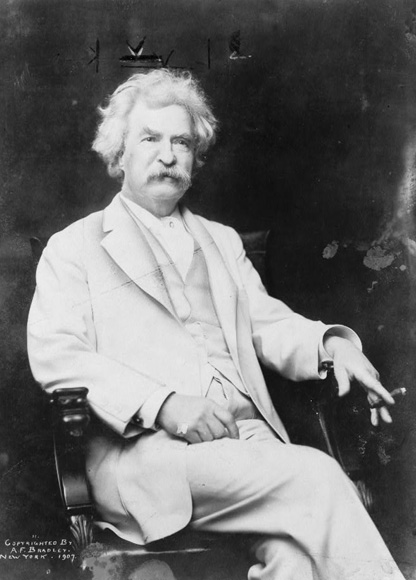
Mark Twain, 1907

The Herald, which at the time was one of the best newspapers in America, reported Twain to be “grievously ill and possibly dying. Worse still, we are told that his brilliant intellect is shattered and that he is sorely in need of money.”

Twain then was in London, about to cover Queen Victoria’s Diamond Jubilee for William Randolph Hearst’s New York Journal. That association allowed the Journal to promptly puncture the Herald‘s story.

In an article published June 2, 1897, beneath the headline, “Mark Twain Amused,” the Journal skewered the Herald‘s account as false and offered Twain’s denial: “The report of my death was an exaggeration.”

Twain’s line is often and erroneously quoted as “the news of my death has been greatly exaggerated” and sometimes the Journal is said to have been the source for the erroneous report, not its swift and thorough debunking.

Twain told the Journal that the likely source of the Herald‘s mistake was the serious illness a few weeks before of a cousin, J.R. Clemens, who had been in London.

Ever eager to indulge in self-promotion, the Journal enthusiastically embraced its brief association with Twain. Still, it could not have been terribly pleased with what the humorist filed about the Diamond Jubilee.

As I wrote in The Year That Defined American Journalism, “Twain’s reporting about Victoria’s jubilee seemed half-hearted and hardly inspired. The spectacle was easily the most regal international story of 1897, and came at a time when the British empire was at or near its height. But Twain found the celebration overwhelming,” calling it “a spectacle for the kodak [camera], not the pen.”

Twain’s dispatch to the Journal included this strange observation:

“I was not dreaming of so stunning a show. All the nations seemed to be filing by. They all seemed to be represented. It was a sort of allegorical suggestion of the Last Day, and some who live to see that day will probably recall this one if they are not too much disturbed in the mind at the time.”

WJC

Related:

<!–[if !mso]> Twain’s reporting about Victoria’s jubilee seemed half-hearted and hardly inspired. The spectacle was easily the most regal international story of 1897, and came at a time when the British empire at or near its height. But Twain found the celebration overwhelming—“a spectacle for the kodak [camera], not the pen.”[i] His dispatch included this strange observation: “I was not dreaming of so stunning a show. All the nations seemed to be filing by. They all seemed to be represented. It was a sort of allegorical suggestion of the Last Day, and some who live to see that day will probably recall this one if they are not too much disturbed in mind at the time.”


[i]. Mark Twain, “The Great Jubilee As Described by the Journal’s Special Writers: Mark Twain’s Pen Picture of the Great Pageant in Honor of Victoria’s Sixtieth Anniversary,” New York Journal (23 June 1897): 1.
Recalling Mansfield’s contribution to unraveling Watergate

In Debunking, Media myths, Washington Post, Watergate myth on May 29, 2010 at 1:22 pm

Politics Daily posted yesterday an admiring piece–make that a hagiographic piece–about former U.S. Senate leader Mike Mansfield, saying his “savvy and sensibilities … are what our politics need on Memorial Day 2010.”

Well, maybe.

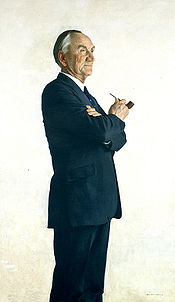
Mansfield (left), who died in 2001, was a Democrat from Montana and the Senate’s longest-serving majority leader, holding the position from 1961-1977.

In its most interesting passage, the Politics Daily commentary recalled Mansfield’s seldom-remembered contribution to unraveling the Watergate scandal, which culminated with President Richard Nixon’s resignation in 1974.

The commentary noted:

“He insisted on a special Senate committee to investigate the unfolding sins of the Nixon era … Because of Mike’s strategic decision to make the Senate investigation open, fair and bipartisan, the country supported a constitutional political process that, for the first time in history, forced a crook out of the White House.”

While that’s a bit over the top, it is clear that Mansfield’s efforts as majority leader to empanel a bipartisan select committee was crucial to the outcome of the scandal, which broke in June 1972 with the arrest of burglars inside Democratic National headquarters at the Watergate complex in Washington, D.C.

As Stanley I. Kutler, the leading historian of the scandal, wrote in his fine book, The Wars of Watergate:

“Watergate might have remained as the story-that-never-was had it not been for the determination of Mike Mansfield and Sam Ervin.”

Ervin, a Democrat from North Carolina, “played a crucial role in securing Senate passage of a resolution calling for the creation of a Select Committee to investigate illegal and unethical conduct in the 1972 presidential campaign,” Kutler wrote. “Mansfield, meanwhile, worked behind the scenes to marshal Democratic support for the resolution. He kept Ervin in the forefront, shrewdly using Ervin’s political capital among Southern Democrats and Republican senators.”

Ervin presided over the hearing of the select committee, which riveted much of the country during the summer of 1973. Its investigation led to the disclosure that Nixon had secretly tape-recorded most Oval Office conversations. Those tapes were crucial to revealing Nixon’s complicity in the scandal and forcing his resignation.

So why is this of interest, and pertinent, to Media Myth Alert?

Recalling Mansfield’s role illustrates anew how a variety of forces were needed to bring down Nixon’s corrupt presidency–a point raised in Getting It Wrong, my soon-to-be-published book that debunks prominent media-driven myths, those false, dubious, or improbable stories about the news media that masquerade as factual.

As I write in Getting It Wrong, rolling up a scandal of Watergate’s complexity required “the collective if not always the coordinated forces of special prosecutors, federal judges, both houses of Congress, the Supreme Court, as well as the Justice Department and the FBI.”

Even then, I argue, “Nixon likely would have served out his term if not for the audiotape recordings.”

The media-centric interpretation of Watergate is that the investigative reporting of the Washington Post was what brought down Nixon. A related claim is that if its reporting didn’t exactly take Nixon down, the Post alone kept the story alive in the summer and fall of 1972, when few people and institutions were much interested in Watergate.

Such claims are mistaken.

The Post didn’t take down Nixon; as leading figures at the newspaper have insisted as much from time to time over the years.

Nor was the Post alone in digging into Watergate during the summer and fall 1972. As I note in Getting It Wrong, rival news organizations such as Los Angeles Times and New York Times also pursued the scandal during those months.

Despite some revealing reporting by the Post and other news organizations, the dimensions of the Watergate scandal were hardly certain by May 1973, when the Senate select committee convened. It was “like an unassembled picture puzzle with crucial pieces missing,” Ervin recalled in his memoir of Watergate.

But with the committee’s hearings during summer of 1973, the scope of the scandal became clearer, leading relentlessly to Nixon and his closest aides.

WJC

Related:

‘Good narrative trumps good history’

In 1897, Cinematic treatments, Furnish the war, Media myths, Reviews, Yellow Journalism on May 28, 2010 at 1:53 pm

The Shotgun Blog today quotes an excerpt from my recent review of Evan Thomas’ disappointing new book, The War Lovers, and offers this telling observation:

“A good narrative trumps good history about nine times out of ten.”

The Shotgun Blog excerpt carries the headline, “You Furnish the Myth, We’ll Furnish the History,” and includes this passage from my review of War Lovers:

“Thomas embraced the media-driven myth of William Randolph Hearst’s purported vow to furnish the war with Spain–a vow supposedly contained in a telegram to the artist Frederic Remington, on assignment in Cuba” in 1897.

The Remingt0n-Hearst anecdote almost certainly is apocryphal, as I discuss in my 2001 book, Yellow Journalism: Puncturing the Myths, Defining the Legacies.

I revisit the anecdote in the first chapter of my soon-to-be-published book, Getting It Wrong, which debunks 10 prominent media-driven myths—false, dubious, or improbable stories about the news media that masquerade as factual.

The Shotgun Blog’s observation about good narrative routinely trumping good history is worthy of rumination, as it does often seem to be the case. It is a topic that I address in Getting It Wrong.

A reason narratives like the Remington-Hearst anecdote triumph is that they are succinct, savory, and easily remembered–as are many media-driven myths.

The Remington-Hearst anecdote is almost too good to be false, a narrative so delicious that it deserves to be true.

The anecdote lives on “despite a nearly complete absence of supporting documentation,” I note in Getting It Wrong, adding:

“It lives on even though telegrams supposedly exchanged by Remington and Hearst have never turned up. It lives on even though Hearst denied ever sending such a message.

“It lives on despite an irreconcilable internal inconsistency: It would have been absurd for Hearst to vow to ‘furnish the war’ because war—specifically, the Cuban rebellion against Spain’s colonial rule—was the very reason Hearst sent Remington to Cuba in the first place.

“Anyone reading U.S. newspapers in early 1897 would have been well aware that Cuba was a theater of a nasty war. By then, the Cuban rebellion had reached island-wide proportion and not a single province had been pacified by Spain’s armed forces.”

What pressed the “furnish the war” anecdote unequivocally into the public consciousness–what sealed the narrative’s triumph over history, if you will–was Citizen Kane, the 1941 motion picture based loosely on Hearst’s life and times.

Kane was not a commercial success, in part because of Hearst’s attempts to block its release, but the film is consistently ranked by critics among the finest ever made, as I note in Getting It Wrong.

A scene early in the film shows Charles Foster Kane, the newspaper tycoon who invites comparisons to Hearst, at his desk, tie untied, quarreling with his former guardian. They are interrupted by Kane’s business manager, “Mr. Bernstein,” who reports that a cable a just arrived from a correspondent in Cuba.

Bernstein reads the contents and Kane, who is played superbly by Orson Welles, dictates a reply that paraphrases Hearst’s purported vow.

Orson Welles

“You provide the prose poems,” Kane says, “and I’ll provide the war.”

Bernstein congratulates Kane on a splendid and witty reply.

Saying he rather likes it himself, Kane instructs Bernstein to send it at once.

WJC

Related:

Media myths, the ‘junk food of journalism’

In Debunking, Furnish the war, Murrow-McCarthy myth, Spanish-American War, Washington Post, Watergate myth on May 26, 2010 at 9:14 pm

Media-driven myths, the subject of my soon-to-be-published book, Getting It Wrong, are prominent tales of doubtful authenticity—false, dubious, or improbable stories about the news media that masquerade as factual.

The  myths addressed and debunked in the book include the notion that two intrepid reporters for the Washington Post took down Richard Nixon’s corrupt presidency, that Edward R. Murrow’s See It Now television program brought an end to Senator Joseph McCarthy’s communists-in-government witch-hunt, and that newspaper magnate William Randolph Hearst vowed to “furnish the war” with Spain at the end of the 19th century.

“In a way,” I write in Getting It Wrong, media myths “are the junk food of journalism—alluring and delicious, perhaps, but not especially wholesome or nourishing.”

But why bother: Why devote a book to debunking media-driven myths?

It’s a question that, somewhat to my surprise, arises not infrequently.

Several answers offer themselves.

For one, there is inherent value is seeking to set straight the historical record. As I write in Getting It Wrong, “the effort to dismantle [media myths] is certainly worthy, if only to insist on a demarcation between fact and fiction.” That effort is aligned with a core objective of newsgathering—that of getting it right.

Media-driven myths, moreover, are neither trivial nor innocuous. They can have adverse consequences. They tend, for example, to minimize the nuance and complexity of historical events and offer simplistic and misleading interpretations instead. It’s effortless and undemanding to say the Washington Post brought down Nixon, that Murrow ended McCarthyism, or that Hearst plunged the United States into war with Spain. The historical reality in each of those cases is, of course, significantly more complex.

So media-driven myths distort popular understanding about the roles and functions of journalism in American society. They tend to confer on the news media far more power and influence than they typically wield.

Media influence, I write in the book, usually “is trumped by other forces” and further undercut by the traditional self-view of American journalists as messengers first, rather than as makers and shapers of news.

What’s more, the news media these days are too splintered and diverse—print, broadcast, cable, satellite, online—to exert much in the way of collective and sustained influence on policymakers or media audiences.

Thus, debunking media-driven myths can help to locate media influence in a more coherent context. Getting It Wrong offers the case that such influence tends to modest, nuanced, and situational.

There are occasions, though, when the splintered news media coalesce and devote exceptionally intense attention to a single topic—such as Hurricane Katrina’s rampage along the Gulf Coast nearly five years ago. The news media gave themselves high marks for their coverage of the disaster’s aftermath, especially of the federal government’s fitful response.

But as I discuss in Getting It Wrong, the coverage also was characterized by highly exaggerated reports of nightmarish violence and wanton criminality in New Orleans in the hurricane’s wake. The misreporting of the disaster’s aftermath, I write, effectively “defamed a battered city and impugned its residents at a time of their deep despair.”

Thus, another reason why debunking matters—media-driven myths can and do feed prejudices and stereotypes.

Finally, confronting media myths discourages the tendency to regard prominent journalists in extreme terms—as heroes or villains. Piercing the myth surrounding Murrow renders him somewhat less Olympian. Similarly, debunking the myth about Hearst and his purported vow to “furnish the war” with Spain makes him seem less manipulative, and less demonic.

Getting It Wrong is a work with a provocative edge. Given that it takes on some of the most treasured stories in American journalism, it could not be otherwise.

WJC

This post first appeared at the University of California Press blog.

Bra-burning and home luxuries lost: Whoa

In Bra-burning, Debunking, Media myths, New York Times on May 23, 2010 at 11:40 am

If I read this article correctly, bra-burning contributed to a decline in the late 20th century of a taste for small luxuries around the home.

Media-driven myths have been mistakenly credited with bringing on wars and bringing down presidents. But bringing about a decline in household luxuries?

This is a first.

The article recalls with praise Mrs. Beeton’s Book of Household Management, which came out in 1861 and offered hundreds of pointers on cooking, supervising servants, and choosing decor.

Says the article, which appeared the other day in the Seattle Times and elsewhere:

“The dang thing had 2,751 entries—from how to cut a side of lamb, to just when to put away the white summer curtains—spelled out across more than 1,680 pages. And back in 1861, millions of copies were sold. Millions.

“Then,” the article says, “came the bra-burning latter half of the 20th century, and along with it permanent-press sheets, the paper napkin, and Hamburger Helper served up on melamine plates.

“We say, Whoa. We might have ditched too much. Lost all hints of luxury in the household department.”

I say, Whoa.

What did bra-burning supposedly have to do with lost “hints of luxury” at home? The article doesn’t say. Nor does it say explain how bra-burning helped to define the “latter half of the 20th century.”

Bra-burning in fact was a dramatically overstated phenomenon, as I discuss in a chapter in Getting It Wrong, my forthcoming book about media-driven myths–well-known and often-told stories about the news media that are dubious, apocryphal, or wildly exaggerated.

As I write in Getting It Wrong, the notion of bra-burning took hold in the days after the Miss America pageant at Atlantic City, N.J., on September 7, 1968, and was promoted, probably unwittingly, by two syndicated columnists.

On that September afternoon, “about 100 women from New York City, New Jersey, Boston, Washington, D.C., and elsewhere arrived by bus at the Atlantic City boardwalk,” I write, adding:

“They were, according to the New York Times, ‘mostly middle-aged careerists and housewives’ and they set up a picket line … across from the Convention Center. They were there, as one participant declared, ‘to protest the degrading image of women perpetuated by the Miss America pageant,’ which took place that night inside the Convention Center.”

A highlight of their protest came when the demonstrators tossed into a barrel what they termed “instruments of torture,” including brassieres, girdles, high-heeled shoes, and magazines such as Playboy and Cosmopolitan.

The protesters dubbed the barrel the Freedom Trash Can.

The organizers of the daylong protest, who included the activist and former child actor Robin Morgan, have long insisted that bras and other contents of the Freedom Trash Can were not set afire during the protest.

But the notion that bra-burning was a dramatic element of the demonstration at Atlantic City was encouraged by syndicated columnists, including Harriett Van Horne.

Soon after the protest, Van Horne wrote that the demonstrators surely were frustrated– “scarred by consorting with the wrong men. Men who do not understand the way to a woman’s heart, i.e., to make her feel utterly feminine, desirable and almost too delicate for this hard world. … No wonder she goes to Atlantic City and burns her bra.”

Van Horne was not at the protest, however. Nor was Art Buchwald, then American journalism’s leading humorist, who nonetheless played on the bra-burning trope in a column published in the Washington Post and other newspapers.

With tongue firmly in cheek, Buchwald wrote that he had been “flabbergasted to read that about 100 women had picketed the Miss America pageant in Atlantic City against ‘ludicrous beauty standards that had enslaved the American woman.’”

He added: “The final and most tragic part of the protest took place when several of the women publicly burned their brassieres.”

As I note in Getting It Wrong, Buchwald’s slyly humorous “characterization of the protest at Atlantic City introduced the notion of flamboyant bra-burning to a national audience, conjuring as it did a powerful mental image of angry women setting fire to bras and twirling them, defiantly, for all … to see.”

But the dramatic burning of bras as a form of feminist protest wasn’t a defining feature of the second half of the 20th century. More than anything, it was an effect of a humor columnist’s satiric riff.

WJC

Just go, Rambo

In Debunking, New York Times on May 21, 2010 at 6:56 am

At least one Connecticut newspaper is having some fun with the dissembling of U.S. Senate candidate Richard Blumenthal about what he did during the Vietnam War.

The Republican American of Waterbury has taken to calling the brittle, strikingly thin Blumenthal “Rambo,” after the beefy fictional hero of cinematic treatments of the war.

And the newspaper has, with tongue undeniably in cheek, has taken to calling Rambogate” the furor that has erupted over Blumenthal’s periodic false claims to have served in Vietnam.

Blumenthal, the state’s attorney general, received at least five deferments that kept him out of the war before landing a coveted place in the Marine Reserve, which was not deployed to Vietnam.

As the New York Times first reported this week, Blumenthal from time to time  has dissembled about his wartime service. The Stamford Advocate in Connecticut added to the controversy yesterday, recalling that Blumenthal in 2008 falsely and publicly claimed:

“I wore the uniform in Vietnam and many came back to all kinds of disrespect. Whatever we think of war, we owe the men and women of the armed forces our unconditional support.”

The occasion was a Veterans Day parade in November 2008, the newspaper said.

It’s hard to envision how Blumenthal’s candidacy and credibility can survive the damage accompanying such disclosures. The attorney general has acknowledged that he inadvertently “misspoke” on a few occasions about his wartime service.

But these false claims clearly are more serious than an occasional slip of the tongue.

Although he probably won’t, it’s time for Blumenthal to pack it in.

Just go, Rambo.

I remain surprised that more attention hasn’t been devoted to Blumenthal’s  subsidiary fictional claims of having faced abuse and indignities upon his fictional “return” from Vietnam.

As I’ve noted, the news reports quoting Blumenthal as having said veterans were spat upon as they came back from Vietnam should prompt further questions about the senate candidate’s truthfulness.

Serious doubts have been raised over the years about such accounts. And yet, Blumenthal has invoked such claims more than a couple of times.

Perhaps the most thoughtful commentary about the Blumenthal mess appeared in yesterday’s Washington Post. It was written by veteran journalist Henry Allen, himself a former Marine.

Allen wrote:

“Blumenthal didn’t get in trouble for confessing he had ducked Vietnam but for lying that he hadn’t, for saying that he’d served there.

“What demon haunts him and others like him? What inconsolable regret provoked these desperate lies?

“He didn’t have to claim he’d been in Vietnam. He already had the résumé to be a shoo-in candidate. Rich kid, Harvard (editor of the Crimson), reporter at The Washington Post, Yale Law School (editor of the law journal), almost two decades as attorney general, the perfect knowledge-class candidate of the kind favored by modern Democrats. (In looks, however, he does bear an unsettling resemblance to disgraced former New York governor Eliot Spitzer.)”

Yes, more Spitzer than Rambo.

But Rambo ought to go.

WJC

Republican American

Mythologizing military service in Vietnam

In Debunking, New York Times on May 18, 2010 at 8:48 am

Today’s New York Times carries a potentially devastating piece about Connecticut Attorney General Richard Blumenthal’s dissembling about his military service during the Vietnam War.

Blumenthal, an odds-on favorite to win election this year to the U.S. Senate, told at least one audience in Connecticut, in 2008, that he had served in Vietnam.

“There was one problem,” the Times article says. “Mr. Blumenthal, a Democrat now running for the United States Senate, never served in Vietnam. He obtained at least five military deferments from 1965 to 1970 and took repeated steps that enabled him to avoid going to war, according to records.”

Blumenthal in Marine Reserve (NYTimes)

The Times has posted at its online site a video in which Blumenthal refers to “the days that I served in Vietnam.” Moreover, the Times reported, Blumenthal in 1970 “landed a coveted spot in the Marine Reserve, which virtually guaranteed that he would not be sent to Vietnam.”

Whether the disclosures are enough to ruin Blumenthal’s candidacy is uncertain.

But I wonder whether Blumenthal–who in nearly 20 years as attorney general seemed ever-eager to go before the television cameras to announce state-sponsored litigation–will be able to stand up to the scrutiny, which is sure to be intense over the next several days.

I knew Blumenthal, vaguely, during my time years ago in Connecticut, reporting for the Hartford Courant–which has to be keenly embarrassed that the Times scored this scoop, debunking Blumenthal’s claim.

Blumenthal always struck me in public as slick-haired, brittle, and ill at ease. Surprisingly so, given his frequent appearances on television.

My guess is that he’ll acknowledge a lamentable slip of the tongue and muddle on, a damaged and perhaps vulnerable candidate for a Senate seat that Democrats have held for 46 years. But I wouldn’t be surprised at all were Blumenthal to find the scrutiny too intense to bear, and step aside.

And with further disclosures about his mythologizing his wartime record, Blumenthal’s candidacy will be toast.

Many thanks to Jim Romenesko for linking to this post.

WJC

In myth, a truism: Hearst’s vow ‘will forever live on’

In 1897, Debunking, Furnish the war, Media myths, Spanish-American War, Yellow Journalism on May 17, 2010 at 8:34 am

William Randolph Hearst’s purported vow to “furnish the war” with Spain “has achieved unique status as an adaptable, hardy, all-purpose anecdote,” I write in my forthcoming book about media-driven myths, Getting It Wrong.

The anecdote, I point out, “has been invoked to illustrate the media’s willingness to compromise impartiality, promote political agendas, and indulge in sensationalism. It has been used, more broadly, to suggest the media’s capacity to inject malign influence into international affairs.”

It is for such reasons the Hearstian anecdote endures, despite having been thoroughly debunked. The tale is revisited, and debunked anew, in the first chapter of Getting It Wrong.

But it may well be that Hearst’s purported vow “will forever live on in journalism history,” as a columnist for the Times of Northwest Indiana newspaper wrote in a commentary published yesterday.

Far from challenging or disputing the tale, the columnist embraced it, repeating as if factual the supposed exchange between Hearst and the artist Frederic Remington, in which Hearst reputedly asserted:

“You furnish the pictures, and I’ll furnish the war.”

Remington was in Cuba in January 1897, on assignment for Hearst’s New York Journal to draw sketches of the rebellion against Spanish colonial rule. If the exchange did take place, it would have been then, in early 1897.

As I write in Getting It Wrong,  the anecdote lives on despite a nearly complete absence of supporting documentation. It lives on even though the telegram that supposedly contained Hearst’s vow has never turned up. It lives on even though Hearst denied ever sending such a message.

And it lives on despite an irreconcilable internal inconsistency: It would have been absurd for Hearst to vow to “furnish the war” because war—specifically, the Cuban rebellion—was the reason he sent Remington to Cuba in the first place. (The rebellion gave rise in 1898 to the Spanish-American War.)

The sole source for the anecdote was a self-important journalist named James Creelman. He was neither in Cuba nor in New York at the time the exchange would have occurred. Creelman then was in Europe, as a correspondent for Hearst’s Journal.

That means Creelman learned about the tale second-hand.

Or made it up.

The durability of media myths such as the “furnish the war” anecdote is discussed in Getting It Wrong. I acknowledge that “some myths addressed [in the book] may prove resistant to debunking. They may still be widely believed despite the contrary evidence marshaled against them.”

I note that the “most resilient myths may be those that can be distilled to a catchy, pithy phrase.”

Quotations such as “You furnish the pictures, and I’ll furnish the war” are indeed neat, tidy, catchy, and delicious. They are easy to remember, fun to repeat, and too good not to be true.

Almost certainly, they will live on.

WJC

Woodward’s reporting ‘changed course of American history’?

In Debunking, Media myths, Washington Post, Watergate myth on May 16, 2010 at 12:10 pm

Bob Woodward’s “investigative reporting of Watergate changed the course of American history.”

So asserted a column in yesterday’s St. Petersburg Times.

Woodward (Library of Congress)

The author didn’t elaborate, or offer supporting evidence for such an exuberant claim. Presumably, he meant that reporting by Woodward and his Washington Post colleague, Carl Bernstein, brought down Richard Nixon’s corrupt presidency in the Watergate scandal of the early 1970s.

That, of course, is among the most appealing and enduring of the many media-driven myths–stories about and or by the news media that are widely believed and often retold but which, under scrutiny, prove apocryphal or wildly exaggerated.

I address, and debunk, 10 prominent media-driven myths in my forthcoming book, Getting It Wrong. Among them is what I call the heroic-journalist myth of Watergate–a trope that knows few bounds.

As I note in Getting It Wrong, even Washington Post officials over the years have scoffed at such claims.

Notable among them was Katherine Graham, the publisher during the Watergate period.

“Sometimes people accuse us of bringing down a president, which of course we didn’t do,” Graham said in 1997, at a program marking the scandal’s twenty-fifth anniversary. “The processes that caused [Nixon’s] resignation were constitutional,” she insisted.

Indeed, I write in Getting It Wrong, “Nixon’s fall was the consequence of his criminal conduct, which was exposed in the convergence of many forces, newspaper reporting being among the least decisive.”

Still, the heroic-journalist myth endures.

An important reason why Woodward and Bernstein are given so much credit is the need for heroes in a business that is much derided and little trusted. As I note in Getting It Wrong, which will be out next month, “media myths can be self-flattering, offering heroes like Woodward and Bernstein to a profession more accustomed to criticism than applause.”

I further write:

“Similarly, media myths invite indulgence in the ‘golden age fallacy,’ the flawed but enticing belief that there really was a time when journalism and its practitioners were respected and inspiring—the time, say, of Murrow or Cronkite, or Woodward and Bernstein.”

Such misplaced nostalgia has helped embed these myths firmly and decisively in media history.

WJC

Myth resurfaces in Cronkite-collaborator report

In Cronkite Moment, Debunking, Media myths, Year studies on May 15, 2010 at 10:28 am

The Yahoo News report yesterday that venerable CBS anchorman Walter Cronkite may have quietly collaborated with antiwar activists in the late 1960s stirred a modest flurry of commentary in the blogosphere.

Cronkite in Vietnam, 1968

Few mainstream media outlets appear to have touched the story, which I find to be something of a stretch. An exception was Rupert Murdoch’s  New York Post, which carried a brief article, essentially a rewrite of the Yahoo report.

That report cited newly released FBI documents in saying that in late 1969, “Cronkite encouraged students at Rollins College in Winter Park, Fla., to invite Maine Sen. Edmund Muskie to address a protest [against the war] they were planning near Cape Kennedy (now known as Cape Canaveral). Cronkite told the group’s leader that Muskie would be nearby for a fundraiser on the day of the protest, and said that ‘CBS would rent [a] helicopter to take Muskie to and from site of rally.'”

Inevitably, the report recalled Cronkite’s famous on-air editorial comment delivered February 27, 1968, at the end of a special report on Vietnam. On that occasion, Cronkite declared the U.S. war effort in Vietnam was “mired in stalemate.”

A post yesterday at mediaite.com noted Cronkite’s 1968 commentary, saying it “is often credited with turning the tide of public opinion against the war.”

Cronkite’s commentary that night has become the stuff of legend. But it was scarcely so powerful or decisive as to much move public opinion.

As I discuss in Getting It Wrong, my forthcoming book about media-driven myths, public opinion had begun turning against the Vietnam War months before the Cronkite program.

In October 1967, a Gallup survey reported that the percentage of respondents saying that U.S. military presence in Vietnam was a mistake had reached a plurality—47 percent. That was 4½ months before Cronkite delivered his on-air commentary. (In August-September 1965, just 24 percent of Gallup poll respondents said sending troops to Vietnam was a mistake.)

In a Gallup poll completed in early February 1968, three weeks before the Cronkite program, the proportion saying the war was a mistake stood at 46 percent; 42 percent said it had not been a mistake.

Gallup asked the question again in a poll completed the day the Cronkite program aired, finding that 49 percent of the respondents said U.S. military intervention in Vietnam had been a mistake; 42 percent said it had not.

By late February 1968, Cronkite’s “mired in stalemate” assessment was, I write in Getting It Wrong, “neither notable nor extraordinary.”

I also note that Mark Kurlansky, author of a year-study about 1968, declared Cronkite’s view “hardly a radical position” for the time.

Cronkite’s remarks that night were fairly mild–certainly less emphatic than comments offered about two weeks later by Frank McGee of the rival NBC network.

“The war,” McGee declared on an NBC News program March 10, 1968, “is being lost by the administration’s definition.”

As I’ve noted previously, it is a bit surprising that McGee’s pointed editorial comments are not more often remembered.

WJC