W. Joseph Campbell

Posts Tagged ‘Debunking’

The hero-journalist myth of Watergate

In Debunking, Media myths, Washington Post, Watergate myth on February 7, 2010 at 10:00 am

What I call “the dominant popular narrative” of the Watergate scandal made an appearance the other day, in a posting at the popular Huffington Post blog.

The occasion was a withering attack on James O’Keefe, the activist-undercover journalist arrested last month posing as a telephone repairman at the New Orleans offices of U.S. Senator Mary Landrieu.

The Huffington Post item unfavorably compared O’Keefe to Bob Woodward and Carl Bernstein, who reported most prominently on the Watergate scandal for the Washington Post in the early 1970s. The item declared:

“Woodward and Bernstein brought down a president and they didn’t have to break into anyone’s office.”

Neither did O’Keefe. But it is striking how routinely and off-handedly Woodward and Bernstein are credited with such an accomplishment, especially when the record of Watergate shows that the Post‘s reporting had a marginal effect on forcing Richard Nixon’s resignation from the presidency.

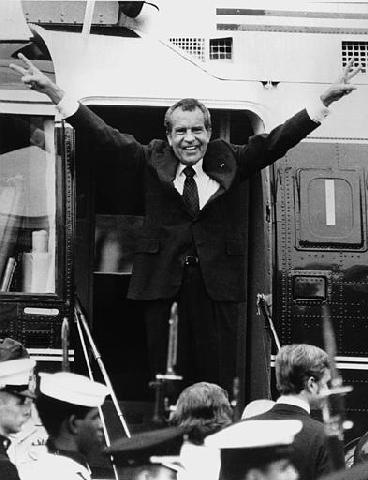
Nixon resigns, 1974

Also striking is how the  Post has acknowledged as much from time to time over the years.

Howard Kurtz, the newspaper’s media reporter, wrote in 2005, for example:

“Despite the mythology, The Post didn’t force Richard Nixon from office—there were also two special prosecutors, a determined judge, bipartisan House and Senate committees, the belated honesty of [former White House lawyer] John Dean and those infamous White House tapes.”

Nixon likely would have completed his term if not for the recordings of his conversations in the Oval Office, conversations that captured his guilty role in authorizing a coverup of the Watergate scandal.

The Senate Select Committee on Watergate–not Woodward and Bernstein–uncovered the existence of the White House tapes. The special federal prosecutors on Watergate (one of whom Nixon ordered fired) pressed for the release of the tapes. And the U.S. Supreme Court unanimously ordered Nixon to turn over the  tapes subpoenaed by the special prosecutor.

“The fact is, an incredible array of powerful actors all converged on Nixon at once—the FBI, prosecutors, congressional investigators, the judicial system,” a leading historian of Watergate, Stanley I. Kutler, has written.

Even so, the heroic-journalist myth long ago became the most familiar storyline, the dominant narrative of Watergate.
That’s partly because few Americans are familiar with the intricacies of the epic scandal, one that sent to jail nearly 20 men who were associated with Nixon’s presidency or his 1972 reelection campaign.

The myth of the heroic-journalist, I write in Getting It Wrong, my forthcoming book about media-driven myths, thus serves as ready short-hand “for grasping the scandal’s essence while avoiding its forbidding complexity.”

I also note in Getting It Wrong:

“How the Post and its reporters uncovered Watergate is deeply ingrained in American journalism as one of the field’s most important and self-reverential stories.”

But it is a misleading interpretation, one that minimizes the more powerful and decisive forces that unraveled the scandal and ended Nixon’s corrupt presidency in the summer of 1974.

WJC

It took Murrow? Not in stopping McCarthy

In Debunking, Media myths, Murrow-McCarthy myth on February 4, 2010 at 10:51 pm

Legendary broadcast journalist Edward R. Murrow is a touchstone for courage in journalism, a model against which contemporary journalists almost always are found wanting.

Murrow in 1954 (Library of Congress)

Emblematic of Murrow’s courage was his standing up to Joseph R. McCarthy, the Red-baiting Republican senator from Wisconsin, at a time when, supposedly, no one else dared.

The occasion was Murrow’s 30-minute See It Now television program on CBS. The program aired March 9, 1954, and focused on McCarthy’s bullying tactics and taste for half-truth and reckless exaggeration.

That Murrow’s See It Now program brought down McCarthy is a great story. It’s also a delicious and tenacious  media-driven myth, one embraced and advanced by worshipful biographers, journalists, Murrow admirers, and even some media critics.

The myth was reiterated today in a commentary posted at the Cleveland Leader online alternative news outlet.

“It took a major media figure as Edward R. Murrow,” the commentary declared, “to strike the blow to reveal the truth of Sen. McCarthy.”

Well, not exactly.

As I write in Getting It Wrong, my forthcoming book about media-driven myths, Murrow “was very late in confronting McCarthy” and “did so only after other journalists had challenged the senator and his tactics for months, even years.”

I note that Eric Sevareid, Murrow’s friend and CBS colleague, chafed at the misleading interpretation, noting that Murrow’s program “came very late in the day.”

In an interview published in 1978, Sevareid added:

“The youngsters read back and they think only one person in broadcasting and the press stood up to McCarthy and this has made a lot of people feel very upset, including me, because that program came awfully late.”

Sevareid was correct. Interestingly, even Murrow acknowledged his role in taking down McCarthy was exaggerated. “It’s a sad state of affairs when people think I was courageous,” Murrow told Newsweek shortly after the See It Now show on McCarthy.

Well before that program aired,  a number prominent journalists—the Washington-based syndicated columnist Drew Pearson among them—had become “persistent and searching critics of McCarthy, his record, and his tactics,” I write in Getting It Wrong.

Pearson, I note, “first wrote about McCarthy’s wild allegations [about communists in government] on February 18, 1950, just days after McCarthy had begun raising them. Pearson called McCarthy the ‘harum-scarum’ senator and said that when he ‘finally was pinned down, he could produce … only four names of State Department officials whom he claimed were communists.'”

And none of the charges held water, Pearson wrote.

The legendary status associated with Murrow and his See It Now program has obscured and diminished the contributions of journalists such as Pearson who took on McCarthy long before March 1954, when doing so held no small risk.

It’s one of the hazards of media-driven myths: they can extend credit where credit is not entirely due.

WJC

Jessica Lynch and the lingering hero myth

In Jessica Lynch, Media myths, Washington Post on February 2, 2010 at 8:05 am

It’s amazing how “hero” still attaches to Jessica Lynch, the blonde, waiflike Army private from West Virginia who, through no exceptional effort of her own, became the best-known American military figure of the early days of the Iraq War.

Jessica Lynch, before the war

Lynch was in Florida the other day, promoting  I Am a Soldier, Too, a book about her that was written by Rick Bragg and published in November 2003 to decidedly mixed reviews.

In a report online, a Florida television station gave 267 words to Lynch’s visit; in that report, “hero” was invoked twice.

It’s amazing, too, how the media-driven aspect of her emergence to sudden fame usually is obscured these days. The Florida station made no mention of the Washington Post‘s overheated and erroneous report that gave rise to the hero-warrior myth of Jessica Lynch.

The myth is examined in detail in a chapter in my forthcoming book, Getting It Wrong, which is due out in the summer.

In it, I recount how Lynch was catapaulted to sudden and unsought fame during the first days of the war in Iraq. Lynch then was a 19-year-old supply clerk in the Army’s 507th Maintenance Company.

On March 23, 2003, elements of the 507th were ambushed by Iraqi irregulars in the southern city of Nasiriyah.  Lynch was badly injured in the crash of her Humvee and was taken prisoner.

Nine days later, she was rescued by a U.S. special operations unit from a hospital in Nasiriyah.

Two days after that, on April 3, 2003, the Washington Post published a sensational report on its front page that said Lynch had “fought fiercely” in Nasiriyah and had “shot several enemy soldiers after Iraqi forces ambushed” her unit, “firing her weapon until she ran out of ammunition.”

Washington Post's erroneous front-page report

The Post’s report cited “U.S. officials” who otherwise were unidentified as saying that Lynch had “continued firing at the Iraqis — even after she sustained multiple gunshot wounds and watched several other soldiers in her unit die around her in fighting March 23.”

One official was quoted anonymously as saying:

“‘She was fighting to the death. She did not want to be taken alive.’”

It was a terrific story that was immediately picked up by news outlets across the United States and around the world.

But it wasn’t true.

The battlefield heroics attributed to Lynch were, quite likely, the deeds of another soldier in her unit, a cook from Oregon named Donald Walters. He fought the Iraqis till his ammunition ran out, was captured, and was executed.

Central to the myth enveloping the Lynch case is that the U.S. military encouraged and promoted the phony hero-warrior story, to help boost public support for the war.

But as I describe in Getting It Wrong, one of the reporters on the Post’s erroneous “fighting to the death” report, told an NPR radio program in late 2003 that “the Pentagon … wouldn’t say anything about Jessica Lynch.”

The reporter, Vernon Loeb, also said in that interview: “I just didn’t see the Pentagon trying to create a hero where there was none.”

And the Post‘s erroneous “Fighting to the death” report about Lynch included this passage:

“Pentagon officials said they had heard ‘rumors’ of Lynch’s heroics but had no confirmation.”

The Post’s hero-warrior story about Lynch has had many unintended consequences beyond vaulting Lynch to celebrity status, which, as her appearance in Florida suggests, has never fully receded.

Her celebrity status also helped pave the way for her lucrative book contract with Bragg. And certainly it obscured the actions of Walters, whose conduct Nasiriyah probably saved the lives of some of his fellow soldiers.

WJC

Murrow the brave? Not in McCarthy days

In Debunking, Media myths, Murrow-McCarthy myth on January 29, 2010 at 7:22 pm

Legendary CBS newsman Edward R. Murrow is given credit in a blog post today for having shown “great courage” during the days of McCarthyism in the 1950s.

In fact, Murrow was quite late to challenge Senator Joseph R. McCarthy, only doing so years after syndicated columnist Drew Pearson, among others, had taken on the demagogue.

Joe McCarthy, 1954

Even so, the notion that Murrow took down McCarthy in a television exposé in March 1954 lives on as an especially tenacious media-driven myth.

It’s a strange one, too, because the myth took hold despite the protestations of Murrow and his producer, Fred Friendly.

As I note in my forthcoming book, Getting It Wrong:

“Murrow said he recognized his accomplishments were modest, that at best he had reinforced what others had long said about McCarthy.”

But a posting today at the Rutherford Institute‘s “Speak Truth to Power” blog indulges the media myth, stating:

“Amid the Red Scare of the 1950s and the Joseph McCarthy era, people were often afraid to speak out against the paranoia being propagated through the media and the government. Fear and paranoia had come to grip much of the American population, and there was a horrible chill in the air.

“But with great courage, Murrow spoke up” on March 9, 1954, on his television documentary television program, show See It Now.

Murrow certainly showed courage during his career in broadcasting. He became a household name in the United States for his coverage from London during Nazi air raids in World War II.

But in early 1954, as I write in Getting It Wrong, “it wasn’t as if Americans … were hoping for someone to step up and expose McCarthy, or waiting for a white knight like Murrow to tell them about the toxic threat the senator posed.

“By then, McCarthy and his tactics were well-known” and the senator had even “become a target of withering ridicule—a sign of diminished capacity to inspire dread.”

I further write in the book, which is due out in summer 2010:

“Long before the See It Now program, several prominent journalists—including the Washington-based syndicated columnist Drew Pearson—had become persistent and searching critics of McCarthy, his record, and his tactics.”

Pearson first challenged McCarthy in 1950, shortly after the senator began his communists-in-government campaign.

McCarthy's nemesis, Drew Pearson

As I say, Murrow and Friendly, his collaborator on See It Now, acknowledged the program on McCarthy was neither decisive nor necessarily brave.

Friendly wrote in his 1967 memoir, Due to Circumstances Beyond Our Control:

“To say that the Murrow broadcast of March 9, 1954, was the decisive blow against Senator McCarthy’s power is as inaccurate as it is to say that Joseph R. McCarthy … single-handedly gave birth to McCarthyism.”

And Murrow told Newsweek a few weeks after the program:

“It’s a sad state of affairs when people think I was courageous.”

WJC

The Watergate myth: Why debunking matters

In Debunking, Media myths, Washington Post, Watergate myth on January 27, 2010 at 8:05 am

My recent post about the heroic-journalist myth of Watergate prompted a few blinkered, ahistoric observations.

Among was this comment, posted at Romenesko‘s feedback site:

“Who cares?” the comment reads. “Watergate was in the early 1970s. …  Arguing the point now about what role a paper played almost 40 years later in a presidency that a significant number of people have no recollections of? Ya gotta admire those authors willing to tackle cutting-edge topics.”

So why does it matter? Why is addressing and debunking the heroic-journalist myth of Watergate — the notion that intrepid reporters for the Washington Post brought down Richard Nixon’s corrupt presidency — still important?

Several reasons present themselves, not the least of which is the vigor that characterizes the Watergate myth: It lives on in textbooks, in classrooms, in newsrooms. It’s a very robust myth, little-restrained in its reach and infiltration.

A hint of its reach came yesterday, in an email from former master’s student of mine, who himself now teaches journalism. He described how he approaches the Watergate story:

“I usually start the class discussion by asking the students to write a sentence that begins with ‘Watergate is the story of…’

“Inevitably, several students write something like ‘Watergate is the story of two young reporters who brought down a corrupt president.’ We then spend the rest of the class period challenging that historical narrative.”

Not only is this a great pedagogic technique; the student responses suggest how ingrained the Watergate myth has become.

A further reason debunking matters is that the Watergate myth severely misinterprets the news media’s capacity to exert decisive influence.

As I write in my forthcoming book, Getting It Wrong, media “myths are neither trivial nor innocuous. … Notably, they tend to distort understanding about the role and function of journalism in American society, conferring on the news media far more power and influence than they necessarily wield.

“Media myths often emerge from an eagerness to find influence and lasting significance in what journalists do and tend to extend credit where credit is not entirely due. The heroic-journalist myth of Watergate is a telling example.”

Indeed, the Watergate myth points unequivocally to presumed power of the news media, that they can expose corruption at the highest levels and thus make a significant and lasting difference.

As Jay Rosen, blogger and media scholar, wrote quite eloquently a few years ago, the heroic-journalist myth of Watergate stands as “the redemptive tale believers learn to tell about the press and what it can do for the American people.

“It is a story of national salvation: truth their only weapons, journalists save the day.”

What’s more, to debunk myths is to be aligned with a fundamental objective of journalism—that of seeking to get it right. The task of debunking is to insist on a demarcation between fact and fiction, and to assert there is intrinsic value in setting the record straight.

And finally, it’s not as if journalism’s past is irrelevant. It’s unevenly taught and poorly understood, a lot of it. But it’s scarcely irrelevant. Not in the digital century, when the media landscape is being so dramatically redrawn.

WJC

‘Pharm parties’ and the tenacity of media myths

In Debunking, Furnish the war, Media myths on January 26, 2010 at 6:25 am

Jack Shafer, editor-at-large at slate.com, recently revisited and re-debunked the media-driven myth of “pharm parties,” those purported gatherings at “which young people … dump the pills they’ve stolen from their parents’ medicine cabinets into a big bowl and then scoop out and swallow random handfuls.”

It’s a phenomenon, he says, that the news media “pretend [is] both real and ubiquitous.”

Shafer begins his take-down with a half-serious lament, writing:

“I regret to inform you that this column has failed to eradicate the ‘pharm party’ meme,” noting that he has written about this fanciful pastime on five other occasions.

Shafer appeals to common sense in deflating the myth, writing:

“There are at least two basic problems with the pharm-party scenario reported in the press. To begin with, if you were a young drug fiend and stole potent drugs, why would you deposit them in a communal bowl if there was a good chance that when your turn came to draw a drug at random, you might get an antihistamine? And second, I’ve yet to read a story in which a journalist actually attends such a gathering, interviews a participant, or cites a police report alleging such behavior.”

It’s an impressive debunking, but Shafer is under no illusions that his efforts will kill off the fantasy.

After all, he says, reports of “pharm parties” or their equivalent can be traced to the mid-1960s. “Any myth hearty enough to survive and thrive for 40-plus years in the media is probably unkillable,” Shafer writes.

And he’s probably right.

As I note in my forthcoming book, Getting It Wrong, some media-driven myths are so tenacious, so debunking-resistant, because they seem too good, too delicious, not to be true.

That’s certainly the case with the hoary tale of William Randolph Hearst’s purported vow to “furnish the war” with Spain at the end of the nineteenth century. What story better captures Hearst the warmonger than that? What tale better signals the potential malignant effects of the news media, writ large?

The anecdote of the Hearstian vow lives on, shrugging off repeated efforts to uproot it.

Likewise, the notion of “pharm parties,” is too enticing, too delicious in a perverse way, not to be true.

Another factor explaining tenacity of media-driven myths is that they readily feed stereotypes. “Pharm parties” certainly do so, offering supposed evidence of the mindless, reckless ways of a younger generation.

One of the cases of stereotyping explored in Getting It Wrong is that of “crack babies,” a frightening and overstated phenomenon of the late 1970s and 1980s. Women who smoked crack cocaine during pregnancy were, it was feared, giving birth to a neurologically damaged “bio-underclass” that would forever be dependent on the state.

The “crack baby” phenomenon turned out to be a widely misreported pandemic. Even so, it seemed to confirm the worst pathologies associated with inner-city poor people. That stereotype was one reason the “crack baby” meme lived on.

And lives on still.

WJC

New Pulitzer biography: An opportunity missed

In 1897, Media myths, Yellow Journalism on January 25, 2010 at 1:35 pm

I recently completed a review of Pulitzer: A Life in Politics, Print, & Power, a forthcoming biography of Joseph Pulitzer, who is routinely—but undeservedly—regarded as an iconic figure in American journalism.

Pulitzer (Library of Congress)

The new biography, by James McGrath Morris, indulges in the cliché of Pulitzer the great innovator. The author calls him the “midwife to the birth of the modern mass media.”

My review, written for the peer-reviewed quarterly journal American Journalism, notes that the book contains ample material for what could have been a long-overdue reinterpretation of Pulitzer, one that would take him down several pegs.

“All the elements are there,” I write, “to depict Pulitzer not as innovator but as a cruel, ruthless, self-absorbed newspaper owner who became a millionaire championing the cause of the dispossessed while eager to rub elbows with the moneyed classes.”

Pulitzer was a hypocrite and an absentee publisher. But the opportunity for a much-needed reinterpretation was missed.

Pulitzer’s correspondence, which Morris tapped extensively, certainly encourages revisionist treatment. As I noted in my 2006 book, The Year That Defined American Journalism:

“Pulitzer’s mean-spirited letters to senior managers do little to support the reputation historians have accorded him, that of a heroic and innovative journalistic icon.”

The new biography also indulges in a media myth in describing William Randolph Hearst, Pulitzer’s rival in New York City journalism in mid- and late 1890s, as an imitator of Pulitzer’s flagship newspaper, the New York World.

It’s quite conventional to make such a claim.

And misleading, too.

Hearst’s significant model was a British journalist named William T. Stead, who in the mid-1880s offered a vision of “government by journalism.” Stead argued that the journalist was “the ultimate depository of power in modern democracy.”

Hearst clearly borrowed from Stead in developing his model of the “journalism of action,” which sought to do much more than gathering, printing, and commenting on the news. As Hearst’s New York Journal put it in 1897, the “journalism of action” obliged a newspaper to inject itself conspicuously and often into public life, to “fitly render any public service within its power.”

It was a breathtaking model of activism that went well beyond the stunt journalism of Pulitzer’s World.

Oddly, the new biography fails to acknowledge Pulitzer’s nod to Hearst’s success with the Journal.

As infirm and disagreeable as Pulitzer had become by 1897, he was not without moments of keen insight. In a letter late that year to his business manager, Pulitzer invoked “Geranium,” his code name for Hearst’s Journal, and declared:

“I personally think Geranium a wonderfully able & attractive and popular paper, perhaps the ablest in the one vital sense, of managing to be talked about; of attracting attention; of constantly furnishing something which will compel people wherever they meet, whether in the drawing room, or in the poor house, elevated car or dinner table, to talk about something in that paper. That is the sort of brains the World needs. Pardon me for saying also, that with all its faults, which I should not like to copy—though they have been exaggerated—it is a newspaper.”

WJC

The Post ‘took down a president’? That’s a myth

In Debunking, Media myths, Washington Post, Watergate myth on January 24, 2010 at 6:58 pm

Nixon after his resignation, 1974

The Washington Post has tried from time to time over the years to distance itself from the media myth that its coverage of the Watergate scandal brought down Richard Nixon’s corrupt presidency.

The newspaper’s publisher at the time of Watergate, Katharine Graham, said at a program at the Newseum in 1997:

“Sometimes people accuse us of bringing down a president, which of course we didn’t do. The processes that caused [Nixon’s] resignation were constitutional.”

Michael Getler, then the newspaper’s ombudsman, wrote in a column in 2005:

“Ultimately, it was not The Post, but the FBI, a Congress acting in bipartisan fashion and the courts that brought down the Nixon administration. They saw Watergate and the attempt to cover it up as a vast abuse of power and attempted corruption of U.S. institutions.”

Still, the media myth that it was the Post — and, specifically, reporters Bob Woodward and Carl Bernstein — who exposed Nixon’s corrupt ways can be too tempting and too perfect to resist.

Such was the case in today’s edition of the Post, in a commentary by Dana Milbank, who declared that “in the mid-1970s,” the Post “took down a president.”

It was a passing reference in a commentary that challenged the dire assessment about the Post published in latest issue of New Republic.

Still, the “took down a president” passage hints at latent hubris and suggests how the Watergate meme can be used as a not-so-subtle reminder of greatness by Post loyalists and insiders.

But as I write in my forthcoming book, Getting It Wrong, to argue that the Post took down Nixon is to “misunderstand the scandal and to indulge in a particularly beguiling media-driven myth.”

It is, I further write, a misleading interpretation that “minimizes the far more decisive forces that unraveled the scandal and forced Nixon from office.”

What I call the “heroic-journalist myth of Watergate” took hold for a number of reasons, among them the sheer complexity of the scandal. Not only was Nixon turned from office but  19 men associated with his presidency or his 1972 reelection campaign went to jail.

The “heoric-journalist” myth has become, I also write in Getting It Wrong, “a proxy for grasping the scandal’s essence while avoiding its forbidding complexity.” That the Post and its reporters supposedly uncovered Watergate “is deeply ingrained in American journalism as one of the field’s most important and self-reverential stories.”

Despite, that is, the periodic protestations from the Post.

Hearty thanks to Jim Romenesko for linking to this post.

WJC

Another twist to the ‘Cronkite Moment’

In Cronkite Moment, Debunking, Media myths on January 21, 2010 at 11:47 pm

The “Cronkite Moment” — that legendary occasion in February 1968 when a CBS News special report by Walter Cronkite supposedly altered the course of the Vietnam War — is one impressively dogged, tenacious media myth.

Cronkite in Vietnam

As I noted in a recent post, the “Cronkite Moment” knows few bounds. It supposedly “turned the tide of American public opinion” against the U.S. war effort in Vietnam and “influenced Lyndon Johnson not to seek reelection” to the presidency.

And just the other day, the TVWeek online site claimed:

“President Lyndon Johnson once famously said about his support of the Vietnam War that once he had lost Walter Cronkite he had lost America. Johnson was referring to a report Cronkite once did where he said the war could not be won.”

Where to start?

First, there is no evidence Johnson ever saw Cronkite’s special report about Vietnam, which aired February 27, 1968. At the close of the program, Cronkite claimed the U.S. military was “mired in stalemate” in Vietnam.

As I write in my forthcoming book, Getting It Wrong, Johnson at the time was not in front of a television set but on the campus of the University of Texas at Austin, attending a party marking the 51st birthday of Governor John Connally.

There is no evidence Johnson later saw the Cronkite program on videotape.

Second, Cronkite did not say in that special report that “the war could not be won.” What the anchorman did say was that the time might be approaching when the United States might seek a negotiated settlement to the war.

As I note in Getting It Wrong, “a close reading of the transcript of Cronkite’s closing remarks reveals how hedged and cautious they really were.”

Cronkite in those remarks held open the possibility that the U.S. military efforts might still force the North Vietnamese to the bargaining table, and suggested the U.S. forces be given a few months more to press the fight in Vietnam.

In addition, the TVWeek item represents a minor addition to the varied accounts of what Johnson supposedly said in response to Cronkite’s closing assessment.

The most common version has Johnson saying: “If I’ve lost Cronkite, I’ve lost Middle America.”

Another version quotes him this way: “I’ve lost Cronkite, I’ve lost the country.”

And another has it this way: “If I’ve lost Cronkite, I’ve lost the American people.”

And: “If I’ve lost Cronkite, I’ve lost the war.”

And “If we lose Cronkite, we lose America.”

The TVWeek item indirectly quotes Johnson as saying that “once he had lost Walter Cronkite he had lost America.”

Version variability of  such magnitude is a strong signal of implausibility.

And of a media-driven myth.

WJC

That awesome ‘Cronkite Moment’

In Cronkite Moment, Debunking, Media myths on January 13, 2010 at 11:44 am

The power of the so-called “Cronkite Moment” knows few bounds.

A column in a Florida newspaper the other day claims that the “Cronkite Moment” was “seminal” because “many say” it “marked the end of the media’s reputation for credibility.”

The occasion was February 27, 1968, when CBS News anchorman Walter Cronkite pronounced that the U.S. war effort in Vietnam had become mired in stalemate. Cronkite suggested that negotiations with the communist North Vietnamese should be considered, as a way to end the conflict.

Cronkite’s analysis was supposedly so powerful and insightful that President Lyndon Johnson purportedly told an aide or aides:

“If I’ve lost Cronkite, I’ve lost Middle America.” Or words to that effect.

Johnson in 1968

The column in the Hernando Today newspaper, a publication of the Tampa Tribune, doesn’t invoke Johnson’s purported remarks — which, as MediaMythAlert has noted several times, Johnson almost certainly did not say.

The column does, though, say that Cronkite’s remarks “turned the tide of American public opinion and influenced Lyndon Johnson not to seek reelection.”

Nope. Not so.

As I discuss in my forthcoming book, Getting It Wrong,  “there is scant evidence that the Cronkite program had much influence at all on American popular opinion about the war.” As I further write in the book, which is to be published in the summer by University of California Press:

“Polling data clearly show that American sentiment had begun shifting months before the Cronkite program.”

Indeed, those data indicate that Americans’ views about the war had begun to shift months before the Cronkite program.

Journalists at the time also detected a softening in support of the war.

In December 1967, for example, Don Oberdorfer, then a national correspondent for the Knight newspapers, noted that “summer and fall of 1967 [had] been a time of switching, when millions of American voters—along with many religious leaders, editorial writers and elected officials—appeared to be changing their views about the war.”

As for Johnson’s decision not to seek reelection, the Cronkite program had little or no effect.

Critical to Johnson’s decision, which he announced at the end of March 1968, was the advice and counsel of his advisers, and the implications of Senator Eugene McCarthy’s insurgent bid for the Democratic nomination for president.

The surprising potency of McCarthy’s antiwar campaign was demonstrated in the Democratic primary election in New Hampshire on March 12, 1968. McCarthy won 42 percent of the vote, a far greater portion than expected. Johnson won 49 percent.

Not only that, there is evidence that Johnson never intended to seek reelection in 1968.

In any event, Cronkite  used to scoff at the notion that his report of February 27, 1968, had a powerful influence on Johnson. Rather, he would say, the effect was like that of “a very small straw.”

Near the end of his life, however, Cronkite (who died in July 2009) came to embrace the supposed power of the broadcast.

“To be honest,” he told Esquire magazine in 2006: “I was rather amazed that my reporting from Vietnam had such an effect on history.”

But it didn’t, though. Not really.

WJC