W. Joseph Campbell

Posts Tagged ‘Fact-checking’

Apocryphal, but still quotable

In Debunking, Media myths, Quotes on December 24, 2011 at 7:24 am

Apocryphal, but still quotable.

That’s the takeaway from a commentary posted yesterday at the online site of the Nation. The commentary invoked Zhou Enlai’s misinterpreted comment about the upshot of the French Revolution.

Zhou supposedly said in 1972 that it was “too early to say” what the effects would be. But Zhou was speaking about the political turmoil in France in 1968, not the years-long upheaval that began in 1789.

The Nation’s commentary, “The Soviet Union’s Afterlife,” tried to have it both ways with Zhou’s remark; the opening paragraph asserted:

“Asked to evaluate the French Revolution nearly 200 years later, the Chinese Premier Zhou Enlai was famously reported to have replied, ‘Too early to say.’ Though apocryphal, the long perspective attributed to Zhou is better informed than the certitudes of American commentators about the causes and consequences of the end of the Soviet Union only twenty years ago.”

If it’s apocryphal, then why invoke it? To do is to distort and confuse and even mislead.

The temptation to invoke telling quotes of dubious derivation can be too powerful to avoid. As I point out in my latest book, Getting It Wrong, “Turns of phrase that sound too neat and tidy often are too perfect to be true.”

Craig Silverman, author of Regret The Error and a columnist for Columbia Journalism Review, has likened dubious quotes to “little gems that supposedly tell a story in just a few words. They lodge themselves in our culture and consciousness.”

So it is with Zhou’s remark, which was made during President Richard Nixon’s historic trip to China in February 1972.

The conventional interpretation — which the Nation commentary invoked — is that the comment stands as evidence of the sage and far-sighted ways of Chinese leaders.

But we know from a retired U.S. diplomat, Charles W. (Chas) Freeman, that Zhou in his talks with Nixon in 1972 was taking a decidedly shorter and more immediate view of turmoil in France.

Freeman was Nixon’s interpreter during the trip and was present when Zhou made the “too early” comment.

Freeman has said that Zhou’s remark came during a discussion about revolutions that had succeeded and failed. The revolutions cited, Freeman said, included the Prague Spring of 1968 and the Hungarian uprising of 1956, both of which the Soviet Union crushed.

Freeman said it was clear from the context that in saying it was “too early to say,” Zhou was speaking about the events in France in May 1968.

How Zhou’s “too early” remark came to be so badly misinterpreted, Freeman was unable to say.

“I cannot explain the confusion about Zhou’s comment except in terms of the extent to which it conveniently bolstered a stereotype (as usual with all stereotypes, partly perceptive) about Chinese statesmen as far-sighted individuals who think in longer terms than their Western counterparts,” he said, adding:

“It was what people wanted to hear and believe, so it took” hold.

First to report Freeman’s debunking was Richard McGregor, a journalist and China expert writing for London’s Financial Times.

As I’ve pointed out, the appeal and tenacity of Zhou’s misinterpreted remark is reminiscent of William Randolph Hearst’s purported vow to “furnish the war” with Spain at the end of the 19th century.

Hearst’s reputed vow  supposedly was made in an exchange of telegrams with the artist Frederic Remington, who was on assignment in Cuba for Hearst’s New York Journal.
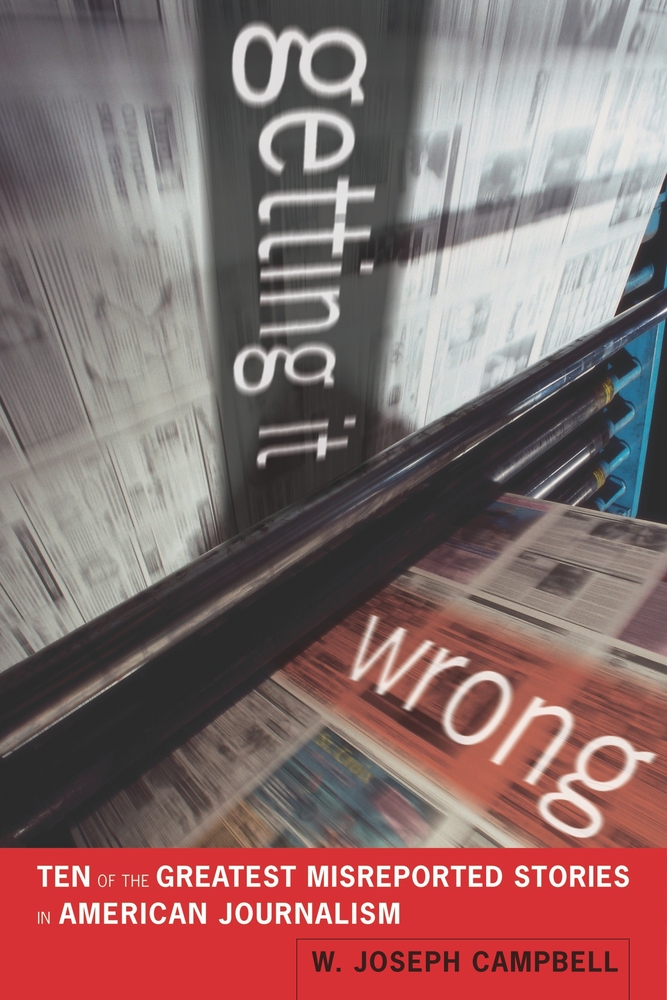
As I point out in Getting It Wrong, it “would have been absurd for Hearst to vow to ‘furnish the war’ because war — specifically, the Cuban rebellion against Spain’s colonial rule — was the very reason Hearst sent Remington to Cuba in the first place.”

“Like many media-driven myths,” I further note, the purported Hearstian vow “is succinct, savory, and easily remembered.

“It is almost too good not to be true.”

WJC

Many thanks to Instapundit
Glenn Reynolds for linking to this post.

Recent and related:

‘Salon’ offers up repudiated Lynch-source claim

In Debunking, Jessica Lynch, Washington Post on December 21, 2011 at 8:47 am

The fallout is unending from the botched Washington Post story about Jessica Lynch’s heroics early in the Iraq War.

The online news and commentary site Salon offered up the other day the discredited claim that the hero-warrior tale about Jessica Lynch was the work of a former White House communications official named Jim Wilkinson.

Salon asserted, without attribution, that Wilkinson was known “for inventing the false story of Jessica Lynch,” a 19-year-old Army supply clerk whom the Post erroneously said had fought fiercely in the ambush of her unit in Iraq in March 2003.

The Post’s electrifying report was published April 3, 2003, and picked up by news organizations around the world. The story soon proved utterly wrong in its most important details, notably that Lynch had never fired a shot in the attack.

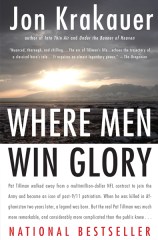
Salon’s claim about Wilkinson was an echo of a since-repudiated assertion in Jon Krakauer’s 2009 book, Where Men Win Glory: The Odyssey of Pat Tillman.

Krakauer claimed — without attribution — that Wilkinson was the Post’s source on the Lynch story. Krakauer asserted that Wilkinson was  “a master propagandist” and “the guy who deserved top billing for creating the myth of Jessica Lynch.”

Wilkinson — who at the time was director of strategic communications for the commander of U.S. forces in Iraq, General Tommy Franks — vigorously denied he was the newspaper’s source.

The Post has never identified the sources who led it so badly awry on the Lynch report.

Wilkinson said he discussed corrections with Krakauer late last year. The unflattering claims about him were removed in a recent paperback printing of Where Men Win Glory, which included a footnote, saying:

“Earlier editions of this book stated that it was Jim Wilkinson ‘who arranged to give the Washington Post exclusive access’ to this leaked intelligence [about Jessica Lynch]. This is incorrect. Wilkinson had nothing to do with the leak.”

Salon’s claim about Wilkinson was included in a commentary posted Monday, that scoffed at speculation that former U.S. Secretary of State Condoleezza Rice might seek the Republican nomination for vice president.

Asked by email about Salon’s claim about his “inventing” the Lynch hero-warrior tale, Wilkinson replied:

“Craziness! Wish they would leave me alone.”

The author of the Salon commentary, Alex Pareene, said by email yesterday that he had relied on Krakauer’s book in offering the claim about Wilkinson.

Pareene also said:

“I was unaware of Krakauer’s correction, and it’s worth an explanatory note.”

He later appended a footnote to his commentary, citing Krakauer’s rollback and stating that Wilkinson “apparently isn’t responsible for falsifying [Lynch’s] actions or leaking that false story to the press.”

So now, how about some transparency from the Washington Post?

By disclosing the identities of its sources on the Lynch case, the Post would help put an end to the erroneous speculation of the kind that has injured Wilkinson’s reputation.

Disclosing its sources also would puncture the false narrative that the U.S. military concocted the story about Lynch’s heroics in a cynical and devious attempt to bolster popular support in the United States for the war in Iraq.

As I point out in my latest book, Getting It Wrong, one of the Post reporters on the botched report about Lynch has said flatly, “Our sources for that story were not Pentagon sources.”

What’s more, public opinion polls in the early days of the Iraq War showed “there was little reason for morale-boosting among Americans,” I write in Getting It Wrong, adding:

“It may be little-recalled now, but the U.S.-led invasion of Iraq was widely supported by the American public. Polling data from March and April 2003, the opening days and weeks of the war, show an overwhelming percentage of Americans supported the conflict and believed the war effort, overall, was going well.”

WJC

Recent and related:

Lynch blames ‘military, media’ for bogus hero story, ignores WaPo

In Debunking, Jessica Lynch, Media myths, Washington Post on December 19, 2011 at 8:09 am

Jessica Lynch has blamed the “military and the media” for the bogus story about her battlefield heroics in the opening days of the Iraq War — but ignored mentioning the Washington Post, which was solely responsible for circulating the erroneous if electrifying tale.

Lynch’s remarks were made in an as-told-to article posted yesterday at the Daily Beast, an online site affiliated with Newsweek magazine.

“Though I didn’t know it at the time,” she said, “the military and the media labeled me a hero. They said I’d gone down guns blazing, like Rambo, when really my rifle had jammed and I hadn’t shot a soul.”

She was referring to the hero-warrior tale the Washington Post thrust into the public domain in a sensational, front-page report on April 3, 2003.

The Post said Lynch, then a 19-year-old Army private, had fought fiercely in the ambush of her unit, the 507th Maintenance Company, at Nasariyah in March 2003.

The botched hero-warrior story

The Post referred anonymously to “U.S. officials” in reporting that Lynch shot several enemy soldiers” in the ambush and “continued firing at the Iraqis even after she sustained multiple gunshot wounds and watched several other soldiers in her unit die around her” in the fighting.

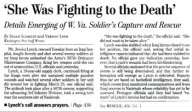
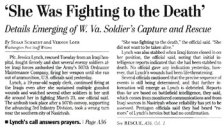
The hero-warrior tale — published beneath the headline “‘She was fighting to the death'” — made terrific copy, and news organizations around the world picked up the story.

As I note in my latest book, Getting It Wrong, Lynch became the best-known Army private of the war.

But the story soon proved thoroughly in error. Lynch never fired a shot in the ambush. She was neither shot nor stabbed. She suffered shattering injuries in the crash of a Humvee as it attempted to flee the ambush.

The bogus story clearly wasn’t the work of multiple news organizations. It was the Post’s story, exclusively.

The Post has never fully explained how it got the dramatic story about Lynch so utterly wrong; nor has the newspaper disclosed the identity of its sources on the bogus story.

Its silence about the sources has allowed a false narrative to fester and spread — namely, that the military concocted the story about Lynch’s heroics and fed it to the Post in a cynical attempt to bolster popular support in the United States for the war in Iraq.

That version, though quite vague, has proved very popular, as suggested by Lynch’s comments posted at the Daily Beast.

But we know from one of the Post reporters on the botched hero-warrior story that the Pentagon wasn’t the newspaper’s source.

The reporter, Vernon Loeb, told NPR in mid-December 2003: “Our sources for that story were not Pentagon sources.”

He also said in the NPR interview that military officials “wouldn’t say anything about Jessica Lynch.

“I’ve never believed that at least as far as the story we wrote goes, that it was a Pentagon attempt to create a hero there.”

Loeb said that “we basically told our readers that day what basically the U.S. intelligence community was telling senior members of the U.S. government. It just kind of goes back to the old adage, you know, that initial reports from the battlefield are almost always wrong.”

It bears repeating: Responsibility for spreading the erroneous account lies neither with the “military” nor with the “media”; it rests solely with the Washington Post.

WJC

Recent and related:

ABC News invokes false narrative of Jessica Lynch case

In Debunking, Jessica Lynch, Media myths, Washington Post on December 17, 2011 at 10:22 am

ABC News yesterday invoked the false derivation of the hero-warrior myth about Jessica Lynch, declaring that “the U.S. government portrayed her as a fearless heroine who had gone down fighting” early in the Iraq War.

Not so. The Washington Post did that.

The Post — alone — placed the bogus tale about Lynch and her battlefield derring-do into the public domain in April 2003, in an electrifying, front-page article that was picked up by news organizations around the world.

The “U.S. government” — specifically, the Pentagon — was loath to embrace the tale about Lynch and her heroics.

Indeed, as one of the Post reporters on the botched report about Lynch later said:

“Our sources for that story were not Pentagon sources.”

The reporter, Vernon Loeb, also said in an interview on NPR: “They wouldn’t say anything about Jessica Lynch.”

Loeb and another Post reporter, Susan Schmidt, had reported on April 3, 2003, that Lynch fought fiercely in the ambush of her unit, the 507th Maintenance Company, on March 23, 2003. Neither Loeb nor Schmidt was with Lynch’s unit; no journalist was.

Loeb and Schmidt wrote that Lynch “shot several enemy soldiers” and  “continued firing at the Iraqis even after she sustained multiple gunshot wounds and watched several other soldiers in her unit die around her in fighting” at Nasiriyah, in southern Iraq.

Loeb and Schmidt quoted a source, to whom they referred as a “U.S. official,” as saying:

“She was fighting to the death. She did not want to be taken alive.”

Though dramatic, and even cinematic, the Post report was utterly wrong.

Lynch had not fired a shot in the ambush; her weapon jammed. Lynch was neither shot nor stabbed; she suffered shattering injuries in the crash of a Humvee as it tried to escape the ambush.

The Post has never fully explained how it botched the hero-warrior story about Lynch. It has never disclosed the identities of the anonymous sources that led it so badly awry on the Lynch story.

The murkiness of the newspaper’s sourcing has not only encouraged the rise of the false narrative, which ABC News cited in asserting, without attribution, that the “U.S. government portrayed” Lynch as a hero.

The Post’s obscure sourcing also has given rise to false allegations. The author Jon Krakauer, for example, wrongly accused Jim Wilkinson, a communications official in the administration of President George Bush, of having “arranged to give the Washington Post exclusive access” to the Lynch hero-warrior tale.

Krakauer called Wilkinson a “master propagandist” who “deserves top billing for creating the myth of Jessica Lynch.”

Krakauer has since quietly rescinded those allegations, which he had included in his 2009 book, Where Men Win Glory: The Odyssey of Pat Tillman.

Another upshot of the false narrative is that it has obscured wide recognition of a real hero at Nasiriyah, a sergeant in Lynch’s unit named Donald Walters.

Sgt. Walters

As I write in my latest book, Getting It Wrong, Walters’ battlefield heroics were likely misattributed to Lynch, owing to mistranslation of Iraqi radio transmissions from the battlefield.

“During the ambush in Nasiriyah,” I write, “… Walters either stayed behind, or was left behind, to lay down covering fire as his fellow soldiers tried to make their escape. Walters fought his attackers in a fashion that the Post attributed to Lynch.”

I point out that the most detailed account of Walters’ bravery appears in Richard Lowry’s fine study of the fighting at Nasiriyah, Marines in the Garden of Eden.

Lowry wrote that Walters killed “several Iraqis before he was surrounded and captured” by Iraqi irregulars, the Fedayeen, and executed.

“We will never really know the details of Walters’ horrible ordeal,” Lowry wrote. “We do know that he risked his life to save his comrades and was separated from the rest of the convoy, deep in enemy territory.

“We know that he fought until he could no longer resist.”

The Post, though, has shown scant interest in Walters’ heroism.

A database search of Post articles published since April 2003 revealed just four stories in which Walters was mentioned. None of those articles discussed in any detail his bravery at Nasiriyah.

WJC

Recent and related:

WaPo still dodging responsibility in Jessica Lynch case

In Debunking, Jessica Lynch, Washington Post on December 14, 2011 at 2:01 pm

Lynch in 2003

The Washington Post — the newspaper that brought the world the bogus hero-warrior tale about Jessica Lynch early in the Iraq War — placed at its Web site today a wire service report about Lynch’s completing an education degree at the University of West Virginia at Parkersburg.

The 900-word report made no mention about the Post’s singular role in pressing the hero-warrior tale into the public domain but instead invoked the false narrative that the U.S. military made up the account about Lynch’s battlefield heroics to bolster support at home for the war.

“To make her seem more heroic and rally public support for the war,” said the report by the Associated Press, which the Post placed online, “the military claimed she’d gone down firing — when, in fact, her rifle had jammed.”

How arrogant: It was the Post that reported Lynch had “gone down firing,” that she had fought ferociously in the ambush of her unit, the 507th Maintenance Company, at Nasariyah in March 2003.

It was the Post — citing otherwise unnamed “U.S. officials” — that presented the electrifying tale that Lynch had “shot several enemy soldiers” in the ambush.

It was the Post that reported Lynch “continued firing at the Iraqis even after she sustained multiple gunshot wounds and watched several other soldiers in her unit die around her” in the fighting.

It was the Post that said Lynch also suffered stab wounds in the ambush.

But none of it was true.

Lynch never fired a shot in Iraq. Her weapon jammed during the ambush.

She suffered shattering injuries not in battling Iraqi soldiers but in the crash of a Humvee as it fled the ambush.

As I discuss in a chapter in my latest book, Getting It Wrong, the Post has never fully explained how it got the Lynch story so badly wrong.

It has never disclosed the anonymous sources it cited in presenting the bogus hero-warrior tale.

Indeed, the Post has largely sidestepped accountability for the bogus hero-warrior narrative, which has allowed the false narrative about the military’s concocting the Lynch story to take hold and proliferate.

We know it’s a false narrative from one of the Post reporters whose byline appeared on the botched Lynch story, which was published April 3, 2003, beneath the headline:

“‘She was fighting to the death.'”

Vernon Loeb, a veteran journalist whose byline appeared on that report, said in an interview on NPR’s Fresh Air program in December 2003:

“Our sources for that story were not Pentagon sources.”

He also said in the interview:

“They wouldn’t say anything about Jessica Lynch.”

Loeb added: “I just didn’t see the Pentagon trying to create a hero where there was none. I mean …they never showed any interest in doing that, to me.”

Loeb said the Post based its story on the accounts of “some really good intelligence sources” in Washington, D.C., adding:

“We wrote a story that turned out to be wrong because intelligence information we were given was wrong. That happens quite often.”

As I note in Getting It Wrong, Loeb on another occasion was quoted in a commentary in the New York Times as saying:

“Far from promoting stories about Lynch, the military didn’t like the story.”

Loeb also was quoted in the commentary as saying that “the sources for this information [about Lynch’s derring-do] were apparently Iraqis, both Iraqi informants and intercepts.”

Loeb’s disclaimers notwithstanding, the notion that the Pentagon’s made up the story to bolster domestic U.S. support for the war makes little sense. The American public, after all, supported the Iraq War in overwhelming numbers in its early days and weeks, as I point out in Getting It Wrong.

But it’s clear that if not for the Post’s erroneous reporting, the bogus tale of Lynch’s battlefield heroism never would have circulated as widely and as profoundly as it did.

WJC

Recent and related:

‘Yes, Virginia’: History does trump TV animation

In 1897, Debunking, Media myths on December 9, 2011 at 11:28 am

CBS is to air tonight its vapid Christmas season special, “Yes Virginia,” which is based on the old New York Sun’s timeless editorial reply to an 8-year-old girl, who in 1897 inquired about the existence of Santa Claus.

The charmless, animated CBS program takes great liberties with the real back story to the “Yes, Virginia” editorial, which was published in the Sun on September 21, 1897, in the third of three columns on editorials.

The Sun’s editorial was a response to young Virginia O’Hanlon who shortly after her 8th birthday in July 1897 wrote to the newspaper, imploring:

“Please tell me the truth; is there a Santa Claus?”

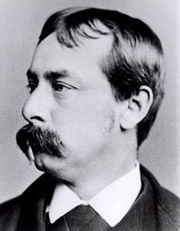
Francis P. Church

The Sun’s reply, written by a retiring editorial writer named Francis P. Church, said in part:

“Yes, Virginia, there is a Santa Claus. He exists as certainly as love and generosity and devotion exist, and you know that they abound and give to your life its highest beauty and joy. Alas! how dreary would be the world if there were no Santa Claus. It would be as dreary as if there were no Virginias.”

In the CBS interpretation, Virginia is waddling, round-headed, and strangely obsessed with the existence of Santa Claus.

Church, the editorial’s author, is depicted as scowling, abrupt, hard-hearted.

Neither portrayal is convincing, neither is realistic.

Church is cast as the editor of the Sun, which is shown as a tabloid newspaper. Church wasn’t editor; he was an editorial writer. And the Sun of 1897 was no tabloid.

What’s more, the CBS show had Virginia writing her letter, and the Sun publishing its reply, in December, as Christmas approached.

Not so.

As I discussed in my 2006 book, The Year That Defined American Journalism: 1897 and the Clash of Paradigms, Virginia wrote the letter in the summer of 1897. The Sun published its editorial-reply on page 6 of its issue of September 21, 1897.

What became the famous essay in American journalism was, in its first appearance, inconspicuous and obscure: It certainly was not introduced with large headlines on the front page, as the CBS show has it.

Its headline posted a timeless question:

“Is There A Santa Claus?”

The editorial was no instant sensation. It was not an immediate hit. And the Sun did not reprint the editorial every year at Christmastime, as is commonly believed.

Indeed, it took years for the newspaper to embrace “Is There A Santa Claus?”

As I noted in The Year That Defined American Journalism, it wasn’t until the mid-1920s when the Sun began routinely publishing the essay in its editorial columns at Christmastime.

What helped kept the editorial alive were the newspaper’s readers.

They found it memorable. They found joy, solace, and inspiration in the passages of “Is There A Santa Claus?”

In untold numbers over the years, readers asked the Sun to reprint the essay.

A letter-writer told the newspaper in 1926 that the editorial offered “fine relief from the commercialism and unsentimental greed” of the Christmas season.

In 1940, a writer to the Sun likened the essay to “a ray of hope on the path to human understanding in our troubled times.”

The CBS program hints at none of that. It offers no indication that the editorial’s fame rests at least in part on generations of readers who, collectively, proved to be far more perceptive than editors of the Sun in identifying the essay’s significance and enduring appeal.

If anything, the tedious CBS show demonstrates anew that history’s back story is often far richer, and far more interesting, than TV fare.

There’s of course little surprise in that observation. As Richard Bernstein wrote in 1989 in a terrific essay about movies and history:

“There are, after all, times when the facts speak far more dramatically than any fictionalized account of them ever could.”

WJC

Recent and related:

Cronkite, Johnson, and the deceptive ‘yardstick’

In Cronkite Moment, Debunking, Media myths on December 7, 2011 at 11:25 am

Cronkite: Wasn't watching Cronkite

The Huffington Post blog bit on the mythical “Cronkite Moment” yesterday, declaring it “a yardstick for how much things have changed.”

That is, how news media once were trusted and respected and influential. Nowadays, not so much.

But if the “Cronkite Moment” is a yardstick of any kind, it’s a measure of how profoundly the media myth has become embedded in the lore of American journalism.

The purported “Cronkite Moment” was on February 27, 1968, when CBS News anchorman Walter Cronkite declared the U.S. military was “mired in stalemate” in Vietnam and suggested that negotiations ultimately might offer a way out.

President Lyndon B. Johnson, as the myth has it, watched the Cronkite report at the White House and, upon hearing the “mired in stalemate” assessment, declared:

“If I’ve lost Cronkite, I’ve lost Middle America.” (Or something to that effect.)

The Huffington Post essay invoked the president’s purported comment in referring to the presumptive “Cronkite Moment,” asserting:

“LBJ famously commented, ‘If I’ve lost Cronkite, I’ve lost Middle America,’ after the beloved journalist called the war ‘unwinnable.’ Several weeks later, Johnson announced that he would not seek reelection as president.”

That paragraph embraces some of the most prominent myths and misunderstandings that have grown up around the presumptive “Cronkite Moment.” Let’s peel them back.

First, Cronkite did not declare the war in Vietnam “unwinnable.” He said the U.S. military was “mired in stalemate” — which hardly was a novel or stunning assessment in early 1968. Many news organizations in fact had used “stalemate” months before Cronkite’s program to characterize the war.

Second, Johnson’s decision not to seek reelection in 1968 had nothing to do with Cronkite’s program. Indeed, there’s strong evidence that Johnson never intended to seek another term, that in 1967, or even earlier, he had decided against another campaign for the presidency.

Johnson wrote in his memoir, The Vantage Point: “Long before I settled on the proper forum to make my announcement, I had told a number of people of my intention not to run again.”

Third, and perhaps most important, is that Johnson did not see Cronkite’s report about Vietnam when it aired.

As I discuss in my latest book, Getting It Wrong, Johnson at the time wasn’t at the White House but at a black-tie party in Austin, Texas, marking the 51st birthday of Governor John Connally.

The president wasn’t agonizing that night over the supposed loss of Cronkite’s support; he wasn’t lamenting having “lost Cronkite.”

Instead, Johnson was offering light-hearted comments about Connally’s age, saying:

“Today you are 51, John. That is the magic number that every man of politics prays for—a simple majority. Throughout the years we have worked long and hard—and I might say late—trying to maintain it, too.”

As I note in Getting It Wrong, there’s no evidence Johnson saw the Cronkite program at a later date, on videotape.

Even if he had, it made no difference to his thinking about Vietnam.

Not long after Cronkite’s program, Johnson delivered a rousing speech in Minneapolis, where he urged “a total national effort” to win the war in Vietnam. That speech was given March 18, 1968, and in it, the president declared:

“We love nothing more than peace, but we hate nothing worse than surrender and cowardice.”

Under scrutiny, then, the presumptive “Cronkite Moment” dissolves as illusory. And not  surprisingly so.

As I point out in Getting It Wrong:

“Seldom, if ever, do the news media exert truly decisive influences in decisions to go to war or to seek negotiated peace. Such decisions typically are driven by forces and factors well beyond the news media’s ability to shape, alter, or significantly influence. So it was in Vietnam, where the war ground on for years after the “Cronkite moment.”

WJC

Recent and related:

A thumbsucker commentary and the Zhou misinterpretation

In Cronkite Moment, Debunking, Furnish the war on December 2, 2011 at 12:49 am

A thumbsucker is what some American journalists call a self-indulgent article or commentary that tends to go on and on, usually about an obscure or time-worn topic.

At its online site yesterday, Britain’s Guardian newspaper posted a thumbsucker that ruminated about the close of historical periods, offering observations such as this:

“Bloodied soldiers didn’t stand around on the battlefield at Bosworth and immediately reflect that, though it had been a hard-fought day, at least the later Middle Ages had now ended.”

Obscure, perhaps, but not altogether uninteresting.

But what caught the eye of Media Myth Alert was the reference to the conventional but erroneous version of Zhou Enlai’s famous and often-quoted comment in 1972, that it was “too early” to assess the implications of the French Revolution.

That version is frequently offered as evidence of China’s sage, patient, and far-sighted ways. That’s rather how the Guardian thumbsucker-commentary referred to it, saying:

“If, as Zhou Enlai said, it is too soon to have a view of the French Revolution, then it is probably too soon to say if the [governing] coalition [in Britain] is a failed government.”

But Zhou was not referring to the French Revolution that began in 1789.

He was speaking about the political turmoil in France of 1968.

We know this from a retired U.S. diplomat, Charles W.  (Chas) Freeman Jr., who was present when Zhou made the comment during President Richard Nixon’s visit to China in 1972.

Freeman, who was Nixon’s interpreter during the historic, weeklong trip, offered the revised interpretation almost six months ago at a panel discussion in Washington.  The discussion’s moderator was Richard McGregor, a journalist and China expert who wrote about Freeman’s comments for the Financial Times of London.

In a subsequent interview with me, Freeman elaborated on his recollection about Zhou’s comment, saying it probably was made over lunch or dinner, during a conversation about revolutions that had succeeded and failed. The discussion, Freeman said, touched on the Prague Spring of 1968 and the Hungarian uprising of 1956, both of which the Soviet Union crushed.

Freeman said it was “absolutely clear” from the context of the discussion that Zhou was speaking about 1968.

Just how Zhou’s remark came to be so dramatically misinterpreted, Freeman was unable to say.

“I cannot explain the confusion about Zhou’s comment except in terms of the extent to which it conveniently bolstered a stereotype (as usual with all stereotypes, partly perceptive) about Chinese statesmen as far-sighted individuals who think in longer terms than their Western counterparts,” Freeman said. “It was what people wanted to hear and believe, so it took” hold.

Stereotyping is but one hazard of dubious quotes like Zhou’s.

Dubious and misinterpreted quotes tend to are falsehoods masquerading as the truth — as suggested by the delicious but apocryphal tale about William Randolph Hearst and his purported vow to “furnish the war” with Spain at the end of the 19th century.

Dubious quotes also dishonor their purported authors — as in the comment often attributed to President Lyndon B. Johnson. Upon hearing newsman Walter Cronkite’s downbeat assessment about the war in Vietnam, Johnson supposedly said:

“If I’ve lost Cronkite, I’ve lost Middle America.”

Or something to that effect.

But as I note in my latest book, Getting It Wrong, there’s no persuasive evidence that Johnson ever made such a comment.

Besides, he didn’t see Cronkite’s report about Vietnam when it aired in late February 1968.

So it’s very difficult to believe the president could have been much moved by a show he didn’t see.

Or that he would have uttered such a comment, if he had seen the program.

WJC

Recent and related:

‘Immortal advice’ given only in a movie

In Debunking, Media myths, Watergate myth on November 23, 2011 at 8:06 am

Add the New Yorker blog “Rational Irrationality” to the lineup of news organizations and outlets that have invoked Watergate’s most famous made-up line — “follow the money” — as if it were genuine.

Felt: Didn't say it

As if the Washington Post’s stealthy “Deep Throat” source really spoke the line “follow the money” as guidance to unraveling the Watergate scandal.

Which he didn’t.

The “Rational Irrationality” blog the other day joined the likes of the Financial Times, Fox News, the Huffington Post, Minnesota Public Radio, the Providence Journal, media critic Eric Alterman, the Hindu newspaper in India, among others, in invoking the line as if it had been advice earnestly offered by “Deep Throat.”

“Rational Irrationality” referred to the line as “immortal advice,” stating:

“There are two ways to figure out what is really happening in Washington politics. One is to interview Administration officials, congressmen, Capitol Hill staffers, think-tank wonks, and so on, and write down what they say. The other journalistic technique is to heed Deep Throat’s immortal advice to Bob Woodward and follow the money trail. When it comes to budgets and the deficit, the Deep Throat methodology is usually the more informative.”

The line certainly may be timeless. Even “immortal.”  But “Deep Throat” never told Woodward, he of the Washington Post, to “follow the money.”

That line appears nowhere in All the President’s Men, the book Woodward wrote with Post colleague Carl Bernstein about their Watergate reporting — reporting that did not, as I discuss in my latest work, Getting It Wrong, bring down Nixon’s corrupt presidency.

Moreover, “follow the money” appeared in no Watergate-related article or editorial published in the Post  before 1981 — which was years after Nixon quit the presidency in disgrace.

Follow the money” was a line made for the movies: It was written into the screenplay of the cinematic version of All the President’s Men.

The line was memorably uttered not by the real-life “Deep Throat” — who in 2005 was self-revealed to have been W. Mark Felt, formerly a top official at the FBI — but by Hal Holbrook, the actor who played “Deep Throat” in the movie.

Holbrook turned in an outstanding performance as a conflicted, tormented “Deep Throat.”

And he delivered his “follow the money” lines with such grave assurance and certainty that it seemed to offer a way to understand the intricacies of the Watergate scandal.

But as I’ve noted at Media Myth Alert, even if Woodward had been counseled to “follow the money,” the advice would have taken him only so far.

It wouldn’t have led him to Nixon.

What forced Nixon from office in 1974 was not the misuse of campaign funds but the president’s active role in attempting to obstruct justice by covering up the signal crime of the Watergate scandal, the break-in at the headquarters of the Democratic National Committee in June 1972.

Rolling up the scandal of Watergate’s complexity and dimension was scarcely as straightforward as pursuing misused campaign contributions.

As I write in Getting It Wrong, unraveling Watergate required “the collective if not always the coordinated forces of special prosecutors, federal judges, both houses of Congress, the Supreme Court, as well as the Justice Department and the FBI.

“Even then,” I argue, “Nixon likely would have served out his term if not for the audiotape recordings he secretly made of most conversations in the Oval Office of the White House.

“Only when compelled by the Supreme Court did Nixon surrender those recordings, which captured him plotting the cover-up” that cost him the presidency.

WJC

Many thanks to Instapundit
Glenn Reynolds for linking to this post

Recent and related:

Accepting the Dicken-Garcia Award for Distinguished Scholarship in Journalism History

In Debunking, Furnish the war, Media myths on November 12, 2011 at 7:49 am

I was honored yesterday to receive the Hazel Dicken-Garcia Award for Distinguished Scholarship in Journalism History, an honor given by the organizers of the annual Symposium on 19th Century Press, the Civil War, and Free Expression, a conference convened in Chattanooga.

The award recognizes my work in journalism history, including the books Getting It Wrong, The Year That Defined American Journalism, and Yellow Journalism: Puncturing the Myths, Defining the Legacies.

The award’s namesake, Hazel Dicken-Garcia, is a retired journalism historian at the University of Minnesota who wrote Journalistic Standards in Nineteenth Century America and is regarded as one of the field’s leading lights.

In accepting the award, which is administered by David B. Sachsman of the University of Tennessee-Chattanooga, I spoke about the importance of myth-busting in media history. I told the conference-goers that “the health and integrity of the field, at least in part, rides on historians’ fulfilling an obligation to bust myths, to seek to set straight the historical record to the extent that’s possible.

“After all,” I added, “to bust myths is to wage war against simplistic and reductive explanations — and to recognize and insist upon the complexity of the historical record.”

I also spoke about my research into media-driven myths, those prominent, well-known stories about and/or by the news media that are widely believed and often retold but which, under scrutiny, prove to be apocryphal or wildly exaggerated.

I noted that media  myths can be thought of as the junk food of journalism – tasty and alluring, perhaps, but not terribly nutritious, and not terribly healthy.

“Media myths,” I said, “are inescapably media-centric; as such, they tend to distort our understanding of the history, roles, and functions of journalism in American society; media myths typically confer on the news media far more power and influence than they necessarily wield.”

Media myths, I added, “often spring from the timeless appeal to distill and simplify, the appeal of condensed, readily digestible historical accounts that are easily grasped, and a delight to retell.”

As examples, I discussed the famous tale about William Randolph Hearst’s purported vow at the end of the 19th century to “furnish the war” with Spain and a Civil War-era quotation attributed to Chicago newspaper editor Wilbur F. Storey, who supposedly told a correspondent to  “telegraph fully all news; and when there is no news, send rumors.”

Both tales, I noted, are based on very thin documentation. Both have serious evidentiary problems.

Hearst’s purported vow was supposedly made in an exchange of telegrams with the artist Frederic Remington, on assignment for Hearst’s New York Journal in early 1897 to draw sketches of the Cuban rebellion against Spanish colonial rule.

I noted in my talk how it would have made no sense for Hearst to have vowed to “furnish the war” when war — the Cuban rebellion — was the very reason he sent Remington to Cuba.

Hearst

Not only that, but the telegrams supposedly exchanged by Hearst and Remington have never turned up; Hearst denied ever making such a vow, and Remington apparently never publicly discussed the matter.

“It’s almost certain that no such telegrams were ever sent,” I said.

The “send rumors” anecdote from the Civil War era is likewise improbable — although undeniably appealing and relevant even today.

“The quotation not only suggests journalism’s inclination to compromise ethics in the gathering of news,” I said, but “it speaks also to the profession’s unending appetite for rumor, gossip, and hearsay.”

The anecdote revolves around instructions supposedly sent in 1864 by Wilbur F. Storey, editor of the Chicago Times, to a correspondent near Nashville, Franc B. Wilkie.

The lone source for Storey’s supposed instructions Wilkie’s memoir,  Personal Reminiscence, which was published in 1891. That was 27 years after the instructions supposedly were sent.

Not only that, but by 1891, Storey had been dead seven years.

I noted that among the reasons for doubting that Storey ever sent such instructions is that they would have been superfluous. It would have made no sense for Storey to have told Wilkie to “send rumors” because the Chicago Times — like many newspapers during the Civil War — routinely printed rumors about battles, about troop movements, and about political developments — and identified them as rumor.

It would have been an unnecessary message, to advise a seasoned correspondent like Wilkie to “send rumors.”

“Simply put,”  I said, “Wilkie would have required no reminder from Storey to ‘telegraph fully all news; and when there is no news, send rumors.'”

I closed my remarks by saying that debunking media myths is  reminder “to be wary about conclusiveness.”

History, I said, “is neither static nor infallible. … There’s plenty of room for skepticism, plenty of room for testing assumptions — for applying tests of evidence and logic to well-known tales and dominant narratives.”

WJC

Recent and related: