W. Joseph Campbell

Posts Tagged ‘McCarthy’

Launching ‘Getting It Wrong’ at Newseum

In Bay of Pigs, Bra-burning, Cronkite Moment, Debunking, Furnish the war, Jessica Lynch, Media myths, Murrow-McCarthy myth, War of the Worlds, Washington Post, Watergate myth on June 14, 2010 at 6:28 am

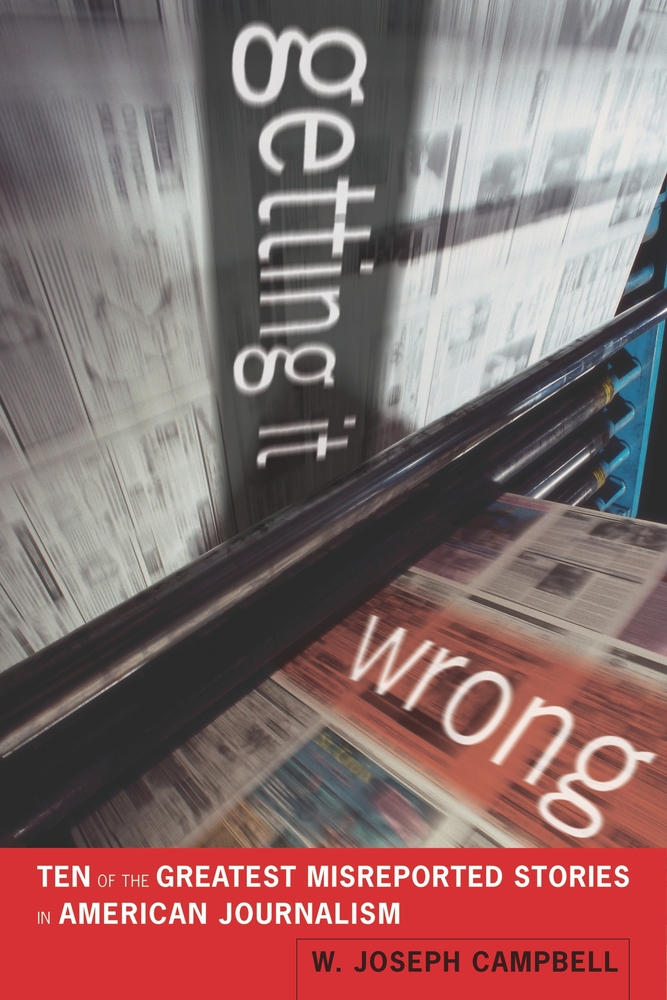
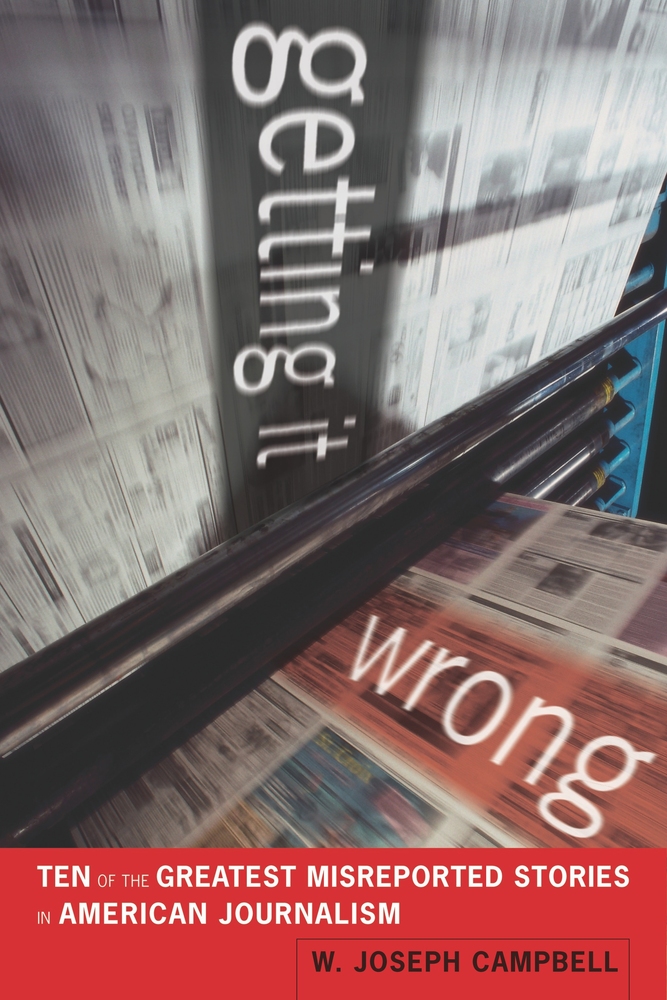
My new book, Getting It Wrong, will be launched Saturday, June 19, at an “Inside Media” program at the Newseum, the $450 million museum of news in downtown Washington, D.C.

The program will begin at 2:30 p.m. in the Knight TV Studio on the third level and will feature a discussion with the Newseum’s John Maynard, followed by audience Q-and-A.

I’ll be signing copies of Getting It Wrong afterward.

The book addresses, and debunks, 10 prominent media-driven myths–stories about and/or by the news media that are widely believed and often retold but which, on close inspection, proved to be apocryphal or wildly exaggerated.

Here is a brief description about each of the 10 myths:

  1. Remington-Hearst: William Randolph Hearst’s famous vow, “you furnish the pictures, I’ll furnish the war,” is almost certainly apocryphal.
  2. War of Worlds: The notion that the War of Worlds radio dramatization in 1938 caused nationwide panic and mass hysteria is exaggerated.
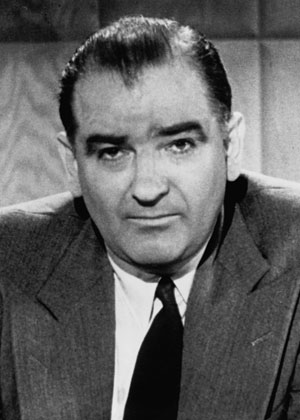
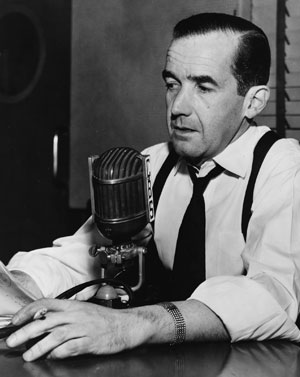
  3. Murrow-McCarthy: Edward R. Murrow’s famous See It Now program in March 1954 did not end Senator Joseph McCarthy’s communists-in-government witch-hunt; Murrow in fact was very late to take on McCarthy.

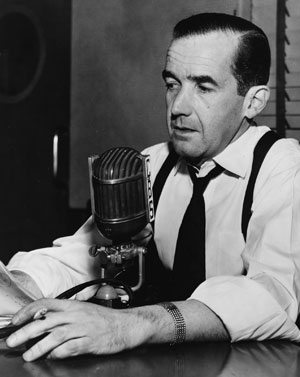
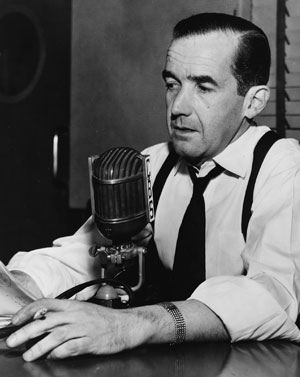
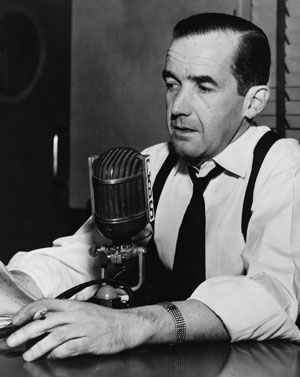
    Murrow in 1954

  4. Bay of Pigs: The New York Times did not suppress its reporting in the run-up to the ill-fated Bay of Pigs invasion in April 1961.
  5. Cronkite-Johnson: Walter Cronkite’s special report on Vietnam in February 1968 did not prompt an immediate reassessment of U.S. war policy.
  6. Bra-burning: Humor columnist Art Buchwald helped spread the notion that feminist demonstrators dramatically burned their bras at a Miss America protest in September 1968.
  7. Watergate: The Washington Post’s intrepid reporters, Carl Bernstein and Bob Woodward, did not bring down Richard Nixon’s corrupt presidency. That they did is a trope that knows few bounds.
  8. Crack babies: The much-feared “bio-underclass” of children born to women who smoked crack cocaine during their pregnancies never materialized.
  9. Jessica Lynch: The Washington Post’s erroneous reporting about Jessica Lynch early in the Iraq War gave rise to several myths about her capture and rescue.
  10. Hurricane Katrina: News coverage of Katrina’s aftermath in New Orleans in early September 2005 was marred by wild exaggerations of extreme, Mad Max-like violence.
As I write in Getting It Wrong, the myths debunked “are among American journalism’s best-known stories. Most of them are savory tales. And at least some of them seem almost too good to be false.”

I further write that because it “takes on some of the most treasured stories in American journalism,” Getting It Wrong is “a work with a provocative edge. It could not be otherwise.”

WJC

Related:

Remembering ‘journalism hero’ Murrow, 45 years on

In Anniversaries, Debunking, Media myths, Murrow-McCarthy myth on April 27, 2010 at 9:46 am

The Poughkeepsie Journal notes the 45th anniversary today of the  death of legendary broadcast journalist Edward R. Murrow.

Murrow died April 27, 1965, at his farm near Pawling, N.Y., about 20 miles from Poughkeepsie. Murrow, a chainsmoker, fell victim to lung cancer. He had just turned 57.

Chainsmoking Ed Murrow

Inevitably, the Poughkeepsie Journal tribute–which carried the headline, “Journalism hero Edward R. Murrow lives on”–recalled Murrow’s famous See It Now documentary program in March 1954. That was when he took on the red-baiting Republican senator from Wisconsin, Joseph R. McCarthy.

The newspaper’s article said Murrow’s program on McCarthy “is credited for exposing the senator’s tactics by using clips of his own words, and helped lead to the senator’s downfall.”

The program’s mythical dimensions are addressed in my forthcoming book, Getting It Wrong, in which I note:

See It Now that night was powerful television. More accurately, it was a hearty serving of advocacy journalism. … Murrow and his See It Now team assembled a series of film clips that was decidedly unflattering to McCarthy.”

I also write:

“McCarthy’s oddball appearance and mannerisms—his hulking, menacing presence, his nutty laugh, his five o’clock shadow, his careless grooming that allowed strands of thinning, greasy hair to creep down his forehead—were among the most revealing and most unforgettable moments of the program.”

But did the show expose McCarthy’s tactics?

Not at all.

McCarthy had burst upon the national scene four years earlier, claiming in a series of speeches that scores of communists, communist sympathizers, or persons of risk were embedded in the U.S. State Department.

His charges were almost immediately challenged by Drew Pearson, a nationally syndicated muckraking columnist based in Washington, D.C.

“The Senator from Wisconsin has been a healthy watchdog of some government activities, but the alleged communists which he claims are sheltered in the State Department just aren’t,” Pearson wrote in February 1950, more than four years before Murrow’s program on McCarthy.

So did the See It Now show “helped lead to the senator’s downfall,” as the Poughkeepsie Journal claims?

Not so much.

By the time Murrow took to the air to confront McCarthy, the senator’s favorability ratings had already hit the skids.

As I write in Getting It Wrong, “it wasn’t as if Americans in early 1954 were hoping for someone to step up and expose McCarthy, or waiting for a white knight like Murrow to tell them about the toxic threat the senator posed.”

Thanks to Pearson, and other journalists, they knew.

WJC

One paragraph, three myths

In Cronkite Moment, Debunking, Media myths, Murrow-McCarthy myth, New York Times, Washington Post, Watergate myth on April 21, 2010 at 11:45 am

A column posted today at a Canadian online news site achieved the feat of working three media-driven myths into a single paragraph.

Here’s what the columnist wrote, in a paean to the power and influence that traditional news media once wielded, supposedly:

“A Walter Cronkite could, however belatedly, expose the pointlessness of Vietnam. Famously, Edward R. Murrow deflated McCarthy. A pair of scruffy reporters could bring down a Nixon.”

Three sentences, three myths–a trifecta that is very rare.

All three media-driven myths are addressed, and debunked, in my book, Getting It Wrong, to be published in summer by the University of California Press.

The reference to Cronkite is to the CBS anchorman’s report of February 27, 1968, in which he said the U.S. military was “mired in stalemate” in Vietnam. As I write in Getting It Wrong, such a characterization was scarcely original or exceptional at the time. It was no exposé.

Indeed, nearly seven months before Cronkite’s pronouncement, the New York Times had suggested in a front-page report that the war was stalemated.

Victory in Vietnam, the Times report said, “is not close at hand. It may be beyond reach.”

That Murrow “deflated” Senator Joseph R. McCarthy is another media myth, stemming from Murrow’s See It Now television program of March 9, 1954.

Murrow in fact was quite belated in confronting McCarthy and the senator’s communists-in-government witch hunt.

The half-hour See It Now program on McCarthy came many months–even years–after other journalists had pointedly challenged the senator and his bullying tactics. Eric Sevareid, a friend and CBS colleague of Murrow, pointedly noted that Murrow’s program “came very late in the day.”

In an interview in 1978, Sevareid said: “The youngsters read back and they think only one person in broadcasting and the press stood up to McCarthy and this has made a lot of people feel very upset, including me, because that program came awfully late.”

And by the time Murrow’s report aired, McCarthy’s favorable ratings had been in decline for three months, as also I note in Getting It Wrong.

The Canadian columnist’s reference to “a pair of scruffy reporters” who supposedly brought down Richard Nixon is, of course, to Carl Bernstein and Bob Woodward, who covered the Watergate scandal for the Washington Post.

As I’ve noted in previous posts at MediaMythAlert, the notion that the reporters brought down Nixon and his corrupt presidency is a myth that even the Post has tried to dismiss.

Howard Kurtz, the newspaper’s media reporter, wrote in 2005, for example:

“Despite the mythology, The Post didn’t force Richard Nixon from office—there were also two special prosecutors, a determined judge, bipartisan House and Senate committees, the belated honesty of [former White House lawyer] John Dean and those infamous White House tapes.”

Kurtz’s observations parallel those of Stanley I. Kutler, a leading historian of the  Watergate scandal, who has written:

“The fact is, an incredible array of powerful actors all converged on Nixon at once—the FBI, prosecutors, congressional investigators, the judicial system.”

The three myths are stories well-known and even cherished in American journalism. They almost always are cited as examples of media power and influence, of journalists at their courageous best.

But as I write in Getting It Wrong:

“To identify these tales as media myths is to confront the reality that the news media are not the powerful agents they, and many others, assume them to be.”

WJC

In today’s ‘Outlook’ section

In Cronkite Moment, Debunking, Furnish the war, Media myths, Murrow-McCarthy myth, Newspapers, Washington Post, Watergate myth on April 11, 2010 at 12:13 pm

An abbreviated version of my recent guestpost at the “Political Bookworm” blog appeared today in the “Outlook” section of the Washington Post.

Here’s the text of the “Outlook” piece, with links that I’ve added:

W. Joseph Campbell, a professor of communication at American University, busts some media myths in his book, “Getting It Wrong: Ten of the Greatest Misreported Stories in American Journalism,” coming in July from the University of California Press. Here are three of Campbell’s biggies:

1. William Randolph Hearst’s purported vow, telegraphed to the artist Frederic Remington in Cuba, to “furnish the war” with Spain. Hearst denied making such a statement. The telegram containing his purported pledge has never turned up. The “furnish the war” anecdote can be traced to 1901 and a memoir by another journalist, James Creelman, who did not say when or how he learned the story about Hearst’s vow.

2. Edward R. Murrow brought an end to Sen. Joseph R. McCarthy’s communists-in-government witch hunt. This myth stems from Murrow’s CBS program “See It Now” on March 9, 1954, when the newsman dissected McCarthy’s crude investigative techniques and taste for the half-truth — none of which was unknown to American audiences at the time. The myth took hold even though years before the program aired, several prominent journalists — including Washington-based syndicated columnist Drew Pearson — had become searching critics of McCarthy and his tactics.

Nixon resigns, 1974

3. The Washington Post’s investigative reporting brought down Richard Nixon’s corrupt presidency. Katharine Graham, The Post’s publisher during the Watergate period, said in 1997: “Sometimes people accuse us of bringing down a president, which of course we didn’t do. The processes that caused [Nixon’s] resignation were constitutional.” She was right, but the complexities of Watergate are not readily recalled these days. What does stand out is a media-centric interpretation that the dogged reporting of Post journalists Bob Woodward and Carl Bernstein brought Nixon down.

WJC

Murrow had McCarthy ‘on his show’? Not quite

In Debunking, Media myths, Murrow-McCarthy myth on April 10, 2010 at 3:11 pm

The myth and misunderstanding associated with Edward R. Murrow’s famous broadcast on CBS about Senator Joseph R. McCarthy are many, and tenacious.

Murrow in 1954

Murrow in 1954

Notable among them is that Murrow’s documentary-style See It Now program of March 9, 1954, exposed McCarthy’s red-baiting ways and abruptly halted the senator’s communists-in-government witch-hunt.

Neither is true, for reasons I discuss in my forthcoming book about media-driven myths, Getting It Wrong.

Another misconception about the Murrow-McCarthy confrontation was raised yesterday, in an item titled “Yellow-bellied journalism” and posted at the Daily Caller online site.  The “yellow-bellied journalism” item stated:

“The problem with the mainstream media is not that they are liberals. It’s that they are cowards. They simply will not engage with any thought that threatens their worldview.

“It’s important to remember that it wasn’t always this way. There once was a time when liberal journalists had the guts to engage, and engage deeply, with the ideas of those who disagreed with them. Edward R. Murrow had Joseph McCarthy on his show.”

That’s an interesting comment about contemporary journalists lacking guts. But as for the point that Murrow had McCarthy “on his show”?

Well, not exactly.

Murrow’s See It Now program of March 9, 1954, was an unrelenting laceration of McCarthy. Murrow made devastatingly effective use of film footage of the senator in action in what was a bravado performance in advocacy journalism.

As I write in Getting It Wrong: “Through clever editing of film of McCarthy in action, Murrow and his See It Now team prepared a powerful indictment” of the senator and his crude investigative tactics.

I also note that  “McCarthy’s oddball appearance and mannerisms—his hulking, menacing presence, his nutty laugh, his five o’clock shadow, his careless grooming that allowed strands of thinning, greasy hair to creep down his forehead—were among the most revealing and most unforgettable moments of the program.”

And as the show neared its end that night, Murrow declared:

“The actions of the junior Senator from Wisconsin have caused alarm and dismay amongst our allies abroad, and given considerable comfort to our enemies.”

But McCarthy wasn’t “on the show” to offer counter-arguments. There were no question-answer exchange between the protagonists. Murrow didn’t really “engage” McCarthy, not in person anyway.

Instead, Murrow gave McCarthy a chance to respond at another time, stating at the outset of the program:

“If the Senator feels that we have done violence to his words or pictures and so desires to speak, to answer himself, an opportunity will be afforded him on this program.”

McCarthy took up the offer, and the See It Now program of April 6, 1954, was devoted to his response, in which McCarthy claimed Murrow was “a symbol, a leader and the cleverest of the jackal pack which is always found at the throat of anyone who dares to expose individual Communists and traitors.”

McCarthy’s rebuttal was rambling, awkward, and unpersuasive.  It was a tedious embarrassment that did McCarthy no good.

And it came nearly a month after Murrow’s memorable, indeed mythical, television program.

WJC

15 movies about journalists: At least 3 boosted myths

In Cinematic treatments, Debunking, Media myths, Murrow-McCarthy myth, Washington Post, Watergate myth on April 8, 2010 at 7:47 pm

It was the day of the journalist (“Dia do Jornalista”) in Brazil yesterday and to help mark the occasion, the RevistaMonet blog posted a lineup, with brief descriptions, of 15 movies about the work of journalists.

They included classics such as The Front Page and His Girl Friday, as well as surprises such as How to Lose a Guy in 10 Days and Superman Returns.

All 15 were English-language films. At least three of them have contributed to, or helped solidify, media-driven myths.

The three myth-builders: All the President’s Men; Good Night, and Good Luck, and my favorite, Citizen Kane.

Cinema’s role in solidifying media-driven myths is discussed in Getting It Wrong, my next book, which will be out in the summer.

“Cinematic treatments,” I write, “influence how historical events are collectively remembered and can harden media-driven myths against debunking.”

That certainly was so with All the President’s Men, the 1976 screen adaptation of Carl Bernstein and Bob Woodward’s book by the same title.

The film characterized Bernstein and Woodward, both of the Washington Post, as central and essential to unraveling the Watergate scandal that toppled President Richard Nixon.

The upshot, I write in  Getting It Wrong, has been “to solidify and elevate the heroic-journalist myth” of Watergate and sustain it in the collective memory.

Indeed, it’s hard to think of Watergate without thinking of All the President’s Men.

Similarly, the 2005 motion picture Good Night, and Good Luck served to popularize and extend the media myth that broadcasting legend Edward R. Murrow exposed and abruptly ended the communists-in-government witch-hunt of Senator Joseph R. McCarthy.

Good Night, and Good Luck was a dramatic retelling of Murrow’s See It Now program on McCarthy, which aired on CBS on March 9, 1954, and often is credited with exposing McCarthy’s crude investigative tactics and bullying ways.

McCarthy in 1954

But as I point out in Getting It Wrong, Murrow’s program on McCarthy came very late–years after other journalists had confronted and challenged the red-baiting senator. By 1954, it wasn’t as if American audiences were waiting for a white knight like Murrow to tell them of the toxic threat McCarthy posed.

They already knew. And in the months immediately before Murrow’s program, the senator’s favorability ratings had begun to fall.

While it never explicitly said as much, Good Night, and Good Luck left the inescapable but erroneous impression that Murrow had courageously and single-handedly challenged and stopped McCarthy.

Citizen Kane, which was released in 1941, arguably is the finest motion picture ever made about journalism: It may have been the best movie, ever.

It certainly was Orson Welles’ towering and most memorable cinematic achievement. Kane was vaguely based on the life and times of media mogul William Randolph Hearst.

Kane‘s contribution to media mythmaking came in a scene that paraphrased Hearst’s purported vow to “furnish the war” with Spain at the end of the 19th century.

As I note in Getting It Wrong,  the Hearstian vow lives on despite a nearly complete absence of supporting documentation. It lives on even though the telegram that supposedly contained Hearst’s message has never turned up. It lives on even though Hearst denied ever making such a statement.

Like many media-driven myths, the story of Hearst’s purported vow is almost too good not to be true.

And given cinematic treatment, it may be impossible ever to inter.

WJC

Did he say it? A curious Murrow quote

In Debunking, Media myths, Murrow-McCarthy myth on March 30, 2010 at 2:38 pm

Edward R. Murrow’s bravery in taking on Senator Joseph R. McCarthy in a televised report in 1954 is the stuff of legend–and of media-driven myth.

The notion that Murrow’s half-hour CBS program halted McCarthy’s communists-in-government witch hunt is one of 10 media-driven myths addressed, and debunked, in my forthcoming book, Getting It Wrong.

Murrow: Did he say it?

The courage Murrow supposedly showed back then was invoked yesterday in a commentary at the Huffington Post blog. The commentary deplored the decline of civility in American political life and declared:

“One of the most courageous heroes steering Americans back to sanity during the McCarthy period, Edward R. Murrow, commented: ‘We must not confuse dissent with disloyalty. When the loyal opposition dies, I think the soul of America dies with it.'”

Besides the reference to Murrow as hero, I was struck by the quotation’s second sentence:

“When the loyal opposition dies, I think the soul of America dies with it.”

I wondered: Did Murrow really say that?

The first portion of the quote–“We must not confuse dissent with disloyalty”–is quite familiar. Murrow intoned the passage during his 1954 program on McCarthy, in a closing editorial comment.

But the rest of quotation– “When the loyal opposition dies, I think the soul of America dies with it”–was not uttered during Murrow’s program on McCarthy.

I ran that passage through the “historical newspapers” database, which includes the New York Times, Washington Post, Chicago Tribune, and Los Angeles Times. No articles quoting the passage were returned.

A search of the LexisNexis database produced a few returns, but none dated before 2001. And none stated when and where Murrow made the comment.

Among the LexisNexis returns was a book review published in 2003 in the Washington Post. The review invoked the “loyal opposition” passage and said Murrow made the remark “half a century ago, at the height of the McCarthy era.” But exactly when and where was left unsaid.

Harry Reid, now the U.S. Senate majority leader, invoked the passage, and cited Murrow as its author, in a speech in 2006 about Iraq. But Reid didn’t say when and where Murrow supposedly made the comment.

Otherwise, the articles, statements, and letters to the editor retrieved from LexisNexis offered no details about the quotation’s derivation.

A Google search produced links to nearly 9,000 online sites that cite the passage. A check of several of those sites turned up nothing about the quote’s derivation.

Google Books identifies seven books that contain the verbatim passage, none of which was published before 2003. None of the seven books is a biography about Murrow.

I could be wrong, but the passage strikes me as dubious, as a flexible, handy, all-purpose comment useful in scoring points by the political left as well as the right.

If it were genuine, if Murrow really said it, its derivation wouldn’t be difficult to track down.

Moreover, the quotation seems almost too neat and tidy to be authentic.

In that sense, it’s evocative of William Randolph Hearst’s often-quoted vow to “furnish the war” with Spain.

And that is a hardy and enduring media-driven myth.

WJC

That heroic Ed Murrow: The myth endures

In Debunking, Media myths, Murrow-McCarthy myth on March 29, 2010 at 10:30 am

Few media-driven myths are as tenacious as the notion that Edward R. Murrow abruptly ended the communists-in-government witch-hunt of Senator Joseph R. McCarthy.

The myth dates to March 9, 1954, when Murrow’s 30-minute See It Now program on CBS television examined the campaign of innuendo, exaggeration, and half-truth that McCarthy had been waging for more than four years.

And the myth was invoked today at Minnesota Public Radio’s online site, in a commentary that declared:

“In the spring of 1954, McCarthy’s crusade of insinuation, innuendo and guilt by association was brought to an end by journalist Edward R. Murrow and Joseph Welsh, attorney for the U.S. Army.”

(The commentary mentioned Welsh because he dramatically confronted McCarthy at a congressional hearing in June 1954, pointedly asking the senator: “Have you no sense of decency, sir? At long last, have you left no sense of decency?”)

As for Murrow, though, his See It Now program on McCarthy was quite belated.

He took on McCarthy only after several other journalists had challenged the senator and his tactics for months, even years.

The Murrow-McCarthy myth is one of 10 that I address, and debunk, in my book, Getting It Wrong. (Note: A second edition of Getting It Wrong came out in 2017.)

I point out in the book that even Murrow’s friend and CBS colleague, Eric Sevareid, “chafed at the misleading interpretation attached to the See It Now program which, he noted, ‘came very late in the day.’

“Sevareid said: ‘The youngsters read back and they think only one person in broadcasting and the press stood up to McCarthy and this has made a lot of people feel very upset, including me, because that program came awfully late.’”

Murrow, himself, acknowledged that his accomplishments in confronting McCarthy were modest, that he had at best reinforced what others had long said about the Republican senator.

I note in Getting It Wrong that Jay Nelson Tuck, then the television critic for the New York Post, wrote in April 1954 that Murrow felt “almost a little shame faced at being saluted for his courage in the McCarthy matter.

“He said he had said nothing that … anyone might not have said without a raised eyebrow only a few years ago,” Tuck wrote.

In no way, then, can Murrow’s See It Now program be said to have “brought to an end” the McCarthy menace.

By the time Murrow took to the air in March 1954, McCarthy’s popularity was already in decline. By then, other journalists–notably Washington’s leading muckraker, Drew Pearson–had called attention to the senator’s crude investigative techniques. And the Army-McCarthy hearings, at which Welch gained lasting fame, proved pivotal to the senator’s downfall.

The hearings led to the Senate’s censuring McCarthy, and to his retreat into political oblivion.

WJC

KTA marks its centenary

In Anniversaries on March 10, 2010 at 10:46 am

Kappa Tau Alpha, the national honor society recognizing high academic excellence in journalism and mass communication, marks its 100th anniversary today in ceremonies at its birthplace, the University of Missouri.

Hearty congratulations to KTA and to its indefatigable executive director, Keith Sanders.

KTA is the country’s seventh-oldest honor society and has chapters on more than 90 college campuses, including American University. I’m the AU chapter adviser as well as the honor society’s national vice president.

KTA’s principal objectives are to promote scholarship and high academic achievement. Each year, its chapters welcome to membership those journalism and mass communication students who rank in the top 10 percent of their respective classes. (The AU chapter typically inducts a smaller percentage.)

KTA also recognizes each year the top research-based book-length study  in journalism and mass communication, with its Frank Luther Mott/Kappa Tau Alpha Research Award.

The centenary will be marked at the campus in Columbia, Missouri, with a lecture by KTA’s national president, Jane B. Singer. She will discuss “Journalism Ethics and Structural Change.”

It’s a memorable week of anniversaries. Not only does KTA mark its 100th, but yesterday was the 56th anniversary of Edward R. Murrow’s famous See It Now television program on Senator Joseph R. McCarthy.

Murrow’s program aired on CBS on March 9, 1954, and a media myth has come to embrace the show: Supposedly, Murrow’s dissection of the red-baiting McCarthy was so courageous and devastating that it abruptly ended the senator’s witch-hunt for communists in the U.S. government.

But as I write in my forthcoming book, Getting It Wrong, the notion that Murrow brought down McCarthy is a durable and powerful media-driven myth.

Murrow “was very late in confronting McCarthy,” I write in Getting It Wrong and “did so only after other journalists had challenged the senator and his tactics for months, even years.” Among them was Drew Pearson, a muckraking columnist who scrutinized McCarthy’s exaggerated claims and allegations as early as 1950–four years before the famous Murrow program.

Indeed, the legendary status associated with Murrow’s program has had the effect of obscuring and diminishing the contributions of journalists, such as Pearson, who were far quicker to discern the toxic threat that McCarthy posed.

WJC

Recalling, and doubting, television’s ‘finest half hour’

In Debunking, Media myths, Murrow-McCarthy myth on March 8, 2010 at 12:18 am

It’ll be 56 years tomorrow since Edward R. Murrow, the “patron saint” of broadcast journalism, took to the small screen to confront Joseph R. McCarthy and decisively end the senator’s witch-hunt for communists in government.

Or so the story goes.

McCarthy in 1954 (Library of Congress)

The occasion was Murrow’s 30-minute See It Now program that aired March 9, 1954, on CBS.

It was a hallowed moment in American journalism, one that supposedly defined the power of television and reaffirmed the courage of Murrow. Among other accolades, the See It Now show on McCarthy has been called television’s “finest half-hour.”

But as I write in my forthcoming book, Getting It Wrong, the notion that Murrow brought down McCarthy is a tenacious though delicious media-driven myth.

Murrow “was very late in confronting McCarthy,” I write in Getting It Wrong and “did so only after other journalists had challenged the senator and his tactics for months, even years.”

I note in the book–which addresses and debunks nine other media-driven myths–that Eric Sevareid, Murrow’s friend and CBS colleague, chafed at the misleading interpretation, pointing out in an interview in 1978 that Murrow’s program “came very late in the day.”

Sevareid was correct.

“Long before the See It Now program, several prominent journalists—including the Washington-based syndicated columnist Drew Pearson—had become persistent and searching critics of McCarthy, his record, and his tactics,” I note in Getting It Wrong.

Pearson wrote the widely read “Washington Merry-Go-Round” column and was the most assertive and persistent of McCarthy’s media critics. He challenged McCarthy’s claims as early as 1950–days after the senator began raising charges that scores of communists and fellow travelers had infiltrated the U.S. State Department.

McCarthy became so angered by Pearson’s searching columns that he threatened the columnist with physical harm–and followed through in December 1950, in a bizarre encounter in the cloakroom of the Sulgrave Club in Washington.

There, McCarthy slapped Pearson, or tried to knee the columnist in the groin. Accounts vary. (Then-Vice President Richard Nixon reportedly broke up the encounter.)

All that came long before Murrow confronted McCarthy on See It Now in 1954.

It’s sometimes argued that Murrow’s most effective contribution was “in mobilizing public opinion against Senator Joe McCarthy.” Such a claim was raised the other day in a post at the online site of the New American magazine.

But in fact, McCarthy’s favorability ratings had been falling for three months before the Murrow program: Factors other than Murrow’s reporting had turned public opinion against McCarthy.

Gallup Poll data show that McCarthy’s appeal crested in December 1953, when 53 percent of Americans said they had a favorable view of him. McCarthy’s favorable rating fell to 40 percent by early January 1954, and to 39 percent in February 1954.

As I write in Getting It Wrong, “it wasn’t as if Americans in early 1954 were hoping for someone to step up and expose McCarthy, or waiting for a white knight like Murrow to tell them about the toxic threat the senator posed.”

Thanks to the work of Pearson and other journalists, they already knew.

WJC