W. Joseph Campbell

Posts Tagged ‘Murrow’

Cinematic treatments can solidify media myths

In Cinematic treatments, Cronkite Moment, Debunking, Media myths, Murrow-McCarthy myth, Newspapers, Washington Post, Watergate myth on November 14, 2010 at 7:12 am

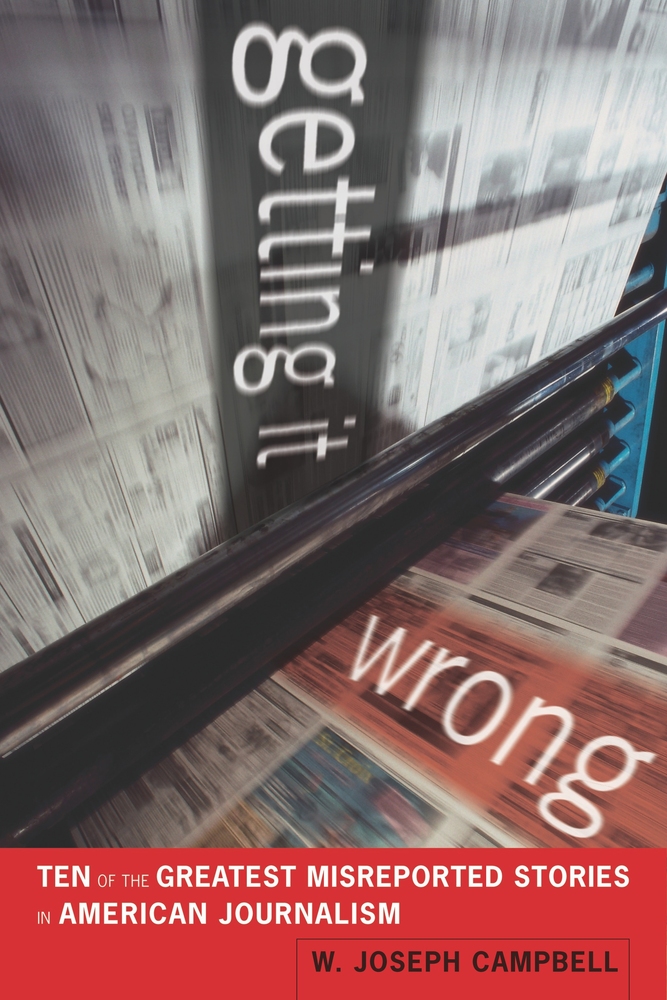
In this, the last of three installments drawn from an interview with Newsbusters about Getting It Wrong, the discussion turns to whether new media are effective in thwarting the spread of media-driven myths.

I express doubts about that prospect.

The Newsbusters interview was conducted by Lachlan Markay, who described Getting It Wrong as “exhaustively researched and painstakingly even-handed.” The interview transcript is accessible here.

NEWSBUSTERS: Looking forward, do new media present an opportunity to debunk these myths, before they get started?

CAMPBELL: You would think that it would, and I think there has been some evidence that that’s the case, but then there are other myths that just seem to defy debunking newer myths.

Jack Shafer at Slate.com has done some interesting work in looking at the so-called … “pharm parties” in which young people would raid their medicine cabinets of their parents and just take whatever medication they could find, bring them to a party, and then dump them in a communal bowl, and sort of play Russian roulette with these drugs–by the handful take them, and see what kind of effect that they have.

And it seems to be an urban legend that’s just taken hold, and it’s appeared in newspapers, periodically, around the country–San Francisco to DC–and there seems to be no evidence to support this other than the notion that police have heard that this kind of stuff goes on. And Shafer’s written a number of columns at Slate that insist that no one has ever seen this happen, no one has ever attended a pharm party, there’s never been any kind of first person documentation.

And yet, the story is too good not to be true, and it lives on.

So you would think that the Internet would have been more effective by now in knocking down that kind of story. It hasn’t.

NB: So these myths, then, get started because newspapers have disregarded their own–or not just newspapers, but any media has disregarded its own standards of journalism.

CAMPBELL: You could see that in some cases, yeah, I suppose that’s true. [But] I don’t think they’re going at this whole hog and saying, we’re just going to forget about our standards and go at this story just because it sounds so good.

NB: Or, put differently, if those standards were followed to a T, some of these myths might never have taken shape.

CAMPBELL: Yeah, that’s probably true.

NB: A lot of these myths are ingrained in our culture. They’re part of American history, included in textbooks. The Woodward and Bernstein example comes to mind. You have movies, for instance, All the President’sMen , or Good Night, and Good Luck with Edward R. Murrow–does pop culture, or culture in general, play a larger part in perpetuating these myths? Is this something that journalists create on their own, or is it out of their hands and American culture sees these magnificent stories, and sort of adopts them as their own?

CAMPBELL: I think the dynamic that leads to the solidification of media myths is a very interesting one. It’s kind of complex, but I think that some of the points that you’ve mentioned are very central to that process of solidifying a myth–sort of the national consciousness. Cinema does a very good job of doing that.

Cinematic treatments help solidify in the minds of people the supposed reality of some of these exchanges, of some of these encounters, of some of these moments.

…. the cinematic treatment of Woodward and Bernstein in All the President’s Men I think really helped solidify the notion that those two guys were central to bringing down Richard Nixon. In fact, the movie, as clever and well-done as it is, leads to no other interpretation but that. It had to be those guys. …

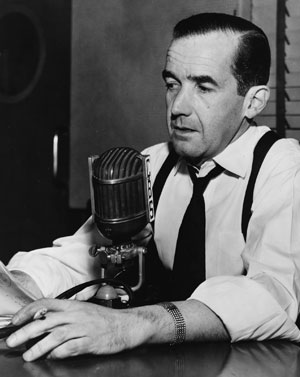
As a nation we do tend to remember things cinematically. I’m not the first one to say that. Others have looked at it more closely than I have and have made that determination. It’s a fair statement. Good Night, and Good Luck introduced a whole new generation of Americans to the notion that Edward R. Murrow was the one who did in Joe McCarthy, with his 30-minute television program.

NB: Do you have students who come in and say, “I saw Good Night and Good Luck and it inspired me to pursue a career in journalism”?

CAMPBELL: You know, I haven’t heard it said quite that way. But they do think that that movie is well done.

NB: The romanticism of journalism appeals to the students.

CAMPBELL: Exactly. And more students have seen All the President’s Men than have read the book, by far. … But cinema really is a factor that propels and solidifies these myths.

End of part three
Media myths send ‘misleading’ message of media power

In Cronkite Moment, Debunking, Hurricane Katrina, Media myths, Murrow-McCarthy myth, Newspapers, Spanish-American War, Washington Post, Watergate myth on November 13, 2010 at 9:42 am

In this, the second of three installments drawn from Newsbusters‘ lengthy interview about Getting It Wrong, I discuss why it’s vital to debunk media-driven myths, those dubious tales about the news media that masquerade as factual.

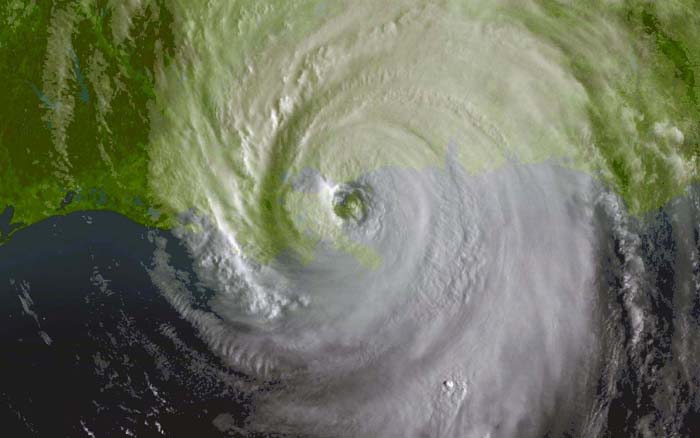
This installment also includes a discussion about the flawed and over-the-top news coverage of Hurricane Katrina‘s aftermath in 2005.

The Newsbusters interview was conducted by Lachlan Markay, who described Getting It Wrong as “exhaustively researched and painstakingly even-handed.”

The third and final excerpt from the interview will be posted tomorrow at Media Myth Alert . The interview transcript is accessible here.

NEWSBUSTERS: So why, personally, do you feel that–you obviously feel it’s very important that these myths be exposed as myths. What’s the damage that these myths do if they carry on unquestioned?

CAMPBELL: I think one of the drawbacks [of media-driven myths] is that they … suggest power that the news media typically do not have. Media power in my view tends to be episodic, tends to be situational, nuanced, and it’s typically trumped by other forces and other factors. Government power, police power tend to overwhelm media power on an average basis in most circumstances.

But these stories–about [Walter] Cronkite, about [Edward] Murrow, about Watergate, about [William Randolph] Hearst, and some of the others in the book–typically send a message that the media have great power, to do good or to do harm.

They can start a war, they can end a war, they can alter the political landscape, they can even bring down a president–they’re that powerful. That’s absolutely a misleading message. It’s not how media power is applied or exerted, and that’s an important reason to debunk these myths.

There’s also some inherent importance too in trying to set the record straight to the extent you can. And in that regard, the book is aligned with the fundamental objective of journalism as practiced in this country, of getting it right, getting the story correct. …

NB: And some of the–the Katrina example comes to mind–some of the myths actually have to do with the media–not just a flawed or misleading understanding of events, but a completely fabricated, and made up and very destructive events sometimes. And I say Katrina because there were all these reports of gunfire in New Orleans, of dead bodies being piled up in the Superdome, none of which was true.

CAMPBELL: That’s right. …  Not only that, but the collective sense that those kinds of media reports gave about New Orleans–the place had just collapsed, the city and its people had collapsed into this sort of apocalyptic, Mad Max-like, nightmarish scene–and it served to besmirch the city and its citizens at the time of their direst need.

And that, I think, is just absolutely reprehensible. And that’s the message that we were getting [from the coverage of Katrina’s aftermath in early September 2005]. …

To the credit of the news media, they did go back –many of them, many of these news organizations–and took a look at how they got it wrong. But that tended to be a one-off kind of thing, and placed … inside the papers.

Broadcast media didn’t do much of this at all. … So even to this day, five years on, I still don’t believe the news media have taken full measure of the mistakes they made in the coverage of Hurricane Katrina.

The tendency is still to blame government–local, state, and certainly federal government–for an inept response. But the story was deeper than that, and it was more complex than that, and that’s the part that the news media got wrong.

NB: And of course one of the consequences of that misreporting was that, as you mention, the federal government especially bore a lot of the blame for what was happening there. And then you also have Murrow taking down perhaps the most notorious cold warrior in our country’s history, you have Cronkite as the standard-bearer for the left’s main cause during the 1960s, you have Woodward and Bernstein taking down a Republican president. Are there political factors at work here, do you think?

CAMPBELL: I think that some of the more enduring myths are those that have appeal across the political spectrum.

The Cronkite moment is one of them–it appeals because this is, for folks on the right, this is a real clear-cut example of how “the news media screwed us in Vietnam, and how they prevented us from winning the war there.” And on the left it’s an example of telling truth to power, and how Walter Cronkite was able to pierce … the nonsense, and make it clear to the Johnson administration that the policy in Vietnam was bankrupt.

Something for everyone.

End of part two

‘Exhaustively researched and painstakingly even-handed’

In Cronkite Moment, Debunking, Media myths, Murrow-McCarthy myth, Newspapers, Spanish-American War, Washington Post, Watergate myth on November 12, 2010 at 10:15 pm

Getting It Wrong is exhaustively researched and painstakingly even-handed,” writes Lachlan Markay in introducing his detailed interview with me about my latest book.

He writes that W. Joseph Campbell “makes sure to stress at the outset that it is not a ‘media-bashing book.’ Rather, the volume stays true to journalism’s real mission: not myth-making, but fact-finding. Campbell seeks to set the record straight where often journalists themselves have obscured it.”

Excerpts of the interview–posted at the lively Newsbusters online site–follow. The transcript of the interview, which runs to 4,200 words, is accessible here. Other excerpts  will be posted at Media Myth Alert tomorrow and Sunday .

NEWSBUSTERS: We as a society, and as a culture, seem to have this iconic image, collective image, of a journalist in the good old days of journalism, of course, as sort of a shadowy figure with a little press label in his hat hammering away at his typewriter all night to make deadline. Is that a media driven myth, and do we have a sort of false nostalgia about the bygone days of journalism, when reporters were hardworking and honest and could really make a difference and affect positive change?

CAMPBELL: I mean, we can look back in those days, and I think very we’re very susceptible in journalism in general, to what I call in the book the Golden Age fallacy. It’s not my construction, others have identified it, but I think its very applicable to journalism to look back and say, “oh, yes, there really was a time when journalism mattered, when [Walter] Cronkite could shift the direction of a war, or [Bob] Woodward and [Carl] Bernstein, two young reporters could bring down a president.”

That’s emblematic of the Golden Age fallacy. …

NB: So how are these media-driven myths created?

CAMPBELL: They come from lots of different sources. Sometimes these are stores that are just too good to be checked out. Like, William Randolph Hearst [and his famous vow], “You furnish the pictures, and I’ll furnish the war.” That sums up not only Hearst and his malignant, toxic personality pretty well, but it also suggests the news media can, at the worst … even bring about a war that the country otherwise wouldn’t have fought.

NB: You open the book with the example of the New York Sun, and mere months before it closes shop, it offers Cronkite and [Edward] Murrow as the paragons of the power of journalism and journalistic integrity and honesty and speaking truth to power. Those are both myths?

CAMPBELL: Yeah, both of ’em. And Murrow–although he’s held up as the white knight of broadcast journalism–was very much a compromised character. Even his own biographers have identified what we would see today as disqualifying ethical lapses in his background. He claimed degrees that he did not earn, he coached Adlai Stevenson on the finer techniques of using television during the 1956 presidential campaign. Privately, he did this, but if that was known, and a well-known broadcast journalist was doing that today–well, I don’t know, but I suspect there would be considerable controversy about that kind of conduct.

Murrow, no white knight

No, Murrow was no white knight. …

NB: Going back to the New York Sun example, these are very self-serving myths sometimes, and today, when traditional journalism, especially print journalism, seems to be on the decline in terms of its influence, are these myths being promoted more than they have traditionally in an attempt by the old guard to convince people of–to make people nostalgic for the time when these honest journalists with integrity spoke truth to power?

CAMPBELL: There is no doubt part of that. That’s one of the factors.

I think that these stories, though, many of them–the Murrow story, the Cronkite story, Watergate, Hearst–are just too good to resist … and they [have] become ingrained as part of the accepted conventional wisdom.

The Watergate story–the dominant narrative of Watergate–really is that Woodward and Bernstein brought down a corrupt president. Now there’s no doubt in my mind that Nixon was corrupt and deserved to be removed from office, but the forces that brought him down were not Woodward and Bernstein. In fact, Woodward and Bernstein and the Washington Post were really marginal to that [outcome]. But it’s become part of the story, part of the dominant narrative, it’s an intriguing story and it lives on that way.

It’s also a very simplistic explanation for a complex historical event, and that’s another reason these myths take hold and live on. Watergate was not–the outcome of Watergate was not due to the Washington Post so much as it was to the combined, collective, if not always coordinated efforts of subpoena-wielding authorities. The FBI, federal prosecutors, special prosecutors, both houses of Congress, ultimately the Supreme Court, which got Nixon to surrender the tapes the prosecutors had wanted, and those tapes quite clearly showed his active role in covering up the seminal crimes of Watergate.

So it took that kind of collective effort over a sustained period of time by people who could compel testimony and could compel the disclosure of evidence in ways that reporters can’t.

End of part one

Sales of ‘Getting It Wrong’ brisk at NPC’s Book Fair

In Debunking, Media myths, Murrow-McCarthy myth, Year studies on November 10, 2010 at 5:43 pm

The National  Press Club’s Book Fair last night was quite a success.

Getting It Wrong was among some 90 titles chosen for the book fair, and sales of the book were gratifyingly brisk. I didn’t keep count, but easily two dozen copies were sold during the three-hour event. Or more.

A volunteer at the checkout counter stopped by as the program was winding down to ask about the book. She said she had seen a lot of people buying it. And she decided to buy a copy, too.

The venue was the Press Club’s ballroom and it was jammed with book-buyers. I thought the crowd was larger than that of four years ago, when I was chosen to attend the book fair to sell copies of The Year The Defined American Journalism: 1897 and the Clash of Paradigms.

I shared a display table this year with Gayle Haggard, the charming author of Why I Stayed, who traveled from Colorado for the book fair. We were across an aisle from Captain Chesley (“Sully”) Sullenberger, who safely landed a stricken USAirways jet on the Hudson River early last year.

Sullenberger was quite the draw, and he left about an hour early, after selling the available copies of his book,  Highest Duty.

I received only one, mild challenge about Getting It Wrong. A small lady who must be in her 70s, thumbed through the book and announced that she disagreed with my take on Edward R. Murrow’s famous television report about Senator Joseph R. McCarthy and his witch-hunting ways.

Murrow “broke the bubble” on the McCarthy scourge, she told me as she returned the book to the stack on the table. I was tempted to point out that Murrow was very late in confronting McCarthy, doing so only after a number of other journalists had taken on the senator. I was tempted as well to note that Murrow and his producer, Fred Friendly, both dismissed the view that Murrow’s 1954 program was decisive in McCarthy’s fall.

But I let it pass.

Another visitor to the table asked whether Getting It Wrong has much attracted from criticism from journalists who find it dismaying that the book busts some of American journalism’s best-known stories.

Some people have resisted giving up on these stories, I replied. But more often the reaction has been one of some surprise that these tales were myths. Others have said they had rather suspected these tales were too good to be true, I added.

During the pre-event reception for authors and guests, I spoke for a while with James Swanson, author of Manhunt: The 12 Day Chase for Lincoln’s Killer and more recently of Bloody Crimes: The Chase for Jefferson Davis and the Death Pageant for Lincoln’s Corpse. Swanson said his next project is a fiction-thriller series. I also chatted with Maurine Beasley, a journalism historian at the University of Maryland who is one of my favorite scholars. Her latest book is Eleanor Roosevelt: Transformative First Lady.

I’m in Florence, Alabama, today, to deliver the first Parker-Qualls Lecture in Communications at the University of North Alabama. It’s a program that I’m very honored to inaugurate.

I also will speak with several classes at UNA on media theory, journalism ethics, and political communication.

WJC

Recent and related:

Suspicious Murrow quote reemerges

In Cinematic treatments, Debunking, Media myths, Murrow-McCarthy myth, Newspapers on October 25, 2010 at 10:06 am

A comment of uncertain authenticity but attributed to legendary broadcast journalist Edward R. Murrow resurfaced the other day, in an item posted at the online site of the Salem-News a news service in Oregon.

Witch-hunting senator

The item included this passage:

“As Edward R. Murrow noted, ‘We must not confuse dissent with disloyalty. When the loyal opposition dies, I think the soul of America dies with it.'”

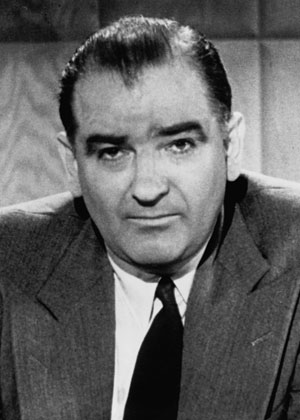
The first portion of the quote–“We must not confuse dissent with disloyalty”–is genuine. Murrow uttered the line during the closing portion of his myth-enveloped television report in March 1954 about Senator Joseph R. McCarthy (above) and his witch-hunting ways.

The second part– “When the loyal opposition dies, I think the soul of America dies with it”–is highly suspect.

Murrow didn’t say it during his program about McCarthy, the mythical elements of which I address in my new book, Getting It Wrong.

Here’s what Murrow said on that occasion, immediately after his remark about not confusing “dissent with disloyalty”:

“We must remember always that accusation is not proof and that conviction depends upon evidence and due process of law.”

That’s not  even remotely suggestive of “When the loyal opposition dies, I think the soul of America dies with it.”

So it’s pretty certain that “We must not confuse dissent with disloyalty” was not followed by “When the loyal opposition dies, I think the soul of America dies with it.”

This dubious Murrow quotation has been the topic of a previous discussion at Media Myth Alert. I noted then that if the quotation were genuine–if Murrow really said it–then its derivation shouldn’t be too difficult to determine.

But its derivation remains unknown.

I’ve searched the “historical newspapers” database for the suspect quote. The database includes the New York Times, Washington Post, Chicago Tribune, and Los Angeles Times; no articles quoting “the loyal opposition” passage were returned.

As I’ve noted previously, a search of the LexisNexis database produced a few returns–and none dated before 2001. And none stated when and where Murrow supposedly made the comment.

Among the LexisNexis returns was a book review published in 2003 in the Washington Post. The review invoked “the loyal opposition” passage and said Murrow made the remark “half a century ago, at the height of the McCarthy era.” But exactly when and where was left unsaid.

I couldn’t find “the loyal opposition” passage in A.M. Sperber’s hefty biography of Murrow; nor could I locate it in Bob Edwards’ more recent and much thinner treatment.

The 2005 movie Good Night and Good Luck, which revisited the Murrow-McCarthy encounter, didn’t invoke the quote, either. The line is not to be found in the film’s script.

So why bother running this down? What’s the point?

Several reasons offer themselves.

As I point out in Getting It Wrong, there is intrinsic value in correcting the historical record, in insisting on “a demarcation between fact and fiction.” As is the case with many media-driven myths, the suspect quotation seems too neat, too tidy to be authentic.

Falsely attributing quotations is unsavory, off-putting, and distorts the historical record. The Murrow-McCarthy encounter is myth-choked as it is, in that it’s widely believed that the Murrow show in 1954 stopped the senator’s witch-hunt in its tracks.

What’s more, the dubious Murrow quote seems to possess particular relevance and resonance today. But to invoke without knowing its derivation is an abuse of history.

WJC

Recent and related:

If not for Edward R. Murrow

In Debunking, Media myths, Murrow-McCarthy myth, Newspapers on October 22, 2010 at 10:11 am

One of the especially savory myths in American journalism centers around Edward R. Murrow, the CBS newsman, and his takedown of Senator Joseph R. McCarthy.

As I discuss in Getting It Wrong, my new book that debunks 10 prominent media-driven myths, legend has it that Murrow “single-handedly confronted and took down the most feared and loathsome American political figure of the Cold War, Joseph R. McCarthy, the Red-baiting Republican senator from Wisconsin.

Murrow in 1954

“Murrow, it is often said, stood up to McCarthy when no one else would, or dared,” and did so March 9, 1954, on the half-hour CBS television program, See It Now.

The Murrow-McCarthy myth was repeated the other day in a commentary posted the other day at the online site of the News-Press of Falls Church, Virginia.

The commentary deceased that “the thuggery of Sen. Joe McCarthy in the early 1950s would not have ceased but for a determined effort by Murrow and CBS news to reveal the extent of the excess.”

Not only is the claim undocumented; it just isn’t true.

As I write in Getting It Wrong, “the evidence is overwhelming that Murrow’s famous program on McCarthy had no such decisive effect” as putting an abrupt end to McCarthy’s communists-in-government witch-hunt. Murrow, in fact, “was very late in confronting McCarthy,” I write, doing so “after other journalists had challenged the senator and his tactics for months, even years.”

What’s more, McCarthy’s favorability ratings had begun to slide months before the Murrow program.

I note in Getting It Wrong that “Gallup Poll data show that McCarthy’s appeal crested in December 1953, when 53 percent of Americans said they had a favorable view of him. McCarthy’s favorable rating had slipped to 40 percent by early January 1954, and to 39 percent in February 1954, when an almost identical number of Americans viewed him unfavorably.”

Interestingly, the Murrow-McCarthy media myth took hold despite the protestations of its central figures.

As I point out in Getting It Wrong:

“In the days and weeks after the See It Now program, Murrow said he recognized his accomplishments were modest, that at best he had reinforced what others had long said about McCarthy. Jay Nelson Tuck, the television critic for the New York Post, wrote that Murrow felt ‘almost a little shame faced at being saluted for his courage in the McCarthy matter. He said he had said nothing that … anyone might not have said without a raised eyebrow only a few years ago.'”

Fred Friendly, Murrow’s collaborator and co-producer, also rejected the notion that the See It Now program on McCarthy was pivotal in the senator’s decline. Friendly wrote in his memoir:

“To say that the Murrow broadcast of March 9, 1954, was the decisive blow against Senator McCarthy’s power is as inaccurate as it is to say that Joseph R. McCarthy … single-handedly gave birth to McCarthyism.”

McCarthy had no more persistent or implacable media foe than Drew Pearson, the muckraking, Washington-based syndicated columnist who wrote critically about the senator as early as February 1950–more than four years before Murrow’s program.

Pearson’s columns criticizing McCarthy began appearing soon after the senator launched his witch-hunt, in which he claimed that communists had infiltrated the U.S. State Department, the military, and the Democratic party.

So why was Murrow so late in confronting McCarthy? Why did Murrow wait until Pearson and other journalists had challenged McCarthy? Why did Murrow move only after McCarthy’s ratings had hit the skids?

Those are questions I pose in Getting It Wrong.

Among the explanations I offer is “the well-recognized tendency of television to follow the lead of print media.”

By the end of 1954, McCarthy had been censured by the Senate and his career had fallen into terminal decline.

WJC

Recent and related:

How late was Ed Murrow in taking on Joe McCarthy?

In Cinematic treatments, Media myths, Murrow-McCarthy myth on September 28, 2010 at 4:25 pm

Murrow in 1954

Edward R. Murrow, the “white knight” of American broadcasting, is often credited with having ended the communists-in-government witch-hunt of Senator Joseph McCarthy at the height of the Cold War.

Murrow supposedly demolished the McCarthy scourge in a 30-minute television program, See It Now, that aired on CBS on March 9, 1954. The show made notably effective use of footage of the senator’s words, actions, and sometimes-bizarre conduct.

By doing that show, it is said, Murrow stood up to McCarthy when no one else would–or dared.

That, however, is a media-driven myth–a dubious tale about the news media that masquerades as factual.

As I write in my new myth-busting book, Getting It Wrong, Murrow was very late in confronting McCarthy, doing so long after other journalists–among them muckraking columnist Drew Pearson–had become persistent and searching critics of the senator, his record, and his tactics.

Pearson wrote critically about McCarthy as early as February 1950–just days after the senator first raised claims about communists having infiltrated the U.S. State Department.

Pearson also raised searching questions years before Murrow’s program about McCarthy’s tax troubles, his accepting suspicious campaign contributions, and his taking a $10,000 payment from a U.S. government contractor for a 7,000 word article.

McCarthy, I write, “had no more relentless, implacable, or scathing foe in the news media than Drew Pearson.”

And there were other journalists, too, who challenged McCarthy and his ways long before Murrow’s See It Now program in 1954.

So undeniably, Murrow’s on-air takedown of McCarthy was belated.

But it wasn’t quite as late as historian Alan Brinkley suggested in a post yesterday at the Speakeasy blog, sponsored by the Wall Street Journal.

Brinkley wrote:

“Anyone who saw the George Clooney film ‘Good Night, and Good Luck,’ about Edward R. Murrow’s decision to attack Joe McCarthy in 1954, will remember the pervasive fear, indeed terror, of employees of CBS who have hidden their leftist political views. (Even Murrow waited until after the Army-McCarthy hearings began before he took on McCarthy.)”

That last bit isn’t correct.

The Army-McCarthy hearings were convened in April 1954, six or so weeks after Murrow’s program, and ran until June 1954. The Museum of Broadcast Communications in Chicago has called the hearings “the first nationally televised congressional inquiry.” And they led to McCarthy’s censure by the Senate in late 1954.

“What made the real difference” in toppling McCarthy, Fred Friendly, Murrow’s producer, later wrote, “wasn’t the Murrow program but the fact that ABC decided to run the Army-McCarthy hearings. People saw the evil right there on the tube. ABC helped put the mirror up to Joe McCarthy.”

The Clooney film that Brinkley mentioned, Good Night, and Good Luck, was an imaginative and clever cinematic treatment of Murrow’s See It Now program about McCarthy. The film came out in 2005 and included archival footage from Murrow’s show.

“While the movie never explicitly said as much,” I write in Getting It Wrong, “it left an inescapable impression that Murrow courageously and single-handedly stopped McCarthy. Many reviewers saw it that way, too.”

For example, the film critic for the Chicago Sun-Times, Roger Ebert, said Good Night, and Good Luck was about “a group of professional newsmen who with surgical precision remove a cancer from the body politic. They believe in the fundamental American freedoms, and in Sen. Joseph McCarthy they see a man who would destroy those freedoms in the name of defending them. … The instrument of his destruction is Edward R. Murrow, a television journalist above reproach.”

But Murrow wasn’t such a “white knight.”

As I note in Getting It Wrong, Murrow claimed a master’s degree he never earned, added five years to his age in his employment application at CBS, and in 1956 privately counseled Adlai Stevenson, the Democratic presidential candidate, on techniques of speaking before a television camera.

Such lapses today, I write in Getting It Wrong, would “almost surely disqualify Murrow, or any journalist, from prominent positions in America’s mainstream news media.”

WJC

Recent and related:

Edward R. Murrow ‘had guts’ in taking on Joe McCarthy? Not really

In Debunking, Media myths, Murrow-McCarthy myth on September 22, 2010 at 4:12 pm

How Edward R. Murrow single-handedly ended the witch-hunting ways of Senator Joseph McCarthy, the most feared and loathsome political figure of the Cold War era, is the stuff of legend.

It’s one of the best-known, most cherished stories about American journalism, one that lives on as an example of media power at its finest and most effective–as a lesson about what courageous journalists can accomplish, even in the face of imposing odds.

Murrow in 1954

It is also one of American journalism’s most tenacious myths.

As I write in my new book, Getting It Wrong, Murrow’s televised report on McCarthy on March 9, 1954–the 30-minute program that lies at the heart of the myth–did not have the outcome so often claimed for it.

Notably, I write, “McCarthy’s favorable ratings had begun to slide well before Murrow took to the air” with his report on McCarthy.

Moreover, Murrow’s program on McCarthy was aired months and even years after exposes of the senator and his tactics had been reported by other American journalists.

As Jay Nelson Turk, television critic for the New York Post wrote after Murrow’s program on McCarthy:

“Murrow said nothing, and his cameras showed nothing, that this and some other newspapers have not been saying—and saying more strongly—for three or four years.”

Still, the notion that Murrow stood up to McCarthy when no one else would, or dared, lives on. It was invoked most recently in a commentary published yesterday at the New Jersey Today online site.

It asserted that before Murrow’s report on McCarthy, “Little substantive commentary was coming from the news media. No one with any power was willing to take on the popular McCarthy ….

“However, on March 9, 1954, Edward R. Murrow, the most-respected newsman on television at the time, broke the ice. He attacked McCarthy on his weekly show, See It Now. Murrow interspersed his own comments and clarifications into a damaging series of film clips from McCarthy’s speeches.”

The commentary added:

“Murrow had guts—something lacking in most of today’s television commentators who are more adept at reading teleprompters than tackling issues—and he spoke truth to power.”

Those paragraphs contain no small amount of error and misinterpretation.

For one, McCarthy was never especially “popular” among Americans.

As I note in Getting It Wrong, “Gallup Poll data show that McCarthy’s appeal crested in December 1953, when 53 percent of Americans said they had a favorable view of him.

“McCarthy’s favorable rating had slipped to 40 percent by early January 1954, and to 39 percent in February 1954, when an almost identical number of Americans viewed him unfavorably.”

The sharp drop, of course, preceded Murrow’s program.

More significant is the commentary’s erroneous claim that the news media had offered little substantive commentary about McCarthy and his communists-in-government witch-hunt.

As I note in Getting It Wrong:

Pearson

“Long before the See It Now program, several prominent journalists—including the Washington-based syndicated columnist Drew Pearson—had become persistent and searching critics of McCarthy, his record, and his tactics.”

Pearson wrote critically about McCarthy beginning in February 1950–just days after the senator first claimed that communists had infiltrated the U.S. State Department.

Pearson noted that he had covered the State Department for about twenty years, during which time he had been “the career boys’ severest critic. However, knowing something about State Department personnel, it is my opinion that Senator McCarthy is way off base.”

In subsequent columns, Pearson raised questions about McCarthy’s tax troubles, his accepting suspicious campaign contributions, and his taking a $10,000 payment from a U.S. government contractor for a 7,000 word article.

“Pearson’s inquiries embarrassed and angered McCarthy, who began entertaining thoughts of doing him harm,” I write in Getting It Wrong. And in December 1950, McCarthy physically assaulted Pearson in the cloakroom of the fashionable Sulgrave Club on DuPont Circle in Washington, D.C. (Accounts vary: McCarthy said he slapped Pearson, hard, with an open hand. Pearson said the senator kneed him, twice, in the groin. Then-Senator Richard M. Nixon pulled McCarthy away from Pearson.)

The encounter at the Sulgrave anticipated McCarthy’s vicious verbal attack on Pearson, declaring from the Senate floor that the columnist was the “diabolically” clever “voice of international communism” and the “sugar-coated voice of Russia.”

Pearson surely wasn’t the most enviable figure in American journalism. Media critic Jack Shafer in a column at Slate the other day called Pearson “one of the skuzziest journalists to ever write a story.”

Perhaps.

But the historical record is clear that if anyone in the news media “broke the ice” about McCarthy, it was Pearson. In 1950.

He posed critical and persistent challenges to McCarthy’s red-baiting ways when doing so really did take guts.

WJC

Related:

‘Getting It Wrong’ goes on WTIC talk radio

In Anniversaries, Debunking, Hurricane Katrina, Media myths, Media myths and radio, Washington Post, Watergate myth on September 12, 2010 at 11:38 am

I was interviewed about Getting It Wrong the other day by Ray Dunaway on WTIC AM radio in Hartford, where years ago I was a reporter for the Hartford Courant newspaper.

The interview was live, brisk, and wide-ranging, covering a number of topics discussed in Getting It Wrong, my new book which debunks 10 prominent media-driven myths–those dubious and improbable stories about the media that masquerade as factual.

Topics that Dunaway and I discussed included the media myths associated with the Washington Post and the Watergate scandal, with Edward R. Murrow and his 1954 program on Senator Joseph McCarthy, and with coverage of Hurricane Katrina’s aftermath in 2005.

Dunaway, a veteran talk-shown host in Connecticut (with whom I had never previously spoken), said in introducing the segment:

“There are a lot of things we believe growing up and some of these are very near and dear to my heart. One would be–and I think this is absolutely true–when I was in graduate school, everybody, especially on the print side, everybody wanted to be the next Carl Bernstein and Bob Woodward [of Watergate fame] and, you know, bring down a president. That was kind of their dream.”

He added:

“Anyhow, there’s a great book out now. And what you believe ain’t necessarily so. W. Joseph Campbell has written a book … called Getting It Wrong

“First of all,” Dunaway said in launching into the interview, “I must tell you how much I enjoyed the book. It was a trip down memory lane, but maybe in a different direction than I originally thought.”

He asked whether I wrote the book to “set the record straight a bit.”

“That’s exactly right,” I replied. “The book is not really a media-bashing book but really aligns itself with a central objective of news-gathering, which is to try to get it right. And the book does seek to set the record straight by offering reappraisals of some of the best-known stories in American journalism.”

I added:

“I think these stories live on because they do offer simplistic explanations and simplistic answers to very complex historical events. So it’s a way of distilling what went on in the past [in] a very digestible and understandable way.

“In the process of simplification, though, there are exaggerations made–and myths are born. And I think that’s a recurring theme in this book. … These stories are appealing stories. They’re delicious stories. They’re almost too good to be checked out, and I think that’s another reason why these have lived on.”

We spent some time discussing the heroic-journalist interpretation of Watergate–that the investigative reporting of Woodward and Bernstein in the Washington Post brought about President Richard Nixon’s resignation in 1974.

“Woodward and Bernstein–the Watergate story–is another example of the David-and-Goliath encounter,” another thread that runs through Getting It Wrong, I said, adding that Nixon’s fall in the Watergate scandal “was the consequence of his own criminal conduct and that was exposed through the convergence of many forces and factors.

“And the Washington Post, although it did some good reporting in the aftermath of the Watergate breakin in 1972–it wasn’t the decisive factor.

“Its reporting did not bring down Richard Nixon.”

Dunaway, who described Getting It Wrong as “well worth reading,” turned the interview to Hurricane Katrina and what I call “the myth of superlative reporting.”

The coverage of Katrina’s aftermath was highly exaggerated and represented “no high heroic moment for American journalism,” I pointed out.

We spoke about exaggerated estimated death tolls in New Orleans in Katrina’s wake–estimates of 10,000 fatalities or more that were offered by public officials including the city’s then-mayor, Ray Nagin.

I noted:

“Nagin’s estimate is another example of why journalists and reporters have an obligation to themselves and to their audiences to question sources closely. ‘How did you find that information, Mr. Mayor? Could we talk to people who came up with that estimate?’ I mean, not being credulous but being searching, and a bit skeptical.

“I think skepticism was absent in the aftermath of Hurricane Katrina, and the apocalyptic horror that the hurricane supposedly unleashed was absolutely untrue.”

Dunaway wrapped up the interview by calling the book “more of a learning experience than a critique.”

That was an interesting characterization with which to close an engaging and thoughtful interview.

WJC

Related:

Unpacking errors in a ‘history lesson in media freedom’

In Debunking, Media myths, Murrow-McCarthy myth on August 29, 2010 at 11:11 am

Confirming anew that prominent myths of American journalism travel far and all too well, a columnist for a South African newspaper recently offered “a brief history lesson in media freedom” that thoroughly mangled the legendary encounter between Edward R. Murrow and Senator Joseph McCarthy.

In offering her “lesson,” the columnist for the online Mail & Guardian wrote:

McCarthy in 1954

“You’ll remember Senator Joseph McCarthy as the one who made America scared of those nasty Communists ….

“He was so scary that the media, although not legally required to do so, practiced extreme self-censorship, and did not criticise McCarthy in an attempt to avoid accusations of trying to bring down the government.

“Thankfully,” she added, “a radio presenter called Edward Murrow, who famously ended his broadcasts with ‘goodnight, and good luck’, came along and said: ‘We must not confuse dissent with disloyalty … We are not descended from men who feared to write, to speak, to associate, and to defend causes that were, for the moment, unpopular.’ At which point everyone realised just how unpopular McCarthy was, and he didn’t last long after that.”

There’s just an astonishing amount of error to unpack in those paragraphs.

Prominent among them is the discussion of Murrow, who was more than just a “radio presenter.” His searing assessment of McCarthy and his communists-in-government witch-hunt was shown on television, on the CBS show See It Now that aired March 9, 1954.

By then, as I write in Getting It Wrong, my new book debunking media-driven myths, McCarthy’s “favorability ratings had been sliding for three months,” from a high of 53 percent in December 1953.

So Americans were turning against McCarthy well before Murrow’s show.

I note in Getting It Wrong, that “it wasn’t as if Americans in early 1954 were hoping for someone to step up and expose McCarthy, or waiting for a white knight like Murrow to tell them about the toxic threat the senator posed. By then, McCarthy and his tactics were well-known and he had become a target of withering ridicule—a sign of diminished capacity to inspire dread.”

I further write:

“Long before the See It Now program, several prominent journalists—including the Washington-based syndicated columnist Drew Pearson—had become persistent and searching critics of McCarthy, his record, and his tactics.”

Hardly did Pearson (not to mention several other American journalists) practice “extreme self-censorship” as McCarthy pressed flimsy claims that communists had infiltrated high into the U.S. government, the military, and the Democratic party.

Pearson in the 1950s was Washington’s most-feared muckraking columnist and he challenged and criticized McCarthy years before Murrow’s program.

In February 1950, just after McCarthy began making extreme charges about communists in government, Pearson ridiculed McCarthy as the “harum-scarum” senator and wrote that his allegations were “way off base.”

Pearson also reported in 1950 about McCarthy’s tax troubles in Wisconsin, the senator’s questionable campaign contributions, and the suspicious payment he accepted from Lustron Corporation, a manufacturer of prefabricated housing that had received millions in federal  government support.

Pearson was unrelenting in his scrutiny of McCarthy, who in typical fashion took to the Senate floor in mid-December 1950 to denounce  the columnist as the “diabolically” clever “voice of international communism.”

A few days before the speech, McCarthy had physically assaulted Pearson in the cloakroom of the exclusive Sulgrave Club on DuPont Circle in Washington.

I write in Getting It Wrong that accounts differed as to what happened at the Sulgrave, noting:

“Pearson said McCarthy pinned his arms to one side and kneed him twice in the groin. McCarthy said he slapped Pearson, hard, with his open hand. A third account, offered by a radio broadcaster friendly to McCarthy, said the senator slugged Pearson, a blow so powerful that it lifted Pearson three feet into the air.”

Richard Nixon, then a U.S. senator, intervened to break up McCarthy’s attack.

So as I note in Getting It Wrong, “the legendary status that came to be associated with the [Murrow] program obscured and diminished the contributions of journalists who took on McCarthy years earlier, at a time when doing so was quite risky.”

And that is the real lesson here.

WJC

Related: