The Wall Street Journal blog “India Real Time” indulged yesterday in the conventional but mistaken narrative of the Watergate scandal, declaring that the Washington Post “played a pivotal role in effectively bringing down then U.S. President Richard Nixon.”
Effectively brought down Nixon, eh?
Not even the Post buys into that misreading of Watergate history.
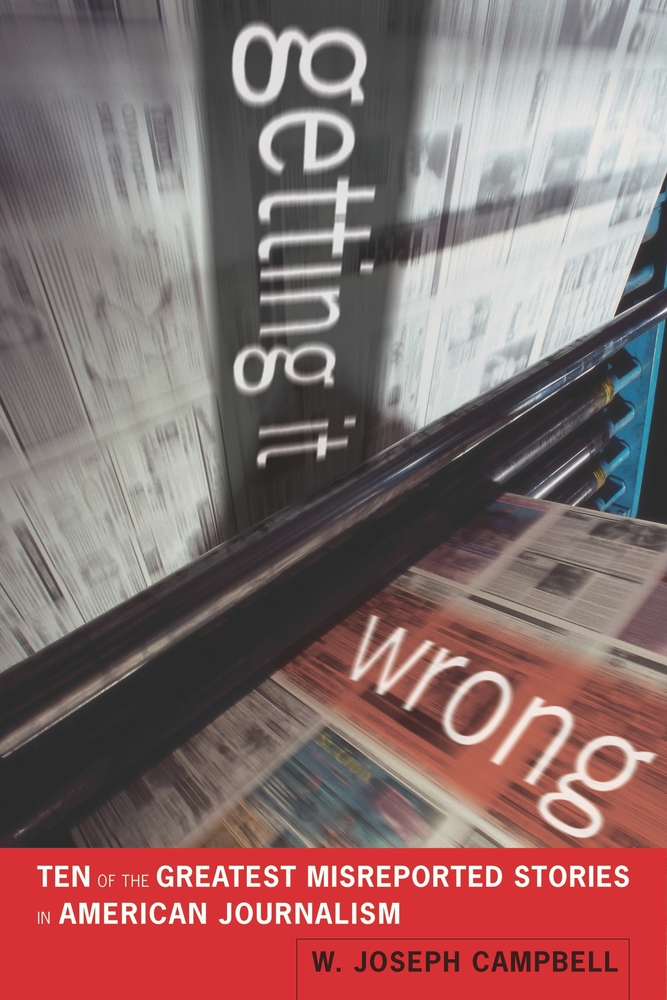
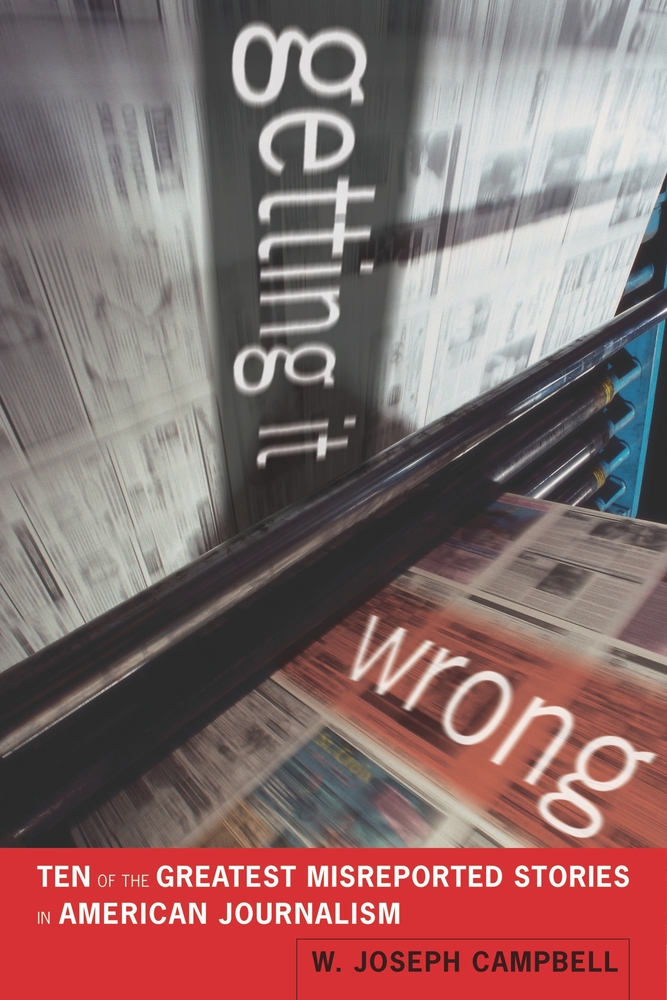 As I note in my latest book, Getting It Wrong, the newspaper’s publisher during and after the Watergate scandal, Katharine Graham, dismissed that interpretation, declaring in 1997:
“Sometimes people accuse us of bringing down a president, which of course we didn’t do. The processes that caused [Nixon’s] resignation were constitutional.”
Similarly, the newspaper’s executive editor during Watergate, Ben Bradlee, has asserted:
“[I]t must be remembered that Nixon got Nixon. The Post didn’t get Nixon.”
Such comments aren’t the manifestation of false modesty. Far from it. Rather, they represent candid observations about the peripheral role the Post played in uncovering the scandal that brought about Nixon’s resignation in 1974.
As I write in Getting It Wrong, rolling up a scandal of the dimension and complexity of Watergate “required the collective if not always the coordinated forces of special prosecutors, federal judges, both houses of Congress, the Supreme Court, as well as the Justice Department and the FBI.
“Even then,” I add, “Nixon likely would have served out his term if not for the audiotape recordings he secretly made of most conversations in the Oval Office of the White House. Only when compelled by the Supreme Court did Nixon surrender those recordings, which captured him plotting the cover-up and authorizing payments of thousands of dollars in hush money.”
Still, the notion that the Post was vital to the outcome of Watergate, that the newspaper “effectively” brought down a president, is the stuff of legend. It’s a powerful media-driven myth that offers a simplistic and misleading interpretation of the country’s greatest political scandal.
 Watergate was among the media myths I discussed last night in a book talk at Kensington Row Bookshop in Kensington, MD.
I noted in my talk: “Obstruction of justice — not the Washington Post — is what cost Nixon his presidency.”
I also spoke about the mythical “Cronkite Moment” of 1968 and the NewYork Times-Bay of Pigs suppression myth of 1961.
The “Cronkite Moment” is shorthand for the dubious notion that the on-air assessment of CBS News anchorman Walter Cronkite forced President Lyndon Johnson to alter policy on Vietnam.
In a special report that aired February 27, 1968, Cronkite declared that the U.S. military effort in Vietnam was “mired in stalemate” and suggested that negotiations would prove to be the way out of the morass.
Johnson supposedly was at the White House that night, watching Cronkite’s show. Upon hearing the “mired in stalemate” assessment, the president supposedly snapped off the television set and said to an aide or aides:
“If I’ve lost Cronkite, I’ve lost Middle America.”
As I said in my talk at the Kensington bookshop, “Acute version variability— the shifting accounts of just what was said — can be a marker of a media-driven myth.”
And so it is with the so-called “Cronkite Moment.”
Johnson did not see the Cronkite program when it aired. The president at the time was in Austin, Texas, offering light-hearted comments at a birthday party for Gov. John Connally, who that day turned 51.
About the time Cronkite was intoning his “mired in stalemate” commentary, Johnson was at the podium at Connally’s birthday party, saying:
“Today, you are 51, John. That is the magic number that every man of politics prays for—a simple majority.”
That line drew laughter from the audience of 25 people at the Kensington bookshop.
The Times-Bay of Pigs suppression myth, I said in my talk, dates almost 50 years — to April 1961, when “a CIA-trained force of Cuban exiles threw themselves on the beaches of southwest Cuba in a futile attempt to turn Fidel Castro from power.”
Supposedly, the Times censored itself about invasion plans several days before the assault took place — at the request of the President John F. Kennedy.
The Times, I said, “did not censor itself. It did not suppress its reporting” about invasion preparations.
“In fact,” I added, “the Times’ accounts of preparations for the invasion were fairly detailed — and prominently displayed on the front page in the days before the Bay of Pigs assault was launched.”
The suppression myth seems to have has its origins in the Cuban Missile Crisis of October 1962 — when the Times, at Kennedy’s request, did hold off publishing a story about the deployment of Soviet nuclear-tipped missiles in Cuba.
On that occasion, I said in my talk, “when the prospect of a nuclear exchange seemed to be in the balance, the Times complied” with the president’s request.
“But no such request,” I added, “was made of the Times in the run-up to the Bay of Pigs invasion of 50 years ago.”
Recent and related
- Recalling the hero of Nasiriyah: It wasn’t Jessica Lynch
- ‘Getting It Wrong’ at Kensington’s Day of the Book
- ‘So to Speak’ about ‘Getting It Wrong’
- Watergate and its hardy myths
- Fact-checking Watergate advice that ‘worked’
- Talking ethics and the ‘golden days’ of Watergate
- The Watergate myth: Why debunking matters
- Knocking down the ‘Cronkite Moment’
- Talking media myths at the alma mater
- SRO for ‘Getting It Wrong’ talk at UMd
- ‘Getting It Wrong’ goes Majic






 Media Myth Alert