W. Joseph Campbell

Posts Tagged ‘Washington Post’

Taking stock: Top mythbusting posts of 2012

In Anniversaries, Cronkite Moment, Debunking, Error, Jessica Lynch, Media myths, New York Times, New Yorker, Photographs, Television, Washington Post on December 30, 2012 at 6:25 am

Media Myth Alert reported in 2012 on the appearance of many prominent media-driven myths and errors. Here are the year’s five top writeups, followed by a roster of other mythbusting posts of note.

Calling out the New York Times on ‘napalm girl’ photo error (posted June 3): The 40th anniversary of the famous “napalm girl” photograph — one of the most memorable images of the Vietnam War — fell in early June.

NapalmGirl photo_AP

Nick Ut/Associated Press

In an obituary a few weeks before, the New York Times had referred to the photograph of terror-stricken Vietnamese children and claimed, erroneously, that it showed “the aftermath of one of the thousands of bombings in the countryside by American planes.”

That passage suggested U.S. forces were responsible for the aerial napalm attack that gave rise to the photograph, taken by Nick Ut of the Associated Press. I pointed this out in an email to the Times, noting that the bombing was a misdirected attack by the South Vietnamese Air Force, as news reports at the time had made clear.

The newspaper’s assistant obituary editor, Peter Keepnews, replied, and offered some baffling logic in doing so:

“You are correct that the bombing in question was conducted by the South Vietnamese Air Force. However, the obituary referred only to ‘American planes,’ and there does not seem to be any doubt that this plane was American –- a Douglas A-1 Skyraider, to be precise.”

As if the aircraft’s manufacturer was at all relevant in the attack.

Independent of my efforts, two former Associated Press journalists also called on the Times to correct its error about “American planes.”

The Times resisted doing so until late August, when it issued a sort-of correction that embraced Keepnews’ tortured reasoning and stated:

“While the planes that carried out that attack were ‘American planes’ in the sense that they were made in the United States, they were flown by the South Vietnamese Air Force, not by American forces.”

It was, I noted, a begrudging and less-than-forthright acknowledgement of error. It hardly was in keeping with the declaration by the newspaper’s then-executive editor, Bill Keller. He asserted in a column in 2011 that “when we get it wrong, we correct ourselves as quickly and forthrightly as possible.”

hagiographic treatment of the “Cronkite Moment” (posted May 31): Few media-driven myths are as tenacious and desperately held as the so-called “Cronkite Moment” of 1968, when CBS News anchorman Walter Cronkite declared on air that the U.S. military was “mired in stalemate” in Vietnam.

Cronkite in Vietnam, 1968

Cronkite in Vietnam, 1968

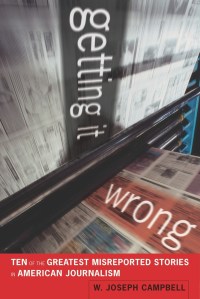
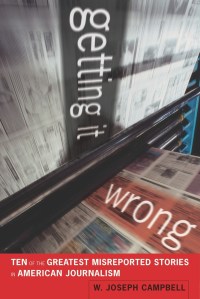
For years, journalists have sought to attach great significance to Cronkite’s assessment, even though it was thoroughly unoriginal and was, as I discuss in my latest book, Getting It Wrong, of little demonstrable impact. Even Cronkite, until late in his life, pooh-poohed its importance.

But all that scarcely deterred Douglas Brinkley from presenting in a hefty biography about Cronkite a decidedly hagiographic — and misleading — interpretation of the “Cronkite Moment.”

Brinkley offered little persuasive evidence in asserting that the “aftershock” of Cronkite’s report about Vietnam, which aired February 27, 1968, “was seismic” and “signaled a major shift in the public’s view of the war.”

In discussing the supposed “seismic” effects of Cronkite’s assessment, Brinkley wrote:

“Even the conservative Wall Street Journal editorial page said, ‘The whole Vietnam effort may be doomed.’”

But the Journal editorial that  said so was published four days before Cronkite’s broadcast. To cite the editorial as evidence of a “seismic” effect of the “Cronkite Moment” was certainly misleading.

What’s more, Cronkite’s characterization of stalemate in Vietnam hardly “signaled a major shift in the public’s view of the war.”  Public opinion polls indicated that the shift had begun several months earlier.

If anything, Cronkite followed rather than led public opinion on Vietnam.

Uneven availability of WaPo’s online content about Jessica Lynch (posted April 27): On April 4, 2003, the Washington Post published a front-page report about an Iraqi lawyer who helped set in motion the rescue from captivity of Jessica Lynch, a wounded, 19-year-old Army private.

That report ran to 1,500 words and is freely available at the Post’s online site.

The day before that article appeared, the Post published an electrifying but far more problematic story about Jessica Lynch — an account that claimed she had fought fiercely against Iraqi attackers and had suffered gunshot and stab wounds before running out of ammunition and being taken prisoner.

Lynch_headline_Post

That article was published on the Post’s front page beneath the headline:

“‘She was fighting to the death.'”

It was a stunning report that proved wrong in all important details: Lynch was neither shot nor stabbed; she did not fire a shot in the attack in Iraq. She was badly injured in the crash of her Humvee in attempting to flee.

But try finding the “fighting to the death” story at the Post’s online site.

Unlike the far less embarrassing report of April 4, 2003, the “fighting to the death” story is not freely available online. Clicking on the story’s URL opens what essentially is an empty link.

Also unavailable online are the scathing reviews of the hero-warrior tale published by the newspaper’s then-ombudsman in April and June 2003.

Such inconsistencies suggest a digital scrubbing of embarrassing content. I asked the newspaper’s incumbent ombudsman, Patrick Pexton, about this matter.

He took several weeks to reply, finally stating in an email in August that he had found “nothing nefarious about this.” He added that the Post since 2003 “has gone through several changes of content management systems,” by which articles are posted online.

He further noted that the “fighting to the death” story about Lynch and related content are available in the Post’s fee-based archive.

So why not make the “fighting to the death” story freely available? Why not remove the fee to access a singularly memorable article about the Iraq War, a mistaken report that made Jessica Lynch something of a celebrity and gave rise to misguided suspicions that the U.S. military concocted the hero-warrior tale and somehow fed it to the Post?

“Restoring the digital version of the article of April 3, 2003, would represent a contribution to the record about the case of Jessica Lynch, which the Post is solely responsible for having placed in the public domain,” I wrote in an email to Pexton in mid-August.

He has not replied.

Kennedy-Nixon debate myth lives on (posted September 30): The run-up to the televised presidential campaign debates in October prompted numerous references to the purported lesson of the first such encounter, between John F. Kennedy and Richard M. Nixon in late September 1960.

That lesson is about the presumptive power of the televised image: Supposedly, television viewers thought Kennedy won the first debate in 1960 while radio listeners felt Nixon got the better of it.

This notion of viewer-listener disagreement has become an enduring media myth, even though it was thoroughly dismantled 25 years ago by scholars David L. Vancil and Sue D. Pendell.

Dismantling, though, hasn’t destroyed the myth. The notion of viewer-listener disagreement remains hardy and irresistible.

For example, in the runup to the debates in October between President Barack Obama and his Republican challenger, Mitt Romney, the founder of USA Today, Al Neuharth, wrote a column that recalled the first Kennedy-Nixon debate.

“Listeners,” Neuharth said, “generally gave Nixon the nod. But TV viewers strongly favored Kennedy.”

And the Chicago Tribune declared that “not everyone thought Kennedy had won the debate. Pollsters found that those who heard the radio broadcast thought Nixon won. … Television viewers experienced a different debate from radio listeners.”

Only one polling organization, Sindlinger & Company, had conducted a survey of any size that included a sub-sample of radio listeners. The Sindlinger survey, taken the day after the first Kennedy-Nixon debate, indicated that radio listeners felt Nixon prevailed, by a margin of 2-to-1.

But Vancil and Pendell, in their article in Central States Speech Journal in 1987, noted that the Sindlinger survey included more than 2,100 respondents, of whom just 282 had listened to the debate on radio.

They noted that “a subordinate group of 282 interviews is below the threshold normally required for a national sample.” Not only that, but only 178 of the 282 respondents “expressed an opinion on the debate winner,” Vancil and Pendell wrote.

Given the shortcomings of the unrepresentative Sindlinger sample, Nixon’s supposedly decisive margin among radio listeners dissolves as meaningless — and renders viewer-listener disagreement a media myth.

George Romney’s “brainwashing” — and Gene McCarthy’s retort (posted September 4): Mitt Romney’s ill-fated run for the presidency prompted reminders of his father’s failed presidential campaign in 1968 — a campaign done in by a memorably clumsy gaffe.

The gaffe, in turn, is said to have inspired one of the most devastating putdowns in American political history. But as my research has found, the context of the supposed putdown is unclear at best.

The gaffe was committed in late August 1967 by George Romney, then governor of Michigan and a presumptive leading candidate for the Republican presidential nomination in 1968.

In an interview with a Detroit television reporter, Romney referred to his visit to South Vietnam in 1965 and said:

“You know, when I came back from Vietnam, I’d just had the greatest brainwashing that anybody could get. … Well, not only by the generals but by the diplomatic corps over there. They do a very thorough job.”

Romney’s claim that he had been duped into supporting America’s war effort in Vietnam suggested muddled thinking, gullibility, and an uncertain command of foreign policy. His abbreviated presidential campaign never recovered from the self-inflicted wound; he ended his  run for the presidency at the end of February 1968.

Sealing the gaffe’s unforgettable quality was the supposed witty putdown by Democratic Senator Eugene McCarthy. Rather than a “brainwashing,” McCarthy supposedly said, a “light rinse” would have sufficed for Romney.

So telling was McCarthy’s “light rinse” quip that it “essentially finished Romney.”

But when, or even whether, McCarthy made the “light rinse” comment is unclear.

A database search of leading U.S. newspapers — including the New York Times, the Washington PostChicago Tribune, Los Angeles Times, and Baltimore Sun — turned up no published reference to the “light rinse” quip in 1967 or 1968. Or for years afterward.

The first reference was in 1983, a column in the Baltimore Sun that did not say when, where, or to whom McCarthy uttered the remark.

It seems improbable that journalists in 1967 or 1968 would have failed to report a retort as delicious as McCarthy’s.

But that’s what An American Melodrama: The Presidential Campaign of 1968, a hefty book published in 1969 would have us believe.

American Melodrama described McCarthy’s remark as off-handed and said the senator’s aides persuaded reporters to hush it up.

While intriguing, American Melodrama doesn’t say when McCarthy made the comment, where, or specifically to whom.

WJC

Many thanks to Instapundit
Glenn Reynolds for linking to this post

Other memorable posts of 2012:

Media myth distorts Chicago Tribune timeline of newspaper history

In Debunking, Error, Media myths, Newspapers, Washington Post, Watergate myth on November 20, 2012 at 9:24 am

The Chicago Tribune the other day published a timeline of American newspaper history over the past 50 years — a chronology tainted by the inclusion of a prominent media myth.

The Tribune declared “the daily paper remains vital to an informed citizenry” in presenting the timeline, which it said demonstrated “how newspapers expose — and occasionally commit — wrongdoing.”

The myth appears in the timeline entry for 1974, which says: “A corrupt U.S. president, Richard Nixon, is brought down by a newspaper, The Washington Post.”

Brought down by a newspaper.

Now, that may be the popular dominant narrative of the Watergate scandal — that the dogged reporting of Washington Post reporters Bob Woodward and Carl Bernstein exposed the corruption that forced Nixon’s resignation.

But it’s a mythical, media-centric interpretation, a trope that not even the Post embraces.

In fact, Woodward once dismissed such characterizations as “horseshit.” And for good reason.

As I discuss in a chapter in my 2010 book, Getting It Wrong, unraveling a scandal of the dimension and complexity of Watergate demanded the collective if not always coordinated efforts of special prosecutors, federal judges, both houses of Congress, the Supreme Court, as well as the Justice Department and the FBI.

Even then, as I note in Getting It Wrong, Nixon likely would have survived the scandal and served out his term had it not been for the audiotape recordings he secretly made of conversations in the Oval Office of the White House.

Only when compelled by the Supreme Court did Nixon surrender the telltale recordings, which captured him approving a plan to divert the FBI’s investigation into Watergate’s seminal crime, the break-in June 17, 1972, at the headquarters of the Democratic National Committee.

It is interesting to note that the Post in its Watergate reporting did not disclose the existence of the Watergate tapes, nor did the newspaper identify or unravel the coverup of Watergate-related crimes.

To assert that the Post brought down Nixon is, as I write in Getting It Wrong, “to abridge and misunderstand the scandal and to indulge in a particularly beguiling media-driven myth.”

What, then, accounts for the tenacity of this hoary media myth? Why does it persist, despite the evidence that can be arrayed against it?

A number of reasons offer themselves.

The Watergate myth, after all, offers a simplistic, easy-to-grasp interpretation of a scandal that was intimidating in its complexity: The web of misconduct that took down Nixon also landed nearly 20 of his top aides, associates, and cabinet officers in jail.

Media myths often spring from simplicity, from the desire for tidy and uncomplicated versions of history. Not only that, but the notion that the Post brought down Nixon fits neatly into a timeline.

A feel-good component buoys the Watergate myth, too: The myth affirms the notion that newspapers, beleaguered though they are, really can make a difference in American politics and in American democracy.

Which, itself, is something of a media myth.

WJC

Recent or related:

Pardon the scoffing: NYT corrections desk is ‘a powerful engine of accountability’?

In Error, New York Times, Photographs on August 26, 2012 at 11:49 am

The swan song column of Arthur Brisbane, the New York Times public editor, salutes the newspaper’s corrections desk as “a powerful engine of accountability” unmatched by similar operations elsewhere.

Brisbane salutes ‘powerful engine of accountability’ (NYTimes photo)

Pardon my scoffing: A “powerful engine of accountability”?

The Times has been often and rightly lampooned for obsessing over trivial lapses while ignoring far more consequential missteps — as suggested by its ignoring repeated recent requests to correct its unambiguous error about the context of the famous “napalm girl” photograph taken in Vietnam in June 1972.

The image, taken by Associated Press photographer Nick Ut, shows a naked child, screaming in pain as she fled an aerial napalm attack near a village in South Vietnam. The photograph won a Pulitzer Prize and remains one of the most memorable images of the Vietnam War.

In an obituary published in May, the Times referred to the image as showing “the aftermath of one of the thousands of bombings in the countryside by American planes: a group of terror-stricken children fleeing the scene, a girl in the middle of the group screaming and naked, her clothes incinerated by burning napalm.”

But as has been repeatedly pointed out to the Times, the plane that dropped the napalm wasn’t American; it was South Vietnamese.

Among those who’ve called attention to the Times’ error are two senior former Associated Press journalists, Richard Pyle, the news agency’s Saigon bureau chief from 1970-73, and Hal Buell, a retired AP vice president.

Both men have petitioned the Times for a correction, stating in a joint letter sent last month by email:

“Our larger concern, beyond amending the immediate record, is that if left standing, this error will be repeated in future by the Times and any publications that might rely on it as a source, in effect causing a significant piece of misinformation to be cast in journalistic stone.”

Pyle and Buell also pointed to the Times’ inclination to police its minor errors, writing:

“Given the Times’ demonstrated commitment to correcting middle initials, transposed letters and other Lilliputian errata, it shouldn’t be asking too much for it to repair a factual error of greater magnitude.”

But the “powerful engine of accountability” hasn’t deigned to address the error, which insinuates that the U.S. military was responsible for the attack that preceded Ut’s “napalm girl” photograph.

By June 1972, however, most U.S. combat units had been removed from South Vietnam. For the American military, the war then was winding down.

Pyle and Buell, jointly and individually, have sought a correction, addressing email to Brisbane’s desk and elsewhere at the Times. I, too, have pointed out the Times’ lapse and in May received this frankly illogical reply from the newspaper’s assistant obituary editor, Peter Keepnews:

“You are correct that the bombing in question was conducted by the South Vietnamese Air Force. However, the obituary referred only to ‘American planes,’ and there does not seem to be any doubt that this plane was American –- a Douglas A-1 Skyraider, to be precise.”

As if the aircraft’s manufacturer were vital to the napalm strike by the South Vietnamese.

The Times’ failure to address the error hints at limited viewpoint diversity in the newsroom, a topic that Brisbane points to in his swan song.

He writes:

“Across the paper’s many departments … so many share a kind of political and cultural progressivism — for lack of a better term — that this worldview virtually bleeds through the fabric of The Times.

“As a result,” Brisbane states, “developments like the Occupy movement and gay marriage seem almost to erupt in The Times, overloved and undermanaged, more like causes than news subjects.”

That description prompted a rebuke from the Times’ executive editor, Jill Abramson. But it’s a telling and doubtless accurate observation that Brisbane ought to have made more often during his two-year tenure as “public editor,” or internal critic.

Brisbane’s comment about “political and cultural progressivism” evokes an observation by the Times’ first ombudsman, Daniel Okrent. In a column in 2004, Okrent addressed what he called “the flammable stuff that ignites the [political] right. These are the social issues: gay rights, gun control, abortion and environmental regulation, among others.

“And if you think The Times plays it down the middle on any of them, you’ve been reading the paper with your eyes closed.”

Brisbane’s comment also is evocative of one of the final columns that Deborah Howell wrote as ombudsman at the Washington Post.

She acknowledged in mid-November 2008 that “some of the conservatives’ complaints about a liberal tilt [in mainstream journalism] are valid. Journalism naturally draws liberals; we like to change the world. I’ll bet that most Post journalists voted for Obama. I did.”

She also wrote:

“There are centrists at The Post as well. But the conservatives I know here feel so outnumbered that they don’t even want to be quoted by name in a memo.”

Howell’s column quoted the director of the Project for Excellence in Journalism, Tom Rosenstiel, as saying:

“The perception of liberal bias is a problem by itself for the news media. It’s not okay to dismiss it. Conservatives who think the press is deliberately trying to help Democrats are wrong. But conservatives are right that journalism has too many liberals and not enough conservatives. It’s inconceivable that that is irrelevant.”

I argue in my latest book, Getting It Wrong, that viewpoint diversity and contrarian thinking should be vigorously promoted in American newsrooms.

But the ideological imbalance of mainstream American journalism never receives much more than passing attention in mainstream American journalism.

It’s little wonder, then, that the believability quotient of leading U.S. news media continues to ebb: There’s a keen sense that they’re not dealing it straight.

According to a recent survey by the Pew Research Center, 14 percent of respondents said they said believed “all or most” of what the Times has to say.

WJC

Recent or related:

10 weeks on: Still no word from WaPo about apparent digital scrubbing of Lynch articles

In Debunking, Jessica Lynch, Media myths, Washington Post on July 6, 2012 at 7:45 am

Where’s the digital version?

The Washington Post ombudsman noted in a column last month that it is “increasingly difficult for iconoclastic, questioning voices to be heard, whether left, right or center.”

The ombudsman, Patrick Pexton, urged the Post and other news organizations “to seek out and cover the unconventional and outsider voices — whether citizen or expert, whether right, center or left. They’re out there; we just have to listen.”

Trouble is, Pexton, himself, doesn’t always much care for “questioning voices” — such as the questions that I’ve raised with him periodically for the past 10 weeks.

Those questions relate to the apparent digital scrubbing of the Post’s botched reporting about Jessica Lynch and her purported heroics early in the Iraq War.

The Post on April 3, 2003, published a stunning report on its front page (see above) about the supposed heroism of Lynch, a 19-year-old Army supply clerk, during an ambush at Nasiriyah in southern Iraq.

The Post’s report said Lynch had fought fiercely and “continued firing at the Iraqis even after she sustained multiple gunshot wounds and watched several other soldiers in her unit die around her” in the fighting, which took place March 23, 2003.

The electrifying report — which the Post headlined “She was fighting to the death” — was picked up by news organizations around the world.

But soon it became apparent that the Post’s hero-warrior story was utterly wrong in all important details. Lynch never fired a shot in Iraq; she was neither shot nor stabbed, as the Post had reported, but badly injured in the crash of a Humvee as it fled the ambush.

The botched hero-warrior story is unavailable at the Post’s online site. Until a few weeks ago, clicking on a link to that report did turn up the story’s headline, byline, and publication detail. But otherwise, it was an empty link: It contained no content.

Now, not even the headline, byline, and publication date are available. The link opens to a page that declares in large headlines: “Page Not Found” and “We’re unable to locate the page you requested.”

So changes recently have been made that expunge any reference to the hero-warrior story.

I pointed this out in an email to Pexton a week ago. He has not replied.

In his most recent correspondence with me, an email sent May 30, Pexton wrote:

“This is a stickier problem than I initially thought. It could be as innocent as the Post has moved masses amount of files three times in the past ten years to different servers. Or it could be deliberate.  …  I have one newsroom employee researching this and an IT person checking on it. When I have an answer, I’ll let you know.”

Pexton turned prickly in that email, making clear he did not appreciate my turning to social media to call attention to this matter.

He expressed objections to the Twitter message I sent on May 25, calling attention to a blog post of the same day that four weeks had passed and the Post had offered no explanation for the apparent scrubbing of the Lynch  content.

“Tweeting about your frustration over the time it is taking is a disincentive for me to push harder on it,” Pexton wrote in his email of May 30. “Most readers are polite and understanding. Why should I put your request ahead of others when you choose to coerce and bully?”

Coerce and bully? C’mon. My inquiries about the Lynch stories are much more akin to the “questioning voices” that Pexton has encouraged the Post to seek out and embrace.

More than five weeks have since passed he sent that prickly email. Pexton has offered no explanation as to why the Lynch content has been excised from the Post’s online site.

“I will get an answer for you if it is obtainable and I will let you know when I do,” he wrote on May 30. “That’s the best I can do. If that’s not to your liking, then I apologize but that is your issue, not mine.”

Woah. It’s not important to him whether the Post has scrubbed digital reminders of an acutely embarrassing story?

The Post, after all, called out Vanity Fair in April for digitally scrubbing a flattering profile of the wife of  Bashar al-Asad, Syria’s dictator. At that time, the Post described Vogue’s removal of the digital version of the profile as “an almost-unheard-of step for a mainstream media organization.”

Interestingly, some Lynch-related content from 2003 remains freely available online — notably this article, at the Post’s link-rich Iraq War archive.

I’ve asked Pexton: Would the Post and its readers not be better served by being consistent about its Lynch-related content?

And I have suggested to him that “my request can be distilled thusly:

“Why is some Lynch-related content from 2003 freely available online (see here), while content more embarrassing to the Post (see empty links here, here, and here) not available? Shouldn’t those empty links be restored, and added to the Post’s link-rich Iraq War archive, where Lynch’s name and image already appear?”

He has given no direct responses to those questions.

So what’s to be concluded, 10 weeks after my initial inquiry to Pexton?

Not unlike Vanity Fair, the Post appears to have scrubbed the digital reminders of an embarrassing misstep, of a high-profile story that the newspaper got utterly wrong.

It’s also pretty clear the Post has no interest in making freely available online its botched reporting about Jessica Lynch.

It’s pretty clear, too, that Pexton doesn’t eagerly follow through on his rhetoric about the value and importance of “iconoclastic, questioning voices.”

WJC

Many thanks to Instapundit
Glenn Reynolds for linking to this post.

Recent or related:

The media myths of Watergate: Part Five

In Anniversaries, Cinematic treatments, Debunking, Media myths, Scandal, Washington Post, Watergate myth on June 21, 2012 at 6:32 am

This is the last of five posts addressing prominent media-driven myths about the Watergate scandal, which began unfolding 40 years ago this week with the foiled burglary at the headquarters in Washington of the
Democratic National Committee.
This installment address the often-stated claim that enrollments in college journalism programs in the United States
soared in the aftermath of Watergate.

Watergate made Gerald Ford president — and made journalism seem sexy

It’s a subsidiary myth of Watergate, that the reporting exploits of Bob Woodward and Carl Bernstein of the Washington Post — made legendary by the cinematic adaptation of their book, All the President’s Men — turned journalism into glamorous and alluring profession.

So alluring and heroic were the depictions of Woodward and Bernstein as they, ahem, toppled a corrupt president that young adult Americans in the 1970s thronged to collegiate journalism programs.

A commentary last week in Post made just that point, declaring that the film had “inspired a generation of journalism school students.” Similarly, a recent essay at Gawker.com said the glowing accounts of Woodward and Bernstein’s work “helped swell enrollments at journalism schools across the nation as eager young college graduates came to view reporting not as a lowly trade but as a noble profession.”

But it’s a media myth that Watergate stimulated journalism school enrollments — a myth that endures despite its thorough repudiation by scholarly research.

As I discuss in my 2010 book, Getting It Wrong (which includes a chapter confronting what I call the heroic-journalist myth of Watergate), two scholarly studies about enrollments in collegiate journalism programs found no evidence that Watergate was much of a stimulus.

Enrollment data are reasonably good proxies as they would surely have reflected heightened interest in careers in the profession. If Watergate and All the President’s Men inspired broad interest in careers in journalism, evidence of the stimulus should be apparent in surging j-school enrollments.

But the evidence just isn’t there.

A study conducted for the Freedom Forum media foundation and released in 1995 found that “growth in journalism education” resulted “not from specific events as Watergate … but rather to a larger extent from the appeal of the field to women, who have been attending universities in record numbers. The growth also in part reflects the applied nature of the field and its link to specific job skills.”

The study’s authors, Lee Becker and Joseph Graf, stated flatly that “students didn’t come rushing to the university because they wanted to follow in the footsteps of Woodward and Bernstein ….”

A separate study, conducted by a senior journalism scholar, Maxwell E. McCombs, reported in 1988 that “the boom in journalism education was underway at least five years before” the Watergate break-in in 1972.

McCombs wrote:

“It is frequently, and wrongly, asserted that the investigative reporting of Woodward and Bernstein provided popular role models for students, and led to a boom in journalism school enrollments. The data … reveal, however, that enrollments already had doubled between 1967 and 1972.”

I point out in Getting It Wrong that the notion that Watergate reporting made journalism appealing and sexy lives on “because it seems irresistibly logical and straightforward— too obvious, almost, not to be true.”

Watergate’s presumed stimulus on journalism school enrollments is an attractive and simplistic construct, easy to grasp, and easy to remember.

And such characteristics — easy to grasp, easy to remember — often are propellants. Propellants of media-driven myths.

WJC

Recent or related:

The media myths of Watergate: Part Four

In Anniversaries, Cinematic treatments, Debunking, Media myths, Newspapers, Quotes, Reviews, Washington Post, Watergate myth on June 20, 2012 at 7:40 am

This is the fourth of five posts addressing prominent media-driven myths about the Watergate scandal, which began unfolding 40 years ago this week, with
the foiled burglary at the headquarters
in Washington of the Democratic National Committee.
This installment addresses the notion that the Watergate reporting of Bob Woodward and Carl Bernstein
placed the reporters in grave danger.

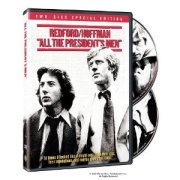
No film or documentary about Watergate has been seen more often by more people than All the President’s Men, the 1976 adaptation of the eponymous book by the Washington Post’s lead reporters on the scandal, Bob Woodward and Carl Bernstein.

The movie won rave reviews. The New York Times called it “a spellbinding detective story” and “an unequivocal smash-hit — the thinking man’s Jaws.”

The Post once immodestly described All the President’s Men as “journalism’s finest 2 hours and 16 minutes” and “the best film ever made about the craft of journalism.”

For all its glowing notices, All the President’s Men was often sluggish in pacing. More than a few scenes showed reporters at their desk, talking into telephones and banging away at typewriters.

Hardly gripping cinema.

But a measure of drama and menace was injected near the close of the movie (see video clip below).

That came when Woodward’s stealthy, high-level “Deep Throat” source, at a meeting in a darkened parking garage, grimly warns the wide-eyed reporter, played by Robert Redford:

“Your lives are in danger.”

But was it even true? Had Woodward and Bernstein, in their reporting about the misdeeds of men close to President Richard Nixon, unknowingly put their lives on the line? Were they targeted by Nixon’s henchmen? Or was this just dramatic license by Hollywood?

The movie leaves such questions hanging. The Woodward/Redford character informs the Bernstein character (played by Dustin Hoffman) about what “Deep Throat” said, and together they confer with the Post’s executive editor character (Jason Robards) — in the middle of the night, in the middle of the editor’s lawn.

But the movie closes before resolving the question of the hazards the reporters faced.

So were their lives really in danger?

Nope.

Not according to the book, All the President’s Men.

The book discusses a late-night meeting between Woodward and “Deep Throat” in mid-May 1973 when the source — W. Mark Felt, a senior official at the FBI, as it turned out — advised the reporter to “be cautious.”

Woodward returned to his apartment and invited Bernstein to stop by. When he did, Woodward typed out a message and handed it to his colleague:

Everyone’s life is in danger.”

Bernstein gave a curious look and Woodward typed another note:

Deep Throat says electronic surveillance is going on and we had better watch it.”

Who was doing the surveillance? Bernstein asked in long hand.

“C-I-A,” Woodward silently mouthed.

For a time afterward, the reporters and senior editors at the Post took precautions to avoid the suspected surveillance of their activities.

Woodward and Bernstein wrote in All the President’s Men that they “conferred on street corners, passed notes in the office, avoided telephone conversations.”

But soon, they said, “it all seemed rather foolish and melodramatic” and they went back to their routines.

No evidence, they wrote, was ever found “that their telephones had been tapped or that anyone’s life had been in danger.”

At a program last week at the Newseum, Woodward said he took Felt’s warning “too literally. I think he was speaking metaphorically” about the hazards.

“I think it was an overreaction,” Woodward said.

On another occasion — an online chat five years ago — Woodward said the “most sinister pressure” he and Bernstein felt during Watergate “was the repeated denial” by Nixon’s White House “of the information we were publishing” as the scandal deepened.

Also in that chat, Woodward said of the cinematic version of All the President’s Men:

“The movie is an incredibly accurate portrait of what happened.”

Oh, sure, it is.

Even that Post review, which called the movie journalism’s finest 2 hours and 16 minutes, noted that All the President’s Men “over-glamorizes reporting, oversimplifies editing and makes power appear the only proper subject for a newsman’s pen.”

WJC

Recent or related:

The media myths of Watergate: Part Three

In Anniversaries, Debunking, Media myths, Newspapers, Quotes, Washington Post, Watergate myth on June 19, 2012 at 5:25 am

This is the third of five posts addressing prominent media-driven myths about the Watergate scandal, which began
unfolding 40 years ago this week with the foiled burglary at the headquarters in Washington of the Democratic National Committee.
This installment discusses the most famous made-up line of Watergate.

“Follow the money.” It’s the best-known, most popular turn-of-phrase associated with the Watergate scandal of 1972-74.

Felt: Never said it

It’s often said that “follow the money” was sage counsel offered by the stealthy, high-level “Deep Throat” source with whom Bob Woodward of the Washington Post periodically met as the scandal unfolded.

The guidance to “follow the money” supposedly proved crucial in understanding and unraveling the labyrinthine scandal that was Watergate.

Except that it really wasn’t.

“Deep Throat” never advised Woodward to “follow the money.”

The passage appears in no Watergate-related article or editorial in the Post until June 1981, nearly seven years after Nixon’s resignation. It doesn’t appear, either, in All the President’s Men, the book Woodward and his Post colleague, Carl Bernstein, wrote about their Watergate reporting.

Follow the money” was written into the screenplay of All the President’s Men, the cinematic adaptation of Woodward and Bernstein’s book.

The line was spoken by Hal Holbrook, the actor who played “Deep Throat” in the movie. (The real “Deep Throat” was self-revealed in 2005 to have been W. Mark Felt, a senior FBI official.)

Holbrook in All the President’s Men turned in a marvelous performance as a twitchy, conflicted, chain-smoking “Deep Throat.”

‘All the President’s Men,’ the movie

He delivered the line, “follow the money,” with such raspy assurance and conviction that it seemed for all the world to be vital to understanding the scandal that began unfolding 40 years ago.

Follow the money” is certainly Watergate’s most memorable and mythical phrase; it is so pithy and emphatic that it seems almost too good not to be true.

Indeed, “follow the money” tends to be treated with reverence by news media. A “credo,” it’s been called.

Take, for example, a recent post at the “Daily Intel” blog of New York Magazine. The blog post began by invoking the famous phrase, with emphasis:

Follow the money. The pithy investigative advice Woodward and Bernstein attributed to Deep Throat is still brilliant and important, whatever else the Watergate reporters may have embellished.”

Brilliant and important?

Made up is more like it.

But even if Woodward had been counseled to “follow the money,” the advice neither would have unraveled the Watergate scandal nor led him to Nixon.

Besides, Woodward and Bernstein already were on the money trail.

One of their most important stories was in reporting that a $25,000 check to Nixon’s reelection campaign had been deposited in the bank account of one of the Watergate burglars.

The scandal, though, was much more than Nixon’s improper use of campaign funds. The president was forced to resign because he obstructed justice by approving a plan to cover up the burglary at the Democratic National Committee.

The simplified, follow-the-money construct not only is inaccurate and misleading: It serves to deflect attention from the array of forces that combined to expose Nixon’s crimes.

As I note in my 2010 book Getting It Wrong, rolling up a scandal of Watergate’s depth and dimension required “the collective if not always the coordinated forces of special prosecutors, federal judges, both houses of Congress, the Supreme Court, as well as the Justice Department and the FBI.

“Even then,” I write, “Nixon likely would have served out his term if not for the audiotape recordings he secretly made of most conversations in the Oval Office of the White House.

“Only when compelled by the Supreme Court did Nixon surrender those recordings, which captured him plotting the cover-up” that cost him the presidency.

WJC

Recent or related:

The media myths of Watergate: Part Two

In Anniversaries, Debunking, Media myths, Newspapers, Scandal, Washington Post, Watergate myth on June 18, 2012 at 5:42 am

This is the second of five posts addressing prominent media-driven myths about the Watergate scandal, which began unfolding 40 years ago this week with
the foiled burglary at the headquarters in Washington
of the Democratic National Committee.
This installment discusses the notion
that the 
Washington Post “uncovered” the Watergate story.

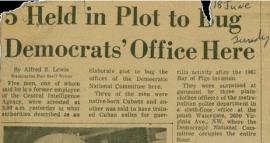
Post’s Watergate story, June 18, 1972 (Ransom Center, University of Texas)

Watergate was America’s gravest political scandal. It began as a police beat story.

News of the scandal’s seminal crime — the thwarted break-in of June 17, 1972, at the headquarters of the Democratic National Committee at the Watergate complex in Washington, D.C. — was circulating within hours.

The opening paragraph of the Posts front-page report about the burglary, published 40 years ago today, made it clear that details had come from investigating authorities. The paragraph read:

“Five men, one of whom said he is a former employee of the Central Intelligence Agency, were arrested at 2:30 a.m. yesterday in what authorities described as an elaborate plot to bug the offices of the Democratic National Committee here.”

So it can’t be said the Post “uncovered” the Watergate story.

Nor can it be said that the newspaper “uncovered” crucial elements of the deepening scandal, which ultimately forced President Richard Nixon to resign the presidency in August 1974.

Take, for example, Nixon’s secret audiotaping system at the White House.

Existence of the tapes was disclosed in July 1973 to a bipartisan select committee of the U.S. Senate (see video clip below).

The tapes were decisive to Watergate’s outcome; Watergate’s leading historian, Stanley I. Kutler, has characterized them as “the gift of the gods.”

The so-called “smoking gun” tape revealed that Nixon had approved a plan to divert the FBI’s investigation of the break-in of DNC headquarters.

He did so in a conversation June 23, 1972, with his top aide, H.R. Haldeman. The contents of the “smoking gun” tape were made public in early August 1974, shortly after the U.S. Supreme Court ordered Nixon to turn it over to investigators.

The “smoking gun” tape sealed Nixon’s fate and led to his resigning the presidency.

(As Kutler has noted, Nixon-White House tapes “released in 1997 clearly reveal” that the president knew about “hush money” payments to the Watergate burglars.)

Interestingly, the Post’s Watergate reporters, Bob Woodward and Carl Bernstein, later claimed to have had a solid lead about Nixon’s taping system — a lead they did not pursue.

They mentioned in their book, All the President’s Men, that Woodward had spoken about the tip with Ben Bradlee, then the Post’s executive editor.

Bradlee advised: “See what more you can find out, but I wouldn’t bust one on it.”

And they didn’t.

Had they, Woodward and Bernstein may well have broken a pivotal story about the scandal.

Principals at the Post often have said that the newspaper’s reporting kept the Watergate story alive during the summer and fall of 1972, a time when few other news organizations seemed interested in pursuing the scandal.

Leonard Downie, who succeeded Bradlee as executive editor, renewed that claim in a recent commentary in the Post.

For “several months after the Watergate burglary in 1972,” Downie wrote, “Woodward, Bernstein and their colleagues on the local news staff of The Post were alone on the story.

“We were ignored and doubted by the rest of the news media and most of the country, and under heavy fire from the Nixon administration and its supporters.”

It’s a heroic interpretation.

But it’s not entirely accurate.

As I point out in my 2010 book, Getting It Wrong, “The Post may well have led other newspapers on the Watergate story — principally was because Watergate at first was a local story, based in Washington, D.C.

“But rival news organizations such as Los Angeles Times and New York Times did not ignore Watergate as the scandal slowly took dimension during the summer and fall of 1972.”

The Los Angeles Times, for example, published a first-person account in early October 1972 of Alfred C. Baldwin III, a former FBI agent who acted as a lookout man in the Watergate burglary.

Significantly, the New York Times was the first news organization to report the payment of hush money to the burglars, a pivotal disclosure in mid-January 1973. The Times report made clear that efforts were under way to cover up and conceal the roles of others in the scandal.

John Dean, Nixon’s former counsel, recalled in a memoir published years later that the Times report about hush-money payments “hit home!”

The disclosure, Dean wrote, “had everyone concerned and folks in the White House and at the reelection committee were on the wall.”

And as Edward Jay Epstein pointed out in a classic essay in 1974, the Post and other newspapers were joined during the summer of 1972 by the General Accounting Office, the investigative arm of Congress, and Common Cause, a foundation that seeks accountability in government office, in directing attention to the scandal.

Moreover, George McGovern, Nixon’s hapless Democratic challenger for the presidency in 1972, not infrequently invoked Watergate in his campaign appearances. At one point in the summer of 1972, McGovern charged that Nixon was “at least indirectly responsible” for the Watergate burglary.

So in the summer and fall of 1972, the Post was one of several institutions seeking to delineate the reach and contours of Watergate.

The Post, as I note in Getting It Wrong, “was very much not alone.”

WJC

Recent or related:

The media myths of Watergate: Part One

In Anniversaries, Cinematic treatments, Debunking, Media myths, Newspapers, Reviews, Scandal, Washington Post, Watergate myth on June 17, 2012 at 6:00 am

This is the first of five posts addressing prominent media-driven myths about the Watergate scandal, which began unfolding 40 years ago with the foiled burglary at the headquarters in Washington of the Democratic National Committee. This installment discusses the tenacious myth
that reporting by the 
Washington Post brought down
Richard Nixon’s corrupt presidency
.

Other posts in this series
may be accessed here, here, here, and here.

For years, the dominant narrative of Watergate has been that the dogged reporting of Bob Woodward and Carl Bernstein for the Washington Post revealed the crimes that forced Richard Nixon to resign the presidency in August 1974.

That’s also a media-driven myth — the heroic-journalist myth, as I called it in my 2010 book, Getting It Wrong.

I note in Getting It Wrong that the media-centric heroic-journalist construct “has become the most familiar storyline of Watergate,” serving as “ready short-hand for understanding Watergate and its denouement, a proxy for grasping the scandal’s essence while avoiding its forbidding complexity.”

The misdeeds of Watergate were many. Twenty men associated with Nixon’s presidency or his 1972 reelection campaign went to jail for crimes such as perjury, obstruction of justice, and conspiracy.

Three powerful and related factors have propelled and solidified the heroic-journalist trope in the popular consciousness.

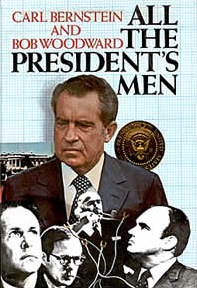
One factor was Woodward and Bernstein’s engaging book about their Watergate reporting, All the President’s Men, which came out in June 1974, just as the scandal was nearing culmination.

As Stanley I. Kutler, Watergate’s preeminent historian, has written, All the President’s Men “offered a journalistic brief to the nation as it prepared to understand and judge for itself” the growing evidence of Nixon’s guilt.

All the President’s Men was quite the success, holding the top spot on the New York Times’ non-fiction best-seller list for 15 weeks — through the climatic days of Watergate and beyond.

“The book’s impeccable timing,” I write in Getting It Wrong, served to “promote an impression that Woodward and Bernstein were central to Watergate’s ultimate outcome.”

The book that helped promote a myth

That impression was deepened in the cinematic version of All the President’s Men, which was released to great fanfare and rave reviews in April 1976.

The movie placed Woodward and Bernstein at the center of Watergate’s unraveling — and minimized or ignored the far more decisive contributions of subpoena-wielding investigators.

Indeed, rolling up a scandal of Watergate’s dimension and complexity required the collective efforts of special prosecutors, federal judges, both houses of Congress, the Supreme Court, as well as the Justice Department and the FBI.

And even then, as I write in Getting It Wrong, Nixon likely would have survived the scandal and served out his term if not for the audiotape recordings he secretly made of conversations in the Oval Office of the White House.

Only when compelled by the Supreme Court did Nixon surrender the recordings, which captured him approving a plan to divert the FBI’s investigation into Watergate’s seminal crime, the break-in June 17, 1972, at the headquarters of the Democratic National Committee.

The third factor in pressing the heroic-journalist myth firmly into the popular consciousness was the 30-year guessing game about the identity of Woodward’s stealthy, high-level source whom a Post editor code-named “Deep Throat.”

Speculation about the identity of “Deep Throat” came not infrequently and was often prominent. The guessing game offered periodic reminders about the Post and its Watergate coverage. The speculation effectively kept Woodward and Bernstein in the public eye far longer than they otherwise might have.

In 2005, W. Mark Felt, formerly second in command at the FBI, disclosed that he had been the “Deep Throat” source — giving rise to yet another round of reminiscing about the heroic journalists  of Watergate.

Such preening was misplaced, of course.

As Max Holland, author of Leak, a recent book about Watergate and “Deep Throat,” has aptly put it:

“Federal prosecutors and agents never truly learned anything germane from The Washington Posts [Watergate] stories — although they were certainly mortified to see the fruits of their investigation appear in print. … The government was always ahead of the press in its investigation of Watergate; it just wasn’t publishing its findings.”

Interestingly, principals at the Post have periodically scoffed at and rejected the heroic-journalist narrative.

For example, Katharine Graham, the Post’s publisher during and after Watergate, said at a program in 1997 marking the scandal’s 25th anniversary:

“Sometimes people accuse us of bringing down a president, which of course we didn’t do. The processes that caused [Nixon’s] resignation were constitutional.”

And Woodward  complained in 1996 that “the mythologizing of our role in Watergate has gone to the point of absurdity, where journalists write … that I, single-handedly, brought down Richard Nixon.

“Totally absurd.”

Indeed. To explain Watergate through the lens of the heroic-journalist is to simplify and misunderstand the scandal. It is to misread history and indulge in a beguiling media-driven myth.

WJC

Recent or related:

Misremembering the Jessica Lynch case, on Memorial Day

In Debunking, Jessica Lynch, Media myths on May 28, 2012 at 5:11 pm

It’s astonishing how engrained the false narrative has become that the Pentagon made up the hero-warrior tale about Army private Jessica Lynch in the early days of the Iraq War.

It is often invoked — and typically without any reference to specific sources.

(Newseum image)

Take, for example, the top-of-the-front-page article today in today’s The State newspaper in South Carolina, which refers to unspecified “critics” who “charge that the Pentagon exaggerated her wounds by saying she was shot and stabbed when she wasn’t.”

As I’ve noted many times at Media Myth Alert, the Pentagon wasn’t the source for the bogus tale about Lynch’s heroics in an ambush at Nasiriyah in southern Iraq.

It was the Washington Post that thrust the story into the public domain in a dramatic account published on its front page on April 3, 2003.

The Post’s report said Lynch, then a 19-year-old supply clerk in the Army’s 507th Maintenance Company, fired at attacking Iraqis “even after she sustained multiple gunshot wounds and watched several other soldiers in her unit die around her in fighting” on March 23, 2003.

The story, which was picked up by news organizations around the world, was embarrassingly wrong in all important details. Lynch, it quickly turned out, was neither shot nor stabbed, as the Post had reported. She did not fire a shot in the ambush. She suffered severe injuries in the crash of a Humvee as it tried to flee the ambush.

Lynch was taken prisoner and treated at an Iraqi hospital, from where she was rescued April 1, 2003, by a U.S. special operations team.

As Lynch herself insists, she was no hero (although she has said she could have embraced the Post’s hero-warrior tale and no one would’ve been the wiser).

We know the Pentagon wasn’t the source of the Post’s exaggerated tale: Vernon Loeb, one of the reporters who wrote the story, said so in an interview on Fresh Air, an NPR radio program, in mid-December 2003.

In the interview, Loeb said flatly:

“Our sources for that story were not Pentagon sources.”

Loeb also said that he “could never get anybody from the Pentagon to talk about” the Lynch case.

“They wouldn’t say anything about Jessica Lynch,” Loeb declared, adding:

“I just didn’t see the Pentagon trying to create a hero where there was none. I mean …they never showed any interest in doing that, to me.”

Loeb said the details about Lynch’s supposed heroics came from “some really good intelligence sources” in Washington, D.C. — sources whom the Post has never specifically identified, although it should.

The State’s article is pegged to Memorial Day and recalls the death at Nasiriyah of Sgt. George Buggs. He was the first serviceman from South Carolina killed in Iraq.

The article notes that “Buggs’ death is now forgotten by most except family and friends. … But his story is both intertwined and overshadowed by one of the most tragic and controversial events in modern U.S. military history — the capture and rescue of a young soldier from West Virginia named Jessica Lynch.”

The article invokes those nameless “critics” in saying they “charged that the United States government exaggerated the facts of the rescue, manipulated the media and exploited Lynch to build public support for a war many thought was unnecessary.”

Such claims are erroneous in at least two important respects.

One, the Defense Department’s acting inspector general reported finding no evidence to support the notion that Lynch’s rescue “was a staged media event.” Rather, the inspector general’s report said the rescue operation was “a valid mission” to recover a prisoner of war “under combat conditions.” It further stated that the “level of force used by [the special forces team] to perform the mission was consistent with the anticipated resistance and established doctrine.”

Two, the U.S. government had little reason to exploit the Lynch case as a means “to build public support”  for the Iraq War. As I point out in my 2010 book, Getting It Wrong:

“It may be little-recalled now, but the U.S.-led invasion of Iraq was widely supported by the American public. Polling data from March and April 2003, the opening days and weeks of the war, show an overwhelming percentage of Americans supported the conflict and believed the war effort, overall, was going well.”

Among those public opinion polls was a Washington Post-ABC News survey conducted in late March and early April 2003. The poll found that eight of ten Americans felt the war effort was going well, and 71 percent approved of the Bush administration’s handling of the Iraq situation.

I further note in Getting It Wrong:

“At the time of the Lynch rescue, U.S. forces were closing in on Baghdad. So it defies logic to argue that the American military would have singled out and hyped the Lynch rescue for morale-building purposes when its central and vastly more important wartime objective was within reach.”

WJC

Recent and related: