W. Joseph Campbell

Archive for April, 2010|Monthly archive page

Today’s Boston Marathon: Recalling the 1897 inaugural run

In 1897, Anniversaries, Year studies, Yellow Journalism on April 19, 2010 at 7:17 pm

An ESPN columnist said it well today:

“The Boston Marathon turned 114 years old on Monday, but it never gets old.”

Indeed. The Boston Marathon is perhaps the most famous and prestigious race of its kind in the United States.

The first running of the storied marathon was in 1897, the year that defined American journalism.  The race was one of the year’s landmark moments.

As I wrote in a book by that title, the inaugural Boston Marathon was run April 19, 1897, having been “inspired by the revival of the marathon race at the first modern Olympic games in 1896.”

The course, I noted in The Year That Defined American Journalism, began in Ashland, Massachusetts, and was 24.5 miles long–about 1.5 miles shorter than that of a contemporary marathon race.

Fifteen men were in the field in 1897.

Some  of them, said the Boston Post, in revealing a delicious sense for detail, “looked as if they could spare a few pounds.”

Winner of the 1897 Boston Marathon

Along the course that spring day, “the runners answered the cheers of spectators with bows and waves.”

The winner of the inaugural run was John J. McDermott of the Pastime Athletic Club in New York. He finished the course in 2 hours, 55 minutes, and 10 seconds, which the Boston Globe said exceeded the record time of the 1896 Olympics.

McDermott supposedly dropped nine pounds during the race, suffered severe leg cramps, and was forced to cut through a funeral procession as the marathon neared the finish line, where some 3,000 spectators awaited.

“This probably will be my last long race,” McDermott said afterward. “I hate to quit now, because I will be called a quitter and a coward, but look at my feet.

“Do you blame me for wanting to stop it? I only walked about a quarter of a mile in the whole distance and it was 20 miles before I lagged a step.”

But, he added, “I think I shall be all right tomorrow.”

McDermott entered the 1898 edition of Boston Marathon, and finished fourth.

WJC

<!–[if !mso]>

The winner was John J. McDermott of the Pastime Athletic Club in New York, who finished the course in 2 hours, 55 minutes, and 10 seconds, which the Boston Globe said exceeded the record time of the 1896 Olympics.[i] McDermott dropped nine pounds, suffered severe leg cramps, and was forced to cut through a funeral procession on the last leg of the race. Some 3,000 spectators awaited at the finish line.[ii] “This probably will be my last long race,” McDermott said afterward. “I hate to quit now, because I will be called a quitter and a coward, but look at my feet. Do you blame me for wanting to stop it? I only walked about a quarter of a mile in the whole distance and it was 20 miles before I lagged a step. I think I shall be all right tomorrow.”

[i]. “Record Time,” Boston Globe (20 April 1897): 1.

[ii]. The crowd estimate appeared in “Beat the Greeks,” Boston Post (20 April 1897): 8.

Skirting the media’s role in the ‘crack baby’ scare

In Debunking, Media myths, Newspapers, Washington Post on April 18, 2010 at 3:40 pm

The Washington Post today revisits the “crack baby” scare of the late 1980s and 1990s and reports that “in the two decades that have passed since … these babies have grown into young adults who can tell their stories–and for the most part, they are tales of success.”

The Post notes that “a lot of misinformation surfaced” about the “crack baby” phenomenon, and cites an often-quoted column by Charles Krauthammer who in 1989 wrote:

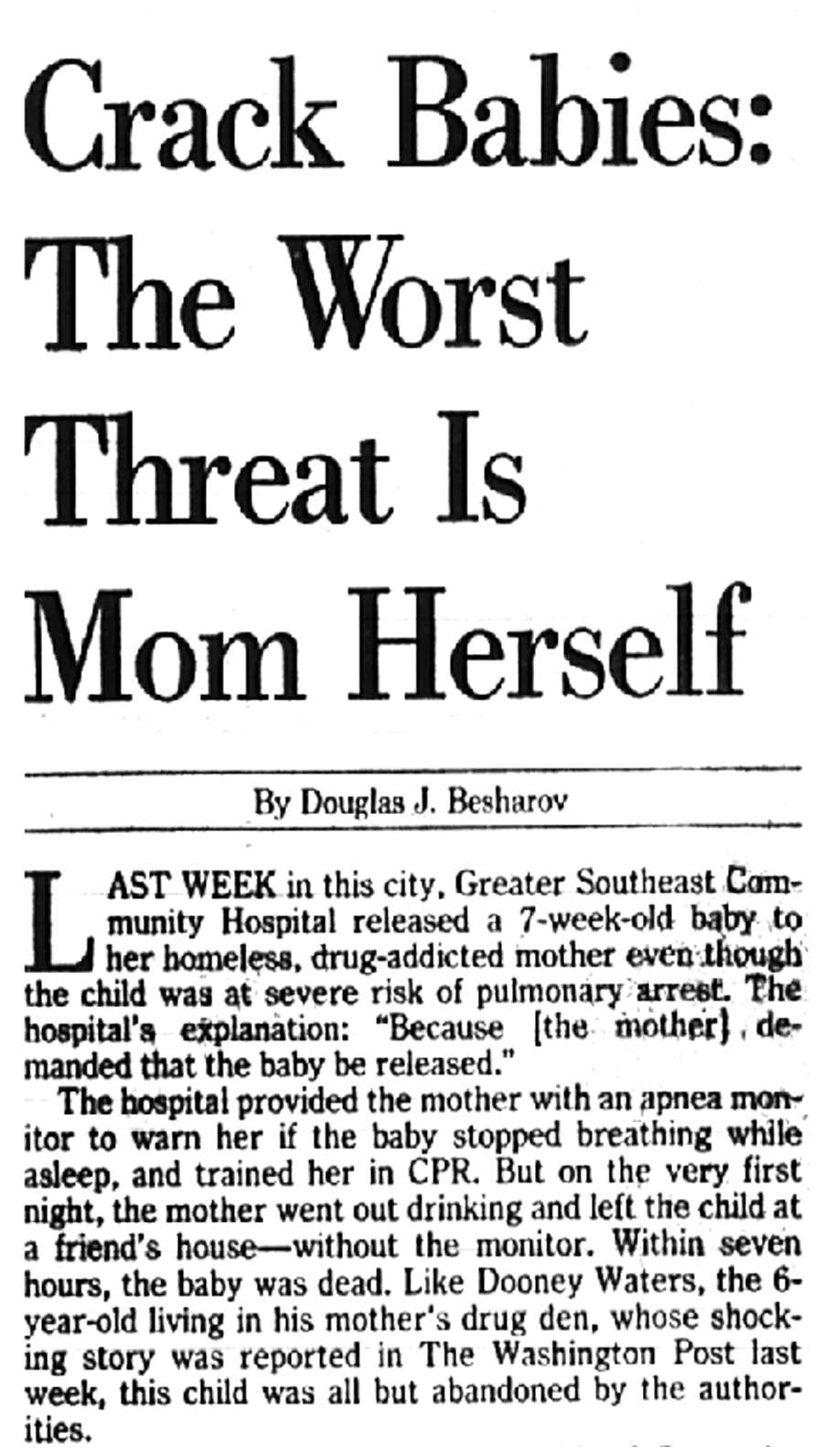
Washington Post, August 1989

“Theirs will be a life of certain suffering, of probable deviance, of permanent inferiority.”

(Although the Post article doesn’t mention it, Krauthammer also wrote in that column: “The inner-city crack epidemic is now giving birth to the newest horror: a bio-underclass, a generation of physically damaged cocaine babies whose biological inferiority is stamped at birth.”)

Otherwise, the Post‘s report steered well clear of considering the news media’s central role in spreading “misinformation” about “crack babies,” a topic is explored in Getting It Wrong, my forthcoming book about media-driven myths.

The scare, I write, “was a media-driven myth based more on anecdote than solid, sustained research, a myth that had the effect of stigmatizing underprivileged children presumed to have been born damaged and despised as ‘crack babies.’”

I further note:

“To be sure, smoking crack during pregnancy is hardly risk-free, and certainly neither prudent nor sensible.”

However, I add, “the effects of prenatal cocaine exposure have proved more subtle than sweeping: Newborns exposed to crack during pregnancy tend to be smaller in birth weight, in length, and in head circumference. Some research suggested that mild cognitive deficiencies, such as difficulties in concentrating on tasks at hand, might be attributable to prenatal cocaine exposure, especially as cognitive demands on children intensify as they grow older.

“But biomedical research has found nothing akin to a ‘bio-underclass,’” that Krauthammer and others warned about some 20 years ago.

Revisiting the media-driven myth of the crack baby is important, I write in Getting It Wrong, because doing so “allows insights into a tendency among journalists to neglect or disregard the tentativeness that characterizes serious scientific and biomedical research, and to reach for certainty and definitiveness that are not often found in preliminary findings.

“The tendency of journalists to push hard on tentative data has been apparent in coverage of more recent drug scares, notably that of methamphetamine in 2004 and 2005.”

The Post‘s report today was the latest in what, in effect, has been an intermittent series in leading newspapers to revisit the “crack baby” scare and find it to have been exaggerated.

In a lengthy article published 15 months ago, the New York Times called the scare “the epidemic that wasn’t.” A columnist for the New York Daily News acknowledged in 2004 that “we probably overreacted with forecasts of harm to so-called ‘crack babies.’”

And more than 12 years ago, the Post carried a story similar to today’s. That article appeared on page Z10, beneath the headline: “‘Crack Baby’ Fears May Have Been Overstated.”

As I note in Getting It Wrong, “The news media’s retreat or rollback on crack babies was neither as extensive nor as prominent as the dramatic and ominous reports about the scourge in the late 1980s and early 1990s.”

I quote the alternative magazine, Mother Jones, which pointed out in 1995:

“The publicity blitz that spread the crack-baby myth has not been matched by an attempt to unmake the myth—and many, many people still believe in it.”

The term “crack babies” remains firmly in circulation; it is invoked casually and idiomatically, as something of a cliché.

WJC

Movies about journalists: Another list, another myth

In Cinematic treatments, Debunking, Furnish the war, Media myths, Newspapers, Washington Post, Watergate myth on April 17, 2010 at 6:31 pm

The blog True/Slant includes a ranking today of the 10 best-ever movies about journalism, and the Bogart film, Deadline U.S.A., tops the list.

This 10-best lineup was inspired by the series of newspapering movies running at Film Forum in Manhattan.

Absence of Malice (which I thought was dreadfully stereotypical), ranked second on the True/Slant list; The Paper was third, and All the President’s Men, the best-known movie about the Watergate scandal, was fourth.

Almost predictably, the description about All the President’s Men said:  “Robert Redford and Dustin Hoffman play Washington Post reporters Carl Bernstein and Bob Woodward, who reported the Watergate scandal and brought down a President. One of the few movies that makes journalism look like something worth doing.”

So there we are again–the hoary claim resurfaces that Nixon was “brought down” by the reporting of the intrepid Post reporters.

It’s what I call the heroic-journalist myth, and it’s addressed, and debunked, in Getting It Wrong, my forthcoming book about media-driven myths.

I note in the book, which is due out this summer, that heroic-journalist myth of Watergate is one of the most appealing and self-reverential stories in American media history.

It is striking indeed how routinely and even off-handedly Bernstein and Woodward are credited with the accomplishment, especially when the record of Watergate shows that the Post’s reporting had at best a marginal effect on forcing Nixon’s resignation in 1974.

Other forces and factors were far more decisive to the denouement of Watergate. As Howard Kurtz, the Post’s media reporter, has written:

“Despite the mythology, The Post didn’t force Richard Nixon from office—there were also two special prosecutors, a determined judge, bipartisan House and Senate committees, the belated honesty of [former White House lawyer] John Dean and those infamous White House tapes.”

Nixon’s White House tapes were crucial to the outcome. He resigned the presidency shortly after the Supreme Court ordered him to turn over the tapes subpoenaed by the Watergate special prosecutor.

One of the tapes undeniably showed Nixon participating in the coverup of the burglary at Democratic national headquarters, the signal crime of the Watergate scandal.

I also note in Getting It Wrong that motion pictures have a way of solidifying media-driven myths in the public’s consciousness.

“High-quality cinematic treatments,” I write, “are powerful agents of media myth-making, and can enhance a myth’s durability.”

And so what’s my top movie about newspapering? The 1941 Orson Welles masterpiece, Citizen Kane.

And that’s probably because I get such a laugh every time I watch the scene that paraphrases William Randolph Hearst‘s purported vow “to furnish the war” with Spain.

That may be the hardiest media myth of all.

A sleeper in my lineup of best movies about journalism is John Ford’s 1962 Western, The Man Who Shot Liberty Valence.

Why Liberty Valence?

Solely because of the movie’s greatest line, which is so applicable to media myth-making:

“This is the West, sir. When the legend becomes fact, print the legend.”

WJC

Myths going polyglot: An emblem of hardiness

In Debunking, Media myths, Washington Post, Watergate myth on April 16, 2010 at 9:29 am

It’s a sure sign of tenacity and hardiness when media-driven myths cross linguistic barriers to become embedded in other languages.

The heroic-journalist myth of Watergate–which I explore in Getting It Wrong, my forthcoming book about media-driven-myths–represents that phenomenon quite well.

In the past few days, references to the myth–which maintains that the work of two young, intrepid reporters for the Washington Post brought down Richard Nixon’s corrupt presidency–have appeared online in French and Italian.

The French version was posted at the Web site of the weekly lifestyle magazine, Paris Match.  The item was about Sheri Fink, who this week became a winner of a Pulitzer Prize in investigative reporting.

Paris Match said of Fink: “She enters the pantheon of the press that includes famous predecessors such as Bob Woodward of the Washington Post who disclosed the Watergate scandal leading to the impeachment of President Nixon.”

For starters, Nixon was never impeached; he resigned the presidency in 1974, to head off certain impeachment and conviction.

Moreover, Woodward and his reporting partner, Carl Bernstein, did not uncover or disclose the Watergate scandal.

As Edward Jay Epstein wrote years ago in a marvelous essay about the news media and Watergate, “the FBI, the federal prosecutors, the [federal] grand jury, and the Congressional committees … unearthed and developed all the actual evidence and disclosures of Watergate.”

Epstein noted that Woodward and Bernstein, in All the President’s Men, their book about their Watergate reporting, “systematically ignored or minimized” the work of those agencies and institutions.

“Instead,” Epstein wrote, “they simply focus on those parts of the prosecutors’ case, the grand-jury investigation, and the FBI reports that were leaked to them.”

The heroic-journalist meme also popped up in an item posted the other day at VignaClaraBlog, an online local news site in Rome. That item told of an upcoming interview with Bernstein, whom it credited with breaking the Watergate scandal, leading to Nixon’s resignation.

The objective here is not to score points at the expense of foreign-language sites invoking the heroic-journalist myth. Rather, it is to underscore how persistent and insidious media-driven myths can be.

Crossing linguistic barriers not only is an emblem of their appeal: It suggests that myths such as that of the heroic-journalist of Watergate are now thoroughly immune to conclusive uprooting.

WJC

On bringing down Nixon

In Cinematic treatments, Debunking, Media myths, Newspapers, Washington Post, Watergate myth on April 12, 2010 at 4:07 pm

My guestpost the other day at the “Political Bookworm” blog–in which I reviewed three media-driven myths explored in my forthcoming book, Getting It Wrong–has attracted more than a few comments, including this particularly blinkered rhetorical question:

“Do you really know anyone who believes the Washington Post brought Nixon down?”

For starters, check Investor’s Business Daily.

On the day the guestpost and the blinkered comment appeared, Investor’s Business Daily said the New York Times, in its coverage of sexual abuses by Roman Catholic priests, was “seeking the biggest prey since Woodward and Bernstein brought down Richard Nixon.”

There you go: Brought down Nixon.

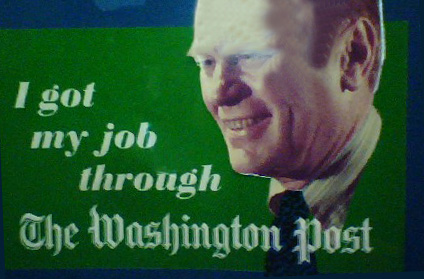
Gerald Ford became president on Nixon's resignation

The Investor’s Business Daily reference, of course, was to Bob Woodward and Carl Bernstein of the Washington Post whose investigative reporting in the Watergate scandal is often and inaccurately said to have toppled Richard Nixon’s corrupt presidency.

As I note in Getting It Wrong, the heroic-journalist meme of Watergate is one of the most hardy, persistent, and delicious myths in American media history.

Interestingly, it lives on despite periodic efforts by principals at the Washington Post to dismiss it. (“Political Bookworm” is a Washington Post blog, it should be noted.)

The newspaper’s media reporter, Howard Kurtz, wrote in 2005, for example:

“Despite the mythology, The Post didn’t force Richard Nixon from office—there were also two special prosecutors, a determined judge, bipartisan House and Senate committees, the belated honesty of [former White House lawyer] John Dean and those infamous White House tapes.”

Kurtz’s observations parallel those of Stanley I. Kutler, a leading historian of Watergate, who has written:

“The fact is, an incredible array of powerful actors all converged on Nixon at once—the FBI, prosecutors, congressional investigators, the judicial system.”

Amid this array of subpoena-wielding authorities investigating Watergate, the contributions of Woodward and Bernstein were modest–and certainly not decisive to the scandal’s outcome.

Still, the heroic-journalist myth is alive, well–and often invoked.

In large measure, that’s because the 1976 motion picture All the President’s Men–the leading movie about Watergate–depicted Woodward and Bernstein as essential to unraveling the scandal.

Indeed, this myth is a trope that knows few bounds.

WJC

In today’s ‘Outlook’ section

In Cronkite Moment, Debunking, Furnish the war, Media myths, Murrow-McCarthy myth, Newspapers, Washington Post, Watergate myth on April 11, 2010 at 12:13 pm

An abbreviated version of my recent guestpost at the “Political Bookworm” blog appeared today in the “Outlook” section of the Washington Post.

Here’s the text of the “Outlook” piece, with links that I’ve added:

W. Joseph Campbell, a professor of communication at American University, busts some media myths in his book, “Getting It Wrong: Ten of the Greatest Misreported Stories in American Journalism,” coming in July from the University of California Press. Here are three of Campbell’s biggies:

1. William Randolph Hearst’s purported vow, telegraphed to the artist Frederic Remington in Cuba, to “furnish the war” with Spain. Hearst denied making such a statement. The telegram containing his purported pledge has never turned up. The “furnish the war” anecdote can be traced to 1901 and a memoir by another journalist, James Creelman, who did not say when or how he learned the story about Hearst’s vow.

2. Edward R. Murrow brought an end to Sen. Joseph R. McCarthy’s communists-in-government witch hunt. This myth stems from Murrow’s CBS program “See It Now” on March 9, 1954, when the newsman dissected McCarthy’s crude investigative techniques and taste for the half-truth — none of which was unknown to American audiences at the time. The myth took hold even though years before the program aired, several prominent journalists — including Washington-based syndicated columnist Drew Pearson — had become searching critics of McCarthy and his tactics.

Nixon resigns, 1974

3. The Washington Post’s investigative reporting brought down Richard Nixon’s corrupt presidency. Katharine Graham, The Post’s publisher during the Watergate period, said in 1997: “Sometimes people accuse us of bringing down a president, which of course we didn’t do. The processes that caused [Nixon’s] resignation were constitutional.” She was right, but the complexities of Watergate are not readily recalled these days. What does stand out is a media-centric interpretation that the dogged reporting of Post journalists Bob Woodward and Carl Bernstein brought Nixon down.

WJC

Murrow had McCarthy ‘on his show’? Not quite

In Debunking, Media myths, Murrow-McCarthy myth on April 10, 2010 at 3:11 pm

The myth and misunderstanding associated with Edward R. Murrow’s famous broadcast on CBS about Senator Joseph R. McCarthy are many, and tenacious.

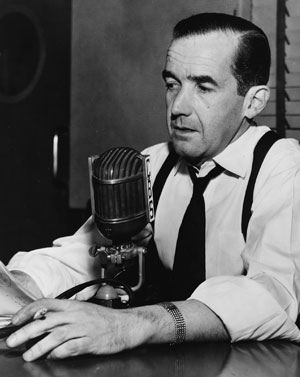
Murrow in 1954

Murrow in 1954

Notable among them is that Murrow’s documentary-style See It Now program of March 9, 1954, exposed McCarthy’s red-baiting ways and abruptly halted the senator’s communists-in-government witch-hunt.

Neither is true, for reasons I discuss in my forthcoming book about media-driven myths, Getting It Wrong.

Another misconception about the Murrow-McCarthy confrontation was raised yesterday, in an item titled “Yellow-bellied journalism” and posted at the Daily Caller online site.  The “yellow-bellied journalism” item stated:

“The problem with the mainstream media is not that they are liberals. It’s that they are cowards. They simply will not engage with any thought that threatens their worldview.

“It’s important to remember that it wasn’t always this way. There once was a time when liberal journalists had the guts to engage, and engage deeply, with the ideas of those who disagreed with them. Edward R. Murrow had Joseph McCarthy on his show.”

That’s an interesting comment about contemporary journalists lacking guts. But as for the point that Murrow had McCarthy “on his show”?

Well, not exactly.

Murrow’s See It Now program of March 9, 1954, was an unrelenting laceration of McCarthy. Murrow made devastatingly effective use of film footage of the senator in action in what was a bravado performance in advocacy journalism.

As I write in Getting It Wrong: “Through clever editing of film of McCarthy in action, Murrow and his See It Now team prepared a powerful indictment” of the senator and his crude investigative tactics.

I also note that  “McCarthy’s oddball appearance and mannerisms—his hulking, menacing presence, his nutty laugh, his five o’clock shadow, his careless grooming that allowed strands of thinning, greasy hair to creep down his forehead—were among the most revealing and most unforgettable moments of the program.”

And as the show neared its end that night, Murrow declared:

“The actions of the junior Senator from Wisconsin have caused alarm and dismay amongst our allies abroad, and given considerable comfort to our enemies.”

But McCarthy wasn’t “on the show” to offer counter-arguments. There were no question-answer exchange between the protagonists. Murrow didn’t really “engage” McCarthy, not in person anyway.

Instead, Murrow gave McCarthy a chance to respond at another time, stating at the outset of the program:

“If the Senator feels that we have done violence to his words or pictures and so desires to speak, to answer himself, an opportunity will be afforded him on this program.”

McCarthy took up the offer, and the See It Now program of April 6, 1954, was devoted to his response, in which McCarthy claimed Murrow was “a symbol, a leader and the cleverest of the jackal pack which is always found at the throat of anyone who dares to expose individual Communists and traitors.”

McCarthy’s rebuttal was rambling, awkward, and unpersuasive.  It was a tedious embarrassment that did McCarthy no good.

And it came nearly a month after Murrow’s memorable, indeed mythical, television program.

WJC

Now at Political Bookworm, where ‘must-read books are discovered’

In Cronkite Moment, Debunking, Furnish the war, Media myths, Washington Post, Watergate myth on April 9, 2010 at 7:35 am

I guestpost today at the Political Bookworm, a Washington Post-sponsored site that describes itself as a blog where “tomorrow’s must-read political books are discovered today.”

In my post, I discuss three of the media-driven myths examined in my forthcoming book, Getting It Wrong, which the University of California Press will publish in the summer.

Political Bookworm is edited by Steven Levingston, the Post‘s nonfiction editor. The blog notes that it “discusses new books long before they hit the shelves.”

And here’s the text of my guest post:

The most famous anecdote in American journalism may be William Randolph Hearst’s purported vow, telegraphed to the artist Frederic Remington in Cuba, to “furnish the war” with Spain at the end of the 19th century.

Or it may be Edward R. Murrow’s television program on CBS in 1954, which supposedly brought an end to Sen. Joseph R. McCarthy’s communists-in-government witch-hunt.

Or it may be the interpretation of Watergate that says The Washington Post’s investigative reporting brought down Richard Nixon’s corrupt presidency.

All three are well-known stories about the exercise of media power, for good or bad. All three anecdotes are often retold.

All three are media-driven myths.

Media myths often confer on the news media far more power and influence than they merit or possess. Media myths also tend to minimize the complexity of historical events in favor of simplistic and misleading interpretations.

That’s an important reason why Hearst’s vow has lived on for more than 100 years: It is succinct, savory, and easily remembered. It conforms to the popular image of Hearst as war-monger.

Hearst, though, denied making such a statement. The telegram containing his purported pledge has never turned up. And it would have been absurd for Hearst to vow to “furnish the war” because war — Cuba’s rebellion against Spain’s colonial rule — was the reason he sent Remington to Cuba. (The Cuban rebellion gave rise in 1898 to the Spanish-American War.)

The “furnish the war” anecdote can be traced to 1901 and a memoir by another journalist, James Creelman, who did not say when or how he learned story about Hearst’s vow.

The Murrow-McCarthy myth stems from Murrow’s See It Now program on March 9, 1954. See It Now that night dissected McCarthy’s crude investigative techniques and taste for the half-truth — none of which was unknown to American audiences at the time

Years before the program aired, several prominent journalists — including the Washington-based syndicated columnist Drew Pearson — had become searching critics of McCarthy and his tactics.

Interestingly, the myth took hold despite Murrow’s protests. In the weeks following the See It Now program, Murrow said he recognized that at best he had reinforced what others had long said about the red-baiting senator.

Similarly, principals at The Washington Post over the years have disputed the notion their newspaper toppled Nixon, who resigned in 1974. Among them was Katharine Graham, the Post’s publisher during the Watergate period. “Sometimes people accuse us of bringing down a president, which of course we didn’t do,” she said in 1997. “The processes that caused [Nixon’s] resignation were constitutional.”

She was right, but the complexities of Watergate — the deceit and criminality that characterized the Nixon White House and the multiple lines of investigation that slowly unwound the scandal — are not readily recalled these days.

What does stand out is a media-centric interpretation, that the dogged reporting of Washington Post journalists Bob Woodward and Carl Bernstein brought Nixon down. It’s a familiar storyline, a proxy for grasping Watergate’s essence while sidestepping its complexities.

That storyline was solidified by the 1976 motion picture, “All the President’s Men,” the screen adaptation of Bernstein and Woodward’s book of the same title. The film casts the reporters as central to unraveling the scandal.

Debunking these and other media myths matters for a variety of reasons. Media myths can and do feed stereotypes. They distort our understanding of the news media and of history. And there is inherent value in setting the record straight.

In that sense, myth-busting is aligned with a central objective of newsgathering — that of getting it right.

WJC

15 movies about journalists: At least 3 boosted myths

In Cinematic treatments, Debunking, Media myths, Murrow-McCarthy myth, Washington Post, Watergate myth on April 8, 2010 at 7:47 pm

It was the day of the journalist (“Dia do Jornalista”) in Brazil yesterday and to help mark the occasion, the RevistaMonet blog posted a lineup, with brief descriptions, of 15 movies about the work of journalists.

They included classics such as The Front Page and His Girl Friday, as well as surprises such as How to Lose a Guy in 10 Days and Superman Returns.

All 15 were English-language films. At least three of them have contributed to, or helped solidify, media-driven myths.

The three myth-builders: All the President’s Men; Good Night, and Good Luck, and my favorite, Citizen Kane.

Cinema’s role in solidifying media-driven myths is discussed in Getting It Wrong, my next book, which will be out in the summer.

“Cinematic treatments,” I write, “influence how historical events are collectively remembered and can harden media-driven myths against debunking.”

That certainly was so with All the President’s Men, the 1976 screen adaptation of Carl Bernstein and Bob Woodward’s book by the same title.

The film characterized Bernstein and Woodward, both of the Washington Post, as central and essential to unraveling the Watergate scandal that toppled President Richard Nixon.

The upshot, I write in  Getting It Wrong, has been “to solidify and elevate the heroic-journalist myth” of Watergate and sustain it in the collective memory.

Indeed, it’s hard to think of Watergate without thinking of All the President’s Men.

Similarly, the 2005 motion picture Good Night, and Good Luck served to popularize and extend the media myth that broadcasting legend Edward R. Murrow exposed and abruptly ended the communists-in-government witch-hunt of Senator Joseph R. McCarthy.

Good Night, and Good Luck was a dramatic retelling of Murrow’s See It Now program on McCarthy, which aired on CBS on March 9, 1954, and often is credited with exposing McCarthy’s crude investigative tactics and bullying ways.

McCarthy in 1954

But as I point out in Getting It Wrong, Murrow’s program on McCarthy came very late–years after other journalists had confronted and challenged the red-baiting senator. By 1954, it wasn’t as if American audiences were waiting for a white knight like Murrow to tell them of the toxic threat McCarthy posed.

They already knew. And in the months immediately before Murrow’s program, the senator’s favorability ratings had begun to fall.

While it never explicitly said as much, Good Night, and Good Luck left the inescapable but erroneous impression that Murrow had courageously and single-handedly challenged and stopped McCarthy.

Citizen Kane, which was released in 1941, arguably is the finest motion picture ever made about journalism: It may have been the best movie, ever.

It certainly was Orson Welles’ towering and most memorable cinematic achievement. Kane was vaguely based on the life and times of media mogul William Randolph Hearst.

Kane‘s contribution to media mythmaking came in a scene that paraphrased Hearst’s purported vow to “furnish the war” with Spain at the end of the 19th century.

As I note in Getting It Wrong,  the Hearstian vow lives on despite a nearly complete absence of supporting documentation. It lives on even though the telegram that supposedly contained Hearst’s message has never turned up. It lives on even though Hearst denied ever making such a statement.

Like many media-driven myths, the story of Hearst’s purported vow is almost too good not to be true.

And given cinematic treatment, it may be impossible ever to inter.

WJC

Remembering the Maine — and a myth of yellow journalism

In Anniversaries, Debunking, Media myths, New York Times, Spanish-American War on April 6, 2010 at 5:33 pm

American yellow journalism of the late 19th century, led by the newspapers of William Randolph Hearst, has been often blamed for bringing on the Spanish-American War, which began 112 years ago this month.

Wreckage of the Maine (Library of Congress)

Wreckage of the Maine

It is an enduring media-driven myth, a misleading, media-centric interpretation that refuses to die, despite considerable evidence to the contrary.

The media myth of the Spanish-American War was invoked in a commentary posted today at the conservative online news site, Human Events.

The commentary–which contemplated parallels in the recent sinking of a South Korean Navy vessel and the destruction in Havana harbor in 1898 of the USS Maine– declared:

“While the cause of the explosion [that destroyed the Maine] remained a mystery, newspapers fighting for readership jumped on the incident as a means to increase sales. Exploiting and distorting the news—an industry art form that came to be called ‘yellow journalism’—reporters slanted the news to sensationalize it. As the Navy continued its investigation [into the causes of the battleship’s loss], the newspapers worked the American public’s emotions into a frenzy.”

There is, quite simply,  little evidence to support such a claim. (And coining the term “yellow journalism” predated the Maine‘s destruction by more than a year.)

Rather than stirring emotions “into a frenzy” in late winter 1898,  the American press was “notably becalmed and restrained,” as I wrote in my 2001 book, Yellow Journalism: Puncturing the Myths, Defining the Legacies.

I cited the trade journal Fourth Estate, which observed that the “frightful news from Havana, telling of the destruction of the . . . Maine, was treated here as a terrible calamity. The natural suspicion that Spanish methods of warfare had destroyed the ship moved men to cry for war, but the press as a whole published and reiterated the message from the [Maine’s] Captain, to ‘suspend judgment.’”

The trade journal also noted:

“Some of our papers, overheated with natural anger, have clamored for war, but the great majority have shown to the world that the press of the United States is in accord with the Government and is anxious for war only when it must be.” (Emphasis added.)

The Fourth Estate‘s reference to “some” papers clamoring for war no doubt was a reference to Hearst’s New York Journal and its racy sister publication, the Evening Journal. Hearst’s papers, as well as those of Joseph Pulitzer, were often speculative and over-the-top in their reporting.

But these newspapers, the leading exemplars of yellow journalism, hardly set an agenda for the American press in the aftermath of the Maine‘s destruction.

As I wrote in Yellow Journalism, scholarly “studies of the heartland press in 1898 signal the limited influence of the Hearst and Pulitzer newspapers—and note that few local newspapers immediately and vigorously advocated war” because of the loss of the Maine in a harbor under Spanish control.

The staid New York Times, which in the late 19th century began emerging as the antithesis to yellow journalism, also noted the generally calm reaction in the United States after the Maine‘s destruction.

The Times stated in late February 1898:

“No Latin race, we imagine, would have kept its head as well as the American people have kept theirs during the disturbing events of the past two weeks. In Spain or France or Italy there would have been tumultuous assemblages, much outcry in the streets, and incitements to riots.

“Outside of the reckless newspapers there has been no raving here.”

So it scarcely can be said that newspapers “worked the American public’s emotions into a frenzy” that led to the Spanish-American War. There is  little to support the notion that a journalistic war cry arose in the wake of the Maine’s destruction.

WJC