W. Joseph Campbell

Archive for April, 2015|Monthly archive page

Hearst, Garrison Keillor, and ‘furnish the war’: Celebrities and media myths

In Media myths, Media myths and radio, Furnish the war, Spanish-American War, 1897, Debunking, Anniversaries, Quotes, Error on April 29, 2015 at 8:44 am

Wasn’t I just blogging about celebrities pushing media myths?

Today brought another entry to that dubious lineup.
Keillor_WritersAlmanac

On his “Writer’s Almanac” podcast that airs on NPR, Garrison Keillor blithely retold the hoary media myth of William Randolph Hearst’s vow to “furnish the war” with Spain.

The occasion for Keillor’s myth-indulgence was the 152d anniversary of Hearst’s birth in San Francisco.

“In 1898,” Keillor smugly told listeners, “Hearst sent the artist Frederic Remington to Cuba to cover the war. And Remington wrote home, ‘There is no war. Request to be recalled.’

“And he was told, ‘You furnish the pictures, I’ll furnish the war.’ And the Hearst newspapers did their best to promulgate what came to be called the Spanish-American War.”

The tale is one of the best-known in American journalism. And it is almost certainly apocryphal, for reasons discussed in my 2010 media-mythbusting book, Getting It Wrong.

Let’s revisit some of the many reasons.

For starters, Hearst denied sending such a message (a denial usually overlooked or ignored) and Remington apparently never discussed it.
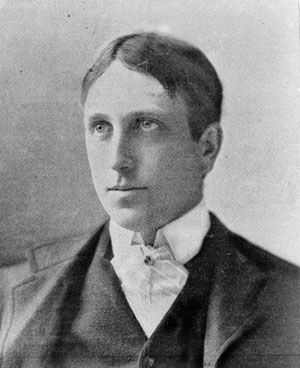
Hearst

Hearst: Denial ignored

What’s more, as I point out in Getting It Wrong, the anecdote lives on despite the absence of supporting documentation: The telegrams that Remington and Hearst supposedly exchanged have never turned up.

Not only that, but the Spanish authorities who controlled incoming and outbound telegraphic traffic in Cuba surely would have intercepted and called attention to such an incendiary message, had it been sent.

The sole original source for the “furnish the war” anecdote was On the Great Highway, a slim volume of reminiscences published in 1901. The author was James Creelman, a portly, cigar-chomping journalist prone to hyperbole and exaggeration.

Creelman did not explain in On the Great Highway how or where he learned about the purported Remingt0n-Hearst exchange.

Nor did he say exactly when the presumed Remington-Hearst exchange took place, writing only that it was “some time before the destruction of the battleship Maine in the harbor of Havana” in mid-February 1898. The only time Remington was in Cuba before the explosion that destroyed the Maine was in January 1897, on assignment for Hearst’s flamboyant New York Journal to draw sketches of the Cuban rebellion against Spain’s colonial rule.

The rebellion was the antecedent to the Spanish-American War of 1898.

The timing of Remington’s trip to Cuba in early 1897 further undercuts the “furnish the war” anecdote: It presents an irreconcilable internal inconsistency, as it would have been absurd for Hearst to have vowed to “furnish the war” because war — specifically, the Cuban rebellion  — was the very reason he sent Remington to Cuba in the first place.

As Keillor’s podcast suggests, the “furnish the war” anecdote is a delicious tale, easy to retell, and easy to believe. Like nearly all media myths, it resides on the cusp of plausibility; it corresponds well to the superficial and misleading image of Hearst as war-monger, as the unscrupulous newspaper publisher who fomented the Spanish-American War.

And that, too, is a tenacious media-driven myth.

WJC

More from Media Myth Alert:

Celebrities pushing media myths: Cavett’s turn in NYTimes

In Cronkite Moment, Debunking, Error, Media myths, New York Times, Quotes, Scandal, Washington Post, Watergate myth on April 27, 2015 at 6:46 am

It’s striking how prominent politicians, entertainers, and celebrities contribute to the recycling and, thus, the solidifying of media-driven myths, those hoary and exaggerated tales that often tell of magnificent deeds by journalists.

During his vice presidency, gaffe-prone Joe Biden went to Moscow and repeated the heroic-journalist trope of Watergate, about how, in his words, “it was a newspaper, not the FBI, or the Justice Department, it was a newspaper, the Washington Post that brought down a President for illegal actions.”

DickCavett

Cavett: Pushing the Cronkite myth

He was referring to the resignation of President Richard M. Nixon in August 1974.

The claim is absurd, but it has resonance across the political spectrum. Last year, for example, Rush Limbaugh, the voluble conservative talk-radio host, indulged in the heroic-journalist myth, declaring on his show last year that Bob Woodward’s Watergate reporting for the Washington Post “destroyed the Nixon presidency.”

That’s an interpretation not even Woodward embraces. He once told an interviewer: “To say the press brought down Nixon, that’s horse shit.”

Now comes Dick Cavett, the former television talk show host, who in a shrill and shallow commentary posted recently at the New York Times online site, recycles the media myth of the “Cronkite Moment” of 1968, when an analysis of the CBS News anchorman about the Vietnam War supposedly brought an epiphany to President Lyndon B. Johnson.

Cavett writes in what is a sneering and superficial assessment of the Vietnam conflict:

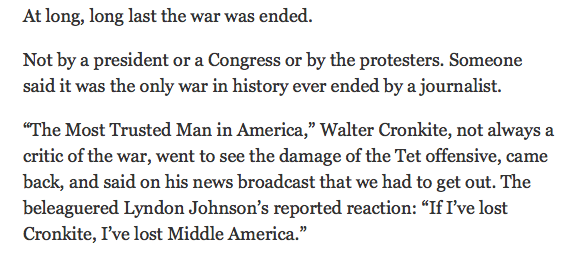
“At long, long last the war was ended.

“Not by a president or a Congress or by the protesters. Someone said it was the only war in history ever ended by a journalist.

“‘The Most Trusted Man in America,’ Walter Cronkite, not always a critic of the war, went to see the damage of the Tet offensive, came back, and said on his news broadcast that we had to get out. The beleaguered Lyndon Johnson’s reported reaction: ‘If I’ve lost Cronkite, I’ve lost Middle America.'”

Cavett commentary_NYT

From Cavett’s commentary

So let’s unpack that bundle of myth and exaggeration.

The reference to “only war in history ever ended by a journalist” sounds much like David Halberstam’s hyperbolic and unsourced claim in his book, The Powers That Be, that Cronkite’s analysis about Vietnam “was the first time in history a war had been declared over by an anchorman.”

Moreover, the notion that Cronkite reigned as America’s “most trusted man” rests more on advertising by CBS News, his employer, than on persuasive empirical evidence such as representative survey samples.

As for Cavett’s claim that Cronkite “said on his news broadcast that we had to get out” — well, that’s not what Cronkite said.

The claim refers to Cronkite’s special report about Vietnam, which CBS aired on February 27, 1968. At the close of the program, Cronkite said the U.S. war effort in Vietnam was “mired in stalemate” and that negotiations might prove to be a way out.

It was hardly a call for withdrawal.

Johnson in Texas, February 27, 1968

Johnson with Connolly: Not watching Cronkite

It was in fact a tepid reiteration of the thinking prevalent in the news media at the time: The war was stalemated. The New York Times had been saying as much periodically for months.

Finally, there’s no compelling evidence that President Lyndon Johnson reacted to Cronkite’s assessment by declaring in a flash of insight:

“If I’ve lost Cronkite, I’ve lost Middle America.”

As I discuss in my media-mythbusting book, Getting It Wrong, Johnson did not see the Cronkite report when it aired, and there is no evidence he saw it on videotape at some later date.

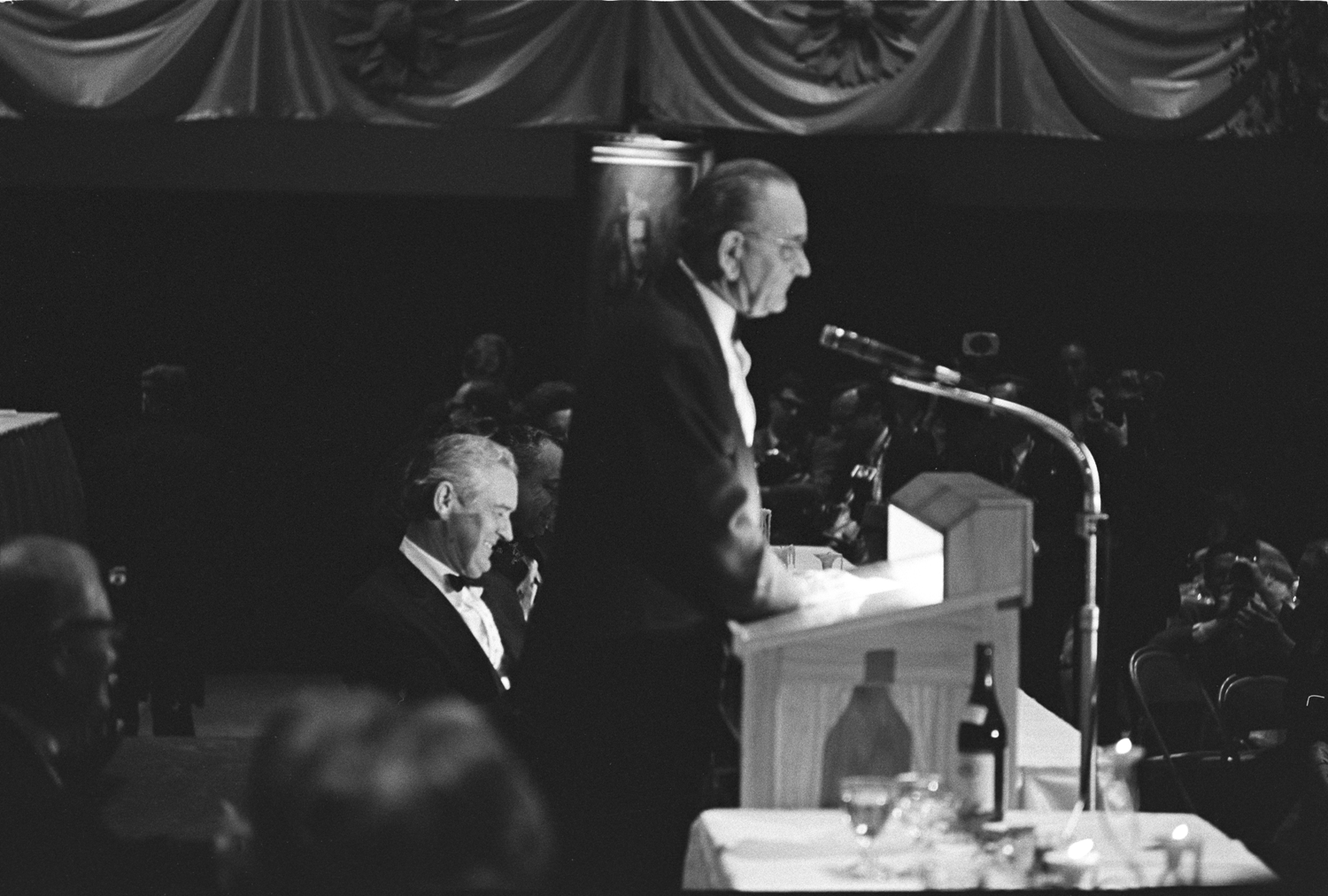
Johnson that night was on the campus of the University of Texas at Austin, attending a black-tie birthday party for his longtime political ally, Texas Governor John Connolly.

About the time Cronkite’s was intoning his tired “mired in stalemate” observation, the president was making light of Connolly’s age.

“Today, you are 51, John,” he said. “That is the magic number that every man of politics prays for—a simple majority.”

WJC

More from Media Myth Alert:

Katharine Graham, the ‘Economist,’ and bringing down Nixon

In Debunking, Error, Media myths, New York Times, Washington Post, Watergate myth on April 16, 2015 at 6:30 pm

With a bit of routine fact-checking, news organizations usually can sidestep the embarrassment of trading in prominent media myths.

But, no: The narrative power of many media myths often makes them too good to check. And so the myth gets retold.

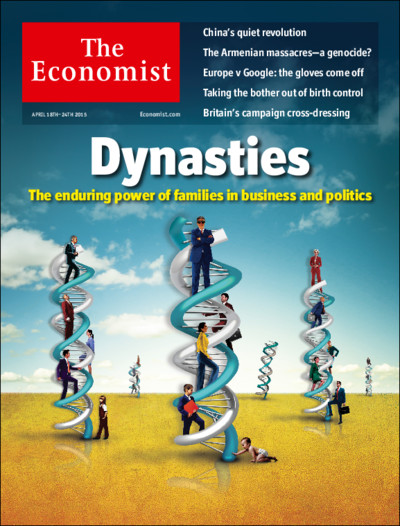
Consider the latest issue of Britain’s Economist newsmagazine. In an extended report about family-run companies, the Economist offers up the simplistic and ever-appealing myth that Richard Nixon’s corrupt presidency was brought low in the 1970s by the Washington Post, then owned by Katharine Graham and family.

Economist cover“Under her iron reign,” the Economist says of Graham, “the Washington Post brought down President Nixon with its investigation into the Watergate break-in and challenged the New York Times for the title of America’s most illustrious newspaper.”

The last claim, about challenging the New York Times, might have been true, for a while. But no more. And there’s no way the Post brought down” Nixon.

Katharine Graham herself said as much, at the 25th anniversary of the break-in in June 1972 of Democratic National Committee headquarters at the Watergate complex in Washington, D.C., the scandal’s seminal crime.

Speaking at an event in suburban Virginia, at the original Newseum (humble predecessor to the $450 million edifice on Pennsylvania Avenue), Graham insisted that the Post had not toppled Nixon.

“Sometimes,” she said, “people accuse us of bringing down a president, which of course we didn’t do. The processes that caused [Nixon’s] resignation were constitutional.”

Graham’s comment is not difficult to track down. It’s in my 2010 mythbusting book, Getting It Wrong, and I have incorporated the quote in many blog posts at Media Myth Alert, including those here, here, here, and here.

Graham was quite right about the processes that forced Nixon’s resignation (he quit in August 1974 in the face of certain impeachment by the U.S. House of Representatives).

And over the years, Graham’s views have been echoed by other principals at the newspaper.

Ben Bradlee, the executive editor during and after the Watergate period, likewise rejected the notion that the Post’s Watergate reporting brought down the president, saying in 1997 that “it must be remembered that Nixon got Nixon. The Post didn’t get Nixon.” (Bradlee was referring to the many hours of White House tapes which Nixon secretly made and which revealed the president’s active role in seeking to block the FBI’s investigation of the seminal crime of Watergate — the break-in at the DNC headquarters.)

Howard Kurtz, formerly the newspaper’s media reporter, wrote in 2005:

“Despite the mythology, The Post didn’t force Richard Nixon from office ….”

And Bob Woodward, one of the newspaper’s lead reporters on Watergate, once told American Journalism Review:

To say the press brought down Nixon, that’s horseshit.”

It is revealing to consider what critical disclosures the Post missed in its Watergate reporting.

It notably did not disclose the White House cover up of the Watergate crimes. It likewise failed to reveal the existence of Nixon’s White House tapes. Indeed, as I noted in Getting It Wrong, the contributions of Woodward and his reporting partner Carl Bernstein to the outcome of Watergate “were modest, and certainly not decisive.”

Far more important, I wrote, were “the collective if not always the coordinated forces of special prosecutors, federal judges, both houses of Congress, the Supreme Court, as well as the Justice Department and the FBI.”

And even then, despite the forces arrayed against him, Nixon probably would have survived Watergate and served out his term as president if not for the tapes — the existence of which was revealed by Alexander Butterfield, a former Nixon aide, before a U.S. Senate select committee in July 1973.

Its latest issue is not the first in which the Economist has indulged in Watergate mythology. In October, shortly after his death, the newsmagazine published a tribute to Bradlee, beneath a headline that read:

“The editor who toppled Nixon.”

That mythical claim appeared in the text of the eulogy as well.

WJC

More from Media Myth Alert: