The Wall Street Journal blog “India Real Time” indulged yesterday in the conventional but mistaken narrative of the Watergate scandal, declaring that the Washington Post “played a pivotal role in effectively bringing down then U.S. President Richard Nixon.”
Effectively brought down Nixon, eh?
Not even the Post buys into that misreading of Watergate history.
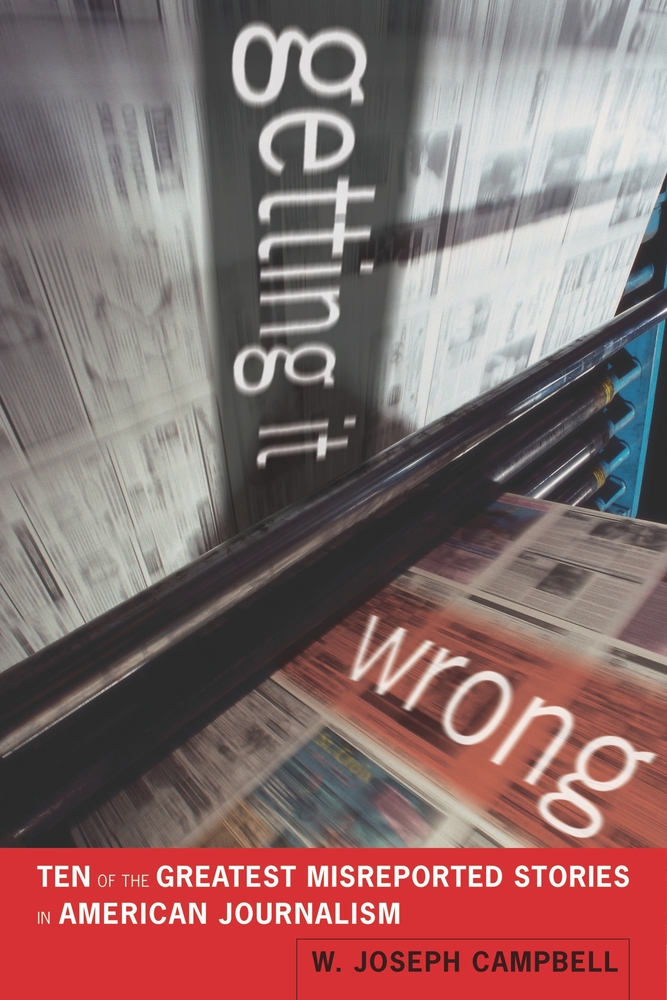 As I note in my latest book, Getting It Wrong, the newspaper’s publisher during and after the Watergate scandal, Katharine Graham, dismissed that interpretation, declaring in 1997:
“Sometimes people accuse us of bringing down a president, which of course we didn’t do. The processes that caused [Nixon’s] resignation were constitutional.”
Similarly, the newspaper’s executive editor during Watergate, Ben Bradlee, has asserted:
“[I]t must be remembered that Nixon got Nixon. The Post didn’t get Nixon.”
Such comments aren’t the manifestation of false modesty. Far from it. Rather, they represent candid observations about the peripheral role the Post played in uncovering the scandal that brought about Nixon’s resignation in 1974.
As I write in Getting It Wrong, rolling up a scandal of the dimension and complexity of Watergate “required the collective if not always the coordinated forces of special prosecutors, federal judges, both houses of Congress, the Supreme Court, as well as the Justice Department and the FBI.
“Even then,” I add, “Nixon likely would have served out his term if not for the audiotape recordings he secretly made of most conversations in the Oval Office of the White House. Only when compelled by the Supreme Court did Nixon surrender those recordings, which captured him plotting the cover-up and authorizing payments of thousands of dollars in hush money.”
Still, the notion that the Post was vital to the outcome of Watergate, that the newspaper “effectively” brought down a president, is the stuff of legend. It’s a powerful media-driven myth that offers a simplistic and misleading interpretation of the country’s greatest political scandal.
 Watergate was among the media myths I discussed last night in a book talk at Kensington Row Bookshop in Kensington, MD.
I noted in my talk: “Obstruction of justice — not the Washington Post — is what cost Nixon his presidency.”
I also spoke about the mythical “Cronkite Moment” of 1968 and the NewYork Times-Bay of Pigs suppression myth of 1961.
The “Cronkite Moment” is shorthand for the dubious notion that the on-air assessment of CBS News anchorman Walter Cronkite forced President Lyndon Johnson to alter policy on Vietnam.
In a special report that aired February 27, 1968, Cronkite declared that the U.S. military effort in Vietnam was “mired in stalemate” and suggested that negotiations would prove to be the way out of the morass.
Johnson supposedly was at the White House that night, watching Cronkite’s show. Upon hearing the “mired in stalemate” assessment, the president supposedly snapped off the television set and said to an aide or aides:
“If I’ve lost Cronkite, I’ve lost Middle America.”
As I said in my talk at the Kensington bookshop, “Acute version variability— the shifting accounts of just what was said — can be a marker of a media-driven myth.”
And so it is with the so-called “Cronkite Moment.”
Johnson did not see the Cronkite program when it aired. The president at the time was in Austin, Texas, offering light-hearted comments at a birthday party for Gov. John Connally, who that day turned 51.
About the time Cronkite was intoning his “mired in stalemate” commentary, Johnson was at the podium at Connally’s birthday party, saying:
“Today, you are 51, John. That is the magic number that every man of politics prays for—a simple majority.”
That line drew laughter from the audience of 25 people at the Kensington bookshop.
The Times-Bay of Pigs suppression myth, I said in my talk, dates almost 50 years — to April 1961, when “a CIA-trained force of Cuban exiles threw themselves on the beaches of southwest Cuba in a futile attempt to turn Fidel Castro from power.”
Supposedly, the Times censored itself about invasion plans several days before the assault took place — at the request of the President John F. Kennedy.
The Times, I said, “did not censor itself. It did not suppress its reporting” about invasion preparations.
“In fact,” I added, “the Times’ accounts of preparations for the invasion were fairly detailed — and prominently displayed on the front page in the days before the Bay of Pigs assault was launched.”
The suppression myth seems to have has its origins in the Cuban Missile Crisis of October 1962 — when the Times, at Kennedy’s request, did hold off publishing a story about the deployment of Soviet nuclear-tipped missiles in Cuba.
On that occasion, I said in my talk, “when the prospect of a nuclear exchange seemed to be in the balance, the Times complied” with the president’s request.
“But no such request,” I added, “was made of the Times in the run-up to the Bay of Pigs invasion of 50 years ago.”
Recent and related
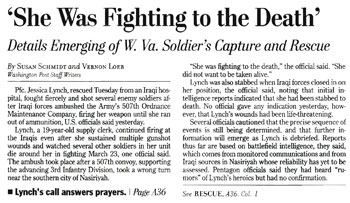
- Recalling the hero of Nasiriyah: It wasn’t Jessica Lynch
- ‘Getting It Wrong’ at Kensington’s Day of the Book
- ‘So to Speak’ about ‘Getting It Wrong’
- Watergate and its hardy myths
- Fact-checking Watergate advice that ‘worked’
- Talking ethics and the ‘golden days’ of Watergate
- The Watergate myth: Why debunking matters
- Knocking down the ‘Cronkite Moment’
- Talking media myths at the alma mater
- SRO for ‘Getting It Wrong’ talk at UMd
- ‘Getting It Wrong’ goes Majic







 Media Myth Alert
1897, Commentary, Debunking, Fact-checking, Hearst, History, Insults, Journalism, Media, New journalism, New York Press, News, Opinion, Pulitzer, Spanish-American War, Yellow Journalism
‘Yellow journalism’ turns 114
In 1897, Anniversaries, Debunking, Media myths, Newspapers, Spanish-American War, Yellow Journalism on January 30, 2011 at 8:21 amIt is a little-recognized, never-celebrated anniversary in American journalism, granted.
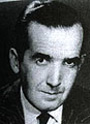
Wardman of the Press
But tomorrow marks 114 years since the term “yellow journalism” first appeared in print, in the old New York Press, edited by the austere Ervin Wardman (left).
The phrase “the Yellow Journalism” appeared in a small headline on the editorial page of the Press on January 31, 1897. The phrase also appeared that day in the newspaper’s editorial page gossip column, “On the Tip of the Tongue.”
“Yellow journalism” quickly caught on, as a sneer to denigrate what then was called the “new journalism” of the New York Journal of William Randolph Hearst and the New York World of Joseph Pulitzer. By the end of March 1897, references to “yellow journalism” had appeared in newspapers in Providence, Richmond, and San Francisco.
In the decades since then, “yellow journalism” has become a widely popular if nebulous term — derisive shorthand for vaguely denouncing sensationalism and journalistic misconduct of all kinds, real and imagined.
“It is,” as I noted in my 2001 book Yellow Journalism: Puncturing the Myths, Defining the Legacies, “an evocative term that has been diffused internationally, in contexts as diverse as Greece and Nigeria, as Israel and India.”
Precisely how Wardman and the Press landed on the phrase “yellow journalism” isn’t clear.
The newspaper’s own, brief discussion of the term’s derivation was unhelpful and unrevealing: “We called them Yellow because they are Yellow,” it said in 1898 about the Journal and the World.
In the 1890s, the color yellow sometimes was associated with decadent literature, which may have been an inspiration to the Harvard-educated Wardman, a figure now largely lost to New York newspaper history.
Wardman was tall and stern-looking. He once was described as showing his “Calvinistic ancestry in every line of his face.” He did little to conceal his contempt for Hearst and Hearst’s journalism.
His disdain was readily apparent in the columns of the Press, of which Wardman became editor in chief in 1896 at the age of 31. (The Press is long defunct; it is not to be confused with the contemporary alternative weekly of the same title.)
Wardman’s Press took to taunting Hearst, Hearst’s mother, and Hearst’s support for Democratic candidate William Jennings Bryan in the 1896 presidential election. The New York Journal was virtually alone among New York newspapers in supporting Bryan’s “free silver” candidacy.
The Press disparaged Hearst, then 34, as a mama’s boy, as “Billy” and “little Willie.” It referred to the Journal as “our silverite, or silver-wrong, contemporary.”
The Press also experimented with pithy blasts on the editorial page to denounce “new journalism.”
“The ‘new journalism,’” the Press said in early January 1897 “continues to think up a varied assortment of new lies.”
Later in the month, the Press asked in a single-line editorial comment:
“Why not call it nude journalism?”
It clearly was a play on “new journalism” and meant to suggest the absence of “even the veneer of decency.”
Before long, Wardman and the Press seized upon the phrase “yellow-kid journalism,” which evoked the Hearst-Pulitzer rivalry over a popular cartoon character known as the “Yellow Kid.”
Both the Journal and the World at the time were publishing versions of the kid.
Yellow kid poster (Library of Congress)
At the end of January 1897, the phrase “yellow-kid journalism” was modified to “the Yellow Journalism,” and the sneer was born.
After landing on that evocative pejorative, Wardman turned to it often, invoking the term in brief editorial comments and asides such as: “The Yellow Journalism is now so overripe that the little insects which light upon it quickly turn yellow, too.”
The diffusion of “yellow journalism” was sealed when the Journal embraced the term in mid-May 1898, during the Spanish-American War. With typical immodesty, the newspaper declared:
“… the sun in heaven is yellow—the sun which is to this earth what the Journal is to American journalism.”
WJC
From an essay originally posted at Media Myth Alert January 31, 2010
Many thanks to Jim Romenesko for linking to this post
Recent and related:
Share this: