W. Joseph Campbell

Archive for the ‘Cronkite Moment’ Category

‘Getting It Wrong’ among 90 titles at NPC Book Fair

In 1897, Cronkite Moment, Debunking, Hurricane Katrina, Media myths, Murrow-McCarthy myth, Newspapers, Washington Post, Watergate myth, Year studies on November 8, 2010 at 11:55 am

I will be among more than 90 authors signing and selling their recent books tomorrow evening at the annual National Press Club Book Fair and Authors’ Night.

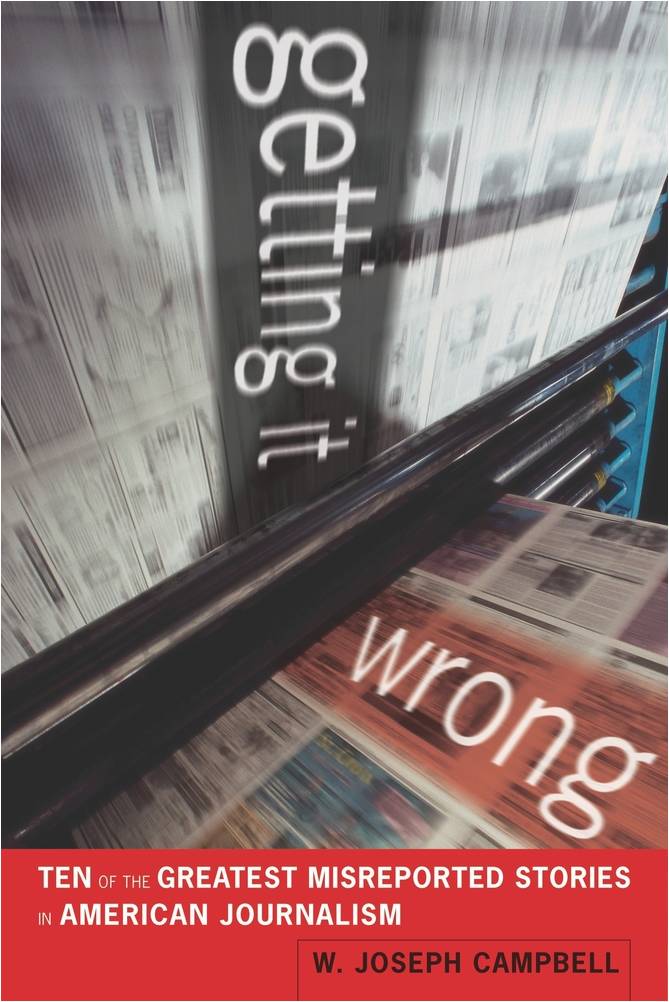
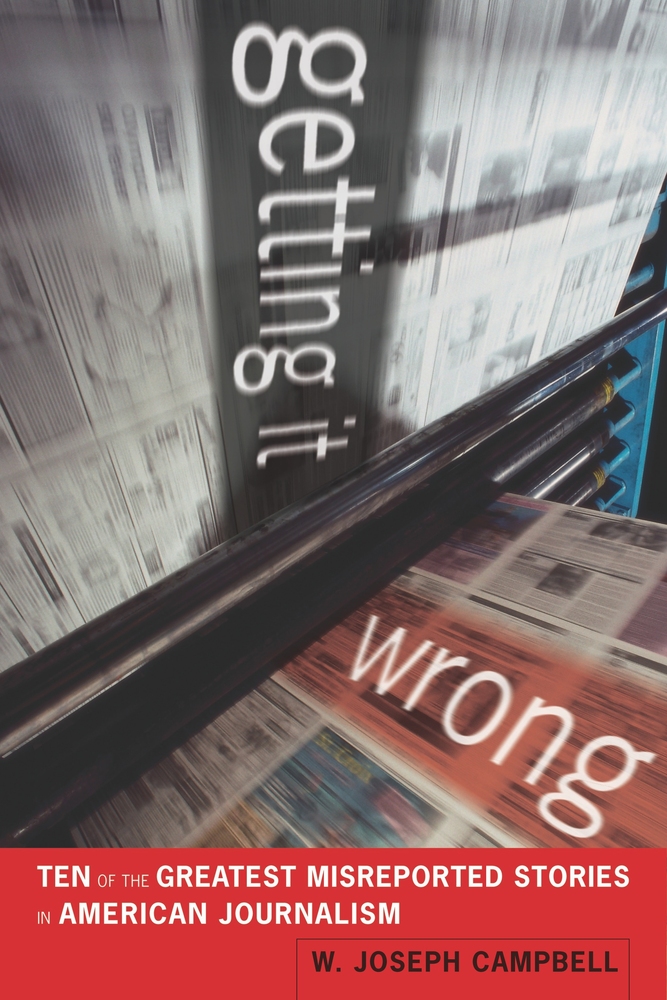
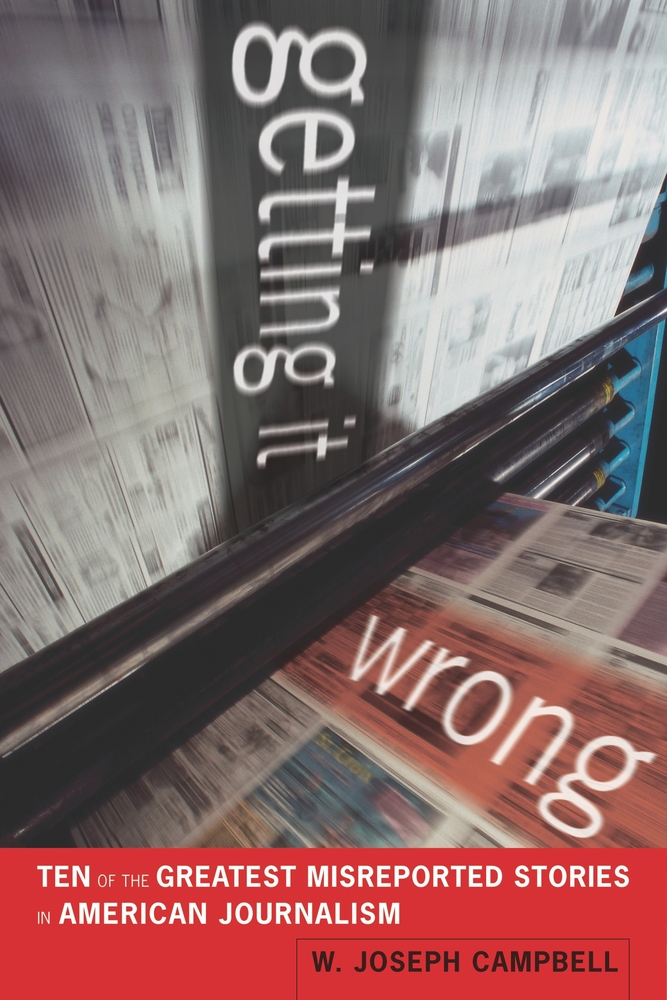
My latest book, Getting It Wrong, will be among the titles at the Press Club event.

The book fair this year brings together a variety of authors, including one of my favorite journalism historians, Maurine Beasley of the University of Maryland; Jack Fuller, author of What Is Happening To News, and Chesley (“Sully”) Sullenberger, the pilot who safely landed a stricken passenger airliner on the Hudson River in January 2009.

The Book Fair is a fine occasion. I attended the event in 2006 and had a great time. My book at that event was The Year That Defined American Journalism: 1897 and the Clash of Paradigms.

Getting It Wrong, which came out during the summer, addresses and debunks 10 prominent media-driven myths. These are stories about and/or by the news media that widely believed and often retold but which, under scrutiny, dissolve as apocryphal or wildly exaggerated.

I liken them to the “junk food” of journalism–delicious and appealing, perhaps, but not terribly healthy or nutritious.

The myths debunked in Getting It Wrong include some of the most cherished stories American journalism tells about itself, including:

“Because it takes on some of the most treasured stories in American journalism,” I write in the introduction to Getting It Wrong, the book “is a work with a provocative edge. It could not be otherwise.”

I further write that Getting It Wrong “aligns itself with a central objective of newsgathering—that of seeking to get it right, of setting straight the record by offering searching reappraisals of some of the best-known stories journalism tells about itself.

“Given that truth-seeking is such a widely shared and animating value in American journalism,” I add, “it is a bit odd that so little effort has been made over the years to revisit, scrutinize, and verify these stories. But then, journalism seldom is seriously introspective, or very mindful of its history. It usually proceeds with little more than a nod to its past.”

I point out that media myths take hold for a variety of reasons: Because they delicious stories that are almost too good not to be true; because they are reductive in offering simplistic interpretations of complex historical events, and because they are self-flattering in that they place journalists at the decisive center of important developments.

The Book Fair opens at 5:30 p.m. Admission is free for members, and $5 for non-members.

WJC

Recent and related:

LBJ ‘changed Vietnam policy based on Cronkite’s views’? Hardly

In Cronkite Moment, Debunking, Media myths on November 7, 2010 at 10:16 am

Cronkite in Vietnam, 1968

The presumptive “Cronkite Moment” is one of American journalism’s most memorable occasions. It was a time, supposedly, when a leading media figure offered analysis so penetrating and revealing that it altered U.S. foreign policy.

That notion was reiterated the other day in a commentary posted at the Big Journalism online site. The commentary alluded to the broadcast in February 1968 in which CBS News anchorman Walter Cronkite declared that the U.S. war effort in Vietnam was “mired in stalemate.” President Lyndon Johnson supposedly saw the Cronkite report and, upon hearing the anchorman’s assessment, realized his war policy was a  shambles.

“If I’ve lost Cronkite,” Johnson purportedly declared, “I’ve lost Middle America.”

Another version has the president saying: “If I’ve lost Cronkite, I’ve lost the war.”

In a clear reference to the mythical “Cronkite Moment,” the Big Journalism commentary stated:

“LBJ was afraid of the activist old media when he changed his Vietnam policy based on what Walter Cronkite thought. Nothing could be more sad and pathetic than that and America paid a dear price for Johnson’s fear of the media.”

As I discuss in my latest book, Getting It Wrong, the Cronkite program on Vietnam quite simply did not have the powerful effects so often attributed to it. The “Cronkite Moment” is one hardy media-driven myth.

I further note in Getting It Wrong:

“Scrutiny of the evidence associated with the program reveals that Johnson did not have—could not have had—the abrupt yet resigned reaction that so often has been attributed to him. That’s because Johnson did not see the program when it was aired.”

The president was not in front of a television set when Cronkite’s report on Vietnam aired on the evening of February 27, 1968. He was not at the White House. He was in Austin, Texas, attending the 51st birthday party of a longtime political ally, Governor John Connally.

And about the time Cronkite was intoning his “mired in stalemate” assessment, Johnson wasn’t throwing up his hands in despair over his war policy. He was offering light-hearted banter about Connally’s age, saying:

“Today you are 51, John. That is the magic number that every man of politics prays for—a simple majority. Throughout the years we have worked long and hard—and I might say late—trying to maintain it, too.”

There is no evidence that Johnson ever watched a recording of the Cronkite show. Johnson’s memoir, The Vantage Point, is silent about the program, offering no clue as to whether he ever saw it or, if he did, what he thought of it.

In any case, the power of the reputed “Cronkite Moment” lies “in the sudden, unexpected, and decisive effect it supposedly had on the president,” I note in Getting It Wrong. “Such an effect would have been absent, or greatly diminished, had Johnson had seen the program on videotape at some later date.”

I also write:

“Even if he had seen Cronkite’s program on videotape, Johnson gave no indication of having taken the anchorman’s message to heart.

“Just three days after the program aired, Johnson vowed in remarks at a testimonial dinner in Texas that the United States would ‘not cut and run’ from Vietnam. ‘We’re not going to be Quislings,’ the president said, invoking the surname of a Norwegian politician who helped the Nazis take over his country. ‘And we’re not going to be appeasers.'”

In the immediate aftermath of the Cronkite program, Johnson remained hawkish on the war in Vietnam. He was not moved by a TV show he had not seen.

WJC

Recent and related:

SRO for ‘Getting It Wrong’ talk at UMd

In Anniversaries, Cronkite Moment, Debunking, Furnish the war, Jessica Lynch, Media myths, Media myths and radio, War of the Worlds, Washington Post, Watergate myth on November 5, 2010 at 11:50 am

A terrific audience of journalism students and faculty turned out last night for my talk at the University of Maryland’s Merrill College of Journalism.

It was standing-room-only at the Knight Hall conference room, where I discussed several chapters in my latest book, Getting It Wrong, which debunks 10 prominent media-driven myths.

I walked through the heroic-journalist myth of the Watergate scandal that toppled Richard Nixon’s presidency; the mythical  “Cronkite Moment” of 1968 that reputedly shifted U.S. public opinion about the war in Vietnam, and The War of the Worlds radio dramatization of 1938 that supposedly panicked listeners across the United States.

During the Q-and-A period that followed, I touched on the famous vow to “furnish the war” attributed to William Randolph Hearst and on the erroneously reported battlefield heroics of Private Jessica Lynch early in the Iraq War.

An intriguing question from the audience was what message should students take away from a book that identifies as media-driven myths some of the best-known stories in American journalism. The implication was that mythbusting may undercut the regard would-be journalists have for the profession.

I replied by saying that I  don’t consider Getting It Wrong a media-bashing book: Such books are many on the market as it is.

Rather, I said, the mythbusting in Getting It Wrong is aligned with the fundamental objective of American journalism. And that is to get it right, to offer an account that is as accurate as possible.

And it does journalism little good to indulge in tales such as the heroic-journalist myth of Watergate or the mythical “Cronkite Moment” that offer misleading interpretations about the news media and their power.

Debunking media myths, as I write in Getting It Wrong, “can help to place media influence in more coherent context.”

Nor should we worry about students being disappointed that well-known and even cherished stories about American journalism have been exposed as mythical. It shouldn’t be disheartening to learn the news media aren’t necessarily the powerful forces they are often believed to be.

Students can handle it.

Not only that, but mythbusting can offer them useful lessons in the importance of applying skepticism and a critical eye to dominant narratives and received wisdom of American journalism.

Indeed, Professor John Kirch, host and organizer of my talk at Maryland, does just that in presenting these and other tales in his journalism classes. Doing so can become a revealing exercise in critical thinking.

I also was asked about candidate-myths for a prospective sequel to Getting It Wrong.

A strong candidate for such a book, I said, is the myth of viewer-listener disagreement in the first Kennedy-Nixon debate in 1960.

The myth has it that people who watched the debate on television thought that Senator John F. Kennedy won; those who listened on radio thought Vice President Richard Nixon had the better of the exchanges.

The notion of listener-viewer-disagreement was long ago debunked by David L. Vancil and Sue D. Pendell, in an article in Central States Speech Journal. They noted that reports of viewer-listener disagreement typically were anecdotal and the few surveys that hinted at a viewer-listener disconnect were too small and unrepresentative from which to make confident judgments.

But the myth is a hardy one, I noted, and it resurfaced in late September, at the 50th anniversary of the Kennedy-Nixon encounter.

Among the 80 or so people in attendance last night was Jamie McIntyre, former Pentagon correspondent for CNN. Afterward, we compared notes about the misreported Lynch case, which the Washington Post propelled into the public domain with a botched, front-page story in early April 2003.

Recent and related:

‘If I’ve lost Cronkite’–ever-hardy, and illusory

In Cronkite Moment, Debunking, Media myths, Newspapers on November 4, 2010 at 5:15 pm

Few tales in American journalism are as hardy as the mythical “Cronkite Moment,” that occasion in late February 1968 when an on-air commentary by CBS News anchorman Walter Cronkite altered a president’s thinking about the war in Vietnam.

The purported “Cronkite Moment” is so trenchant, so believable and revealing that it lives on as a timeless example of the power of the news media–of how effective they can be as forces for truth-telling.

Problem is, the “Cronkite Moment” is illusory.

As I discuss in my latest book, Getting It Wrong, the anecdote is dubious and improbable on many grounds.

Still, the “Cronkite Moment” made another appearance recently, this time in column posted at the New York edition of examiner.com. The column declared:

“President Lyndon Johnson is reported to have said, referring to diminishing support from pivotal 1960s news anchor Walter Cronkite, ‘If I’ve lost Cronkite, I’ve lost Middle America.'”

The anecdote centers around Cronkite’s special program on the Vietnam War, a show that aired February 27, 1968. Near the end of the report, Cronkite declared the U.S. war effort was “mired in stalemate” and suggested negotiations with the communist North Vietnamese as a way to end the conflict.

At the White House, Johnson supposedly watched the Cronkite program. Upon hearing the anchorman’s assessment, the president supposedly snapped off the television set and told an aide or aides:

“If I’ve lost Cronkite, I’ve lost Middle America.”

Or something to that effect. As I point out in Getting It Wrong, versions vary markedly as to what the president supposedly said. And acute version variability can be a marker of a media-driven myth.

The anecdote’s broader point is that Cronkite was such an honest and trusted figure that his views could sway opinions of thousands of Americans. And with Cronkite having gone wobbly on Vietnam, the Johnson White House supposedly reeled.

But the Cronkite program on Vietnam quite clearly had no such effect.

Johnson didn’t see the show when it aired. He wasn’t in front of a television set; nor was he at the White House.

The president that night was in Austin, Texas, attending the 51st birthday party of a longtime political ally, Governor John Connally.

At about the moment Cronkite was intoning his “mired in stalemate” commentary, Johnson was offering light-hearted banter about Connally and his age.

“Today you are 51, John,” the president told Connally. “That is the magic number that every man of politics prays for—a simple majority. Throughout the years we have worked long and hard—and I might say late—trying to maintain it, too.”

Earlier that day, Johnson has delivered a rousing speech in Dallas, in which he cast America’s role in Vietnam in Churchillian terms.

“There will be blood, sweat and tears shed,” the president declared, adding:  “I do not believe that America will ever buckle” in pursuit of its objectives in Vietnam.

Even if the president did see the Cronkite program, or was told about the show, it is exceedingly difficult to imagine how his mood could have swung so abruptly, from vigorously defending the war effort to throwing up his hands in despair.

But if the “Cronkite Moment” is to be believed, that’s what happened: An abrupt, dramatic, and decisive change of heart occurred within hours of the president’s hawkish speech in Dallas.

And that’s just not likely.

WJC

Recent and related:

Mythical ‘Cronkite Moment’ is ‘believed because it’s believable’

In Cronkite Moment, Debunking, Media myths on November 2, 2010 at 5:15 pm

Johnson and 'Cronkite Moment'

The Wall Street Journal‘s “Best of the Web” online feature yesterday invoked the mythical “Cronkite Moment” of 1968, recalling it as “the oft-told story of President Johnson lamenting, ‘If I’ve lost [Walter] Cronkite, I’ve lost Middle America.'”

Best of the Web,” which is compiled and written by James Taranto, noted that the Cronkite-Johnson anecdote “is almost certainly apocryphal, but it was widely believed because it was believable.”

It’s a telling point: The tale is believed–and is often retold–because it is believable. Like other media-driven myths, the “Cronkite Moment” resides on the cusp of plausibility.

The anecdote tells of Lyndon Johnson’s supposed reaction to Cronkite’s on-air assessment that the U.S. war effort in Vietnam was “mired in stalemate” and that negotiations might prove to be the way out. Johnson reputedly watched the program at the White House and, upon hearing Cronkite’s show-ending commentary, leaned over and switched off the television and said to an aide or aides:

“If I’ve lost Cronkite, I’ve lost Middle America.”

Or words to that effect. Versions vary markedly as to what the president supposedly said.

Cronkite’s assessment reputedly was an epiphany to the president, who after the “Cronkite Moment” altered war policy and decided against seeking reelection. In the aftermath of Cronkite’s “mired in stalemate” assessment, American public opinion also swung against the war.

Or so the story has it.

But as I write in my latest book, Getting It Wrong, Cronkite’s report, which aired on CBS on February 27, 1968, had none of those effects–principally because Johnson did not see the show program when it aired.

The president at the time was in Austin, Texas, attending the 51st birthday party of Governor John Connally, a longtime political ally (see photo, above).

There’s no evidence that Johnson later saw the program on videotape, or what he thought of it, if he did see it.

We do know, though, that Johnson was openly hawkish about the war in the days and weeks immediately following Cronkite’s report. As I point out in Getting It Wrong, in mid-March 1968, Johnson gave a rousing, lectern-pounding speech in which he urged a “total national effort” to win the war in Vietnam.

So Johnson was hardly throwing up his hands in despair. That he remained hawkish signals how the “Cronkite Moment” represented no epiphany for the president.

Taranto’s quite right about the anecdote’s being “believed because it was believable.” Although it’s doubtful whether Cronkite ever was “the most trusted” man in America, he was a force in American broadcast journalism in the 1960s and 1970s, a time when network television news mostly was delivered on just three or four channels.

The Cronkite-Johnson story also lives on because it is so readily grasped and easily recalled. As I write in Getting It Wrong, prominent media myths are tenacious because they are reductive–they tend to “minimize or negate complexity in historical events and offer simplistic and misleading interpretations instead.”

The Cronkite-Johnson anecdote is a simplistic tale, but it also affirms the supposed power of the news media in American life. On important issues, the anecdote says, the news media can tell truth to power. They can be vital, even courageous forces in shaping and executing policy.

But all of those powerful effects begin to dissolve when it’s pointed out that Johnson never saw Cronkite’s program in the first place.

WJC

Recent and related:

On Cronkite, Jon Stewart, and ‘the most trusted man’

In Cronkite Moment, Debunking, Media myths, Washington Post on October 31, 2010 at 11:37 am

Jon Stewart, the TV satirist whom the Washington Post calls a founding father of “fake news,” drew tens of thousands of fans to Washington, D.C., yesterday in an enthusiastic rally on the National Mall.

Stewart, TV comedian

Stewart of late also has invited improbable parallels to Walter Cronkite, the former CBS News anchorman who died last year. The Guardian newspaper in London the other day suggested an unlikely Stewart-Cronkite linkage, saying of the star of Comedy Central’s Daily Show:

“To some Americans he is the most trusted man in the US since the iconic news anchor, Walter Cronkite, told the country that the Vietnam war was a lost cause.”

While impressed by the turnout yesterday on the Mall, Media Myth Alert was struck even more by the over-the-top, “most trusted” claim.

For starters, the reference to Cronkite and Vietnam is exaggerated.

Cronkite, TV anchor

Cronkite, in a special report broadcast February 27, 1968, asserted that the U.S. military effort against the communist North Vietnamese was “mired in stalemate“–not that the war was lost. And as I note in my latest book, Getting It Wrong, the “mired in stalemate’ assessment was neither notable nor extraordinary” by that time.

Indeed, nearly seven months before Cronkite’s program, the New York Times reported the war was “not going well” and that victory “may be beyond reach.” The report was published on the Times’ front page in August 1967, beneath the headline:

“Vietnam: The Signs of Stalemate.”

Cronkite’s “mired in stalemate” assessment hardly can be interpreted as an implicit claim that war had become “a lost cause.” Indeed, it’s striking just “how hedged and cautious” Cronkite’s remarks about Vietnam really were, I note in Getting It Wrong.

Cronkite, I write, “held open the possibility that the U.S. military efforts might still force the North Vietnamese to the bargaining table and suggested the U.S. forces be given a few months more to press the fight in Vietnam.”

But back to the Stewart-Cronkite comparisons.

The Guardian asserted that to “some Americans,” the often-sarcastic Stewart “is the most trusted man” in America since Cronkite.

Sounds impressive. But “most trusted” is  quite a dubious and slippery characterization.

Cronkite often was called the “most trusted man” in America. Supporting evidence for such a claim was very vague, however.

As the inestimable Jack Shafer pointed out in a column after Cronkite’s death, the “most trusted” epithet can be traced to an unrepresentative survey conducted in 18 states in 1972. The pollster was Oliver Quayle and Company, which sought to measure public trust among U.S. in politicians who were prominent at the time.

Cronkite was inexplicably included in the Quayle poll, meaning he was compared to the likes of Richard Nixon, Hubert Humphrey, Edmund Muskie,  George McGovern, Edward Kennedy, and Spiro Agnew.

It obviously was a shaky and imprecise measure on which to build the claim of “most trusted.”

Indeed, the following year, the pollster Sindlinger and Company reported survey results showing that John Chancellor, anchorman of NBC’s Nightly News, ran slightly ahead of Cronkite in “trust and accuracy.”

As for Stewart, what’s the evidence’s that he’s now the “most trusted” man in America?

It’s likewise pretty thin.

In August 2008, the New York Times profiled Stewart in an article that carried the headline, “Is Jon Stewart the Most Trusted Man in America?

The profile ran nearly 3,000 words–and nowhere after the headline does the phrase “most trusted” appear.

The Times article quoted Stewart as likening his job to ”throwing spitballs” from the rear of the room and as saying the mandate of his Daily Show program on cable television is to entertain, not inform.

Following Cronkite’s death in July 2009, Time magazine conducted an online poll that suggested Stewart was “trusted” more than any network anchor–easily outdistancing Katie Couric of CBS News, Charlie Gibson of ABC News, and Brian Williams of NBC News.

Time appended a disclaimer to the poll results, noting they were “not scientific and reflect the opinions of only those users who chose to participate.”

In other words, the results were useless for purposes of comparison.

But still, they attracted no small amount of attention.

Perhaps the Fresh Air program on National Public Radio has best taken the measure of Stewart and “trust.”  Fresh Air‘s characterization of the likable comedian?

The Most Trusted Name in Fake News.”

WJC

Recent and Related:

Sniffing out media myths

In Cronkite Moment, Debunking, Furnish the war, Media myths, Washington Post, Watergate myth on October 17, 2010 at 8:19 am

I had a fine interview about Getting It Wrong the other day with Eric Deggans of the St. Petersburg Times, the fruits of which appear in his column today.

He writes that Getting It Wrong, my latest book, “picks apart some of journalism’s key moments, from the notion that Bob Woodward and Carl Bernstein’s Watergate reporting brought down Richard Nixon’s White House (action by the FBI, U.S. Congress and Supreme Court actually did that), to the myth of babies born to crack-addicted moms swamping the country and the idea that CBS anchorman Walter Cronkite turned public opinion on the Vietnam War with a single critical broadcast (public opinion had been souring on the war for months).”

Deggans cleverly structured the column as a series of “clues to spot myths in the making.”

Tip-offs mentioned in his column are:

  • Myths can seem too good to be true.
  • Myths tend to support the notion of media power.
  • Myths simplify complex issues and historical events.

Those factors certainly do characterize media-driven myths, which are prominent stories about and/or by the news media that are widely believed and often retold but which, under scrutiny, dissolve as apocryphal or wildly exaggerated. Media myths can be thought of as the junk food of journalism–tasty and alluring, perhaps, but not terribly nutritious or healthy.

The media myths addressed and debunked in Getting It Wrong include some of American journalism’s best-known stories. “Most of them are savory tales,” I write in the book. “And at least some of them seem almost too good to be false.”

Media myths, I point out in Getting It Wrong, do “tend to distort understanding about the role and function of journalism in American society, conferring on the news media far more power and influence than they necessarily wield.”

They are media-centric. Self-flattering.

As I further write in Getting It Wrong:

“Media myths often emerge from an eagerness to find influence and lasting significance in what journalists do and tend to extend credit where credit is not entirely due.”

What I call the heroic-journalist myth of Watergate is an example of such hero-seeking.

The myth has it that the investigative reporting of Woodward and Bernstein in the Washington Post brought down Nixon’s corrupt presidency.

“In reality,” I write in Getting It Wrong, “the Post and other news organizations were marginal factors in unraveling the Watergate scandal. Nixon’s fall was the consequence of his criminal conduct, which was exposed in the convergence of many forces, newspaper reporting being among the least decisive.”

And yet the Watergate myth lives on, as an example of the news media exerting power in an effective and beneficial manner.

Media myths also endure, I write, because they tend to be reductive. That is,  they simplify, they “offer unambiguous, easily remembered explanations about complex historic events.”

It is, after all, far easier to place Woodward and Bernstein at the center of unraveling Watergate than it is to grapple with and understand the sprawling complexity of the scandal.

Media myths also invite indulgence in the “golden age fallacy,” a flawed but enticing belief that there really was a time when journalism and its practitioners were respected and inspiring—the time, say, of Woodward and Bernstein.

Interestingly, Woodward has scoffed at the notion that he and Bernstein took down Nixon. Woodward said in an interview in 2005:

“To say that the press brought down Nixon, that’s horseshit.”

To the list of tip-offs that Deggans discusses, I would add: “Myths often fail the sniff test.” Tales that are quite neat and tidy do tend to emit a whiff of phoniness.

Pithy quotes such as William Randolph Hearst’s vow to “furnish the war” with Spain fail the sniff test. They invite suspicion because they seem almost too perfect, too neat and tidy.

Hearst’s famous vow is examined in Chapter One in Getting It Wrong.

In closing, I note another newspaper reference to Getting It Wrong.

Leo Morris, editorial page editor at the News-Sentinel in Fort Wayne, Indiana, wrote the other day that he the book “sounded so intriguing” that he was prompted to download its Kindle edition.

Morris’ brief piece carried the headline: “Journalism’s mythtakes.”

Clever. “Mythtakes.” I like it.

WJC

Recent and related:

‘Getting It Wrong’ goes on ‘PJM Political’

In Cronkite Moment, Debunking, Furnish the war, Hurricane Katrina, Media myths on October 10, 2010 at 10:24 am

I had a fine interview recently with Silicon Valley blogger Ed Driscoll for the Pajamas Media radio show, PJM Political.

The interview aired yesterday on Sirus-XM radio’s POTUS channel.

Topic: My new book, Getting It Wrong, which debunks 10 prominent media-driven myths, those dubious and improbable tales about the news media that masquerade as factual.

Driscoll, who conducts a thoughtful and well-prepared interview, led me through a discussion of several myths addressed in Getting It Wrong, including the Cronkite Moment” of 1968.

That was when, supposedly, the on-air analysis of CBS anchorman Walter Cronkite prompted President Lyndon Johnson to change his thinking about the Vietnam War and led him to decide against seeking reelection.

“That’s simply not true,” I pointed out. “Lyndon Johnson didn’t even see the [Cronkite] program when it aired in February 1968. And his decision not to seek reelection was driven by other forces and factors. Cronkite really was irrelevant to that equation, to that decision.

“But yet it lives on, as an example of media power, the media telling truth to power. And it’s a misleading interpretation, it’s a misreading of history.”

Driscoll said that the chapters of Getting It Wrong “have a sort of curious” set of bookends, in that they begin with a discussion of William Randolph Hearst’s famous vow to “furnish the war” with Spain and end with a look at the exaggerated, over-the-top coverage of Hurricane Katrina’s aftermath.

“Was this sort of book-ending intentional?” Driscoll asked.

It was an insightful question–and the first time an interviewer had asked about the book’s conceptual component.

I noted that the “original framework of the book had it organized more thematically, by ‘media and war’ and ‘media and government,'” and so on.

That framework was discarded, I said, “for a more chronological approach. So the bookends were driven more by chronology than anything else.”

We discussed how Orson Welles‘ cinematic masterpiece, Citizen Kane, helped cement the “furnish the war” myth in the public’s consciousness. Kane includes a scene that paraphrases Hearst’s purported vow.

The “furnish-the-war” anecdote about Hearst is dubious in many respects, I said, adding:

“Yet it lives on as an example of Hearst as the war-monger, as an example of the media–at its most malignant, in an extreme–can bring about a war that the country otherwise wouldn’t have fought.”

I mentioned how media-driven myths can be thought of as the “junk food of journalism,” which prompted Driscoll to ask:

What’s wrong with the American people being fed a little junk food? What’s wrong with being fed a few media myths?

There are several reasons, I replied.

Notably, “these myths tend to misrepresent the role of the news media in American society. They tend to grant the news media far more power and far more influence than they really do exert in American life.”

I added:

“Most people believe the media are powerful agents and powerful entities and often refer to some of the myths that I address, and debunk, in Getting It Wrong. They refer to them in support of this mistaken notion.”

In wrapping up the interview, Driscoll referred to Media Myth Alert as “a nifty blog.”

It was a generous plug that was much appreciated.

WJC

Recent and related:

Encore: Sighting the mythical ‘Cronkite Moment’

In Cronkite Moment, Debunking, Media myths, New York Times on September 23, 2010 at 5:43 am

Cronkite in Vietnam

Sighting the “Cronkite Moment” is fairly easy game.

After all, few media-driven myths are invoked as routinely or as matter-of-factly as the legendary occasion when CBS anchorman Walter Cronkite altered U.S. policy with his downbeat, on-air assessment of the war in Vietnam.

The “Cronkite Moment” stems from a special report that aired February 27, 1968. At the end of the half-hour show, Cronkite intoned that the U.S. war effort was “mired in stalemate” and suggested that negotiations might eventually offer a way out for American forces.

The myth–which is debunked in my new book, Getting It Wrong–lies in the purported reaction to Cronkite’s assessment.

At the White House, President Lyndon Johnson supposedly watched the program and, upon hearing the anchorman’s closing remarks, reached over and snapped off the television set, declaring:

“If I’ve lost Cronkite, I’ve lost Middle America.”

Or words to that effect: Versions vary as to what the president purportedly said.

“If I’ve lost Cronkite, I’ve lost Middle America” was the version invoked the other day in a commentary posted at the Daily Caller online site, in a recent sighting of the myth.

The commentary–which discussed former Secretary of State Colin Powell’s recent criticism of President Barack Obama–opened by invoking the “Cronkite Moment,” stating:

“‘If I’ve lost Walter Cronkite, I’ve lost Middle America,’ said President Lyndon B. Johnson at the time of the Communist Tet Offensive in Vietnam in 1968. Walter Cronkite was then the CBS News anchor man, often described as ‘the most trusted man in America.’ Just a few weeks after he said that, LBJ withdrew from his party’s nomination contest.”
But as I note in Getting It Wrong, Johnson did not see the Cronkite program when it aired. Nor was the president at the White House.

He was in Austin, Texas, on the campus of the University of Texas, attending the 51st birthday party of a longtime political ally, Governor John Connally.

About the time Cronkite offered his “mired in stalemate” assessment, Johnson was joking about Connally’s age, saying:

“Today you are 51, John. That is the magic number that every man of politics prays for—a simple majority.”

It wasn’t the most humorous joke ever told by a president. But Johnson clearly wasn’t throwing his hands up in despair about his failed war policy.

He wasn’t lamenting “If I’ve lost Cronkite….”

There is, moreover, no evidence that Johnson later saw the Cronkite program on videotape.

“The power of the ‘Cronkite moment,'” I write in Getting It Wrong, “resides in the sudden, unexpected, and decisive effect it supposedly had on the president:  Such an effect would have been absent, or greatly diminished, had Johnson seen the program on videotape at some later date.”

But even if Johnson later heard—or heard about— Cronkite’s assessment, it represented no epiphany for him.

Not long after the program, Johnson gave a rousing, lectern-pounding speech in which he urged a “total national effort” to win the war in Vietnam. So in the days and even weeks immediately after the Cronkite program, Johnson remained publicly hawkish on the war.

What’s more, Cronkite’s assessment about the U.S. predicament in Vietnam was scarcely original or exceptional in early 1968.

Jack Gould, the New York Times’ television critic, noted in a review of the Cronkite’s program that the anchorman’s assessment “did not contain striking revelations” but served instead “to underscore afresh the limitless difficulties lying ahead and the mounting problems attending United States involvement.”

It’s revealing to note that nearly seven months before the “Cronkite Moment,” the New York Times published on its front page as analysis that said victory in Vietnam “is not close at hand. It may be beyond reach.” The Times analysis was published in August 1967 beneath the headline:

Vietnam: The Signs of Stalemate.”

As for Johnson’s announcing he would not seek reelection, Cronkite’s program was a non-factor in that decision.

Johnson’s announcement came at the end of March 1968, a month after Cronkite’s program–and a couple of weeks after the president’s poor showing as a write-in candidate in the Democratic primary in New Hampshire.

What’s more, there’s strong evidence that Johnson never intended to seek reelection, that he had privately decided in 1967, or even not sooner, against another campaign for the presidency.

<!–[if !mso]> The power of the “Cronkite moment” resides in the sudden, unexpected, and decisive effect it supposedly had on the president:[i] Such an effect would have been absent, or greatly diminished, had Johnson had seen the program on videotape at some later date


[i] See, for example, Jeffrey Lord, who wrote at the American Spectator’s online site: “The effect was almost immediate. In the White House, the President of the United States looked grimly at his television and in a remark that would become famous said, ‘If I’ve lost Cronkite, I’ve lost middle America.’” Lord, “The Limbaugh-Hannity Administration,” American Spectator (3 February 2009), posted at: http://spectator.org/archives/2009/02/03/the-limbaugh-hannity-administr.

‘Exquisitely researched and lively’

In Cronkite Moment, Debunking, Hurricane Katrina, Media myths, Reviews on September 16, 2010 at 9:40 am

That’s the Denver Post‘s take on Getting It Wrong, my new book on media-driven myths which the newspaper recently reviewed.

The Post offers a discerning summary of the book, noting that it “takes a critical look at 10 stories that were either total fabrications or blown way out of proportion and yet became part of our popular culture.”

It also says Getting It Wrong offers “an exquisitely researched and lively look at an industry that too often shines the light on itself more than it does on events and public figures.”

And it notes, quite correctly:

“Much of the ‘wrong’ coverage through the years comes from the media’s self-congratulatory preening.”

The review points out that the sternest criticism in Getting It Wrong is reserved “for coverage, mainly by television, of the chaotic aftermath of Hurricane Katrina in New Orleans in 2005.

“Hyperactive reporters told tales of snipers roaming the streets, ‘hundreds’ of bodies stacked up in the Super Dome and babies being raped and murdered, none of which could be verified.

The upshot of the exaggerated coverage of the storm’s aftermath, the review notes, “was that rescue operations were hindered by fear, and prejudices of a watching public against poor people and minorities were confirmed.”

The review was written by Dick Kreck, a former reporter and columnist for the Post who has written three books. Kreck is an engaging storyteller and the go-to source for details about the lusty history of Denver journalism. (Full disclosure: Kreck spoke at a program at the Denver Post during last month’s convention of the Association for Education in Journalism and Mass Convention. I helped organize the program.)

Kreck opens the review of Getting It Wrong by declaring:

“Memo to media: Get over yourself. You’re not that important.”

He later cites a passage in Getting It Wrong quoting Robert Samuelson, a columnist who writes on economic issues for the Washington Post:

“Because the media are everywhere—and inspire much resentment—their influence is routinely exaggerated. The mistake is confusing visibility with power and the media are often complicit in the confusion. We [in the news media] embrace the mythology, because it flatters our self-importance.”

Getting It Wrong indeed offers a brief for modest media effects.

To bust media myths, I write in the book, “is to confront the reality that the news media are not the powerful agents they, and many others, assume them to be.

“It is exceedingly rare for any news report to trigger a powerful, immediate and decisive reaction akin to President Lyndon Johnson’s purported response to [Walter] Cronkite’s televised assessment about Vietnam: ‘If I’ve lost Cronkite ….’

“Researchers long ago dismissed the notion the news media can create such profound and immediate effects, as if absorbing media messages were akin to receiving potent drugs via a hypodermic needle,” I note, adding:

“Media power tends to be modest, nuanced, diffused, and situational.” And typically trumped by other, more powerful forces and factors.

WJC

Related: